Water Hyundai Terracan 2003 Workshop Manual
[x] Cancel search | Manufacturer: HYUNDAI, Model Year: 2003, Model line: Terracan, Model: Hyundai Terracan 2003Pages: 349, PDF Size: 4.56 MB
Page 287 of 349
DRIVING YOUR HYUNDAI
2- 16 ZC170E1-E
Windscreen Washers & Wipers
The windscreen washer bottle should be filled with a solution of water and a proprietary winterscreen wash additive. The windscreen wipersshould not be used if the blades are frozen tothe windscreen or if they are covered withsnow, before this is removed. NOTE: Never allow undiluted screen washer fluid additive to spill upon the paintwork or useengine coolant anti-freeze since damage tothe paintwork may result.
o When driving in extreme conditions, the windscreen wiper blades may fail to clearthe screen properly due to the formation ofice upon the blade edge. It will therefore benecessary to periodically remove such iceto restore their efficiency.
o If the power operated door mirrors become frozen, attempts to adjust these may dam-age the mechanism.
o The formation of snow or ice build up inside the wheel arches may interfere with theroadwheels or steering mechanism. In suchinstances, unusual noises or an increase insteering effort may result. Therefore, ensurethat the wheelarches are checked periodi-cally and any accumulated snow or ice re-moved.
ZC170B1-E
Electrical System
Winter conditions impose severe demands upon
vehicle electrical systems, particularly the charg-ing circuit. The battery condition and perfor-mance along with the alternator performanceand drive belt condition should be checked priorto the onset of winter.
YC170C1-E
Anti-freeze/Corrosion inhibitor The cooling system must always contain anEthylene-Glycol based anti-freeze solution. Thesystem is filled during manufacture with solu-tion of the correct strength which should bechecked before the onset of winter and adjust-ed or changed as required. NOTE: The anti-freeze solution contains a corro- sion inhibitor to prevent degradation of thealuminium castings contained within theengine. Therefore, never, drain the systemand refill with water only. In addition, anti-freeze solution must ALWAYS be used in vehicles fitted with air conditioning,to prevent the heater matrix from freezing andsubsequently bursting with the refrigeration sys-tem in use. ZC170D1-E
Door Locks
Should the door lock mechanism become fro-zen, a proprietary lock de-icer should be used.Alternatively, warming the door key may thawthe door lock. However, the key should behandled carefully to avoid burning the fingers. Never attempt to thaw a frozen door lock using hot water, since the water will eventually freezeand compound the problem. NOTE: The proper temperature for using the immo-bilizer key is from -40°F to 176°F (-40°C to80°C). If you heat the immobilizer key over176°F to open the frozen lock, it may causedamage to the transponder in its head.
Page 292 of 349
IN CASE OF EMERGENCY
3-2
CAUTION:
Personal injury and damage to the vehicle
may occur if jump starting is not performed correctly. If any doubt exists as to how thisoperation should be performed, seek assis-tance from qualified personnel. WARNING:
Motor vehicle batteries contain sulphuric
acid and emit hydrogen gas. Protective cloth- ing should be worn and care exercised toprevent the acid from coming into contactwith skin or clothing and the vehicle. Nakedlights should not be permitted in the vicinityof the battery. Care should be exercised toprevent sparks occurring during connec-tion. If acid accidentally comes into contactwith skin or eyes, the affected area shouldimmediately be flushed with copious CAUTION: If the jump cable is incorrectly installed, damage to the vehicle electrical system mayoccur, in particular the electronic compo-nents such as the Fuel Injection system
computer and the Automatic Transmissioncomputer. The battery must never be dis-connected whilst the engine is running.
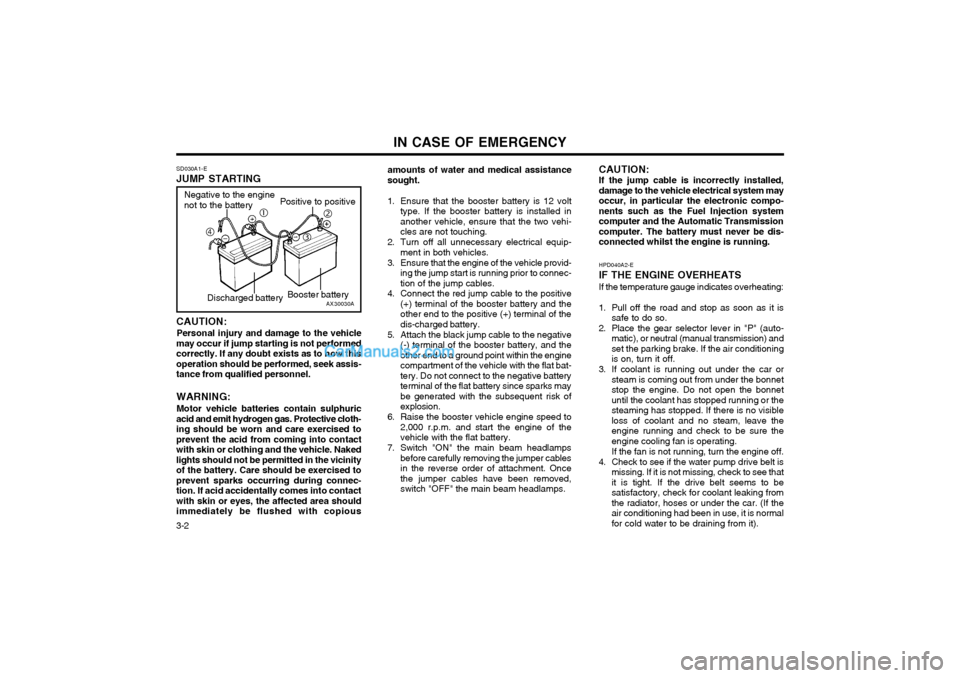
SD030A1-E JUMP STARTING
amounts of water and medical assistance sought.
1. Ensure that the booster battery is 12 volt type. If the booster battery is installed inanother vehicle, ensure that the two vehi-cles are not touching.
2. Turn off all unnecessary electrical equip- ment in both vehicles.
3. Ensure that the engine of the vehicle provid- ing the jump start is running prior to connec-tion of the jump cables.
4. Connect the red jump cable to the positive (+) terminal of the booster battery and theother end to the positive (+) terminal of thedis-charged battery.
5. Attach the black jump cable to the negative (-) terminal of the booster battery, and theother end to a ground point within the enginecompartment of the vehicle with the flat bat-tery. Do not connect to the negative batteryterminal of the flat battery since sparks maybe generated with the subsequent risk ofexplosion.
6. Raise the booster vehicle engine speed to 2,000 r.p.m. and start the engine of thevehicle with the flat battery.
7. Switch "ON" the main beam headlamps before carefully removing the jumper cablesin the reverse order of attachment. Oncethe jumper cables have been removed,switch "OFF" the main beam headlamps. HPD040A2-E IF THE ENGINE OVERHEATS If the temperature gauge indicates overheating:
1. Pull off the road and stop as soon as it is
safe to do so.
2. Place the gear selector lever in "P" (auto- matic), or neutral (manual transmission) and set the parking brake. If the air conditioningis on, turn it off.
3. If coolant is running out under the car or steam is coming out from under the bonnetstop the engine. Do not open the bonnetuntil the coolant has stopped running or thesteaming has stopped. If there is no visibleloss of coolant and no steam, leave theengine running and check to be sure theengine cooling fan is operating. If the fan is not running, turn the engine off.
4. Check to see if the water pump drive belt is missing. If it is not missing, check to see that it is tight. If the drive belt seems to besatisfactory, check for coolant leaking fromthe radiator, hoses or under the car. (If theair conditioning had been in use, it is normalfor cold water to be draining from it).
AX30030A
Negative to the engine not to the battery
Positive to positive
Booster battery
c
e
f d
Discharged battery
Page 293 of 349
IN CASE OF EMERGENCY 3-3
WARNING: Whilst the engine is running, keep hands
and clothing away from moving parts such as the fan and drive belts to prevent injury.
WARNING (Diesel only): Never work on injection system with engine
running or within 30 seconds after shutting off engine. High pressure pump, rail, injec-tors and high pressure pipes are subject tohigh pressure even after the engine stopped.The fuel jet produced by fuel leaks maycause serious injury, if it touch the body.People using pacemakers should not movethan 30cm closer to the ECU or wiring har-ness within the engine room while engine isrunning, since the high currents in the Com-mon Rail system produce considerable mag-netic fields.
5. If the water pump drive belt is broken or coolant is leaking out, stop the engine imme- diately and call the nearest Hyundai dealerfor assistance.
WARNING: Do not remove the radiator cap when the
engine is hot since steam and boiling water may be ejected from the radiator resulting inburns or scalding. YD050A1-E
SPARE TYRE For Full Size
The following instructions for the FULL SIZE
spare tyre should be observed:
Check inflation pressure as soon as possible
after installing the spare tyre, and adjust to the specified pressure. The tyre pressure shouldbe periodically checked and maintained at thespecified pressure whilst the tyre is stored.
Spare Tyre Pressure
Inflation Pressure
Tyre Size
FULL SIZE 29 psi (200 kPa)
6. If the cause of the overheating cannot be
found, wait until the engine temperature has returned to normal. Then, if coolant hasbeen lost, carefully remove the radiator capand add water to bring the fluid level in thereservoir up to the base of the radiator fillopening. Fill the coolant expansion tank tothe halfway mark.
7. Proceed with caution until it is established that the engine is operating normally. If theengine overheats repeatedly, the advice of aHyundai dealer should be sought.
CAUTION: Serious loss of coolant indicates there is a
leak in the cooling system and this should be checked as soon as possible by a Hyundaidealer.
D040B01HP
D040B03HP-EAT
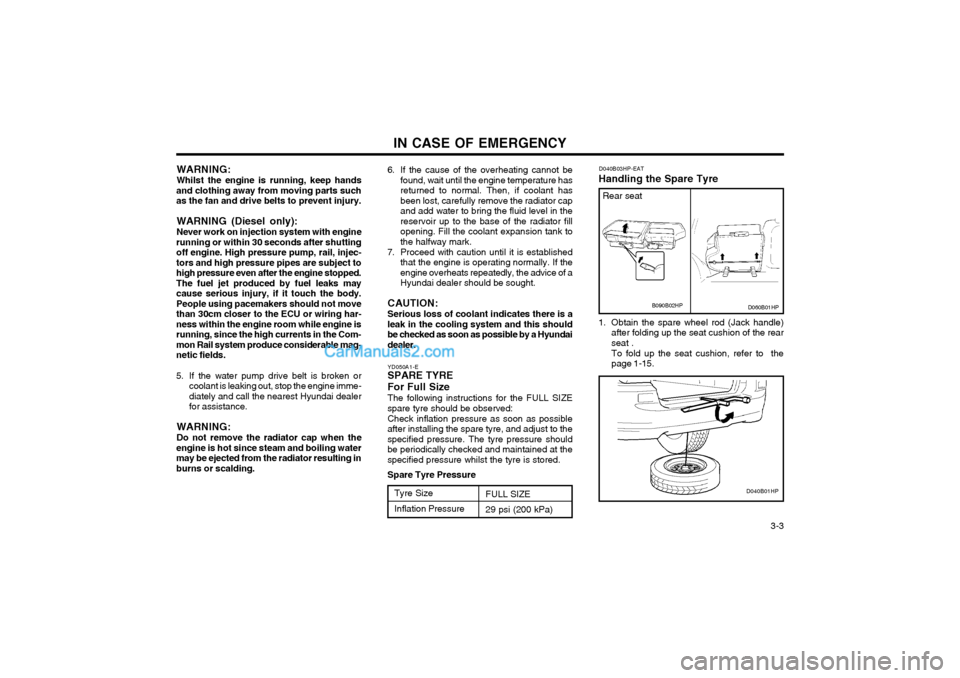
Handling the Spare Tyre
1. Obtain the spare wheel rod (Jack handle) after folding up the seat cushion of the rear seat . To fold up the seat cushion, refer to the page 1-15.
D060B01HPB090B02HP
Rear seat
Page 302 of 349
APPEARANCE CARE 4-1
NOTE: The underbody should never be steam
cleaned since the underbody coating may be removed by this process.
During the interim period between power
washing the underbody, the more vulnera-ble areas such as wheelarches should behosed off, particularly during the winter sea-son to prevent prolonged contact of roadsalt with the body.
Ensure that the various drain points located
at bottom of the door panels are kept clear,to prevent water becoming trapped withinthe cavities. Wherever possible, the parkingof the vehicle in a confined, poorly ventilat-ed location (e.g.) garage should be avoidedwhen the vehicle is wet or covered withsnow or ice. Under these conditions, theinternal cavities of the vehicle will remaindamp for long periods of time which en-courage corrosion. Parking the vehicle wheregood ventilation exists is preferable. JE050A1-E
VALETING
Regular cleaning of the exterior paintwork serves
two important functions. Firstly, the removal ofabrasive dirt and contaminants will maintain thelustre of the paintwork and will preventdiscolouration and dulling due to prolonged con-tact.
Secondly, the presence of damage through
impact or abrasion will be apparent allowingearly rectification to be made thus preventingcorrosion from becoming established andspreading beneath the paint film. To avoid "wa-ter spotting" the vehicle should not be washedin direct sunlight particularly in the case ofvehicles having dark body colours. The heatfrom the sun rays is absorbed by the paint filmincreasing the surface temperature. This actioncauses water used for washing to evaporatequickly leaving behind the deposits from thewater and the shampoo used.
Use only a shampoo intended for the purpose
and ensure that the body work is thoroughlywetted to soften the dirt film prior to attemptingto remove this.
After removing the dirt film with a soft sponge,
the body work should be thoroughly rinsed andthen dried with a good quality chamois leatherto prevent streaking or spotting of the paintwork. Household detergents, solvents and abrasive
cleaning materials should not be used in orderto avoid damaging the paint film.
SE000A1-E
4. APPEARANCE
CARE
ZE020A1-E
APPEARANCE CARE
In using the most advanced design and con-
struction practices, every Hyundai is built to retain its original factory finish for many years.However, long term durability is also greatlydependant upon maintaining the various pro-tection systems and coatings used in manufac-ture since constant exposure to the elementswill eventually result in their breakdown andloss of effectiveness. The following sugges-tions are made to assist in the maintenance ofthe vehicle bodywork.
ZE020B1-E
Underbody Coatings Every Hyundai passenger car receives a full
underbody and cavity injection treatment duringproduction. In order that this treatment mayretain maximum effectiveness, it is recommend-ed that the underbody receives a power washand a thorough inspection after each winterseason. In doing so any accumulations of mud,which act as moisture traps and combine withroad salts to accelerate corrosion, will be re-moved. Should any damage to or deteriorationof the underbody coating be apparent, the ad-vice of a Hyundai dealer regarding the use of acompatible repair material should be sought. ZE020C1-E
Interior During the winter period, it is possible that the
carpet within the passenger compartment maybecome wet. The carpet should not be allowedto remain in this condition for prolonged periodssince the carpet may begin to create mustysmells and promote internal corrosion of thefloorpan.
4
Page 303 of 349
APPEARANCE CARE
4-2 JE070A1-E
POLISHING
The exterior paint work should be polished with
a proprietary wax polish when water no longer collects in bead form on the paint work. Theinstructions of the product manufacturer shouldbe adhered to. JE120A1-E
WINDOWS A proprietary glass cleaner should be used toclean the inside of the windows. However, therear heated windscreen must only be cleanedusing a light horizontal cleaning action. Careshould be exercised to avoid the use of abra-sive cleaners or contact with items of jewellerywhich may damage the heating elements.
Plastic wheel covers should be cleaned using a
sponge and water. Cast alloy wheels should becleaned using a mild soap or neutral detergent.Abrasive compounds must not be used since inthe event of these damaging the lacquer coat-ing, oxidisation of the aluminium wheel willoccur, spoiling the appearance.
The use of a toothbrush will facilitate cleaning
between the wheel "spokes". and ensure that accidental spillages are imme-diately flushed with water.
Do not use abrasive cleaning materials whichmay damage the bumpers.Avoid subjecting the bumpers to high tempera-tures such as may be encountered in high bakepaint ovens. JE110A1-E
INTERIOR VALETING
The soft trim and carpets should be maintainedwith the regular use of a vacuum cleaner. Heavysoiling should be removed with a dry cleaningagent recommended for this purpose followingthe instructions of the product manufacturer.Paint thinner, solvents or other such cleaningmaterials should not be used since damage tothe upholstery may result.
JE060A1-E
STAIN/SPOT REMOVAL Should tree sap, dead insects or tar prove to be
difficult to remove from the paint film, turpentineor a proprietary paint cutting compound may beused. Ensure that the area to be cleaned is notrubbed intensively to prevent breaking throughthe colour coat and exposing the under coat.
JE080A1-E
BUMPER MAINTENANCE The special material from which the bumpers
are manufactured warrants special attention topreserve the appearance of the bumpers. Avoidcontact with battery electrolyte or brake fluid JE090A1-E
ACCIDENT REPAIRS
In the event of the body work sustaining dam-age, the following points should be noted priorto repairs being undertaken. If body panels are replaced or repaired, anti corrosion treatment must be applied to therepair area. The product used must be compat-ible with those used in manufacture. It is recom-mended that repairs are entrusted to a Hyundaidealer to ensure that replacement parts usedare of the same high quality as those used inmanufacture of the vehicle and that the correctrepair methods and materials will ensure ade-quate levels of corrosion protection and thecontinued validity of the Anti Perforation War-ranty. JE100A1-E
SEAT BELTS
Seat belts should be cleaned only with a mild soap solution. Strong detergents, solvens orbleaches may damage the belt webbing andtherefore reduce the effectiveness of the belt.Belts which display signs of fraying, wear or cutshould be replaced.
Page 304 of 349
APPEARANCE CARE 4-3
YE010A1-E
To Clean Leather Upholstery
(Not all models) In the normal course of use, leather upholstered
surfaces will, like any material, pick-up dust and dirt. This dust and dirt MUST be cleaned off orit may work into the surface of the leather,causing damage.
Fine leather needs care. This care, as with all
fine things, need not be elaborated, but shouldinclude cleaning when necessary. Washingleather thoroughly with soap and water willkeep your leather lustrous, beautiful and ensureyou have many years of wear.
Take a piece of cheese cloth and using any
mild soap and lukewarm water, work up a goodlather. Thoroughly wash the leather. Wipe cleanwith a slightly damp cloth and dry with softcloth. Do this as often as the leather becomessoiled. During tanning operations, sufficient oils are
incorporated through processing that none needbe applied during the life of the leather. Oilapplied to the finished surface will in no wayhelp the leather and may do more harm thangood. Varnished and furniture polishes shouldNEVER be used under any conditions.
Page 309 of 349
VEHICLE MAINTENANCE REQUIREMENTS 5-5
F040A05HP-EAT
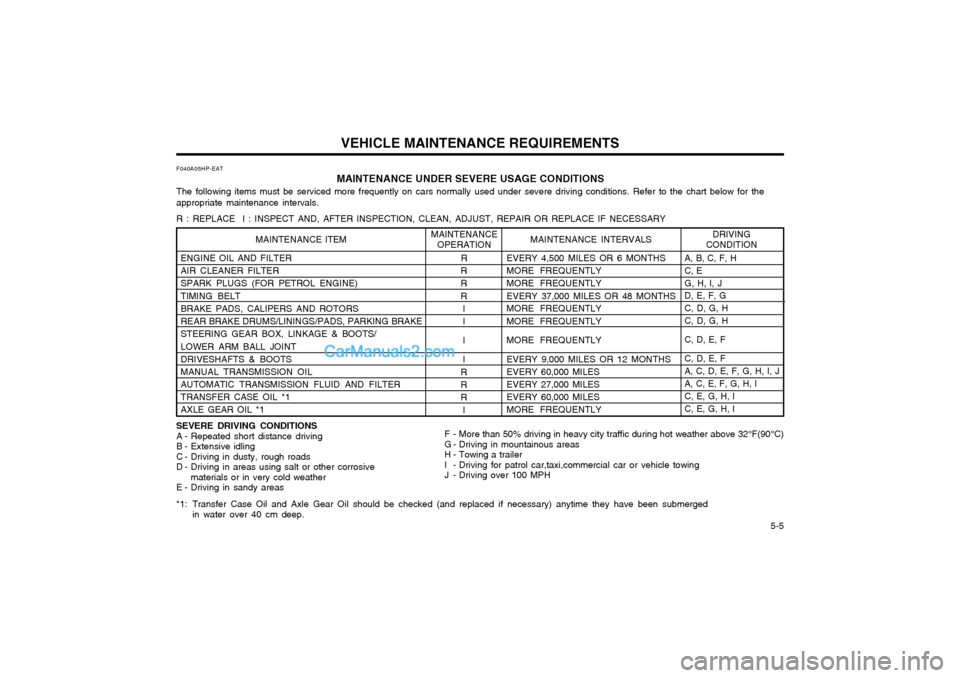
MAINTENANCE UNDER SEVERE USAGE CONDITIONS
The following items must be serviced more frequently on cars normally used under severe driving conditions. Refer to the chart below for the appropriate maintenance intervals. R : REPLACE I : INSPECT AND, AFTER INSPECTION, CLEAN, ADJUST, REPAIR OR REPLACE IF NECESSARY
SEVERE DRIVING CONDITIONS
A - Repeated short distance driving
B - Extensive idling
C - Driving in dusty, rough roads
D - Driving in areas using salt or other corrosive materials or in very cold weather
E - Driving in sandy areas ENGINE OIL AND FILTER AIR CLEANER FILTER SPARK PLUGS (FOR PETROL ENGINE) TIMING BELT BRAKE PADS, CALIPERS AND ROTORS REAR BRAKE DRUMS/LININGS/PADS, PARKING BRAKE STEERING GEAR BOX, LINKAGE & BOOTS/ LOWER ARM BALL JOINT DRIVESHAFTS & BOOTS MANUAL TRANSMISSION OIL AUTOMATIC TRANSMISSION FLUID AND FILTERTRANSFER CASE OIL *1AXLE GEAR OIL *1
EVERY 4,500 MILES OR 6 MONTHS MORE FREQUENTLY MORE FREQUENTLY EVERY 37,000 MILES OR 48 MONTHS MORE FREQUENTLY MORE FREQUENTLY MORE FREQUENTLYEVERY 9,000 MILES OR 12 MONTHS EVERY 60,000 MILESEVERY 27,000 MILESEVERY 60,000 MILES MORE FREQUENTLY
MAINTENANCE
OPERATIONMAINTENANCE ITEM
R
R R R II II
R R R I A, B, C, F, H C, EG, H, I, J D, E, F, G C, D, G, HC, D, G, H C, D, E, FC, D, E, F A, C, D, E, F, G, H, I, JA, C, E, F, G, H, I C, E, G, H, I C, E, G, H, I
MAINTENANCE INTERVALS
DRIVING
CONDITION
F - More than 50% driving in heavy city traffic during hot weather above 32°F(90°C)
G - Driving in mountainous areas
H - Towing a trailer
I - Driving for patrol car,taxi,commercial car or vehicle towing
J - Driving over 100 MPH
*1: Transfer Case Oil and Axle Gear Oil should be checked (and replaced if necessary) anytime they have been submerged in water over 40 cm deep.
Page 318 of 349
OWNER MAINTENANCE
6-6
To replace the oil and filter, proceed as follows:
1. Ensure that the engine is at normal operat- ing temperature and park the vehicle on level ground with the parking brake securelyapplied and the engine turned off.
2. Open the bonnet and remove the oil filler cap.
3. Prepare a suitable receptacle to collect the displaced oil and remove the drain plug fromthe sump.
CAUTION: The oil being drained from the engine will be
hot. Care should be exercised to prevent scalding.
4. When the oil has drained from the sump, replace the drain plug using a new washer ensuring that the plug is not over tightened. Tightening torque is: 3.5 ~ 4.5 kgf.m
5. Remove the oil filter by rotating counter- clockwise, using a proprietary oil filter re- moval tool if necessary. Note that the oilfilter will contain approximately 0.5 litres ofoil and this should be collected in a suitablereceptacle.
6. Install a new oil filter having smeared the sealing ring with clean oil and rotating clock-wise until the filter contacts the mountingand then a further one half turn. Do not over-tighten. Tightening torque: Petrol Engine - 1.2 ~ 1.6 kgf.mDiesel Engine - 2.3 ~ 2.5 kgf.m
7. Pour the specified quantity of the recom- mended oil into the engine and replace the filler cap. Start the engine and ensure thatno oil leaks exist. Turn off the engine andafter a couple minutes, recheck the oil level.
WARNING: Prolonged and repeated contact with used engine oils may result in serious skin disor-ders including dermatitis and cancer. Avoidcontact with skin as far as possible andalways wash thoroughly after any contact.Keep used oils out of reach of children. It isillegal to pollute drains, water courses andsoil. Use only authorized waste collectionfacilities including civic amenity sites andgarages for the disposal of used oil and oilfilters. If in doubt, contact the local authorityfor disposal instructions. SG050A1-E
ENGINE COOLANT CHECKING AND REPLACING
WARNING: Do not remove the radiator cap when the engine is hot, since the system is pressur-ized and coolant may be ejected from theradiator resulting in scalding. SG050B1-E
Coolant recommendations Only ethylene glycol based coolant with a cor- rosion inhibitor suited to aluminium alloy enginecomponents should be used in the coolingsystem. No further additives or inhibitors shouldbe used. The coolant specific gravity should bechecked as prescribed in the maintenanceschedule to ensure adequate frost and corro-sion protection. In addition, the engine coolantmust be replaced at the specified interval sincethe corrosion inhibitor properties deteriorate withtime. It is important to note that whilst an increase in the concentration of anti freeze gives an in-crease in the level of frost protection, a solutionwhich is in excess of 65% anti freeze will resultin reduced frost protection and engine over-heating. Therefore the recommended concen-tration of 50% should not be exceeded forgeneral use.The use of methanol based anti freeze com-pounds may result in engine overheating andwill invalidate the vehicle warranty.
Page 319 of 349
OWNER MAINTENANCE 6-7
NOTE: It is imperative that vehicles fitted with an
air conditioning system have a coolant con- centration of the recommended strength atall times. The use of the air conditioningsystem when the cooling system is filledwith water only will result in the heatermatrix freezing and subsequently bursting.
SG050C1-E
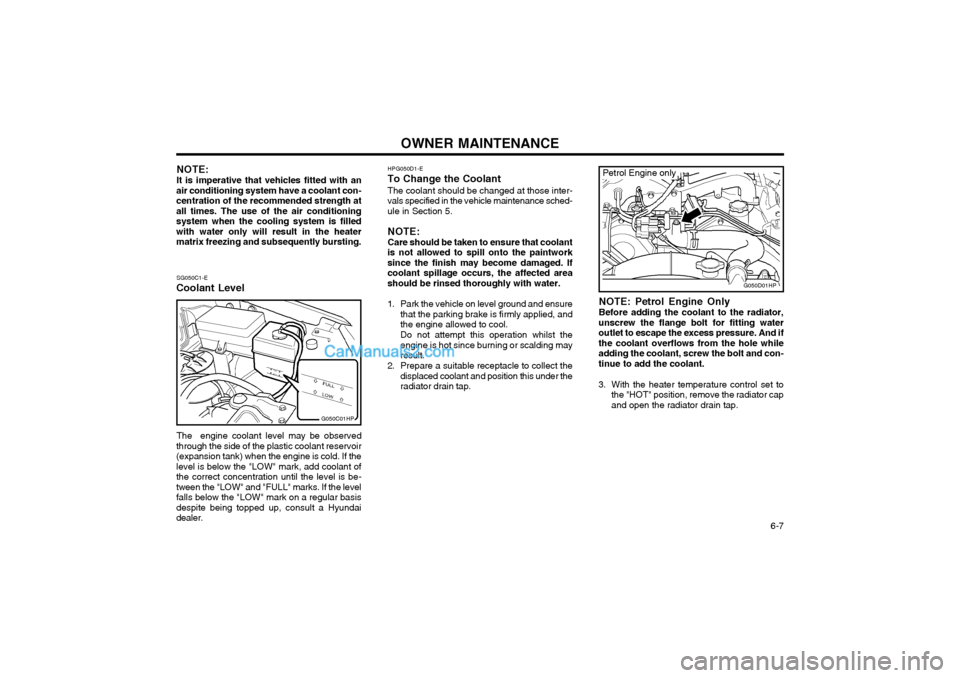
Coolant Level
The engine coolant level may be observed
through the side of the plastic coolant reservoir(expansion tank) when the engine is cold. If thelevel is below the "LOW" mark, add coolant ofthe correct concentration until the level is be-tween the "LOW" and "FULL" marks. If the levelfalls below the "LOW" mark on a regular basisdespite being topped up, consult a Hyundaidealer. HPG050D1-E
To Change the Coolant
The coolant should be changed at those inter-
vals specified in the vehicle maintenance sched-ule in Section 5.
NOTE: Care should be taken to ensure that coolant
is not allowed to spill onto the paintwork since the finish may become damaged. Ifcoolant spillage occurs, the affected areashould be rinsed thoroughly with water.
1. Park the vehicle on level ground and ensure that the parking brake is firmly applied, and the engine allowed to cool. Do not attempt this operation whilst the engine is hot since burning or scalding mayresult.
2. Prepare a suitable receptacle to collect the displaced coolant and position this under theradiator drain tap. NOTE: Petrol Engine Only Before adding the coolant to the radiator,
unscrew the flange bolt for fitting water outlet to escape the excess pressure. And ifthe coolant overflows from the hole whileadding the coolant, screw the bolt and con-tinue to add the coolant.
3. With the heater temperature control set to the "HOT" position, remove the radiator cap and open the radiator drain tap.
G050D01HP
Petrol Engine only
G050C01HP
Page 321 of 349
OWNER MAINTENANCE 6-9
Type
RC10PYPB4 (CHAMPION) PFR5N-11 (NGK)
Remark
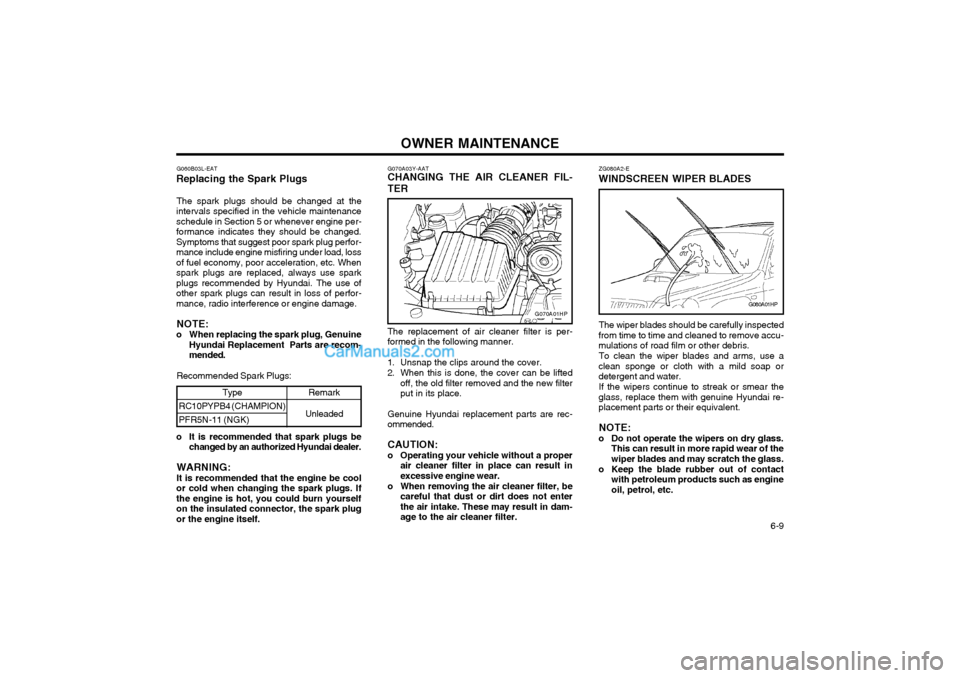
Unleaded G070A03Y-AAT CHANGING THE AIR CLEANER FIL- TER The replacement of air cleaner filter is per- formed in the following manner.
1. Unsnap the clips around the cover.
2. When this is done, the cover can be lifted
off, the old filter removed and the new filter put in its place.
Genuine Hyundai replacement parts are rec-ommended. CAUTION:
o Operating your vehicle without a proper air cleaner filter in place can result in excessive engine wear.
o When removing the air cleaner filter, be careful that dust or dirt does not enterthe air intake. These may result in dam-age to the air cleaner filter.
G070A01HPG080A01HP
ZG080A2-E
WINDSCREEN WIPER BLADES
G060B03L-EAT
Replacing the Spark Plugs
The spark plugs should be changed at the
intervals specified in the vehicle maintenance schedule in Section 5 or whenever engine per-formance indicates they should be changed.Symptoms that suggest poor spark plug perfor-mance include engine misfiring under load, lossof fuel economy, poor acceleration, etc. Whenspark plugs are replaced, always use sparkplugs recommended by Hyundai. The use ofother spark plugs can result in loss of perfor-mance, radio interference or engine damage.
NOTE:
o When replacing the spark plug, Genuine Hyundai Replacement Parts are recom-mended.
Recommended Spark Plugs: The wiper blades should be carefully inspected
from time to time and cleaned to remove accu-mulations of road film or other debris.
To clean the wiper blades and arms, use a
clean sponge or cloth with a mild soap ordetergent and water.
If the wipers continue to streak or smear the
glass, replace them with genuine Hyundai re-placement parts or their equivalent.
NOTE:
o Do not operate the wipers on dry glass. This can result in more rapid wear of thewiper blades and may scratch the glass.
o Keep the blade rubber out of contact with petroleum products such as engineoil, petrol, etc.
o It is recommended that spark plugs be
changed by an authorized Hyundai dealer.
WARNING: It is recommended that the engine be cool
or cold when changing the spark plugs. If the engine is hot, you could burn yourselfon the insulated connector, the spark plugor the engine itself.