Water Hyundai Terracan 2003 Owner's Guide
[x] Cancel search | Manufacturer: HYUNDAI, Model Year: 2003, Model line: Terracan, Model: Hyundai Terracan 2003Pages: 349, PDF Size: 4.56 MB
Page 135 of 349
CORROSION PREVENTION AND APPEARANCE CARE 4-1
4. CORROSION
PREVENTION & APPEARANCECARE E020B01A-AAT Keep Your Car Clean The best way to prevent corrosion is to keep your car clean and free of corrosive materials. Atten- tion to the underside of the car is particularly important.
o If you live in a high-corrosion area — where
road salts are used, near the ocean, areas with industrial pollution, acid rain, etc.—, you should take extra care to prevent corrosion. In winter, hose off the underside of your car at least once a month and be sure to clean the underside thoroughly when winter is over.
o When cleaning underneath the car, give par- ticular attention to the components under the fenders and other areas that are hidden from view. Do a thorough job; just dampening the accumulated mud rather than washing it away will accelerate corrosion rather than prevent it. Water under high pressure and steam are particularly effective in removing accumulat- ed mud and corrosive materials.
o When cleaning lower door panels, rocker
panels and frame members, be sure that drain holes are kept open so that moisture can escape and not be trapped inside to ac- celerate corrosion.
E010A01A-AAT CORROSION PROTECTION Protecting Your Hyundai from Corro- sion By using the most advanced design and con- struction practices to combat corrosion, Hyundai produces cars of the highest quality, However, this is only part of the job. To achieve the long- term corrosion resistance your Hyundai can de- liver, the owner’s cooperation and assistance is also required.
E010C01A-AAT High-Corrosion Areas If you live in an area where your car is regularly exposed to corrosive materials, corrosion pro- tection is particularly important. Some of the common causes of accelerated corrosion are road salts, dust control chemicals, ocean air and industrial pollution.
E010B01A-AAT Common Causes of Corrosion The most common causes of corrosion on your car are:
o Road salt, dirt and moisture that is allowed to accumulate underneath the car.
o Removal of paint or protective coatings by stones, gravel, abrasion or minor scrapes and dents which leave unprotected metal exposed to corrosion. E010D01A-AAT Moisture Breeds Corrosion Moisture creates the conditions in which corro- sion is most likely to occur. For example, corro- sion is accelerated by high humidity, particularly when temperatures are just above freezing. In such conditions, the corrosive material is kept incontact with the car surfaces by moisture that is slow to evaporate. Mud is particularly corrosive because it is slow to dry and holds moisture in contact with the ve- hicle. Although the mud appears to be dry, it can still retain the moisture and promote corrosion. High temperatures can also accelerate corro- sion of parts that are not properly ventilated so the moisture can be dispersed. For all these reasons, it is particularly important to keep your car clean and free of mud or accumulations of other materials. This applies not only to the visible surfaces but particularly to the underside of the car. E020A01A-AAT TO HELP PREVENT CORROSION You can help prevent corrosion from getting started by observing the following:
4
Page 136 of 349
CORROSION PREVENTION AND APPEARANCE CARE
4-2
E020C01A-AAT Keep Your Garage Dry Don’t park your car in a damp, poorly ventilated garage. This creates a favorable environment for corrosion. This is particularly true if you wash your car in the garage or drive it into the garage when it is still wet or covered with snow, ice or mud. Even a heated garage can contribute to corrosion unless it is well ventilated so moisture is dispersed. E020D01A-AAT Keep Paint and Trim in Good Condition Scratches or chips in the finish should be cov- ered with "touch-up" paint as soon as possible to reduce the possibility of corrosion. If bare metal is showing through, the attention of a qualified body and paint shop is recommended. E020E01A-AAT Don’t Neglect the Interior Moisture can collect under the floor mats and carpeting to cause corrosion. Check under the mats periodically to be sure the carpeting is dry. Use particular care if you carry fertilizers, clean- ing materials or chemicals in the car. These should be carried only in proper contain- ers and any spills or leaks should be cleaned up, flushed with clear water and thoroughly dried.
E030A01A-AAT WASHING AND WAXING Washing Your Hyundai Never wash your car when the surface is hot from being in the sun. Always wash your car in the shade. Wash your car frequently. Dirt is abrasive and can scratch the paint if it is not removed. Air pollution or acid rain may damage the paint and trim through chemical action if pollutants are allowed to remain in contact with the surface. If you live near the ocean or in an area where road salts or dust control chemicals are used, you should pay particular attention to the underside of the car. Start by rinsing the car to remove dust and loose dirt. In winter, or if you have driven through mud or muddy water, be sure to thor- oughly clean the underside as well. Use a hard direct stream of water to remove accumulations of mud or corrosive materials. Use a good quality car-washing solution and follow the manufac- turer’s directions on the package. These are available at your Hyundai dealer or auto parts outlet. Don’t use strong household detergents, gasoline, strong solvents or abrasive cleaning powders as these may damage the finish. Use a clean sponge or cloth, rinse it frequently and don’t damage the finish by rubbing too hard. For stubborn spots, dampen them frequently and remove them a little at a time. To clean whitewall tires, use a stiff brush or soapy steel-wool scouring pad.To clean plastic wheel covers, use a clean spongeor soft cloth and water. To clean cast aluminum alloy wheels, use a mild soap or neutral detergent. Do not use abrasive cleaners. Protect the bare-metal surfaces by cleaning, polishing and waxing. Because alumi- num is subject to corrosion, be sure to give aluminum alloy wheels special attention in win- ter. If you drive on salted roads, clean the wheels thoroughly afterwards. After washing, be sure to rinse thoroughly. If soapy water dries on the finish, streaking will result. When the weather is warm and the humidity low, you may find it necessary to rinse each section immediately after washing to avoid streaking. After rinsing, dry the car using a damp chamois or soft, absorbent cloth. The reason for drying the car is to remove water from the car so it will dry without water spots. Don’t rub, this can damage the finish. If you find any nicks or scratches in the paint, use touch-up paint to cover them to prevent corro- sion. To protect the paintwork of the car against corrosion, you must clean your Hyundai (at least once a month). Give special attention to the removal of salt, mud and other substances on the underside of the splashboards of the car. Make sure that the outlets and the underside of the doors are open. Paint damage can be caused by small accumulation of tar, industrial precipita-
Page 137 of 349
CORROSION PREVENTION AND APPEARANCE CARE 4-3
tion, tree resin, insects and bird droppings, when not removed immediately. If water alone is not strong enough to remove the accumulated dirt, use a mild car washing solution. Be sure to rinse the surface after washing to remove the solution. Never allow the solution to dry on the painted surfaces.
E030D01A-AAT When to Wax Again You should polish and wax the car again when water no longer beads on a clean surface but spreads out over a larger area. E030E01A-AAT Maintaining Bumpers Special precautions must be observed to pre- serve the appearance of the bumpers on your Hyundai. They are:
o Be careful not to spill battery electrolyte or
hydraulic brake fluid on the bumpers. If you do, wash it off immediately with clean water.
o Be gentle when cleaning the bumper sur- faces. They are made of soft plastic and the surface can be damaged if mistreated. Do not use abrasive cleaners. Use warm water and mild soap or car-washing solution.
o Do not expose the bumpers to high tem-
peratures. For example, if you have your car repainted, do not leave the bumpers on the car if the car is going to be placed in a high- temperature paint booth.
E040A01A-AAT CLEANING THE INTERIOR To Clean the Vinyl Upholstery To clean the vinyl upholstery, first remove loose dirt and dust with a vacuum cleaner. Then apply a solution of mild soap or detergent and water using a clean sponge or soft cloth. Allow this to stay on the surface to loosen the dirt, then wipe with a clean damp sponge or cloth. If all the dirt stains are not removed, repeat this procedure until the upholstery is clean. Do not use gasoline, solvent, paint thinner or other strong cleaners.
E030B01A-AAT Spot CleaningDon’t use gasoline, strong solvents or corrosive cleaning agents. These can damage the finish of the car. To remove road tar, use turpentine on a clean, soft cloth or commercially available bug and tar remover. Be gentle. To remove dead insects or tree sap, use warm water and mild soap or car-washing solution. Soak the spot and rub gently. If the paint has lost its luster, use a commercial car-cleaning polish. E030C01A-AAT Polishing and Waxing Always wash and dry the car before polishing or waxing or using a combination cleaner and wax. Use a good quality commercial product and follow the manufacturer’s directions on the con- tainer. Polish and wax the bright trim pieces as well as the paint. E040B01A-AAT To Clean the Leather Upholstery (If installed) In the normal course of use, leather upholsteredsurfaces will, like any material, pick-up dust and dirt. This dust and dirt must be cleaned off or it may work into the surface of the leather, causing damage. Fine leather needs care, and should be cleaned when necessary. Washing leather thoroughly with soap and water will keep your leather lus- trous, beautiful and ensure you have many years of wear. Take a piece of cheese cloth and using any mild soap and lukewarm water, work up a good lather. Thoroughly wash the leather. Wipe clean with a slightly damp cloth and dry with soft cloth. Do this as often as the leather becomes soiled. During tanning operations, sufficient oils are in- corporated through processing that none need be applied during the life of the leather. Oil applied to the finished surface will in no way help the leather and may do more harm than good. Varnishes and furniture polishes should never be used under any conditions.
Page 138 of 349
CORROSION PREVENTION AND APPEARANCE CARE
4-4 E040E01A-AAT Cleaning the Windows You may use any household window cleaner on the windows. However, when cleaning the inside of the rear window be careful not to damage the rear window defroster wiring. E050A01A-AAT Any Questions? If you have any questions about the care of your car, consult your Hyundai dealer.
E040D01A-AAT Cleaning the Seat Belts To clean the seat belts, use a cloth or sponge with mild soap or detergent and warm water. Do not use strong detergents, dye, bleach or abra- sive materials on the seat belts as this may weaken the fabric. While cleaning the belts, inspect them for exces- sive wear, cuts, fraying or other signs of damage and replace them if necessary.
E040C01A-AAT Cleaning the Carpets Use a foam-type carpet cleaner. Cleaners of this type are available in aerosol cans in liquid form or powder. Read the instructions and follow them exactly. Using a vacuum cleaner with the appro- priate attachment, remove as much dirt from the carpets as possible. Apply the foam following the manufacturer’s directions, then rub in overlap- ping circles. Do not add water. These cleaners work best when the carpet is kept as dry as possible.
Page 141 of 349
VEHICLE MAINTENANCE REQUIREMENTS 5-3
KILOMETERS X 1000 MONTHS
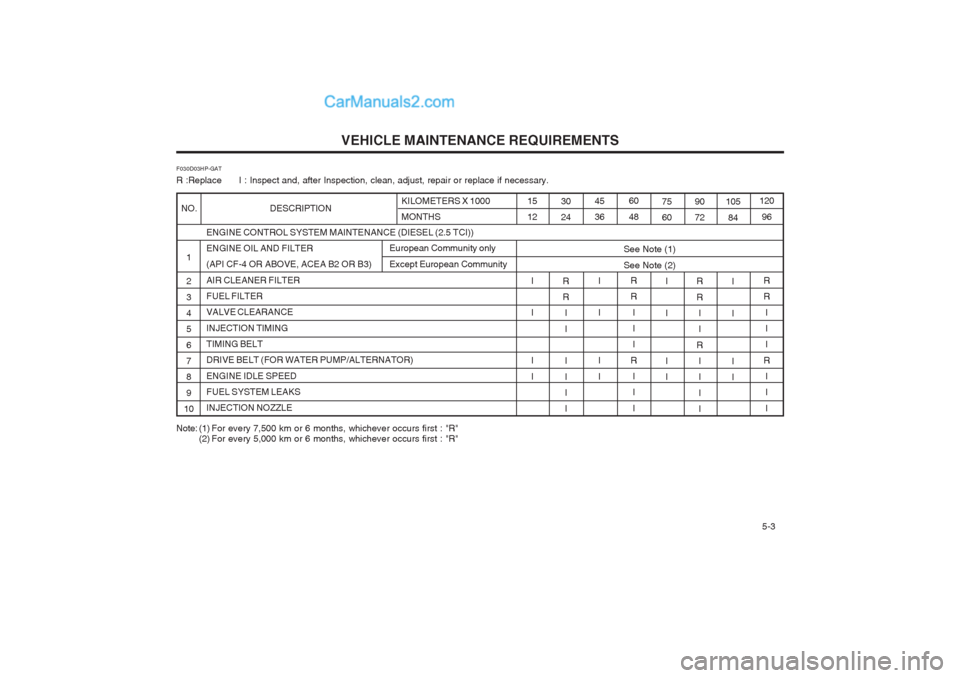
F030D03HP-GAT R :Replace I : Inspect and, after Inspection, clean, adjust, repair or replace if necessary.
ENGINE CONTROL SYSTEM MAINTENANCE (DIESEL (2.5 TCI)) ENGINE OIL AND FILTER(API CF-4 OR ABOVE, ACEA B2 OR B3) AIR CLEANER FILTER FUEL FILTERVALVE CLEARANCE INJECTION TIMING TIMING BELTDRIVE BELT (FOR WATER PUMP/ALTERNATOR) ENGINE IDLE SPEED FUEL SYSTEM LEAKSINJECTION NOZZLE
NO. DESCRIPTION
1 2 3 45 6 78 9
10120
96
R R III
R II I105
84
I I I I90 72R R I I
R II I I75 60
I I I I60 48R R III
R II I45 36
I I I I30 24RR I I I I II15 12
I I I I
See Note (1) See Note (2)
Note: (1) For every 7,500 km or 6 months, whichever occurs first : "R"
(2) For every 5,000 km or 6 months, whichever occurs first : "R"European Community only Except European Community
Page 143 of 349
VEHICLE MAINTENANCE REQUIREMENTS 5-5
I
R I III I III I I I III
R I
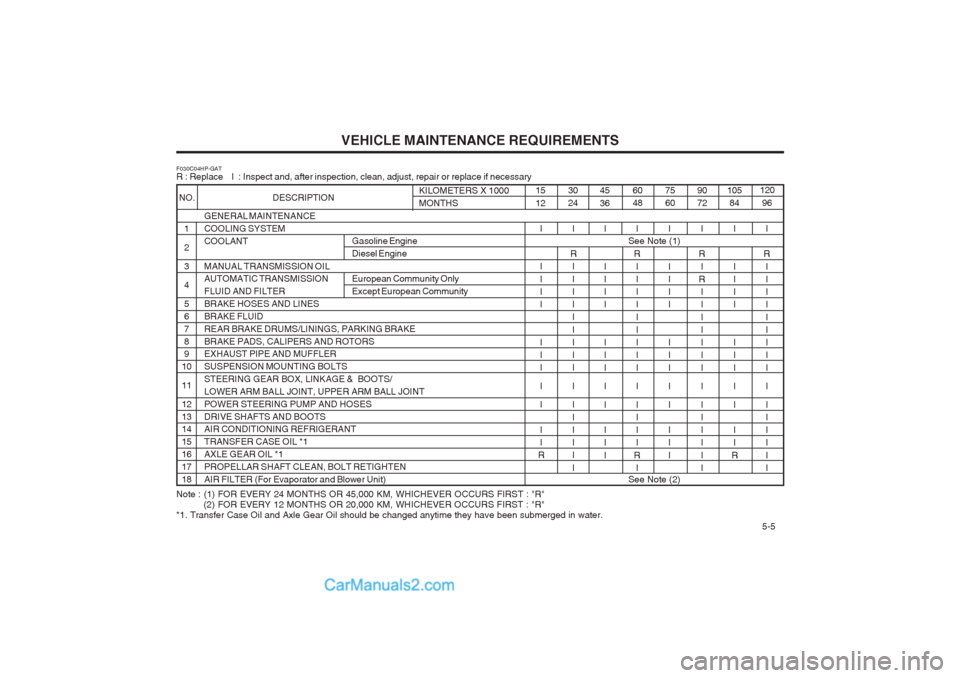
GENERAL MAINTENANCECOOLING SYSTEMCOOLANT MANUAL TRANSMISSION OIL AUTOMATIC TRANSMISSION FLUID AND FILTERBRAKE HOSES AND LINESBRAKE FLUIDREAR BRAKE DRUMS/LININGS, PARKING BRAKEBRAKE PADS, CALIPERS AND ROTORS EXHAUST PIPE AND MUFFLER SUSPENSION MOUNTING BOLTSSTEERING GEAR BOX, LINKAGE & BOOTS/LOWER ARM BALL JOINT, UPPER ARM BALL JOINTPOWER STEERING PUMP AND HOSESDRIVE SHAFTS AND BOOTS AIR CONDITIONING REFRIGERANT TRANSFER CASE OIL *1AXLE GEAR OIL *1PROPELLAR SHAFT CLEAN, BOLT RETIGHTENAIR FILTER (For Evaporator and Blower Unit)
1 23 4 5 678 9
10 1112 13 14 15161718
F030C04HP-GAT R : Replace I : Inspect and, after inspection, clean, adjust, repair or replace if necessary
Note : (1) FOR EVERY 24 MONTHS OR 45,000 KM, WHICHEVER OCCURS FIRST : "R"
(2) FOR EVERY 12 MONTHS OR 20,000 KM, WHICHEVER OCCURS FIRST : "R"
*1. Transfer Case Oil and Axle Gear Oil should be changed anytime they have been submerged in water.
NO. DESCRIPTION
I
R I III I III I I I III I I15 12 30 24
45 36 60 48
75609072105
84 120
96KILOMETERS X 1000 MONTHS
I
R I I III I III I I I III I I I III I I I I I I I I
I I I II I II I I I I
R I I III I I I I I I I II
R I
R
I I I III I I I III I I I I III I I I I I I I
R
European Community Only Except European Community
See Note (1)Gasoline Engine Diesel Engine
See Note (2)
Page 154 of 349
DO-IT-YOURSELF MAINTENANCE
6-8
G050B01A-DAT Recommended Engine Coolant
35% 65%
40% 60%
50% 50%
60% 40%
Ambient
temperature °C ( °F)-15 (5)
-25 (-13) -35 (-31)-45 (-49)
Antifreeze solution Water
Engine Coolant concentration
G050B01HP
G050C01A-AAT
To Check the Coolant Level
G050C01HP
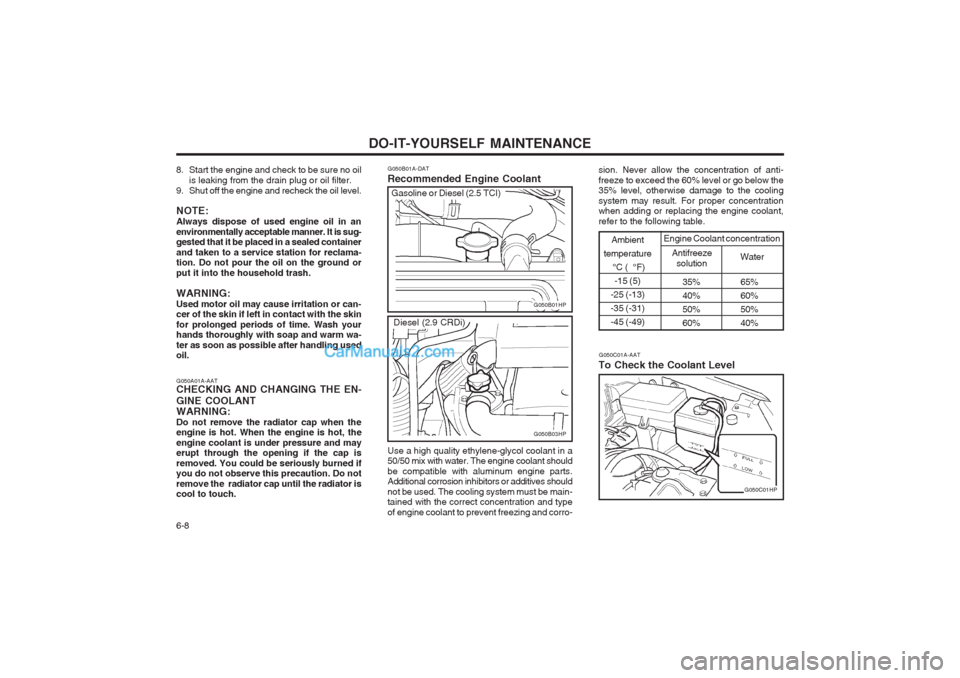
Use a high quality ethylene-glycol coolant in a 50/50 mix with water. The engine coolant should be compatible with aluminum engine parts. Additional corrosion inhibitors or additives should not be used. The cooling system must be main- tained with the correct concentration and type of engine coolant to prevent freezing and corro-
Gasoline or Diesel (2.5 TCI)
G050B03HP
Diesel (2.9 CRDi) sion. Never allow the concentration of anti- freeze to exceed the 60% level or go below the 35% level, otherwise damage to the cooling system may result. For proper concentration when adding or replacing the engine coolant, refer to the following table.
8. Start the engine and check to be sure no oil
is leaking from the drain plug or oil filter.
9. Shut off the engine and recheck the oil level. NOTE: Always dispose of used engine oil in anenvironmentally acceptable manner. It is sug- gested that it be placed in a sealed container and taken to a service station for reclama- tion. Do not pour the oil on the ground or put it into the household trash. WARNING: Used motor oil may cause irritation or can- cer of the skin if left in contact with the skin for prolonged periods of time. Wash your hands thoroughly with soap and warm wa- ter as soon as possible after handling used oil. G050A01A-AAT CHECKING AND CHANGING THE EN- GINE COOLANT WARNING: Do not remove the radiator cap when the engine is hot. When the engine is hot, the engine coolant is under pressure and may erupt through the opening if the cap is removed. You could be seriously burned if you do not observe this precaution. Do not remove the radiator cap until the radiator is cool to touch.
Page 155 of 349
DO-IT-YOURSELF MAINTENANCE 6-9
coolant container, add the appropriate quan- tity of coolant to the radiator.
G050D03HP
G050D01HP
G050D02HP
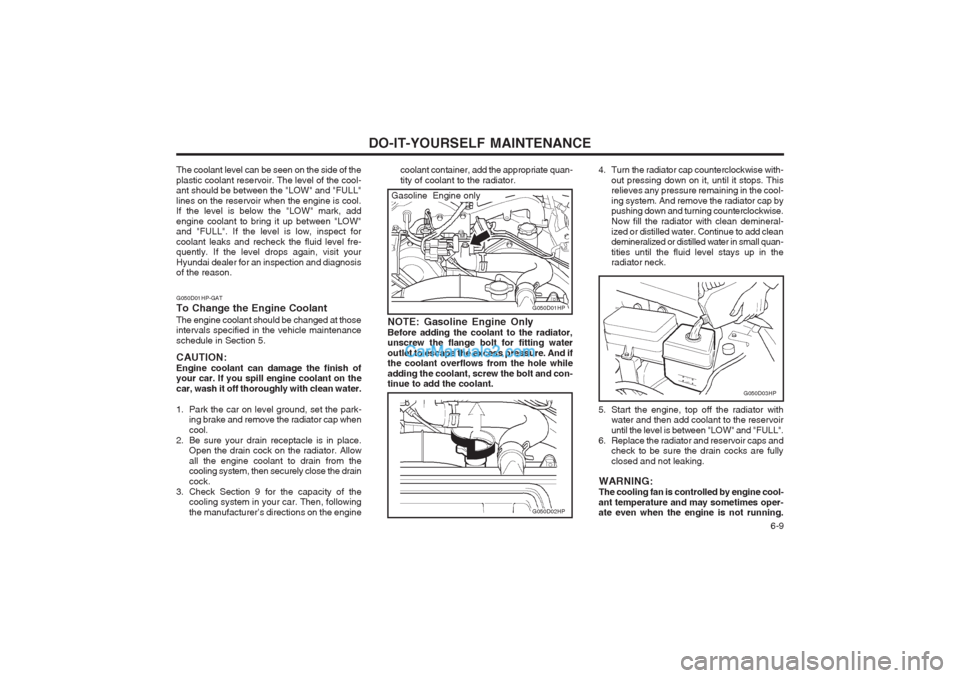
NOTE: Gasoline Engine Only Before adding the coolant to the radiator, unscrew the flange bolt for fitting water outlet to escape the excess pressure. And if the coolant overflows from the hole while adding the coolant, screw the bolt and con- tinue to add the coolant. 4. Turn the radiator cap counterclockwise with-
out pressing down on it, until it stops. Thisrelieves any pressure remaining in the cool- ing system. And remove the radiator cap by pushing down and turning counterclockwise. Now fill the radiator with clean demineral-ized or distilled water. Continue to add clean demineralized or distilled water in small quan- tities until the fluid level stays up in the radiator neck.
5. Start the engine, top off the radiator with water and then add coolant to the reservoir until the level is between "LOW" and "FULL".
6. Replace the radiator and reservoir caps and check to be sure the drain cocks are fullyclosed and not leaking.
WARNING:The cooling fan is controlled by engine cool-
ant temperature and may sometimes oper- ate even when the engine is not running.
Gasoline Engine only
The coolant level can be seen on the side of the plastic coolant reservoir. The level of the cool- ant should be between the "LOW" and "FULL" lines on the reservoir when the engine is cool. If the level is below the "LOW" mark, add engine coolant to bring it up between "LOW" and "FULL". If the level is low, inspect for coolant leaks and recheck the fluid level fre- quently. If the level drops again, visit your Hyundai dealer for an inspection and diagnosis of the reason.
G050D01HP-GAT To Change the Engine CoolantThe engine coolant should be changed at those intervals specified in the vehicle maintenance schedule in Section 5. CAUTION: Engine coolant can damage the finish of your car. If you spill engine coolant on the car, wash it off thoroughly with clean water.
1. Park the car on level ground, set the park-
ing brake and remove the radiator cap when cool.
2. Be sure your drain receptacle is in place. Open the drain cock on the radiator. Allowall the engine coolant to drain from the cooling system, then securely close the drain cock.
3. Check Section 9 for the capacity of the cooling system in your car. Then, followingthe manufacturer’s directions on the engine
Page 157 of 349
DO-IT-YOURSELF MAINTENANCE 6-11
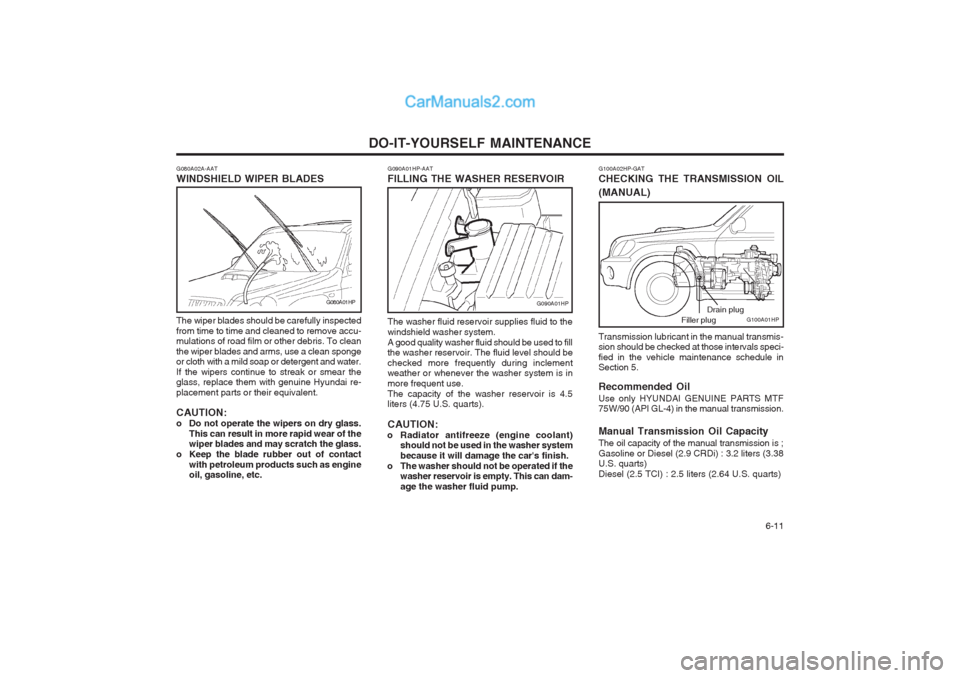
G090A01HP-AAT FILLING THE WASHER RESERVOIR
G090A01HP
The washer fluid reservoir supplies fluid to the windshield washer system.A good quality washer fluid should be used to fill the washer reservoir. The fluid level should be checked more frequently during inclement weather or whenever the washer system is in more frequent use.The capacity of the washer reservoir is 4.5 liters (4.75 U.S. quarts). CAUTION:
o Radiator antifreeze (engine coolant) should not be used in the washer system because it will damage the car's finish.
o The washer should not be operated if the washer reservoir is empty. This can dam-age the washer fluid pump.
G100A02HP-GAT CHECKING THE TRANSMISSION OIL (MANUAL)
G100A01HP
Drain plug
Filler plug
Transmission lubricant in the manual transmis- sion should be checked at those intervals speci- fied in the vehicle maintenance schedule in Section 5. Recommended Oil Use only HYUNDAI GENUINE PARTS MTF 75W/90 (API GL-4) in the manual transmission. Manual Transmission Oil Capacity The oil capacity of the manual transmission is ; Gasoline or Diesel (2.9 CRDi) : 3.2 liters (3.38 U.S. quarts) Diesel (2.5 TCI) : 2.5 liters (2.64 U.S. quarts)
G080A02A-AAT WINDSHIELD WIPER BLADES
The wiper blades should be carefully inspected from time to time and cleaned to remove accu- mulations of road film or other debris. To clean the wiper blades and arms, use a clean sponge or cloth with a mild soap or detergent and water. If the wipers continue to streak or smear the glass, replace them with genuine Hyundai re- placement parts or their equivalent. CAUTION:
o Do not operate the wipers on dry glass. This can result in more rapid wear of the wiper blades and may scratch the glass.
o Keep the blade rubber out of contact with petroleum products such as engineoil, gasoline, etc.
G080A01HP
Page 161 of 349
DO-IT-YOURSELF MAINTENANCE 6-15
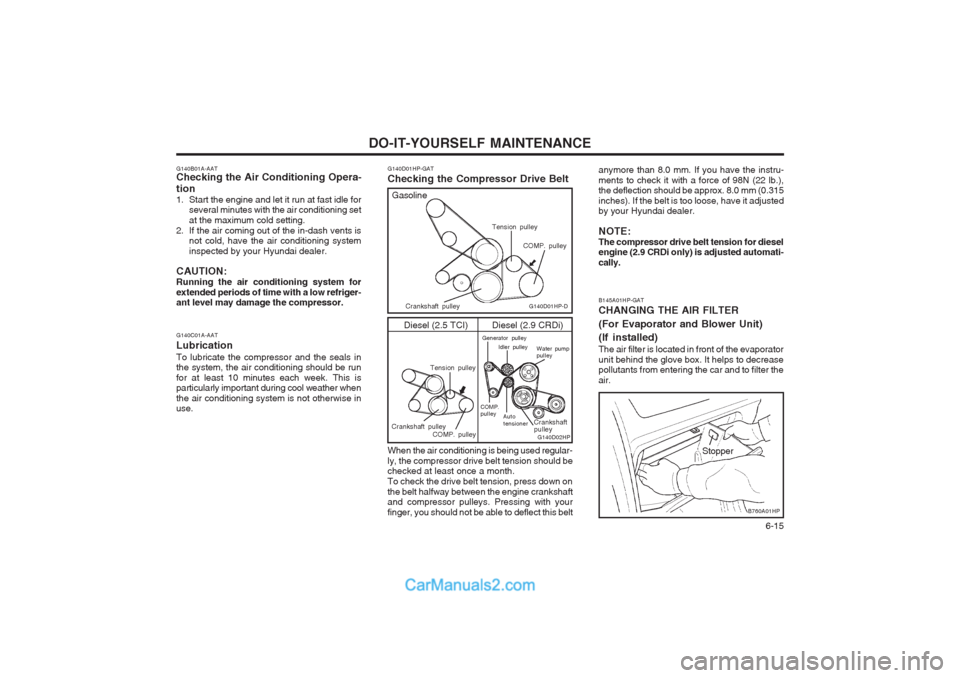
anymore than 8.0 mm. If you have the instru- ments to check it with a force of 98N (22 lb.), the deflection should be approx. 8.0 mm (0.315 inches). If the belt is too loose, have it adjusted by your Hyundai dealer. NOTE: The compressor drive belt tension for diesel engine (2.9 CRDi only) is adjusted automati- cally.
B145A01HP-GAT CHANGING THE AIR FILTER (For Evaporator and Blower Unit) (If installed) The air filter is located in front of the evaporator unit behind the glove box. It helps to decrease pollutants from entering the car and to filter the air.
B760A01HP
Stopper
Diesel (2.5 TCI)
G140D01HP-GAT Checking the Compressor Drive Belt When the air conditioning is being used regular- ly, the compressor drive belt tension should be checked at least once a month. To check the drive belt tension, press down onthe belt halfway between the engine crankshaft and compressor pulleys. Pressing with your finger, you should not be able to deflect this belt
G140D01HP-D
G140D02HP
Gasoline
Generator pulley
Idler pulley Water pump pulley
COMP.pulley Auto tensionerCOMP. pulley
Crankshaft pulley Diesel (2.9 CRDi)
Crankshaft pulleyCOMP. pulleyCrankshaft pulley
Tension pulley
Tension pulley
G140B01A-AAT Checking the Air Conditioning Opera- tion
1. Start the engine and let it run at fast idle for
several minutes with the air conditioning set at the maximum cold setting.
2. If the air coming out of the in-dash vents is not cold, have the air conditioning systeminspected by your Hyundai dealer.
CAUTION:Running the air conditioning system forextended periods of time with a low refriger- ant level may damage the compressor. G140C01A-AAT LubricationTo lubricate the compressor and the seals in the system, the air conditioning should be run for at least 10 minutes each week. This is particularly important during cool weather when the air conditioning system is not otherwise in use.