warning Hyundai Terracan 2004 Owners Manual
[x] Cancel search | Manufacturer: HYUNDAI, Model Year: 2004, Model line: Terracan, Model: Hyundai Terracan 2004Pages: 361, PDF Size: 4.69 MB
Page 220 of 361
CONTROLS AND EQUIPMENT
1- 20 B230A03P-EAT CHILD RESTRAINT SYSTEMChildren riding in the car should sit in the rear seat and must always be restrained to minimizethe risk of injury in an accident, sudden stop orsudden manoeuvre. According to accident sta-tistics, children are safer when properly re-strained in the rear seats than in the front seat.Larger children should use one of the seat beltsprovided. You are required by law to use safety restraints for children. If small children ride in your vehicleyou must put them in a child restraint system(safety seat). Children could be injured or killed in a crash if their restraints are not properly secured. Forsmall children and babies, a child seat or infantseat must be used. Before buying a particularchild restraint system, make sure it fits your carseat and seat belts, and fits your child. Followall the instructions provided by the manufac-turer when installing the child restraint system.
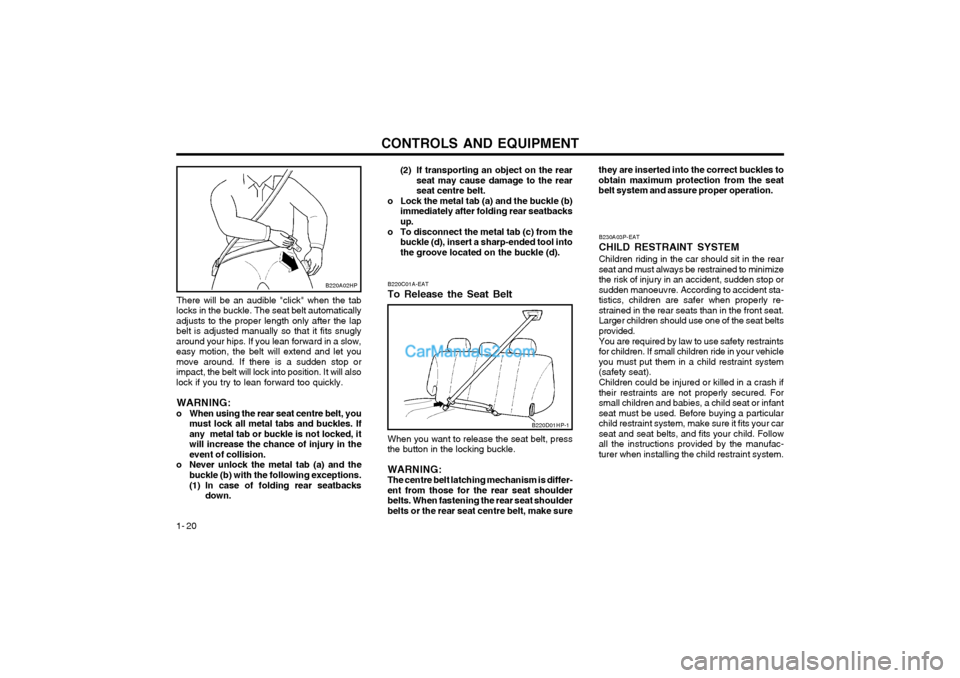
There will be an audible "click" when the tab
locks in the buckle. The seat belt automaticallyadjusts to the proper length only after the lapbelt is adjusted manually so that it fits snuglyaround your hips. If you lean forward in a slow,easy motion, the belt will extend and let youmove around. If there is a sudden stop orimpact, the belt will lock into position. It will alsolock if you try to lean forward too quickly.
WARNING:
o When using the rear seat centre belt, you must lock all metal tabs and buckles. Ifany metal tab or buckle is not locked, itwill increase the chance of injury in theevent of collision.
o Never unlock the metal tab (a) and the buckle (b) with the following exceptions.
(1) In case of folding rear seatbacks down.
B220A02HP (2) If transporting an object on the rear
seat may cause damage to the rear seat centre belt.
o Lock the metal tab (a) and the buckle (b) immediately after folding rear seatbacksup.
o To disconnect the metal tab (c) from the buckle (d), insert a sharp-ended tool intothe groove located on the buckle (d).
B220C01A-EAT To Release the Seat Belt When you want to release the seat belt, press
the button in the locking buckle. WARNING: The centre belt latching mechanism is differ-ent from those for the rear seat shoulderbelts. When fastening the rear seat shoulderbelts or the rear seat centre belt, make sure
B220D01HP-1 they are inserted into the correct buckles to obtain maximum protection from the seatbelt system and assure proper operation.
Page 221 of 361
CONTROLS AND EQUIPMENT1- 21
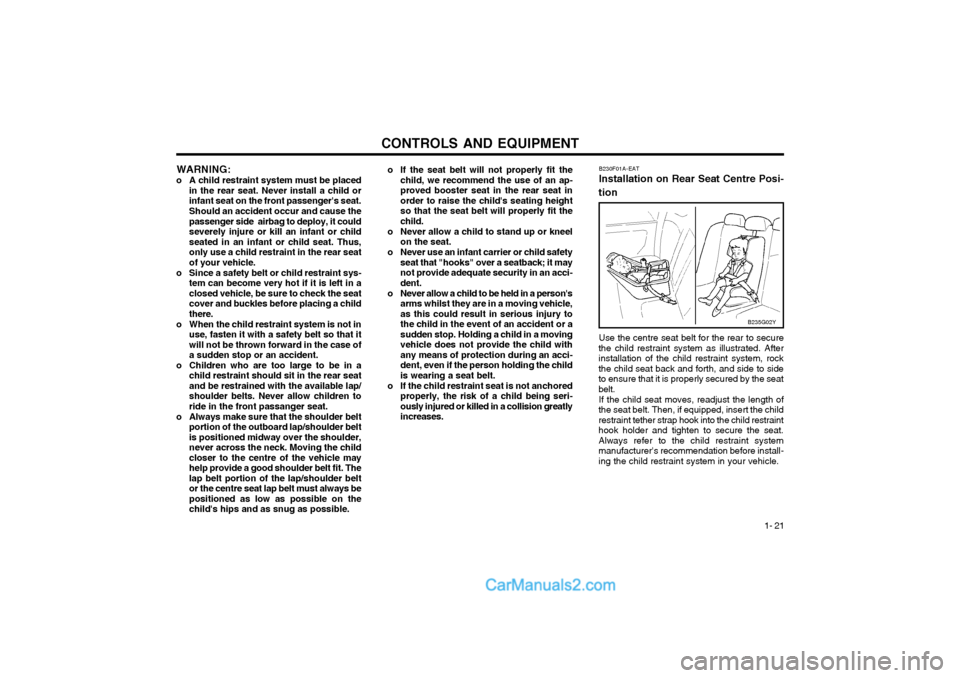
B230F01A-EAT Installation on Rear Seat Centre Posi-
tion
Use the centre seat belt for the rear to secure
the child restraint system as illustrated. After installation of the child restraint system, rockthe child seat back and forth, and side to sideto ensure that it is properly secured by the seatbelt.
If the child seat moves, readjust the length of
the seat belt. Then, if equipped, insert the childrestraint tether strap hook into the child restrainthook holder and tighten to secure the seat.Always refer to the child restraint systemmanufacturer's recommendation before install-ing the child restraint system in your vehicle.
o If the seat belt will not properly fit the
child, we recommend the use of an ap-proved booster seat in the rear seat inorder to raise the child's seating heightso that the seat belt will properly fit thechild.
o Never allow a child to stand up or kneel on the seat.
o Never use an infant carrier or child safety seat that "hooks" over a seatback; it maynot provide adequate security in an acci-dent.
o Never allow a child to be held in a person's arms whilst they are in a moving vehicle,as this could result in serious injury tothe child in the event of an accident or asudden stop. Holding a child in a movingvehicle does not provide the child withany means of protection during an acci-dent, even if the person holding the childis wearing a seat belt.
o If the child restraint seat is not anchored properly, the risk of a child being seri-ously injured or killed in a collision greatlyincreases.
WARNING:
o A child restraint system must be placed in the rear seat. Never install a child orinfant seat on the front passenger's seat. Should an accident occur and cause the passenger side airbag to deploy, it couldseverely injure or kill an infant or childseated in an infant or child seat. Thus,only use a child restraint in the rear seatof your vehicle.
o Since a safety belt or child restraint sys- tem can become very hot if it is left in aclosed vehicle, be sure to check the seatcover and buckles before placing a childthere.
o When the child restraint system is not in use, fasten it with a safety belt so that itwill not be thrown forward in the case ofa sudden stop or an accident.
o Children who are too large to be in a child restraint should sit in the rear seatand be restrained with the available lap/shoulder belts. Never allow children toride in the front passanger seat.
o Always make sure that the shoulder belt portion of the outboard lap/shoulder beltis positioned midway over the shoulder,never across the neck. Moving the childcloser to the centre of the vehicle mayhelp provide a good shoulder belt fit. Thelap belt portion of the lap/shoulder beltor the centre seat lap belt must always bepositioned as low as possible on thechild's hips and as snug as possible.
B235G02Y
Page 222 of 361
CONTROLS AND EQUIPMENT
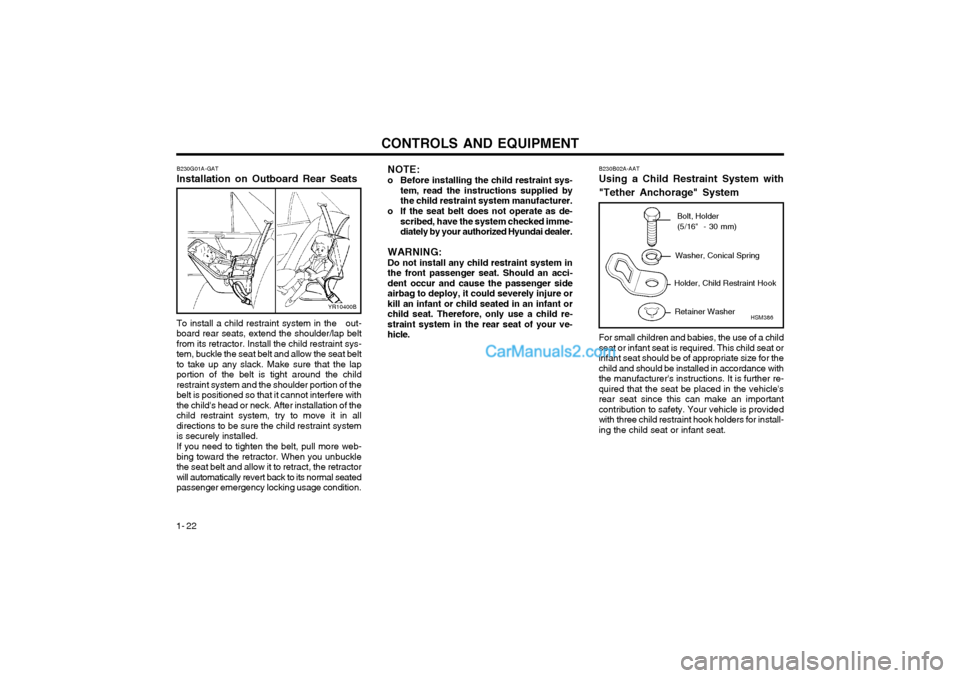
1- 22 B230G01A-GAT Installation on Outboard Rear Seats To install a child restraint system in the out- board rear seats, extend the shoulder/lap beltfrom its retractor. Install the child restraint sys-tem, buckle the seat belt and allow the seat beltto take up any slack. Make sure that the lapportion of the belt is tight around the childrestraint system and the shoulder portion of thebelt is positioned so that it cannot interfere withthe child's head or neck. After installation of thechild restraint system, try to move it in alldirections to be sure the child restraint systemis securely installed. If you need to tighten the belt, pull more web- bing toward the retractor. When you unbucklethe seat belt and allow it to retract, the retractorwill automatically revert back to its normal seatedpassenger emergency locking usage condition.
NOTE:
o Before installing the child restraint sys- tem, read the instructions supplied bythe child restraint system manufacturer.
o If the seat belt does not operate as de- scribed, have the system checked imme-diately by your authorized Hyundai dealer.
WARNING:Do not install any child restraint system inthe front passenger seat. Should an acci-dent occur and cause the passenger sideairbag to deploy, it could severely injure orkill an infant or child seated in an infant orchild seat. Therefore, only use a child re-straint system in the rear seat of your ve-hicle.
YR10400B B230B02A-AAT Using a Child Restraint System with
"Tether Anchorage" System For small children and babies, the use of a child seat or infant seat is required. This child seat orinfant seat should be of appropriate size for thechild and should be installed in accordance withthe manufacturer's instructions. It is further re-quired that the seat be placed in the vehicle'srear seat since this can make an importantcontribution to safety. Your vehicle is providedwith three child restraint hook holders for install-ing the child seat or infant seat. Bolt, Holder (5/16" - 30 mm)
Washer, Conical Spring
Holder, Child Restraint Hook
Retainer WasherHSM386
Page 224 of 361
CONTROLS AND EQUIPMENT
1- 24
NOTE: At present, this seat is the only one comply-
ing with that provision. In case that other manufacturers will furnish proof of a re-spective certification, Hyundai is going toevaluate this seat carefully and will give arecommendation provided that seat com-plies to the law. Please ask your Hyundaidealer in this respect.
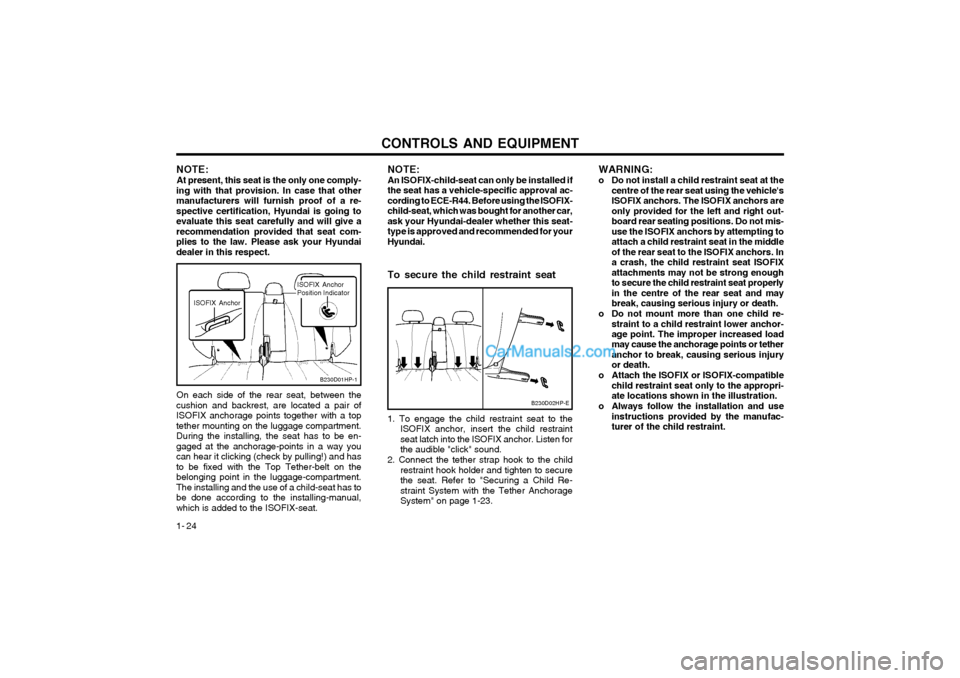
On each side of the rear seat, between the
cushion and backrest, are located a pair ofISOFIX anchorage points together with a toptether mounting on the luggage compartment.During the installing, the seat has to be en-gaged at the anchorage-points in a way youcan hear it clicking (check by pulling!) and hasto be fixed with the Top Tether-belt on thebelonging point in the luggage-compartment.The installing and the use of a child-seat has tobe done according to the installing-manual,which is added to the ISOFIX-seat.
B230D02HP-E
NOTE: An ISOFIX-child-seat can only be installed ifthe seat has a vehicle-specific approval ac-cording to ECE-R44. Before using the ISOFIX-child-seat, which was bought for another car,ask your Hyundai-dealer whether this seat-type is approved and recommended for yourHyundai.
To secure the child restraint seat
1. To engage the child restraint seat to the ISOFIX anchor, insert the child restraintseat latch into the ISOFIX anchor. Listen forthe audible "click" sound.
2. Connect the tether strap hook to the child restraint hook holder and tighten to securethe seat. Refer to "Securing a Child Re-straint System with the Tether AnchorageSystem" on page 1-23. WARNING:
o Do not install a child restraint seat at the
centre of the rear seat using the vehicle's ISOFIX anchors. The ISOFIX anchors areonly provided for the left and right out-board rear seating positions. Do not mis-use the ISOFIX anchors by attempting toattach a child restraint seat in the middleof the rear seat to the ISOFIX anchors. Ina crash, the child restraint seat ISOFIXattachments may not be strong enoughto secure the child restraint seat properlyin the centre of the rear seat and maybreak, causing serious injury or death.
o Do not mount more than one child re- straint to a child restraint lower anchor-age point. The improper increased load may cause the anchorage points or tether anchor to break, causing serious injuryor death.
o Attach the ISOFIX or ISOFIX-compatible child restraint seat only to the appropri-ate locations shown in the illustration.
o Always follow the installation and use instructions provided by the manufac-turer of the child restraint.
B230D01HP-1
ISOFIX Anchor ISOFIX Anchor Position Indicator
Page 225 of 361
CONTROLS AND EQUIPMENT1- 25
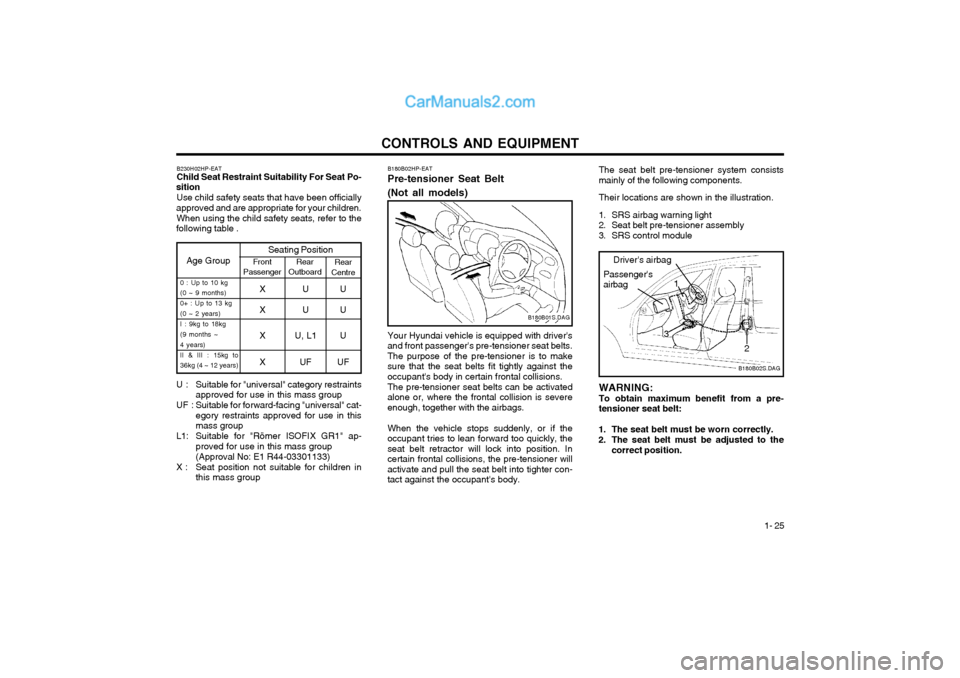
The seat belt pre-tensioner system consists mainly of the following components. Their locations are shown in the illustration.
1. SRS airbag warning light
2. Seat belt pre-tensioner assembly
3. SRS control module WARNING: To obtain maximum benefit from a pre-tensioner seat belt:
1. The seat belt must be worn correctly.
2. The seat belt must be adjusted to the correct position.
Age Group Seating PositionFront
Passenger Rear
Outboard Rear
Centre
0 : Up to 10 kg (0 ~ 9 months) 0+ : Up to 13 kg(0 ~ 2 years)I : 9kg to 18kg(9 months ~4 years) II & III : 15kg to36kg (4 ~ 12 years)XUU
XUU
X U, L1 U XU FUF
B230H02HP-EAT Child Seat Restraint Suitability For Seat Po-
sition
Use child safety seats that have been officially
approved and are appropriate for your children.
When using the child safety seats, refer to the
following table .
U : Suitable for "universal" category restraints approved for use in this mass group
UF : Suitable for forward-facing "universal" cat- egory restraints approved for use in this mass group
L1: Suitable for "Römer ISOFIX GR1" ap- proved for use in this mass group (Approval No: E1 R44-03301133)
X : Seat position not suitable for children in this mass group Your Hyundai vehicle is equipped with driver's and front passenger's pre-tensioner seat belts. The purpose of the pre-tensioner is to makesure that the seat belts fit tightly against theoccupant's body in certain frontal collisions. The pre-tensioner seat belts can be activated alone or, where the frontal collision is severeenough, together with the airbags. When the vehicle stops suddenly, or if the occupant tries to lean forward too quickly, theseat belt retractor will lock into position. Incertain frontal collisions, the pre-tensioner willactivate and pull the seat belt into tighter con-tact against the occupant's body.
B180B02HP-EAT Pre-tensioner Seat Belt (Not all models)
B180B01S.DAG
B180B02S.DAG
Driver's airbag
1
Passenger's
airbag
3
2
Page 226 of 361
CONTROLS AND EQUIPMENT
1- 26 tion key is turned to "ON" or if it remains illuminated after blinking for approxi-mately 6 seconds, or if it illuminates whilstthe vehicle is being driven, please havean authorized Hyundai dealer inspect thepre-tensioner seat belts and SRS airbagsystem as soon as possible.
WARNING:
o Pre-tensioners are designed to operate only one time. After activation, pre-tensioner seat belts must be replaced.All seat belts, of any type, should alwaysbe replaced after they have been wornduring a collision.
o The pre-tensioner seat belt assembly mechanisms become hot during activa-tion. Do not touch the pre-tensioner seatbelt assemblies for several minutes afterthey have been activated.
o Do not attempt to inspect or replace the pre-tensioner seat belts yourself. Thismust be done by an authorized Hyundaidealer.
o Do not strike the pre-tensioner seat belt assemblies.
o Do not attempt to service or repair the pre-tensioner seat belt system in anymanner.
o Improper handling of the pre-tensioner seat belt assemblies, and failure to heedthe warnings to not strike, modify, insp-ect, replace, service or repair the pre-tensioner seat belt assemblies may lead to improper operation or inadvertent ac-tivation and serious injury.
o Always wear seat belts when driving or riding in a motor vehicle.
NOTE:
o Both the driver's and front passenger's pre-tensioner seat belts will be activatedin certain frontal collisions. The pre-tensioner seat belts can be activated aloneor, where the frontal collision is severeenough, together with the airbags.
o When the pre-tensioner seat belts are activated, a loud noise may be heard andfine dust, which may appear to be smoke,may be visible in the passenger compart-ment. These are normal operating condi-tions and are not hazardous.
o Although it is harmless, the fine dust may cause skin irritation and should notbe breathed for prolonged periods. Washyour hands and face thoroughly after anaccident in which the pre-tensioner seatbelts were activated.
CAUTION:
o Because the sensor that activates the SRS airbag is connected with pre-tensioner seat belt, the SRS airbag warn-ing light on the instrument panel willblink for approximately 6 seconds afterthe ignition key has been turned to the"ON" position, and then it should turnoff.
o If pre-tensioner seat belt is not working properly, this warning light will illumi-nate even if there is no malfunction of theSRS airbag. If the SRS airbag warninglight does not illuminate when the igni-
AIR
BAG
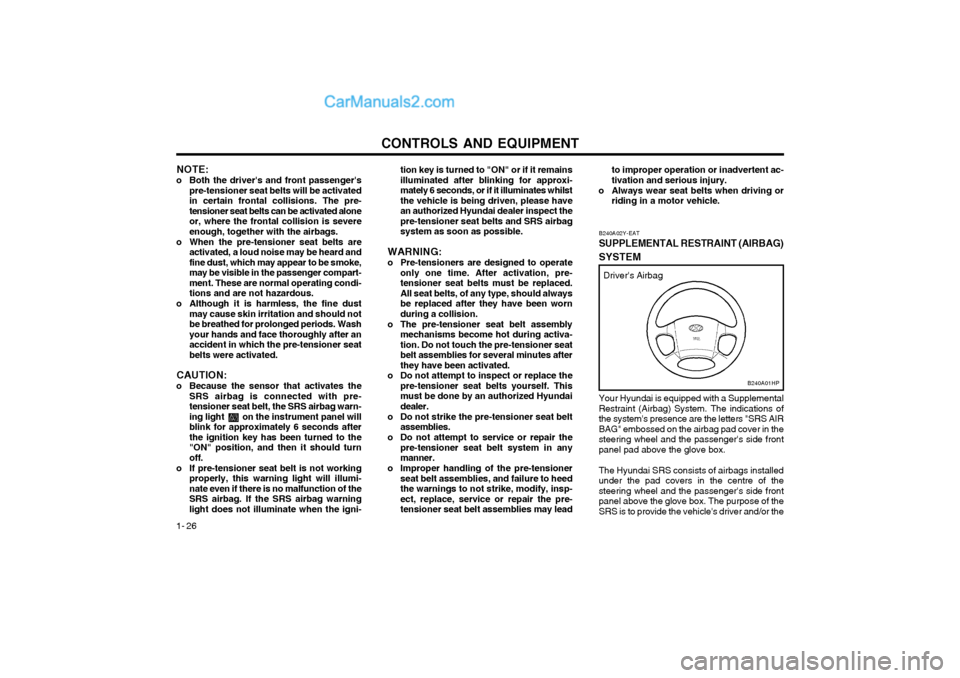
Your Hyundai is equipped with a Supplemental Restraint (Airbag) System. The indications ofthe system's presence are the letters "SRS AIRBAG" embossed on the airbag pad cover in thesteering wheel and the passenger's side frontpanel pad above the glove box. The Hyundai SRS consists of airbags installed under the pad covers in the centre of thesteering wheel and the passenger's side frontpanel above the glove box. The purpose of theSRS is to provide the vehicle's driver and/or the
B240A01HP
Driver's Airbag
B240A02Y-EAT
SUPPLEMENTAL RESTRAINT (AIRBAG)
SYSTEM
Page 227 of 361
CONTROLS AND EQUIPMENT1- 27
B240B02A-EAT SRS Components and Functions
B240B01L-D
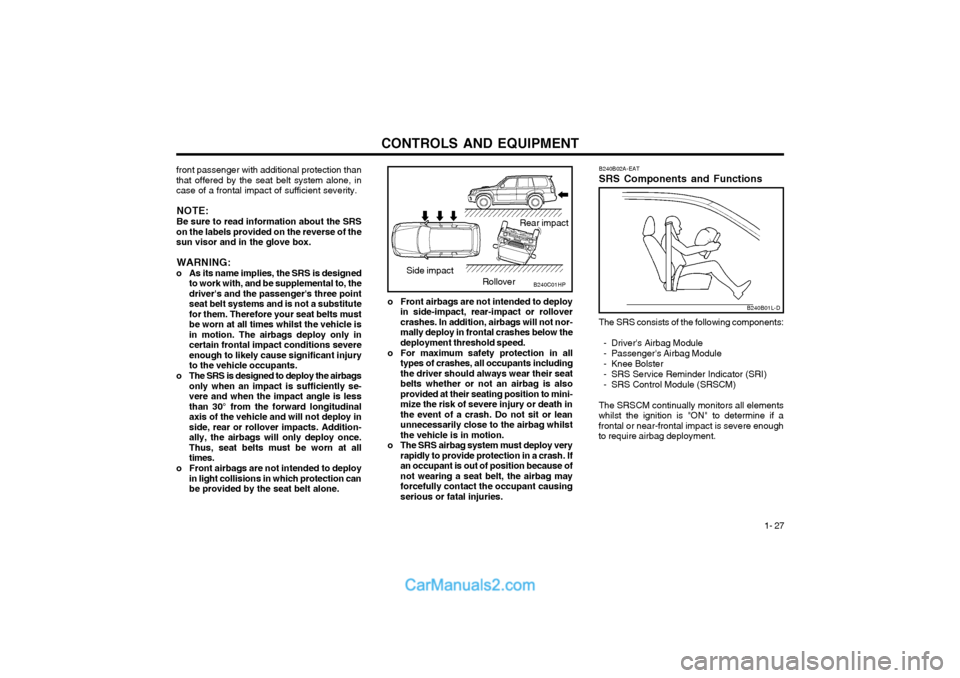
The SRS consists of the following components:
- Driver's Airbag Module
- Passenger's Airbag Module
- Knee Bolster
- SRS Service Reminder Indicator (SRI)
- SRS Control Module (SRSCM)
The SRSCM continually monitors all elements
whilst the ignition is "ON" to determine if a frontal or near-frontal impact is severe enoughto require airbag deployment.o Front airbags are not intended to deploy in side-impact, rear-impact or rollover crashes. In addition, airbags will not nor-mally deploy in frontal crashes below thedeployment threshold speed.
o For maximum safety protection in all types of crashes, all occupants includingthe driver should always wear their seatbelts whether or not an airbag is alsoprovided at their seating position to mini-mize the risk of severe injury or death inthe event of a crash. Do not sit or leanunnecessarily close to the airbag whilstthe vehicle is in motion.
o The SRS airbag system must deploy very rapidly to provide protection in a crash. Ifan occupant is out of position because ofnot wearing a seat belt, the airbag mayforcefully contact the occupant causingserious or fatal injuries.
front passenger with additional protection thanthat offered by the seat belt system alone, incase of a frontal impact of sufficient severity.
NOTE: Be sure to read information about the SRS
on the labels provided on the reverse of the sun visor and in the glove box.
WARNING:
o As its name implies, the SRS is designed to work with, and be supplemental to, thedriver's and the passenger's three pointseat belt systems and is not a substitutefor them. Therefore your seat belts mustbe worn at all times whilst the vehicle isin motion. The airbags deploy only incertain frontal impact conditions severeenough to likely cause significant injuryto the vehicle occupants.
o The SRS is designed to deploy the airbags only when an impact is sufficiently se-vere and when the impact angle is lessthan 30° from the forward longitudinalaxis of the vehicle and will not deploy inside, rear or rollover impacts. Addition-ally, the airbags will only deploy once.Thus, seat belts must be worn at alltimes.
o Front airbags are not intended to deploy in light collisions in which protection canbe provided by the seat belt alone.
B240C01HP
Rear impact
Side impact Rollover
Page 229 of 361
CONTROLS AND EQUIPMENT1- 29
B240C01HP-GAT SRS CareThe SRS is virtually maintenance-free and so
there are no parts you can safely service by yourself. The entire SRS system must be in-
spected by an authorized Hyundai dealer 10years after the date that the vehicle was man-ufactured.
Any work on the SRS system, such as remov-
ing, installing, repairing, or any work on thesteering wheel must be performed by a quali-
fied Hyundai technician. Improper handling ofthe SRS system may result in serious personal
injury. WARNING:
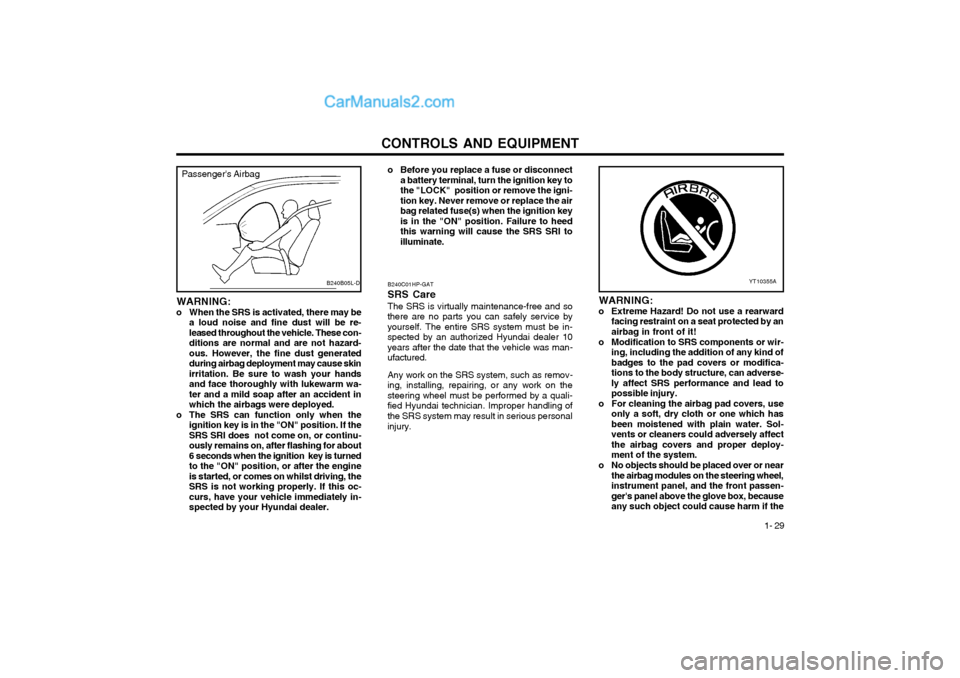
o Extreme Hazard! Do not use a rearward facing restraint on a seat protected by anairbag in front of it!
o Modification to SRS components or wir- ing, including the addition of any kind ofbadges to the pad covers or modifica-
tions to the body structure, can adverse-ly affect SRS performance and lead topossible injury.
o For cleaning the airbag pad covers, use only a soft, dry cloth or one which hasbeen moistened with plain water. Sol-
vents or cleaners could adversely affectthe airbag covers and proper deploy-ment of the system.
o No objects should be placed over or near the airbag modules on the steering wheel,instrument panel, and the front passen-
ger's panel above the glove box, becauseany such object could cause harm if the
YT10355A
Passenger's Airbag
B240B05L-D
WARNING:
o When the SRS is activated, there may be a loud noise and fine dust will be re- leased throughout the vehicle. These con-ditions are normal and are not hazard-ous. However, the fine dust generatedduring airbag deployment may cause skinirritation. Be sure to wash your handsand face thoroughly with lukewarm wa-ter and a mild soap after an accident inwhich the airbags were deployed.
o The SRS can function only when the ignition key is in the "ON" position. If theSRS SRI does not come on, or continu-ously remains on, after flashing for about6 seconds when the ignition key is turnedto the "ON" position, or after the engineis started, or comes on whilst driving, theSRS is not working properly. If this oc-curs, have your vehicle immediately in-spected by your Hyundai dealer. o Before you replace a fuse or disconnect
a battery terminal, turn the ignition key tothe "LOCK" position or remove the igni-tion key. Never remove or replace the airbag related fuse(s) when the ignition keyis in the "ON" position. Failure to heedthis warning will cause the SRS SRI toilluminate.
Page 231 of 361
CONTROLS AND EQUIPMENT1- 31
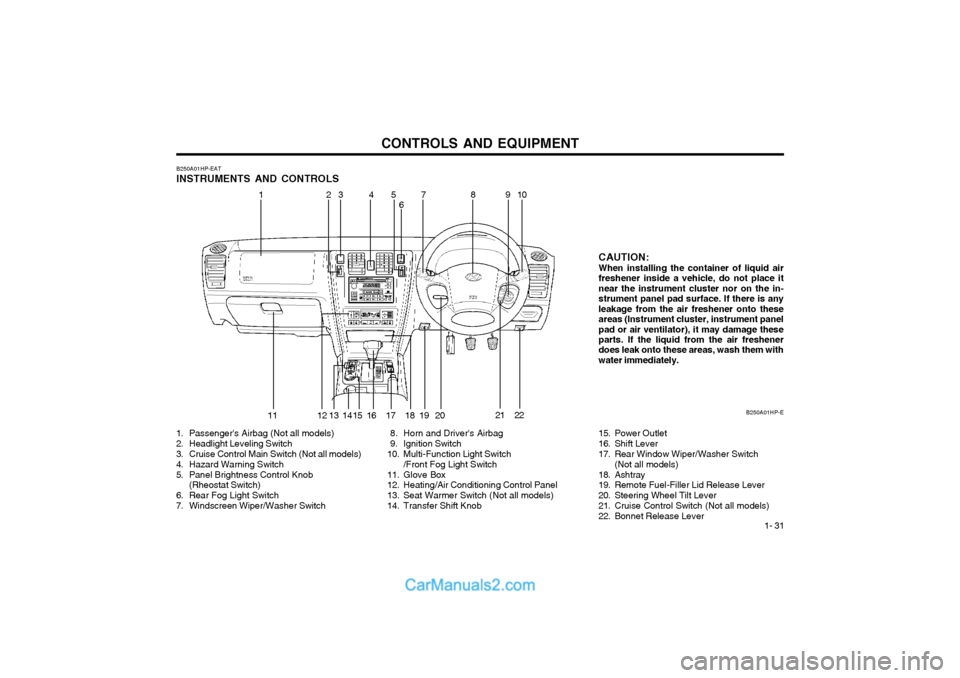
B250A01HP-EAT INSTRUMENTS AND CONTROLS
1. Passenger's Airbag (Not all models)
2. Headlight Leveling Switch
3. Cruise Control Main Switch (Not all models)
4. Hazard Warning Switch
5. Panel Brightness Control Knob (Rheostat Switch)
6. Rear Fog Light Switch
7. Windscreen Wiper/Washer Switch 8. Horn and Driver's Airbag
9. Ignition Switch
10. Multi-Function Light Switch
/Front Fog Light Switch
11. Glove Box
12. Heating/Air Conditioning Control Panel
13. Seat Warmer Switch (Not all models)
14. Transfer Shift Knob CAUTION:When installing the container of liquid air freshener inside a vehicle, do not place itnear the instrument cluster nor on the in-strument panel pad surface. If there is anyleakage from the air freshener onto theseareas (Instrument cluster, instrument panelpad or air ventilator), it may damage these parts. If the liquid from the air freshener does leak onto these areas, wash them withwater immediately.
B250A01HP-E
21
15. Power Outlet
16. Shift Lever
17. Rear Window Wiper/Washer Switch(Not all models)
18. Ashtray
19. Remote Fuel-Filler Lid Release Lever
20. Steering Wheel Tilt Lever
21. Cruise Control Switch (Not all models)
22. Bonnet Release Lever
11 910
13 45
6 78
12 13 14 16 17 18 19 2022
2
15
Page 233 of 361
CONTROLS AND EQUIPMENT1- 33
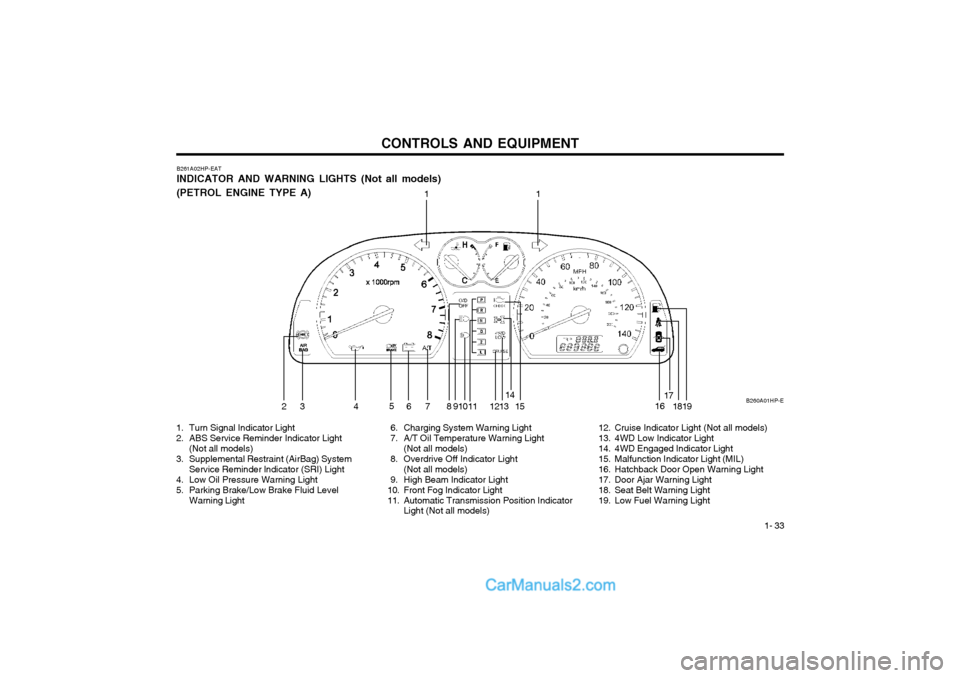
B261A02HP-EAT INDICATOR AND WARNING LIGHTS (Not all models) (PETROL ENGINE TYPE A)
11
23 4 5
6 7 8 91011 1213 14
15 1617
18
19
1. Turn Signal Indicator Light
2. ABS Service Reminder Indicator Light (Not all models)
3. Supplemental Restraint (AirBag) System Service Reminder lndicator (SRI) Light
4. Low Oil Pressure Warning Light
5. Parking Brake/Low Brake Fluid Level
Warning Light 6. Charging System Warning Light
7. A/T Oil Temperature Warning Light
(Not all models)
8. Overdrive Off Indicator Light (Not all models)
9. High Beam Indicator Light
10. Front Fog Indicator Light
11. Automatic Transmission Position Indicator Light (Not all models) 12. Cruise Indicator Light (Not all models)
13. 4WD Low Indicator Light
14. 4WD Engaged Indicator Light
15. Malfunction Indicator Light (MIL)
16. Hatchback Door Open Warning Light
17. Door Ajar Warning Light
18. Seat Belt Warning Light
19. Low Fuel Warning LightB260A01HP-E