warning Hyundai Terracan 2004 Service Manual
[x] Cancel search | Manufacturer: HYUNDAI, Model Year: 2004, Model line: Terracan, Model: Hyundai Terracan 2004Pages: 361, PDF Size: 4.69 MB
Page 72 of 361
FEATURES OF YOUR HYUNDAI
1- 64
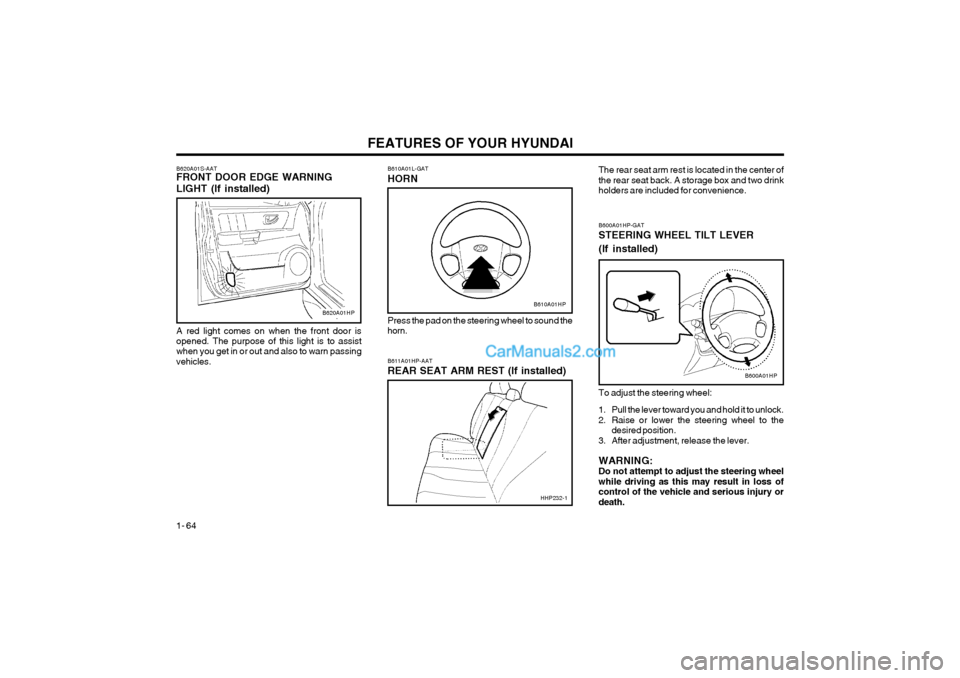
B600A01HP-GAT STEERING WHEEL TILT LEVER (If installed) To adjust the steering wheel:
1. Pull the lever toward you and hold it to unlock.
2. Raise or lower the steering wheel to the desired position.
3. After adjustment, release the lever. WARNING: Do not attempt to adjust the steering wheelwhile driving as this may result in loss ofcontrol of the vehicle and serious injury ordeath.
B600A01HP
B620A01S-AAT FRONT DOOR EDGE WARNING LIGHT (If installed) A red light comes on when the front door is opened. The purpose of this light is to assist when you get in or out and also to warn passingvehicles.B610A01L-GAT HORN
B610A01HP
Press the pad on the steering wheel to sound the horn. B611A01HP-AAT REAR SEAT ARM REST (If installed) The rear seat arm rest is located in the center of the rear seat back. A storage box and two drinkholders are included for convenience.B620A01HP
HHP232-1
Page 74 of 361
FEATURES OF YOUR HYUNDAI
1- 66
B660D01HP
B660E01L-AAT To Reset at a Faster Speed
1. Push the control switch "RESUME (ACCEL)" and hold it.
2. Accelerate to desired speed and release the control switch. While the control switch is held, the vehicle will gradually gain speed.
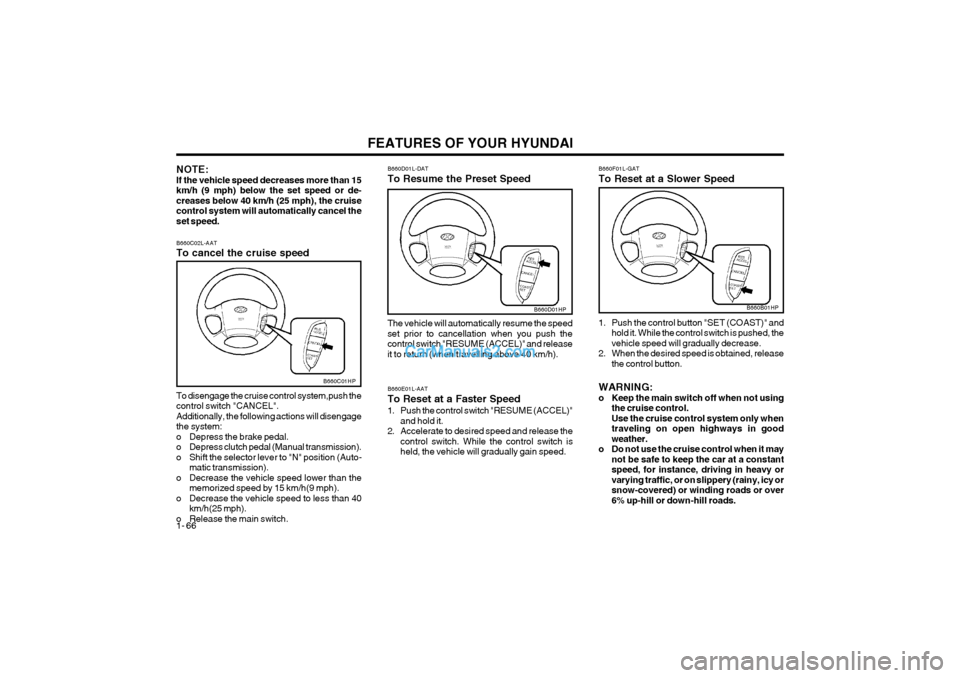
B660C02L-AAT To cancel the cruise speed To disengage the cruise control system,push the control switch "CANCEL".Additionally, the following actions will disengagethe system:
o Depress the brake pedal.
o Depress clutch pedal (Manual transmission).
o Shift the selector lever to "N" position (Auto-
matic transmission).
o Decrease the vehicle speed lower than the memorized speed by 15 km/h(9 mph).
o Decrease the vehicle speed to less than 40 km/h(25 mph).
o Release the main switch.
B660C01HP
B660B01HP
NOTE: If the vehicle speed decreases more than 15km/h (9 mph) below the set speed or de-creases below 40 km/h (25 mph), the cruisecontrol system will automatically cancel theset speed. B660D01L-DAT To Resume the Preset Speed The vehicle will automatically resume the speed set prior to cancellation when you push thecontrol switch "RESUME (ACCEL)" and releaseit to return (when travelling above 40 km/h).B660F01L-GAT To Reset at a Slower Speed
1. Push the control button "SET (COAST)" and
hold it. While the control switch is pushed, the vehicle speed will gradually decrease.
2. When the desired speed is obtained, release the control button.
WARNING:
o Keep the main switch off when not using the cruise control.Use the cruise control system only whentraveling on open highways in goodweather.
o Do not use the cruise control when it may not be safe to keep the car at a constantspeed, for instance, driving in heavy orvarying traffic, or on slippery (rainy, icy orsnow-covered) or winding roads or over6% up-hill or down-hill roads.
Page 89 of 361
FEATURES OF YOUR HYUNDAI 1- 81
B750B02Y-AAT Using a cellular phone or a two-way radio When a cellular phone is used inside the vehicle, noise may be produced from the audio equip-ment. This does not mean that something iswrong with the audio equipment. In such a case,use the cellular phone at a place as far aspossible from the audio equipment. CAUTION: When using a communication system such acellular phone or a radio set inside the vehi-cle, a separate external antenna must befitted. When a cellular phone or a radio set isused with an internal antenna alone, it mayinterfere with the vehicle's electrical systemand adversely affect safe operation of thevehicle. WARNING: Don't use a cellular phone when you aredriving. Stop at a safe place to use a cellularphone.
SSAR013ASSAR014A
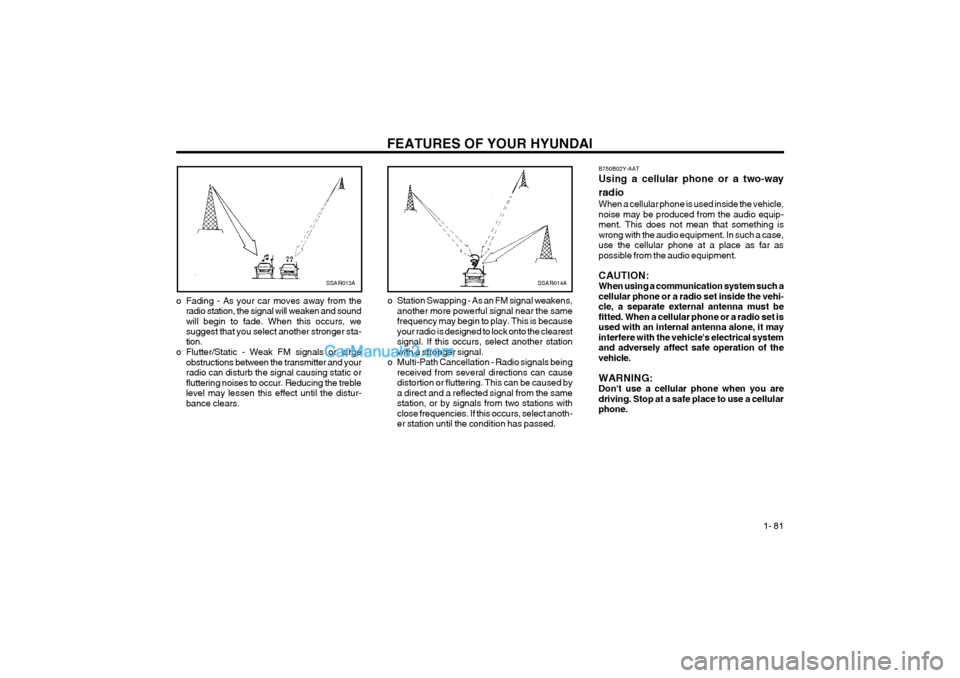
o Fading - As your car moves away from the radio station, the signal will weaken and sound will begin to fade. When this occurs, wesuggest that you select another stronger sta- tion.
o Flutter/Static - Weak FM signals or large obstructions between the transmitter and your radio can disturb the signal causing static orfluttering noises to occur. Reducing the treblelevel may lessen this effect until the distur-bance clears. o Station Swapping - As an FM signal weakens,
another more powerful signal near the samefrequency may begin to play. This is becauseyour radio is designed to lock onto the clearestsignal. If this occurs, select another stationwith a stronger signal.
o Multi-Path Cancellation - Radio signals being received from several directions can causedistortion or fluttering. This can be caused bya direct and a reflected signal from the samestation, or by signals from two stations withclose frequencies. If this occurs, select anoth-er station until the condition has passed.
Page 110 of 361
DRIVING YOUR HYUNDAI 2- 1
2. DRIVING YOUR HYUNDAI
C010A01O-AAT
WARNING: ENGINE EXHAUST CAN BE DANGEROUS!
Engine exhaust fumes can be extremely dangerous. If, at any time, you smell exhaust fumes inside the vehicle, open the windows immediately. o Do not inhale exhaust fumes. Exhaust fumes contain carbon monoxide, a colorless, odorless gas that can cause unconsciousness and death by asphyxiation. o Be sure the exhaust system does not leak. The exhaust system should be checked whenever the vehicle is raised to change the oil or for any other purpose. If you hear a change in the sound of the exhaust or if you drive over something that strikes the underneath side of the car, have the exhau st
system checked as soon as possible by your Hyundai dealer. o Do not run the engine in an enclosed area. Letting the engine idle in your garage, even with the garage door open, is a hazardous practice. Never run the engine in your garage any longer than it takes to start the engine and back the car out. o Avoid idling the engine for prolonged periods with people inside the car. If it is necessary to idle the engine for a prolonged period with people inside the car, be sure to do so only in an open area with
the air intake set at "Fresh" and fan operating at one of the higher speeds so fresh air is drawn into the interior. If you must drive with the tail gate open because you are carrying objects that make this necessary:1. Close all windows. 2. Open side vents. 3. Set the air intake control at "Fresh", the air flow control at "Floor" or "Face" and the fan at one of the higher speeds.
To assure proper operation of the ventilation system, be sure the ventilation air intakes located just in front of the windshield are kept clear of snow, ice, leaves or other obstructions.
2
Page 111 of 361
DRIVING YOUR HYUNDAI
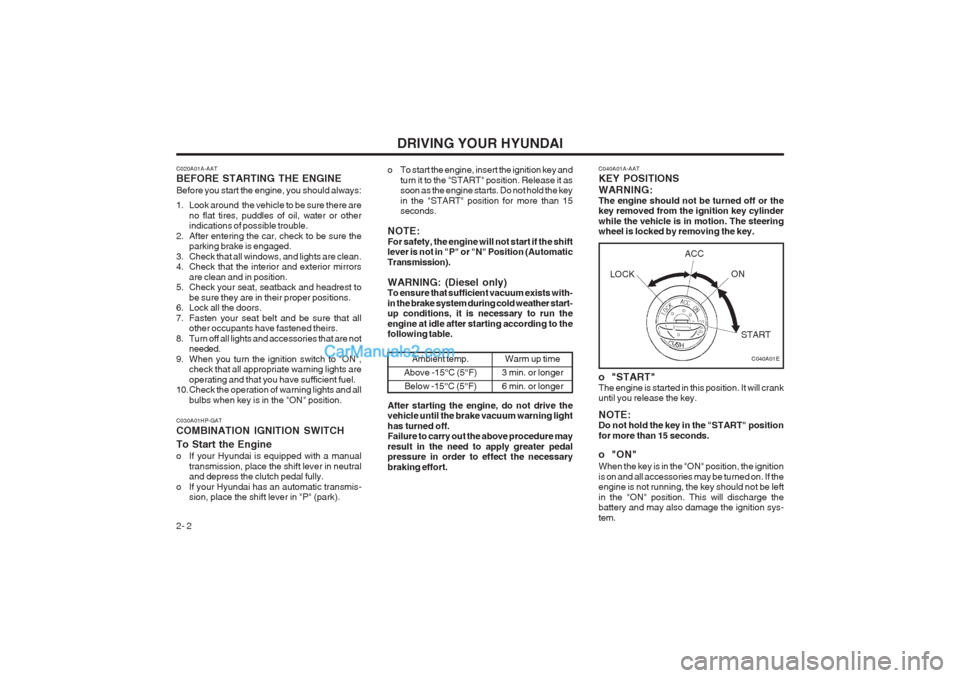
2- 2 C040A01A-AAT KEY POSITIONS WARNING: The engine should not be turned off or the key removed from the ignition key cylinder while the vehicle is in motion. The steering wheel is locked by removing the key.
o "START" The engine is started in this position. It will crank until you release the key. NOTE: Do not hold the key in the "START" position for more than 15 seconds.
o "ON" When the key is in the "ON" position, the ignition is on and all accessories may be turned on. If the engine is not running, the key should not be left in the "ON" position. This will discharge the battery and may also damage the ignition sys- tem.
C020A01A-AAT BEFORE STARTING THE ENGINE Before you start the engine, you should always:
1. Look around the vehicle to be sure there are
no flat tires, puddles of oil, water or other indications of possible trouble.
2. After entering the car, check to be sure the parking brake is engaged.
3. Check that all windows, and lights are clean.
4. Check that the interior and exterior mirrors are clean and in position.
5. Check your seat, seatback and headrest to
be sure they are in their proper positions.
6. Lock all the doors.
7. Fasten your seat belt and be sure that all other occupants have fastened theirs.
8. Turn off all lights and accessories that are not needed.
9. When you turn the ignition switch to "ON", check that all appropriate warning lights areoperating and that you have sufficient fuel.
10. Check the operation of warning lights and all
bulbs when key is in the "ON" position. o To start the engine, insert the ignition key and
turn it to the "START" position. Release it as soon as the engine starts. Do not hold the key in the "START" position for more than 15 seconds.
NOTE: For safety, the engine will not start if the shift lever is not in "P" or "N" Position (Automatic Transmission). WARNING: (Diesel only) To ensure that sufficient vacuum exists with- in the brake system during cold weather start- up conditions, it is necessary to run the engine at idle after starting according to the following table.
C030A01HP-GAT COMBINATION IGNITION SWITCH To Start the Engine
o If your Hyundai is equipped with a manual transmission, place the shift lever in neutral and depress the clutch pedal fully.
o If your Hyundai has an automatic transmis- sion, place the shift lever in "P" (park).
C040A01EAmbient temp.
Above -15°C (5°F) Below -15°C (5°F)Warm up time
3 min. or longer 6 min. or longer LOCK
ACC
ON
START
After starting the engine, do not drive the vehicle until the brake vacuum warning light has turned off. Failure to carry out the above procedure may result in the need to apply greater pedal pressure in order to effect the necessary braking effort.
Page 112 of 361
DRIVING YOUR HYUNDAI 2- 3
C070C01A-AAT
To Remove The Ignition Key
1. Turn the ignition key to the "ACC" position. C050A01A-AAT STARTING
C050A01E
WARNING: Never run the engine in a closed or poorly ventilated area any longer than is needed to move your car in or out of the area. The carbon monoxide gas emitted is odorless and can cause serious injury or death.
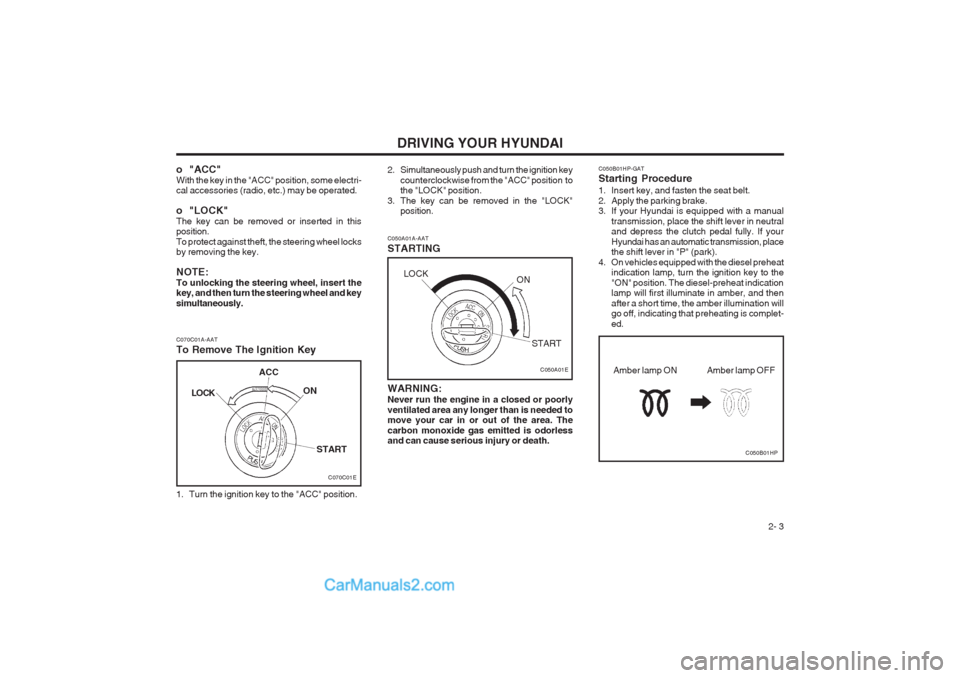
o "ACC" With the key in the "ACC" position, some electri- cal accessories (radio, etc.) may be operated.
o "LOCK" The key can be removed or inserted in this position. To protect against theft, the steering wheel locks by removing the key. NOTE: To unlocking the steering wheel, insert the key, and then turn the steering wheel and key simultaneously.
2. Simultaneously push and turn the ignition key
counterclockwise from the "ACC" position to the "LOCK" position.
3. The key can be removed in the "LOCK" position. C050B01HP-GAT Starting Procedure
1. Insert key, and fasten the seat belt.
2. Apply the parking brake.
3. If your Hyundai is equipped with a manual
transmission, place the shift lever in neutraland depress the clutch pedal fully. If your Hyundai has an automatic transmission, place the shift lever in "P" (park).
4. On vehicles equipped with the diesel preheat indication lamp, turn the ignition key to the "ON" position. The diesel-preheat indication lamp will first illuminate in amber, and then after a short time, the amber illumination will go off, indicating that preheating is complet- ed.
C050B01HP
Amber lamp OFF
Amber lamp ON
C070C01E
LOCK
ACC
ON
START
LOCK ON
START
Page 113 of 361
DRIVING YOUR HYUNDAI
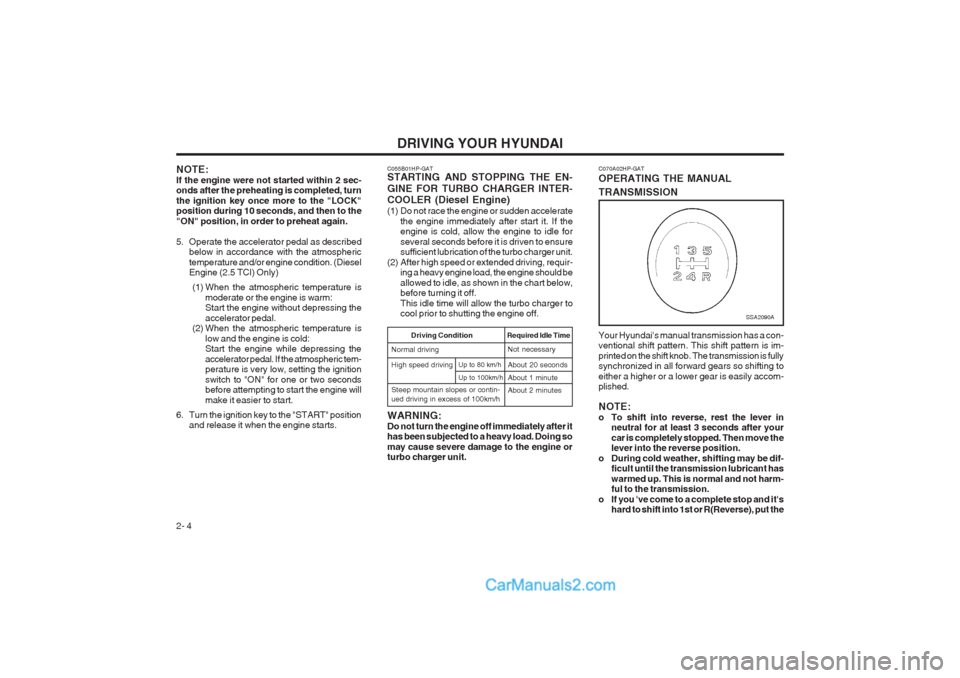
2- 4 C070A02HP-GAT OPERATING THE MANUAL TRANSMISSION Your Hyundai's manual transmission has a con- ventional shift pattern. This shift pattern is im- printed on the shift knob. The transmission is fully synchronized in all forward gears so shifting to either a higher or a lower gear is easily accom- plished. NOTE:
o To shift into reverse, rest the lever in
neutral for at least 3 seconds after yourcar is completely stopped. Then move the lever into the reverse position.
o During cold weather, shifting may be dif- ficult until the transmission lubricant has warmed up. This is normal and not harm- ful to the transmission.
o If you 've come to a complete stop and it's hard to shift into 1st or R(Reverse), put the
SSA2090A
NOTE: If the engine were not started within 2 sec- onds after the preheating is completed, turn the ignition key once more to the "LOCK" position during 10 seconds, and then to the "ON" position, in order to preheat again.
5. Operate the accelerator pedal as describedbelow in accordance with the atmospheric temperature and/or engine condition. (Diesel Engine (2.5 TCI) Only)
(1) When the atmospheric temperature is moderate or the engine is warm:Start the engine without depressing the accelerator pedal.
(2) When the atmospheric temperature is
low and the engine is cold: Start the engine while depressing the accelerator pedal. If the atmospheric tem- perature is very low, setting the ignition switch to "ON" for one or two seconds before attempting to start the engine will make it easier to start.
6. Turn the ignition key to the "START" position and release it when the engine starts. C055B01HP-GAT STARTING AND STOPPING THE EN- GINE FOR TURBO CHARGER INTER- COOLER (Diesel Engine)
(1) Do not race the engine or sudden accelerate
the engine immediately after start it. If the engine is cold, allow the engine to idle for several seconds before it is driven to ensure sufficient lubrication of the turbo charger unit.
(2) After high speed or extended driving, requir- ing a heavy engine load, the engine should be allowed to idle, as shown in the chart below, before turning it off. This idle time will allow the turbo charger to cool prior to shutting the engine off.
Required Idle Time
High speed driving Driving Condition
Normal drivingNot necessary About 20 seconds About 1 minute
Up to 100km/h
Up to 80 km/h
Steep mountain slopes or contin- ued driving in excess of 100km/h About 2 minutes
WARNING: Do not turn the engine off immediately after it has been subjected to a heavy load. Doing so may cause severe damage to the engine or turbo charger unit.
Page 114 of 361
DRIVING YOUR HYUNDAI 2- 5
C070B01A-AAT Using the Clutch The clutch should be pressed all the way to the floor before shifting, then released slowly. The clutch pedal should always be used after fully returning to the original position. Do not rest your foot on the clutch pedal while driving. This can cause unnecessary wear. Do not partially en- gage the clutch to hold the car on an incline. This causes unnecessary wear. Use the parking brake to hold the car on an incline. Do not operate the clutch pedal rapidly and repeatedly. shift lever in N(Neutral) position and re-lease the clutch. Press the clutch pedal back down, and then shift into 1st or R(Reverse) gear position.
o Do not use the shift lever as a handrest
during driving, as this can result in prema- ture wear of the transmission shift forks.
CAUTION: When downshifting from fifth gear to fourth gear, caution should be taken not to inadvert- ently press the gear shift lever sideways in such a manner that second gear is engaged. Such a drastic downshift may cause the en- gine speed to increase to the point that the tachometer will enter the red-zone. Such over- revving of the engine may possibly cause engine damage. C070D02O-AAT Good Driving Practices
o Never take the car out of gear and coast down
a hill. This is extremely hazardous. Always leave the car in gear.
o Don't "ride" the brakes. This can cause them
to overheat and malfunction. Instead, when you are driving down a long hill, slow down and shift to a lower gear. When you do this, engine braking will help slow the car.
o Slow down before shifting to a lower gear. This will help avoid over-revving the engine, which can cause damage.
o Slow down when you encounter cross winds.
This gives you much better control of your car.
o Be sure the car is completely stopped before you attempt to shift into reverse. The trans- mission can be damaged if you do not. To shift into reverse, depress the clutch, move the shift lever to neutral, wait three seconds, then shift to the reverse position.
o Exercise extreme caution when driving on a slippery surface. Be especially careful when braking, accelerating or shifting gears. On a slippery surface, an abrupt change in vehicle speed can cause the drive wheels to lose traction and the vehicle to go out of control.
WARNING:
o Avoid high cornering speeds.
o Do not make quick steering wheel move- ments, such as sharp lane changes orfast, sharp turns. C070E03A-GAT RECOMMENDED SHIFT POINTS
1-2 2-3 3-4 4-5
Shift
from-to Recommended
20 km/h (15 mph) 40 km/h (25 mph) 55 km/h (35 mph)75 km/h (45 mph)
The shift points as shown above are recom- mended for optimum fuel economy and perfor- mance.
o Always wear your seat belts.
In a collision crash, an unbelted person is significantly more likely to die than a per- son wearing a seatbelt.
o The risk of rollover is greatly increased if
you lose control of your vehicle at high- way speeds.
o Loss of control often occurs if two or more wheels drop off the roadway and the driver oversteers to reenter the roadway.
o In the event your vehicle leaves the road-
way, do not steer sharply. Instead, slow down before pulling back into the travel lanes.
o Never exceed posted speed limits.
Page 117 of 361
DRIVING YOUR HYUNDAI
2- 8
o Do not "ride" the brakes. This can cause them
to overheat and malfunction. Instead, when you are driving down a long hill, slow down and shift to a lower gear. When you do this, engine braking will help slow the car.
o Slow down before shifting to a lower gear.
Otherwise, the lower gear may not be en- gaged.
o Always use the parking brake. Do not depend on placing the transmission in "P" to keep the car from moving.
o Exercise extreme caution when driving on a
slippery surface. Be especially careful when braking, accelerating or shifting gears. On a slippery surface, an abrupt change in vehicle speed can cause the drive wheels to lose traction and the vehicle to go out of control.
WARNING:
o Avoid high cornering speeds.
o Do not make quick steering wheel move- ments, such as sharp lane changes orfast, sharp turns.
o Always wear your seat belts.
In a collision crash, an unbelted person is significantly more likely to die than a per- son wearing a seatbelt.
o The risk of rollover is greatly increased if
you lose control of your vehicle at high- way speeds.
o Loss of control often occurs if two or more wheels drop off the roadway and the driver oversteers to reenter the roadway. C120A02A-AAT ANTI-LOCK BRAKE SYSTEM (If installed) The Anti-Lock Brake System (ABS) is designed to prevent wheel lock-up during sudden braking or on hazardous road surfaces. The ABS control module monitors the wheel speed and controls the pressure applied to each brake. Thus, in emergency situations or on slick roads, ABS will increase vehicle control during braking. NOTE: During ABS operation, a slight pulsation may be felt in the brake pedal when the brakes are applied. Also, a noise may be heard in the engine compartment while braking. These conditions are normal and indicate that the anti-lock brake system is functioning prop- erly.
D090A01P-GAT FOUR-WHEEL DRIVE (4WD) You can send your engine power to all front and rear wheels for maximum power. 4WD is useful when you drive in snow, mud, ice, mountainous or sandy areas where good traction is required, or when your wheels lose traction using two- wheel drive.
WARNING:ABS will not prevent accidents due to im- proper or dangerous driving maneuvers. Even though vehicle control is improved during emergency braking, always maintain a safe distance between you and objects ahead. Vehicle speeds should always be reduced during extreme road conditions. The braking distance for cars equipped with an anti-lock braking system may be longer than for those without it in the following road conditions. During these conditions the ve- hicle should be driven at reduced speeds.
o Rough, gravel or snow-covered roads.
o With tire chains installed.
o Roads where the road surface is pitted or
has different surface height.
The safety features of an ABS equipped ve-hicle should not be tested by high speed driving or cornering. This could endanger the safety of yourself or others.
o In the event your vehicle leaves the road-
way, do not steer sharply. Instead, slowdown before pulling back into the travel lanes.
o Never exceed posted speed limits.
Page 121 of 361
DRIVING YOUR HYUNDAI
2- 12 WARNING: Keep away from the front of the vehicle while inspecting. This is very dangerous as the vehicle can jump forward and cause serious injury or death.
(9) When using tire chains, always attach them
to the rear wheels.
(10) I f the front or rear wheels get stuck in the
mud, do not spin them recklessly. The 4WD system could be damaged.
Driving on dry paved road and high- way Select the AUTO to drive on dry paved roads. Especially on dry highway, never select the LOW. Driving on snowy or icy roads Select the AUTO or LOW in accordance with the road conditions, and then gradually depress the accelerator pedal for a smooth start. Driving on sandy or muddy roads Select the LOW and then gradually depress the accelerator pedal for a smooth start. Keep the pressure on the accelerator pedal constant as possible, and drive at low speed.
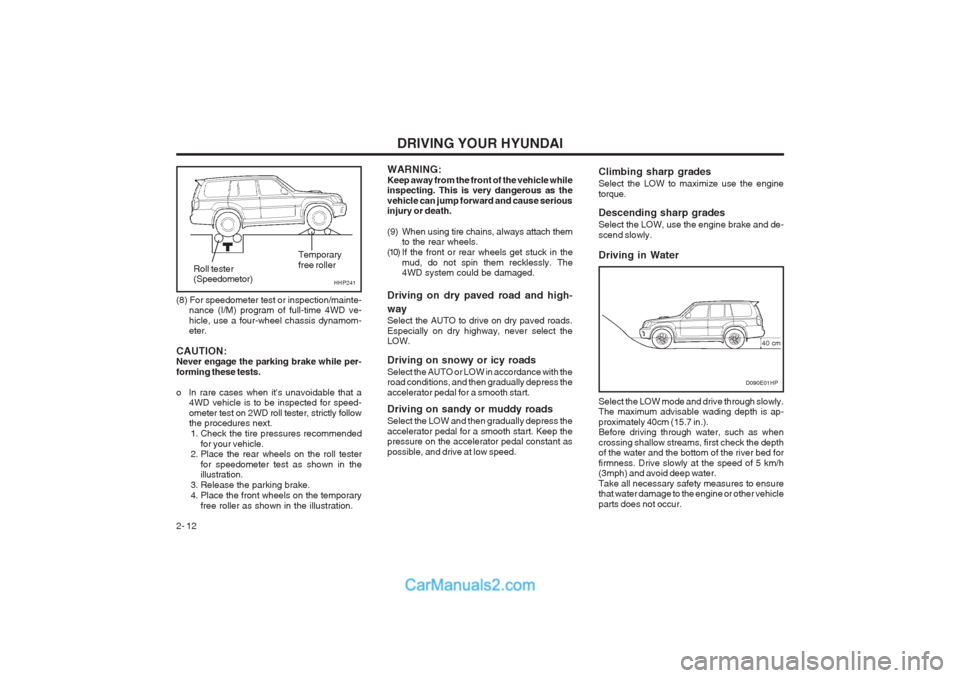
(8) For speedometer test or inspection/mainte-
nance (I/M) program of full-time 4WD ve-hicle, use a four-wheel chassis dynamom- eter.
CAUTION:Never engage the parking brake while per- forming these tests.
o In rare cases when it's unavoidable that a 4WD vehicle is to be inspected for speed- ometer test on 2WD roll tester, strictly follow the procedures next.
1. Check the tire pressures recommended for your vehicle.
2. Place the rear wheels on the roll tester
for speedometer test as shown in theillustration.
3. Release the parking brake.
4. Place the front wheels on the temporary free roller as shown in the illustration.
HHP241
Roll tester (Speedometor) Temporary free roller
D090E01HP
40 cm
Climbing sharp grades Select the LOW to maximize use the engine torque. Descending sharp grades Select the LOW, use the engine brake and de- scend slowly. Driving in Water Select the LOW mode and drive through slowly. The maximum advisable wading depth is ap- proximately 40cm (15.7 in.). Before driving through water, such as when crossing shallow streams, first check the depth of the water and the bottom of the river bed for firmness. Drive slowly at the speed of 5 km/h (3mph) and avoid deep water. Take all necessary safety measures to ensure that water damage to the engine or other vehicle parts does not occur.