warning Hyundai Terracan 2004 User Guide
[x] Cancel search | Manufacturer: HYUNDAI, Model Year: 2004, Model line: Terracan, Model: Hyundai Terracan 2004Pages: 361, PDF Size: 4.69 MB
Page 26 of 361
FEATURES OF YOUR HYUNDAI
1- 18
B150A02A-GAT SEAT BELT PRECAUTIONSAll occupants of the vehicle should wear their
seat belts at all times. Indeed, your province'slaws may require that some or all occupants ofthe vehicle use seat belts.The possibility of injury or the severity of injury inan accident will be decreased if this elementarysafety precaution is observed. In addition, followthe other instructions provided in this section.
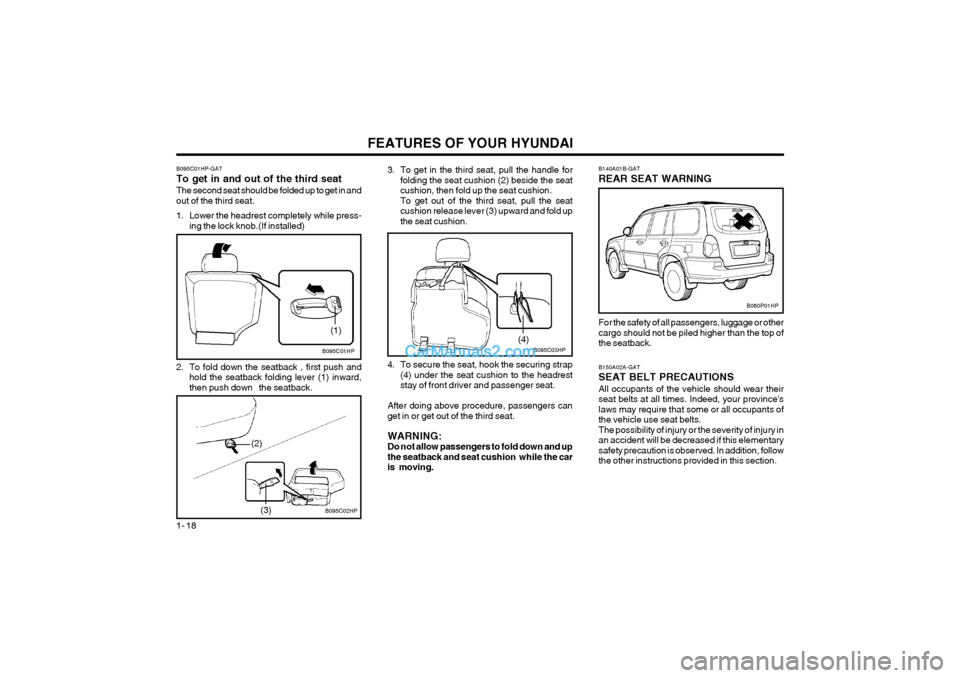
3. To get in the third seat, pull the handle for
folding the seat cushion (2) beside the seatcushion, then fold up the seat cushion.To get out of the third seat, pull the seatcushion release lever (3) upward and fold upthe seat cushion.
4. To secure the seat, hook the securing strap (4) under the seat cushion to the headreststay of front driver and passenger seat.
After doing above procedure, passengers canget in or get out of the third seat. WARNING: Do not allow passengers to fold down and upthe seatback and seat cushion while the caris moving.
B095C03HP
(4)
B140A01B-GAT REAR SEAT WARNING
B080P01HP
For the safety of all passengers, luggage or other cargo should not be piled higher than the top ofthe seatback.
B095C01HP-GAT To get in and out of the third seatThe second seat should be folded up to get in and out of the third seat.
1. Lower the headrest completely while press- ing the lock knob.(If installed)
2. To fold down the seatback , first push and hold the seatback folding lever (1) inward, then push down the seatback.
B095C01HP
B095C02HP
(1)
(3)
(2)
Page 27 of 361
FEATURES OF YOUR HYUNDAI 1- 19
B150B01Y-GAT Infant or Small ChildSome countries require the use of child restraint
systems for infants and small children. Whetherthis is required by law or not, it is stronglyrecommended that a child restraint seat or infantrestraint system be used for infants or smallchildren weighing less than 18 kilograms (40pounds). NOTE: Small children are best protected in an acci-
dent when properly restrained by a childrestraint system. B150C02A-AAT Larger ChildrenChildren who are too large for child restraint systems should always occupy the rear seat anduse the available lap/shoulder belts. The lapportion should be fastened snug on the hips andas low as possible. Check belt fit periodically. Achild's squirming could put the belt out of posi-tion. Children are afforded the most safety in theevent of an accident when they are restrained bya proper restraint system in the rear seat. If alarger child (over age 13) must be seated in thefront seat, the child should be securely restrainedby the available lap/shoulder belt and the seatshould be placed in the rearmost position. Chil-dren under the age of 13 should be restrainedsecurely in the rear seat. NEVER place a childunder the age of 13 in the front seat. NEVERplace a rear facing child seat in the front seat ofa vehicle.
B150E01A-AAT Injured Person A seat belt should be used when an injured person is being transported. When this is neces-sary, you should consult a physician for recom-mendations. B150F01A-AAT One Person Per Belt Two people (including children) should never attempt to use a single seat belt. This couldincrease the severity of injuries in case of anaccident. B150G01A-AAT Do Not Lie DownTo reduce the chance of injuries in the event of an accident and to achieve maximum effectivenessof the restraint system, all passengers should besitting up and the front seats should be in anupright position when the car is moving. A seatbelt cannot operate properly if the person is lyingdown in the rear seat or if the front seat is in areclined position.
B150D01A-AAT Pregnant WomenThe use of a seat belt is recommended for pregnant women to lessen the chance of injury inan accident. When a seat belt is used, the lap beltportion should be placed as low and snugly aspossible on the hips, not across the abdomen.For specific recommendations, consult a physi-cian.
WARNING:Sitting in a reclined position or lying downwhen your vehicle is in motion can be dan-gerous. Even if you buckle up, your seat beltscan't do their job when you're reclined.The shoulder belt can't do its job because itwon't be against your body. Instead, it will bein front of you. In a crash you could go into itwith great force, receiving serious neck orother injuries.The lap belt can't do its job either. In a crashthe belt could go up over your abdomen. Thebelt forces would be applied there, not at yourstrong pelvic bones.This could cause serious internal injuries.For proper protection when the vehicle is inmotion, have the seatback upright. Then sitwell back in the seat and wear your seat beltproperly. See page 1-21. B160A01A-AAT CARE OF SEAT BELTS Seat belt systems should never be disassem- bled or modified. In addition, care should betaken to assure that seat belts and belt hardwareare not damaged by seat hinges, doors or otherabuse. WARNING: When you return the rear seatback to itsupright position after the rear seatback wasfolded down, be careful not to damage theseat belt webbing or buckle. Be sure that thewebbing or buckle does not get caught orpinched in the rear seat.
Page 28 of 361
FEATURES OF YOUR HYUNDAI
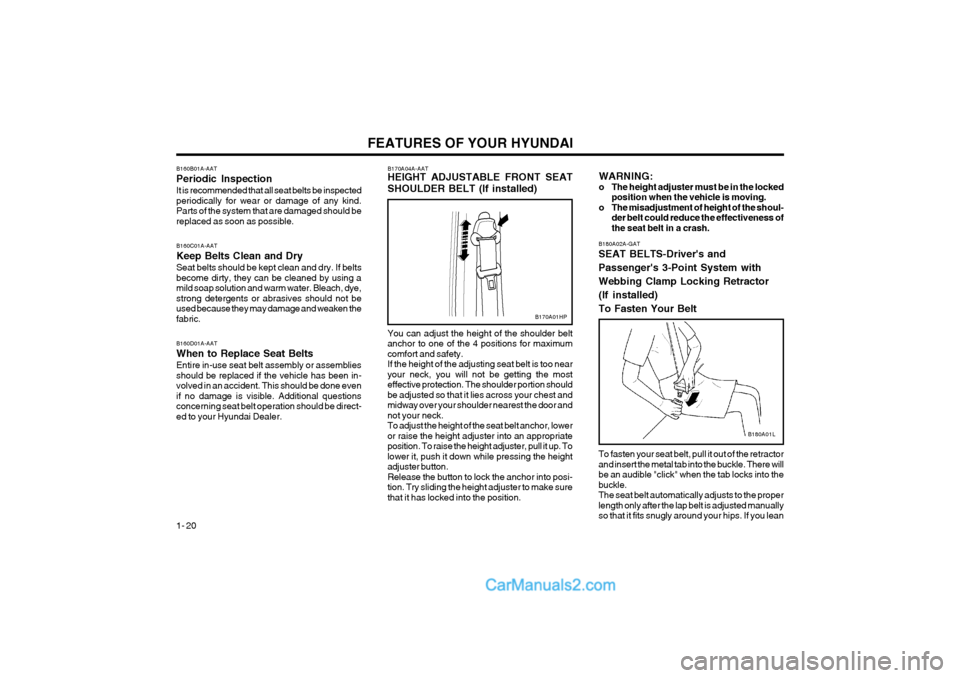
1- 20 To fasten your seat belt, pull it out of the retractor and insert the metal tab into the buckle. There willbe an audible "click" when the tab locks into thebuckle.The seat belt automatically adjusts to the properlength only after the lap belt is adjusted manuallyso that it fits snugly around your hips. If you lean
B180A02A-GAT SEAT BELTS-Driver's and Passenger's 3-Point System withWebbing Clamp Locking Retractor(If installed)To Fasten Your Belt
B180A01L
B170A04A-AAT HEIGHT ADJUSTABLE FRONT SEAT SHOULDER BELT (If installed)
B170A01HP
You can adjust the height of the shoulder belt anchor to one of the 4 positions for maximumcomfort and safety.If the height of the adjusting seat belt is too nearyour neck, you will not be getting the mosteffective protection. The shoulder portion shouldbe adjusted so that it lies across your chest andmidway over your shoulder nearest the door andnot your neck.To adjust the height of the seat belt anchor, loweror raise the height adjuster into an appropriateposition. To raise the height adjuster, pull it up. Tolower it, push it down while pressing the heightadjuster button.Release the button to lock the anchor into posi-tion. Try sliding the height adjuster to make surethat it has locked into the position. WARNING:
o The height adjuster must be in the locked
position when the vehicle is moving.
o The misadjustment of height of the shoul- der belt could reduce the effectiveness ofthe seat belt in a crash.
B160B01A-AAT Periodic InspectionIt is recommended that all seat belts be inspected periodically for wear or damage of any kind.Parts of the system that are damaged should bereplaced as soon as possible. B160C01A-AAT Keep Belts Clean and DrySeat belts should be kept clean and dry. If belts become dirty, they can be cleaned by using amild soap solution and warm water. Bleach, dye,strong detergents or abrasives should not beused because they may damage and weaken thefabric. B160D01A-AAT When to Replace Seat Belts Entire in-use seat belt assembly or assemblies should be replaced if the vehicle has been in-volved in an accident. This should be done evenif no damage is visible. Additional questionsconcerning seat belt operation should be direct-ed to your Hyundai Dealer.
Page 30 of 361
FEATURES OF YOUR HYUNDAI
1- 22
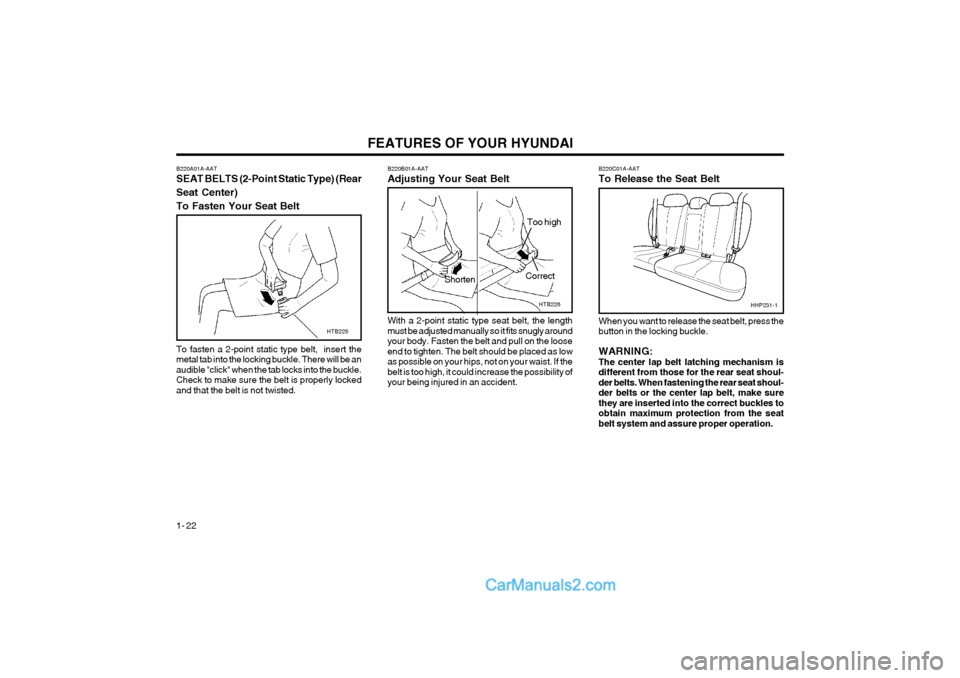
B220C01A-AAT To Release the Seat Belt When you want to release the seat belt, press the button in the locking buckle. WARNING: The center lap belt latching mechanism isdifferent from those for the rear seat shoul-der belts. When fastening the rear seat shoul-der belts or the center lap belt, make surethey are inserted into the correct buckles toobtain maximum protection from the seatbelt system and assure proper operation.
B220B01A-AAT Adjusting Your Seat Belt
HTB226
With a 2-point static type seat belt, the length must be adjusted manually so it fits snugly aroundyour body. Fasten the belt and pull on the looseend to tighten. The belt should be placed as lowas possible on your hips, not on your waist. If thebelt is too high, it could increase the possibility ofyour being injured in an accident. Correct
Shorten Too high
HTB225
B220A01A-AAT SEAT BELTS (2-Point Static Type) (Rear Seat Center)To Fasten Your Seat Belt To fasten a 2-point static type belt, insert the metal tab into the locking buckle. There will be anaudible "click" when the tab locks into the buckle.Check to make sure the belt is properly lockedand that the belt is not twisted.
HHP231-1
Page 31 of 361
FEATURES OF YOUR HYUNDAI 1- 23
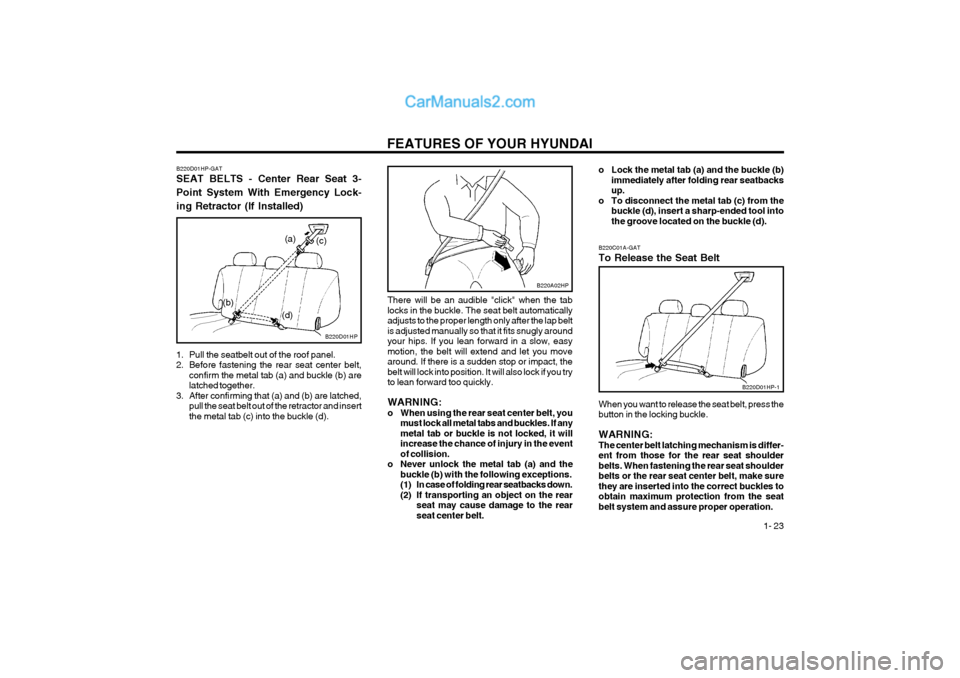
B220D01HP-GAT SEAT BELTS - Center Rear Seat 3- Point System With Emergency Lock-ing Retractor (If Installed)
1. Pull the seatbelt out of the roof panel.
2. Before fastening the rear seat center belt,
confirm the metal tab (a) and buckle (b) arelatched together.
3. After confirming that (a) and (b) are latched, pull the seat belt out of the retractor and insertthe metal tab (c) into the buckle (d).
B220D01HP There will be an audible "click" when the tab locks in the buckle. The seat belt automaticallyadjusts to the proper length only after the lap beltis adjusted manually so that it fits snugly aroundyour hips. If you lean forward in a slow, easymotion, the belt will extend and let you movearound. If there is a sudden stop or impact, thebelt will lock into position. It will also lock if you tryto lean forward too quickly. WARNING:
o When using the rear seat center belt, you
must lock all metal tabs and buckles. If anymetal tab or buckle is not locked, it willincrease the chance of injury in the eventof collision.
o Never unlock the metal tab (a) and the buckle (b) with the following exceptions.
(1) In case of folding rear seatbacks down.
(2) If transporting an object on the rear seat may cause damage to the rearseat center belt.
B220A02HP o Lock the metal tab (a) and the buckle (b)
immediately after folding rear seatbacks up.
o To disconnect the metal tab (c) from the buckle (d), insert a sharp-ended tool intothe groove located on the buckle (d).
B220C01A-GAT To Release the Seat Belt When you want to release the seat belt, press the button in the locking buckle. WARNING: The center belt latching mechanism is differ-ent from those for the rear seat shoulderbelts. When fastening the rear seat shoulderbelts or the rear seat center belt, make surethey are inserted into the correct buckles toobtain maximum protection from the seatbelt system and assure proper operation.
B220D01HP-1
(a)
(b) (c)
(d)
Page 32 of 361
FEATURES OF YOUR HYUNDAI
1- 24
B230A03P-GAT CHILD RESTRAINT SYSTEM (If Installed) Children riding in the car should sit in the rear seat and must always be properly restrained tominimize the risk of injury in an accident, suddenstop or sudden maneuver. According to accidentstatistics, children are safer when properly re-strained in the rear seats than in the front seat.Larger children not in a child restraint should useone of the seat belts provided.You are required by law to use safety restraintsfor children. If small children ride in your vehicleyou must put them in a child restraint system(safety seat).Children could be injured or killed in a crash iftheir restraints are not properly secured. Forsmall children and babies, a child seat or infantseat must be used. Before buying a particularchild restraint system, make sure it fits your carand seat belts, and fits your child. Follow all theinstructions provided by the manufacturer wheninstalling the child restraint system.
WARNING:
o A child restraint system must be placed in
the rear seat. Never install a child or infantseat on the front passenger's seat.Should an accident occur and cause the
passenger's side airbag to deploy, it couldseverely injure or kill an infant or childseated in an infant or child seat. Thus,only use a child restraint in the rear seat ofyour vehicle.
o Since a safety belt or child restraint sys- tem can become very hot if it is left in aclosed vehicle, be sure to check the seatcover and buckles before placing a childthere.
o When the child restraint system is not in use, fasten it with a safety belt so that itwill not be thrown forward in the case of asudden stop or an accident.
o Children who are too large to be in a child restraint should sit in the rear seat and berestrained with the available lap/shoulderbelts. Never allow children to ride in thefront passenger seat.
o Always make sure that the shoulder belt portion of the outboard lap/shoulder beltis positioned midway over the shoulder,never across the neck or behind the back.Moving the child closer to the center of thevehicle may help provide a good shoulderbelt fit. The lap belt portion of the lap/shoulder belt or the center seat lap beltmust always be positioned as low as pos-sible on the child's hips and as snug aspossible. o If the seat belt will not properly fit the
child, Hyundai recommends the use of anapproved booster seat in the rear seat inorder to raise the child's seating height sothat the seat belt will properly fit the child.
o Never allow a child to stand up or kneel on the seat.
o Never use an infant carrier or child safety seat that "hooks" over a seatback; it maynot provide adequate security in an acci-dent.
o Never allow a child to be held in a person's arms while they are in a moving vehicle, asthis could result in serious injury to thechild in the event of an accident or asudden stop. Holding a child in a movingvehicle does not provide the child withany means of protection during an acci-dent, even if the person holding the childis wearing a seat belt.
o If the child restraint seat is not anchored properly, the risk of a child being seri-ously injured or killed in a collision greatlyincreases.
Page 33 of 361
FEATURES OF YOUR HYUNDAI 1- 25
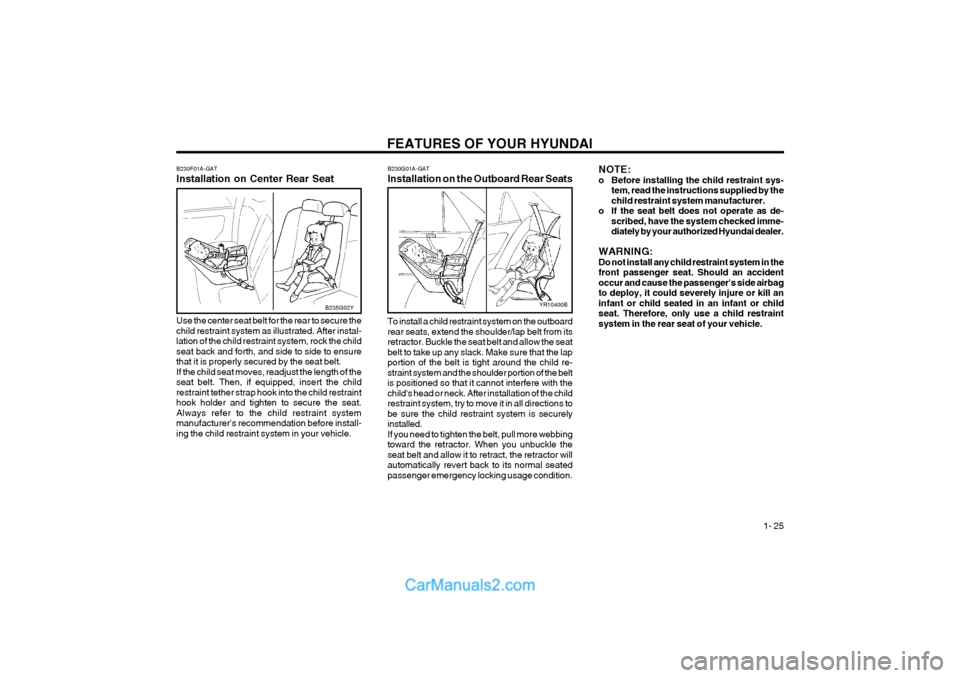
B230F01A-GAT Installation on Center Rear Seat Use the center seat belt for the rear to secure the child restraint system as illustrated. After instal-lation of the child restraint system, rock the childseat back and forth, and side to side to ensurethat it is properly secured by the seat belt.If the child seat moves, readjust the length of theseat belt. Then, if equipped, insert the childrestraint tether strap hook into the child restrainthook holder and tighten to secure the seat.Always refer to the child restraint systemmanufacturer's recommendation before install-ing the child restraint system in your vehicle.
B230G01A-GAT Installation on the Outboard Rear Seats To install a child restraint system on the outboard rear seats, extend the shoulder/lap belt from itsretractor. Buckle the seat belt and allow the seatbelt to take up any slack. Make sure that the lapportion of the belt is tight around the child re-straint system and the shoulder portion of the beltis positioned so that it cannot interfere with thechild's head or neck. After installation of the childrestraint system, try to move it in all directions tobe sure the child restraint system is securelyinstalled.If you need to tighten the belt, pull more webbingtoward the retractor. When you unbuckle theseat belt and allow it to retract, the retractor willautomatically revert back to its normal seatedpassenger emergency locking usage condition.
B235G02YYR10400B
NOTE:
o Before installing the child restraint sys-
tem, read the instructions supplied by thechild restraint system manufacturer.
o If the seat belt does not operate as de- scribed, have the system checked imme-diately by your authorized Hyundai dealer.
WARNING:Do not install any child restraint system in thefront passenger seat. Should an accidentoccur and cause the passenger's side airbagto deploy, it could severely injure or kill aninfant or child seated in an infant or childseat. Therefore, only use a child restraintsystem in the rear seat of your vehicle.
Page 36 of 361
FEATURES OF YOUR HYUNDAI
1- 28
WARNING:
o Do not install a child restraint seat at the
center of the rear seat using the vehicle'sISOFIX anchors. The ISOFIX anchors areonly provided for the left and right out-board rear seating positions. Do not mis-use the ISOFIX anchors by attempting toattach a child restraint seat in the middleof the rear seat to the ISOFIX anchors. Ina crash, the child restraint seat ISOFIXattachments may not be strong enough tosecure the child restraint seat properly inthe center of the rear seat and may break,causing serious injury or death.
o Do not mount more than one child re- straint to a child restraint lower anchor-age point. The improper increased loadmay cause the anchorage points or tetheranchor to break, causing serious injury ordeath.
o Attach the ISOFIX or ISOFIX-compatible child restraint seat only to the appropriatelocations shown in the illustration.
o Always follow the installation and use instructions provided by the manufacturerof the child restraint.
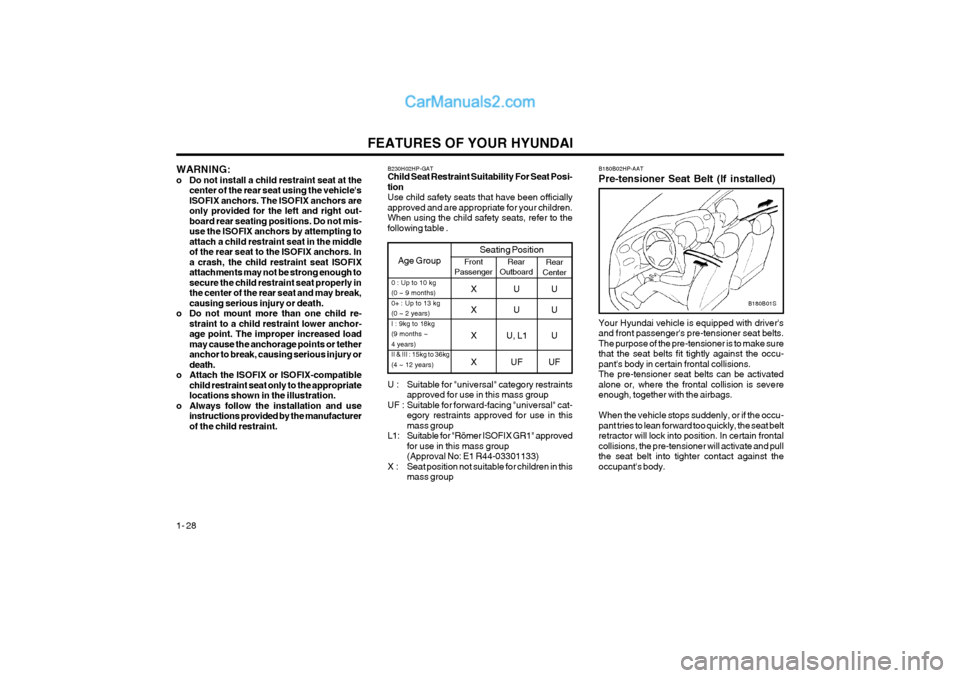
Age Group Seating PositionFront
Passenger Rear
Outboard Rear
Center
0 : Up to 10 kg (0 ~ 9 months)0+ : Up to 13 kg(0 ~ 2 years)I : 9kg to 18kg(9 months ~4 years)II & III : 15kg to 36kg(4 ~ 12 years)XUU
XUU
X U, L1 U XU FUF
B230H02HP-GAT Child Seat Restraint Suitability For Seat Posi- tionUse child safety seats that have been officiallyapproved and are appropriate for your children.When using the child safety seats, refer to thefollowing table .
U : Suitable for "universal" category restraints approved for use in this mass group
UF : Suitable for forward-facing "universal" cat- egory restraints approved for use in thismass group
L1: Suitable for "Römer ISOFIX GR1" approved for use in this mass group(Approval No: E1 R44-03301133)
X : Seat position not suitable for children in this mass group Your Hyundai vehicle is equipped with driver'sand front passenger's pre-tensioner seat belts.The purpose of the pre-tensioner is to make surethat the seat belts fit tightly against the occu-pant's body in certain frontal collisions.The pre-tensioner seat belts can be activatedalone or, where the frontal collision is severeenough, together with the airbags. When the vehicle stops suddenly, or if the occu- pant tries to lean forward too quickly, the seat beltretractor will lock into position. In certain frontalcollisions, the pre-tensioner will activate and pullthe seat belt into tighter contact against theoccupant's body.
B180B02HP-AAT Pre-tensioner Seat Belt (If installed)
B180B01S
Page 37 of 361
FEATURES OF YOUR HYUNDAI 1- 29
nated after blinking for approximately 6 seconds, or if it illuminates while the ve-hicle is being driven, please have an au-thorized Hyundai dealer inspect the pre-tensioner seat belts and SRS airbag sys-tem as soon as possible.
WARNING:
o Pre-tensioners are designed to operate only one time. After activation, pre-tensioner seat belts must be replaced. Allseat belts, of any type, should always bereplaced after they have been worn duringa collision.
o The pre-tensioner seat belt assembly mechanisms become hot during activa-tion. Do not touch the pre-tensioner seatbelt assemblies for several minutes afterthey have been activated.
o Do not attempt to inspect or replace the pre-tensioner seat belts yourself. Thismust be done by an authorized Hyundaidealer.
o Do not strike the pre-tensioner seat belt assemblies.
o Do not attempt to service or repair the pre- tensioner seat belt system in any manner.
o Improper handling of the pre-tensioner seat belt assemblies, and failure to heedthe warnings to not strike, modify, insp-ect, replace, service or repair the pre-tensioner seat belt assemblies may leadto improper operation or inadvertent acti-vation and serious injury.
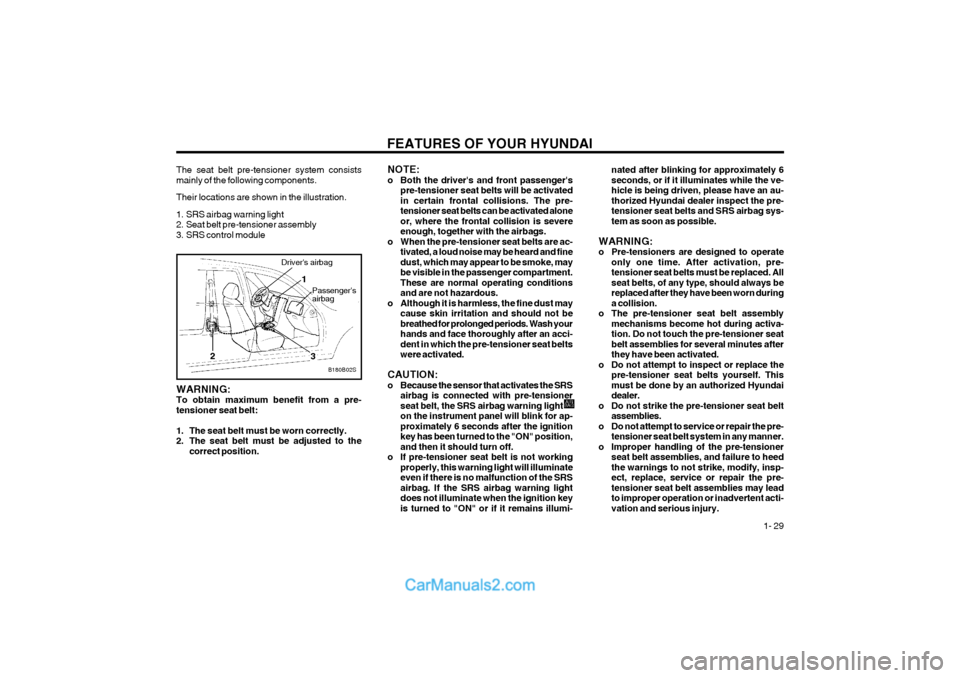
The seat belt pre-tensioner system consistsmainly of the following components. Their locations are shown in the illustration.
1. SRS airbag warning light
2. Seat belt pre-tensioner assembly
3. SRS control module
B180B02S
Driver's airbag
1
3
Passenger's airbag
WARNING: To obtain maximum benefit from a pre-tensioner seat belt:
1. The seat belt must be worn correctly.
2. The seat belt must be adjusted to the correct position. NOTE:
o Both the driver's and front passenger's
pre-tensioner seat belts will be activatedin certain frontal collisions. The pre-tensioner seat belts can be activated aloneor, where the frontal collision is severeenough, together with the airbags.
o When the pre-tensioner seat belts are ac- tivated, a loud noise may be heard and finedust, which may appear to be smoke, maybe visible in the passenger compartment.These are normal operating conditionsand are not hazardous.
o Although it is harmless, the fine dust may cause skin irritation and should not bebreathed for prolonged periods. Wash yourhands and face thoroughly after an acci-dent in which the pre-tensioner seat beltswere activated.
CAUTION:
o Because the sensor that activates the SRS airbag is connected with pre-tensionerseat belt, the SRS airbag warning lighton the instrument panel will blink for ap-proximately 6 seconds after the ignitionkey has been turned to the "ON" position,and then it should turn off.
o If pre-tensioner seat belt is not working properly, this warning light will illuminateeven if there is no malfunction of the SRSairbag. If the SRS airbag warning lightdoes not illuminate when the ignition keyis turned to "ON" or if it remains illumi-
AIR
BAG
2
Page 38 of 361
FEATURES OF YOUR HYUNDAI
1- 30 NOTE: Be sure to read information about the SRS onthe labels provided on the backside of thesun visor and in the glove box. WARNING:
o As its name implies, the SRS is designed
to work with, and be supplemental to, thedriver's and the passenger's three pointseat belt systems and is not a substitutefor them. Therefore, your seat belts mustbe worn at all times while the vehicle is inmotion. The airbags deploy only in certainfrontal impact conditions severe enoughto likely cause significant injury to thevehicle occupants.
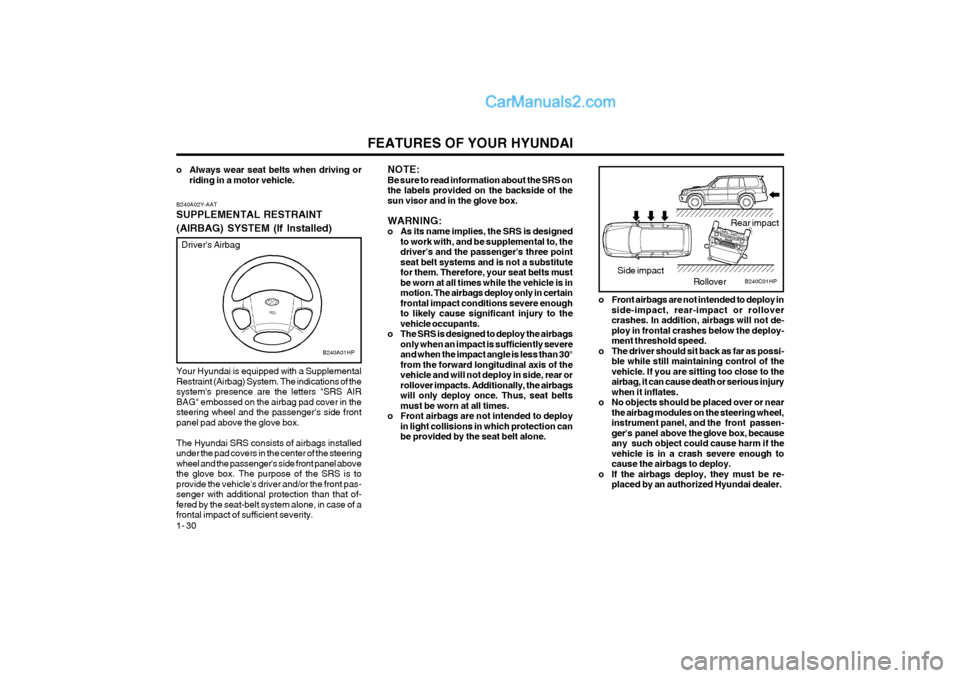
o The SRS is designed to deploy the airbags only when an impact is sufficiently severeand when the impact angle is less than 30°from the forward longitudinal axis of thevehicle and will not deploy in side, rear orrollover impacts. Additionally, the airbagswill only deploy once. Thus, seat beltsmust be worn at all times.
o Front airbags are not intended to deploy in light collisions in which protection canbe provided by the seat belt alone.
o Always wear seat belts when driving or
riding in a motor vehicle.
B240A02Y-AAT SUPPLEMENTAL RESTRAINT (AIRBAG) SYSTEM (If Installed) Your Hyundai is equipped with a Supplemental
Restraint (Airbag) System. The indications of the
system's presence are the letters "SRS AIRBAG" embossed on the airbag pad cover in the
steering wheel and the passenger's side frontpanel pad above the glove box. The Hyundai SRS consists of airbags installed
under the pad covers in the center of the steeringwheel and the passenger's side front panel abovethe glove box. The purpose of the SRS is toprovide the vehicle's driver and/or the front pas-senger with additional protection than that of-fered by the seat-belt system alone, in case of afrontal impact of sufficient severity. Driver's Airbag
B240A01HP
B240C01HP
Rear impact
Side impact Rollover
o Front airbags are not intended to deploy in side-impact, rear-impact or rollover crashes. In addition, airbags will not de-ploy in frontal crashes below the deploy-ment threshold speed.
o The driver should sit back as far as possi- ble while still maintaining control of thevehicle. If you are sitting too close to theairbag, it can cause death or serious injurywhen it inflates.
o No objects should be placed over or near the airbag modules on the steering wheel,instrument panel, and the front passen-ger's panel above the glove box, becauseany such object could cause harm if thevehicle is in a crash severe enough tocause the airbags to deploy.
o If the airbags deploy, they must be re- placed by an authorized Hyundai dealer.