fuel INFINITI M 2010 Owner's Guide
[x] Cancel search | Manufacturer: INFINITI, Model Year: 2010, Model line: M, Model: INFINITI M 2010Pages: 445, PDF Size: 6.15 MB
Page 299 of 445

5-speed model :
Shift ranges up or down one by one as follows:
M1!
ÃM2!
ÃM3!
ÃM4!
ÃM5
M5 (5th):
Use this position for all normal forward driving
at highway speeds.
M4 (4th):
Use this position when driving up long slopes,
or for engine braking when driving down long
slopes.
M3 (3rd) andM2 (2nd):
Use these positions for hill climbing or engine
braking on downhill grades.
M1 (1st):
Use this position when climbing steep hills
slowly or driving slowly through deep snow, or
for maximum engine braking on steep downhill
grades. 7-speed model :
Shift ranges up or down one by one as follows:
M1
!
ÃM2!
ÃM3!
ÃM4!
ÃM5!
ÃM6!
ÃM7
M7 (7th):
Use this position for all normal forward driving
at highway speeds.
M6 (6th) andM5 (5th):
Use these positions when driving up long
slopes, or for engine braking when driving
down long slopes.
M4 (4th),M3 (3rd) andM2 (2nd):
Use these positions for hill climbing or engine
braking on downhill grades.
M1 (1st):
Use this position when climbing steep hills
slowly or driving slowly through deep snow, or
for maximum engine braking on steep downhill
grades.
Precaution :
c Remember not to drive at high speeds for
extended periods of time in lower than 5th
gear (5-speed model) or 7th gear (7-speed
model). This reduces fuel economy. c
Moving the selector lever rapidly to the same
side twice will shift the ranges in succes-
sion.
c In the manual shift mode, the transmission
may not shift to the selected gear. This helps
maintain driving performance and reduces
the chance of vehicle damage or loss of con-
trol.
c In the manual shift mode, the transmission
automatically shifts down to 1st gear before
the vehicle comes to a stop. When accelerat-
ing again, it is necessary to shift up to the
desired range.
Accelerator downshift Ð In D (Drive)
position Ð
For passing or hill climbing, fully depress the
accelerator pedal to the floor. This shifts the
transmission down into the lower gear, depend-
ing on the vehicle speed.
Fail-safe
When the fail-safe operation occurs, note that
the transmission will be locked in any of the
forward gears according to the condition.
If the vehicle is driven under extreme conditions,
such as excessive wheel spinning and subse-
quent hard braking, the fail-safe system may be
activated. This will occur even if all electrical
5-14Starting and driving
wÐ
Ð
05/15/09Ðpattie
X
Page 331 of 445
CAUTION
During the first 1,200 miles (2,000 km), follow
these recommendations to obtain maximum
engine performance and ensure the future reli-
ability and economy of your new vehicle. Fail-
ure to follow these recommendations may re-
sult in shortened engine life and reduced
engine performance.
c Avoid driving for long periods at constant
speed, either fast or slow. Do not run the
engine over 4,000 rpm.
c Do not accelerate at full throttle in any gear.
c Avoid quick starts.
c Avoid hard braking as much as possible. c
Accelerate slowly and smoothly. Maintain
cruising speeds with a constant accelerator
position.
c Drive at moderate speeds on the highway.
Driving at high speed lowers fuel economy.
c Avoid unnecessary stopping and braking.
Keep a safe distance behind other vehicles.
c Select a gear range suitable to road condi-
tions.
c Avoid unnecessary engine idling.
c Keep your engine tuned up.
c Follow the recommended periodic mainte-
nance schedule.
c Keep the tires inflated to the correct pres-
sure. Low tire pressure increases tire wear
and lowers fuel economy.
c Keep the wheels in correct alignment. Im-
proper alignment increases tire wear and
lowers fuel economy.
c Climate control operation lowers fuel
economy. Use the air conditioner only when
necessary.
c When cruising at highway speeds, it is more
economical to use the air conditioner and
leave the windows closed to reduce drag. c
Use the recommended viscosity engine oil.
(See ªENGINE OIL AND OIL FILTER RECOM-
MENDATIONº in the ª9. Technical and con-
sumer informationº section.)
BREAK-IN SCHEDULE INCREASING FUEL ECONOMY
5-46Starting and driving
wÐ
Ð
05/15/09Ðpattie
X
Page 365 of 445

MOST COMMON FACTORS
CONTRIBUTING TO VEHICLE
CORROSION
cThe accumulation of moisture-retaining dirt
and debris in body panel sections, cavities,
and other areas.
c Damage to paint and other protective coat-
ings caused by gravel and stone chips or
minor traffic accidents.
ENVIRONMENTAL FACTORS INFLUENCE
THE RATE OF CORROSION
Moisture
Accumulation of sand, dirt and water on the
vehicle body underside can accelerate corro-
sion. Wet floor coverings will not dry completely
inside the vehicle, and should be removed for
drying to avoid floor panel corrosion.
Relative humidity
Corrosion will be accelerated in areas of high
relative humidity, especially those areas where
the temperatures stay above freezing where
atmospheric pollution exists, or where road salt
is used.
Temperature
A temperature increase will accelerate the rate
of corrosion to those parts which are not well
ventilated.
Air pollution
Industrial pollution, the presence of salt in the
air in coastal areas, or heavy road salt use will
accelerate the corrosion process. Road salt will
also accelerate the disintegration of paint sur-
faces.
TO PROTECT YOUR VEHICLE FROM
CORROSION
cWash and wax your vehicle often to keep the
vehicle clean.
c Always check for minor damage to the paint
and repair it as soon as possible.
c Keep drain holes at the bottom of the doors
open to avoid water accumulation.
c Check the underbody for accumulation of
sand, dirt or salt. If present, wash with water
as soon as possible.
CAUTION
cNEVER remove dirt, sand or other debris from
the passenger compartment by washing it
out with a hose. Remove dirt with a vacuum
cleaner.
c Never allow water or other liquids to come in
contact with electronic components inside
the vehicle as this may damage them.
Chemicals used for road surface deicing are
extremely corrosive. They accelerate corrosion
and deterioration of underbody components
such as the exhaust system, fuel and brake
lines, brake cables, floor pan and fenders.
In winter, the underbody must be cleaned peri-
odically.
For additional protection against rust and cor-
rosion, which may be required in some areas,
consult an INFINITI retailer.
CORROSION PROTECTION
7-6Appearance and care
wÐ
Ð
05/15/09Ðpattie
X
Page 369 of 445

Steering wheel:Check for changes in the steer-
ing conditions, such as excessive free play,
hard steering or strange noises.
Warning lights and chimes: Make sure that all
warning lights and chimes are operating prop-
erly.
Windshield defroster: Check that the air comes
out of the defroster outlets properly and in
sufficient quantity when operating the heater or
air conditioner.
Windshield wiper and washer*: Check that the
wipers and washer operate properly and that
the wipers do not streak.
Under the hood and vehicle
The maintenance items listed here should be
checked periodically (for example, each time
you check the engine oil or refuel).
Battery*: Check the fluid level in each cell. It
should be between the MAX and MIN lines.
Vehicles operated in high temperatures or un-
der severe condition require frequent checks of
the battery fluid level.
Brake fluid level*: Make sure that the brake
fluid level is between the MAX and MIN lines on
the reservoir.
Engine coolant level*: Check the coolant level
when the engine is cold. Engine drive belts*:
Make sure that the drive
belts are not frayed, worn, cracked or oily.
Engine oil level*: Check the level after parking
the vehicle on a level surface and turning off the
engine. Wait more than 10 or 15 minutes for the
oil to drain back into the oil pan.
Exhaust system: Make sure there are no loose
supports, cracks or holes. If the sound of the
exhaust seems unusual or there is a smell of
exhaust fumes, immediately have the exhaust
system inspected by an INFINITI retailer. (See
ªPRECAUTIONS WHEN STARTING AND DRIVINGº
in the ª5. Starting and drivingº section for
exhaust gas (carbon monoxide).)
Fluid leaks: Check under the vehicle for fuel, oil,
water or other fluid leaks after the vehicle has
been parked for a while. Water dripping from
the air conditioner after use is normal. If you
should notice any leaks or if gasoline fumes are
evident, check for the cause and have it cor-
rected immediately.
Power steering fluid level* and lines: Check the
level when the fluid is cold, with the engine off.
Check the lines for proper attachment, leaks,
cracks, etc.
Radiator and hoses: Check the front of the
radiator and clean off any dirt, insects, leaves, etc., that may have accumulated. Make sure the
hoses have no cracks, deformation, rot or loose
connections.
Underbody:
The underbody is frequently ex-
posed to corrosive substances such as those
used on icy roads or to control dust. It is very
important to remove these substances, other-
wise rust will form on the floor pan, frame, fuel
lines and around the exhaust system. At the
end of winter, the underbody should be thor-
oughly flushed with plain water, being careful
to clean those areas where mud and dirt may
accumulate. For additional information, see
ªCLEANING EXTERIORº in the ª7. Appearance
and careº section.
Windshield washer fluid*: Check that there is
adequate fluid in the reservoir.
8-4Maintenance and do-it-yourself
wÐ
Ð
05/19/09Ðtbrooks
X
Page 370 of 445

When performing any inspection or mainte-
nance work on your vehicle, always take care to
prevent serious accidental injury to yourself or
damage to the vehicle. The following are gen-
eral precautions which should be closely ob-
served.
WARNING
cPark the vehicle on a level surface, apply the
parking brake securely and block the wheels
to prevent the vehicle from moving. Move
the selector lever to P (Park).
c Be sure the ignition switch is in the LOCK
position when performing any parts replace-
ment or repairs.
c If you must work with the engine running,
keep your hands, clothing, hair and tools
away from moving fans, belts and any other
moving parts.
c It is advisable to secure or remove any loose
clothing and remove any jewelry, such as
rings, watches, etc. before working on your
vehicle.
c Always wear eye protection whenever you
work on your vehicle. c
If you must run the engine in an enclosed
space such as a garage, be sure there is
proper ventilation for exhaust gases to
escape.
c Never get under the vehicle while it is sup-
ported only by a jack. If it is necessary to
work under the vehicle, support it with
safety stands.
c Keep smoking materials, flame and sparks
away from fuel tank and the battery.
c Your vehicle is equipped with an automatic
engine cooling fan. It may come on at any
time without warning, even if the ignition
key is in the OFF position and the engine is
not running. To avoid injury, always discon-
nect the negative battery cable before work-
ing near the fan.
c The fuel filter or fuel lines should be serviced
by an INFINITI retailer because the fuel lines
are under high pressure even when the en-
gine is off.
CAUTION
cDo not work under the hood while the engine
is hot. Turn the engine off and wait until it
cools down. c
Avoid direct contact with used engine oil and
coolant. Improperly disposed engine oil, en-
gine coolant and/or other vehicle fluids can
damage the environment. Always conform to
local regulations for disposal of vehicle
fluid.
c Never connect or disconnect the battery or
any transistorized component while the ig-
nition switch is in the ON position.
c Never leave the engine or automatic trans-
mission related component harnesses dis-
connected while the ignition switch is in the
ON position.
This ª8. Maintenance and do-it-yourselfº sec-
tion gives instructions regarding only those
items which are relatively easy for an owner to
perform.
A genuine INFINITI Service Manual is also avail-
able. (See ªOWNER'S MANUAL/SERVICE
MANUAL ORDER INFORMATIONº in the ª9. Tech-
nical and consumer informationº section.)
You should be aware that incomplete or im-
proper servicing may result in operating diffi-
culties or excessive emissions, and could affect
warranty coverage. If in doubt about any servic-
ing, we recommend that it be done by an INFINITI
retailer.
MAINTENANCE PRECAUTIONS
Maintenance and do-it-yourself8-5
wÐ
Ð
05/19/09Ðtbrooks
X
Page 379 of 445

Engine oil and filter
1. Place a large drain pan under the drainplug.
2. Remove the oil filler cap.
3. Remove the drain plug
s1with a wrench
and completely drain the oil.
CAUTION
Be careful not to burn yourself, as the engine oil
is hot.
cWaste oil must be disposed of properly.
c Check your local regulations.
Perform steps 4 to 7 only when the engine oil
filter change is needed.
4. Loosen the oil filters2with an oil filter
wrench. Remove the oil filter by turning it
by hand.
5. Wipe the engine oil filter mounting sur- face with a clean rag.
CAUTION
Be sure to remove any old rubber gasket re-
maining on the mounting surface of the engine.
Failure to do so could lead to engine failure.
6. Coat the gasket on the new filter with clean engine oil.
7. Screw in the oil filter clockwise until a slight resistance is felt, then tighten ad-
ditionally more than 2/3 turn.
Oil filter tightening torque:11 to 15 ft-lb
(14.7 to 20.5 N´m)
8. Clean and re-install the drain plug with a new washer. Securely tighten the drain
plug with a wrench.
Drain plug tightening torque:22 to 29 ft-lb
(29 to 39 N´m)
Do not use excessive force.
9. Refill engine with recommended oil and install the oil filler cap securely.
CAUTION
The dipstick must be inserted in place to pre-
vent oil spillage from the dipstick hole while
filling the engine with oil.
See ªCAPACITIES AND RECOMMENDED
FUEL/LUBRICANTSº in the ª9. Technical and
consumer informationº section for drain and refill capacity. The drain and refill capacity
depends on the oil temperature and drain time.
Use these specifications for reference only.
Always use the dipstick to determine the proper
amount of oil in the engine.
10. Start the engine and check for leakage
around the drain plug and the oil filter.
Correct as required.
11. Turn the engine off and wait more than 15 minutes. Check the oil level with the
dipstick. Add engine oil if necessary.
After the operation
1. Install the engine undercover into positionas the following steps.
a. Pull the center of the small plastic clip out.
b. Hold the engine undercover into position.
c. Insert the clip through the undercover into the hole in the frame, then push the
center of the clip in to lock the clip in
place.
d. Install the other bolts that hold the un- dercover in place. Be careful not to strip
the bolts or over-tighten them.
2. Lower the vehicle carefully to the ground.
3. Dispose of waste oil and filter properly.
8-14Maintenance and do-it-yourself
wÐ
Ð
05/15/09Ðpattie
X
Page 381 of 445
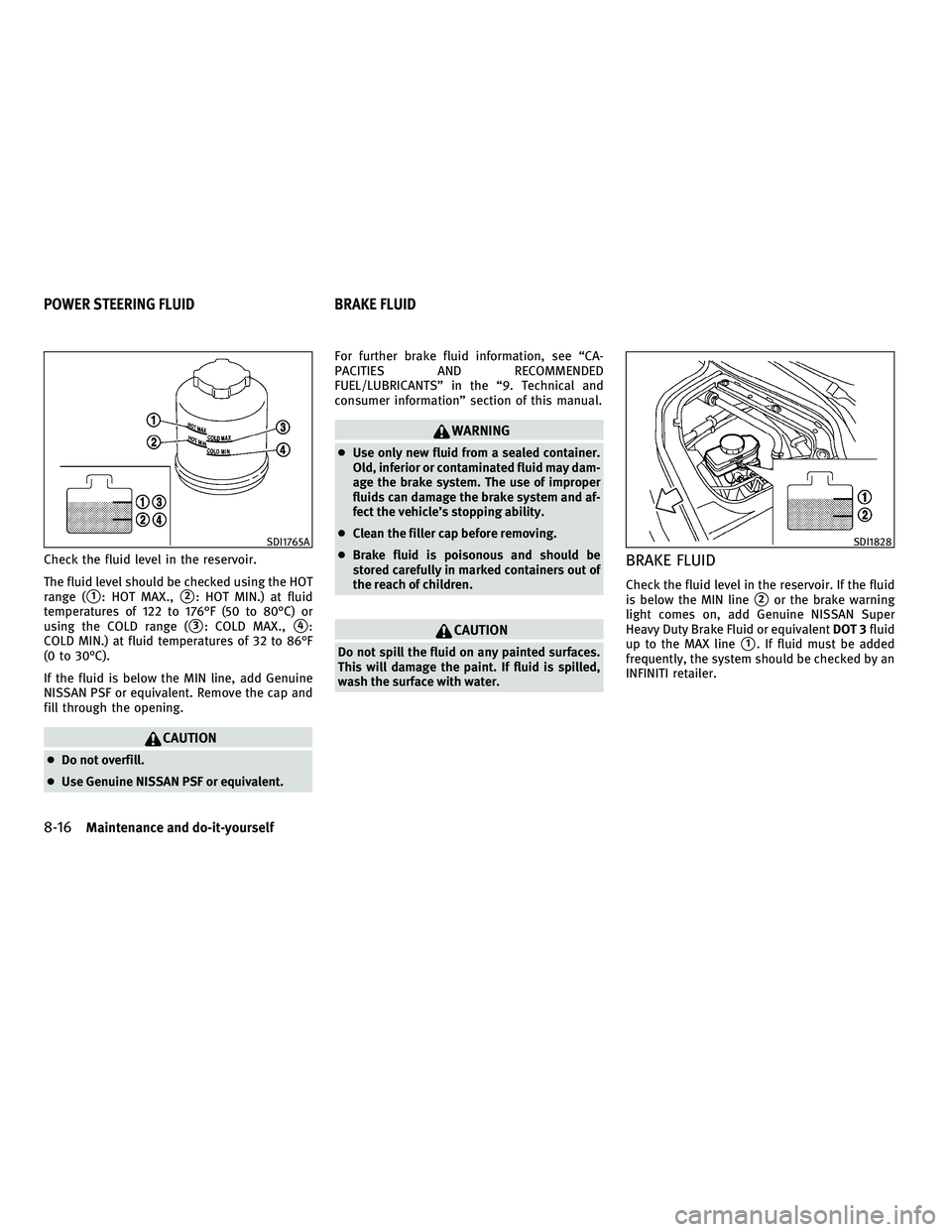
Check the fluid level in the reservoir.
The fluid level should be checked using the HOT
range (
s1: HOT MAX.,s2: HOT MIN.) at fluid
temperatures of 122 to 176ÉF (50 to 80ÉC) or
using the COLD range (
s3: COLD MAX.,s4:
COLD MIN.) at fluid temperatures of 32 to 86ÉF
(0 to 30ÉC).
If the fluid is below the MIN line, add Genuine
NISSAN PSF or equivalent. Remove the cap and
fill through the opening.
CAUTION
c Do not overfill.
c Use Genuine NISSAN PSF or equivalent. For further brake fluid information, see ªCA-
PACITIES AND RECOMMENDED
FUEL/LUBRICANTSº in the ª9. Technical and
consumer informationº section of this manual.
WARNING
c
Use only new fluid from a sealed container.
Old, inferior or contaminated fluid may dam-
age the brake system. The use of improper
fluids can damage the brake system and af-
fect the vehicle's stopping ability.
c Clean the filler cap before removing.
c Brake fluid is poisonous and should be
stored carefully in marked containers out of
the reach of children.
CAUTION
Do not spill the fluid on any painted surfaces.
This will damage the paint. If fluid is spilled,
wash the surface with water.
BRAKE FLUID
Check the fluid level in the reservoir. If the fluid
is below the MIN line
s2or the brake warning
light comes on, add Genuine NISSAN Super
Heavy Duty Brake Fluid or equivalent DOT 3fluid
up to the MAX line
s1. If fluid must be added
frequently, the system should be checked by an
INFINITI retailer.
SDI1765ASDI1828
POWER STEERING FLUID BRAKE FLUID
8-16Maintenance and do-it-yourself
wÐ
Ð
05/15/09Ðpattie
X
Page 387 of 445

nance log shown in the ªINFINITI Service and
Maintenance Guideº. When replacing the filter,
wipe the inside of the air cleaner housing and
the cover with a damp cloth.
WARNING
cOperating the engine with the air cleaner
removed can cause you or others to be
burned. The air cleaner not only cleans the
air, it stops flame if the engine backfires. If it
isn't there, and the engine backfires, you
could be burned. Do not drive with the air
cleaner removed, and be careful when work-
ing on the engine with the air cleaner
removed.
c Never pour fuel into the throttle body or at-
tempt to start the engine with the air cleaner
removed. Doing so could result in serious
injury.
CLEANING
If your windshield is not clear after using the
windshield washer or if a wiper blade chatters
when running, wax or other material may be on
the blade or windshield.
Clean the outside of the windshield with a
washer solution or a mild detergent. Your wind-
shield is clean if beads do not form when
rinsing with clear water.
Clean each blade by wiping it with a cloth
soaked in a washer solution or a mild deter-
gent. Then rinse the blade with clear water. If
your windshield is still not clear after cleaning
the blades and using the wiper, replace the
blades.
CAUTION
Worn windshield wiper blades can damage the
windshield and impair driver vision.
VK45DE engine
SDI1830
WINDSHIELD WIPER BLADES
8-22Maintenance and do-it-yourself
wÐ
Ð
05/15/09Ðpattie
X
Page 412 of 445

9 Technical and consumer information
Capacities and recommended fuel/lubricants........ 9-2
Fuel recommendation ........................... 9-4
Engine oil and oil filter recommendation ......... 9-6
Air conditioning system refrigerant and
lubricant recommendations ..................... 9-7
Specifications ..................................... 9-8
Engine ........................................ 9-8
Wheels and tires ............................... 9-9
Dimensions and weights ....................... 9-10
When traveling or registering your vehicle in
another country .................................. 9-10
Vehicle identification .............................. 9-11
Vehicle Identification Number (VIN) plate......... 9-11
Vehicle identification number
(chassis number) ............................... 9-11
Engine serial number .......................... 9-12
F.M.V.S.S./C.M.V.S.S. certification label .........9-12
Emission control information label ..............9-12
Tire and loading information label ..............9-13
Air conditioner specification label ...............9-13Installing front license plate
.......................9-14
Vehicle loading information ........................9-15
Terms ......................................... 9-15
Vehicle load capacity .......................... 9-16
Loading tips .................................. 9-17
Measurement of weights ....................... 9-18
Towing a trailer .................................. 9-18
Flat towing ...................................... 9-19
Automatic transmission ........................ 9-19
Uniform tire quality grading .......................9-19
Treadwear .................................... 9-19
Traction AA, A, B and C ........................ 9-20
Temperature A, B and C ....................... 9-20
Emission control system warranty .................9-20
Reporting safety defects (US only) .................9-21
Readiness for Inspection/Maintenance (I/M) test ....9-22
Event Data Recorders (EDR) .......................9-23
Owner's Manual/Service Manual order
information ...................................... 9-23
In the event of a collision ......................9-24
wÐ
Ð
05/19/09Ðtbrooks
X
Page 413 of 445

The following are approximate capacities. The actual refill capacities may be a little different. When refilling, follow the procedure instructed in the ª8.
Maintenance and do-it-yourselfº section to determine the proper refill capacity.
Capacity (Approximate)Recommended specifications
US measure
Imp measureLiter
Fuel 20 gal 16-5/8 gal 76 See ªFUEL RECOMMENDATIONº later in this section.
Engine oil*1
Drain and refill With oil filter change VK45DE AWD 6-1/8 qt 5-1/8 qt 5.8 ·Engine oil with API Certification Mark*2, *3
·Viscosity SAE 5W-30*2, *3
2WD 5-7/8 qt 4-7/8 qt 5.5
VQ35HR AWD/2WD 5-1/8 qt 4-3/8 qt 4.9
Without oil filter change VK45DE AWD 5-1/2 qt 4-5/8 qt 5.2
2WD 5-1/8 qt 4-3/8 qt 4.9
VQ35HR AWD/2WD 4-7/8 qt 4 qt 4.6
Cooling system With reservoir VK45DE 11 qt 9-1/8 qt 10.4 50% Genuine NISSAN Long Life Antifreeze/Coolant or equivalent
50% Demineralized or distilled water
VQ35HR 9-3/4 qt 8-1/8 qt 9.2
Reservoir 7/8 qt 3/4 qt 0.8
Automatic Transmission Fluid (ATF) ÐÐÐ Genuine NISSAN Matic S ATF*4
Differential gear oil ÐÐÐ Genuine NISSAN Differential Oil Hypoid Super GL-5, 80W-90 or API
GL-5, Viscosity SAE 80W-90*5
Transfer fluid ÐÐÐ Genuine NISSAN Matic J ATF*6
Power Steering Fluid (PSF) Refill to the proper oil level according to
the instructions in the ª8. Maintenance
and do-it-yourselfº section. Genuine NISSAN PSF or equivalent*7
Brake fluid Genuine NISSAN Super Heavy Duty Brake Fluid*8 or equivalent DOT 3
CAPACITIES AND RECOMMENDED
FUEL/LUBRICANTS
9-2Technical and consumer information
wÐ
Ð
05/15/09Ðpattie
X