fuse ISUZU KB P190 2007 Workshop Repair Manual
[x] Cancel search | Manufacturer: ISUZU, Model Year: 2007, Model line: KB P190, Model: ISUZU KB P190 2007Pages: 6020, PDF Size: 70.23 MB
Page 1791 of 6020
6E-174 ENGINE CONTROL SYSTEM (4JK1/4JJ1)
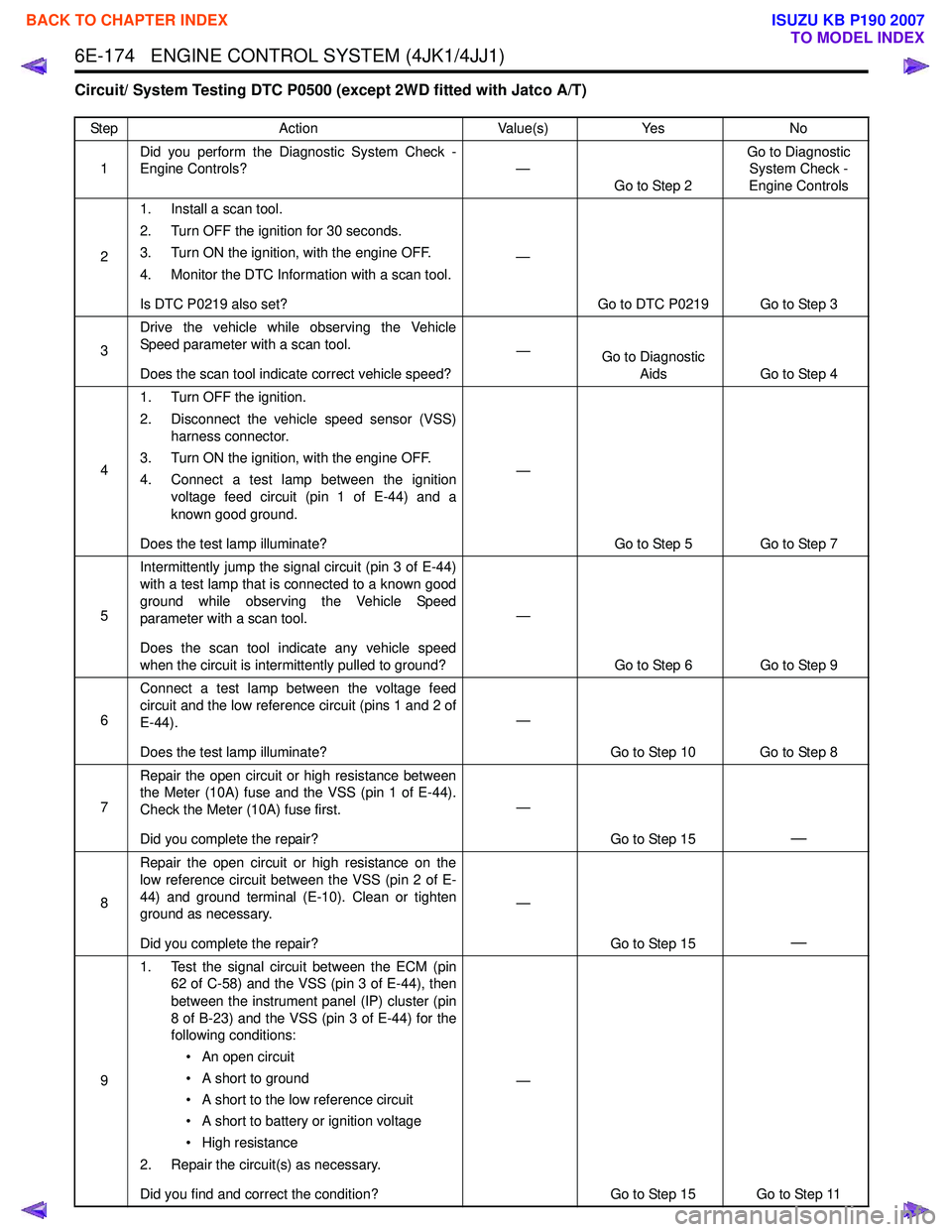
Circuit/ System Testing DTC P0500 (except 2WD fitted with Jatco A/T)
StepAction Value(s)Yes No
1 Did you perform the Diagnostic System Check -
Engine Controls? —
Go to Step 2 Go to Diagnostic
System Check -
Engine Controls
2 1. Install a scan tool.
2. Turn OFF the ignition for 30 seconds.
3. Turn ON the ignition, with the engine OFF.
4. Monitor the DTC Information with a scan tool.
Is DTC P0219 also set? —
Go to DTC P0219 Go to Step 3
3 Drive the vehicle while observing the Vehicle
Speed parameter with a scan tool.
Does the scan tool indicate correct vehicle speed? —
Go to Diagnostic
Aids Go to Step 4
4 1. Turn OFF the ignition.
2. Disconnect the vehicle speed sensor (VSS) harness connector.
3. Turn ON the ignition, with the engine OFF.
4. Connect a test lamp between the ignition voltage feed circuit (pin 1 of E-44) and a
known good ground.
Does the test lamp illuminate? —
Go to Step 5 Go to Step 7
5 Intermittently jump the signal circuit (pin 3 of E-44)
with a test lamp that is connected to a known good
ground while observing the Vehicle Speed
parameter with a scan tool.
Does the scan tool indicate any vehicle speed
when the circuit is intermittently pulled to ground? —
Go to Step 6 Go to Step 9
6 Connect a test lamp between the voltage feed
circuit and the low reference circuit (pins 1 and 2 of
E-44).
Does the test lamp illuminate? —
Go to Step 10 Go to Step 8
7 Repair the open circuit or high resistance between
the Meter (10A) fuse and the VSS (pin 1 of E-44).
Check the Meter (10A) fuse first.
Did you complete the repair? —
Go to Step 15
—
8Repair the open circuit or high resistance on the
low reference circuit between the VSS (pin 2 of E-
44) and ground terminal (E-10). Clean or tighten
ground as necessary.
Did you complete the repair? —
Go to Step 15
—
91. Test the signal circuit between the ECM (pin
62 of C-58) and the VSS (pin 3 of E-44), then
between the instrument panel (IP) cluster (pin
8 of B-23) and the VSS (pin 3 of E-44) for the
following conditions:
• An open circuit
• A short to ground
• A short to the low reference circuit
• A short to battery or ignition voltage
• High resistance
2. Repair the circuit(s) as necessary.
Did you find and correct the condition? —
Go to Step 15 Go to Step 11
BACK TO CHAPTER INDEX
TO MODEL INDEX
ISUZU KB P190 2007
Page 1792 of 6020

ENGINE CONTROL SYSTEM (4JK1/4JJ1) 6E-175
101. Inspect for an intermittent and for poor
connections at the harness connector of the
VSS (pin 1, 2 and 3 of E-44).
2. Repair the connection(s) as necessary.
Did you find and correct the condition? —
Go to Step 15 Go to Step 12
11 1. Turn OFF the ignition.
2. Disconnect the ECM harness connector.
3. Inspect for an intermittent and for a poor connection at the harness connector of the
ECM (pin 62 of C-58).
4. Repair the connection(s) as necessary.
Did you find and correct the condition? —
Go to Step 15 Go to Step 14
12 1. Inspect the VSS, drive gear, driven gear or
output shaft for the following conditions:
• Physical damage of sensor, drive gear or driven gear
• Loose or improper installation of sensor, drive gear or driven gear
• Transmission output shaft teeth damage
• Excessive transmission output shaft play
• Transfer output shaft teeth damage
• Excessive transfer output shaft play
2. Repair or replace as necessary.
Did you find and correct the condition? —
Go to Step 15 Go to Step 13
13 Replace the VSS. Refer to VSS Replacement.
Did you complete the replacement? —
Go to Step 15
—
14Important:
Replacement ECM must be
programmed and learned.
Replace the ECM. Refer to ECM Replacement.
Did you complete the replacement? —
Go to Step 15
—
151. Reconnect all previously disconnected fuse or
harness connector(s).
2. Clear the DTCs with a scan tool.
3. Turn OFF the ignition for 30 seconds.
4. Drive the vehicle while observing the Vehicle Speed parameter with a scan tool.
Does the scan tool indicate correct vehicle speed? —
Go to Step 16 Go to Step 4
16 Observe the DTC Information with a scan tool.
Are there any DTCs that you have not diagnosed? —
Go to DTC List System OK
Step
Action Value(s)Yes No
BACK TO CHAPTER INDEX
TO MODEL INDEX
ISUZU KB P190 2007
Page 1793 of 6020

6E-176 ENGINE CONTROL SYSTEM (4JK1/4JJ1)
DTC P0501 (Flash Code 25)
Circuit Description
The vehicle speed sensor (VSS) is used by the ECM
and speedometer, which generates a speed signal from
the transmission output shaft rotational speed or
transfer output shaft rotational speed. The sensor has
the following circuits.
• Ignition voltage feed circuit
• Low reference circuit
• VSS signal circuit
The VSS uses a hall effect element. It interacts with the
magnetic field created by the rotating magnet and
outputs square wave pulse signal. The ECM calculates
the vehicle speed by the VSS. If the 2WD fitted with
Jatco automatic transmission, VSS signals are sent
from the TCM. If the ECM detects VSS signals are
sharply changed, this DTC will set.
Condition for Running the DTC • The ignition voltage is more than 9 volts.
• The ignition switch is ON.
Condition for Setting the DTC • The ECM detects that the VSS signal are changed larger than a predetermined vehicle speed within a
very short calibrated time. Action Taken When the DTC Sets
• The ECM illuminates the MIL when the diagnostic runs and fails. Refer to DTC Type Definitions for
Action Taken When the DTC Sets - Type A.
• The ECM inhibits cruise control.
Condition for Clearing the DTC • Refer to DTC Type Definitions for Condition for Clearing the MIL/ DTC - Type A.
Diagnostic Aids • If an intermittent condition is suspected, refer to Intermittent Conditions in this section.
• Electromagnetic interference in the VSS circuits may set this DTC.
Notice: • If this DTC set, the Vehicle Speed parameter on the scan tool will display 3 km/h (2 MPH).
Schematic Reference: Engine Controls Schematics
Connector End View Reference: Engine Controls
Connector End Views or ECM Connector End Views
Circuit/ System Testing DTC P0501
Step Action Value(s)Yes No
1 Did you perform the Diagnostic System Check -
Engine Controls? —
Go to Step 2 Go to Diagnostic
System Check -
Engine Controls
2 1. Inspect all of the circuits going to the vehicle
speed sensor (VSS) for the following
conditions:
• Routed too closely to fuel injection wiring or components
• Routed too closely to after-market add- on electrical equipment
• Routed too closely to solenoids, relays, and motors
2. If you find incorrect routing, correct the harness routing.
Did you find and correct the condition? —
Go to Step 8 Go to Step 3
3 1. Inspect for an intermittent, for poor
connections and corrosion at the Meter (10A)
fuse.
2. Repair the connection(s) as necessary.
Did you find and correct the condition? —
Go to Step 8 Go to Step 4
4 1. Inspect for an intermittent, a poor connection
and corrosion at the ground terminal (E-10).
2. Repair the connection(s) as necessary.
Did you find and correct the condition? —
Go to Step 8 Go to Step 5
BACK TO CHAPTER INDEX
TO MODEL INDEX
ISUZU KB P190 2007
Page 1795 of 6020

6E-178 ENGINE CONTROL SYSTEM (4JK1/4JJ1)
DTC P0512 (Flash Code 417)
Circuit Description
The starter switch signal is inputted to the ECM during
the ignition switch START position. If the ECM detects
the starter switch signal continuously ON during the
engine running, this DTC will set.
Condition for Running the DTC • The ignition switch is ON.
• The engine is running.
Condition for Setting the DTC • The ECM detects that the starter switch signal is stuck at the ON position (high voltage) for longer
than 20 seconds.
Action Taken When the DTC Sets • The ECM illuminates the SVS lamp when the diagnostic runs and fails. Refer to DTC Type
Definitions for Action Taken When the DTC Sets -
Type C. Condition for Clearing the DTC
• Refer to DTC Type Definitions for Condition for Clearing the SVS Lamp/ DTC - Type C.
Diagnostic Aids • If an intermittent condition is suspected, refer to Intermittent Conditions in this section.
Notice: • This DTC will set if the ignition switch continues being START position for longer than 20 seconds.
Schematic Reference: Engine Controls Schematics
Connector End View Reference: Engine Controls
Connector End Views or ECM Connector End Views
Circuit/ System Testing DTC P0512
Step Action Value(s)Yes No
1 Did you perform the Diagnostic System Check -
Engine Controls? —
Go to Step 2 Go to Diagnostic
System Check -
Engine Controls
2 1. Turn OFF the ignition.
2. Remove the starter cut relay in order to inhibit starter motor engagement at ignition switch
ON.
3. Install a scan tool.
4. Turn ON the ignition, with the engine OFF.
5. Observe the Starter Switch parameter with a scan tool.
Does the Starter Switch parameter indicate OFF? —
Go to Diagnostic Aids Go to Step 3
3 Remove the Starter (10A) fuse in the cabin fuse
block.
Does the Starter Switch parameter indicate OFF? —
Go to Step 4 Go to Step 5
4 1. Test the signal circuit between the starter
switch (pin 1 of B-63) and each terminal of the
ignition switch (pins 1, 2, 3 and 4 of B-62 and
pin 3 of B-63) for short circuit each other at the
ignition switch ON.
2. Repair the circuit(s) as necessary.
Did you find and correct the condition? —
Go to Step 8 Go to Step 7
5 1. Test the signal circuit between the ECM (pin
44 of C-58) and the Starter (10A) fuse or
starter relay (pin 3 of X-8) for a short to battery
or ignition voltage.
2. Repair the circuit(s) as necessary.
Did you find and correct the condition? —
Go to Step 8 Go to Step 6
BACK TO CHAPTER INDEX
TO MODEL INDEX
ISUZU KB P190 2007
Page 1803 of 6020

6E-186 ENGINE CONTROL SYSTEM (4JK1/4JJ1)
4Observe the Cruise Cancel Switch parameter with
a scan tool while momentarily jumping 3-amp fused
jumper wire across the combination switch harness
connector (male side) between pins 10 and 11 of B-
59.
Does the scan tool indicate ON when the circuit is
jumpered and OFF when the circuit is not
jumpered? —
Go to Step 7 Go to Step 6
5 Repair the open circuit or high resistance between
the Engine (10A) fuse and the combination switch
(pin 11 of B-59). Check Engine (10A) fuse first.
Did you complete the repair? —
Go to Step 11
—
61. Test the signal circuit between the ECM (pin
13 of C-58) and the combination switch (pin 11
of B-59) for and open circuit or high
resistance.
2. Repair the circuit(s) as necessary.
Did your find and correct the condition? —
Go to Step 11 Go to Step 8
7 1. Inspect fro an intermittent and for a poor
connection at the harness connector of the
combination switch (pin 11 of B-59).
2. Repair the connection(s) as necessary.
Did you find and correct the condition? —
Go to Step 11 Go to Step 9
8 1. Turn OFF the ignition.
2. Disconnect the ECM harness connector.
3. Inspect for an intermittent and for poor connections at the harness connector of the
ECM (pin 13 of C-58).
4. Repair the connection(s) as necessary.
Did you find and correct the condition? —
Go to Step 11 Go to Step 10
9 Repair or replace the combination switch.
Did you complete the repair or replacement? —
Go to Step 11
—
10Important:
Replacement ECM must be
programmed and learned.
Replace the ECM. Refer to ECM Replacement.
Did you complete the replacement? —
Go to Step 11
—
111. Reconnect all previously disconnected
harness connector(s).
2. Clear the DTCs with a scan tool.
3. Turn ON the ignition, with the engine OFF.
4. Observe the Cruise Cancel Switch parameter with a scan tool.
Dose the scan tool indicate OFF when the switch is
applied and ON when the switch is released? —
Go to Step 12 Go to Step 3
12 Observe the DTC Information with a scan tool.
Are there any DTCs that you have not diagnosed? —
Go to DTC List System OK
Step
Action Value(s)Yes No
BACK TO CHAPTER INDEX
TO MODEL INDEX
ISUZU KB P190 2007
Page 1809 of 6020

6E-192 ENGINE CONTROL SYSTEM (4JK1/4JJ1)
51. Turn ON the ignition, with the engine OFF.
2. Observe the Brake Switch 1 parameter with a scan tool while momentarily jumping 3-amp
fused jumper wire across the brake switch
harness connector between pins 1 and 2 of
the C-44.
Does the scan tool indicate Applied when the circuit
is jumpered and Released when the circuit is not
jumpered? —
Go to Step 14 Go to Step 7
6 Repair the open circuit or high resistance between
the Stop Light (15A) fuse and the brake switch (pin
1 of C-44). Check the Stop Light (15A) fuse first.
Did you complete the repair? —
Go to Step 18
—
71. Test the signal circuit between the ECM (pin
21 of C-58) and the brake switch (pin 2 of C-
44) for the following conditions:
• An open circuit
• A short to battery or ignition voltage
• High resistance
2. Repair the circuit(s) as necessary.
Did you find and correct the condition? —
Go to Step 18 Go to Step 15
8 Observe the Brake Switch 2 parameter with a scan
tool while fully depressing and releasing the brake
pedal.
Does the scan tool indicate Applied when the brake
pedal is applied and Released when the brake
pedal is released? —
Go to Diagnostic Aids Go to Step 9
9 1. Check to ensure the brake switch is adjusted
correctly. The plunger should be all the way in
when the pedal is released, yet should not
impede with the brake pedal full upward travel.
2. Adjust the brake switch as necessary.
Did you find and correct the condition? —
Go to Step 18 Go to Step 10
10 1. Turn OFF the ignition.
2. Disconnect the brake switch harness connector.
3. Turn ON the ignition, with the engine OFF.
4. Connect a test lamp between the ignition voltage feed circuit of the brake switch 2
harness (pin 4 of C-44) and a known good
ground.
Does the test lamp illuminate? —
Go to Step 11 Go to Step 12
11 Observe the Brake Switch 2 parameter with a scan
tool while momentarily jumping 3-amp fused
jumper wire across the brake switch harness
connector between pins 3 and 4 of the C-44.
Does the scan tool indicate Released when the
circuit is jumpered and Applied when the circuit is
not jumpered? —
Go to Step 14 Go to Step 13
12 Repair the open circuit or high resistance between
the Engine (10A) fuse and the brake switch (pin 4
of C-44). Check the Engine (10A) fuse first.
Did you complete the repair? —
Go to Step 18
—
Step Action Value(s)Yes No
BACK TO CHAPTER INDEX
TO MODEL INDEX
ISUZU KB P190 2007
Page 1810 of 6020

ENGINE CONTROL SYSTEM (4JK1/4JJ1) 6E-193
131. Test the signal circuit between the ECM (pin 1
of C-58) and the brake switch (pin 3 of C-44)
for the following conditions:
• An open circuit
• A short to battery or ignition voltage
• High resistance
2. Repair the circuit(s) as necessary.
Did you find and correct the condition? —
Go to Step 18 Go to Step 15
14 1. Inspect for an intermittent and for poor
connections at the harness connector of the
brake switch (pins 1, 2, 3 and 4 of C-44).
2. Repair the connection(s) as necessary.
Did you find and correct the condition? —
Go to Step 18 Go to Step 16
15 1. Turn OFF the ignition.
2. Disconnect the ECM harness connector.
3. Inspect for an intermittent and for poor connections at the harness connector of the
ECM (pins 1 and 21 of C-58).
4. Repair the connection(s) as necessary.
Did you find and correct the condition? —
Go to Step 18 Go to Step 17
16 Replace brake switch. Refer to Brake Switch
Replacement.
Did you complete the replacement? —
Go to Step 18
—
17Important:
Replacement ECM must be
programmed and learned.
Replace the ECM. Refer to ECM Replacement.
Did you complete the replacement? —
Go to Step 18
—
181. Reconnect all previously disconnected fuse or
harness connector(s).
2. Clear the DTCs with a scan tool.
3. Turn OFF the ignition for 30 seconds.
4. Turn ON the ignition, with the engine OFF.
5. Observe the Brake Switch 1 and Brake Switch 2 parameter with a scan tool while fully
depressing and releasing the brake pedal.
Does the scan tool indicate Applied when the brake
pedal is applied and Released when the brake
pedal is released on each parameter? —
Go to Step 19 Go to Step 2
19 Observe the DTC Information with a scan tool.
Are there any DTCs that you have not diagnosed? —
Go to DTC List System OK
Step
Action Value(s)Yes No
BACK TO CHAPTER INDEX
TO MODEL INDEX
ISUZU KB P190 2007
Page 1823 of 6020
6E-206 ENGINE CONTROL SYSTEM (4JK1/4JJ1)
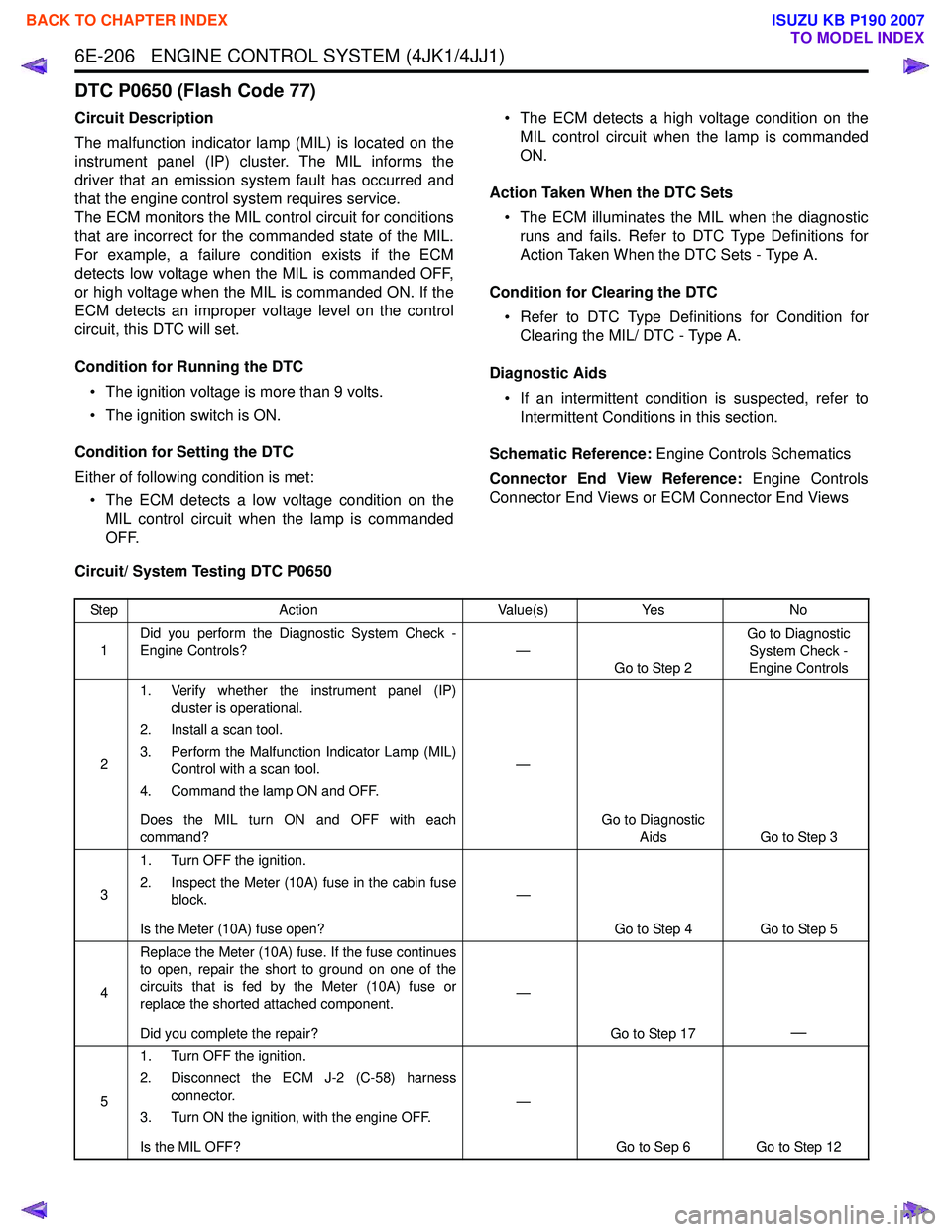
DTC P0650 (Flash Code 77)
Circuit Description
The malfunction indicator lamp (MIL) is located on the
instrument panel (IP) cluster. The MIL informs the
driver that an emission system fault has occurred and
that the engine control system requires service.
The ECM monitors the MIL control circuit for conditions
that are incorrect for the commanded state of the MIL.
For example, a failure condition exists if the ECM
detects low voltage when the MIL is commanded OFF,
or high voltage when the MIL is commanded ON. If the
ECM detects an improper voltage level on the control
circuit, this DTC will set.
Condition for Running the DTC • The ignition voltage is more than 9 volts.
• The ignition switch is ON.
Condition for Setting the DTC
Either of following condition is met: • The ECM detects a low voltage condition on the MIL control circuit when the lamp is commanded
OFF. • The ECM detects a high voltage condition on the
MIL control circuit when the lamp is commanded
ON.
Action Taken When the DTC Sets • The ECM illuminates the MIL when the diagnostic runs and fails. Refer to DTC Type Definitions for
Action Taken When the DTC Sets - Type A.
Condition for Clearing the DTC • Refer to DTC Type Definitions for Condition for Clearing the MIL/ DTC - Type A.
Diagnostic Aids • If an intermittent condition is suspected, refer to Intermittent Conditions in this section.
Schematic Reference: Engine Controls Schematics
Connector End View Reference: Engine Controls
Connector End Views or ECM Connector End Views
Circuit/ System Testing DTC P0650
Step Action Value(s)Yes No
1 Did you perform the Diagnostic System Check -
Engine Controls? —
Go to Step 2 Go to Diagnostic
System Check -
Engine Controls
2 1. Verify whether the instrument panel (IP)
cluster is operational.
2. Install a scan tool.
3. Perform the Malfunction Indicator Lamp (MIL) Control with a scan tool.
4. Command the lamp ON and OFF.
Does the MIL turn ON and OFF with each
command? —
Go to Diagnostic Aids Go to Step 3
3 1. Turn OFF the ignition.
2. Inspect the Meter (10A) fuse in the cabin fuse block.
Is the Meter (10A) fuse open? —
Go to Step 4 Go to Step 5
4 Replace the Meter (10A) fuse. If the fuse continues
to open, repair the short to ground on one of the
circuits that is fed by the Meter (10A) fuse or
replace the shorted attached component.
Did you complete the repair? —
Go to Step 17
—
51. Turn OFF the ignition.
2. Disconnect the ECM J-2 (C-58) harness connector.
3. Turn ON the ignition, with the engine OFF.
Is the MIL OFF? —
Go to Sep 6 Go to Step 12
BACK TO CHAPTER INDEX
TO MODEL INDEX
ISUZU KB P190 2007
Page 1824 of 6020

ENGINE CONTROL SYSTEM (4JK1/4JJ1) 6E-207
61. Remove the Meter (10A) fuse that supplies
voltage to the MIL.
2. Turn ON the ignition, with the engine OFF.
3. Measure the voltage from the MIL control circuit in the ECM harness connector (pin 57
of C-58) to a known good ground.
Is the voltage less than the specified value? 1 volt
Go to Step 7 Go to Step 13
7 1. Turn OFF the ignition.
2. Reinstall the Meter (10A) fuse.
3. Turn ON the ignition, with the engine OFF.
4. Connect a 3-amp fused jumper wire between the ECM harness connector (pin 57 of C-58)
and a known good ground.
Is the MIL illuminated? —
Go to Step 11 Go to Step 8
8 1. Turn OFF the ignition.
2. Remove the IP cluster.
3. Connect a test lamp between the ignition voltage feed circuit of the IP cluster harness
connector (pin 8 of B-24) and a known good
ground.
4. Turn ON the ignition, with the engine OFF.
Does the test lamp illuminate? —
Go to Step 9 Go to Step 14
9 1. Test the control circuit between the ECM (pin
57 of C-58) and the IP cluster (pin 38 of B-23)
for an open circuit or high resistance.
2. Repair the circuit(s) as necessary.
Did you find and correct the condition? —
Go to Step 17 Go to Step 10
10 1. Inspect for an intermittent and for poor
connections at the harness connector of the
IP cluster (pin 8 of B-24 and pin 38 of B-23).
2. Repair the connection(s) as necessary.
Did you find and correct the condition? —
Go to Step 17 Go to Step 15
11 1. Inspect for an intermittent and for a poor
connection at the harness connector of the
ECM (pin 57 of C-58).
2. Repair the connection(s) as necessary.
Did you find and correct the condition? —
Go to Step 17 Go to Step 16
12 Repair the short to ground between the ECM (pin
57 of C-58) and the IP cluster (pin 38 of B-23).
Did you complete the repair? —
Go to Step 17
—
13Repair the short to battery or ignition voltage
between the ECM (pin 57 of C-58) and the IP
cluster (pin 38 of B-23).
Did you complete the repair? —
Go to Step 17
—
14Repair the open circuit or high resistance on the
ignition voltage feed circuit between the Meter
(10A) fuse and the IP cluster (pin 8 of B-24).
Did you complete the repair? —
Go to Step 17
—
15Repair or replace the IP cluster.
Did you complete the repair or replacement? —
Go to Step 17—
Step Action Value(s)Yes No
BACK TO CHAPTER INDEX
TO MODEL INDEX
ISUZU KB P190 2007
Page 1825 of 6020
6E-208 ENGINE CONTROL SYSTEM (4JK1/4JJ1)
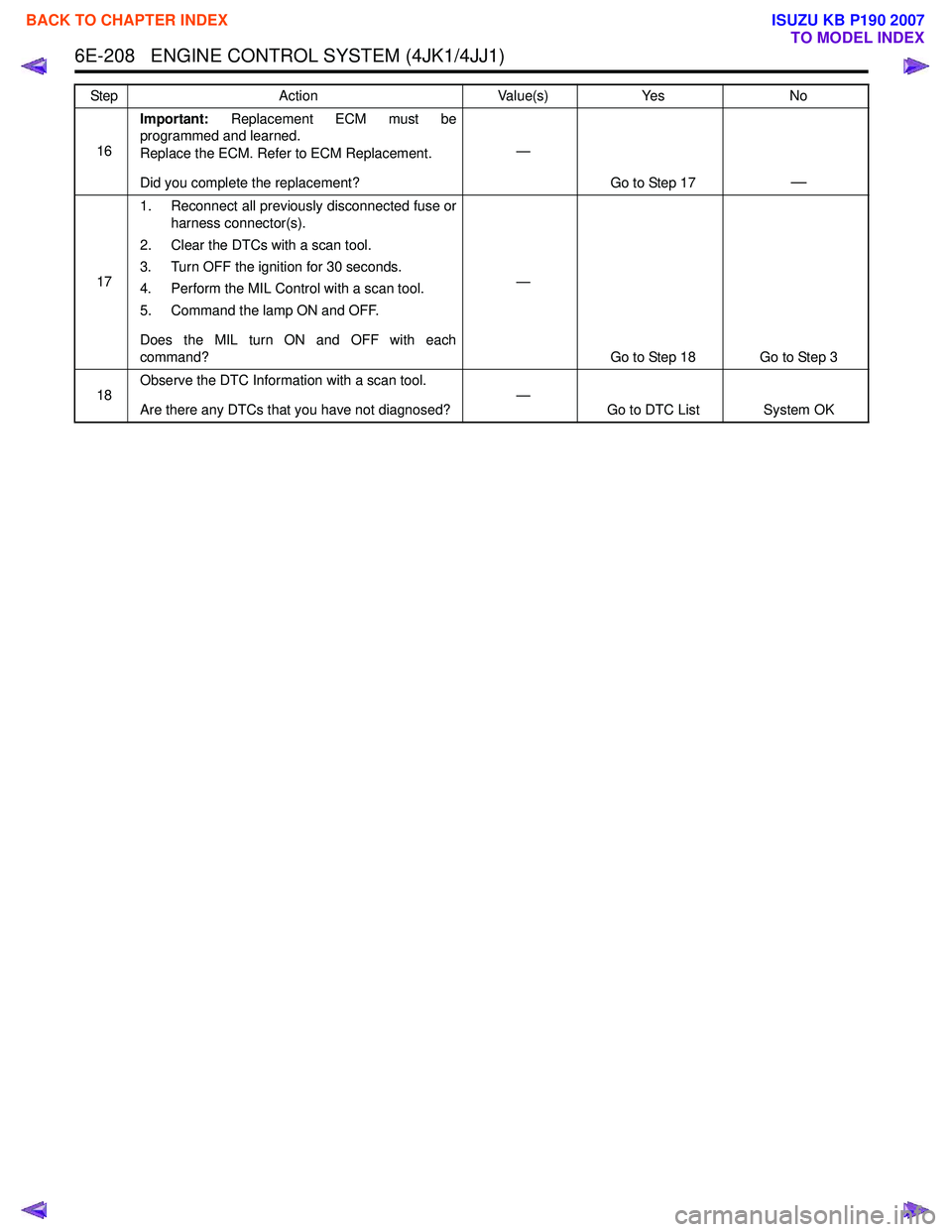
16Important:
Replacement ECM must be
programmed and learned.
Replace the ECM. Refer to ECM Replacement.
Did you complete the replacement? —
Go to Step 17
—
171. Reconnect all previously disconnected fuse or
harness connector(s).
2. Clear the DTCs with a scan tool.
3. Turn OFF the ignition for 30 seconds.
4. Perform the MIL Control with a scan tool.
5. Command the lamp ON and OFF.
Does the MIL turn ON and OFF with each
command? —
Go to Step 18 Go to Step 3
18 Observe the DTC Information with a scan tool.
Are there any DTCs that you have not diagnosed? —
Go to DTC List System OK
Step
Action Value(s)Yes No
BACK TO CHAPTER INDEX
TO MODEL INDEX
ISUZU KB P190 2007