start ISUZU KB P190 2007 Workshop Repair Manual
[x] Cancel search | Manufacturer: ISUZU, Model Year: 2007, Model line: KB P190, Model: ISUZU KB P190 2007Pages: 6020, PDF Size: 70.23 MB
Page 1227 of 6020

Engine Control System (4JH1) 6E-193
DTC P1120 (Symptom Code 7) (Flash Code 21)
Circuit Description
The accelerator pedal position (APP) sensor is mounted
on the intake throttle assembly. The engine control
module (ECM) uses the APP sensors to determine the
amount of acceleration or deceleration desired by the
person driving the vehicle via the fuel injection control.
The APP sensor has the following circuits.
• 5 volts reference circuit
• Low reference circuit
• APP sensor signal circuit
The ECM provides 5 volts reference voltage through the
reference circuit to the APP sensor. The ECM monitors
the voltage on the 5 volts reference circuit. If the ECM
detects an excessively high APP sensor 5 volts
reference voltage, this DTC will set.
Condition for Running the DTC
• The ignition switch is ON.
Condition for Setting the DTC
• The ECM detects that the APP sensor voltage
supply circuit is more than 5.2 volts for 0.5
seconds.
Action Taken When the DTC Sets
• The ECM illuminates the malfunction indicato
r
lamp (MIL) when the diagnostic runs and fails.
• The ECM uses an engine speed substitution o
f
1400 RPM.
Condition for Clearing the MIL/DTC • The ECM turns OFF the MIL when the diagnostic
runs and does not fail.
• A history DTC clears after 40 consecutive driving
cycles without a fault. Or clear with the scan tool.
Diagnostic Aids • If an intermittent condition is suspected, refer to
Intermittent Conditions in this section.
DTC P1120 (Symptom Code 7) (Flash Code 21)
Schematic Reference: Engine Controls Schematics
Connector End View Reference: Engine Controls
Connector End Views or Engine Control Module (ECM)
Connector End Views
Step Action Value(s) Yes No
1 Did you perform the Diagnostic System Check-
Engine Controls?
Go to Step 2 Go to Diagnostic
System Check-
Engine Controls
2 1. Install the scan tool. 2. Turn OFF the ignition for 30 seconds.
3. Start the engine.
4. Monitor the Diagnostic Trouble Code (DTC) Information with the scan tool.
Does the DTC fail this ignition?
Go to Step 3 Go to Diagnostic
Aids
3 1. Test the 5 volts reference circuit between 1the engine control module (ECM) (pin 57 of C-56
connector) and the accelerator pedal position
(APP) sensor (pin 3 of E-22 connector) for a
short to battery or ignition voltage.
2. Repair the circuit(s) as necessary.
Did you find and correct the condition?
Go to Step 5 Go to Step 4
4 Important: Replacement ECM must be
programmed.
Replace the ECM. Refer to Engine Control Module
(ECM) Replacement in this section.
Did you complete the replacement?
Go to Step 5
5 1. Reconnect all previously disconnected harness
connector(s).
2. Clear the DTCs with the scan tool.
3. Turn OFF the ignition for 30 seconds.
4. Turn ON the ignition, with the engine OFF.
5. Fully depress and release the accelerator pedal many times.
6. Monitor the DTC Information with the scan tool.
Did the DTC fail this ignition?
Go to Step 3 Go to Step 6
BACK TO CHAPTER INDEX
TO MODEL INDEX
ISUZU KB P190 2007
Page 1229 of 6020

Engine Control System (4JH1) 6E-195
DTC P1120 (Symptom Code 9) (Flash Code 21)
Circuit Description
The accelerator pedal position (APP) sensor is mounted
on the intake throttle assembly. The engine control
module (ECM) uses the APP sensors to determine the
amount of acceleration or deceleration desired by the
person driving the vehicle via the fuel injection control.
The APP sensor has the following circuits.
• 5 volts reference circuit
• Low reference circuit
• APP sensor signal circuit
The ECM provides 5 volts reference voltage through the
reference circuit to the APP sensor. The ECM monitors
the voltage on the 5 volts reference circuit. If the ECM
detects an excessively high APP sensor 5 volts
reference voltage, this DTC will set.
Condition for Running the DTC
• The ignition switch is ON.
Condition for Setting the DTC
• The ECM detects that the APP sensor voltage
supply circuit is less than 4.6 volts for 0.5 seconds.
Action Taken When the DTC Sets
• The ECM illuminates the malfunction indicato
r
lamp (MIL) when the diagnostic runs and fails.
• The ECM uses an engine speed substitution o
f
1400 RPM.
Condition for Clearing the MIL/DTC • The ECM turns OFF the MIL when the diagnostic
runs and does not fail.
• A history DTC clears after 40 consecutive driving
cycles without a fault. Or clear with the scan tool.
Diagnostic Aids • If an intermittent condition is suspected, refer to
Intermittent Conditions in this section.
Test Description
The number below refers to the step number on the
diagnostic table.
3. If the APP sensor 5 volts reference circuit between
the ECM and the sensor is normal, the sensor signal
correlation DTC P1120 (Symptom Code E) will set.
DTC P1120 (Symptom Code 9) (Flash Code 21)
Schematic Reference: Engine Controls Schematics
Connector End View Reference: Engine Controls
Connector End Views or Engine Control Module (ECM)
Connector End Views
Step Action Value(s) Yes No
1 Did you perform the Diagnostic System Check-
Engine Controls?
Go to Step 2 Go to Diagnostic
System Check-
Engine Controls
2 1. Install the scan tool. 2. Turn OFF the ignition for 30 seconds.
3. Start the engine.
4. Monitor the Diagnostic Trouble Code (DTC) Information with the scan tool.
Does the DTC fail this ignition?
Go to Step 3 Go to Diagnostic
Aids
3 1. Turn OFF the ignition. 2. Disconnect the accelerator pedal position (APP) sensor harness connector.
3. Turn ON the ignition, with the engine OFF.
4. Depress and release the accelerator pedal many times.
5. Monitor the DTC Information with the scan tool.
Does DTC P1120 (Symptom Code E) set, but not
DTC P1120 (Symptom Code 9)?
Go to Step 5 Go to Step 4
4 1. Test the 5 volts reference circuit between the engine control module (ECM) (pin 57 of C-56
connector) and the APP sensor (pin 3 of E-22
connector) for the following conditions: • A short to ground
• A short to the low reference circuit
2. Repair the circuit(s) as necessary.
Did you find and correct the condition?
Go to Step 7 Go to Step 6
BACK TO CHAPTER INDEX
TO MODEL INDEX
ISUZU KB P190 2007
Page 1238 of 6020

6E-204 Engine Control System (4JH1)
DTC P1173 (Symptom Code 3) (Flash Code 22)
Circuit Description
The engine coolant temperature (ECT) sensor is
installed to the thermostat housing. The ECT sensor is
a variable resistor. The ECT sensor has a signal circuit
and a low reference circuit. The ECT sensor measures
the temperature of the engine coolant. The engine
control module (ECM) supplies 5 volts to the ECT signal
circuit and a ground for the ECT low reference circuit.
W hen the ECT sensor is cold, the sensor resistance is
high. W hen the engine coolant temperature increases,
the sensor resistance decreases. W ith high senso
r
resistance, the ECM detects a high voltage on the ECT
signal circuit. W ith lower sensor resistance, the ECM
detects a lower voltage on the ECT signal circuit. If the
ECM detects an excessive high coolant temperature,
this DTC will set.
Condition for Running the DTC
• The ignition switch is ON.
Condition for Setting the DTC • The ECM detects an excessive high coolant
temperature for longer than 30 seconds.
Action Taken When the DTC Sets • The ECM does not illuminate the malfunction
indicator lamp (MIL) when the diagnostic runs and
fails.
Condition for Clearing the DTC
• A history DTC clears after 40 consecutive driving
cycles without a fault. Or clear with the scan tool.
Diagnostic Aids
• If an intermittent condition is suspected, refer to
Intermittent Conditions in this section.
•
After starting the engine, the ECT should rise
steadily to about 80°C – 85°C (176°F – 185°F)
then stabilize when the thermostat opens.
• Use the Temperature vs. Resistance table to test
the ECT sensor at various temperature levels to
evaluate the possibility of a skewed sensor.
A
skewed sensor could result in poor driveabilit
y
concerns.
Notice: • This DTC is caused by an engine overheat
condition (i.e. low engine coolant level). Since this
DTC does not illuminate any lamps, clear the DTC
and ensure there are no signs of engine damage.
Excessive engine overheat may damage internal
engine components.
DTC P1173 (Symptom Code 3) (Flash Code 22)
Step Action Value(s) Yes No
1 Did you perform the Diagnostic System Check-
Engine Controls?
Go to Step 2 Go to Diagnostic
System Check-
Engine Controls
2 1. Install the scan tool. 2. Turn OFF the ignition for 30 seconds.
3. Start the engine and wait until engine is fully warms upped.
4. Observe the Engine Coolant Temperature (ECT) parameter with the scan tool.
Is the ECT parameter more than the specified
value? 100°C (212°F)
Go to Step 4 Go to Step 3
3 Ask the driver if overheat is caused by low engine coolant level, etc.
If engine overheat has experienced, the engine must
be inspected and repaired as necessary.
Did you complete the action?
Go to Step 6
4 1. Test the ECT sensor at various temperature
levels to evaluate the possibility if a skewed
sensor.
2. Replace the ECT sensor as necessary.
Did you find and correct the condition?
Go to Step 6 Go to Step 5
BACK TO CHAPTER INDEX
TO MODEL INDEX
ISUZU KB P190 2007
Page 1239 of 6020

Engine Control System (4JH1) 6E-205
Step Action Value(s) Yes No
5 1. Test the engine cooling system for the following
condition. Refer to diagnosis of the engine
cooling system section for testing. • Engine coolant level
• Engine coolant leakage
• Cooling fan belt slippage
• Cooling fan clutch working
• Thermostat working
• W ater pump working
• Radiator clogging
2. Repair or replace as necessary.
Did you find and correct the condition?
Go to Step 6 Go to Diagnostic
Aids
6 1. Reconnect all previously disconnected harness connector(s).
2. Clear the DTCs with the scan tool.
3. Turn OFF the ignition for 30 seconds.
4. Start the engine and wait until engine is fully warms upped.
5. Observe the ECT parameter with the scan tool.
Is the ECT parameter more than the specified
value? 100°C (212°F)
Go to Step 4 Go to Step 7
7 Observe the DTC Information with the scan tool. Are there any DTCs that you have not diagnosed? Go to Diagnostic
Trouble Code (DTC) List System OK
BACK TO CHAPTER INDEX
TO MODEL INDEX
ISUZU KB P190 2007
Page 1240 of 6020

6E-206 Engine Control System (4JH1)
DTC P1173 (Symptom Code 7, A) (Flash Code 22)
Circuit Description
The fuel temperature (FT) sensor is internal to the fuel
injection pump control unit (PCU). It detects fuel
temperature in the fuel injection pump. If the PCU
detects an excessively high or low fuel temperature, this
DTC will set.
Condition for Running the DTC
• The ignition switch is ON.
Condition for Setting the DTC • The ECM detects an excessive high FT for longe
r
than 30 seconds. (Symptom Code 7)
• The ECM detects an excessive low FT for longe
r
than 30 seconds. (Symptom Code A)
Action Taken When the DTC Sets • The ECM does not illuminate the malfunction
indicator lamp (MIL) when the diagnostic runs and
fails.
• The PCU limits fuel injection quantity. (Symptom
Code 7)
Condition for Clearing the DTC
• A history DTC clears after 40 consecutive driving
cycles without a fault. Or clear with the scan tool.
Diagnostic Aids
• If an intermittent condition is suspected, refer to
Intermittent Conditions in this section.
Notice:
• FT sensor is internal to the PCU and it is part o
f
the fuel injection pump assembly.
DTC P1173 (Symptom Code 7, A) (Flash Code 22)
Step Action Value(s) Yes No
1 Did you perform the Diagnostic System Check-
Engine Controls?
Go to Step 2 Go to Diagnostic
System Check-
Engine Controls
2 1. Install the scan tool. 2. Turn OFF the ignition for 30 seconds.
3. Start the engine.
4. Monitor the Diagnostic Trouble Code (DTC) Information with the scan tool.
Does the DTC fail this ignition?
Go to Step 3 Go to Step 4
3 Important: The fuel injection pump must be timed to
the engine.
Replace the fuel injection pump. Refer to Fuel
Injection Pump Replacement in engine mechanical
section. (Fuel temperature [FT] sensor is internal to
the fuel injection pump control unit [PCU] and it is
part of the fuel injection pump assembly.)
Did you complete the replacement?
Go to Step 4
4 1. Clear the DTCs with the scan tool.
2. Turn OFF the ignition for 30 seconds.
3. Start the engine.
4. Monitor the DTC Information with the scan tool.
Did the DTC fail this ignition?
Go to Step 3 Go to Step 5
5 Observe the DTC Information with the scan tool. Are there any DTCs that you have not diagnosed? Go to Diagnostic
Trouble Code (DTC) List System OK
BACK TO CHAPTER INDEX
TO MODEL INDEX
ISUZU KB P190 2007
Page 1241 of 6020

Engine Control System (4JH1) 6E-207
DTC P1335 (Symptom Code A) (Flash Code 43)
Circuit Description
The crankshaft position (CKP) sensor is located on top
of the flywheel housing. There are 4 slits spaced 90 °
on the flywheel circumference. The CKP sensor is a
magnetic coil type sensor, which generates an AC
signal voltage based on the crankshaft rotational speed.
The engine control module (ECM) monitors both the
CKP sensor and injection pump camshaft position
(CMP) sensor signals to ensure they correlate with each
other. If the fuel injection pump control unit (PCU)
receives faulty CKP sensor signal pulses, this DTC will
set.
Condition for Running the DTC
• The ignition switch is ON.
Condition for Setting the DTC • The PCU detects CKP sensor signal from the
ECM is faulty.
Action Taken When the DTC Sets • The ECM illuminates the malfunction indicato
r
lamp (MIL) when the diagnostic runs and fails.
• The ECM limits fuel injection quantity.
Condition for Clearing the MIL/DTC
• The ECM turns OFF the MIL when the diagnostic
runs and does not fail.
• A history DTC clears after 40 consecutive driving
cycles without a fault. Or clear with the scan tool.
Diagnostic Aids
• If an intermittent condition is suspected, refer to
Intermittent Conditions in this section.
Notice: • PCU is part of the fuel injection pump assembly.
DTC P1335 (Symptom Code A) (Flash Code 43)
Schematic Reference: Engine Controls Schematics
Connector End View Reference: Engine Controls
Connector End Views or Engine Control Module (ECM)
Connector End Views
Step Action Value(s) Yes No
1 Did you perform the Diagnostic System Check-
Engine Controls?
Go to Step 2 Go to Diagnostic
System Check-
Engine Controls
2 1. Install the scan tool. 2. Turn OFF the ignition for 30 seconds.
3. Start the engine (Note a slight start delay may be noticed).
4. Monitor the Diagnostic Trouble Code (DTC) Information with the scan tool.
Is DTC P0335 (Symptom Code B or D) set?
Go to Applicable DTC Go to Step 3
3 1. Turn OFF the ignition. 2. Disconnect the engine control module (ECM) C-57 harness connector. Keep the C-56 harness
connector with connected.
3. Connect a DMM between the crankshaft position (CKP) sensor signal output circuit (pin 91 of C-57
connector) and a known good ground.
4. Turn ON the ignition, with the engine OFF.
Does the DMM voltage more than the specified
value? 10 volts
Go to Step 5 Go to Step 4
4 1. Test the CKP sensor signal output circuit between the ECM (pin 91 of C-57 connector) and
the fuel injection pump (pin 8 of E-6 connector)
for the following conditions: • An open circuit
• A short to ground
• High resistance
2. Repair the circuit(s) as necessary.
Did you find and correct the condition?
Go to Step 10 Go to Step 6
BACK TO CHAPTER INDEX
TO MODEL INDEX
ISUZU KB P190 2007
Page 1242 of 6020

6E-208 Engine Control System (4JH1)
Step Action Value(s) Yes No
5 1. Test the CKP sensor signal output circuit
between the ECM (pin 91 of C-57 connector) and
the fuel injection pump control unit (PCU) (pin 8
of E-6 connector) for a short to battery or ignition
voltage.
Notice:
Perform this by connecting a test lamp between the
ECM harness connector (pin 91 of C-57 connector)
and a known good ground. If the test lamp
illuminate, circuit is short to battery or ignition
voltage.
2. Repair the circuit(s) as necessary.
Did you find and correct the condition?
Go to Step 10 Go to Step 7
6 1. Turn OFF the ignition. 2. Disconnect the PCU harness connector.
3. Inspect for an intermittent and for a poor connection on the CKP sensor signal circuit at
the harness connector of the PCU (pin 8 of E-6
connector).
4. Repair the connection(s) as necessary.
Did you find and correct the condition?
Go to Step 10 Go to Step 8
7 1. Turn OFF the ignition. 2. Disconnect the ECM harness connector.
3. Inspect for an intermittent and for a poor connection on the CKP sensor signal output
circuit at the harness connector of the ECM (pin
92 of C-57 connector).
4. Repair the connection(s) as necessary.
Did you find and correct the condition?
Go to Step 10 Go to Step 9
8 Important: The fuel injection pump must be timed to
the engine.
Replace the fuel injection pump. Refer to Fuel
Injection Pump Replacement in engine mechanical
section.
Did you complete the replacement?
Go to Step 10
9 Important: Replacement ECM must be
programmed.
Replace the ECM. Refer to Engine Control Module
(ECM) Replacement in this section.
Did you complete the replacement?
Go to Step 10
10 1. Reconnect all previously disconnected harness
connector(s).
2. Clear the DTCs with the scan tool.
3. Turn OFF the ignition for 30 seconds.
4. Start the engine.
5. Monitor the DTC Information with the scan tool.
Did the DTC fail this ignition?
Go to Step 2 Go to Step 11
11 Observe the DTC Information with the scan tool. Are there any DTCs that you have not diagnosed? Go to Diagnostic
Trouble Code (DTC) List System OK
BACK TO CHAPTER INDEX
TO MODEL INDEX
ISUZU KB P190 2007
Page 1243 of 6020

Engine Control System (4JH1) 6E-209
DTC P1345 (Symptom Code A) (Flash Code 41)
Circuit Description
The engine control module (ECM) calculates the
desired fuel injection quantity and timing using data sent
from various sensors. These desired data are sent to
the fuel injection pump control unit (PCU) via a
controller area network (CAN) communication bus. The
PCU also receives signals from the internal inputs:
pump camshaft position (CMP) sensor that is located
inside the fuel injection pump to determine the cam ring
rotation angle and the fuel injection pump speed. The
fuel temperature (FT) sensor is internal the PCU. These
values are used to compare the desired values sent
from the ECM then PCU determines the injection time
r
piston position and fuel injection quantity, and actuates
timing control valve (TCV) & fuel injection solenoid
valve based on control maps in the PCU. The PCU also
compares the engine speed signal sent from the ECM
and the fuel injection pump speed. If the PCU received
faulty fuel injection pump CMP sensor signal, this DTC
will set.
Condition for Setting the DTC • The PCU received faulty fuel injection pump CMP
sensor signal for 1 second.
Action Taken When the DTC Sets
• The ECM illuminates the malfunction indicato
r
lamp (MIL) when the diagnostic runs and fails.
• The ECM limits fuel injection quantity.
Condition for Clearing the MIL/DTC • The ECM turns OFF the MIL when the diagnostic
runs and does not fail.
• A history DTC clears after 40 consecutive driving
cycles without a fault. Or clear with the scan tool.
Diagnostic Aids
• If an intermittent condition is suspected, refer to
Intermittent Conditions in this section.
Notice:
• Fuel injection pump CMP sensor is internal to the
fuel injection pump assembly.
• PCU is part of the fuel injection pump assembly.
DTC P1345 (Symptom Code A) (Flash Code 41)
Step Action Value(s) Yes No
1 Did you perform the Diagnostic System Check-
Engine Controls?
Go to Step 2 Go to Diagnostic
System Check-
Engine Controls
2 1. Install the scan tool. 2. Turn OFF the ignition for 30 seconds.
3. Start the engine.
4. Monitor the Diagnostic Trouble Code (DTC) Information with the scan tool.
Does the DTC fail this ignition?
Go to Step 3 Go to Step 4
3 Important: The fuel injection pump must be timed to
the engine.
Replace the fuel injection pump. Refer to Fuel
Injection Pump Replacement in engine mechanical
section.
Did you complete the replacement?
Go to Step 4
4 1. Clear the DTCs with the scan tool.
2. Turn OFF the ignition for 30 seconds.
3. Start the engine.
4. Monitor the DTC Information with the scan tool.
Does the DTC fail this ignition?
Go to Step 3 Go to Step 5
5 Observe the DTC Information with the scan tool. Are there any DTCs that you have not diagnosed? Go to Diagnostic
Trouble Code (DTC) List System OK
BACK TO CHAPTER INDEX
TO MODEL INDEX
ISUZU KB P190 2007
Page 1257 of 6020
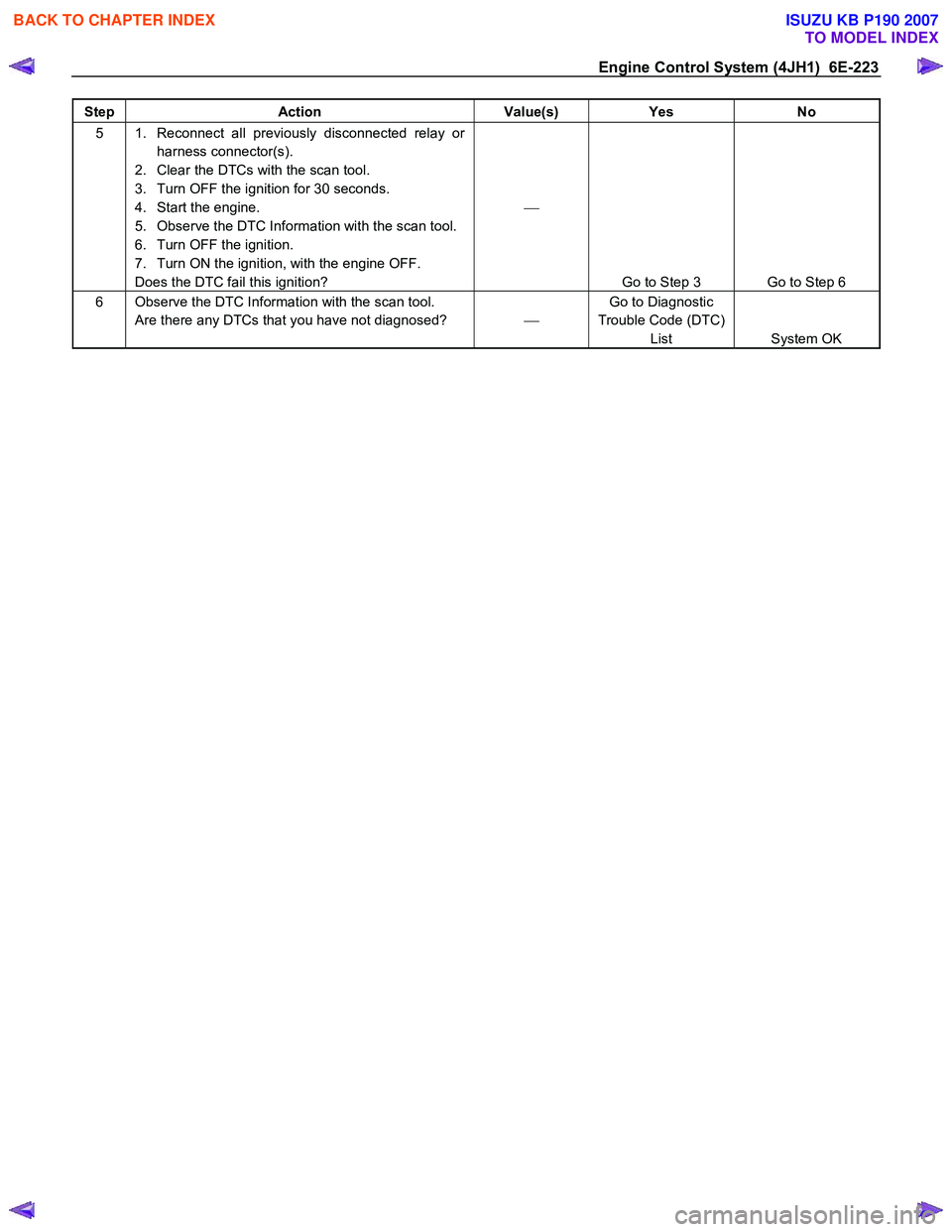
Engine Control System (4JH1) 6E-223
Step Action Value(s) Yes No
5 1. Reconnect all previously disconnected relay or
harness connector(s).
2. Clear the DTCs with the scan tool.
3. Turn OFF the ignition for 30 seconds.
4. Start the engine.
5. Observe the DTC Information with the scan tool.
6. Turn OFF the ignition.
7. Turn ON the ignition, with the engine OFF.
Does the DTC fail this ignition?
Go to Step 3 Go to Step 6
6 Observe the DTC Information with the scan tool. Are there any DTCs that you have not diagnosed? Go to Diagnostic
Trouble Code (DTC) List System OK
BACK TO CHAPTER INDEX
TO MODEL INDEX
ISUZU KB P190 2007
Page 1260 of 6020
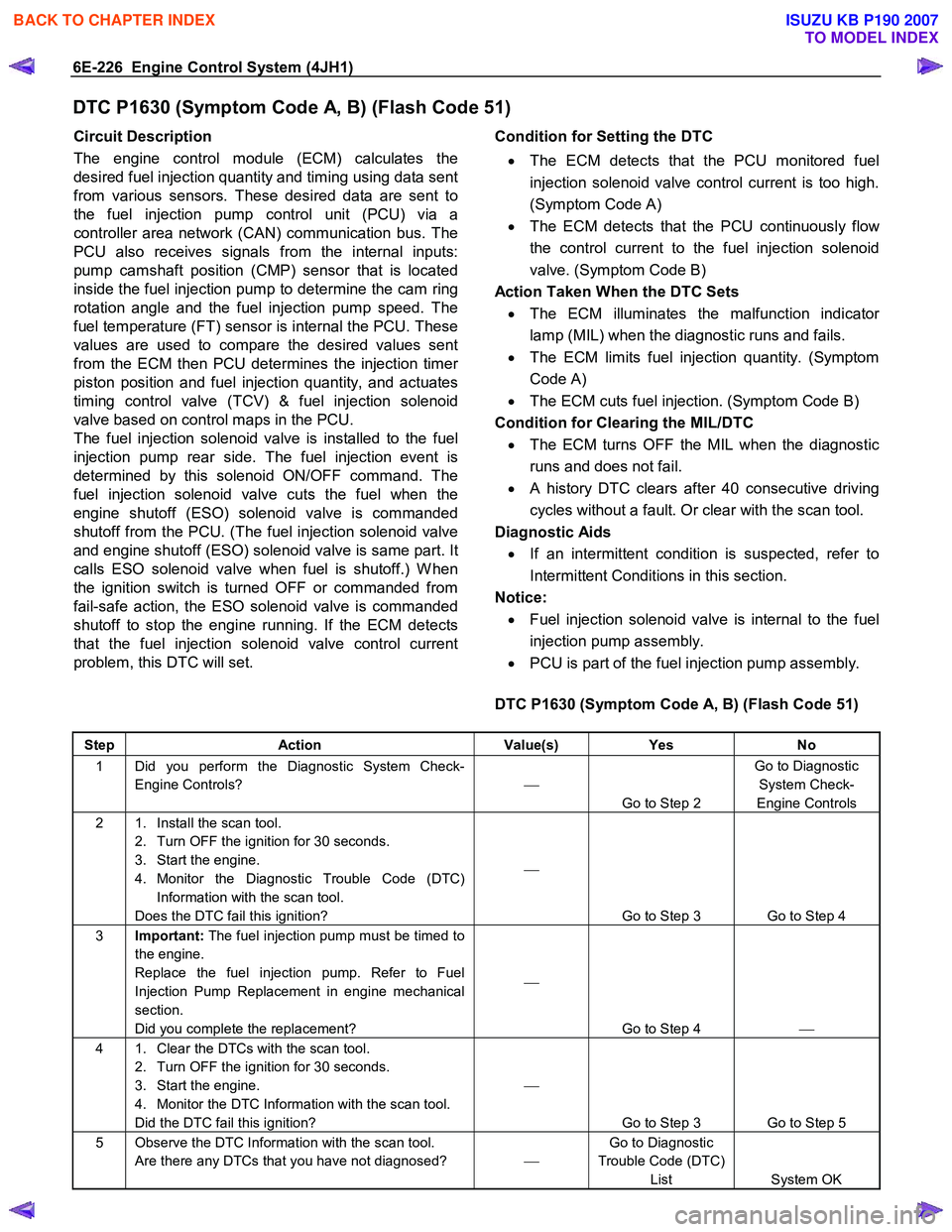
6E-226 Engine Control System (4JH1)
DTC P1630 (Symptom Code A, B) (Flash Code 51)
Circuit Description
The engine control module (ECM) calculates the
desired fuel injection quantity and timing using data sent
from various sensors. These desired data are sent to
the fuel injection pump control unit (PCU) via a
controller area network (CAN) communication bus. The
PCU also receives signals from the internal inputs:
pump camshaft position (CMP) sensor that is located
inside the fuel injection pump to determine the cam ring
rotation angle and the fuel injection pump speed. The
fuel temperature (FT) sensor is internal the PCU. These
values are used to compare the desired values sent
from the ECM then PCU determines the injection time
r
piston position and fuel injection quantity, and actuates
timing control valve (TCV) & fuel injection solenoid
valve based on control maps in the PCU.
The fuel injection solenoid valve is installed to the fuel
injection pump rear side. The fuel injection event is
determined by this solenoid ON/OFF command. The
fuel injection solenoid valve cuts the fuel when the
engine shutoff (ESO) solenoid valve is commanded
shutoff from the PCU. (The fuel injection solenoid valve
and engine shutoff (ESO) solenoid valve is same part. It
calls ESO solenoid valve when fuel is shutoff.) W hen
the ignition switch is turned OFF or commanded from
fail-safe action, the ESO solenoid valve is commanded
shutoff to stop the engine running. If the ECM detects
that the fuel injection solenoid valve control current
problem, this DTC will set.
Condition for Setting the DTC
• The ECM detects that the PCU monitored fuel
injection solenoid valve control current is too high.
(Symptom Code A)
• The ECM detects that the PCU continuously flo
w
the control current to the fuel injection solenoid
valve. (Symptom Code B)
Action Taken When the DTC Sets • The ECM illuminates the malfunction indicato
r
lamp (MIL) when the diagnostic runs and fails.
• The ECM limits fuel injection quantity. (Symptom
Code A)
• The ECM cuts fuel injection. (Symptom Code B)
Condition for Clearing the MIL/DTC • The ECM turns OFF the MIL when the diagnostic
runs and does not fail.
• A history DTC clears after 40 consecutive driving
cycles without a fault. Or clear with the scan tool.
Diagnostic Aids
• If an intermittent condition is suspected, refer to
Intermittent Conditions in this section.
Notice:
• Fuel injection solenoid valve is internal to the fuel
injection pump assembly.
• PCU is part of the fuel injection pump assembly.
DTC P1630 (Symptom Code A, B) (Flash Code 51)
Step Action Value(s) Yes No
1 Did you perform the Diagnostic System Check-
Engine Controls?
Go to Step 2 Go to Diagnostic
System Check-
Engine Controls
2 1. Install the scan tool. 2. Turn OFF the ignition for 30 seconds.
3. Start the engine.
4. Monitor the Diagnostic Trouble Code (DTC) Information with the scan tool.
Does the DTC fail this ignition?
Go to Step 3 Go to Step 4
3 Important: The fuel injection pump must be timed to
the engine.
Replace the fuel injection pump. Refer to Fuel
Injection Pump Replacement in engine mechanical
section.
Did you complete the replacement?
Go to Step 4
4 1. Clear the DTCs with the scan tool.
2. Turn OFF the ignition for 30 seconds.
3. Start the engine.
4. Monitor the DTC Information with the scan tool.
Did the DTC fail this ignition?
Go to Step 3 Go to Step 5
5 Observe the DTC Information with the scan tool. Are there any DTCs that you have not diagnosed? Go to Diagnostic
Trouble Code (DTC) List System OK
BACK TO CHAPTER INDEX
TO MODEL INDEX
ISUZU KB P190 2007