start ISUZU KB P190 2007 Workshop Repair Manual
[x] Cancel search | Manufacturer: ISUZU, Model Year: 2007, Model line: KB P190, Model: ISUZU KB P190 2007Pages: 6020, PDF Size: 70.23 MB
Page 1263 of 6020
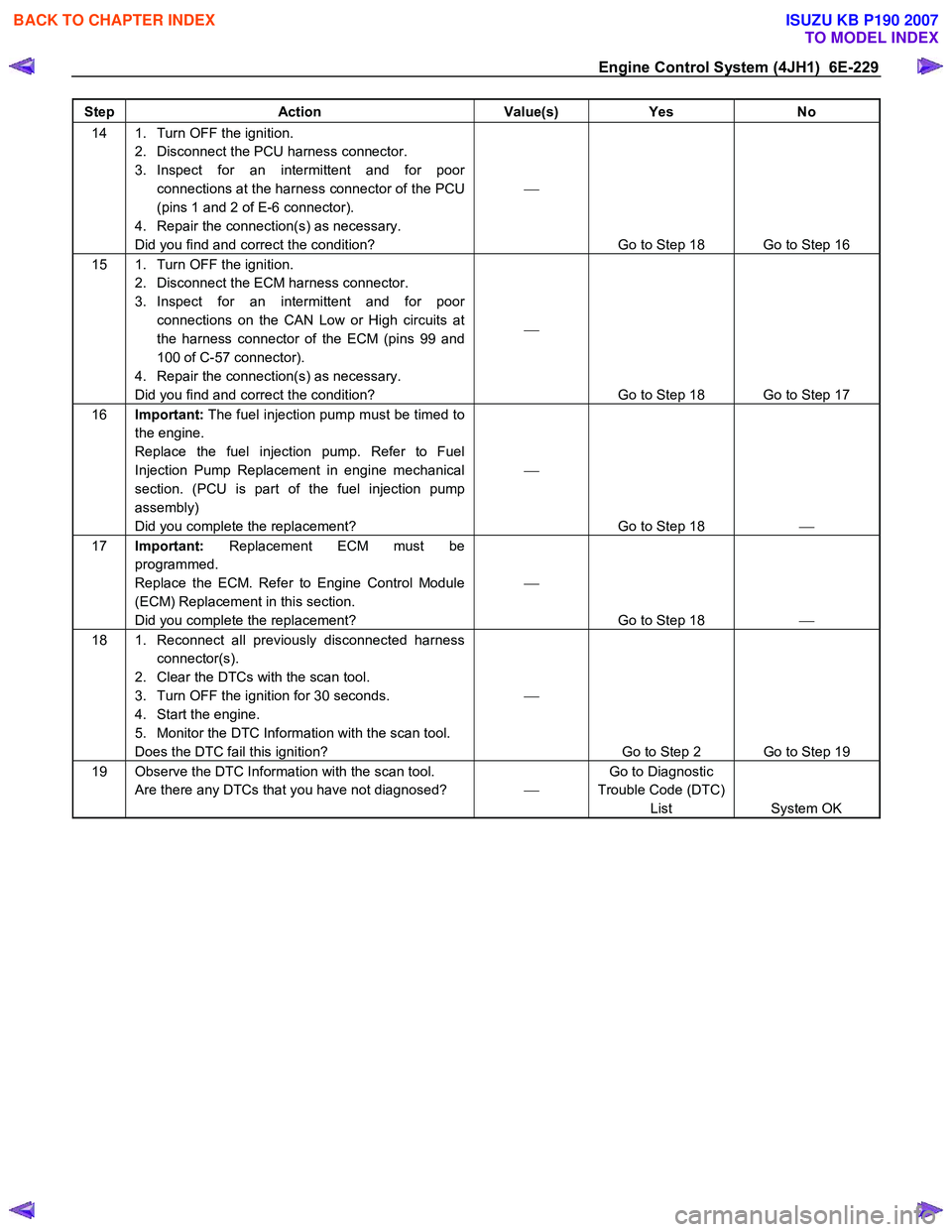
Engine Control System (4JH1) 6E-229
Step Action Value(s) Yes No
14 1. Turn OFF the ignition.
2. Disconnect the PCU harness connector.
3. Inspect for an intermittent and for poor connections at the harness connector of the PCU
(pins 1 and 2 of E-6 connector).
4. Repair the connection(s) as necessary.
Did you find and correct the condition?
Go to Step 18 Go to Step 16
15 1. Turn OFF the ignition. 2. Disconnect the ECM harness connector.
3. Inspect for an intermittent and for poor connections on the CAN Low or High circuits at
the harness connector of the ECM (pins 99 and
100 of C-57 connector).
4. Repair the connection(s) as necessary.
Did you find and correct the condition?
Go to Step 18 Go to Step 17
16 Important: The fuel injection pump must be timed to
the engine.
Replace the fuel injection pump. Refer to Fuel
Injection Pump Replacement in engine mechanical
section. (PCU is part of the fuel injection pump
assembly)
Did you complete the replacement?
Go to Step 18
17 Important: Replacement ECM must be
programmed.
Replace the ECM. Refer to Engine Control Module
(ECM) Replacement in this section.
Did you complete the replacement?
Go to Step 18
18 1. Reconnect all previously disconnected harness
connector(s).
2. Clear the DTCs with the scan tool.
3. Turn OFF the ignition for 30 seconds.
4. Start the engine.
5. Monitor the DTC Information with the scan tool.
Does the DTC fail this ignition?
Go to Step 2 Go to Step 19
19 Observe the DTC Information with the scan tool. Are there any DTCs that you have not diagnosed? Go to Diagnostic
Trouble Code (DTC) List System OK
BACK TO CHAPTER INDEX
TO MODEL INDEX
ISUZU KB P190 2007
Page 1264 of 6020

6E-230 Engine Control System (4JH1)
DTC P1650 (Symptom Code B) (Flash Code 44)
Circuit Description
The engine control module (ECM) calculates the
desired fuel injection quantity and timing using data sent
from various sensors. These desired data are sent to
the fuel injection pump control unit (PCU) via a
controller area network (CAN) communication bus. The
PCU also receives signals from the internal inputs:
pump camshaft position (CMP) sensor that is located
inside the fuel injection pump to determine the cam ring
rotation angle and the fuel injection pump speed. The
fuel temperature (FT) sensor is internal the PCU. These
values are used to compare the desired values sent
from the ECM then PCU determines the injection time
r
piston position and fuel injection quantity, and actuates
timing control valve (TCV) & fuel injection solenoid
valve based on control maps in the PCU.
The ECM monitors CAN operational status by expecting
a constant flow of messages from the PCU. If the ECM
detects internal CAN controller does not react, this DTC
will set.
Condition for Setting the DTC
• The ECM detects internal CAN controller does not
react.
Action Taken When the DTC Sets • The ECM illuminates the malfunction indicato
r
lamp (MIL) when the diagnostic runs and fails.
• The ECM cuts the fuel injection.
Condition for Clearing the MIL/DTC • The ECM turns OFF the MIL when the diagnostic
runs and does not fail.
• A history DTC clears after 40 consecutive driving
cycles without a fault. Or clear with the scan tool.
Notice:
• CAN controller is internal to the ECM.
DTC P1650 (Symptom Code B) (Flash Code 44)
Step Action Value(s) Yes No
1 Did you perform the Diagnostic System Check-
Engine Controls?
Go to Step 2 Go to Diagnostic
System Check-
Engine Controls
2 1. Install the scan tool. 2. Turn OFF the ignition for 30 seconds.
3. Turn ON the ignition, with the engine OFF.
4. Monitor the Diagnostic Trouble Code (DTC) Information with the scan tool.
Does the DTC fail this ignition?
Go to Step 3 Go to Step 4
3 Important: Replacement ECM must be
programmed.
Replace the ECM. Refer to Engine Control Module
(ECM) Replacement in this section.
Did you complete the replacement?
Go to Step 4
4 1. Clear the DTCs with the scan tool.
2. Turn OFF the ignition for 30 seconds.
3. Start the engine.
4. Monitor the DTC Information with the scan tool.
Did the DTC fail this ignition?
Go to Step 3 Go to Step 5
5 Observe the DTC Information with the scan tool. Are there any DTCs that you have not diagnosed? Go to Diagnostic
Trouble Code (DTC) List System OK
BACK TO CHAPTER INDEX
TO MODEL INDEX
ISUZU KB P190 2007
Page 1265 of 6020

Engine Control System (4JH1) 6E-231
DTC P1651 (Symptom Code A, B) (Flash Code 45)
Circuit Description
The engine control module (ECM) calculates the
desired fuel injection quantity and timing using data sent
from various sensors. These desired data are sent to
the fuel injection pump control unit (PCU) via a
controller area network (CAN) communication bus. The
PCU also receives signals from the internal inputs:
pump camshaft position (CMP) sensor that is located
inside the fuel injection pump to determine the cam ring
rotation angle and the fuel injection pump speed. The
fuel temperature (FT) sensor is internal the PCU. These
values are used to compare the desired values sent
from the ECM then PCU determines the injection time
r
piston position and fuel injection quantity, and actuates
timing control valve (TCV) & fuel injection solenoid
valve based on control maps in the PCU.
The ECM monitors CAN operational status by expecting
a constant flow of messages from the PCU. If the ECM
fails to receive an expected message from the PCU,
this will set depending on what communication is lost.
Condition for Setting the DTC
• The ECM detects that the PCU does not receive
the CAN messages from the ECM. (Symptom
Code A)
•
The ECM does not receive the CAN messages
from the PCU. (Symptom Code B)
Action Taken When the DTC Sets • The ECM illuminates the malfunction indicato
r
lamp (MIL) when the diagnostic runs and fails.
The ECM cuts the fuel injection.
Condition for Clearing the MIL/DTC • The ECM turns OFF the MIL when the diagnostic
runs and does not fail.
• A history DTC clears after 40 consecutive driving
cycles without a fault. Or clear with the scan tool.
Diagnostic Aids
• If an intermittent condition is suspected, refer to
Intermittent Conditions in this section.
DTC P1651 (Symptom Code A, B) (Flash Code 45)
Schematic Reference: Engine Controls Schematics
Connector End View Reference: Engine Controls
Connector End Views or Engine Control Module (ECM)
Connector End Views
Step Action Value(s) Yes No
1 Did you perform the Diagnostic System Check-
Engine Controls?
Go to Step 2 Go to Diagnostic
System Check-
Engine Controls
2 1. Install the scan tool. 2. Turn OFF the ignition for 30 seconds.
3. Start the engine.
4. Monitor the Diagnostic Trouble Code (DTC) Information with the scan tool.
Does the DTC fail this ignition?
Go to Step 3 Go to Step 4
3 1. Turn OFF the ignition. 2. Disconnect the fuel injection pump control unit (PCU) harness connector.
3. Connect a DMM across the controller area network (CAN) harness (pins 1 and 2 of E-6
connector).
4. Measure the resistance across the CAN terminals.
Is the resistance within the specified value? 110-130
Ω
Go to Step 4 Go to Step 9
4 1. Connect a DMM between the CAN Low signal circuit (pin 1 of E-6 connector) and a known good
ground.
2. Turn ON the ignition, with the engine OFF.
Is the DMM voltage within the specified value? 1.5 – 2.5 volts
Go to Step 5 Go to Step 10
5 1. Keep the ignition switch ON, with the engine OFF.
2. Connect a DMM between the CAN High signal circuit (pin 2 of E-6 connector) and a known good
ground.
Is the DMM voltage within the specified value? 3.0 – 4.0 volts
Go to Step 6 Go to Step 11
BACK TO CHAPTER INDEX
TO MODEL INDEX
ISUZU KB P190 2007
Page 1267 of 6020
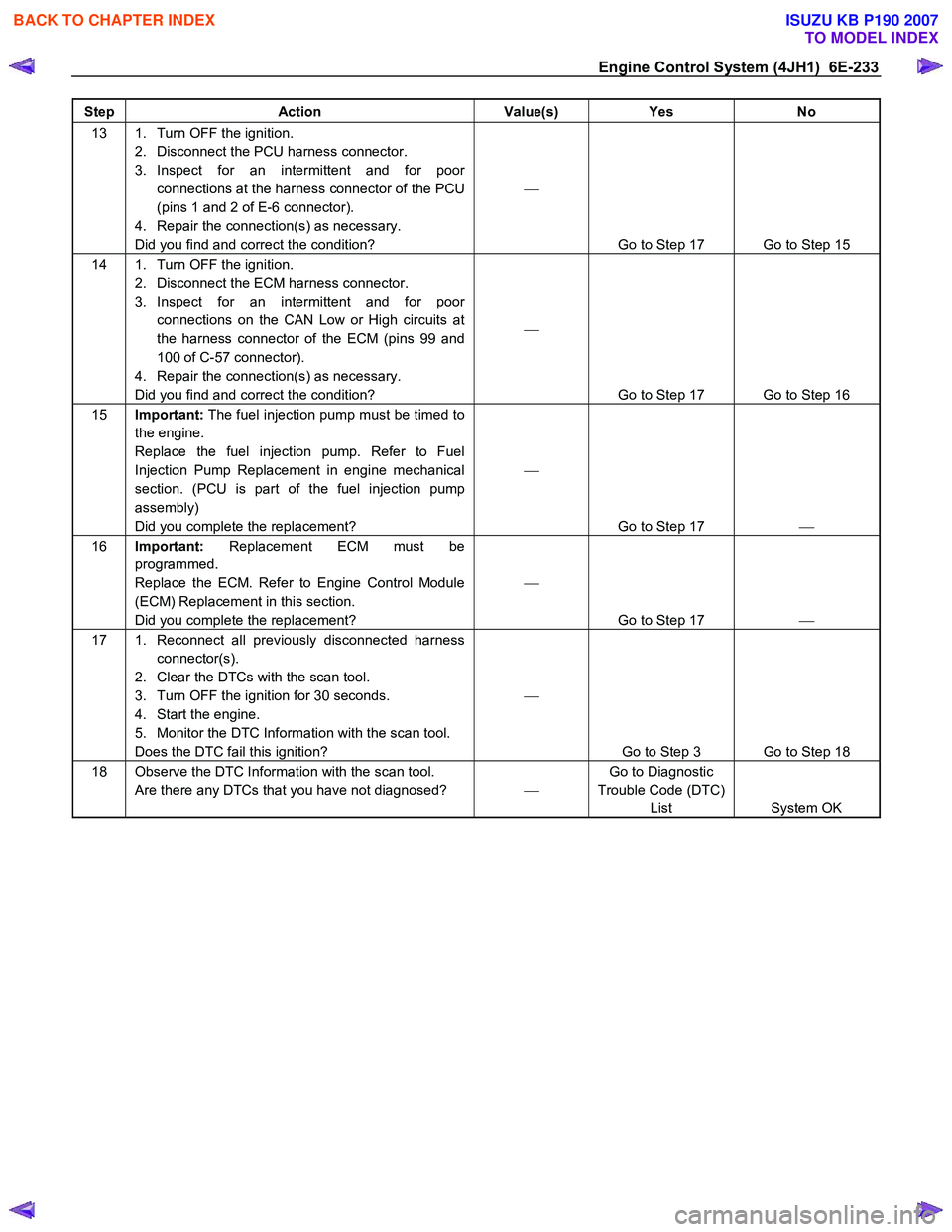
Engine Control System (4JH1) 6E-233
Step Action Value(s) Yes No
13 1. Turn OFF the ignition.
2. Disconnect the PCU harness connector.
3. Inspect for an intermittent and for poor connections at the harness connector of the PCU
(pins 1 and 2 of E-6 connector).
4. Repair the connection(s) as necessary.
Did you find and correct the condition?
Go to Step 17 Go to Step 15
14 1. Turn OFF the ignition. 2. Disconnect the ECM harness connector.
3. Inspect for an intermittent and for poor connections on the CAN Low or High circuits at
the harness connector of the ECM (pins 99 and
100 of C-57 connector).
4. Repair the connection(s) as necessary.
Did you find and correct the condition?
Go to Step 17 Go to Step 16
15 Important: The fuel injection pump must be timed to
the engine.
Replace the fuel injection pump. Refer to Fuel
Injection Pump Replacement in engine mechanical
section. (PCU is part of the fuel injection pump
assembly)
Did you complete the replacement?
Go to Step 17
16 Important: Replacement ECM must be
programmed.
Replace the ECM. Refer to Engine Control Module
(ECM) Replacement in this section.
Did you complete the replacement?
Go to Step 17
17 1. Reconnect all previously disconnected harness
connector(s).
2. Clear the DTCs with the scan tool.
3. Turn OFF the ignition for 30 seconds.
4. Start the engine.
5. Monitor the DTC Information with the scan tool.
Does the DTC fail this ignition?
Go to Step 3 Go to Step 18
18 Observe the DTC Information with the scan tool. Are there any DTCs that you have not diagnosed? Go to Diagnostic
Trouble Code (DTC) List System OK
BACK TO CHAPTER INDEX
TO MODEL INDEX
ISUZU KB P190 2007
Page 1270 of 6020
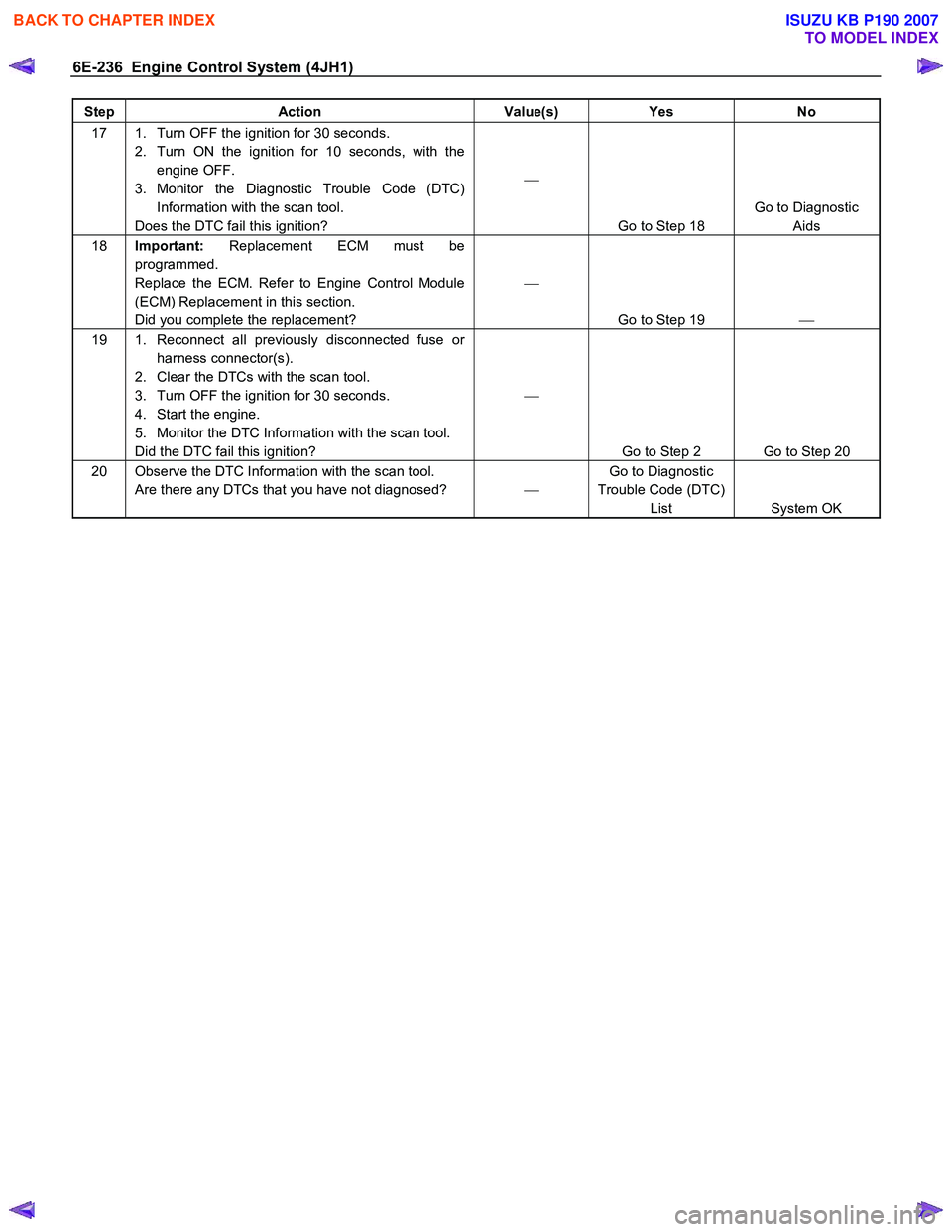
6E-236 Engine Control System (4JH1)
Step Action Value(s) Yes No
17 1. Turn OFF the ignition for 30 seconds.
2. Turn ON the ignition for 10 seconds, with the engine OFF.
3. Monitor the Diagnostic Trouble Code (DTC) Information with the scan tool.
Does the DTC fail this ignition?
Go to Step 18 Go to Diagnostic
Aids
18 Important: Replacement ECM must be
programmed.
Replace the ECM. Refer to Engine Control Module
(ECM) Replacement in this section.
Did you complete the replacement?
Go to Step 19
19 1. Reconnect all previously disconnected fuse or
harness connector(s).
2. Clear the DTCs with the scan tool.
3. Turn OFF the ignition for 30 seconds.
4. Start the engine.
5. Monitor the DTC Information with the scan tool.
Did the DTC fail this ignition?
Go to Step 2 Go to Step 20
20 Observe the DTC Information with the scan tool. Are there any DTCs that you have not diagnosed? Go to Diagnostic
Trouble Code (DTC) List System OK
BACK TO CHAPTER INDEX
TO MODEL INDEX
ISUZU KB P190 2007
Page 1272 of 6020
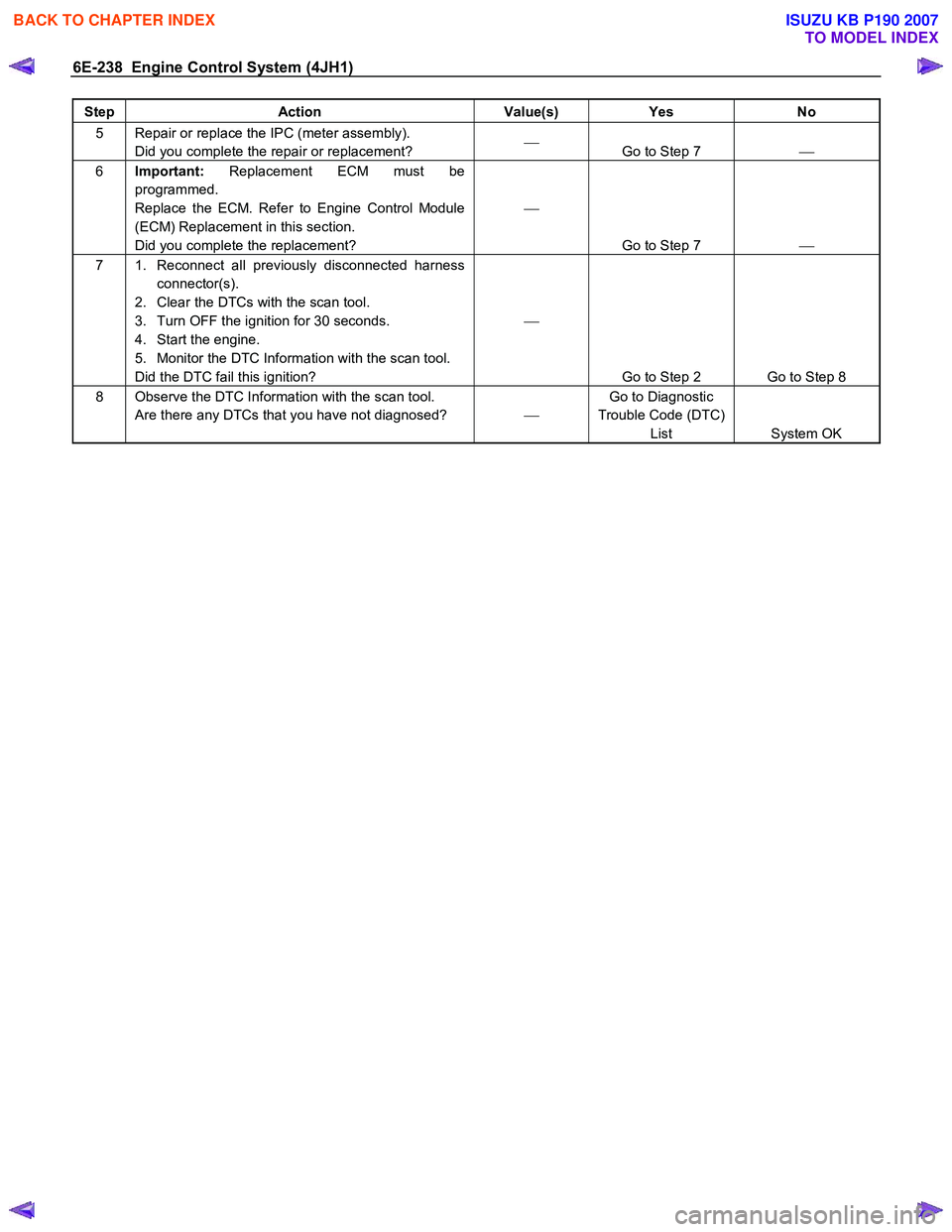
6E-238 Engine Control System (4JH1)
Step Action Value(s) Yes No
5 Repair or replace the IPC (meter assembly).
Did you complete the repair or replacement?
Go to Step 7
6 Important: Replacement ECM must be
programmed.
Replace the ECM. Refer to Engine Control Module
(ECM) Replacement in this section.
Did you complete the replacement?
Go to Step 7
7 1. Reconnect all previously disconnected harness
connector(s).
2. Clear the DTCs with the scan tool.
3. Turn OFF the ignition for 30 seconds.
4. Start the engine.
5. Monitor the DTC Information with the scan tool.
Did the DTC fail this ignition?
Go to Step 2 Go to Step 8
8 Observe the DTC Information with the scan tool. Are there any DTCs that you have not diagnosed? Go to Diagnostic
Trouble Code (DTC) List System OK
BACK TO CHAPTER INDEX
TO MODEL INDEX
ISUZU KB P190 2007
Page 1273 of 6020

Engine Control System (4JH1) 6E-239
Glow Control System Check
Description
The glow control system consists of the engine control
module (ECM), the glow relay and glow plugs. The glo
w
control system is operated when the engine coolant
temperature is low, which allows easier engine starting.
The ECM commands the glow relay ON for a certain
length of time at ignition switch is ON with engine OFF.
In after glow phase, the glow plugs remain energized fo
r
a certain period with engine run.
Glow Control Operation
•
The pre glow control system operates when the
engine coolant temperature is less than 30 °C
(86 °F).
• The after glow control system operates when the
engine coolant temperature is less than 60 °C
(140 °F).
Glow Control System Check
Schematic Reference: Engine Controls Schematics
Connector End View Reference: Engine Controls
Connector End Views
Step Action Value(s) Yes No
1 Did you perform the Diagnostic System Check-
Engine Controls?
Go to Step 2 Go to Diagnostic
System Check-
Engine Controls
2 1. Install the scan tool. 2. Turn OFF the ignition for 30 seconds.
3. Turn ON the ignition, with the engine OFF.
4. Monitor the Diagnostic Trouble Code (DTC) Information of the engine control system with the
scan tool and check whether following DTC(s) is
set: • P0115 (Symptom Code 1 & 2)
• P0380 (Symptom Code 4 & 8)
• P0381 (Symptom Code 4 & 8)
Are any of the above DTC(s) set?
Refer to Applicable DTC Go to Step 3
3 1. Turn OFF the ignition.
2. Make sure the metal bus bar that connects switched battery voltage supply terminal (E-49)
and all glow plugs is secured tightly.
3. Turn ON the ignition, with the engine OFF
4. Connect a test lamp between the metal bus bar (glow plug power supply E-49 terminal) and a
known good ground.
5. Perform the Glow Relay test with the scan tool.
6. Command the Glow Relay ON with the scan tool while observing the test lamp.
Does the test lamp turn ON only when commanded
ON with the scan tool?
Go to Step 4 Go to Step 5
4 1. Turn OFF the ignition. 2. Remove the metal bus bar from the glow plugs.
3. Measure resistance of each glow plug between the glow plug terminals and a known good
ground. Make sure to record all measurements
and take them quickly as to not allow engine
temperature changes between measurements.
Are the resistances within the specified value each
other? 1
Ω
System OK Go to Step 15
BACK TO CHAPTER INDEX
TO MODEL INDEX
ISUZU KB P190 2007
Page 1274 of 6020

6E-240 Engine Control System (4JH1)
Step Action Value(s) Yes No
5 1. Turn OFF the ignition.
2. Replace the glow relay with the starter relay or replace with a known good relay.
3. Turn ON the ignition, with the engine OFF.
4. Connect a test lamp between the metal bus bar (glow plug power supply E-49 connector) and a
known good ground.
5. Perform the Glow Relay test with the scan tool.
6. Command the Glow Relay ON with the scan tool while observing the test lamp.
Does the test lamp turn ON only when commanded
ON with the scan tool?
Go to Step 9 Go to Step 6
6 Inspect the Glow (60A) slow blow fuse (SBF-8) in the engine room fuse block.
Is the Glow (60A) slow blow fuse (SBF-8) open?
Go to Step 10 Go to Step 7
7 1. Turn OFF the ignition. 2. Remove the glow relay in the engine room relay block.
3. Connect a test lamp between the voltage feed circuit of the glow relay terminal (pin 4 of X-5
connector) and a known good ground.
4. Turn ON the ignition, with the engine OFF.
Does the test lamp illuminate?
Go to Step 8 Go to Step 11
8 1. Turn ON the ignition, with the engine OFF. 2. Connect a test lamp between the power supply circuit of glow plugs (pin 1 of X-5 connector) and
a known good ground.
Does the test lamp illuminate?
Go to Step 13 Go to Step 12
9 1. Turn OFF the ignition. 2. Inspect for an intermittent and for poor connections at the glow relay terminals (pins 1
and 4 of X-5 connector).
3. Repair the connection(s) as necessary.
Did you find and correct the condition?
Go to Step 16 Go to Step 14
10 1. Replace the Glow (60A) slow blow fuse (SBF-8). If the slow blow fuse continues to open, repair
the short to ground on a circuit fed by the slow
blow fuse or check for a shorted attached
component.
2. Repair the short to ground or replace the component as necessary.
Did you complete the repair?
Go to Step 16
11 Repair the open circuit in the battery voltage supply
circuit between the Glow (60A) slow blow fuse (SBF-
8) and the glow relay (pin 1 of X-5 connector).
Did you complete the repair?
Go to Step 16
12 Repair the open circuit in the switched battery
voltage supply circuit between the glow relay (pin 1
of X-5 connector) and the glow plugs (E-49
terminal).
Did you complete the repair?
Go to Step 16
BACK TO CHAPTER INDEX
TO MODEL INDEX
ISUZU KB P190 2007
Page 1276 of 6020

6E-242 Engine Control System (4JH1)
DTC A/C Compressor System Check
Description
W hen air conditioning (A/C) and blower fan are
selected, and if the system has a sufficient refrigerant
charge. A 12-volt signal is supplied to the A/C request
input of the Engine Control Module (ECM). The A/C
request signal may be temporarily canceled during
system operation by the electronic thermostat in the
evaporator to prevent the evaporator icing. Also, it is
cancelled when the pressure switch detected abnormal
pressure in the line. W hen the A/C request signal is
received by the ECM, the ECM supplies a ground from
the A/C compressor relay if the engine operating
conditions are within acceptable ranges. W ith the A/C
compressor relay energized, voltage is supplied to the
compressor clutch coil. The ECM will enable the
compressor clutch to engage whenever A/C has been
selected with the engine running and enable conditions
are met.
Condition for Running the A/C Compressor:
• The engine is running.
• The A/C switch is ON.
• The engine coolant temperature (ECT) is less than
105 °C(221 °F).
A/C Compressor System Check
Schematic Reference: Engine Controls Schematics
Connector End View Reference: Engine Controls
Connector End Views or Engine Control Module (ECM)
Connector End Views
Chart 1 of 2
Step Action Value(s) Yes No
1 Did you perform the Diagnostic System Check-
Engine Controls?
Go to Step 2 Go to Diagnostic
System Check – Engine Controls
2 1. Install the scan tool. 2. Turn OFF the ignition for 30 seconds.
3. Turn ON the ignition, with the engine OFF.
4. Monitor the Diagnostic Trouble Code (DTC) Information of the engine control system with the
scan tool and check whether following DTC(s) is
set: • P0115 (Symptom Code 1 & 2)
• P0645 (Symptom Code 4 & 8)
Are any of the above DTC(s) set?
Refer to Applicable DTC Go to Step 3
3 1. Turn ON the ignition, with the engine OFF.
2. Turn ON the blower motor switch.
Does the blower motor turn ON and operate
correctly?
Go to Step 4 Refer to Applicable
Diagnostic Chart in Heating & Air Conditioning Section
4 1. Turn OFF the blower motor switch. 2. Keep the A/C switch OFF.
Does the A/C Request Signal parameter indicate
OFF?
Go to Step 5 Go to Chart 2 of 2
with heater Step 1 OR
Go to Chart 2 of 2
without heater Step 1
5 1. Start the engine and let the engine idle. 2. Keep the blower motor switch OFF.
3. Keep the A/C switch OFF.
Does the A/C compressor clutch keep OFF
(disengage)?
Go to Step 6 Go to Step 11
6 1. Turn ON the blower motor switch. 2. Keep the A/C switch OFF.
Does the A/C compressor clutch keep OFF
(disengage)?
Go to Step 7 Go to Chart 2 of 2
with heater Step 7 OR
Go to Chart 2 of 2
without heater Step 4
BACK TO CHAPTER INDEX
TO MODEL INDEX
ISUZU KB P190 2007
Page 1277 of 6020
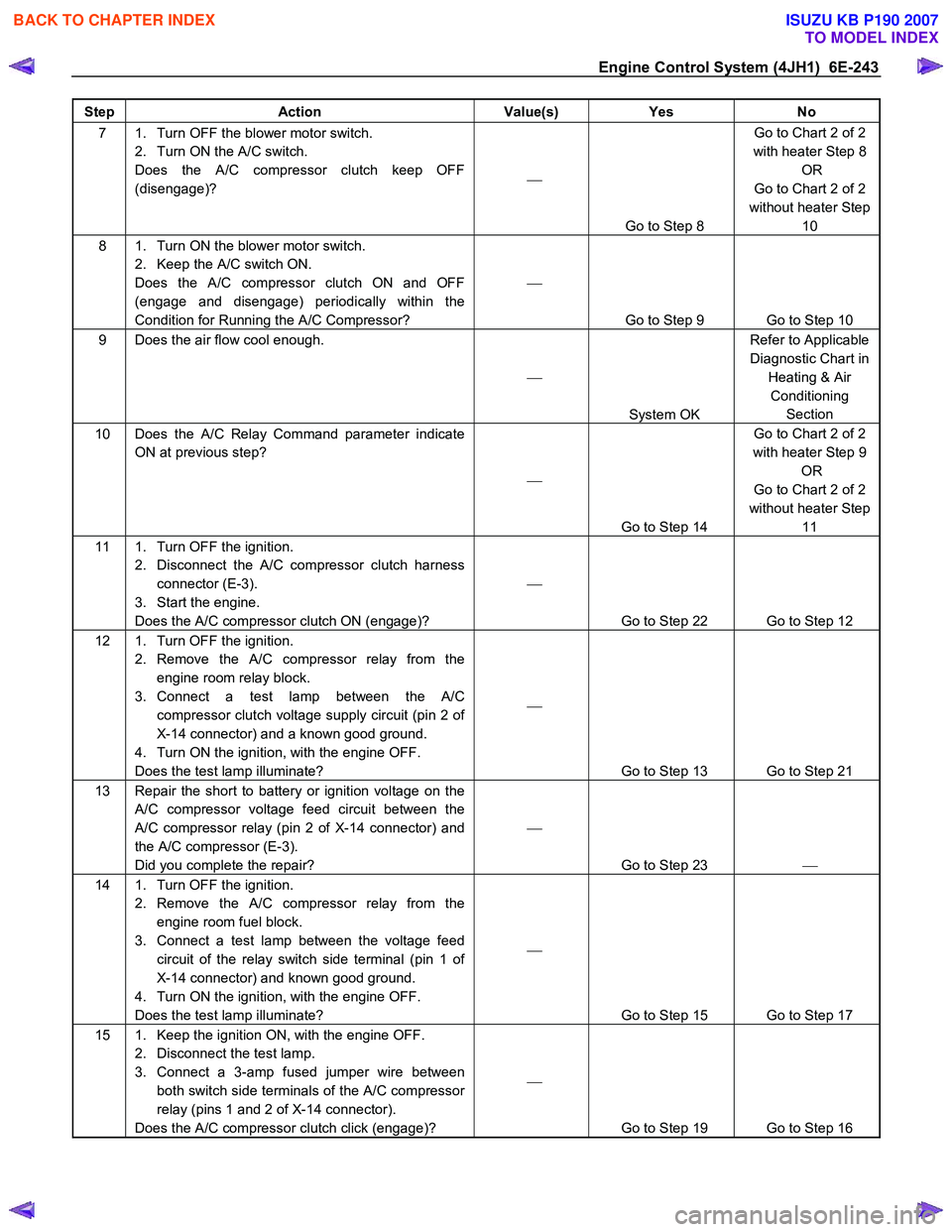
Engine Control System (4JH1) 6E-243
Step Action Value(s) Yes No
7 1. Turn OFF the blower motor switch.
2. Turn ON the A/C switch.
Does the A/C compressor clutch keep OFF
(disengage)?
Go to Step 8 Go to Chart 2 of 2
with heater Step 8 OR
Go to Chart 2 of 2
without heater Step 10
8 1. Turn ON the blower motor switch. 2. Keep the A/C switch ON.
Does the A/C compressor clutch ON and OFF
(engage and disengage) periodically within the
Condition for Running the A/C Compressor?
Go to Step 9 Go to Step 10
9 Does the air flow cool enough.
System OK Refer to Applicable
Diagnostic Chart in Heating & Air Conditioning Section
10 Does the A/C Relay Command parameter indicate ON at previous step?
Go to Step 14 Go to Chart 2 of 2
with heater Step 9 OR
Go to Chart 2 of 2
without heater Step 11
11 1. Turn OFF the ignition. 2. Disconnect the A/C compressor clutch harness connector (E-3).
3. Start the engine.
Does the A/C compressor clutch ON (engage)?
Go to Step 22 Go to Step 12
12 1. Turn OFF the ignition. 2. Remove the A/C compressor relay from the engine room relay block.
3. Connect a test lamp between the A/C compressor clutch voltage supply circuit (pin 2 of
X-14 connector) and a known good ground.
4. Turn ON the ignition, with the engine OFF.
Does the test lamp illuminate?
Go to Step 13 Go to Step 21
13 Repair the short to battery or ignition voltage on the A/C compressor voltage feed circuit between the
A/C compressor relay (pin 2 of X-14 connector) and
the A/C compressor (E-3).
Did you complete the repair?
Go to Step 23
14 1. Turn OFF the ignition.
2. Remove the A/C compressor relay from the engine room fuel block.
3. Connect a test lamp between the voltage feed circuit of the relay switch side terminal (pin 1 of
X-14 connector) and known good ground.
4. Turn ON the ignition, with the engine OFF.
Does the test lamp illuminate?
Go to Step 15 Go to Step 17
15 1. Keep the ignition ON, with the engine OFF. 2. Disconnect the test lamp.
3. Connect a 3-amp fused jumper wire between both switch side terminals of the A/C compressor
relay (pins 1 and 2 of X-14 connector).
Does the A/C compressor clutch click (engage)?
Go to Step 19 Go to Step 16
BACK TO CHAPTER INDEX
TO MODEL INDEX
ISUZU KB P190 2007