engine ISUZU KB P190 2007 Workshop Repair Manual
[x] Cancel search | Manufacturer: ISUZU, Model Year: 2007, Model line: KB P190, Model: ISUZU KB P190 2007Pages: 6020, PDF Size: 70.23 MB
Page 2685 of 6020
Engine Mechanical – V6 Page 6A1–206
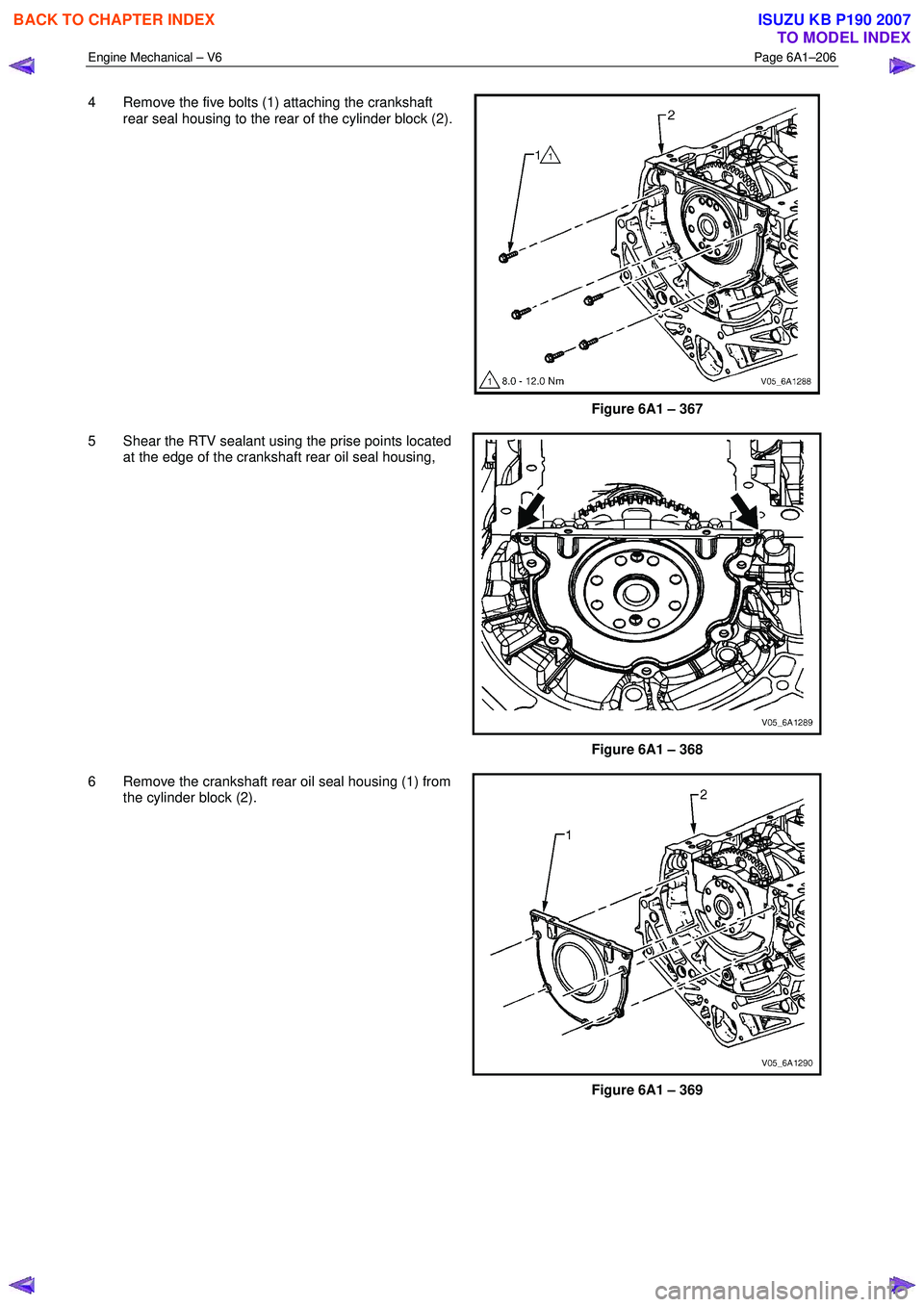
4 Remove the five bolts (1) attaching the crankshaft
rear seal housing to the rear of the cylinder block (2).
Figure 6A1 – 367
5 Shear the RTV sealant using the prise points located at the edge of the crankshaft rear oil seal housing,
Figure 6A1 – 368
6 Remove the crankshaft rear oil seal housing (1) from the cylinder block (2).
Figure 6A1 – 369
BACK TO CHAPTER INDEX
TO MODEL INDEX
ISUZU KB P190 2007
Page 2686 of 6020
Engine Mechanical – V6 Page 6A1–207
Reinstall
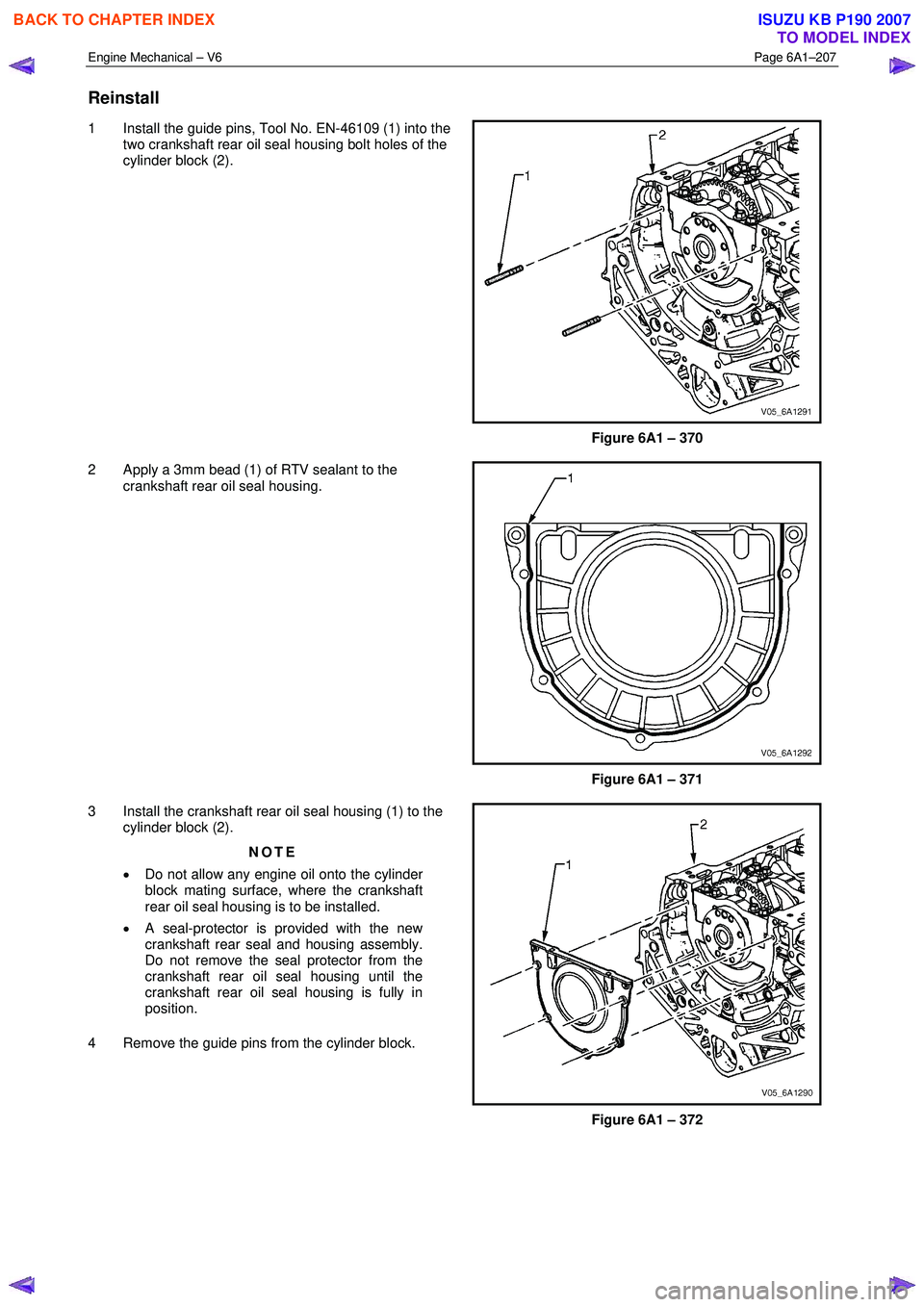
1 Install the guide pins, Tool No. EN-46109 (1) into the
two crankshaft rear oil seal housing bolt holes of the
cylinder block (2).
Figure 6A1 – 370
2 Apply a 3mm bead (1) of RTV sealant to the crankshaft rear oil seal housing.
Figure 6A1 – 371
3 Install the crankshaft rear oil seal housing (1) to the cylinder block (2).
NOTE
• Do not allow any engine oil onto the cylinder
block mating surface, where the crankshaft
rear oil seal housing is to be installed.
• A seal-protector is provided with the new
crankshaft rear seal and housing assembly.
Do not remove the seal protector from the
crankshaft rear oil seal housing until the
crankshaft rear oil seal housing is fully in
position.
4 Remove the guide pins from the cylinder block.
Figure 6A1 – 372
BACK TO CHAPTER INDEX
TO MODEL INDEX
ISUZU KB P190 2007
Page 2687 of 6020

Engine Mechanical – V6 Page 6A1–208
5 Install the crankshaft rear oil seal housing attaching
bolts (1) to the cylinder block (2) and tighten to the
correct torque specification.
Crankshaft rear oil seal housing
attaching bolt torque specification .............8.0 – 12.0 Nm
Figure 6A1 – 373
4.5 Pistons, Pins, Rings, Connecting Rods and Big-end Bearings
Remove
1 Remove the engine assembly, refer to 4.1 Engine .
2 Remove both cylinder head assemblies, refer to 3.22 Cylinder Head Assembly.
3 Remove the oil pan assembly, refer to 4.2 Oil Pan and Oil Pump Suction Pipe Assembly.
4 Mark the top of the piston being removed to identify its specific bore.
5 Install Tool No. EN-46111 (1) onto the crankshaft (2).
6 Rotate the crankshaft until the piston being removed is at the bottom of its stroke; bottom dead centre
(BDC).
Figure 6A1 – 374
CAUTION
If the connecting rod bearings have been
used in a running engine, they must be
replaced with new connecting rod bearings
for reassembly.
7 Before removing the connecting rods, check the connecting rod side clearance using the following procedure: a Tap the connecting rod to one end of the crankshaft journal with a dead blow or wooden hammer.
b Using feeler gauges, measure the clearance between the crankshaft counterweight and the connecting rod.
c The connecting rod side clearance should not exceed specifications, refer to 5 Specifications.
BACK TO CHAPTER INDEX
TO MODEL INDEX
ISUZU KB P190 2007
Page 2688 of 6020
Engine Mechanical – V6 Page 6A1–209
d If the endplay exceeds the specified limits, measure the width of the crankpin end of the connecting rod, refer
to 5 Specifications.
e If the connecting rod width is significantly smaller than specified and severe wear is present on the side of the connecting rod, replace the connecting rod.
f If the connecting rod width is within specification and excessive scoring is present on the crankshaft journals, replace the crankshaft.
CAUTION
Do not use a stamp, punch or any other
method that may distort or stress the
connecting rod and cap. Extensive engine
damage may result from a connecting rod that
is distorted or stressed.
8 Mark the cylinder number on the connecting rod and the connecting rod cap with a paint stick or permanent marker.
CAUTION
Powdered metal connecting rods have rod
bolts which yield when tighten to the
specified torque. If the bolts are loosened or
removed they must be replaced. Rod bolts
that are not replaced will not torque to the
correct clamp load and can lead to serious
engine damage.
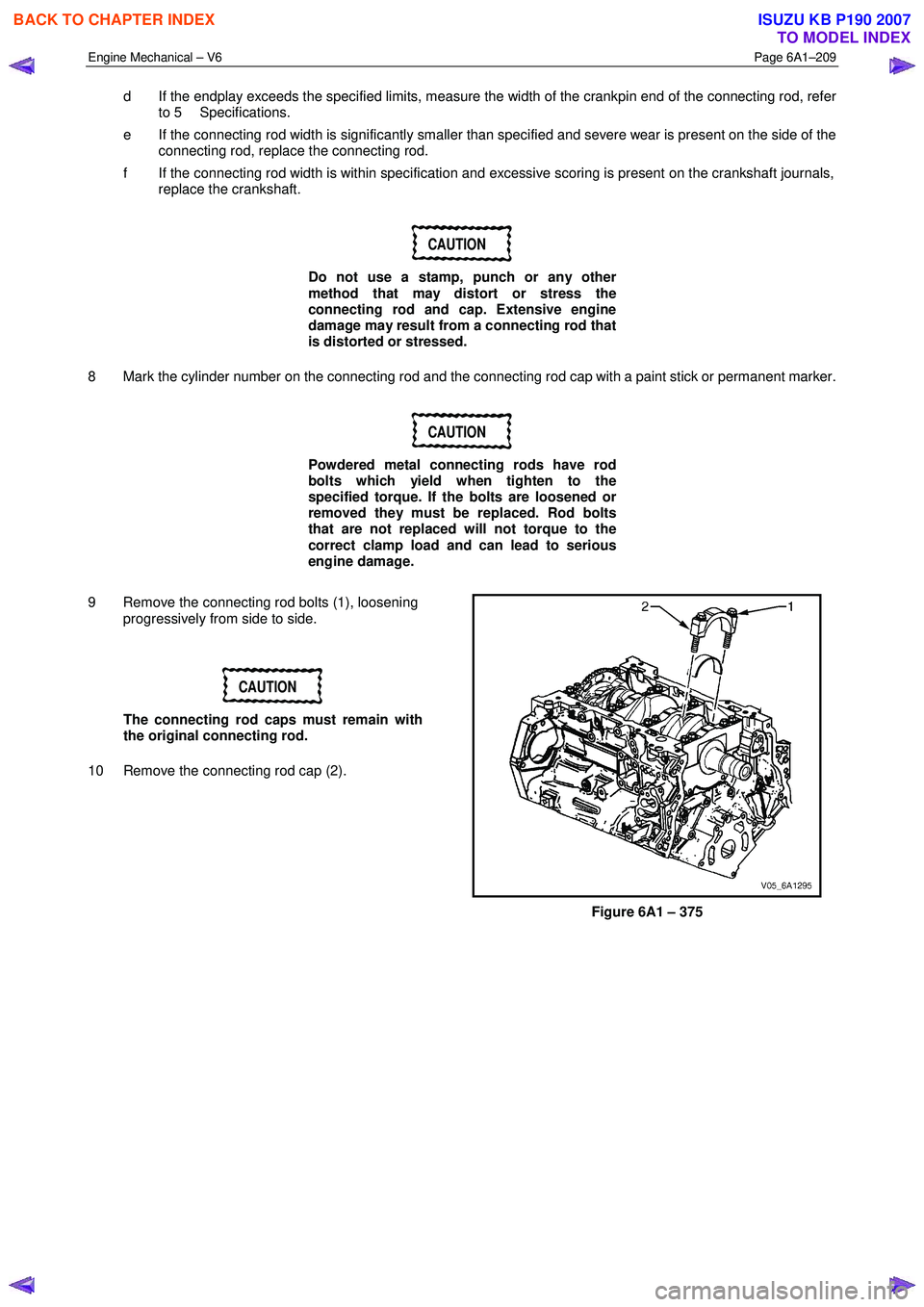
9 Remove the connecting rod bolts (1), loosening progressively from side to side.
CAUTION
The connecting rod caps must remain with
the original connecting rod.
10 Remove the connecting rod cap (2).
Figure 6A1 – 375
BACK TO CHAPTER INDEX
TO MODEL INDEX
ISUZU KB P190 2007
Page 2689 of 6020
Engine Mechanical – V6 Page 6A1–210
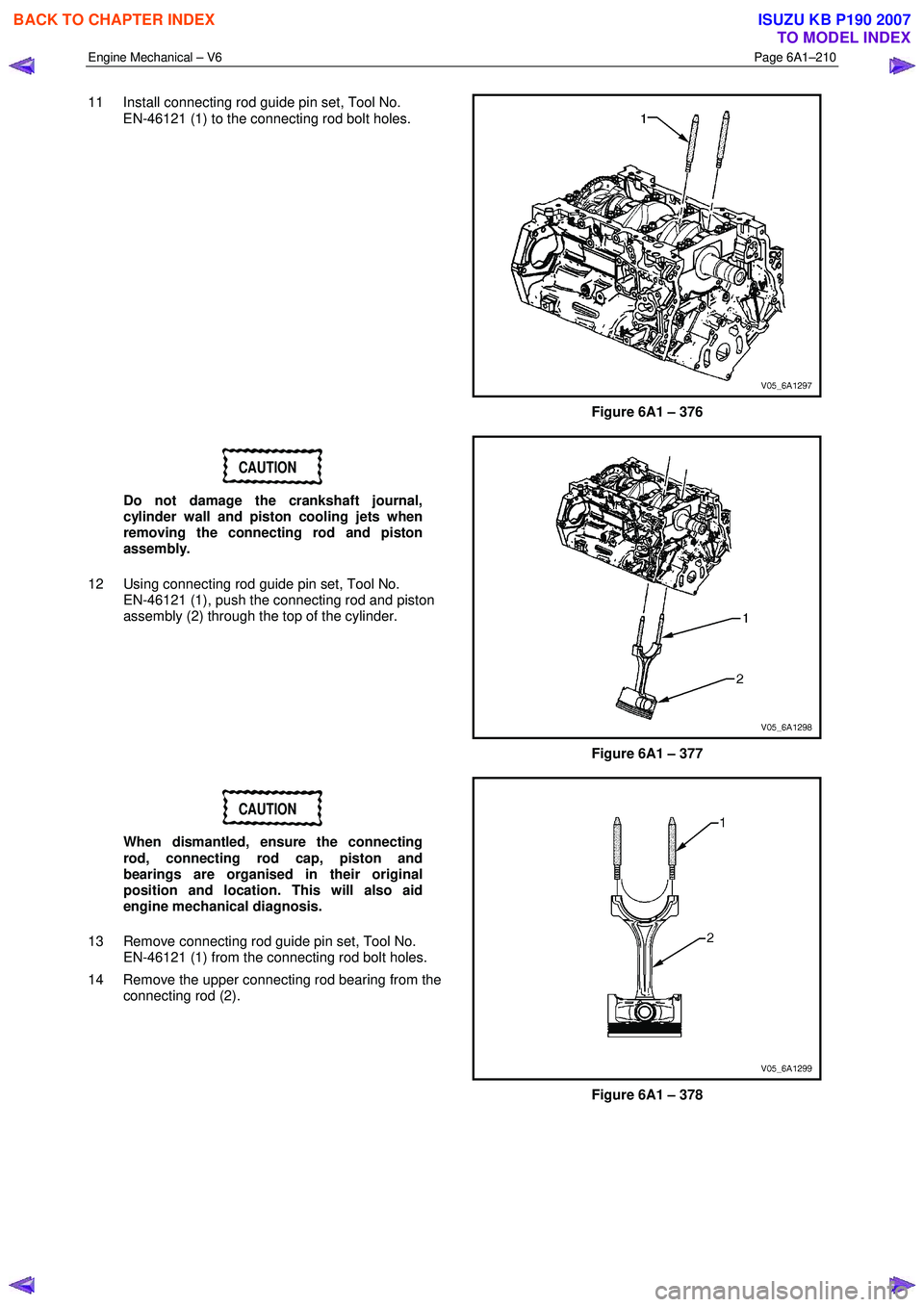
11 Install connecting rod guide pin set, Tool No.
EN-46121 (1) to the connecting rod bolt holes.
Figure 6A1 – 376
CAUTION
Do not damage the crankshaft journal,
cylinder wall and piston cooling jets when
removing the connecting rod and piston
assembly.
12 Using connecting rod guide pin set, Tool No. EN-46121 (1), push the connecting rod and piston
assembly (2) through the top of the cylinder.
Figure 6A1 – 377
CAUTION
When dismantled, ensure the connecting
rod, connecting rod cap, piston and
bearings are organised in their original
position and location. This will also aid
engine mechanical diagnosis.
13 Remove connecting rod guide pin set, Tool No. EN-46121 (1) from the connecting rod bolt holes.
14 Remove the upper connecting rod bearing from the connecting rod (2).
Figure 6A1 – 378
BACK TO CHAPTER INDEX
TO MODEL INDEX
ISUZU KB P190 2007
Page 2690 of 6020
Engine Mechanical – V6 Page 6A1–211
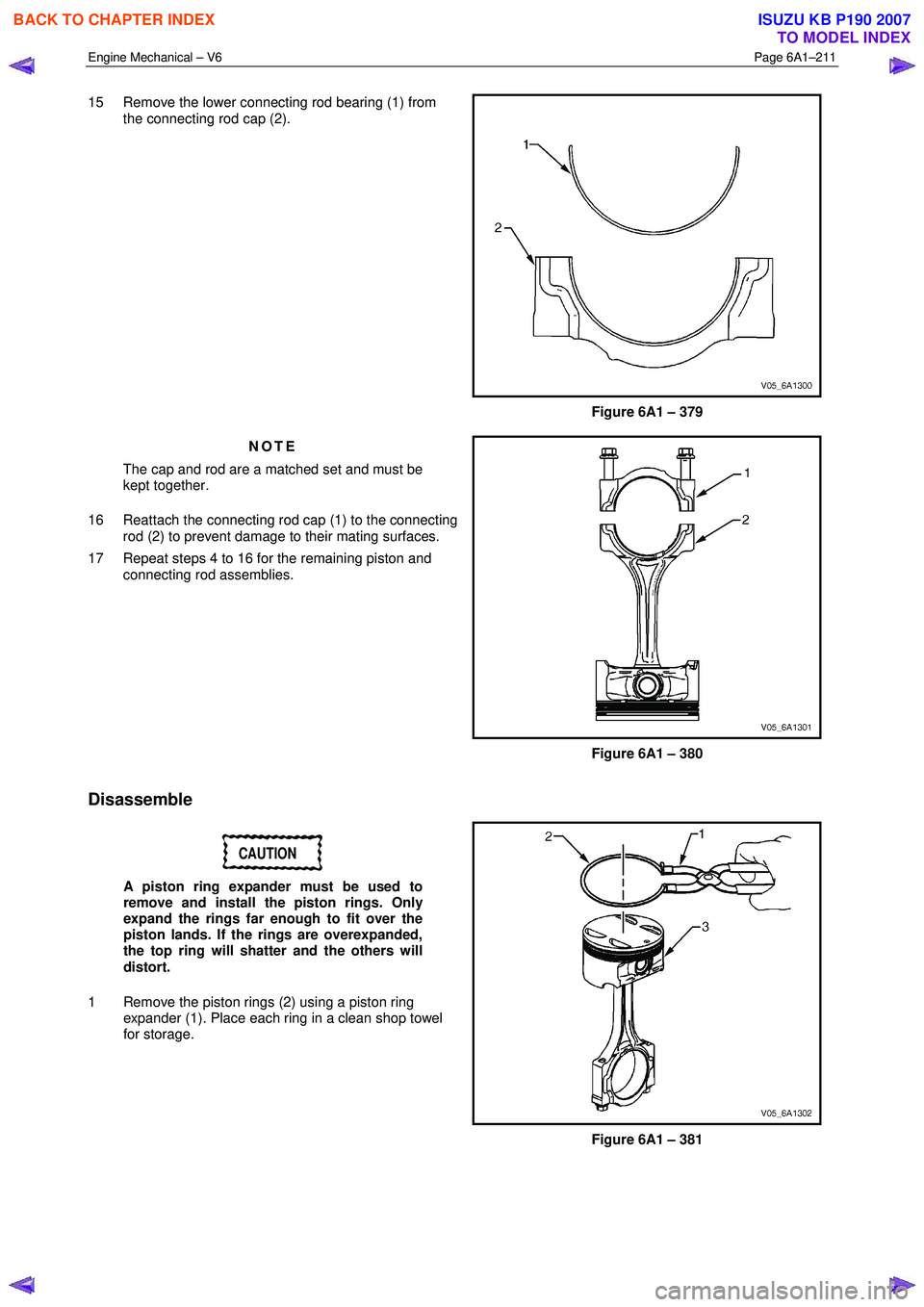
15 Remove the lower connecting rod bearing (1) from
the connecting rod cap (2).
Figure 6A1 – 379
NOTE
The cap and rod are a matched set and must be
kept together.
16 Reattach the connecting rod cap (1) to the connecting rod (2) to prevent damage to their mating surfaces.
17 Repeat steps 4 to 16 for the remaining piston and connecting rod assemblies.
Figure 6A1 – 380
Disassemble
CAUTION
A piston ring expander must be used to
remove and install the piston rings. Only
expand the rings far enough to fit over the
piston lands. If the rings are overexpanded,
the top ring will shatter and the others will
distort.
1 Remove the piston rings (2) using a piston ring expander (1). Place each ring in a clean shop towel
for storage.
Figure 6A1 – 381
BACK TO CHAPTER INDEX
TO MODEL INDEX
ISUZU KB P190 2007
Page 2691 of 6020
Engine Mechanical – V6 Page 6A1–212
CAUTION
Do not reuse the piston pin retainers.
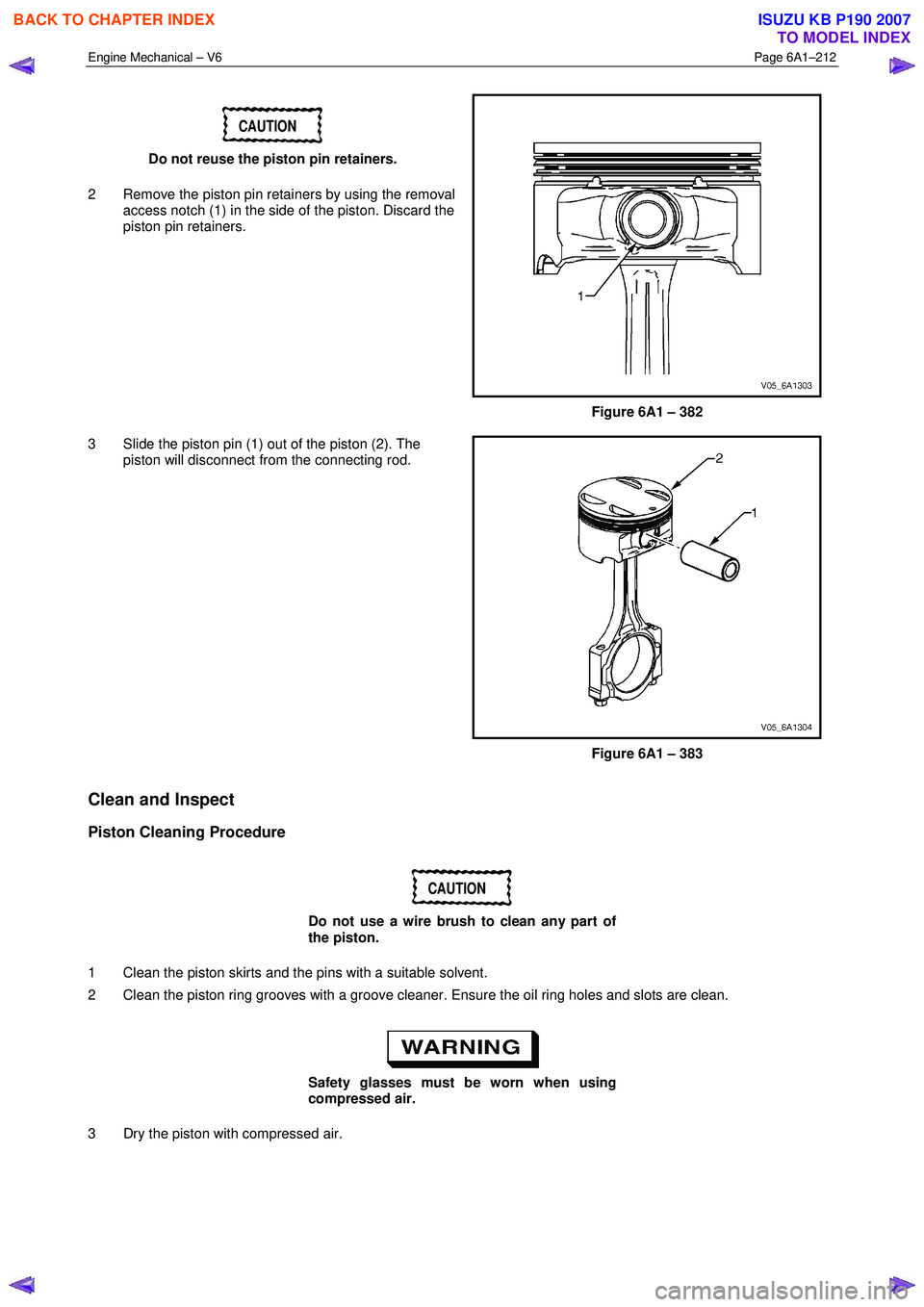
2 Remove the piston pin retainers by using the removal access notch (1) in the side of the piston. Discard the
piston pin retainers.
Figure 6A1 – 382
3 Slide the piston pin (1) out of the piston (2). The piston will disconnect from the connecting rod.
Figure 6A1 – 383
Clean and Inspect
Piston Cleaning Procedure
CAUTION
Do not use a wire brush to clean any part of
the piston.
1 Clean the piston skirts and the pins with a suitable solvent.
2 Clean the piston ring grooves with a groove cleaner. Ensure the oil ring holes and slots are clean.
Safety glasses must be worn when using
compressed air.
3 Dry the piston with compressed air.
BACK TO CHAPTER INDEX
TO MODEL INDEX
ISUZU KB P190 2007
Page 2692 of 6020

Engine Mechanical – V6 Page 6A1–213
Piston Inspection Procedure
1 Inspect the pistons for the following conditions:
• eroded areas at the top of the piston (1),
• piston pin retainer grooves for burrs (2),
• worn piston pin bores or worn piston pins (3),
• scuffed or damaged skirt coating (4),
• ring grooves for cracks, nicks or burrs that may
cause binding (5), and
• warped or worn ring lands.
2 Replace pistons that show any signs of damage or excessive wear.
Figure 6A1 – 384
Piston Measurement
1 Measure piston width using the following procedure:
a Using an outside micrometer, measure the width of the piston at 30 mm below the crown
top (1), at the thrust surfaces of the piston,
perpendicular to the piston pin centreline.
b Compare the measurement of the piston to its original cylinder by subtracting the piston width
from the cylinder diameter.
c Check your measurements with specifications, refer to 5 Specifications.
d If the clearance obtained through measurement is greater than the provided specifications and
the cylinder bores are within specification,
replace the piston.
Figure 6A1 – 385
2 Measure the piston pin bore to piston pin (2) clearances using the following procedure:
a Piston pin bores and pins must be free of varnish or scuffing.
b Use an outside micrometer (1) to measure the piston pin in the piston contact areas.
Figure 6A1 – 386
BACK TO CHAPTER INDEX
TO MODEL INDEX
ISUZU KB P190 2007
Page 2693 of 6020

Engine Mechanical – V6 Page 6A1–214
3 Using an inside micrometer, measure the piston pin
bore (1). Compare the result with the piston pin
diameter and piston pin to piston pin bore clearance
listed in the specifications, refer to 5 Specifications.
4 If the clearance is excessive, determine which piece is out of specification and replace as required.
5 Replace the piston if any of its dimensions are out of specification.
6 If the new piston does not meet clearance specifications, the cylinder block may need to be
oversized to 0.25 mm. There is only one size of
oversized pistons and rings available for service.
Figure 6A1 – 387
Piston Ring Measurement
1 Measure the piston ring end gap using the following procedure:
a Place the piston ring (1) in the area of the bore where the piston ring will travel, approximately 25 mm below
the deck surface. Ensure the ring is square with the
cylinder bore by positioning the ring with the piston
head.
b Measure the end gap of the piston ring with feeler gauges (2), refer to 5 Specifications.
c If the clearance exceeds the provided specifications, the piston rings must be replaced.
d Repeat the procedure for all piston rings.
Figure 6A1 – 388
2 Measure the piston ring side clearance using the following procedure:
a Roll the piston ring (1) entirely around the piston ring groove. If any binding is caused by the ring groove,
dress the groove with a fine file. If any binding is
caused by a distorted piston ring, replace the ring.
b W ith the piston ring on the piston, use feeler gauges (2) to check clearance at multiple locations.
c Compare the measurements with piston ring side clearance listed in the specifications, refer to 5
Specifications.
d If the clearance is greater than specifications, replace the piston rings.
Figure 6A1 – 389
BACK TO CHAPTER INDEX
TO MODEL INDEX
ISUZU KB P190 2007
Page 2694 of 6020
Engine Mechanical – V6 Page 6A1–215
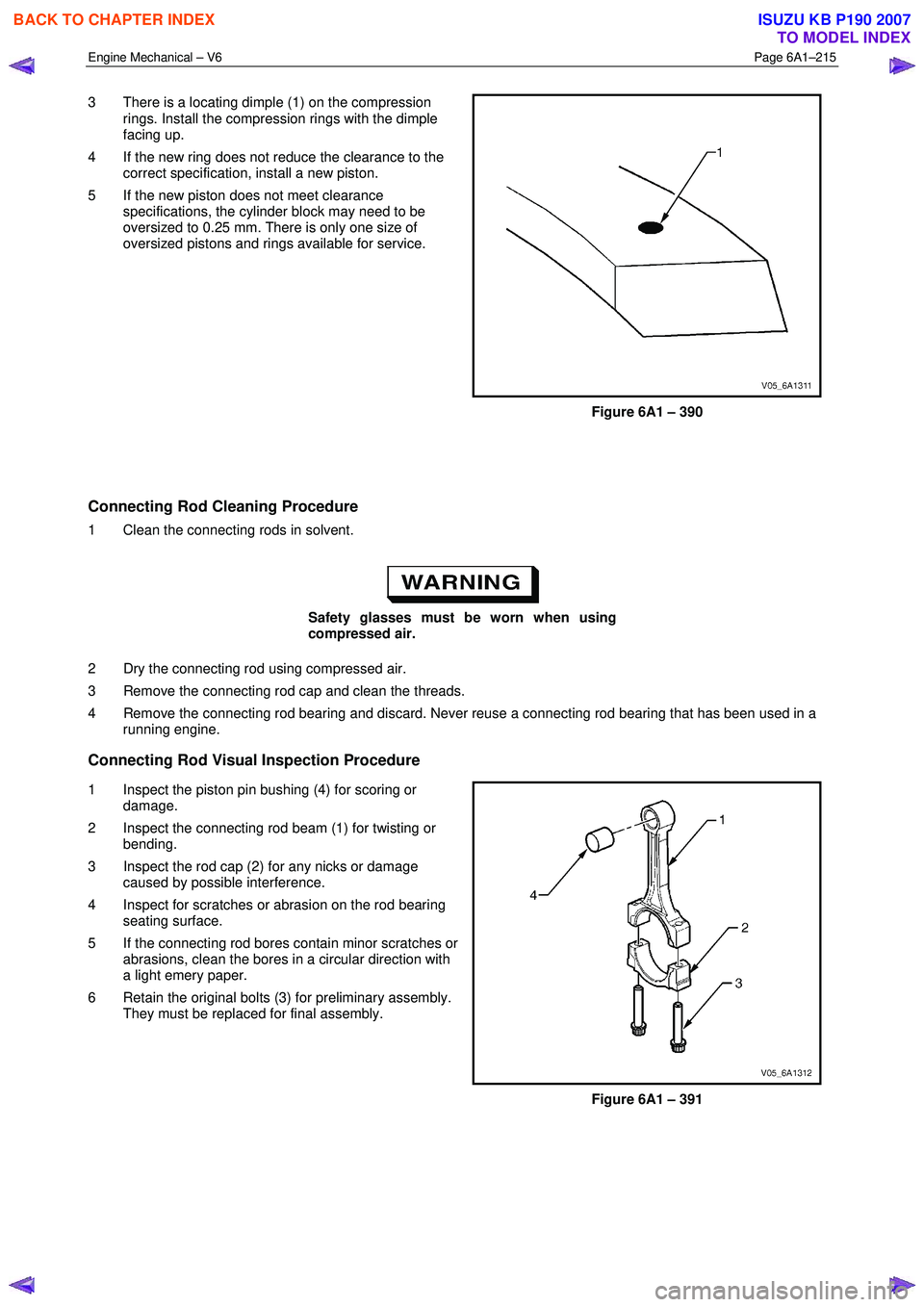
3 There is a locating dimple (1) on the compression
rings. Install the compression rings with the dimple
facing up.
4 If the new ring does not reduce the clearance to the correct specification, install a new piston.
5 If the new piston does not meet clearance specifications, the cylinder block may need to be
oversized to 0.25 mm. There is only one size of
oversized pistons and rings available for service.
Figure 6A1 – 390
Connecting Rod Cleaning Procedure
1 Clean the connecting rods in solvent.
Safety glasses must be worn when using
compressed air.
2 Dry the connecting rod using compressed air.
3 Remove the connecting rod cap and clean the threads.
4 Remove the connecting rod bearing and discard. Never reuse a connecting rod bearing that has been used in a running engine.
Connecting Rod Visual Inspection Procedure
1 Inspect the piston pin bushing (4) for scoring or
damage.
2 Inspect the connecting rod beam (1) for twisting or bending.
3 Inspect the rod cap (2) for any nicks or damage caused by possible interference.
4 Inspect for scratches or abrasion on the rod bearing seating surface.
5 If the connecting rod bores contain minor scratches or abrasions, clean the bores in a circular direction with
a light emery paper.
6 Retain the original bolts (3) for preliminary assembly. They must be replaced for final assembly.
Figure 6A1 – 391
BACK TO CHAPTER INDEX
TO MODEL INDEX
ISUZU KB P190 2007