start ISUZU KB P190 2007 Workshop Repair Manual
[x] Cancel search | Manufacturer: ISUZU, Model Year: 2007, Model line: KB P190, Model: ISUZU KB P190 2007Pages: 6020, PDF Size: 70.23 MB
Page 1753 of 6020
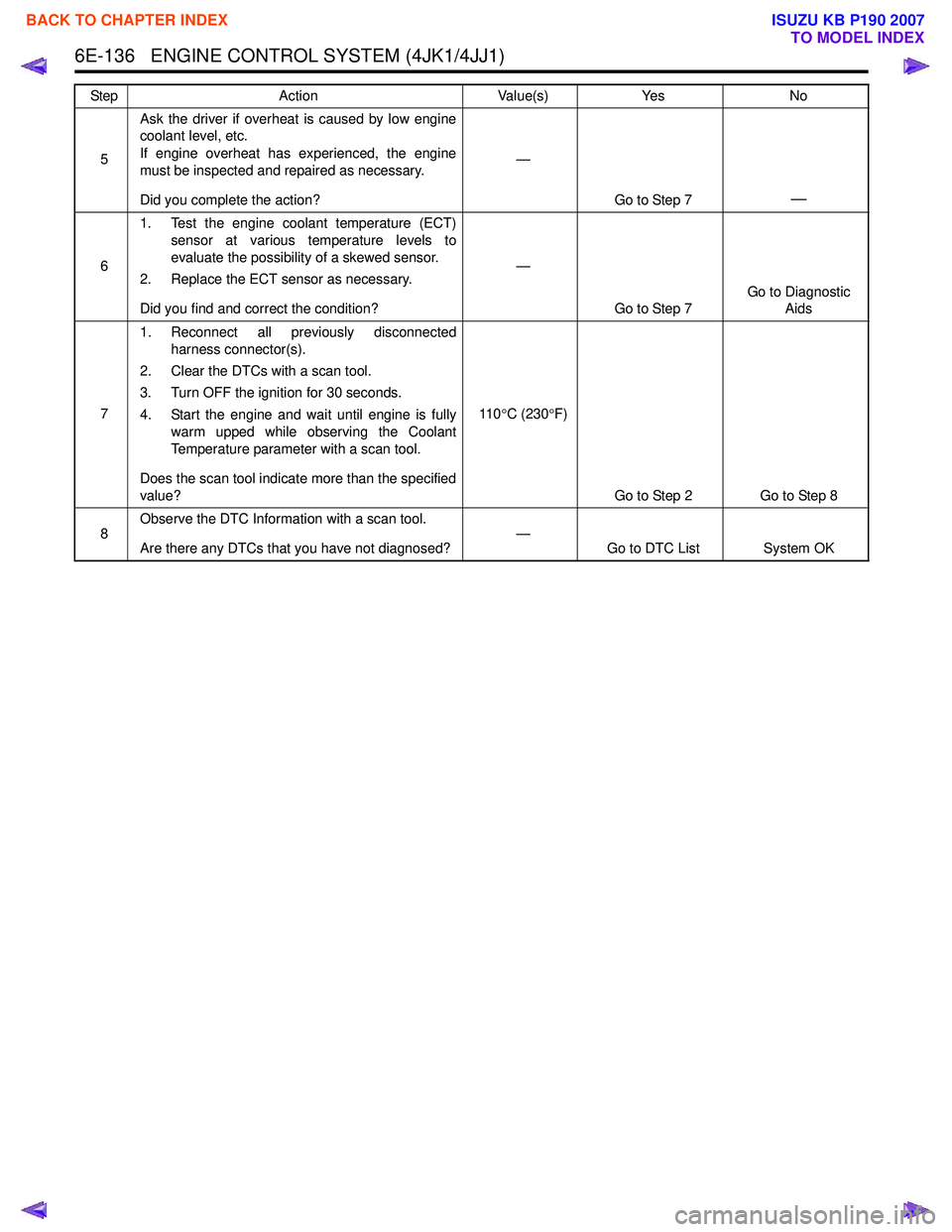
6E-136 ENGINE CONTROL SYSTEM (4JK1/4JJ1)
5Ask the driver if overheat is caused by low engine
coolant level, etc.
If engine overheat has experienced, the engine
must be inspected and repaired as necessary.
Did you complete the action? —
Go to Step 7
—
61. Test the engine coolant temperature (ECT)
sensor at various temperature levels to
evaluate the possibility of a skewed sensor.
2. Replace the ECT sensor as necessary.
Did you find and correct the condition? —
Go to Step 7 Go to Diagnostic
Aids
7 1. Reconnect all previously disconnected
harness connector(s).
2. Clear the DTCs with a scan tool.
3. Turn OFF the ignition for 30 seconds.
4. Start the engine and wait until engine is fully warm upped while observing the Coolant
Temperature parameter with a scan tool.
Does the scan tool indicate more than the specified
value? 11 0
°C (230 °F)
Go to Step 2 Go to Step 8
8 Observe the DTC Information with a scan tool.
Are there any DTCs that you have not diagnosed? —
Go to DTC List System OK
Step
Action Value(s)Yes No
BACK TO CHAPTER INDEX
TO MODEL INDEX
ISUZU KB P190 2007
Page 1754 of 6020

ENGINE CONTROL SYSTEM (4JK1/4JJ1) 6E-137
DTC P0219 (Flash Code 543)
Circuit Description
The crankshaft position (CKP) sensor is located on the
left-hand of the cylinder block rear and it is behind the
starter motor. The ECM calculates the engine speed
and exact position of the crankshaft based on the
signal pulse from the CKP sensor. If the ECM detects
an engine overrun condition, this DTC will set.
Condition for Setting the DTC • The ECM detects that the engine speed is more than 4900 RPM (4JK1 standard output) or 4700
RPM (4JK1 high output and 4JJ1).
Action Taken When the DTC Sets • The ECM illuminates the SVS lamp when the diagnostic runs and fails. Refer to DTC Type
Definitions for Action Taken When the DTC Sets -
Type C. (Euro 4 Specification)
• The ECM illuminates the MIL when the diagnostic runs and fails. Refer to DTC Type Definitions for
Action Taken When the DTC Sets - Type A.
(Except Euro 4 Specification)
• The ECM limits fuel injection quantity.
• The ECM inhibits pilot injection.
• The ECM inhibits cruise control. • The ECM stops engine running when the vehicle
speed is lower than 5 km/h (3 MPH) for 5 seconds.
The engine will run after the key is cycled when the
ignition has been tuned OFF for longer than 10
seconds.
Condition for Clearing the DTC • Refer to DTC Type Definitions for Condition for Clearing the SVS Lamp/ DTC - Type C. (Euro 4
Specification)
• Refer to DTC Type Definitions for Condition for Clearing the MIL/ DTC - Type A. (Except Euro 4
Specification)
Diagnostic Aids • Make sure the CKP sensor is tight and the teeth are not damaged.
• Electromagnetic interference in the CKP sensor circuits may set this DTC.
• The Total Engine Overspeed Events parameter on scan tool indicates number of overrun events.
Notice: • This DTC is caused by an engine overspeed condition, which was most likely caused by driver
error (i.e. downshifting a manual transmission on a
steep grade). Excessive engine overspeed may
damage internal engine components.
Circuit/ System Testing DTC P0219
Step Action Value(s)Yes No
1 Did you perform the Diagnostic System Check -
Engine Controls? —
Go to Step 2 Go to Diagnostic
System Check -
Engine Controls
2 Important:
If DTC P0335 or P0336 is set, diagnose
that DTC first.
1. Install a scan tool.
2. Start the engine.
3. Observe the Engine Speed parameter with a scan tool.
4. Accelerate the engine as necessary.
Does the Engine Speed parameter ever exceed the
specified value? 5000 RPM
Go to Step 4 Go to Step 3
3 Ask the driver if overrun is caused by gear slip-out,
shift error, down-slope driving, etc. If engine
overrun has experienced, the engine must be
inspected and repaired as necessary.
Did you complete the action? —
Go to Step 6
—
BACK TO CHAPTER INDEX
TO MODEL INDEX
ISUZU KB P190 2007
Page 1755 of 6020

6E-138 ENGINE CONTROL SYSTEM (4JK1/4JJ1)
41. Inspect the CKP sensor and sensor rotor for
the following conditions:
• Physical damage of sensor
• Loose or improper installation of sensor
• Excessive air gap
• Foreign material passing between sensor and sensor rotor
• Physical damage of sensor rotor
• Loose or improper installation of sensor rotor
2. Repair or replace as necessary.
Did you find and correct the condition? —
Go to Step 6 Go to Step 5
5 Replace the CKP sensor. Refer to CKP Sensor
Replacement.
Did you complete the replacement? —
Go to Step 5
—
61. Reconnect all previously disconnected
harness connector(s).
2. Clear the DTCs with a scan tool.
3. Turn OFF the ignition for 30 seconds.
4. Start the engine.
5. Accelerate the engine between idle and W.O.T. (accelerator pedal full travel) many
times while observing the Engine Speed
parameter with a scan tool.
Does the Engine Speed parameter ever exceed the
specified value? 5000 RPM
Go to Step 4 Go to Step 7
7 Observe the DTC Information with a scan tool.
Are there any DTCs that you have not diagnosed? —
Go to DTC List System OK
Step
Action Value(s)Yes No
BACK TO CHAPTER INDEX
TO MODEL INDEX
ISUZU KB P190 2007
Page 1758 of 6020
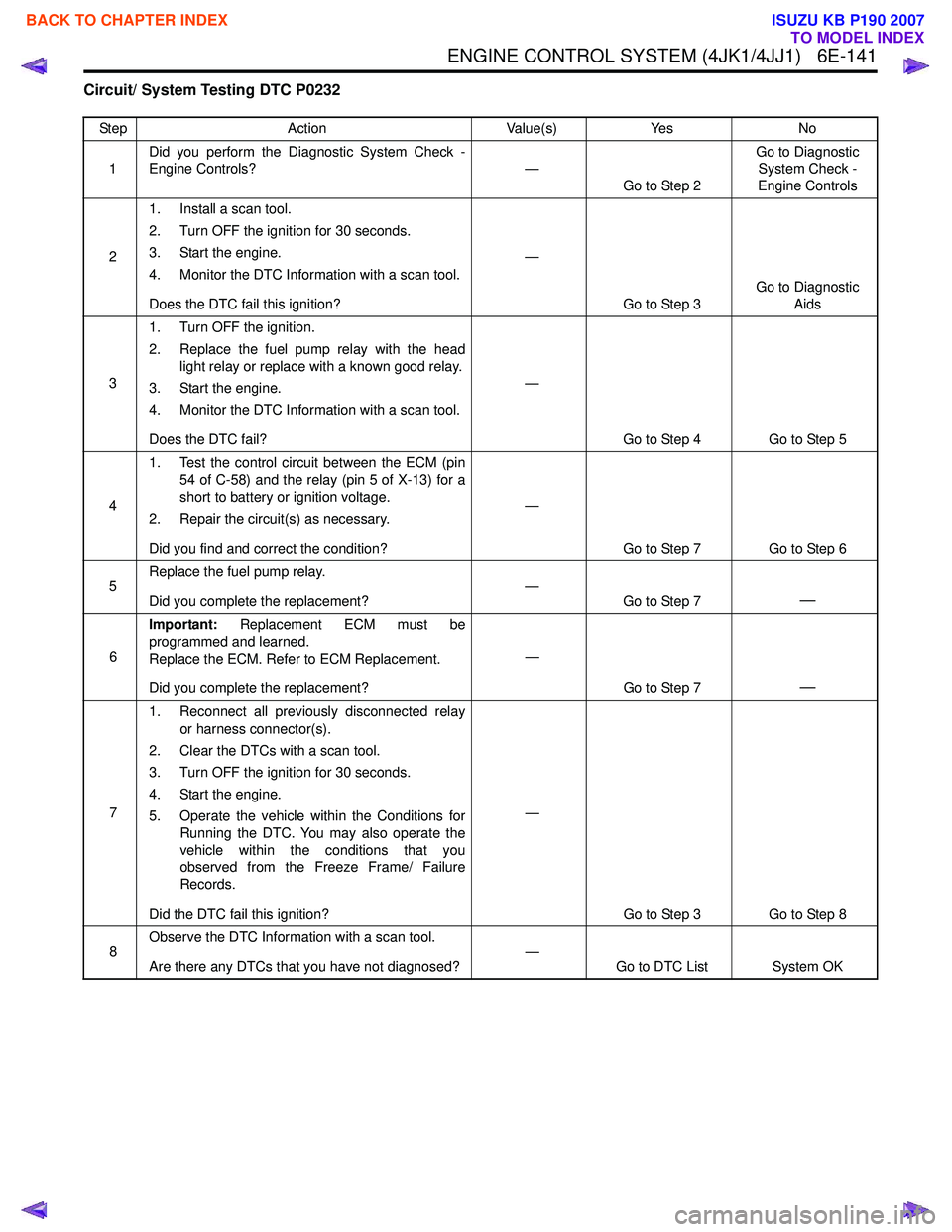
ENGINE CONTROL SYSTEM (4JK1/4JJ1) 6E-141
Circuit/ System Testing DTC P0232
StepAction Value(s)Yes No
1 Did you perform the Diagnostic System Check -
Engine Controls? —
Go to Step 2 Go to Diagnostic
System Check -
Engine Controls
2 1. Install a scan tool.
2. Turn OFF the ignition for 30 seconds.
3. Start the engine.
4. Monitor the DTC Information with a scan tool.
Does the DTC fail this ignition? —
Go to Step 3 Go to Diagnostic
Aids
3 1. Turn OFF the ignition.
2. Replace the fuel pump relay with the head light relay or replace with a known good relay.
3. Start the engine.
4. Monitor the DTC Information with a scan tool.
Does the DTC fail? —
Go to Step 4 Go to Step 5
4 1. Test the control circuit between the ECM (pin
54 of C-58) and the relay (pin 5 of X-13) for a
short to battery or ignition voltage.
2. Repair the circuit(s) as necessary.
Did you find and correct the condition? —
Go to Step 7 Go to Step 6
5 Replace the fuel pump relay.
Did you complete the replacement? —
Go to Step 7
—
6Important:
Replacement ECM must be
programmed and learned.
Replace the ECM. Refer to ECM Replacement.
Did you complete the replacement? —
Go to Step 7
—
71. Reconnect all previously disconnected relay
or harness connector(s).
2. Clear the DTCs with a scan tool.
3. Turn OFF the ignition for 30 seconds.
4. Start the engine.
5. Operate the vehicle within the Conditions for Running the DTC. You may also operate the
vehicle within the conditions that you
observed from the Freeze Frame/ Failure
Records.
Did the DTC fail this ignition? —
Go to Step 3 Go to Step 8
8 Observe the DTC Information with a scan tool.
Are there any DTCs that you have not diagnosed? —
Go to DTC List System OK
BACK TO CHAPTER INDEX
TO MODEL INDEX
ISUZU KB P190 2007
Page 1759 of 6020

6E-142 ENGINE CONTROL SYSTEM (4JK1/4JJ1)
DTC P0234 (Flash Code 42)
Circuit Description
The boost pressure sensor is located in the air
induction tubing. The sensor is a transducer that varies
voltage according to changes in the air pressure inside
the air tubing. The ECM monitors the boost pressure
sensor signal for abnormal values. If the ECM detects
that the sensor signal is excessively high, this DTC will
set. This indicates excessive high boost pressure.
Condition for Running the DTC • DTCs P0045, P0107 and P0108 are not set.
• The ignition switch is ON.
• The engine is running.
Condition for Setting the DTC • The ECM detects that the actual boost pressure is more than 20 kPa (3 psi) over the desired boost
pressure under certain conditions for longer than
10 seconds.
Action Taken When the DTC Sets • The ECM illuminates the MIL when the diagnostic runs and fails. Refer to DTC Type Definitions for
Action Taken When the DTC Sets - Type A.
• The ECM limits fuel injection quantity.
• The ECM inhibits pilot injection.
Condition for Clearing the DTC • Refer to DTC Type Definitions for Condition for Clearing the MIL/ DTC - Type A.
• The ECM limits fuel injection quantity.
• The ECM inhibits pilot injection. • The ECM inhibits cruise control.
Diagnostic Aids • An open circuit or high resistance in the boost pressure low reference circuit may set this DTC.
• Misrouted vacuum hoses may set this DTC.
• Check the turbocharger nozzle control actuator for a sticking. Refer to Turbocharger in the Engine
Mechanical section.
• Use a scan tool to verify the integrity of the boost pressure sensor signal. Compare the Boost
Pressure to the Desired Boost Pressure under all
load conditions for an excessively high value.
• The fuel with which gasoline was mixed may set this DTC.
Test Description
The numbers below refer to the step number on the
Circuit/ System Testing.
3. A skewed boost pressure sensor value (shifted to a
higher pressure) can set this DTC. The Boost Pressure
on the scan tool should read near Barometric Pressure
(BARO) with the key ON and engine OFF.
4. A skewed BARO sensor value (shifted to a lower
pressure) may indicate a wrong boost pressure. The
BARO on the scan tool should read near surrounding
barometric pressure.
Schematic Reference: Vacuum Hose Routing
Diagram and Engine Controls Schematics
Connector End View Reference: Engine Controls
Connector End Views or ECM Connector End Views
Circuit/ System Testing DTC P0234
Step Action Value(s)Yes No
1 Did you perform the Diagnostic System Check -
Engine Controls? —
Go to Step 2 Go to Diagnostic
System - Check
Engine Controls
2 1. Install a scan tool.
2. Turn OFF the ignition for 30 seconds.
3. Start the engine.
4. Monitor the DTC Information with a scan tool.
Is DTC P0045, P0107, P0108, P0638, P1196,
P1197, P1198, P2227, P2228 or P2229 also set? —
Go to Applicable DTC Go to Step 3
3 1. Turn ON the ignition, with the engine OFF.
2. Observe the Boost Pressure and Barometric Pressure (BARO) with a scan tool.
Does the scan tool indicate that the difference
between the Boost Pressure and BARO is more
than the specified value? 10 kPa (1.5
psi)
Go to Step 4 Go to Step 5
BACK TO CHAPTER INDEX
TO MODEL INDEX
ISUZU KB P190 2007
Page 1762 of 6020

ENGINE CONTROL SYSTEM (4JK1/4JJ1) 6E-145
DTC P0299 (Flash Code 65)
Circuit Description
The boost pressure sensor is located in the air
induction tubing. The sensor is a transducer that varies
voltage according to changes in the air pressure inside
the air tubing. The ECM monitors the boost pressure
sensor signal for abnormal values. If the ECM detects
that the sensor signal is excessively low, this DTC will
set. This indicates excessive low boost pressure.
Condition for Running the DTC • DTCs P0045, P0087, P0088, P0089, P0091, P0092, P0093, P0101, P0102, P0103, P0107,
P0108, P0116, P0117, P0118, P0122, P0123,
P0192, P0193, P0401, P0403, P0404, P0405,
P0406, P0638, P0652, P0653, P0698, P0699,
P1064, P1065, P1093, P1404, P2100, P2101,
P2103, P2227, P2228 and P2229 are not set.
• The ignition switch is ON.
• The engine is running.
• The fuel injection quantity is higher than a predetermined value.
Condition for Setting the DTC • The ECM detects that the actual boost pressure is more than 40 kPa (6 psi) below the desired boost
pressure under certain conditions for longer than
10 seconds.
Action Taken When the DTC Sets • The ECM illuminates the MIL when the diagnostic runs and fails. Refer to DTC Type Definitions for
Action Taken When the DTC Sets - Type A.
• The ECM limits fuel injection quantity.
• The ECM inhibits cruise control. Condition for Clearing the DTC
• Refer to DTC Type Definitions for Condition for Clearing the MIL/ DTC - Type A.
Diagnostic Aids • Induction air leakage can cause a low boost pressure condition. A whistling noise may be heard
if a component is allowing air to enter the induction
system.
• Check for cracked air tubing that may only open during certain engine movement conditions.
• Misrouted vacuum hoses may set this DTC.
• Check the turbocharger nozzle control actuator for a sticking. Refer to Turbocharger in the Engine
Mechanical section.
• Use a scan tool to verify the integrity of the boost pressure sensor signal. Compare the Boost
Pressure to the Desired Boost Pressure under all
load conditions for an excessively low value.
• Loss of vacuum pressure or vacuum pump problem sets this DTC.
Test Description
The numbers below refer to the step number on the
diagnostic table.
4. A skewed boost pressure sensor value (shifted to a
lower pressure) can set this DTC. The Boost Pressure
on the scan tool should read near Barometric Pressure
(BARO) with the key ON and engine OFF.
5. A skewed BARO sensor value (shifted to a higher
pressure) may indicate a wrong boost pressure. The
BARO on the scan tool should read near surrounding
barometric pressure.
Schematic Reference: Vacuum Hose Routing
Diagram and Engine Controls Schematics
Connector End View Reference: Engine Controls
Connector End Views or ECM Connector End Views
Circuit/ System Testing DTC P0299
Step Action Value(s)Yes No
1 Did you perform the Diagnostic System Check -
Engine Controls? —
Go to Step 2 Go to Diagnostic
System Check -
Engine Controls
2 1. Install a scan tool.
2. Turn OFF the ignition for 30 seconds.
3. Start the engine.
4. Monitor the DTC Information with a scan tool.
Is DTC P0045, P0107, P0108, P2227, P2228 or
P2229 also set? —
Go to Applicable DTC Go to Step 3
BACK TO CHAPTER INDEX
TO MODEL INDEX
ISUZU KB P190 2007
Page 1765 of 6020
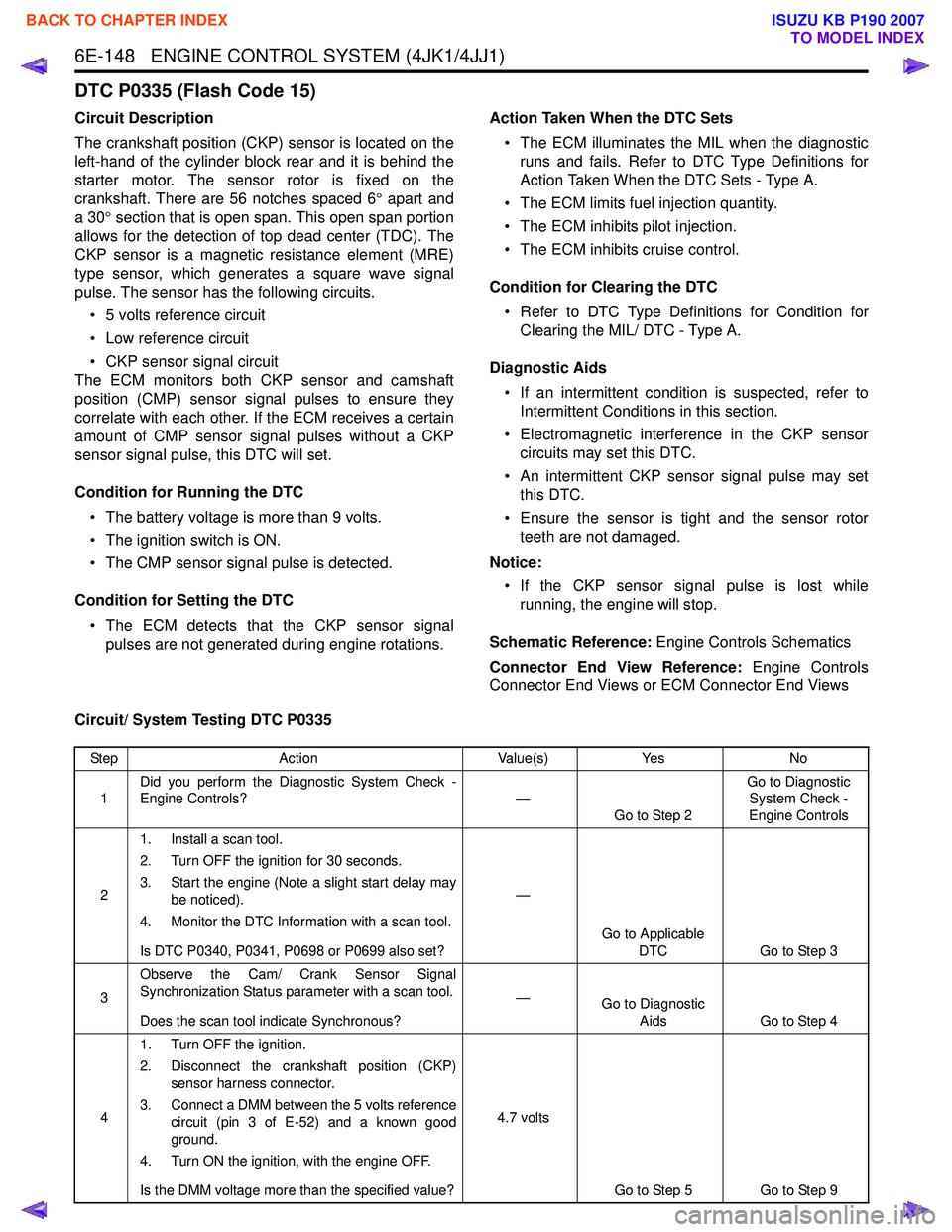
6E-148 ENGINE CONTROL SYSTEM (4JK1/4JJ1)
DTC P0335 (Flash Code 15)
Circuit Description
The crankshaft position (CKP) sensor is located on the
left-hand of the cylinder block rear and it is behind the
starter motor. The sensor rotor is fixed on the
crankshaft. There are 56 notches spaced 6 ° apart and
a 30 ° section that is open span. This open span portion
allows for the detection of top dead center (TDC). The
CKP sensor is a magnetic resistance element (MRE)
type sensor, which generates a square wave signal
pulse. The sensor has the following circuits.
• 5 volts reference circuit
• Low reference circuit
• CKP sensor signal circuit
The ECM monitors both CKP sensor and camshaft
position (CMP) sensor signal pulses to ensure they
correlate with each other. If the ECM receives a certain
amount of CMP sensor signal pulses without a CKP
sensor signal pulse, this DTC will set.
Condition for Running the DTC • The battery voltage is more than 9 volts.
• The ignition switch is ON.
• The CMP sensor signal pulse is detected.
Condition for Setting the DTC • The ECM detects that the CKP sensor signal pulses are not generated during engine rotations. Action Taken When the DTC Sets
• The ECM illuminates the MIL when the diagnostic runs and fails. Refer to DTC Type Definitions for
Action Taken When the DTC Sets - Type A.
• The ECM limits fuel injection quantity.
• The ECM inhibits pilot injection.
• The ECM inhibits cruise control.
Condition for Clearing the DTC • Refer to DTC Type Definitions for Condition for Clearing the MIL/ DTC - Type A.
Diagnostic Aids • If an intermittent condition is suspected, refer to Intermittent Conditions in this section.
• Electromagnetic interference in the CKP sensor circuits may set this DTC.
• An intermittent CKP sensor signal pulse may set this DTC.
• Ensure the sensor is tight and the sensor rotor teeth are not damaged.
Notice: • If the CKP sensor signal pulse is lost while running, the engine will stop.
Schematic Reference: Engine Controls Schematics
Connector End View Reference: Engine Controls
Connector End Views or ECM Connector End Views
Circuit/ System Testing DTC P0335
Step Action Value(s)Yes No
1 Did you perform the Diagnostic System Check -
Engine Controls? —
Go to Step 2 Go to Diagnostic
System Check -
Engine Controls
2 1. Install a scan tool.
2. Turn OFF the ignition for 30 seconds.
3. Start the engine (Note a slight start delay may be noticed).
4. Monitor the DTC Information with a scan tool.
Is DTC P0340, P0341, P0698 or P0699 also set? —
Go to Applicable DTC Go to Step 3
3 Observe the Cam/ Crank Sensor Signal
Synchronization Status parameter with a scan tool.
Does the scan tool indicate Synchronous? —
Go to Diagnostic
Aids Go to Step 4
4 1. Turn OFF the ignition.
2. Disconnect the crankshaft position (CKP) sensor harness connector.
3. Connect a DMM between the 5 volts reference circuit (pin 3 of E-52) and a known good
ground.
4. Turn ON the ignition, with the engine OFF.
Is the DMM voltage more than the specified value? 4.7 volts
Go to Step 5 Go to Step 9
BACK TO CHAPTER INDEX
TO MODEL INDEX
ISUZU KB P190 2007
Page 1767 of 6020

6E-150 ENGINE CONTROL SYSTEM (4JK1/4JJ1)
141. Inspect for an intermittent and for poor
connections at the harness connector of the
CKP sensor (pins 1, 2 and 3 of E-52).
2. Repair the connection(s) as necessary.
Did you find and correct the condition? —
Go to Step 19 Go to Step 16
15 1. Turn OFF the ignition.
2. Disconnect the ECM harness connector.
3. Inspect for an intermittent and for poor connections at the harness connector of the
ECM (pins 37, 38, 39 and 58 of E-90).
4. Repair the connection(s) as necessary.
Did you find and correct the condition? —
Go to Step 19 Go to Step 18
16 1. Inspect the CKP sensor and sensor rotor for
the following conditions:
• Physical damage of sensor
• Loose or improper installation of sensor
• Excessive air gap
• Foreign material passing between sensor and sensor rotor
• Physical damage of sensor rotor
• Loose or improper installation of sensor rotor
2. Repair or replace as necessary.
Did you find and correct the condition? —
Go to Step 19 Go to Step 17
17 Replace the CKP sensor. Refer to CKP Sensor
Replacement.
Did you complete the replacement? —
Go to Step 19
—
18Important:
Replacement ECM must be
programmed and learned.
Replace the ECM. Refer to ECM Replacement.
Did you complete the replacement? —
Go to Step 19
—
191. Reconnect all previously disconnected
harness connector(s).
2. Clear the DTCs with a scan tool.
3. Turn OFF the ignition for 30 seconds.
4. Start the engine.
5. Operate the vehicle within the Conditions for Running the DTC. You may also operate the
vehicle within the conditions that you
observed from the Freeze Frame/ Failure
Records.
Did the DTC fail this ignition? —
Go to Step 2 Go to Step 20
20 Observe the DTC Information with a scan tool.
Are there any DTCs that you have not diagnosed? —
Go to DTC List System OK
Step
Action Value(s)Yes No
BACK TO CHAPTER INDEX
TO MODEL INDEX
ISUZU KB P190 2007
Page 1768 of 6020
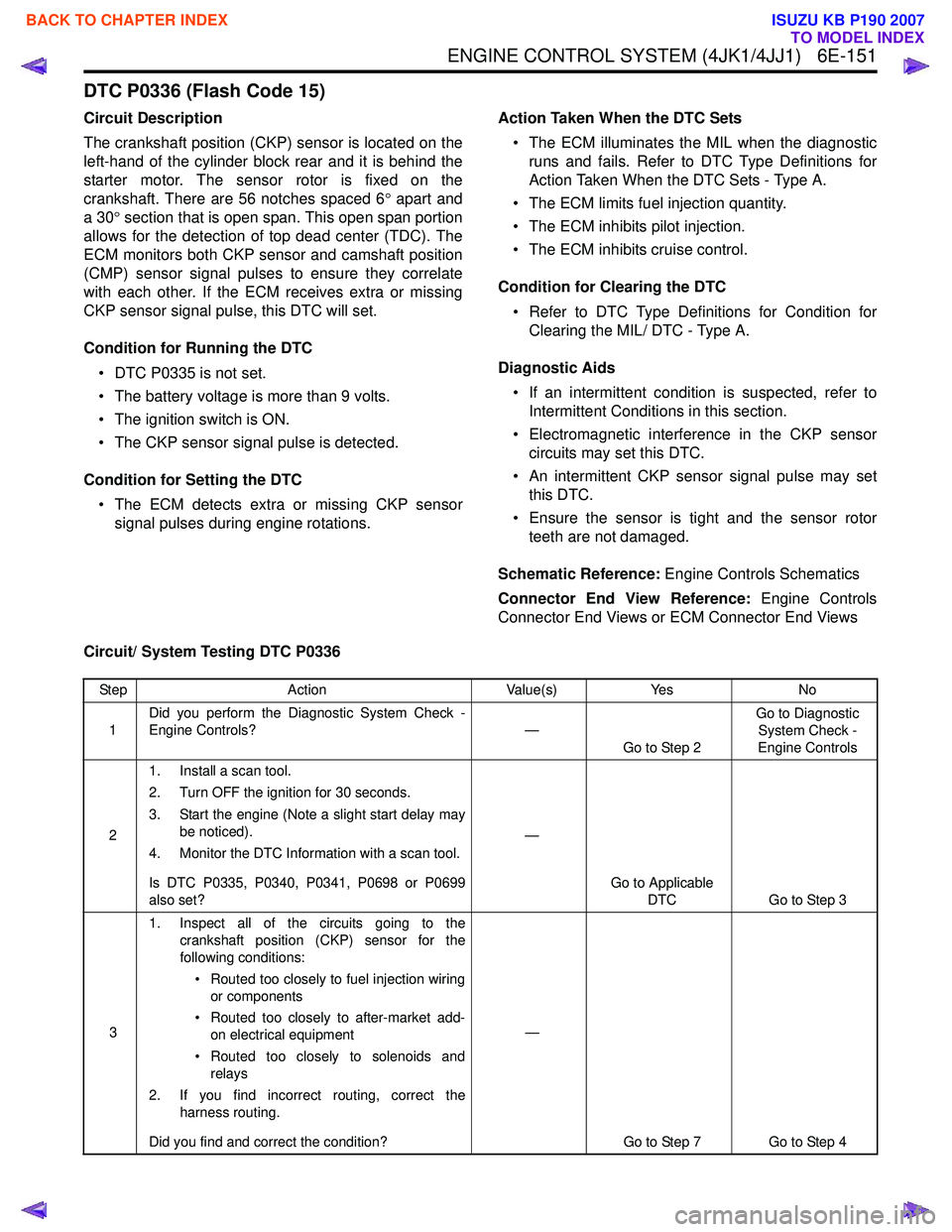
ENGINE CONTROL SYSTEM (4JK1/4JJ1) 6E-151
DTC P0336 (Flash Code 15)
Circuit Description
The crankshaft position (CKP) sensor is located on the
left-hand of the cylinder block rear and it is behind the
starter motor. The sensor rotor is fixed on the
crankshaft. There are 56 notches spaced 6 ° apart and
a 30 ° section that is open span. This open span portion
allows for the detection of top dead center (TDC). The
ECM monitors both CKP sensor and camshaft position
(CMP) sensor signal pulses to ensure they correlate
with each other. If the ECM receives extra or missing
CKP sensor signal pulse, this DTC will set.
Condition for Running the DTC • DTC P0335 is not set.
• The battery voltage is more than 9 volts.
• The ignition switch is ON.
• The CKP sensor signal pulse is detected.
Condition for Setting the DTC • The ECM detects extra or missing CKP sensor signal pulses during engine rotations. Action Taken When the DTC Sets
• The ECM illuminates the MIL when the diagnostic runs and fails. Refer to DTC Type Definitions for
Action Taken When the DTC Sets - Type A.
• The ECM limits fuel injection quantity.
• The ECM inhibits pilot injection.
• The ECM inhibits cruise control.
Condition for Clearing the DTC • Refer to DTC Type Definitions for Condition for Clearing the MIL/ DTC - Type A.
Diagnostic Aids • If an intermittent condition is suspected, refer to Intermittent Conditions in this section.
• Electromagnetic interference in the CKP sensor circuits may set this DTC.
• An intermittent CKP sensor signal pulse may set this DTC.
• Ensure the sensor is tight and the sensor rotor teeth are not damaged.
Schematic Reference: Engine Controls Schematics
Connector End View Reference: Engine Controls
Connector End Views or ECM Connector End Views
Circuit/ System Testing DTC P0336
Step Action Value(s)Yes No
1 Did you perform the Diagnostic System Check -
Engine Controls? —
Go to Step 2 Go to Diagnostic
System Check -
Engine Controls
2 1. Install a scan tool.
2. Turn OFF the ignition for 30 seconds.
3. Start the engine (Note a slight start delay may be noticed).
4. Monitor the DTC Information with a scan tool.
Is DTC P0335, P0340, P0341, P0698 or P0699
also set? —
Go to Applicable DTC Go to Step 3
3 1. Inspect all of the circuits going to the
crankshaft position (CKP) sensor for the
following conditions:
• Routed too closely to fuel injection wiring or components
• Routed too closely to after-market add- on electrical equipment
• Routed too closely to solenoids and relays
2. If you find incorrect routing, correct the harness routing.
Did you find and correct the condition? —
Go to Step 7 Go to Step 4
BACK TO CHAPTER INDEX
TO MODEL INDEX
ISUZU KB P190 2007
Page 1769 of 6020

6E-152 ENGINE CONTROL SYSTEM (4JK1/4JJ1)
41. Turn OFF the ignition.
2. Disconnect the ECM harness connector.
3. Inspect for an intermittent, for poor connections and corrosion at the harness
connector of the ECM (pins 37, 38, 39 and 58
of E-90).
4. Disconnect the CKP sensor harness connector.
5. Inspect for an intermittent, for poor connections and corrosion at the harness
connector of the CKP sensor (pins 1, 2 and 3
of E-52).
6. Repair the connection(s) as necessary.
Did you find and correct the condition? —
Go to Step 7 Go to Step 5
5 1. Inspect the CKP sensor and sensor rotor for
the following conditions:
• Physical damage of sensor
• Loose or improper installation of sensor
• Excessive air gap
• Foreign material passing between sensor and sensor rotor
• Physical damage of sensor rotor
• Loose or improper installation of sensor rotor
2. Repair or replace as necessary.
Did you find and correct the condition? —
Go to Step 7 Go to Step 6
6 Replace the CKP sensor. Refer to CKP Sensor
Replacement.
Did you complete the replacement? —
Go to Step 7
—
71. Reconnect all previously disconnected
harness connector(s).
2. Clear the DTCs with a scan tool.
3. Turn OFF the ignition for 30 seconds.
4. Start the engine.
5. Operate the vehicle within the Conditions for Running the DTC. You may also operate the
vehicle within the conditions that you
observed from the Freeze Frame/ Failure
Records.
Did the DTC fail this ignition? —
Go to Step 2 Go to Step 8
8 Observe the DTC Information with a scan tool.
Are there any DTCs that you have not diagnosed? —
Go to DTC List System OK
Step
Action Value(s)Yes No
BACK TO CHAPTER INDEX
TO MODEL INDEX
ISUZU KB P190 2007