start ISUZU KB P190 2007 Workshop Repair Manual
[x] Cancel search | Manufacturer: ISUZU, Model Year: 2007, Model line: KB P190, Model: ISUZU KB P190 2007Pages: 6020, PDF Size: 70.23 MB
Page 2671 of 6020
Engine Mechanical – V6 Page 6A1–192
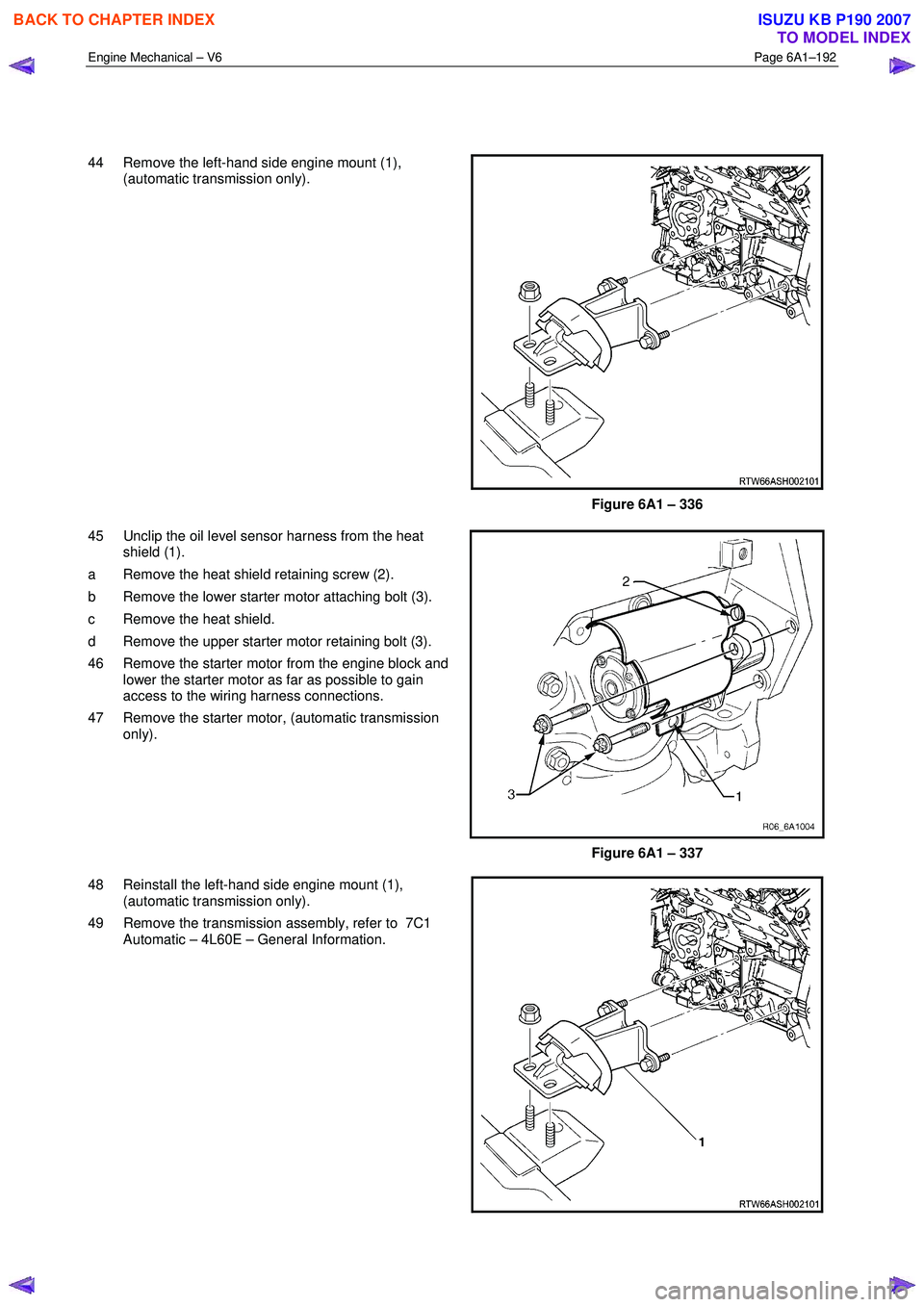
44 Remove the left-hand side engine mount (1), (automatic transmission only).
Figure 6A1 – 336
45 Unclip the oil level sensor harness from the heat shield (1).
a Remove the heat shield retaining screw (2).
b Remove the lower starter motor attaching bolt (3).
c Remove the heat shield.
d Remove the upper starter motor retaining bolt (3).
46 Remove the starter motor from the engine block and lower the starter motor as far as possible to gain
access to the wiring harness connections.
47 Remove the starter motor, (automatic transmission only).
Figure 6A1 – 337
48 Reinstall the left-hand side engine mount (1), (automatic transmission only).
49 Remove the transmission assembly, refer to 7C1 Automatic – 4L60E – General Information.
BACK TO CHAPTER INDEX
TO MODEL INDEX
ISUZU KB P190 2007
Page 2677 of 6020
Engine Mechanical – V6 Page 6A1–198
k Timing chains, tensioners, shoes, guides & sprockets, refer to 3.16 Timing Chains, Tensioners, Shoes and
Guides.
l Cylinder head assemblies, refer to 3.22 Cylinder Head Assembly.
m Oil pan assembly, refer to 4.2 Oil Pan and Oil Pump Suction Pipe Assembly.
n Piston and connecting rod assemblies, refer to 4.5 Pistons, Pins, Rings, Connecting Rods and Big-end Bearings.
o Crankshaft assembly, refer to 4.6 Crankshaft and Main Bearings.
p Piston oil nozzles, refer 4.5 Pistons, Pins, Rings, Connecting Rods and Big-end Bearings.
Reassemble
Reassembly of the engine assembly is the reverse of the disassembly procedure.
Reinstall
Reinstallation of the engine assembly is the reverse to the removal procedure, noting the following:
NOTE
Refer to 6 Torque Wrench Specifications
for the correct torque specifications.
1 Tighten the fasteners to the correct torque specification.
Engine ground connector bolt
torque specification ............................................10.0 Nm
Power steering high pressure line
attaching bolt torque specification .............8.0 – 12.0 Nm
Power steering high pressure line
flare nut torque specification ...................25.0 – 35.0 Nm
Engine mount to frame attaching bolt
torque specification .................................44.0 – 60.0 Nm
Knock Sensor Attaching Nut
torque specification ............................................23.0 Nm
2 Use only the specified engine lubricant type and quantity. It is recommended that a fluorescent oil dye, such as that contained in J 28481-B, be added to assist in any future oil leak diagnosis.
3 Fill the cooling system with the correct quantity and grade of coolant, refer to 6B1 Engine Cooling – V6.
4 Check transmission fluid level, replenishing as required, using the specified lubricant for the transmission fitted, refer to 7C1 Automatic – 4L60E – General Information.
5 Disable the ignition system, refer to 6C1-3 Engine Management – V6 – Service Operations.
6 Crank the engine several times. Listen for any unusual noises or evidence that parts are binding.
7 Enable the ignition system. Start the engine and listen for any unusual noises.
8 Check the vehicle oil pressure gauge or warning indicator and confirm the engine has acceptable oil pressure. If required, install an oil pressure gauge and measure the engine oil pressure, refer to 2.19 Engine Oil Pressure
Diagnosis.
9 Run the engine at about 1,000 r.p.m. until the engine has reached normal operating temperature.
10 Listen for any unusual noises.
11 Check for oil, fuel, coolant and exhaust leaks while the engine is running, correcting as required.
12 Perform a final inspection for correct engine oil and coolant levels.
4.2 Oil Pan and Oil Pump Suction Pipe Assembly
Remove
1 Remove the engine assembly from the vehicle, refer to 4.1 Engine .
2 Separate the engine and transmission assemblies, refer to 7C1 Automatic – 4L60E – General Information.
3 Mount the engine assembly on a suitable engine stand.
4 Remove the engine front cover, refer to 3.15 Front Cover Assembly.
BACK TO CHAPTER INDEX
TO MODEL INDEX
ISUZU KB P190 2007
Page 2682 of 6020
Engine Mechanical – V6 Page 6A1–203
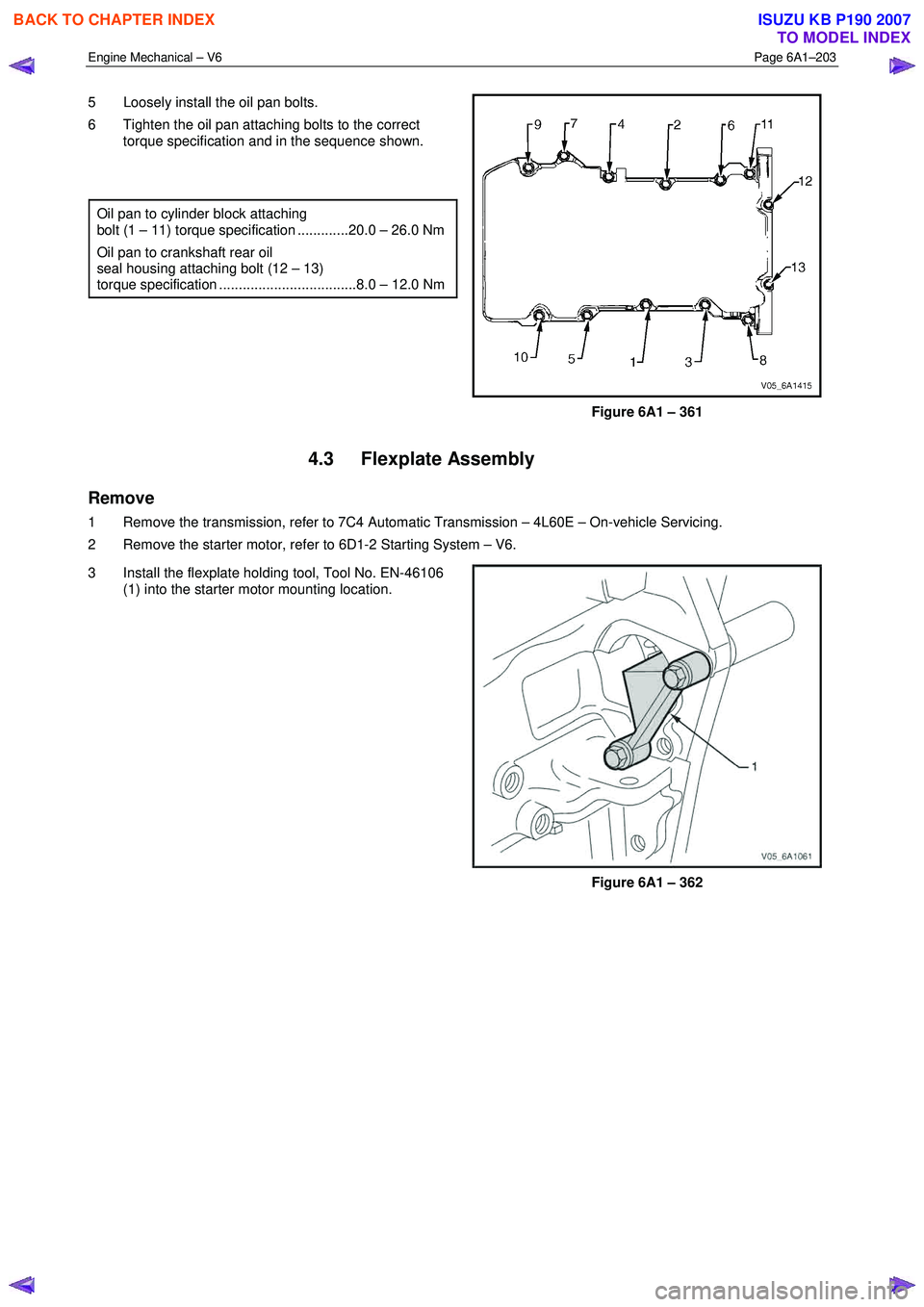
5 Loosely install the oil pan bolts.
6 Tighten the oil pan attaching bolts to the correct torque specification and in the sequence shown.
Oil pan to cylinder block attaching
bolt (1 – 11) torque specification .............20.0 – 26.0 Nm
Oil pan to crankshaft rear oil
seal housing attaching bolt (12 – 13)
torque specification ...................................8.0 – 12.0 Nm
Figure 6A1 – 361
4.3 Flexplate Assembly
Remove
1 Remove the transmission, refer to 7C4 Automatic Transmission – 4L60E – On-vehicle Servicing.
2 Remove the starter motor, refer to 6D1-2 Starting System – V6.
3 Install the flexplate holding tool, Tool No. EN-46106 (1) into the starter motor mounting location.
Figure 6A1 – 362
BACK TO CHAPTER INDEX
TO MODEL INDEX
ISUZU KB P190 2007
Page 2684 of 6020
Engine Mechanical – V6 Page 6A1–205
Reinstall
NOTE
The bolt holes are unevenly spaced to enable
flexplate fitment in the one position only.
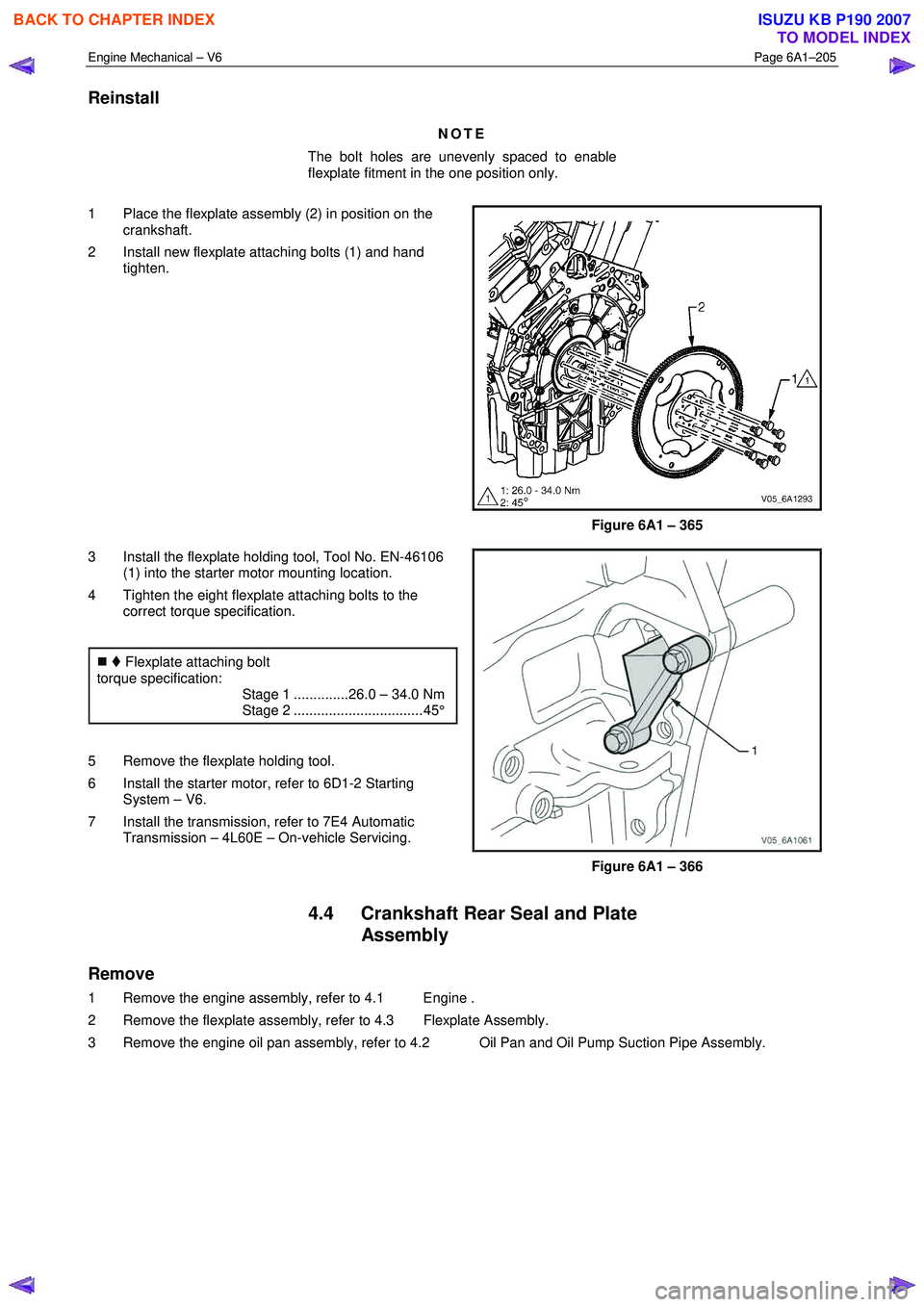
1 Place the flexplate assembly (2) in position on the crankshaft.
2 Install new flexplate attaching bolts (1) and hand tighten.
Figure 6A1 – 365
3 Install the flexplate holding tool, Tool No. EN-46106 (1) into the starter motor mounting location.
4 Tighten the eight flexplate attaching bolts to the correct torque specification.
„ Flexplate attaching bolt
torque specification:
Stage 1 ..............26.0 – 34.0 Nm
Stage 2 ................................. 45°
5 Remove the flexplate holding tool.
6 Install the starter motor, refer to 6D1-2 Starting System – V6.
7 Install the transmission, refer to 7E4 Automatic Transmission – 4L60E – On-vehicle Servicing.
Figure 6A1 – 366
4.4 Crankshaft Rear Seal and Plate Assembly
Remove
1 Remove the engine assembly, refer to 4.1 Engine .
2 Remove the flexplate assembly, refer to 4.3 Flexplate Assembly.
3 Remove the engine oil pan assembly, refer to 4.2 Oil Pan and Oil Pump Suction Pipe Assembly.
BACK TO CHAPTER INDEX
TO MODEL INDEX
ISUZU KB P190 2007
Page 2735 of 6020
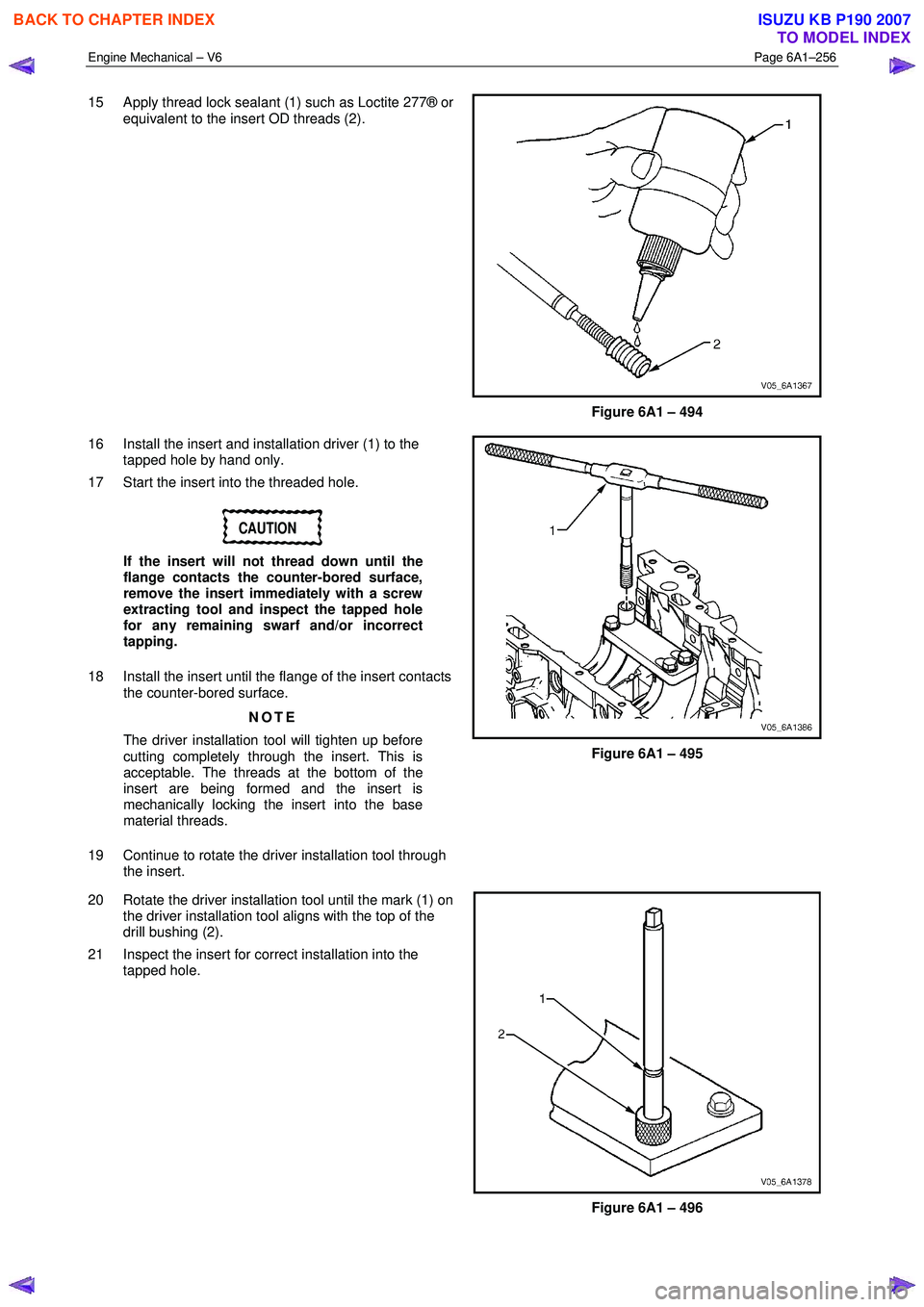
Engine Mechanical – V6 Page 6A1–256
15 Apply thread lock sealant (1) such as Loctite 277® or
equivalent to the insert OD threads (2).
Figure 6A1 – 494
16 Install the insert and installation driver (1) to the tapped hole by hand only.
17 Start the insert into the threaded hole.
CAUTION
If the insert will not thread down until the
flange contacts the counter-bored surface,
remove the insert immediately with a screw
extracting tool and inspect the tapped hole
for any remaining swarf and/or incorrect
tapping.
18 Install the insert until the flange of the insert contacts the counter-bored surface.
NOTE
The driver installation tool will tighten up before
cutting completely through the insert. This is
acceptable. The threads at the bottom of the
insert are being formed and the insert is
mechanically locking the insert into the base
material threads.
19 Continue to rotate the driver installation tool through the insert.
Figure 6A1 – 495
20 Rotate the driver installation tool until the mark (1) on the driver installation tool aligns with the top of the
drill bushing (2).
21 Inspect the insert for correct installation into the tapped hole.
Figure 6A1 – 496
BACK TO CHAPTER INDEX
TO MODEL INDEX
ISUZU KB P190 2007
Page 2741 of 6020
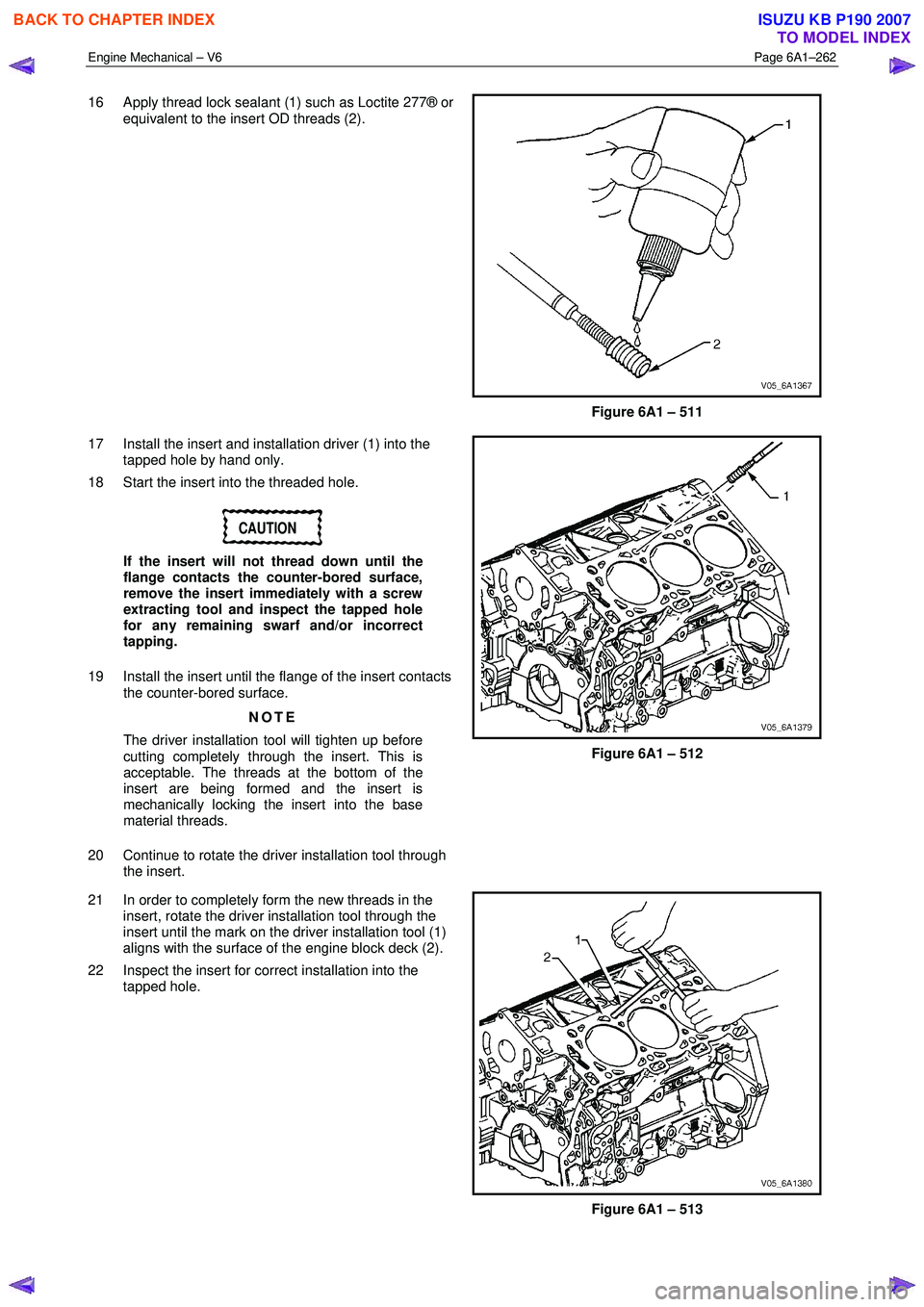
Engine Mechanical – V6 Page 6A1–262
16 Apply thread lock sealant (1) such as Loctite 277® or
equivalent to the insert OD threads (2).
Figure 6A1 – 511
17 Install the insert and installation driver (1) into the tapped hole by hand only.
18 Start the insert into the threaded hole.
CAUTION
If the insert will not thread down until the
flange contacts the counter-bored surface,
remove the insert immediately with a screw
extracting tool and inspect the tapped hole
for any remaining swarf and/or incorrect
tapping.
19 Install the insert until the flange of the insert contacts the counter-bored surface.
NOTE
The driver installation tool will tighten up before
cutting completely through the insert. This is
acceptable. The threads at the bottom of the
insert are being formed and the insert is
mechanically locking the insert into the base
material threads.
20 Continue to rotate the driver installation tool through the insert.
Figure 6A1 – 512
21 In order to completely form the new threads in the insert, rotate the driver installation tool through the
insert until the mark on the driver installation tool (1)
aligns with the surface of the engine block deck (2).
22 Inspect the insert for correct installation into the tapped hole.
Figure 6A1 – 513
BACK TO CHAPTER INDEX
TO MODEL INDEX
ISUZU KB P190 2007
Page 2779 of 6020

Engine Mechanical – V6 Page 6A1–2
Page 6A1–2
Visual / Physical Inspection ................................................................................................... .............................31
Intermittent ................................................................................................................... ........................................31
2.3 Engine Misfire without In ternal Engine Noises .................................................................................. ...............32
2.4 Engine Misfire with Abnormal In ternal Lower Engine Noises...................................................................... ....34
2.5 Engine Misfire with Abno rmal Valve Train Noise ................................................................................. .............35
2.6 Engine Misfire with Coolant Consumption ........................................................................................ ................36
2.7 Engine Misfire with E xcessive Oil Consumption .................................................................................. ............37
2.8 Engine Noise on Start-up, but only Lasting a Few Seconds ....................................................................... .....38
2.9 Upper Engine Noise, Rega rdless of Engine Speed................................................................................. ..........39
2.10 Lower Engine Noise, Rega rdless of Engine Speed ................................................................................. .........40
2.11 Engine Noise Under Load ................................................................................................................................... 41
2.12 Engine Will Not Crank – Crankshaft Will Not Rotate ............................................................................. ...........42
2.13 Coolant in Com bustion Chamber .................................................................................................. .....................43
Definition ..................................................................................................................... .........................................43
2.14 Coolant in Engine Oil........................................................................................................................................... 44
Definition ..............................................................................................................................................................44
2.15 Engine Compression Test........................................................................................................ ...........................45
Preliminary Steps................................................................................................................................................. 45
Engine Cylinder Compression Test ............................................................................................... ....................45
Test Result Evaluation ......................................................................................................... ...............................45
2.16 Cylinder Leakage Test .......................................................................................................... ...............................46
2.17 Engine Oil Consumption Diagnosis ............................................................................................... ....................47
Definition ..................................................................................................................... .........................................47
2.18 Engine Oil Leak Diagnosis .................................................................................................................................. 48
Introduction ..........................................................................................................................................................48
Locating and Identifying the Leak .............................................................................................. ........................48
Visual Inspection .............................................................................................................. ...................................48
Powder Method .................................................................................................................. ..................................48
Black Light and Dye Method ............................................................................................................................... 48
Possible Causes for Engine Oil Leaks ........................................................................................... ....................49
2.19 Engine Oil Pressu re Diagnosis .................................................................................................. .........................50
2.20 Accessory Drive Belt Diagnosis ................................................................................................. ........................51
Tension Check .................................................................................................................. ...................................51
Inspect ........................................................................................................................ ..........................................52
Drive Belt Chirp .................................................................................................................................................... 53
Definition ..................................................................................................................... .....................................53
Diagnostic Aids................................................................................................................................................. 53
Test Description ............................................................................................................... ................................53
Diagnostic Table............................................................................................................... ................................54
Drive Belt Squeal .............................................................................................................. ...................................55
Definition ..................................................................................................................... .....................................55
Diagnostic Aids................................................................................................................................................. 55
Test Description ............................................................................................................... ................................55
Diagnostic Table............................................................................................................... ................................55
Drive Belt Whine .................................................................................................................................................. 57
Definition ..................................................................................................................... .....................................57
Diagnostic Aids................................................................................................................................................. 57
Test Description ............................................................................................................... ................................57
Diagnostic Table............................................................................................................... ................................57
Drive Belt Rumble .............................................................................................................. ..................................58
Definition ..................................................................................................................... .....................................58
Diagnostic Aids................................................................................................................................................. 58
Test Description ............................................................................................................... ................................58
Diagnostic Table............................................................................................................... ................................58
Drive Belt Vibration........................................................................................................... ...................................60
Definition ..................................................................................................................... .....................................60
Diagnostic Aids................................................................................................................................................. 60
Test Description ............................................................................................................... ................................60
Diagnostic Table............................................................................................................... ................................60
Drive Belt Falls Off ........................................................................................................... ....................................62
BACK TO CHAPTER INDEX
TO MODEL INDEX
ISUZU KB P190 2007
Page 2801 of 6020
Engine Mechanical – V6 Page 6A1–24
Page 6A1–24
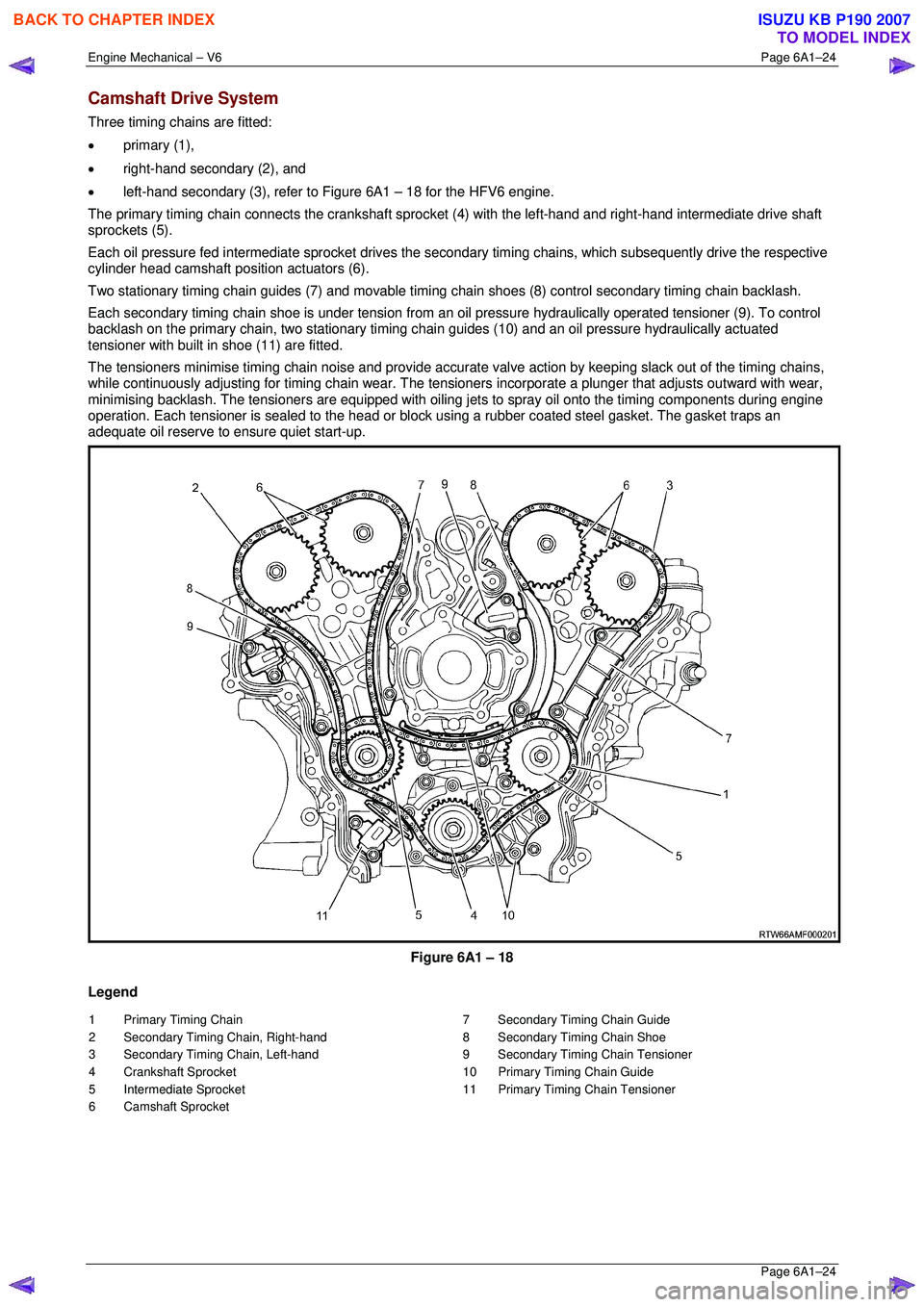
Camshaft Drive System
Three timing chains are fitted:
• primary (1),
• right-hand secondary (2), and
• left-hand secondary (3), refer to Figure 6A1 – 18 for the HFV6 engine.
The primary timing chain connects the crankshaft sprocket (4) with the left-hand and right-hand intermediate drive shaft
sprockets (5).
Each oil pressure fed intermediate sprocket drives the se condary timing chains, which subsequently drive the respective
cylinder head camshaft position actuators (6).
Two stationary timing chain guides (7) and movable timing c hain shoes (8) control secondary timing chain backlash.
Each secondary timing chain shoe is under tension from an oil pressure hydraulically operated tensioner (9). To control
backlash on the primary chain, two st ationary timing chain guides (10) and an oil pressure hydraulically actuated
tensioner with built in shoe (11) are fitted.
The tensioners minimise timing chain noise and provide accura te valve action by keeping slack out of the timing chains,
while continuously adjusting for timing chain wear. The tensioners incorporate a plunger that adjusts outward with wear,
minimising backlash. The tensioners are equipped with oiling jets to spray oil onto the timing components during engine
operation. Each tensioner is sealed to the head or block using a rubber coated steel gasket. The gasket traps an
adequate oil reserve to ens ure quiet start-up.
Figure 6A1 – 18
Legend
1 Primary Timing Chain
2 Secondary Timing Chain, Right-hand
3 Secondary Timing Chain, Left-hand
4 Crankshaft Sprocket
5 Intermediate Sprocket
6 Camshaft Sprocket 7 Secondary Timing Chain Guide
8 Secondary Timing Chain Shoe
9 Secondary Timing Chain Tensioner
10 Primary Timing Chain Guide
11 Primary Timing Chain Tensioner
BACK TO CHAPTER INDEX
TO MODEL INDEX
ISUZU KB P190 2007
Page 2803 of 6020

Engine Mechanical – V6 Page 6A1–26
Page 6A1–26
1.6 Service Notes
Cleanliness and Care
Throughout this Section, correct cleaning and protection of machined surfaces and fr iction areas is a part of the repair
procedure. This is considered standard workshop practice, even if not specifically stated.
When any internal engine part is serviced, care and cleanliness is extremely important.
When components are removed for service, they should be ma rked, organised or retained in a specific order for
reassembly.
At the time of installation, components should be installed in the same location and with the same mating surface as
when removed.
Any engine is a combination of many machined, honed, polished and lapped surfaces with tole rances that are measured
in thousandths of a millimetre. Thes e surfaces should be covered or protected to avoid component damage.
A liberal coating of clean engine oil should be applied to fricti on areas during assembly, as the lubrication will protect and
lubricate friction surfaces dur ing the initial engine start-up.
Replacing Engine Gaskets
Re-Using Gaskets and Applying Sealants
• do not reuse any gasket unless specified,
• gaskets that can be reused will be ident ified in the service procedure, and
• do not apply sealant to any gasket or sealing surf ace unless specified in the service information.
Separating Components
• Use a rubber mallet to separate components.
• Bump the part sideways to loosen the components.
• Bumping should be done at bends or reinforced areas to prevent distortion of parts.
Cleaning Gasket Surfaces
• Where required, remove all gasket and sealing materi al from the part using a plastic or wood scraper.
• Care must be used to avoid gouging or scraping the sealing surfaces.
• Do not use any other method or technique to re move sealant or gasket material from a part.
• Do not use abrasive pads, sand paper, or power tools to clean the gasket surfaces as these methods of cleaning
can cause damage to the component sealing surfaces. Abrasive pads also produce fine grit that the oil filter cannot
remove from the oil. This grit is abrasiv e and has been known to cause internal engine damage.
Assembling Components
• When assembling components, use only the sealant specified or equivalent in the service procedure.
• Sealing surfaces should be cl ean and free of debris or oil.
• Specific components such as crankshaft oil seals or valve stem oil seals may require lubrication during assembly.
• Components requiring lubrication will be i dentified in the service procedure.
• When applying sealant to a component, apply the am ount specified in the service procedure.
• Do not allow the sealant to enter into any blind threaded hol es as it may prevent the bolt from clamping correctly or
cause component damage when tightened.
• Only ever tighten bolts to the correct to rque specification. Do not over-tighten.
BACK TO CHAPTER INDEX
TO MODEL INDEX
ISUZU KB P190 2007
Page 2808 of 6020

Engine Mechanical – V6 Page 6A1–31
Page 6A1–31
2.2 Symptoms
Strategy Based Diagnosis
1 Review the system operations to familiarise yourself with the system functions, refer to 1 General Information and
6C1-1 Engine Management General Information.
2 Perform an engine management Diagnostic System Check, refer to Section 6C1-2 Engine Management – V6 –
Diagnostics .
All diagnosis on a vehicle should follow a logical process. Strategy based diagnosis is a uniform approach for repairing
all vehicle systems. The strategy based diagnostic flow chart may always be used to resolve a system problem. The
diagnostic flow chart is the place to start when repairs are required. For a detailed explanation of strategy based
diagnosis and the flow chart, refer to Section 6C1-2 Engine Management – V6 – Diagnostics .
Visual / Physical Inspection
1 Inspect the vehicle for aftermarket accessories which may adversely affect engine operation.
2 Inspect the easily accessible or visible system components for obvious signs of damage or conditions that may cause the symptom.
3 Check the engine lubrication system for the following:
• correct oil level,
• correct lubricant viscosity,
• correct oil filter application, and
• contaminated or burnt oil.
4 Confirm the exact operating conditions under whic h the fault occurs. Note factors such as:
• engine speed (r.p.m.),
• ambient temperature,
• engine temperature,
• engine warm-up time, and
• vehicle road speed.
5 Compare the engine sounds, if applic able, to a known good engine, and ensure you are not trying to diagnose a
normal operating condition.
Intermittent
For intermittent faults, test the vehicle under the same conditions the customer reported in order to confirm whether the
system is operating correctly.
BACK TO CHAPTER INDEX
TO MODEL INDEX
ISUZU KB P190 2007