start ISUZU KB P190 2007 Workshop Repair Manual
[x] Cancel search | Manufacturer: ISUZU, Model Year: 2007, Model line: KB P190, Model: ISUZU KB P190 2007Pages: 6020, PDF Size: 70.23 MB
Page 3410 of 6020
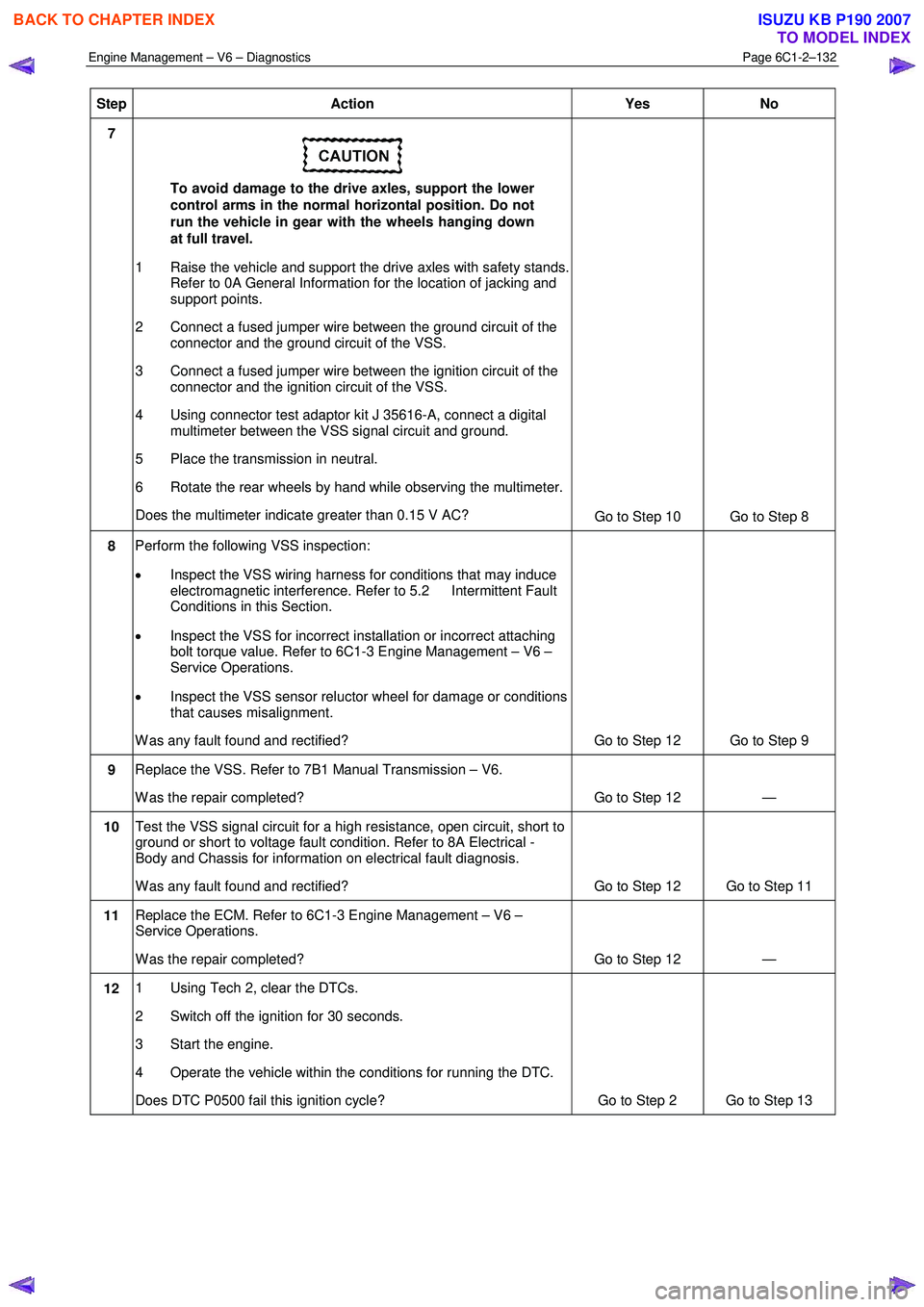
Engine Management – V6 – Diagnostics Page 6C1-2–132
Step Action Yes No
7
To avoid damage to the drive axles, support the lower
control arms in the normal horizontal position. Do not
run the vehicle in gear with the wheels hanging down
at full travel.
1 Raise the vehicle and support the drive axles with safety stands. Refer to 0A General Information for the location of jacking and
support points.
2 Connect a fused jumper wire between the ground circuit of the connector and the ground circuit of the VSS.
3 Connect a fused jumper wire between the ignition circuit of the connector and the ignition circuit of the VSS.
4 Using connector test adaptor kit J 35616-A, connect a digital multimeter between the VSS signal circuit and ground.
5 Place the transmission in neutral.
6 Rotate the rear wheels by hand while observing the multimeter.
Does the multimeter indicate greater than 0.15 V AC? Go to Step 10 Go to Step 8
8 Perform the following VSS inspection:
• Inspect the VSS wiring harness for conditions that may induce
electromagnetic interference. Refer to 5.2 Intermittent Fault
Conditions in this Section.
• Inspect the VSS for incorrect installation or incorrect attaching
bolt torque value. Refer to 6C1-3 Engine Management – V6 –
Service Operations.
• Inspect the VSS sensor reluctor wheel for damage or conditions
that causes misalignment.
W as any fault found and rectified? Go to Step 12 Go to Step 9
9 Replace the VSS. Refer to 7B1 Manual Transmission – V6.
W as the repair completed? Go to Step 12 —
10 Test the VSS signal circuit for a high resistance, open circuit, short to
ground or short to voltage fault condition. Refer to 8A Electrical -
Body and Chassis for information on electrical fault diagnosis.
W as any fault found and rectified? Go to Step 12 Go to Step 11
11 Replace the ECM. Refer to 6C1-3 Engine Management – V6 –
Service Operations.
W as the repair completed? Go to Step 12 —
12 1 Using Tech 2, clear the DTCs.
2 Switch off the ignition for 30 seconds.
3 Start the engine.
4 Operate the vehicle within the conditions for running the DTC.
Does DTC P0500 fail this ignition cycle? Go to Step 2 Go to Step 13
BACK TO CHAPTER INDEX
TO MODEL INDEX
ISUZU KB P190 2007
Page 3413 of 6020

Engine Management – V6 – Diagnostics Page 6C1-2–135
Step Action Yes No
10 1 Repair the high resistance or open circuit fault condition in the
voltage circuit of the cruise control cancel switch. Refer to 8A
Electrical - Body and Chassis for information on electrical wiring
repair procedures.
W as the repair completed? Go to Step 14 —
11 1 Test the cruise control cancel switch. Refer to 8C Cruise Control
– HFV6.
W as any fault found and rectified? Go to Step 14 Go to Step 12
12 1 Test the control circuits of the cruise control cancel switch for a
high resistance, open circuit, short to ground or short to voltage
fault condition. Refer to 8A Electrical - Body and Chassis for
information on electrical fault diagnosis.
W as the repair completed? Go to Step 14 Go to Step 13
13 1 Replace the ECM. Refer to 6C1-3 Engine Management – V6 –
Service Operations.
W as the repair completed? Go to Step 14 —
14 1 Using Tech 2, clear the DTCs.
2 Switch off the ignition for 30 seconds.
3 Start the engine.
4 Operate the vehicle within the conditions for running the DTC.
Does DTC P0504 or P571 fail this ignition cycle? Go to Step 2 Go to Step 2
15 1 Using Tech 2, select the DTC display function.
Are there any DTCs displayed? Go to the
appropriate DTC
Table in this Section System OK
When all diagnosis and repairs are completed, check the system for correct operation.
7.29 DTC P0506, P0507, P0638, P1551, P2100,
P2101, P2119 or P2176
DTC Descriptors
This diagnostic procedure supports the following DTCs:
• DTC P0506 – Idle Speed Control rpm Too Low
• DTC P0507 – Idle Speed Control rpm Too High
• DTC P0638 – Commanded Versus Actual Throttle Position Correlation
• DTC P1551 – Throttle Control Lower Position Not Reached During Learning Mode
• DTC P2100 – Throttle Control Motor Malfunction
• DTC P2101 – Throttle Control Position Range / Performance
• DTC P2119 – Closed Throttle Position Range / Performance
• DTC P2176 – Throttle Control Lower Position not Learned
Circuit Description
The ECM monitors and evaluates the accelerator pedal position (APP) sensors signal voltage along with other sensor
inputs to determine the desired throttle opening. To control the throttle plate movement, the ECM applies a pulse width
modulated (PW M) signal voltage to the throttle actuator motor through the throttle actuator motor control circuits.
• At engine idle speed or when no current is flowing into the throttle actuator motor, a constant force return spring
holds the throttle plate at a constant seven percent throttle opening position.
BACK TO CHAPTER INDEX
TO MODEL INDEX
ISUZU KB P190 2007
Page 3415 of 6020

Engine Management – V6 – Diagnostics Page 6C1-2–137
Conditions for Setting the DTC
DTC P0506
The actual engine speed is less than the desired idle speed by at least 100 rpm for 10 seconds.
DTC P0507
The actual engine speed is greater than the desired idle speed by at least 200 rpm for 10 seconds or the ECM detects
three fuel cut-offs due to an engine over speed condition while the engine is idling.
DTC P0638
The ECM detects the commanded duty cycle is greater than 80 percent for longer than 0.6 second.
DTC P1551
The ECM detects the TP sensor angle is outside the predetermined range of 1.8 – 13.0 percent when the TAC motor is
deactivated.
DTC 2100
The ECM detects that its internal TAC motor output driver does not deactivate when commanded off.
DTC P2101
The ECM detects the difference between the commanded and the actual throttle opening is greater than 10 percent.
DTC P2119
The ECM determines the throttle plate didn't return to the rest position within 720 milliseconds.
DTC P2176
One of the following conditions exist:
• The TP sensor 1 voltage is outside the range of 0.2 – 0.9 V during the throttle learn procedure.
• The TP sensor 2 voltage is outside the range of 4.2 – 4.8 V during the throttle learn procedure.
• The throttle learn procedure is not learned after an ECM replacement.
Conditions for Clearing DTC
The TAC motor control circuit DTCs are Type A DTCs. Refer to 1.4 Diagnostic Trouble Codes in this Section, for
action taken when a Type A DTC sets and conditions for clearing Type A DTCs.
Additional Information
• Refer to 6C1-1 Engine Management – V6 – General Information for details of the Throttle Actuator Control System
operation.
• For an intermittent fault condition, refer to 5.2 Intermittent Fault Conditions in this Section.
• Since fault condition in a wiring connector may trigger DTCs, always test the connectors related to this diagnostic
procedure for shorted terminals or poor wiring connection before replacing any component. Refer to 8A Electrical -
Body and Chassis for information on electrical fault diagnosis.
• To assist diagnosis, refer to 3 W iring Diagrams and Connector Charts in this Section, for the system wiring
diagram and connector charts.
Test Description
The following numbers refer to the step numbers in the diagnostic table:
4 A constant force return spring holds the throttle plate at a constant seven percent throttle opening position and should move in either direction under spring pressure and without binding.
8 W hen the ignition is switched on, the ECM operates the throttle actuator motor to verify the integrity of the TAC system prior to start up. This can be seen by the momentary flash of the test lamp as the ignition is switched on.
BACK TO CHAPTER INDEX
TO MODEL INDEX
ISUZU KB P190 2007
Page 3416 of 6020

Engine Management – V6 – Diagnostics Page 6C1-2–138
P0506, P0507, P0638, P1551, P2100, P2101, P2119 or P2176 Diagnostic Table
Step Action Yes No
1 Has the Diagnostic System Check been performed?
Go to Step 2 Refer to
4.4 Diagnostic
System Check in this Section
2 1 Switch off the ignition for 30 seconds.
2 Operate the vehicle within the conditions for running the DTC.
3 Start the engine.
4 Quickly depress the accelerator pedal to wide-open throttle then release pedal. Repeat this procedure several times.
5 Using Tech 2, select the DTC display function.
Does DTC P0506, P0507, P0638, P1551, P2100, P2101, P2119 or
P2176 fail this ignition cycle? Go to Step 3 Refer to Additional
Information in this DTC
3 Is DTC P0121, P0122, P0123, P0221, P0222 or P0223 also set? Go to the
appropriate DTC table. Go to Step 4
4 1 Disconnect the throttle actuator wiring connector.
Accidental operation of the TAC motor while
performing throttle plate inspection may cause severe
personal injury. Refer to 6C1-3 Engine Management –
V6 – Service Operations for additional precautions on
throttle body service procedure.
2 Inspect the throttle plate for the following:
• excessive dirt build-up in the throttle body,
• not in rest position,
• binding open or binding close,
• binding when moving from open to close or close to open
position, and
• free to move open or close without spring pressure.
W as any fault found and rectified? Go to Step 13 Go to Step 5
5 Inspect the engine for fault conditions that causes incorrect idle
speed. Refer to 5.12 Rough, Unstable, Incorrect Idle or Stalling in
this Section.
W as any fault found and rectified? Go to Step 13 Go to Step 6
6 1 Switch on the ignition with the engine not running.
2 Using a digital multimeter, measure the voltage between the TAC positive circuit and the ECM housing.
Does the multimeter display 2 – 4 V? Go to Step 7 Go to Step 9
7 1 Switch on the ignition with the engine not running.
2 Using a digital multimeter, measure the voltage between the TAC negative control circuit and the ECM housing.
Does the multimeter display 2 – 4 V? Go to Step 8 Go to Step 9
BACK TO CHAPTER INDEX
TO MODEL INDEX
ISUZU KB P190 2007
Page 3417 of 6020

Engine Management – V6 – Diagnostics Page 6C1-2–139
Step Action Yes
No
8 1 Switch off the ignition.
2 Connect Tool No. J34730-405 injector test lamp between the positive and negative control circuit of the TAC.
3 Switch on the ignition for about 5 seconds then switch off while observing the test lamp.
Does the test lamp illuminate briefly each time the ignition cycles? Go to Step 11 Go to Step 10
9 Test the TAC control circuit that measured outside the specified value
for a high resistance, open circuit, short to ground or short to voltage
fault condition. Refer to 8A Electrical - Body and Chassis for
information on electrical fault diagnosis.
W as any fault found and rectified? Go to Step 13 Go to Step 12
10 Test the positive and negative control circuits of the TAC for a shorted
together fault condition. Refer to 8A Electrical - Body and Chassis for
information on electrical fault diagnosis.
W as any fault found and rectified? Go to Step 13 Go to Step 12
11 Replace the throttle body assembly. Refer to 6C1-3 Engine
Management – V6 – Service Operations.
W as the repair completed? Go to Step 13 —
12 Replace the ECM. Refer to 6C1-3 Engine Management – V6 –
Service Operations.
W as the repair completed? Go to Step 13 —
13 1 Using Tech 2, clear the DTCs.
2 Switch off the ignition for 30 seconds.
3 Start the engine.
4 Operate the vehicle within the conditions for running the DTC.
Does any of the TAC motor control circuit DTCs fail this ignition
cycle? Go to Step 2 Go to Step 14
14 Using Tech 2, select the DTC display function.
Does Tech 2 display any DTCs? Go to the
appropriate DTC
Table in this Section System OK
When all diagnosis and repairs are completed, check the system for correct operation.
7.30 DTC P0513, P0633, P1629, P1632, P1677,
P1678 or P1679
DTC Descriptors
This diagnostic procedure supports the following DTCs:
• DTC P0513 – W rong Transponder Key
• DTC P0633 – Immobiliser Function Not Programmed
• DTC P1629 – Immobiliser Fuel Enable Signal Not Received
• DTC P1632 – Immobiliser Fuel Disable Signal Received
• DTC P1677 – Immobiliser Function Not Enabled
• DTC P1678 – Engine Control Module Identification Failed
• DTC P1679 – Immobiliser Environment Identification Failed
BACK TO CHAPTER INDEX
TO MODEL INDEX
ISUZU KB P190 2007
Page 3418 of 6020

Engine Management – V6 – Diagnostics Page 6C1-2–140
Circuit Description
The engine control module (ECM), the powertrain interface module (PIM) and the immobiliser control unit (ICU) are
integral parts of the vehicle immobiliser system. The immobiliser system authenticates the security code programmed
into each of these modules to prevent unauthorised vehicle operation. This authentication process includes the following
steps:
1 At predetermined situations, the ICU sends a security code to the PIM.
2 W hen the ignition is switched ON, the PIM receives and compares this security code from the ICU against the security code programmed into the PIM.
3 Once the PIM receives the correct security code from the ICU, it sends a security code to the ECM.
4 The ECM receives and compares this security code from the PIM against the security code programmed into the ECM.
5 The authentication process is complete once the ECM receives the correct security code from the PIM within the specified time frame.
6 The ECM allows normal vehicle operation.
NOTE
If any of these authentication processes fail, the
vehicle will not start and DTCs will set. For further
information on the immobiliser system, refer to
11A Immobiliser.
Conditions for Running the DTC
Conditions for running the DTC are:
• The ignition is switched on.
• The ignition voltage is 10.0 – 16.0 V.
Conditions for Setting the DTC
P0513
The ECM receives an incorrect response from the PIM during the immobiliser authentication process.
P0633
An attempt is made to start the engine before the immobiliser function has been programmed into a new PIM.
P1629
The ECM has not received a fuel enable password from the ICU.
P1632
The ECM receives an incorrect response from the PIM during the immobiliser authentication process.
P1677
An attempt is made to start the vehicle after the ECM was reset.
P1678
The ECM does not receive a valid response from the PIM when an attempt is made to start the engine.
P1679
The ECM receives a message from the PIM stating that it can't authenticate to the ICU.
BACK TO CHAPTER INDEX
TO MODEL INDEX
ISUZU KB P190 2007
Page 3419 of 6020

Engine Management – V6 – Diagnostics Page 6C1-2–141
Conditions for Clearing the DTC
Refer to 1.4 Diagnostic Trouble Codes in this Section, for action taken when a Type B DTC sets and conditions for
clearing Type B DTCs.
Additional Information
• Refer to 6C1-1 Engine Management –V6 – General Information for details of the ECM operation.
• Refer to 11A Immobiliser for the following information:
• ICU link to PIM, and
• Immobiliser System.
• Since a fault condition in a wiring connector may trigger DTCs, always test the connectors related to this
diagnostic procedure for shorted terminals or poor wiring connection before replacing any component. Refer to 8A
Electrical - Body and Chassis for information on electrical fault diagnosis.
• For an intermittent fault condition, refer to 5.2 Intermittent Fault Conditions in this Section.
• To assist diagnosis, refer to 3 W iring Diagrams and Connector Charts in this Section, for the system wiring
diagram and connector charts.
DTC P0513, P0633, P1629, P1632, P0633, P1677, P1678, P1679 Diagnostic Table
Step Action Yes No
1 Has the Diagnostic System Check been performed?
Go to Step 2 Refer to
4.4 Diagnostic
System Check in this Section
2 1 Switch off the ignition for 30 seconds.
2 Operate the vehicle within the conditions for setting the DTC.
3 Using Tech 2, select the DTC display function.
Does DTC P0513, P1629, P1632, P0633, P1677, P1678 or P1679 fail
this ignition cycle? Go to Step 3 Refer to Additional
Information in this DTC
3 Using Tech 2, perform the ICU Link to ECM / PIM procedure. Refer to
6E1 Powertrain Interface Module – V6.
Has the linking procedure been performed correctly? Go to Step 7 Go to Step 4
4 Test the Immobiliser system. Refer to 11A Immobiliser.
Has any fault been found and rectified? Go to Step 7 Go to Step 5
5 1 Test all ground circuits of the PIM for a high resistance or an
open circuit fault condition. Refer to 8A Electrical - Body and
Chassis for information on electrical fault diagnosis.
2 Test the PIM ignition supply voltage circuit for a high resistance, open circuit or short to ground fault condition. Refer to 8A
Electrical - Body and Chassis for information on electrical fault
diagnosis.
Has any fault been found and rectified? Go to Step 7 Go to Step 6
6 Replace the PIM. Refer to 6E1 Powertrain Interface Module – V6.
Has the repair been completed? Go to Step 7 —
7 1 Using Tech 2, clear the DTCs.
2 Switch off the ignition for 30 seconds.
3 Start the engine.
4 Operate the vehicle within the conditions for running the DTC.
Do any of the immobiliser DTCs fail this ignition cycle? Go to Step 2 Go to Step 8
BACK TO CHAPTER INDEX
TO MODEL INDEX
ISUZU KB P190 2007
Page 3422 of 6020

Engine Management – V6 – Diagnostics Page 6C1-2–144
Step Action
Yes No
8 1 Disconnect the ECM wiring connector.
2 Test the EOP sensor low reference circuit for a high resistance and open circuit fault condition. Refer to 8A Electrical - Body
and Chassis for information on electrical fault diagnosis.
NOTE
The EOP sensor shares the low reference circuit with
other sensors. A fault condition in the low reference circuit
may trigger DTCs on sensors that share this circuit. Refer
to 3 W iring Diagrams and Connector Charts in this
Section, to assist diagnosis.
W as any fault found and rectified? Go to Step 11 Go to Step 10
9 Replace the EOP sensor. Refer to 6C1-3 Engine Management – V6 –
Service Operations.
W as the repair completed? Go to Step 11 —
10 Replace the ECM. Refer to 6C1-3 Engine Management – V6 –
Service Operations.
W as the repair completed? Go to Step 11 —
11 1 Using Tech 2, clear the DTCs.
2 Switch off the ignition for 30 seconds.
3 Start the engine.
4 Operate the vehicle within the conditions for running the DTC.
Does any of the for the engine oil pressure sensor circuit DTCs s fail
this ignition cycle? Go to Step 2 Go to Step 12
12 Using Tech 2, select the DTC display function.
Does Tech 2 display any DTCs? Go to the
appropriate DTC
Table in this Section System OK
When all diagnosis and repairs are completed, check the system for correct operation.
7.32 DTC P0532 or P0533
DTC Descriptors
This diagnostic procedure supports the following DTCs:
• DTC P0532 – A/C Pressure Sensor Voltage Low
• DTC P0533 – A/C Pressure Sensor Voltage High
Circuit Description
The ECM supplies a positive 5 V reference voltage to the air-conditioning (A/C) refrigerant pressure sensor through
reference circuit and the ground through the low reference circuit.
The A/C pressure sensor provides signal voltage to the ECM through the signal circuit that is proportional to the A/C
refrigerant pressure. The ECM monitors the signal voltage of the A/C pressure sensor to determine the refrigerant
pressure.
• The A/C pressure sensor voltage increases as the refrigerant pressure increases.
• W hen the ECM detects the refrigerant pressure exceeds a predetermined value, the ECM activates the cooling
fans to reduce the refrigerant pressure.
• W hen the ECM detects the refrigerant pressure is too high or too low, the ECM disables the A/C clutch to protect
the A/C compressor from damage.
BACK TO CHAPTER INDEX
TO MODEL INDEX
ISUZU KB P190 2007
Page 3425 of 6020

Engine Management – V6 – Diagnostics Page 6C1-2–147
Step Action Yes No
12 1 Using Tech 2, clear the DTCs.
2 Switch off the ignition for 30 seconds.
3 Start the engine.
4 Operate the vehicle within the conditions for running the DTC.
Does any of the A/C refrigerant pressure sensor circuit DTCs fail this
ignition cycle? Go to Step 2 Go to Step 13
13 Using Tech 2, select the DTC display function.
Does Tech 2 display any DTCs? Go to the
appropriate DTC
Table in this Section System OK
When all diagnosis and repairs are completed, check the system for correct operation.
7.33 DTC P0560, P0562 or P0563
DTC Descriptors
This diagnostic procedure supports the following DTCs:
• DTC P0560 – System Voltage Malfunction
• DTC P0562 – System Voltage Low Voltage
• DTC P0563 – System Voltage High Voltage
Circuit Description
Battery voltage is supplied continuously to the engine control module (ECM) through the continuous battery supply
circuit and the ground through the ground connection of the ECM housing to the engine.
Turning the ignition switch on activates the ignition control relay, which directs ignition positive voltage from the battery
to the ECM switched battery supply circuit which activates the ECM. The ECM then applies control voltage to the control
circuit of the engine control relay to activate the engine control relay. The engine control relay supplies ignition voltage
to the various engine management system components.
The ECM monitors the battery voltage circuits to ensure the voltage available to the engine management system stays
within the specified range. Incorrect system voltage may cause incorrect engine management system operation or
component malfunction.
An ECM system voltage DTC sets if the ECM detects the voltage available to any of the ECM voltage supply circuit is
outside the specified range.
Conditions for Running the DTC
DTCs P0560, P0563 and P0563 runs continuously when the engine is running at speeds greater than 1500 rpm
Conditions for Setting the DTC
DTC P0560
The ECM detects the ignition 1, ignition 2 or switched battery supply voltage is out of the specified range for 30 seconds.
DTC P0562
The ECM detects the ECM system voltage is less than 11 V for 5 seconds.
DTC P0563
The ECM detects the ECM system voltage is greater than 16 V.
BACK TO CHAPTER INDEX
TO MODEL INDEX
ISUZU KB P190 2007
Page 3427 of 6020

Engine Management – V6 – Diagnostics Page 6C1-2–149
Step Action Yes
No
9 1 Using Tech 2, clear the DTCs.
2 Switch off the ignition for 30 seconds.
3 Start the engine.
4 Operate the vehicle within the conditions for running the DTC.
Does any of the ECM system voltage DTCs fail this ignition cycle? Go to Step 2 Go to Step 10
10 Using Tech 2, select the DTC display function.
Does Tech 2 display any DTCs? Go to the
appropriate DTC
Table in this Section System OK
When all diagnosis and repairs are completed, check the system for correct operation.
7.34 DTC P0601, P0602, P0604 or P0606
DTC Description
This diagnostic procedure supports the following DTCs:
• DTC P0601 – Replace Electronic Control Unit (ECU)
• DTC P0602 – Program Electronic Control Unit (ECU)
• DTC P0604 – Replace Electronic Control Unit (ECU)
• DTC P0606 – Replace Electronic Control Unit (ECU)
Circuit Description
The engine control module (ECM) is the control centre of the engine management system. The programming and
calibration needed by the ECM to control the functionality of the engine management system are stored in the ECM read
only memory (ROM).
An ECM internal circuit, programming or memory fault DTC sets if there is an internal microprocessor integrity fault
condition with the ECM or if the ECM is not programmed.
Conditions for Running the DTC
DTC P0601
Runs once when the checksum calculation at power down is completed in the last ignition cycle.
DTC P0602 and P0606
Runs continuously when the ignition is switched on with the engine not running.
DTC P0604
Runs once when the read / write test at power-down is completed in the last ignition cycle.
Conditions for Setting the DTC
DTC P0601
The ECM detects an incorrect ROM checksum for greater than 30 seconds.
DTC P0602
The ECM programming is incomplete.
DTC P0604
The ECM detects an error in the RAM for 6 seconds.
BACK TO CHAPTER INDEX
TO MODEL INDEX
ISUZU KB P190 2007