start ISUZU KB P190 2007 Workshop Repair Manual
[x] Cancel search | Manufacturer: ISUZU, Model Year: 2007, Model line: KB P190, Model: ISUZU KB P190 2007Pages: 6020, PDF Size: 70.23 MB
Page 3340 of 6020

Engine Management – V6 – Diagnostics Page 6C1-2–62
DTC P0008, P0009 or P0016 Diagnostic Table
Step Action Yes No
1 1 Has the Diagnostic System Check been performed?
Go to Step 2 Refer to
4.4 Diagnostic
System Check in this Section
2 1 Switch off the ignition for 30 seconds.
2 Start the engine.
3 Allow the engine to reach the normal operating temperature.
4 Increase the engine speed to 2,000 rpm for 10 seconds.
5 Using Tech 2, select the DTC display function.
Does DTC P0008, P0009 or P0016 fail this ignition cycle? Go to Step 3 Refer to Additional
Information in this DTC
3 1 Are DTCs relating to the following DTCs also set:
• Camshaft actuator circuit
• CMP sensor circuit
• CKP sensor circuit Go to the
appropriate DTC
Table in this Section Go to Step 4
4 1 Inspect the engine for the following fault conditions. Refer to
6A1 Engine Mechanical – V6:
• incorrect installation of the CMP sensor,
• incorrect installation of the CKP sensor,
• timing chain tensioner fault condition,
• incorrectly installed timing chain,
• excessive play in the timing chain, and
• timing chain that jumped teeth.
W as any fault found and rectified? Go to Step 5 Refer to Additional
Information in this DTC
5 1 Using Tech 2, clear the DTCs.
2 Switch off the ignition for 30 seconds.
3 Start the engine.
4 Operate the vehicle within the conditions for running the DTC.
Does any of the crankshaft / camshaft position correlation DTCs fail
this ignition cycle? Go to Step 2 Go to Step 6
6 Using Tech 2, select the DTC display function.
Does Tech 2 display any DTCs? Go to the
appropriate DTC
Table in this Section System OK
When all diagnosis and repairs are completed, check the system for correct operation.
7.3 DTC P0030, P0031, P0032, P0036, P0037,
P0038, P0050, P0051, P0052, P0056,
P0057 or P0058
DTC Descriptor
This diagnostic procedure supports the following DTCs:
• DTC P0030 – O2 Sensor Heater Circuit Malfunction (Bank 1, Sensor 1)
• DTC P0031 – O2 Sensor Heater Circuit Low Voltage (Bank 1, Sensor 1)
BACK TO CHAPTER INDEX
TO MODEL INDEX
ISUZU KB P190 2007
Page 3342 of 6020
Engine Management – V6 – Diagnostics Page 6C1-2–64
• Inspect the HO2S wiring harness for contact with the exhaust system.
• The front and the rear HO2Ss have a separate fuse connection. If both front or both the rear DTCs are set, the
appropriate HO2S ignition voltage circuit may be open.
• Since fault condition in a wiring connector may trigger DTCs, always test the connectors related to this diagnostic
procedure for shorted terminals or poor wiring connection before replacing any component. Refer to 8A Electrical -
Body and Chassis for information on electrical fault diagnosis.
• To assist diagnosis, refer to 3 W iring Diagrams and Connector Charts in this Section, for the system wiring
diagram and connector charts.
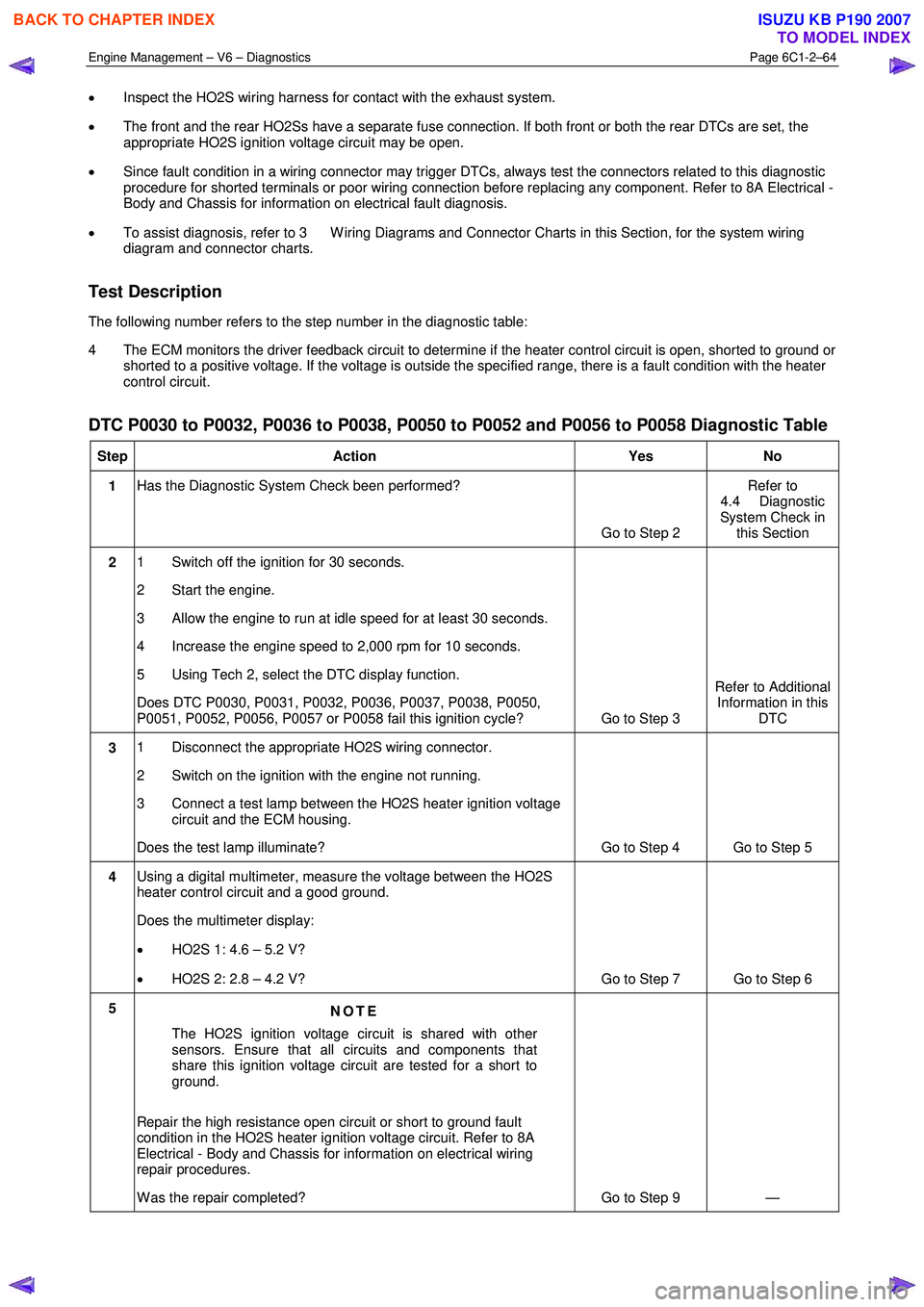
Test Description
The following number refers to the step number in the diagnostic table:
4 The ECM monitors the driver feedback circuit to determine if the heater control circuit is open, shorted to ground or shorted to a positive voltage. If the voltage is outside the specified range, there is a fault condition with the heater
control circuit.
DTC P0030 to P0032, P0036 to P0038, P0050 to P0052 and P0056 to P0058 Diagnostic Table
Step Action Yes No
1 Has the Diagnostic System Check been performed?
Go to Step 2 Refer to
4.4 Diagnostic
System Check in this Section
2 1 Switch off the ignition for 30 seconds.
2 Start the engine.
3 Allow the engine to run at idle speed for at least 30 seconds.
4 Increase the engine speed to 2,000 rpm for 10 seconds.
5 Using Tech 2, select the DTC display function.
Does DTC P0030, P0031, P0032, P0036, P0037, P0038, P0050,
P0051, P0052, P0056, P0057 or P0058 fail this ignition cycle? Go to Step 3 Refer to Additional
Information in this DTC
3 1 Disconnect the appropriate HO2S wiring connector.
2 Switch on the ignition with the engine not running.
3 Connect a test lamp between the HO2S heater ignition voltage circuit and the ECM housing.
Does the test lamp illuminate? Go to Step 4 Go to Step 5
4 Using a digital multimeter, measure the voltage between the HO2S
heater control circuit and a good ground.
Does the multimeter display:
• HO2S 1: 4.6 – 5.2 V?
• HO2S 2: 2.8 – 4.2 V? Go to Step 7 Go to Step 6
5
NOTE
The HO2S ignition voltage circuit is shared with other
sensors. Ensure that all circuits and components that
share this ignition voltage circuit are tested for a short to
ground.
Repair the high resistance open circuit or short to ground fault
condition in the HO2S heater ignition voltage circuit. Refer to 8A
Electrical - Body and Chassis for information on electrical wiring
repair procedures.
W as the repair completed? Go to Step 9 —
BACK TO CHAPTER INDEX
TO MODEL INDEX
ISUZU KB P190 2007
Page 3343 of 6020

Engine Management – V6 – Diagnostics Page 6C1-2–65
Step Action Yes No
6 Test the HO2S heater control circuit for a high resistance, open
circuit, short to ground or short to voltage fault condition. Refer to 8A
Electrical - Body and Chassis for information on electrical fault
diagnosis.
W as any fault found and rectified? Go to Step 9 Go to Step 8
7 Replace the appropriate HO2S. Refer to 6C1-3 Engine Management
– V6 – Service Operations.
W as the repair completed? Go to Step 9 —
8 Replace the ECM. Refer to 6C1-3 Engine Management – V6 –
Service Operations.
W as the repair completed? Go to Step 9 —
9 1 Using Tech 2, clear the DTCs.
2 Switch off the ignition for 30 seconds.
3 Start the engine.
4 Operate the vehicle within the conditions for running the DTC.
Does any of the HO2S heater control circuit DTCs fail this ignition
cycle? Go to Step 2 Go to Step 10
10 Using Tech 2, select the DTC display function.
Does Tech 2 display any DTCs? Go to the
appropriate DTC
Table in this Section System OK
When all diagnosis and repairs are completed, check the system for correct operation.
7.4 DTC P0040 or P0041
DTC Descriptor
This diagnostic procedure supports the following DTCs:
• DTC P0040 – O2 Sensor Signals Not Plausible (Bank 1, Sensor 1 & Bank 2, Sensor 1)
• DTC P0041 – O2 Sensor Signals Not Plausible (Bank 1, Sensor 2 & Bank 2, Sensor 2)
Circuit Description
The engine control relay applies positive voltage to the heater ignition voltage circuits of the HO2S. The ECM applies a
pulse width modulated (PW M) ground to the heater control circuit of the HO2S through a device within the ECM called a
driver, to control the HO2S rate of heating.
The ECM applies a voltage of approximately 450 mV between the reference signal circuit and low reference circuit of the
HO2S while the sensor temperature is less than the operating range.
Once the HO2S reaches operating temperature, the sensor varies this reference signal voltage, which constantly
fluctuates between the high voltage output and the low voltage output.
• The low voltage output is 0 – 450 mV, which occurs if the air fuel mixture is lean.
• The high voltage output is 450 – 1,000 mV, which occurs if the air fuel mixture is rich.
The ECM monitors, stores and evaluates the HO2S voltage fluctuation information to determine the level of oxygen
concentration in the exhaust.
An HO2S signal not plausible or wire connector swapped DTC sets if the ECM detects the HO2S signal voltages are
heading in the opposite direction of what was commanded.
Additional Information
• Refer to 6C1-1 Engine Management – V6 – General Information for details of the HO2S system operation.
• For an intermittent fault condition, refer to 5.2 Intermittent Fault Conditions in this Section.
BACK TO CHAPTER INDEX
TO MODEL INDEX
ISUZU KB P190 2007
Page 3344 of 6020

Engine Management – V6 – Diagnostics Page 6C1-2–66
• The HO2S must be tightened correctly. A loose HO2S will trigger these DTCs.
• Since fault condition in a wiring connector may trigger DTCs, always test the connectors related to this diagnostic
procedure for shorted terminals or poor wiring connection before replacing any component. Refer to 8A Electrical -
Body and Chassis for information on electrical fault diagnosis.
• To assist diagnosis, refer to 3 W iring Diagrams and Connector Charts in this Section, for the system wiring
diagram and connector charts.
Conditions for Running the DTC
Run continuously once the following conditions are met:
• The ignition voltage is 10.0 – 16.0 V.
• The engine is running.
• The O2 Sensors are in closed loop.
• The ECM is commanding the HO2Ss fuel trim.
Conditions for Setting the DTC
The ECM detects the HO2S signal voltages are heading in the opposite direction of what was commanded.
Conditions for Clearing the DTC
The HO2S signal not plausible DTCs are Type B DTCs. Refer to 1.4 Diagnostic Trouble Codes in this Section, for
action taken when Type B DTC sets and conditions for clearing Type B DTCs.
DTC P0040 and P0041 Diagnostic Table
Step Action Yes No
1 Has the Diagnostic System Check been performed?
Go to Step 2 Refer to
4.4 Diagnostic
System Check in this Section
2 1 Switch off the ignition for 30 seconds.
2 Start the engine.
3 Allow the engine to reach the normal operating temperature.
4 Increase the engine speed to 2,000 rpm for 10 seconds.
5 Using Tech 2, select the DTC display function.
Does P0040 or P0041 fail this ignition cycle? Go to Step 3 Refer to Additional
Information in this DTC
3 Check the HO2S 2 wiring connectors for a swapped connector fault
condition.
W as any fault found and rectified? Go to Step 5 Go to Step 4
4 Are DTCs relating to other circuits of the HO2S also set? Go to the
appropriate DTC in this Section Refer to Additional
Information in this DTC
5 1 Using Tech 2, clear the DTCs.
2 Switch off the ignition for 30 seconds.
3 Start the engine.
4 Operate the vehicle within the conditions for running the DTC.
Does any of the HO2S signal not plausible or wire connector swapped
DTCs fail this ignition cycle? Go to Step 2 Go to Step 6
BACK TO CHAPTER INDEX
TO MODEL INDEX
ISUZU KB P190 2007
Page 3346 of 6020

Engine Management – V6 – Diagnostics Page 6C1-2–68
Additional Information
• Refer to 6C1-1 Engine Management – V6 – General Information for details of the HO2S system operation.
• For an intermittent fault condition, refer to 5.2 Intermittent Fault Conditions in this Section.
• The HO2S must be tightened correctly. A loose HO2S will trigger these DTCs.
• Since fault condition in a wiring connector may trigger DTCs, always test the connectors related to this diagnostic
procedure for shorted terminals or poor wiring connection before replacing any component. Refer to 8A Electrical -
Body and Chassis for information on electrical fault diagnosis.
• To assist diagnosis, refer to 3 W iring Diagrams and Connector Charts in this Section, for the system wiring
diagram and connector charts.
DTC P0053 and P0059 Diagnostic Table
Step Action Yes No
1 Has the Diagnostic System Check been performed?
Go to Step 2 Refer to
4.4 Diagnostic
System Check in this Section
2 1 Switch off the ignition for 30 seconds.
2 Start the engine.
3 Allow the engine to reach the normal operating temperature.
4 Increase the engine speed to 2,000 rpm for 10 seconds.
5 Using Tech 2, select the DTC display function.
Does P0053 or P0059 fail this ignition cycle? Go to Step 3 Refer to Additional
Information in this DTC
3 Are DTCs relating to other circuits of the HO2S also set? Go to the
appropriate DTC
Table in this Section Go to Step 4
4 Replace the ECM. Refer to 6C1-3 Engine Management – V6 –
Service Operations.
W as the repair completed? Go to Step 5 —
5 1 Using Tech 2, clear the DTCs.
2 Switch off the ignition for 30 seconds.
3 Start the engine.
4 Operate the vehicle within the conditions for running the DTC.
Does any of the HO2S internal heater resistance performance DTCs
fail this ignition cycle? Go to Step 2 Go to Step 6
6 Using Tech 2, select the DTC display function.
Does Tech 2 display any DTCs? Go to the
appropriate DTC
Table in this Section System OK
When all diagnosis and repairs are completed, check the system for correct operation.
7.6 DTC P0101, P0102 or P0103
DTC Descriptors
This diagnostic procedure supports the following DTCs:
• DTC P0101 – Mass Air Flow Sensor Circuit Range / Performance
• DTC P0102 – Mass Air Flow Sensor Voltage Low
• DTC P0103 – Mass Air Flow Sensor Voltage High
BACK TO CHAPTER INDEX
TO MODEL INDEX
ISUZU KB P190 2007
Page 3350 of 6020

Engine Management – V6 – Diagnostics Page 6C1-2–72
Step Action Yes No
8 Test the MAF sensor 5 V reference circuit for a high resistance, open
circuit or short to voltage fault condition. Refer to 8A Electrical - Body
and Chassis for information on electrical fault diagnosis.
NOTE
The MAF sensor shares the 5 V reference circuit with
other sensors. A fault condition in the 5 V reference circuit
will trigger DTCs on sensors that share this circuit.
W as any fault found and rectified? Go to Step 14 Go to Step 13
9 Test the MAF sensor signal circuit for a high resistance, open circuit,
short to ground or short to voltage fault condition. Refer to 8A
Electrical - Body and Chassis for information on electrical fault
diagnosis.
W as any fault found and rectified? Go to Step 14 Go to Step 13
10 Test the MAF sensor low reference circuit for a high resistance or an
open circuit fault condition. Refer to 8A Electrical - Body and Chassis
for information on electrical fault diagnosis.
W as any fault found and rectified? Go to Step 14 Go to Step 13
11 Repair the high resistance or open circuit fault condition in the MAF
sensor circuit ignition voltage. Refer to 8A Electrical - Body and
Chassis for information on electrical wiring repair procedures.
W as the repair completed? Go to Step 14 —
12 Replace the MAF sensor. Refer to 6C1-3 Engine Management – V6 –
Service Operations.
W as the repair completed? Go to Step 14 —
13 Replace the ECM. Refer to 6C1-3 Engine Management – V6 –
Service Operations.
W as the repair completed? Go to Step 14 —
14 1 Using Tech 2, clear the DTCs.
2 Switch off the ignition for 30 seconds.
3 Start the engine.
4 Operate the vehicle within the conditions for running the DTC.
Does any of the MAF Sensor Circuit DTCs fail this ignition cycle? Go to Step 2 Go to Step 15
15 Using Tech 2, select the DTC display function.
Does Tech 2 display any DTCs? Go to the
appropriate DTC
Table in this Section System OK
When all diagnosis and repairs are completed, check the system for correct operation.
7.7 DTC P0112 or P0113
DTC Descriptors
This diagnostic procedure supports the following DTCs:
• DTC P0112 – Intake Air Temperature Sensor Circuit Low Voltage
• DTC P0113 – Intake Air Temperature Sensor Circuit High Voltage
Circuit Description
The ECM applies a reference 5 V to the intake air temperature (IAT) sensor signal circuit and ground through the low
reference circuit. The IAT sensor is a variable resistor that measures the engine intake air temperature.
BACK TO CHAPTER INDEX
TO MODEL INDEX
ISUZU KB P190 2007
Page 3352 of 6020
Engine Management – V6 – Diagnostics Page 6C1-2–74
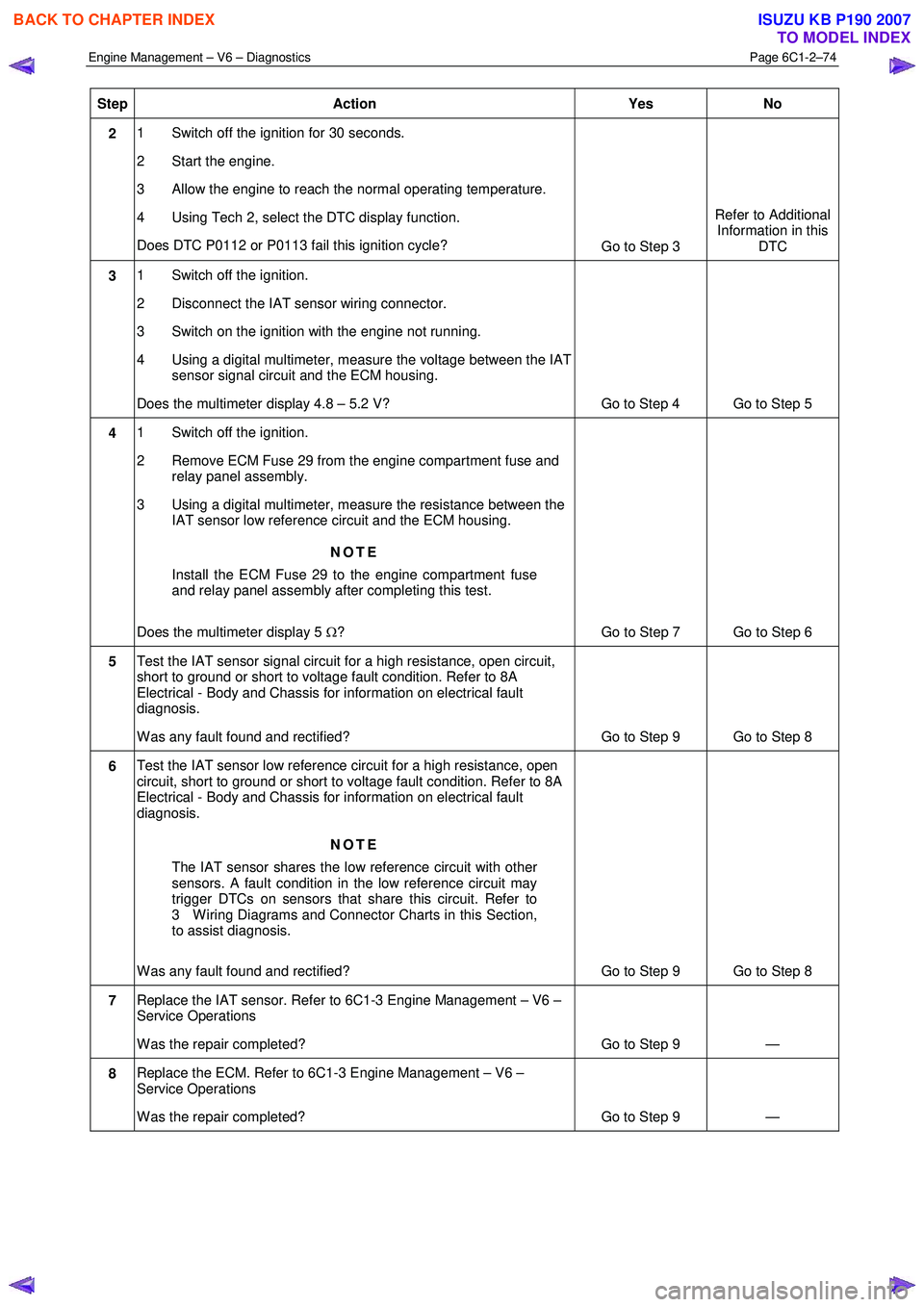
Step Action Yes No
2 1 Switch off the ignition for 30 seconds.
2 Start the engine.
3 Allow the engine to reach the normal operating temperature.
4 Using Tech 2, select the DTC display function.
Does DTC P0112 or P0113 fail this ignition cycle? Go to Step 3 Refer to Additional
Information in this DTC
3 1 Switch off the ignition.
2 Disconnect the IAT sensor wiring connector.
3 Switch on the ignition with the engine not running.
4 Using a digital multimeter, measure the voltage between the IAT sensor signal circuit and the ECM housing.
Does the multimeter display 4.8 – 5.2 V? Go to Step 4 Go to Step 5
4 1 Switch off the ignition.
2 Remove ECM Fuse 29 from the engine compartment fuse and relay panel assembly.
3 Using a digital multimeter, measure the resistance between the IAT sensor low reference circuit and the ECM housing.
NOTE
Install the ECM Fuse 29 to the engine compartment fuse
and relay panel assembly after completing this test.
Does the multimeter display 5 Ω? Go to Step 7 Go to Step 6
5 Test the IAT sensor signal circuit for a high resistance, open circuit,
short to ground or short to voltage fault condition. Refer to 8A
Electrical - Body and Chassis for information on electrical fault
diagnosis.
W as any fault found and rectified? Go to Step 9 Go to Step 8
6 Test the IAT sensor low reference circuit for a high resistance, open
circuit, short to ground or short to voltage fault condition. Refer to 8A
Electrical - Body and Chassis for information on electrical fault
diagnosis.
NOTE
The IAT sensor shares the low reference circuit with other
sensors. A fault condition in the low reference circuit may
trigger DTCs on sensors that share this circuit. Refer to
3 W iring Diagrams and Connector Charts in this Section,
to assist diagnosis.
W as any fault found and rectified? Go to Step 9 Go to Step 8
7 Replace the IAT sensor. Refer to 6C1-3 Engine Management – V6 –
Service Operations
W as the repair completed? Go to Step 9 —
8 Replace the ECM. Refer to 6C1-3 Engine Management – V6 –
Service Operations
W as the repair completed? Go to Step 9 —
BACK TO CHAPTER INDEX
TO MODEL INDEX
ISUZU KB P190 2007
Page 3353 of 6020
Engine Management – V6 – Diagnostics Page 6C1-2–75
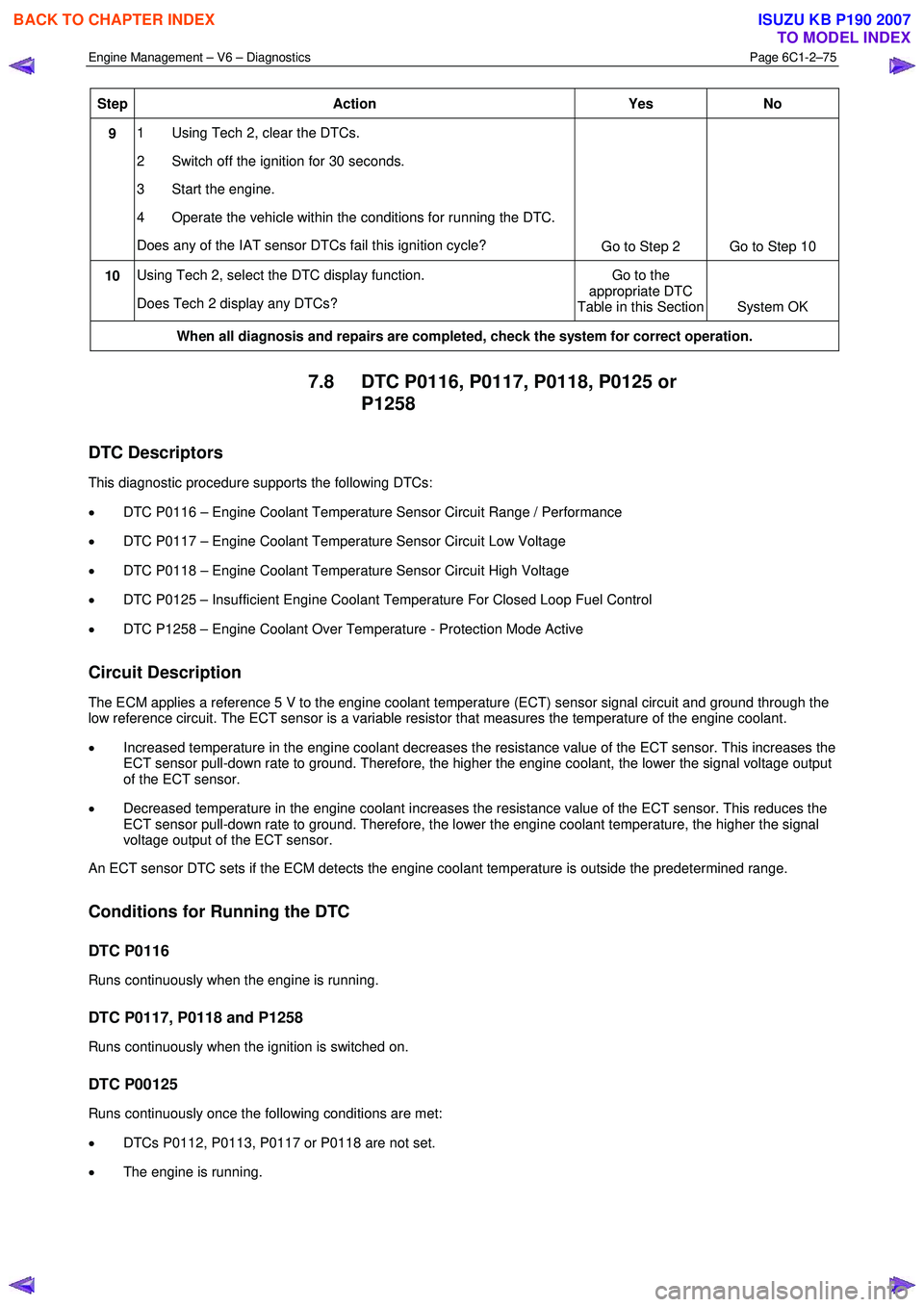
Step Action Yes No
9 1 Using Tech 2, clear the DTCs.
2 Switch off the ignition for 30 seconds.
3 Start the engine.
4 Operate the vehicle within the conditions for running the DTC.
Does any of the IAT sensor DTCs fail this ignition cycle? Go to Step 2 Go to Step 10
10 Using Tech 2, select the DTC display function.
Does Tech 2 display any DTCs? Go to the
appropriate DTC
Table in this Section System OK
When all diagnosis and repairs are completed, check the system for correct operation.
7.8 DTC P0116, P0117, P0118, P0125 or
P1258
DTC Descriptors
This diagnostic procedure supports the following DTCs:
• DTC P0116 – Engine Coolant Temperature Sensor Circuit Range / Performance
• DTC P0117 – Engine Coolant Temperature Sensor Circuit Low Voltage
• DTC P0118 – Engine Coolant Temperature Sensor Circuit High Voltage
• DTC P0125 – Insufficient Engine Coolant Temperature For Closed Loop Fuel Control
• DTC P1258 – Engine Coolant Over Temperature - Protection Mode Active
Circuit Description
The ECM applies a reference 5 V to the engine coolant temperature (ECT) sensor signal circuit and ground through the
low reference circuit. The ECT sensor is a variable resistor that measures the temperature of the engine coolant.
• Increased temperature in the engine coolant decreases the resistance value of the ECT sensor. This increases the
ECT sensor pull-down rate to ground. Therefore, the higher the engine coolant, the lower the signal voltage output
of the ECT sensor.
• Decreased temperature in the engine coolant increases the resistance value of the ECT sensor. This reduces the
ECT sensor pull-down rate to ground. Therefore, the lower the engine coolant temperature, the higher the signal
voltage output of the ECT sensor.
An ECT sensor DTC sets if the ECM detects the engine coolant temperature is outside the predetermined range.
Conditions for Running the DTC
DTC P0116
Runs continuously when the engine is running.
DTC P0117, P0118 and P1258
Runs continuously when the ignition is switched on.
DTC P00125
Runs continuously once the following conditions are met:
• DTCs P0112, P0113, P0117 or P0118 are not set.
• The engine is running.
BACK TO CHAPTER INDEX
TO MODEL INDEX
ISUZU KB P190 2007
Page 3354 of 6020
Engine Management – V6 – Diagnostics Page 6C1-2–76
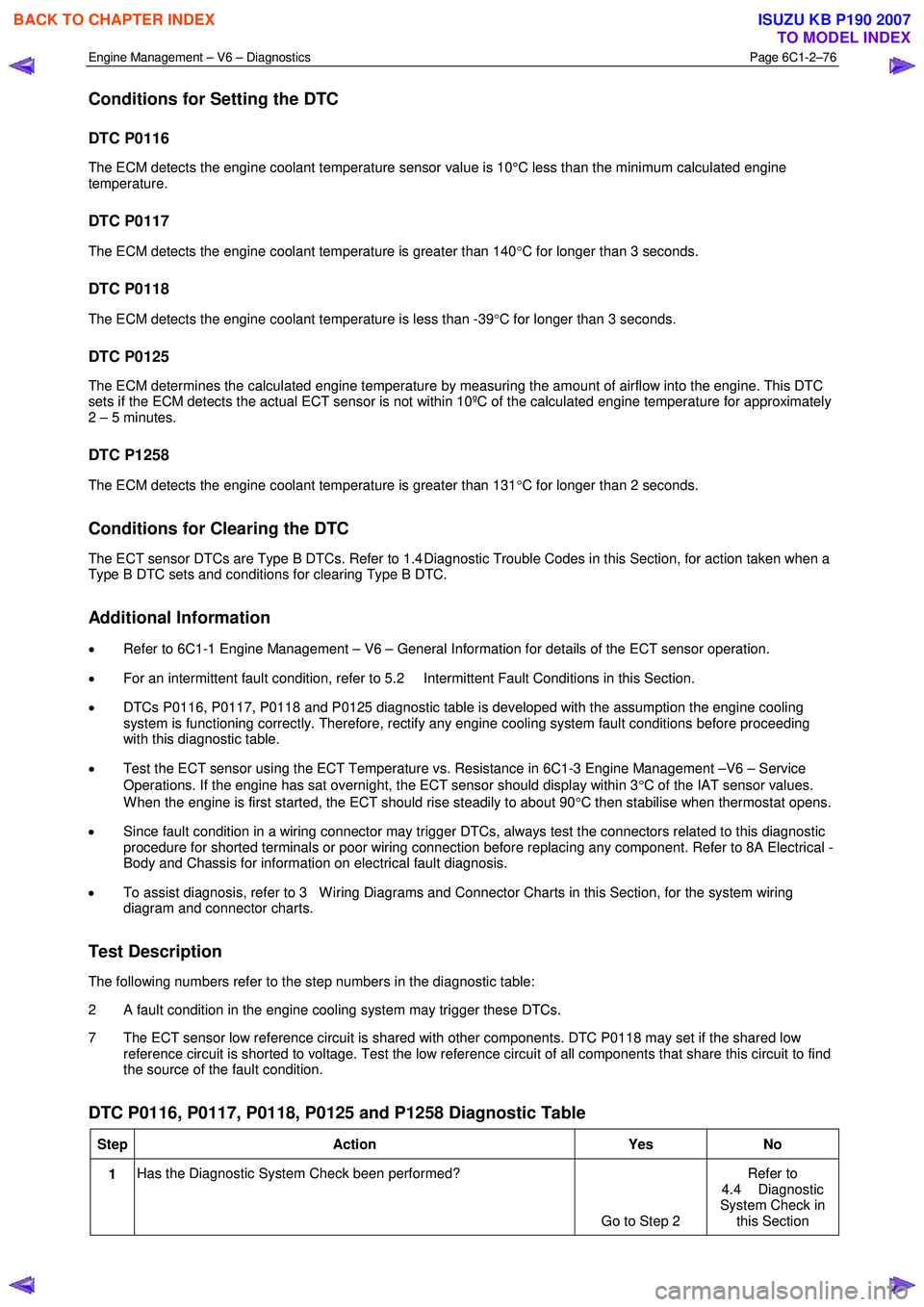
Conditions for Setting the DTC
DTC P0116
The ECM detects the engine coolant temperature sensor value is 10°C less than the minimum calculated engine
temperature.
DTC P0117
The ECM detects the engine coolant temperature is greater than 140 °C for longer than 3 seconds.
DTC P0118
The ECM detects the engine coolant temperature is less than -39 °C for longer than 3 seconds.
DTC P0125
The ECM determines the calculated engine temperature by measuring the amount of airflow into the engine. This DTC
sets if the ECM detects the actual ECT sensor is not within 10ºC of the calculated engine temperature for approximately
2 – 5 minutes.
DTC P1258
The ECM detects the engine coolant temperature is greater than 131 °C for longer than 2 seconds.
Conditions for Clearing the DTC
The ECT sensor DTCs are Type B DTCs. Refer to 1.4 Diagnostic Trouble Codes in this Section, for action taken when a
Type B DTC sets and conditions for clearing Type B DTC.
Additional Information
• Refer to 6C1-1 Engine Management – V6 – General Information for details of the ECT sensor operation.
• For an intermittent fault condition, refer to 5.2 Intermittent Fault Conditions in this Section.
• DTCs P0116, P0117, P0118 and P0125 diagnostic table is developed with the assumption the engine cooling
system is functioning correctly. Therefore, rectify any engine cooling system fault conditions before proceeding
with this diagnostic table.
• Test the ECT sensor using the ECT Temperature vs. Resistance in 6C1-3 Engine Management –V6 – Service
Operations. If the engine has sat overnight, the ECT sensor should display within 3 °C of the IAT sensor values.
W hen the engine is first started, the ECT should rise steadily to about 90 °C then stabilise when thermostat opens.
• Since fault condition in a wiring connector may trigger DTCs, always test the connectors related to this diagnostic
procedure for shorted terminals or poor wiring connection before replacing any component. Refer to 8A Electrical -
Body and Chassis for information on electrical fault diagnosis.
• To assist diagnosis, refer to 3 W iring Diagrams and Connector Charts in this Section, for the system wiring
diagram and connector charts.
Test Description
The following numbers refer to the step numbers in the diagnostic table:
2 A fault condition in the engine cooling system may trigger these DTCs.
7 The ECT sensor low reference circuit is shared with other components. DTC P0118 may set if the shared low reference circuit is shorted to voltage. Test the low reference circuit of all components that share this circuit to find
the source of the fault condition.
DTC P0116, P0117, P0118, P0125 and P1258 Diagnostic Table
Step Action Yes No
1 Has the Diagnostic System Check been performed?
Go to Step 2 Refer to
4.4 Diagnostic
System Check in this Section
BACK TO CHAPTER INDEX
TO MODEL INDEX
ISUZU KB P190 2007
Page 3356 of 6020
Engine Management – V6 – Diagnostics Page 6C1-2–78
Step Action Yes No
10 1 Using Tech 2, clear the DTCs.
2 Switch off the ignition for 30 seconds.
3 Start the engine.
4 Operate the vehicle within the conditions for running the DTC.
Does any of the ECT sensor DTCs fail this ignition cycle? Go to Step 2 Go to Step 11
11 Using Tech 2, select the DTC display function.
Does Tech 2 display any DTCs? Go to the
appropriate DTC
Table in this Section System OK
When all diagnosis and repairs are completed, check the system for correct operation.
7.9 DTC P0121, P0122, P0123, P0221,
P0222,or P0223
DTC Descriptors
This diagnostic procedure supports the following DTCs:
• DTC P0121 – Throttle Position Sensor 1 Circuit Range / Performance
• DTC P0122 – Throttle Position Sensor 1 Circuit Low Voltage
• DTC P0123 – Throttle Position Sensor 1 Circuit High Voltage
• DTC P0221 – Throttle Position Sensor 2 Circuit Range / Performance
• DTC P0222 – Throttle Position Sensor 2 Circuit Low Voltage
• DTC P0223 – Throttle Position Sensor 2 Circuit High Voltage
Circuit Description
The ECM applies 5 V to the throttle position (TP) sensor 1 through the 5 V reference circuit and the ground through the
low reference circuit. TP sensor 1 and TP sensor 2 share common 5 V reference circuit and low reference circuit.
The TP sensor 1 and TP sensor 2 have individual signal circuits with opposite functionality. These signal circuits provide
the ECM with a signal voltage that is proportional to the throttle plate movement.
• The TP sensor 1 signal voltage is less than 1 V when the throttle plate is in closed position, which increases to
greater than 4 V when the throttle plate is moved to wide-open throttle.
• The TP sensor 2 signal voltage is greater than 4 V when the throttle plate is in closed position, which decreases to
less than 1 V when the throttle plate is moved to wide-open throttle.
The ECM monitors and compares the TP sensor 1 signal voltage to the TP sensor signal voltage 2. In addition, the ECM
compares the TP sensor signal to the MAF sensor signal to determine a calculated TP sensor signal.
A TP sensor DTC sets if the ECM detects a fault condition in the TP sensor signal output.
Conditions for Running the DTC
DTC P0121 runs continuously once the following conditions are met:
• The ignition voltage is greater than 7 V.
• The TP sensor 1 signal voltage is 0.17 – 4.6 V.
DTC P0122, P0123, P0222 and P0223 runs continuously once the following conditions are met:
• The ignition voltage is greater than 7 V.
• The ignition is switched on.
DTC P0221 runs continuously once the following conditions are met:
• The battery voltage is greater than 7 V.
BACK TO CHAPTER INDEX
TO MODEL INDEX
ISUZU KB P190 2007