start ISUZU KB P190 2007 Workshop Repair Manual
[x] Cancel search | Manufacturer: ISUZU, Model Year: 2007, Model line: KB P190, Model: ISUZU KB P190 2007Pages: 6020, PDF Size: 70.23 MB
Page 3358 of 6020
Engine Management – V6 – Diagnostics Page 6C1-2–80
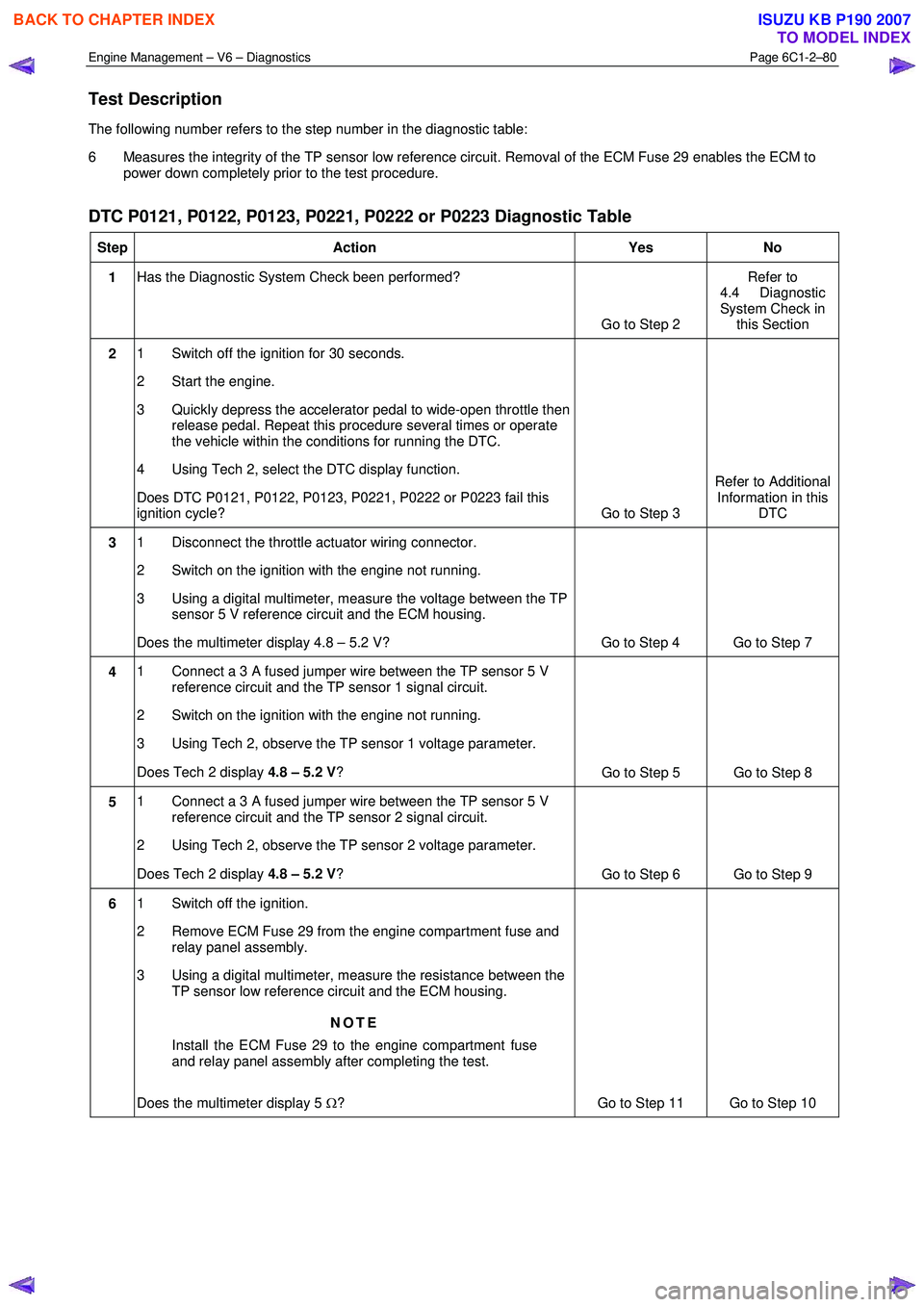
Test Description
The following number refers to the step number in the diagnostic table:
6 Measures the integrity of the TP sensor low reference circuit. Removal of the ECM Fuse 29 enables the ECM to power down completely prior to the test procedure.
DTC P0121, P0122, P0123, P0221, P0222 or P0223 Diagnostic Table
Step Action Yes No
1 Has the Diagnostic System Check been performed?
Go to Step 2 Refer to
4.4 Diagnostic
System Check in this Section
2 1 Switch off the ignition for 30 seconds.
2 Start the engine.
3 Quickly depress the accelerator pedal to wide-open throttle then release pedal. Repeat this procedure several times or operate
the vehicle within the conditions for running the DTC.
4 Using Tech 2, select the DTC display function.
Does DTC P0121, P0122, P0123, P0221, P0222 or P0223 fail this
ignition cycle? Go to Step 3 Refer to Additional
Information in this DTC
3 1 Disconnect the throttle actuator wiring connector.
2 Switch on the ignition with the engine not running.
3 Using a digital multimeter, measure the voltage between the TP sensor 5 V reference circuit and the ECM housing.
Does the multimeter display 4.8 – 5.2 V? Go to Step 4 Go to Step 7
4 1 Connect a 3 A fused jumper wire between the TP sensor 5 V
reference circuit and the TP sensor 1 signal circuit.
2 Switch on the ignition with the engine not running.
3 Using Tech 2, observe the TP sensor 1 voltage parameter.
Does Tech 2 display 4.8 – 5.2 V?
Go to Step 5 Go to Step 8
5 1 Connect a 3 A fused jumper wire between the TP sensor 5 V
reference circuit and the TP sensor 2 signal circuit.
2 Using Tech 2, observe the TP sensor 2 voltage parameter.
Does Tech 2 display 4.8 – 5.2 V?
Go to Step 6 Go to Step 9
6 1 Switch off the ignition.
2 Remove ECM Fuse 29 from the engine compartment fuse and relay panel assembly.
3 Using a digital multimeter, measure the resistance between the TP sensor low reference circuit and the ECM housing.
NOTE
Install the ECM Fuse 29 to the engine compartment fuse
and relay panel assembly after completing the test.
Does the multimeter display 5 Ω? Go to Step 11 Go to Step 10
BACK TO CHAPTER INDEX
TO MODEL INDEX
ISUZU KB P190 2007
Page 3359 of 6020
Engine Management – V6 – Diagnostics Page 6C1-2–81
Step Action Yes No
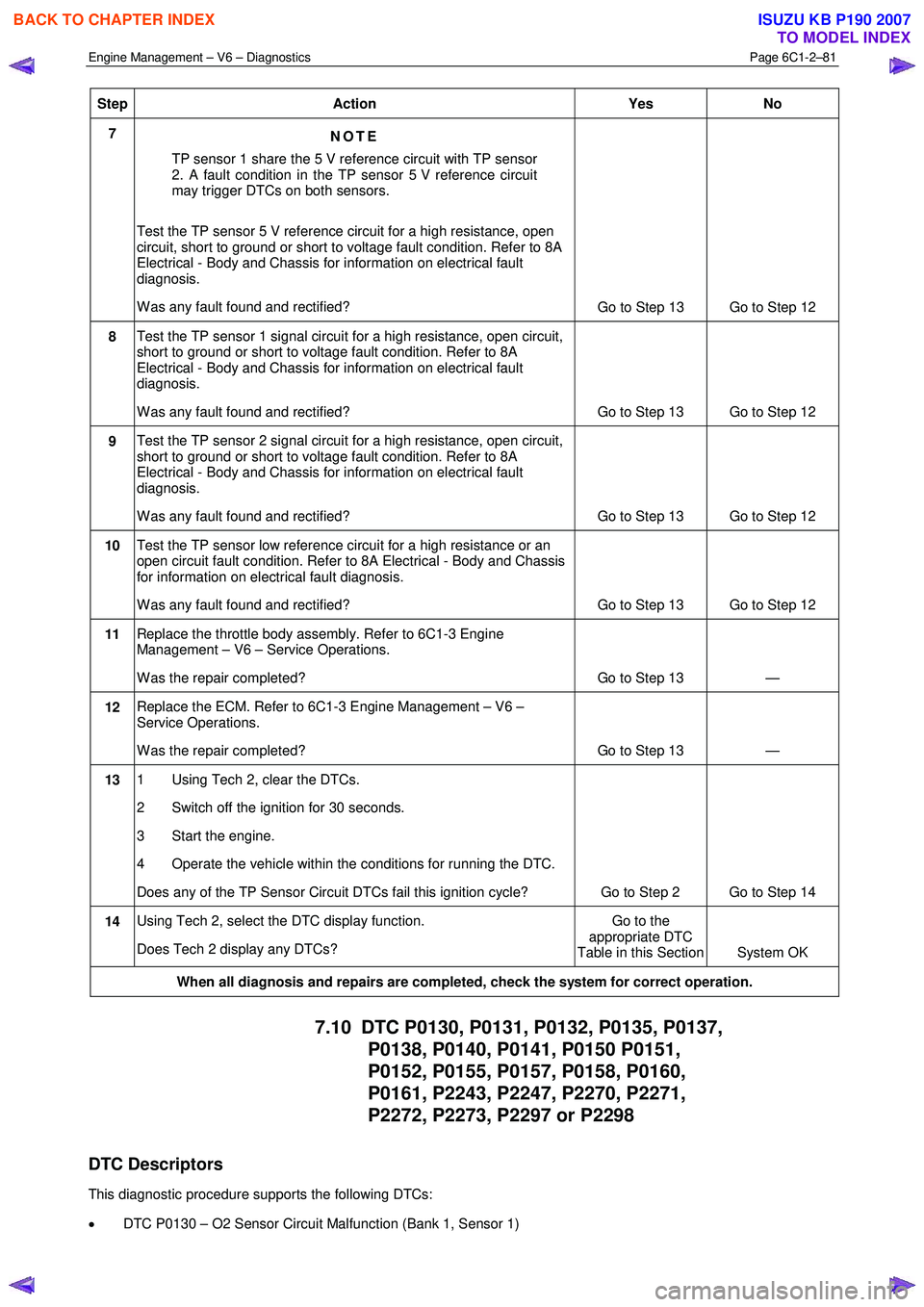
7
NOTE
TP sensor 1 share the 5 V reference circuit with TP sensor
2. A fault condition in the TP sensor 5 V reference circuit
may trigger DTCs on both sensors.
Test the TP sensor 5 V reference circuit for a high resistance, open
circuit, short to ground or short to voltage fault condition. Refer to 8A
Electrical - Body and Chassis for information on electrical fault
diagnosis.
W as any fault found and rectified? Go to Step 13 Go to Step 12
8 Test the TP sensor 1 signal circuit for a high resistance, open circuit,
short to ground or short to voltage fault condition. Refer to 8A
Electrical - Body and Chassis for information on electrical fault
diagnosis.
W as any fault found and rectified? Go to Step 13 Go to Step 12
9 Test the TP sensor 2 signal circuit for a high resistance, open circuit,
short to ground or short to voltage fault condition. Refer to 8A
Electrical - Body and Chassis for information on electrical fault
diagnosis.
W as any fault found and rectified? Go to Step 13 Go to Step 12
10 Test the TP sensor low reference circuit for a high resistance or an
open circuit fault condition. Refer to 8A Electrical - Body and Chassis
for information on electrical fault diagnosis.
W as any fault found and rectified? Go to Step 13 Go to Step 12
11 Replace the throttle body assembly. Refer to 6C1-3 Engine
Management – V6 – Service Operations.
W as the repair completed? Go to Step 13 —
12 Replace the ECM. Refer to 6C1-3 Engine Management – V6 –
Service Operations.
W as the repair completed? Go to Step 13 —
13 1 Using Tech 2, clear the DTCs.
2 Switch off the ignition for 30 seconds.
3 Start the engine.
4 Operate the vehicle within the conditions for running the DTC.
Does any of the TP Sensor Circuit DTCs fail this ignition cycle? Go to Step 2 Go to Step 14
14 Using Tech 2, select the DTC display function.
Does Tech 2 display any DTCs? Go to the
appropriate DTC
Table in this Section System OK
When all diagnosis and repairs are completed, check the system for correct operation.
7.10 DTC P0130, P0131, P0132, P0135, P0137,
P0138, P0140, P0141, P0150 P0151,
P0152, P0155, P0157, P0158, P0160,
P0161, P2243, P2247, P2270, P2271,
P2272, P2273, P2297 or P2298
DTC Descriptors
This diagnostic procedure supports the following DTCs:
• DTC P0130 – O2 Sensor Circuit Malfunction (Bank 1, Sensor 1)
BACK TO CHAPTER INDEX
TO MODEL INDEX
ISUZU KB P190 2007
Page 3362 of 6020
Engine Management – V6 – Diagnostics Page 6C1-2–84
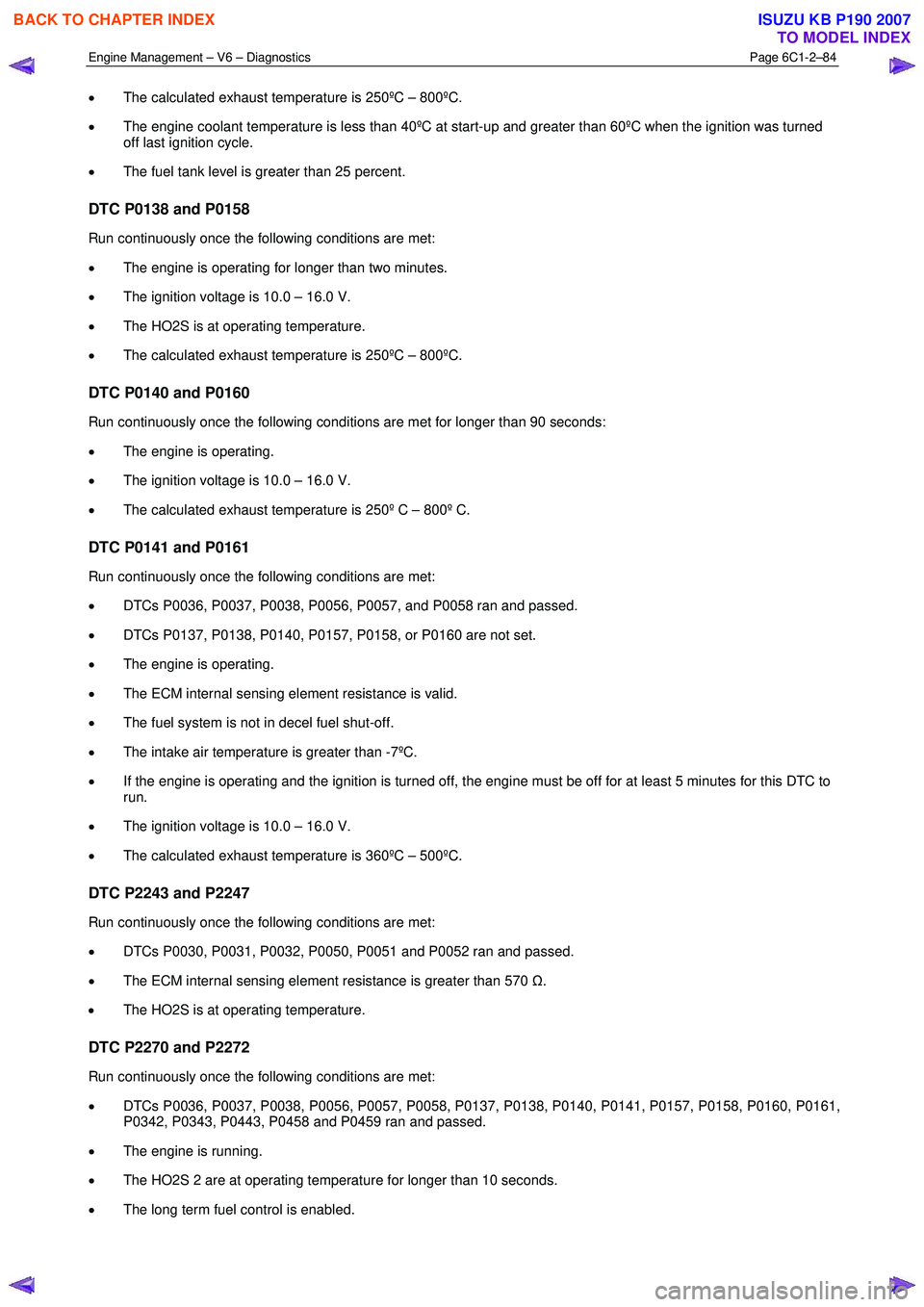
• The calculated exhaust temperature is 250ºC – 800ºC.
• The engine coolant temperature is less than 40ºC at start-up and greater than 60ºC when the ignition was turned
off last ignition cycle.
• The fuel tank level is greater than 25 percent.
DTC P0138 and P0158
Run continuously once the following conditions are met:
• The engine is operating for longer than two minutes.
• The ignition voltage is 10.0 – 16.0 V.
• The HO2S is at operating temperature.
• The calculated exhaust temperature is 250ºC – 800ºC.
DTC P0140 and P0160
Run continuously once the following conditions are met for longer than 90 seconds:
• The engine is operating.
• The ignition voltage is 10.0 – 16.0 V.
• The calculated exhaust temperature is 250º C – 800º C.
DTC P0141 and P0161
Run continuously once the following conditions are met:
• DTCs P0036, P0037, P0038, P0056, P0057, and P0058 ran and passed.
• DTCs P0137, P0138, P0140, P0157, P0158, or P0160 are not set.
• The engine is operating.
• The ECM internal sensing element resistance is valid.
• The fuel system is not in decel fuel shut-off.
• The intake air temperature is greater than -7ºC.
• If the engine is operating and the ignition is turned off, the engine must be off for at least 5 minutes for this DTC to
run.
• The ignition voltage is 10.0 – 16.0 V.
• The calculated exhaust temperature is 360ºC – 500ºC.
DTC P2243 and P2247
Run continuously once the following conditions are met:
• DTCs P0030, P0031, P0032, P0050, P0051 and P0052 ran and passed.
• The ECM internal sensing element resistance is greater than 570 Ω.
• The HO2S is at operating temperature.
DTC P2270 and P2272
Run continuously once the following conditions are met:
• DTCs P0036, P0037, P0038, P0056, P0057, P0058, P0137, P0138, P0140, P0141, P0157, P0158, P0160, P0161,
P0342, P0343, P0443, P0458 and P0459 ran and passed.
• The engine is running.
• The HO2S 2 are at operating temperature for longer than 10 seconds.
• The long term fuel control is enabled.
BACK TO CHAPTER INDEX
TO MODEL INDEX
ISUZU KB P190 2007
Page 3364 of 6020

Engine Management – V6 – Diagnostics Page 6C1-2–86
DTC P2243 and P2247
The ECM detects the internal HO2S signal voltage is not 0.2 – 4.7 V.
DTC P2270 and P2272
W hen the ECM detects the HO2S 2 is less than 650 mV for 100 seconds, the ECM enriches the fuel mixture up to 30
percent for 10 seconds. This DTC sets if the ECM detects the HO2S 2 is still less than 650 mV.
DTC P2271 and P2273
W hen the ECM detects the HO2S 2 is greater than 650 mV for 100 seconds, the ECM leans the fuel mixture up to -7
percent for 10 seconds. If this signal voltage is still greater than 650 mV, the ECM tests the HO2S at the next decel fuel
cut-off. This DTC sets if the ECM detects the HO2S 2 signal voltage is greater than 200 mV after 4 seconds in decel fuel
cu-off mode.
DTC P2297 and P2298
The ECM detects the internal HO2S 1 signal voltage is greater than 3.7 V for longer than 10 seconds.
Conditions for Clearing the DTC
The HO2S reference circuit DTCs are Type B DTCs. Refer to 1.4 Diagnostic Trouble Codes in this Section, for action
taken when Type B DTC sets and conditions for clearing Type B DTCs.
Additional Information
• Refer to 6C1-1 Engine Management – V6 – General Information for details of the HO2S system operation.
• For an intermittent fault condition, refer to 5.2 Intermittent Fault Conditions in this Section.
• The HO2S must be tightened correctly. A loose HO2S will trigger these DTCs.
• A fault condition in the fuel delivery system, air intake system or exhaust system may trigger these DTCs.
• Since fault condition in a wiring connector may trigger DTCs, always test the connectors related to this diagnostic
procedure for shorted terminals or poor wiring connection before replacing any component. Refer to 8A Electrical -
Body and Chassis for information on electrical fault diagnosis.
• To assist diagnosis, refer to 3 W iring Diagrams and Connector Charts in this Section, for the system wiring
diagram and connector charts.
DTC P0130 to P0132, P0135 to P0138, P0140, P0141, P0150 to P0152, P0155, P0157, P0158,
P0160, P0161, P2243, P2247, P2270 to P2273, P2297 or P2298 Diagnostic Table
Step Action Yes No
1
Has the Diagnostic System Check been performed? Go to Step 2 Refer to
4.4 Diagnostic
System Check in this Section
2 1 Switch off the ignition for 30 seconds.
2 Start the engine.
3 Allow the engine to reach the normal operating temperature.
4 Increase the engine speed to 2,000 rpm for 10 seconds or operate the vehicle within the conditions for setting the DTC.
5 Using Tech 2, select the DTC display function.
Does DTC P0130, P0131, P0132, P0135, P0137, P0138, P0140,
P0141, P0150, P0151, P0152, P0155, P0160, P0161, P2243, P2247,
P2270, P2271, P2272, P2273, P2297 or P2298 fail this ignition cycle? Go to Step 3 Refer to Additional
Information in this DTC
3 Are DTCs relating to the heater circuit of the O2 sensor, also set?
(e.g. P0030, P0031, P0032, P0036, P0037, P0038, P0050, P0051,
P0052, P0056, P0057 or P0058) Go to the
appropriate DTC
Table in this Section Go to Step 4
BACK TO CHAPTER INDEX
TO MODEL INDEX
ISUZU KB P190 2007
Page 3365 of 6020
Engine Management – V6 – Diagnostics Page 6C1-2–87
Step Action Yes No
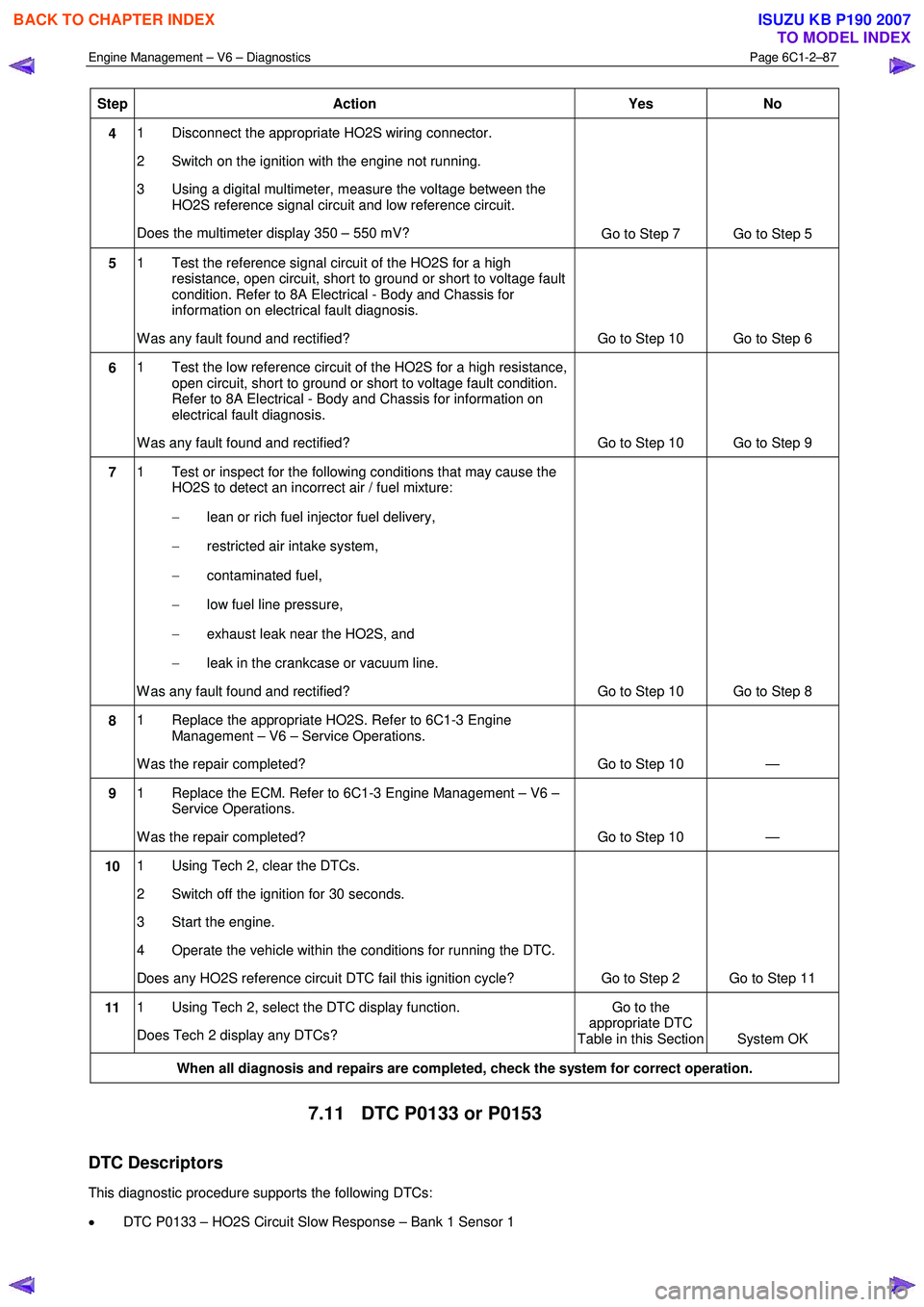
4 1 Disconnect the appropriate HO2S wiring connector.
2 Switch on the ignition with the engine not running.
3 Using a digital multimeter, measure the voltage between the HO2S reference signal circuit and low reference circuit.
Does the multimeter display 350 – 550 mV? Go to Step 7 Go to Step 5
5 1 Test the reference signal circuit of the HO2S for a high
resistance, open circuit, short to ground or short to voltage fault
condition. Refer to 8A Electrical - Body and Chassis for
information on electrical fault diagnosis.
W as any fault found and rectified? Go to Step 10 Go to Step 6
6 1 Test the low reference circuit of the HO2S for a high resistance,
open circuit, short to ground or short to voltage fault condition.
Refer to 8A Electrical - Body and Chassis for information on
electrical fault diagnosis.
W as any fault found and rectified? Go to Step 10 Go to Step 9
7 1 Test or inspect for the following conditions that may cause the
HO2S to detect an incorrect air / fuel mixture:
− lean or rich fuel injector fuel delivery,
− restricted air intake system,
− contaminated fuel,
− low fuel line pressure,
− exhaust leak near the HO2S, and
− leak in the crankcase or vacuum line.
W as any fault found and rectified? Go to Step 10 Go to Step 8
8 1 Replace the appropriate HO2S. Refer to 6C1-3 Engine
Management – V6 – Service Operations.
W as the repair completed? Go to Step 10 —
9 1 Replace the ECM. Refer to 6C1-3 Engine Management – V6 –
Service Operations.
W as the repair completed? Go to Step 10 —
10 1 Using Tech 2, clear the DTCs.
2 Switch off the ignition for 30 seconds.
3 Start the engine.
4 Operate the vehicle within the conditions for running the DTC.
Does any HO2S reference circuit DTC fail this ignition cycle? Go to Step 2 Go to Step 11
11 1 Using Tech 2, select the DTC display function.
Does Tech 2 display any DTCs? Go to the
appropriate DTC
Table in this Section System OK
When all diagnosis and repairs are completed, check the system for correct operation.
7.11 DTC P0133 or P0153
DTC Descriptors
This diagnostic procedure supports the following DTCs:
• DTC P0133 – HO2S Circuit Slow Response – Bank 1 Sensor 1
BACK TO CHAPTER INDEX
TO MODEL INDEX
ISUZU KB P190 2007
Page 3368 of 6020

Engine Management – V6 – Diagnostics Page 6C1-2–90
Step Action Yes No
2 NOTE
• DTC P0133 is for bank 1 sensor 1 and DTC P0153 is
for bank 2 sensor 1.
• DTC P0132 causes DTC P0153 to set. If DTC P0132
is set with DTC P0153, refer to 7.10 DTC
P0130, P0131, P0132, P0135, P0137, P0138, P0140,
P0141, P0150 P0151, P0152, P0155, P0157, P0158,
P0160, P0161, P2243, P2247, P2270, P2271, P2272,
P2273, P2297 or P2298 in this Section.
• Inspect the heated oxygen sensor (HO2S) for being
secure before proceeding with this DTC. A sensor that
is loose could cause this DTC to set.
1 Start engine and allow to reach operating temperature.
2 Observe the diagnostic trouble code (DTC) information with Tech 2.
Did DTC P0133 and / or DTC P0153 fail this ignition cycle? Go to Step 4 Go to Step 3
3 1 Observe the Freeze Frame / Failure Records for this DTC.
2 Turn OFF the ignition for 30 seconds.
3 Start the engine.
4 Operate the vehicle within the Conditions for Running the DTC. You may also operate the vehicle within the conditions that you
observed from the Freeze Frame / Failure Records.
Did the DTC fail this ignition? Go to Step 4 Go to Additional
Information in this DTC
4 Did DTC P0133 and DTC P0153 fail this ignition cycle? Go to Step 7 Go to Step 5
5 1 Inspect for an exhaust leak near the HO2S. Refer to 6F Exhaust
System – V6. After you inspect the exhaust system, return to
this diagnostic.
Did you find and correct the condition? Go to Step 8 Go to Step 6
6 1 Inspect or test for the following conditions:
• Inspect that the HO2S is securely installed.
• Inspect for corrosion on the HO2S terminals.
• Inspect the terminal tension at the HO2S and at the
engine control module (ECM). Refer to 8A Electrical-Body
and Chassis.
• Inspect the HO2S wiring for damage.
Did you find and correct the condition? Go to Step 8 Go to Step 7
BACK TO CHAPTER INDEX
TO MODEL INDEX
ISUZU KB P190 2007
Page 3369 of 6020

Engine Management – V6 – Diagnostics Page 6C1-2–91
Step Action Yes No
7 NOTE
If both DTCs are set, determine and correct the cause of
the contamination before replacing a sensor.
1 Inspect for the following conditions:
• Fuel contamination – refer to 6.5 Alcohol / Contaminants
in Fuel Diagnosis in this Section.
• The correct RTV sealant.
• Engine oil consumption – refer to 6A1 Engine Mechanical
– V6.
• Engine coolant consumption – refer to 6B1 Engine Cooling
– V6.
2 Replace the HO2S. Refer to 6C1-3 Engine Management – V6 – Service Operations.
Did you complete the replacement? Go to Step 8 —
8 1 Use Tech 2 to Clear the DTCs.
2 Turn OFF the ignition for 30 seconds.
3 Start the engine.
4 Operate the vehicle within the Conditions for Running the DTC. You may also operate the vehicle within the conditions that you
observed from the Freeze Frame / Failure Records.
Did the DTC fail this ignition? Go to Step 2 Go to Step 9
9 1 Using Tech 2, select the DTC display function.
Does Tech 2 display any DTCs? Go to the
appropriate DTC
Table in this Section System OK
When all diagnosis and repairs are completed, clear all DTCs and verify correct operation
7.12 DTC P0139 or P0159
DTC Descriptors
This diagnostic procedure supports the following DTCs:
• DTC P0139 – O2 Sensor Circuit Slow Response (Bank 1 Sensor 2)
• DTC P0159 – O2 Sensor Circuit Slow Response (Bank 2 Sensor 2)
Circuit Description
The post catalytic converter heated oxygen sensor (HO2S) produces a voltage that varies between 100 – 900 mV under
normal operating conditions. The engine control module (ECM) produces a bias voltage on the HO2S signal circuit of
420 – -480 mV. The reference ground for the sensor is provided through the ECM.
The ECM monitors the signal voltage to determine if the exhaust is lean or rich. The oxygen sensor voltage is high when
the exhaust is rich, and low when the exhaust is lean. The ECM constantly monitors the HO2S signal during the Closed
Loop operation. If the ECM detects that the decel fuel cut-off rich-to-lean transition time is too long, DTC P0139 will set
for bank 1 sensor 2, or DTC P0159 will set for bank 2 sensor 2.
Conditions for Running the DTC
• DTCs P0021, P0024, P0030, P0031, P0032, P0036, P0037, P0038, P0050, P0051, P0052, P0056, P0057, P0058,
P0101, P0102, P0103, P0106, P0107, P0108, P0116, P0117, P0118, P0121, P0122, P0123, P0125, P0128,
P0131, P0132, P0135, P0137, P0138, P0139, P0140, P0141, P0151, P0152, P0155, P0157, P0158, P0159,
P0160, P0161, P0201-P0208, P0221, P0222, P0223, P0261, P0262, P0264, P0265, P0267, P0268, P0270,
P0271, P0273, P0274, P0276, P0277, P0279, P0280, P0282, P0283, P0300, P0301-P0308, P0335, P0336,
BACK TO CHAPTER INDEX
TO MODEL INDEX
ISUZU KB P190 2007
Page 3370 of 6020

Engine Management – V6 – Diagnostics Page 6C1-2–92
P0340, P0341, P0345, P0346, P0351-P0358, P0365, P0366, P0390, P0391, P0442, P0443, P0446, P0449,
P0453, P0454, P0455, P0458, P0459, and P0496 are not set.
• The ECT Sensor parameter is more than 66° C.
• The Vehicle Speed Sensor parameter is between 5 – 180 km/h.
• The calculated catalytic converter temperature is more than 520° C.
• DTC P0139 or P0159 runs continuously once the above conditions are met.
Conditions for Setting the DTC
• The ECM detects that the decel fuel cut-off and rich-to-lean transition time has exceeded 1 second.
Action Taken When the DTC Sets
• The ECM illuminates the malfunction indicator lamp (MIL) on the second consecutive ignition cycle that the
diagnostic runs and fails.
• The ECM records the operating conditions at the time the diagnostic fails. The first time the diagnostic fails, the
control module stores this information in the Failure Records. If the diagnostic reports a failure on the second
consecutive ignition cycle, the control module records the operating conditions at the time of the failure.
• The ECM writes the operating conditions to the Freeze Frame and updates the Failure Records.
Conditions for Clearing the MIL/DTC
• The ECM turns OFF the malfunction indicator lamp (MIL) after three consecutive ignition cycles that the diagnostic
runs and does not fail.
• A current DTC, Last Test Failed, clears when the diagnostic runs and passes.
• A history DTC clears after 40 consecutive warm-up cycles, if no failures are reported by this or any other emission
related diagnostic.
• Use Tech 2 to clear the MIL and the DTC.
DTC P0139 or P0159 Diagnostic Table
Step Action Value(s) Yes No
1
Has the Diagnostic System Check been completed? —
Go to Step 2 Refer to
4.4 Diagnostic System Check
2 1 Start and run the engine until normal operating
temperature is reached.
2 Quickly cycle the throttle from closed throttle to wide open throttle (W OT) 3 times within
5 seconds while observing the HO2S Bank 1
Sensor 2 or HO2S Bank 2 Sensor 2 voltage
parameter with Tech 2.
Does the voltage react immediately when performing
the above action? —
Go to Step 3 Go to Step 4
3 1 Observe the Freeze Frame / Failure Records for
this DTC.
2 Turn OFF the ignition for 30 seconds.
3 Start the engine.
4 Operate the vehicle within the Conditions for Running the DTC. You may also operate the
vehicle within the conditions that you observed
from the Freeze Frame / Failure Records.
Did the DTC fail this ignition? —
Go to Step 4 Go to 5.2
Intermittent Fault Conditions in this Section.
BACK TO CHAPTER INDEX
TO MODEL INDEX
ISUZU KB P190 2007
Page 3372 of 6020
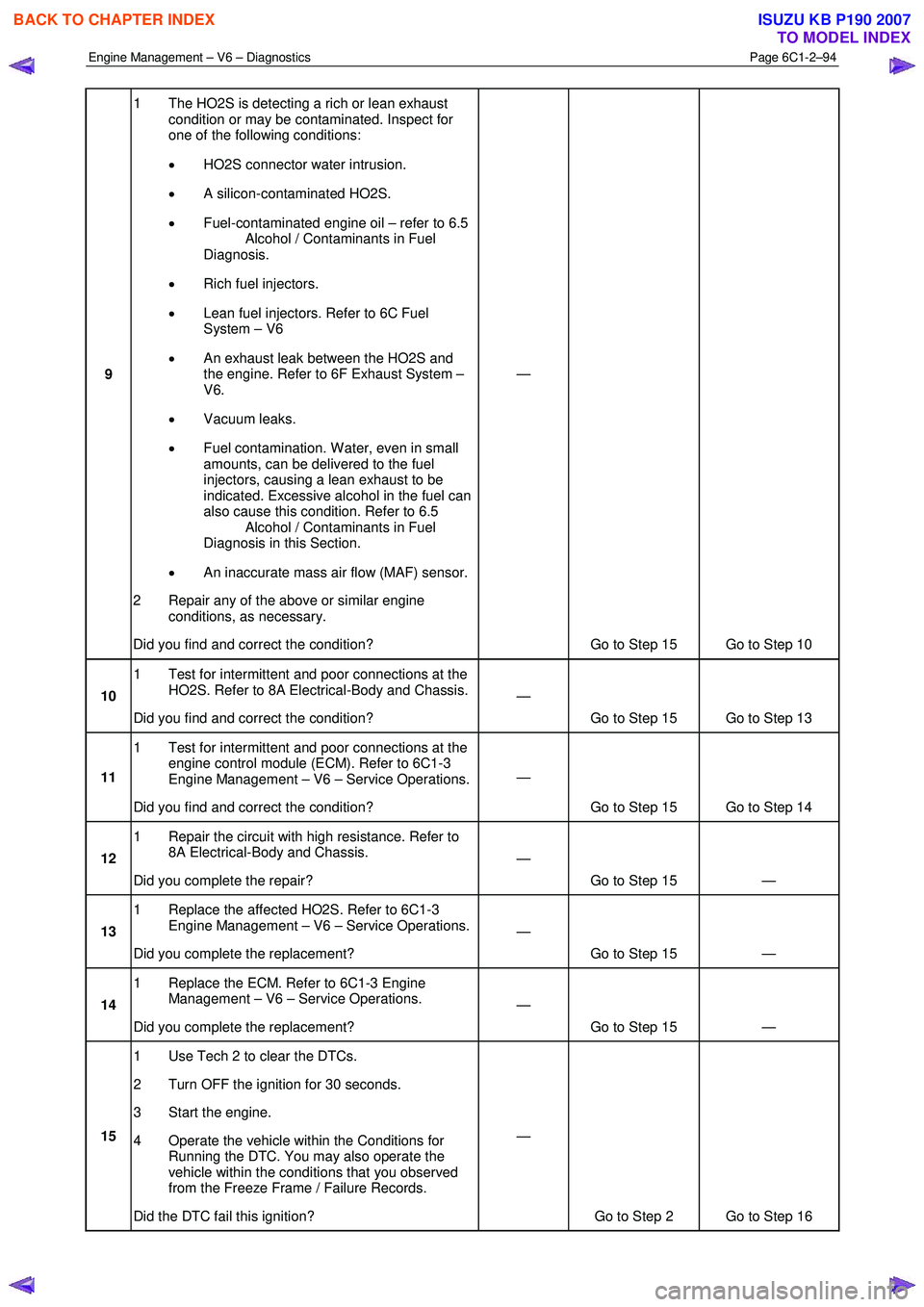
Engine Management – V6 – Diagnostics Page 6C1-2–94
9 1 The HO2S is detecting a rich or lean exhaust
condition or may be contaminated. Inspect for
one of the following conditions:
• HO2S connector water intrusion.
• A silicon-contaminated HO2S.
• Fuel-contaminated engine oil – refer to 6.5
Alcohol / Contaminants in Fuel
Diagnosis.
• Rich fuel injectors.
• Lean fuel injectors. Refer to 6C Fuel
System – V6
• An exhaust leak between the HO2S and
the engine. Refer to 6F Exhaust System –
V6.
• Vacuum leaks.
• Fuel contamination. W ater, even in small
amounts, can be delivered to the fuel
injectors, causing a lean exhaust to be
indicated. Excessive alcohol in the fuel can
also cause this condition. Refer to 6.5
Alcohol / Contaminants in Fuel
Diagnosis in this Section.
• An inaccurate mass air flow (MAF) sensor.
2 Repair any of the above or similar engine conditions, as necessary.
Did you find and correct the condition? —
Go to Step 15 Go to Step 10
10 1 Test for intermittent and poor connections at the
HO2S. Refer to 8A Electrical-Body and Chassis.
Did you find and correct the condition? —
Go to Step 15 Go to Step 13
11 1 Test for intermittent and poor connections at the
engine control module (ECM). Refer to 6C1-3
Engine Management – V6 – Service Operations.
Did you find and correct the condition? —
Go to Step 15 Go to Step 14
12 1 Repair the circuit with high resistance. Refer to
8A Electrical-Body and Chassis.
Did you complete the repair? —
Go to Step 15 —
13 1 Replace the affected HO2S. Refer to 6C1-3
Engine Management – V6 – Service Operations.
Did you complete the replacement? —
Go to Step 15 —
14 1 Replace the ECM. Refer to 6C1-3 Engine
Management – V6 – Service Operations.
Did you complete the replacement? —
Go to Step 15 —
15 1 Use Tech 2 to clear the DTCs.
2 Turn OFF the ignition for 30 seconds.
3 Start the engine.
4 Operate the vehicle within the Conditions for Running the DTC. You may also operate the
vehicle within the conditions that you observed
from the Freeze Frame / Failure Records.
Did the DTC fail this ignition? —
Go to Step 2 Go to Step 16
BACK TO CHAPTER INDEX
TO MODEL INDEX
ISUZU KB P190 2007
Page 3375 of 6020

Engine Management – V6 – Diagnostics Page 6C1-2–97
Step Action Yes
No
8 Test the EOT sensor low reference circuit for a high resistance and
open circuit fault condition. Refer to 8A Electrical - Body and Chassis
for information on electrical fault diagnosis.
NOTE
The EOT sensor shares the low reference circuit with
other sensors. A fault condition in the low reference circuit
may trigger DTCs on sensors that share this circuit. Refer
to 3 W iring Diagrams and Connector Charts in this
Section, to assist diagnosis.
W as any fault found and rectified? Go to Step 11 Go to Step 10
9 Replace the EOT sensor. Refer to 6C1-3 Engine Management – V6 –
Service Operations.
W as the repair completed? Go to Step 11 —
10 Replace the ECM. Refer to 6C1-3 Engine Management – V6 –
Service Operations.
W as the repair completed? Go to Step 11 —
11 1 Using Tech 2, clear the DTCs.
2 Switch off the ignition for 30 seconds.
3 Start the engine.
4 Operate the vehicle within the conditions for running the DTC.
Does any of the conditions for the engine oil pressure sensor circuit
DTCs fail this ignition cycle? Go to Step 2 Go to Step 12
12 Using Tech 2, select the DTC display function.
Does Tech 2 display any DTCs? Go to the
appropriate DTC
Table in this Section System OK
When all diagnosis and repairs are completed, check the system for correct operation.
7.14 DTC P0201, P0202, P0203, P0204, P0205,
P0206, P0261, P0262, P0264, P0265,
P0267, P0268, P0270, P0271, P0273,
P0274, P0276 or P0277
DTC Descriptors
This diagnostic procedure supports the following DTCs:
• DTC P0201 – Injector 1 Control Circuit Malfunction
• DTC P0202 – Injector 2 Control Circuit Malfunction
• DTC P0203 – Injector 3 Control Circuit Malfunction
• DTC P0204 – Injector 4 Control Circuit Malfunction
• DTC P0205 – Injector 5 Control Circuit Malfunction
• DTC P0206 – Injector 6 Control Circuit Malfunction
• DTC P0261 – Injector 1 Control Circuit Low Voltage
• DTC P0262 – Injector 1 Control Circuit High Voltage
• DTC P0264 – Injector 2 Control Circuit Low Voltage
• DTC P0265 – Injector 2 Control Circuit High Voltage
• DTC P0267 – Injector 3 Control Circuit Low Voltage
BACK TO CHAPTER INDEX
TO MODEL INDEX
ISUZU KB P190 2007