change time ISUZU KB P190 2007 Workshop Manual Online
[x] Cancel search | Manufacturer: ISUZU, Model Year: 2007, Model line: KB P190, Model: ISUZU KB P190 2007Pages: 6020, PDF Size: 70.23 MB
Page 4267 of 6020

7A1-28 CONSTRUCTION AND FUNCTION
Item Description
Learning function The learning function is provided to correct the oil pressure control timing to engage or
disengage the clutch optimally in order to compensate changes of the engine performance
and changes of the transmission with time. It is controlled to bring the shift time closer to
the value pre-set to the TCM.
Fail-safe function In the case of a malfunction of the vehicle speed sensor, APP sensor, all solenoids or the
inhibitor switch, TCM automatically begins fail-safe control to minimize effects on driving.
The gear is fixed in 3rd gear and the power supply to the solenoid is shut off so that the
solenoid does not work. Lock up clutch is disengaged in this mode.
Self-diagnosis function Parts required for controlling the automatic transmission are provided with a self-diagnosis
function. W hen any trouble occurs, the check trans indicator lamp blinks to warn the driver.
The trouble code is memorized in the TCM.
BACK TO CHAPTER INDEX
TO MODEL INDEX
ISUZU KB P190 2007
Page 4272 of 6020
CONSTRUCTION AND FUNCTION 7A1-33
LEARNING FUNCTION
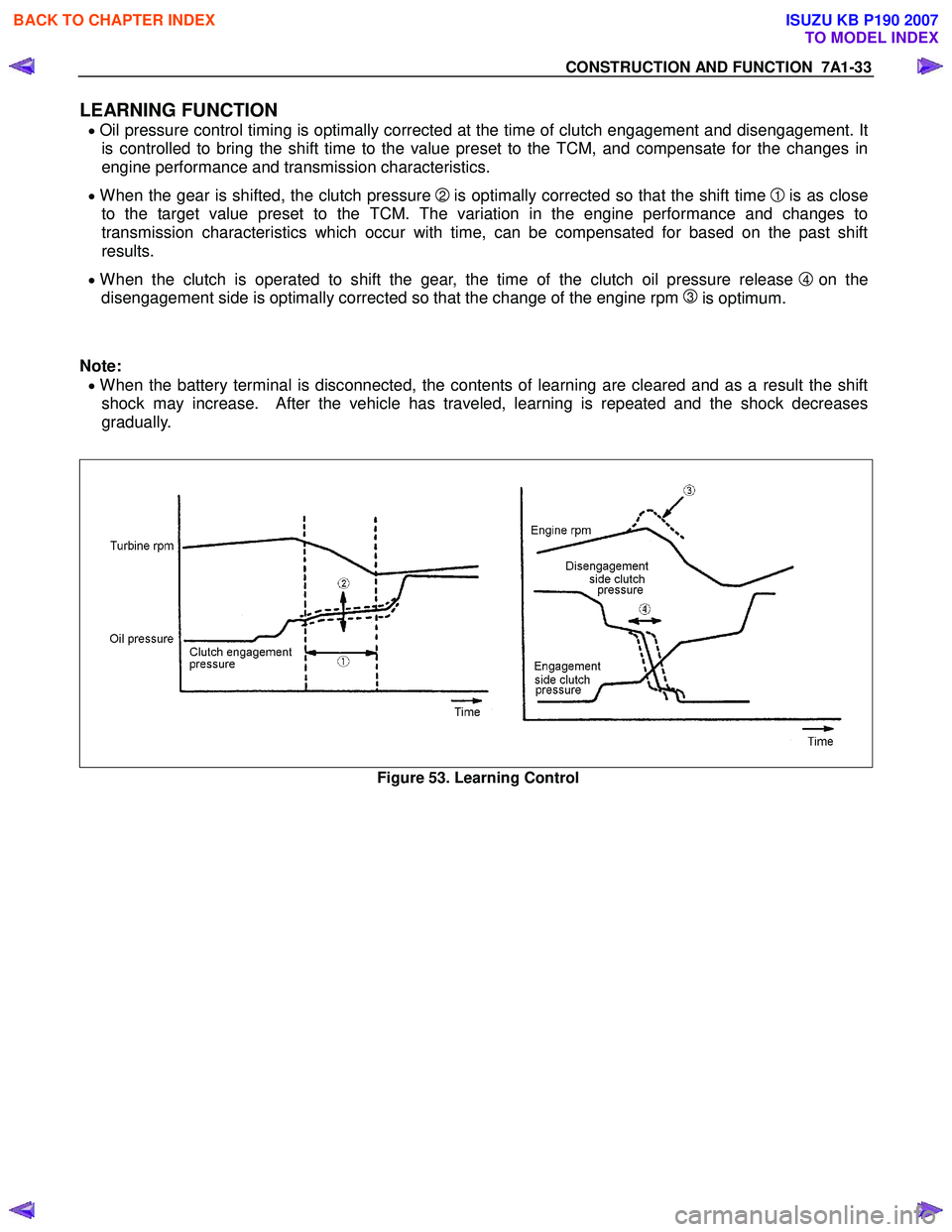
• Oil pressure control timing is optimally corrected at the time of clutch engagement and disengagement. It
is controlled to bring the shift time to the value preset to the TCM, and compensate for the changes in
engine performance and transmission characteristics.
• When the gear is shifted, the clutch pressure 2 is optimally corrected so that the shift time 1 is as close
to the target value preset to the TCM. The variation in the engine performance and changes to
transmission characteristics which occur with time, can be compensated for based on the past shift
results.
• When the clutch is operated to shift the gear, the time of the clutch oil pressure release 4 on the
disengagement side is optimally corrected so that the change of the engine rpm
3 is optimum.
Note:
• When the battery terminal is disconnected, the contents of learning are cleared and as a result the shift
shock may increase. After the vehicle has traveled, learning is repeated and the shock decreases
gradually.
Figure 53. Learning Control
BACK TO CHAPTER INDEX
TO MODEL INDEX
ISUZU KB P190 2007
Page 4379 of 6020

TRANSMISSION CONTROL SYSTEM (JR405E) 7A2-95
Vehicle Does Not Run
Trouble at Starting
Faulty Gearshift
Faulty Shift Pattern
No or Error Gearshift
Faulty Operation During Running
Faulty Operation in Stopping
Faulty Lock Up
No Lock Up
Transmission Fluid Leak
Others
Diagnostic CategoryCategory No.
This table consists of diagnostic categories that are located in the left column. Using this column, choose the appropriate
category based on the operating conditions of the vehicle or transmission. After selecting a category, use the right column to
locate the specific symptom diagnostic information.
Vehicle Does Not Run Vehicle does not run in D, 3, 2, L & L range A1
Vehicle does not run in R range A2
Vehicle does not run in D, 3, 2 and L range A3
Trouble at Starting Vehicle runs in N range B1
Poor acceleration at starting B2
Engine races up during starting (slip) B3
Large shock when selector lever is changed from N to D range or N to R
range B4
Engine stalls when selector lever is changed from N to R, D, 3, 2 or L
range B5
Engine does not crank in P or N range B6
Engine cranks in other than P or N range B7
Extended time lag when selector lever is changed from N to D B8
Extended time lag when selector lever is changed from N to R B9
Brake is applied in R range B10
Insufficient starting or shaking in D range B11
Noise or vibration occurs at starting B12
BACK TO CHAPTER INDEX
TO MODEL INDEX
ISUZU KB P190 2007
Page 4382 of 6020

7A2-98 TRANSMISSION CONTROL SYSTEM (JR405E)
A1Vehicle does not run in D, 3, 2, L & L rangeA2Vehicle does not run in R rangeA3Vehicle does not run in D, 3, 2 and L rangeB1Vehicle runs in N rangeB2Poor acceleration at startingB3Engine races up during starting (slip)B4
Large shock when selector lever is changed
from N to D range or N to R range
B5
Engine stalls when selector lever is changed
from N to R, D, 3, 2 or L range
B6 Engine does not crank in P or N rangeB7Engine cranks in other than P or N rangeB8
Extended time lag when selector lever is
changed from N to D
B9
Extended time lag when selector lever is
changed from N to R
B10 Brake is applied in R rangeB11Insufficient starting or shaking in D rangeB12Noise or vibration occurs at starting
Error, open or short circuit
Error, open or short circuit
Error, open or short circuit
Error, open or short circuit
Open or short circuit
Open or short circuit
Open or short circuit
Error, open or short circuit
Open or short circuit
Open or short circuit
Open or short circuit
Open or short circuit
Open or short circuit
Open or short circuit
Open or short circuit
Open or short circuit
Open or short circuit
Open or short circuit
Out of standard value
Faulty operation
Faulty operation
Faulty operation
Faulty operation
Faulty operation
Faulty operation
Faulty operation
Clogged passage
Clogged passage
Clogged passage
Clogged passage
Clogged passage
Clogged passage
Clogged passage
Slip
Seizure
Faulty operation
Separation
Faulty operation
Engine speed signal
Accelerator pedal position signal
Input shaft speed sensor
Output shaft speed sensor
Power drive or 3rd start switch
Transmission range switch
TCM power or ground
Transmission fluid temperature sensor
Pressure control solenoid
Torque converter clutch solenoid
Low & reverse brake solenoid
2-4 brake solenoid
High clutch solenoid
Low clutch solenoid
Ground return circuit
Low & reverse brake fluid pressure switch
2-4 brake fluid pressure switch
High clutch fluid pressure switch
Transmission fluid quantity
Control spool valve
High clutch solenoid accumulator
Low clutch solenoid accumulator
Low & reverse brake solenoid accumulator
2-4 brake solenoid accumulator
High clutch accumulator
2-4 brake accumulator
Pressure control solenoid hydraulic circuit
Torque converter clutch hydraulic circuit
High clutch solenoid hydraulic circuit
Low clutch solenoid hydraulic circuit
Low & reverse brake solenoid hydraulic circuit
2-4 brake solenoid hydraulic circuit
Oil cooler
Torque converter
Diagnostic category
Possible causes
Electrical
Disordered selector lever cable
Disordered transmission range switch
Faulty line pressure
Faulty engine idle speed
Clutch (brake)
Torque converter clutch piston
Hydraulic control
Powertrain
BACK TO CHAPTER INDEX
TO MODEL INDEX
ISUZU KB P190 2007
Page 4390 of 6020

7A2-106 TRANSMISSION CONTROL SYSTEM (JR405E)
B5: Engine Stalls When Selector Lever is Changed from N to R, D, 3, 2 or L Range
B6: Engine Does Not Crank in P or N Range
B7: Engine Cranks in other than P or N Range
B8: Extended Time Lag When Selector Lever is Changed from N to D
Checks Action
Definition:
The engine stalls when selector lever is changed from N or P position to a run position during engine idling.
Diagnosis Hints • As the correct cause is attributable to the engine, faulty idle up, insufficient
engine output, etc. are suspected.
• As this is a cause of the transmission, faulty torque converter clutch (TCC) piston is suspected.
• If the transmission fluid through resistance increases due to clogged oil cooler or some other reason, or if the transmission fluid level decreases, the TCC piston
works causing the engine stall.
Transmission Fluid Checks Inspect the transmission fluid for the following conditions. If the transmission fluid is
extremely blacked, contaminated or smells burnt, slipping of clutch is suspected.
• Low quantity
• Contamination
• Smell
Line Pressure Checks Inspect the line pressure in forward ranges for a possible dropped pressure. Refer to
Line Pressure Test in Test Instruction section.
Stall Speed Checks Inspect the stall speed in forward ranges. Refer to Stall Test in Test Instruction
section.
Control Valve Body Checks Inspect the valve body for the following conditions.
• Faulty operation
• Sticking lock up spool valve
• Sticking TCC solenoid valve. Perform function check. Refer to On-Vehicle Service section.
• Clogged hydraulic circuit
Additional Checks • Inspect the engine for proper outputs. Refer to appropriate inspection chart in
engine section.
• Inspect the engine for proper idle speed.
Checks Action
Definition: • The engine starter does not run even though the P or N range.
• The engine starter runs even though the R, D, 3, 2 or L range.
Transmission Range Switch & Selector
Lever Cable Checks Inspect the transmission range switch and selector lever cable for misadjusting or
disordering. Refer to On-Vehicle Service section.
Checks Action
Definition:
The shift time lag is longer than the standard value when the selector lever is changed from N to D.
Transmission Fluid Checks Inspect the transmission fluid for low quantity.
Line Pressure Checks Inspect the line pressure in D range for a possible dropped pressure. Refer to Line
Pressure Test in Test Instruction section.
BACK TO CHAPTER INDEX
TO MODEL INDEX
ISUZU KB P190 2007
Page 4391 of 6020

TRANSMISSION CONTROL SYSTEM (JR405E) 7A2-107
B9: Extended Time Lag When Selector Lever is Changed from N to R
B10: Brake is Applied in R Range
B11: Insufficient Starting or Shaking in D Range
Control Valve Body Checks Inspect the valve body for the following conditions.
• Faulty operation
• Sticking spool valve
• Clogged hydraulic circuit
Clutch and Brake Checks Inspect the low clutch and low one-way clutch for slipping.
Solenoid Valve Checks • Inspect the low clutch solenoid valve for faulty operation.
Checks Action
Definition:
The shift time lag is longer than the standard value when the selector lever is changed from N to R.
Transmission Fluid Checks Inspect the transmission fluid for low quantity.
Line Pressure Checks Inspect the line pressure in R range for a possible dropped pressure. Refer to Line
Pressure Test in Test Instruction section.
Control Valve Body Checks Inspect the valve body for the following conditions.
• Faulty operation
• Sticking spool valve
• Clogged hydraulic circuit
Clutch and Brake Checks Inspect the low & reverse brake for slipping.
Solenoid Valve Checks • Inspect the low & reverse brake solenoid valve for faulty operation.
Checks
Action
Checks Action
Definition:
Brake is applied suddenly in R range.
Diagnosis Hints Trouble in transmission main unit is suspected. The trouble in the transmission main
unit may originate from the input circuits or output circuits; these circuits should also
be checked to prevent a reoccurrence of the trouble.
Transmission Range Switch & Selector
Lever Cable Checks Inspect the transmission range switch and selector lever cable for misadjusting or
disordering. Refer to On-Vehicle Service section.
Transmission Fluid Checks Inspect the transmission fluid for low quantity.
Control Valve Body Checks Inspect the valve body for the following conditions.
• Faulty operation
• Sticking spool valve
• Clogged hydraulic circuit
Clutch and Brake Checks Inspect the low clutch, high clutch or 2-4 brake for seizing.
Additional Checks • Inspect the parking mechanism for faulty operation.
Checks Action
Definition:
Insufficient starting or shaking in D range.
Transmission Fluid Checks Inspect the transmission fluid for low quantity.
Line Pressure Checks Inspect the line pressure in D range for a possible dropped pressure. Refer to Line
Pressure Test in Test Instruction section.
BACK TO CHAPTER INDEX
TO MODEL INDEX
ISUZU KB P190 2007
Page 4396 of 6020

7A2-112 TRANSMISSION CONTROL SYSTEM (JR405E)
D3: Gearshift Point is Low or High at All Points
D4: Gearshift Point is Low or High at Limited Area
D5: No Kick-down
E1: No Gearshift
Checks Action
Definition: • Gearshift point is deviated from the shift speed chart.
• Gear is not shifted up properly, even though the vehicle is accelerating.
• Gear is not shifted immediately and enough acceleration cannot be obtained, even though the accelerator pedal is being stepped on.
Diagnosis Hints • Inspect the output shaft speed (OSS) sensor for faulty operation.
• Incorrect accelerator pedal position signal is suspected. Observe the Accelerator Pedal Position (APP). APP parameter should change linearly
from 0 to 99 or 100% according to the accelerator pedal operation.
Checks Action
Definition:
The engine speeds up but the vehicle speed does not increase when the accelerator pedal is being stepped on at starting.
Diagnosis Hints Incorrect accelerator pedal position signal is suspected. Observe the
Accelerator Pedal Position (APP). APP parameter should change linearly from
0 to 99 or 100% according to the accelerator pedal operation.
Checks Action
Definition: • Gear is fixed, such as no gearshift from 1st to 2nd, 2nd to 3rd, and 3rd to 4th.
• Sometimes the gear is shifted, and sometimes it is not possible.
Diagnosis Hints • Fixing at same gear speed, a signal error from the accelerator pedal
position (APP) sensor or trouble in the transmission main unit are
suspected.
• Slipping of the clutch is suspected. Gear ratio error DTC might be set.
Transmission Range Switch & Selector Lever
Cable Checks Inspect the transmission range switch and selector lever cable for misadjusting
or disordering. Refer to On-Vehicle Service section.
Transmission Fluid Checks Inspect the transmission fluid for the following conditions. If the transmission
fluid is extremely blacked, contaminated or smells burnt, slipping of clutch is
suspected.
• Low quantity
• Contamination
•Smell
Line Pressure Checks Inspect the line pressure in forward ranges for a possible dropped pressure.
Refer to Line Pressure Test in Test Instruction section.
Stall Speed Checks Inspect the stall speed in forward ranges. Refer to Stall Test in Test Instruction
section.
Control Valve Body Checks Inspect the valve body for the following conditions.
• Faulty operation
• Sticking spool valve
• Sticking shift solenoid valve. Perform function check. Refer to On-Vehicle Service section.
• Clogged hydraulic circuit
Clutch and Brake Checks Inspect the low clutch, high clutch or low & reverse brake for slipping.
BACK TO CHAPTER INDEX
TO MODEL INDEX
ISUZU KB P190 2007
Page 4444 of 6020
7A2-160 TRANSMISSION CONTROL SYSTEM (JR405E)
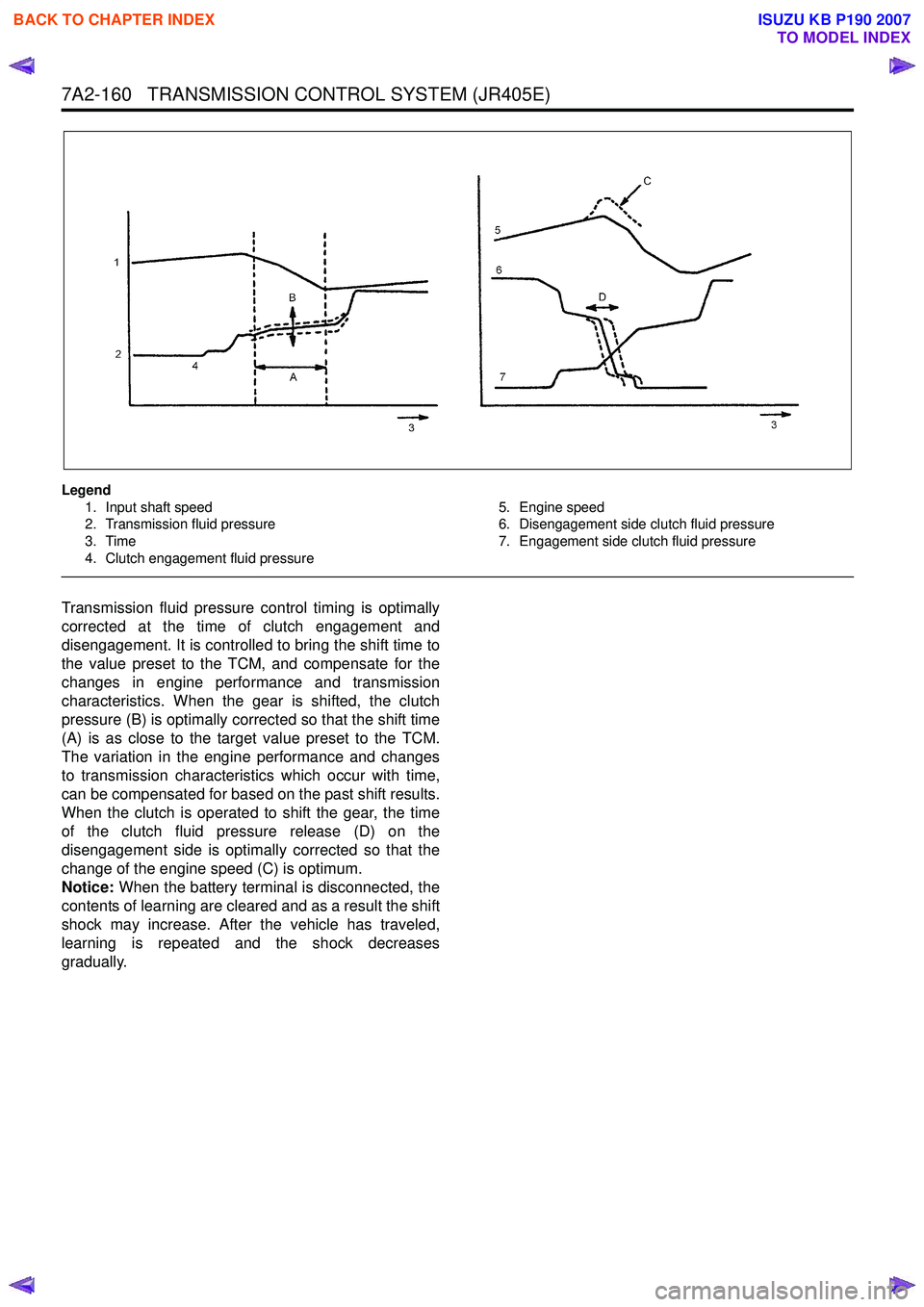
Legend1. Input shaft speed
2. Transmission fluid pressure
3. Time
4. Clutch engagement fluid pressure 5. Engine speed
6. Disengagement side clutch fluid pressure
7. Engagement side clutch fluid pressure
Transmission fluid pressure control timing is optimally
corrected at the time of clutch engagement and
disengagement. It is controlled to bring the shift time to
the value preset to the TCM, and compensate for the
changes in engine performance and transmission
characteristics. When the gear is shifted, the clutch
pressure (B) is optimally corrected so that the shift time
(A) is as close to the target value preset to the TCM.
The variation in the engine performance and changes
to transmission characteristics which occur with time,
can be compensated for based on the past shift results.
When the clutch is operated to shift the gear, the time
of the clutch fluid pressure release (D) on the
disengagement side is optimally corrected so that the
change of the engine speed (C) is optimum.
Notice: When the battery terminal is disconnected, the
contents of learning are cleared and as a result the shift
shock may increase. After the vehicle has traveled,
learning is repeated and the shock decreases
gradually.
BACK TO CHAPTER INDEX
TO MODEL INDEX
ISUZU KB P190 2007
Page 4468 of 6020
7A3-14 ON-VEHICLE SERVICE (JR405E)
Install or Connect
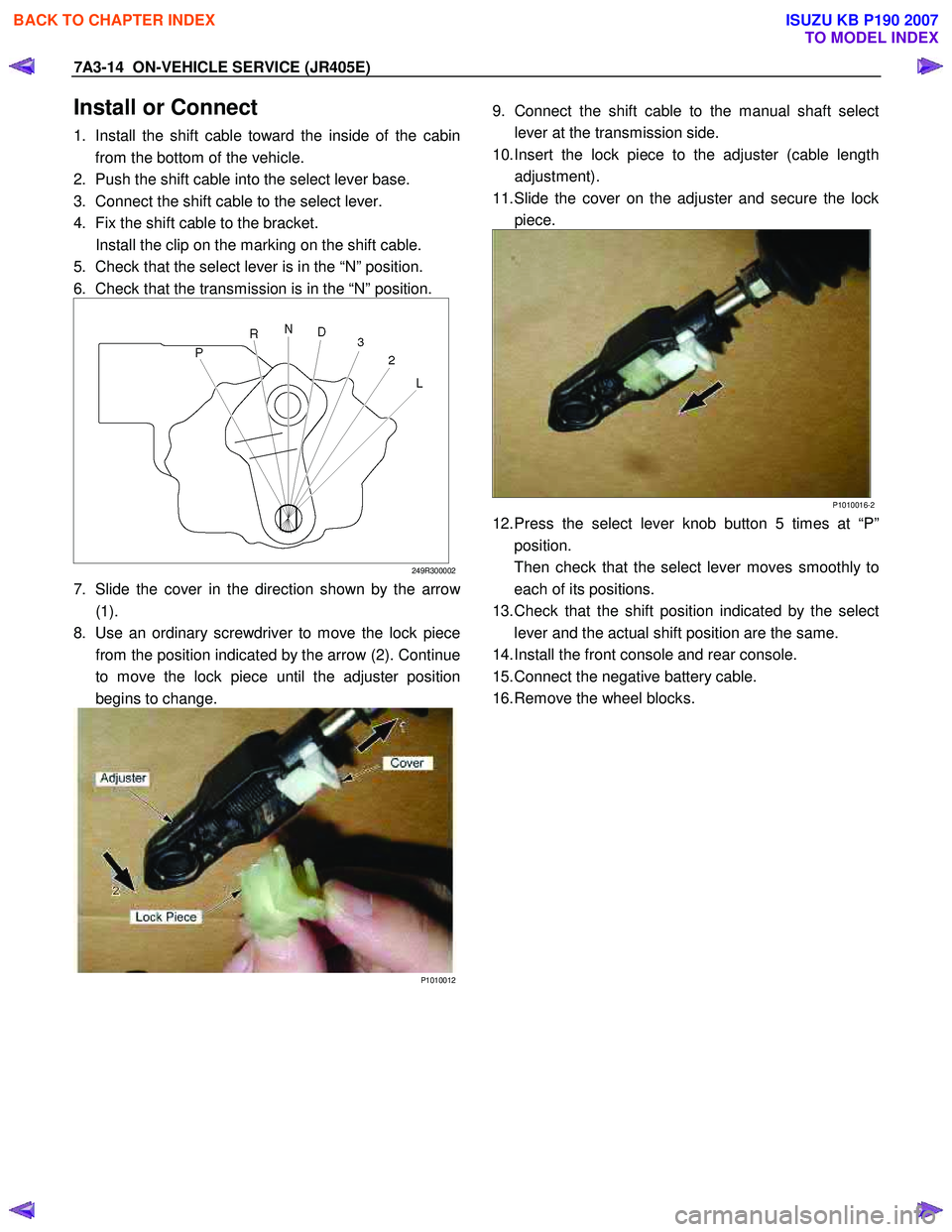
1. Install the shift cable toward the inside of the cabin
from the bottom of the vehicle.
2. Push the shift cable into the select lever base.
3. Connect the shift cable to the select lever.
4. Fix the shift cable to the bracket.
Install the clip on the marking on the shift cable.
5. Check that the select lever is in the “N” position.
6. Check that the transmission is in the “N” position.
249R300002
7. Slide the cover in the direction shown by the arrow
(1).
8. Use an ordinary screwdriver to move the lock piece from the position indicated by the arrow (2). Continue
to move the lock piece until the adjuster position
begins to change.
P1010012
9. Connect the shift cable to the manual shaft select
lever at the transmission side.
10. Insert the lock piece to the adjuster (cable length adjustment).
11. Slide the cover on the adjuster and secure the lock piece.
P1010016-2
12. Press the select lever knob button 5 times at “P”position.
Then check that the select lever moves smoothly to each of its positions.
13. Check that the shift position indicated by the select lever and the actual shift position are the same.
14. Install the front console and rear console.
15. Connect the negative battery cable.
16. Remove the wheel blocks.
BACK TO CHAPTER INDEX
TO MODEL INDEX
ISUZU KB P190 2007
Page 4538 of 6020
UNIT REPAIR (JR405E) 7A4-61
31ASSY074
•
Tighten each of the bolts a little at a time to the specified
torque.
Be sure that the return spring and the low one-wa
y
clutch inner race installation position does not change as
you tighten the bolts.
Torque: 24 N ⋅
⋅⋅
⋅
m (2.4 kgf ⋅
⋅⋅
⋅
m/17 Ib ⋅
⋅⋅
⋅
ft)
32ASSY007
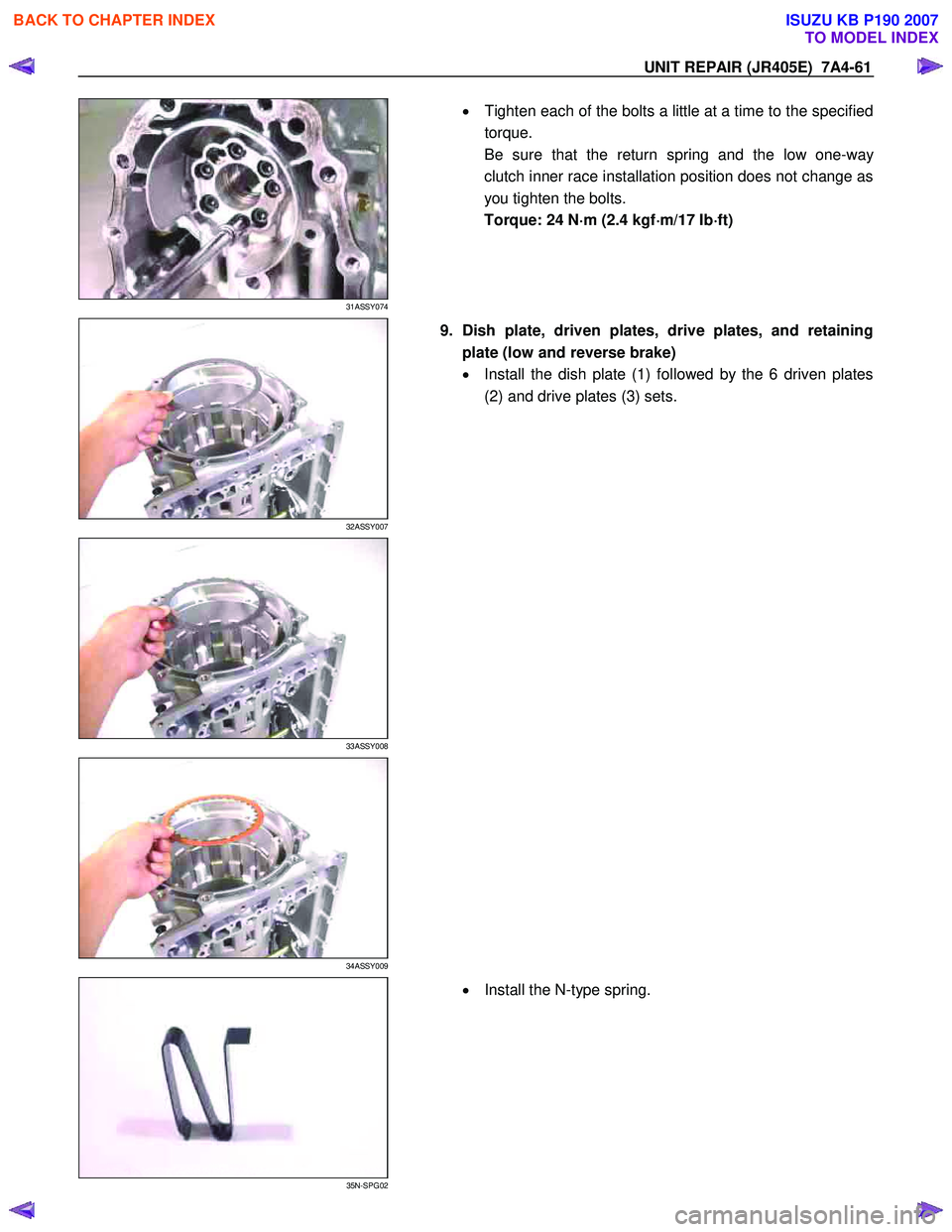
9. Dish plate, driven plates, drive plates, and retaining
plate (low and reverse brake)
• Install the dish plate (1) followed by the 6 driven plates
(2) and drive plates (3) sets.
33ASSY008
34ASSY009
35N-SPG02
•
Install the N-type spring.
BACK TO CHAPTER INDEX
TO MODEL INDEX
ISUZU KB P190 2007