Cat JAGUAR XF 2009 1.G Owners Manual
[x] Cancel search | Manufacturer: JAGUAR, Model Year: 2009, Model line: XF, Model: JAGUAR XF 2009 1.GPages: 391, PDF Size: 19.32 MB
Page 217 of 391
217
Wheels and tyres
11.Wear rate indicator. A tyre rated at 400 for
example, will last twice as long as a tyre
rated at 200.
12. The traction rating grades a tyres
performance when stopping on a wet road
surface. The higher the grade the better the
braking performance. The grades from
highest to lowest are, AA, A, B, and C.
13. The maximum load which can be carried
by the tyre.
14. Heat resistance grading. The tyre's
resistance to heat is grade A, B, or C, with
A indicating the greatest resistance to heat.
This grading is provided for a correctly
inflated tyre, which is being used within its
speed and loading limits.
15. The maximum inflation pressure for the
tyre. This pressure should not be used for
normal driving.
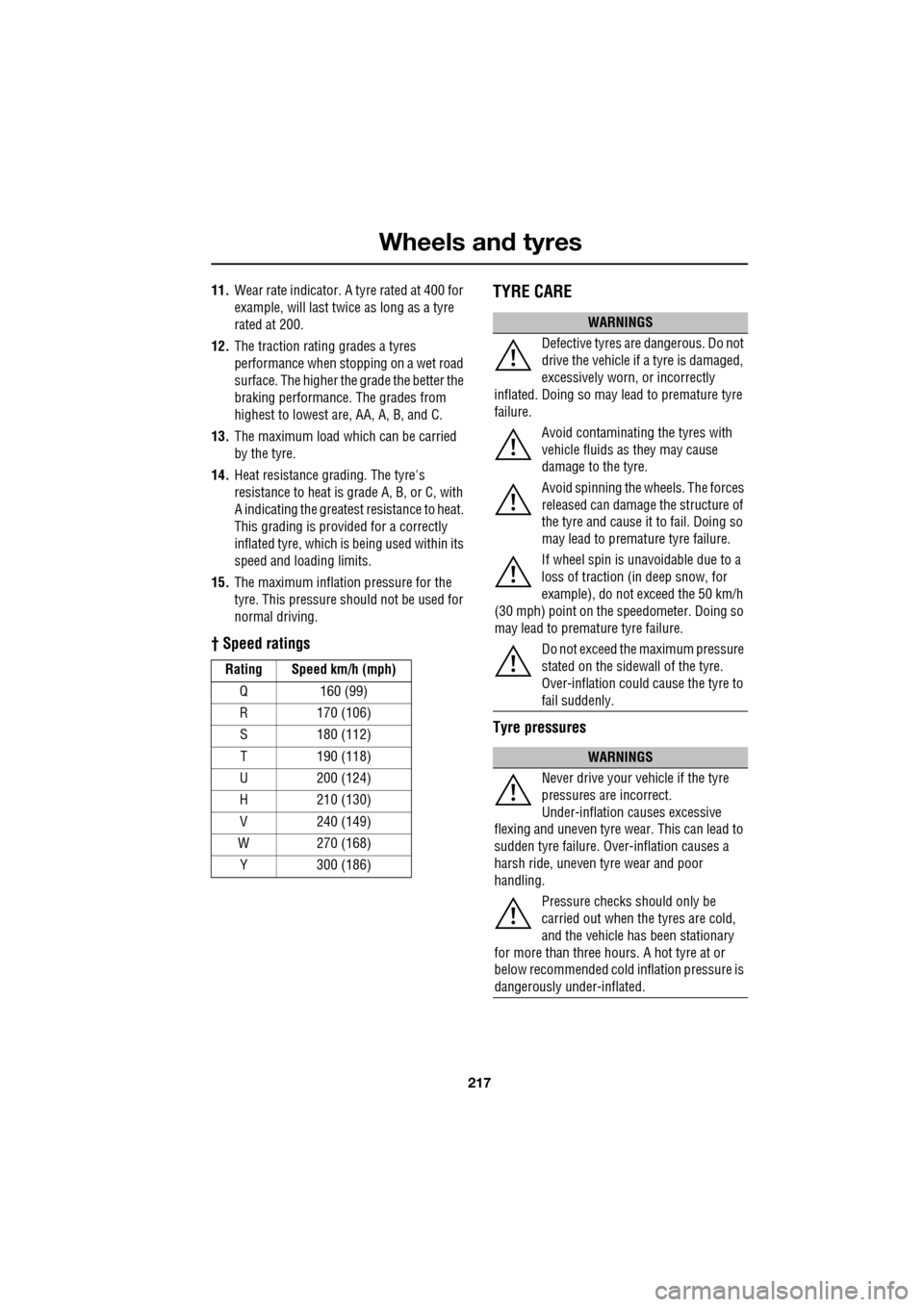
† Speed ratings
TYRE CARE
Tyre pressures
Rating Speed km/h (mph)
Q 160 (99)
R 170 (106)S 180 (112)
T 190 (118)
U 200 (124)
H 210 (130)
V 240 (149)
W 270 (168) Y 300 (186)
WARNINGS
Defective tyres are dangerous. Do not
drive the vehicle if a tyre is damaged,
excessively worn, or incorrectly
inflated. Doing so may lead to premature tyre
failure.
Avoid contaminating the tyres with
vehicle fluids as they may cause
damage to the tyre.
Avoid spinning the wh eels. The forces
released can damage the structure of
the tyre and cause it to fail. Doing so
may lead to premature tyre failure.
If wheel spin is unavoidable due to a
loss of traction (i n deep snow, for
example), do not exceed the 50 km/h
(30 mph) point on the speedometer. Doing so
may lead to premature tyre failure.
Do not exceed the maximum pressure
stated on the sidewall of the tyre.
Over-inflation could cause the tyre to
fail suddenly.
WARNINGS
Never drive your vehicle if the tyre
pressures are incorrect.
Under-inflation causes excessive
flexing and uneven tyre we ar. This can lead to
sudden tyre failure. Ov er-inflation causes a
harsh ride, uneven tyre wear and poor
handling.
Pressure checks should only be
carried out when the tyres are cold,
and the vehicle has been stationary
for more than three hours. A hot tyre at or
below recommended cold inflation pressure is
dangerously under-inflated.
Page 220 of 391
Wheels and tyres
220
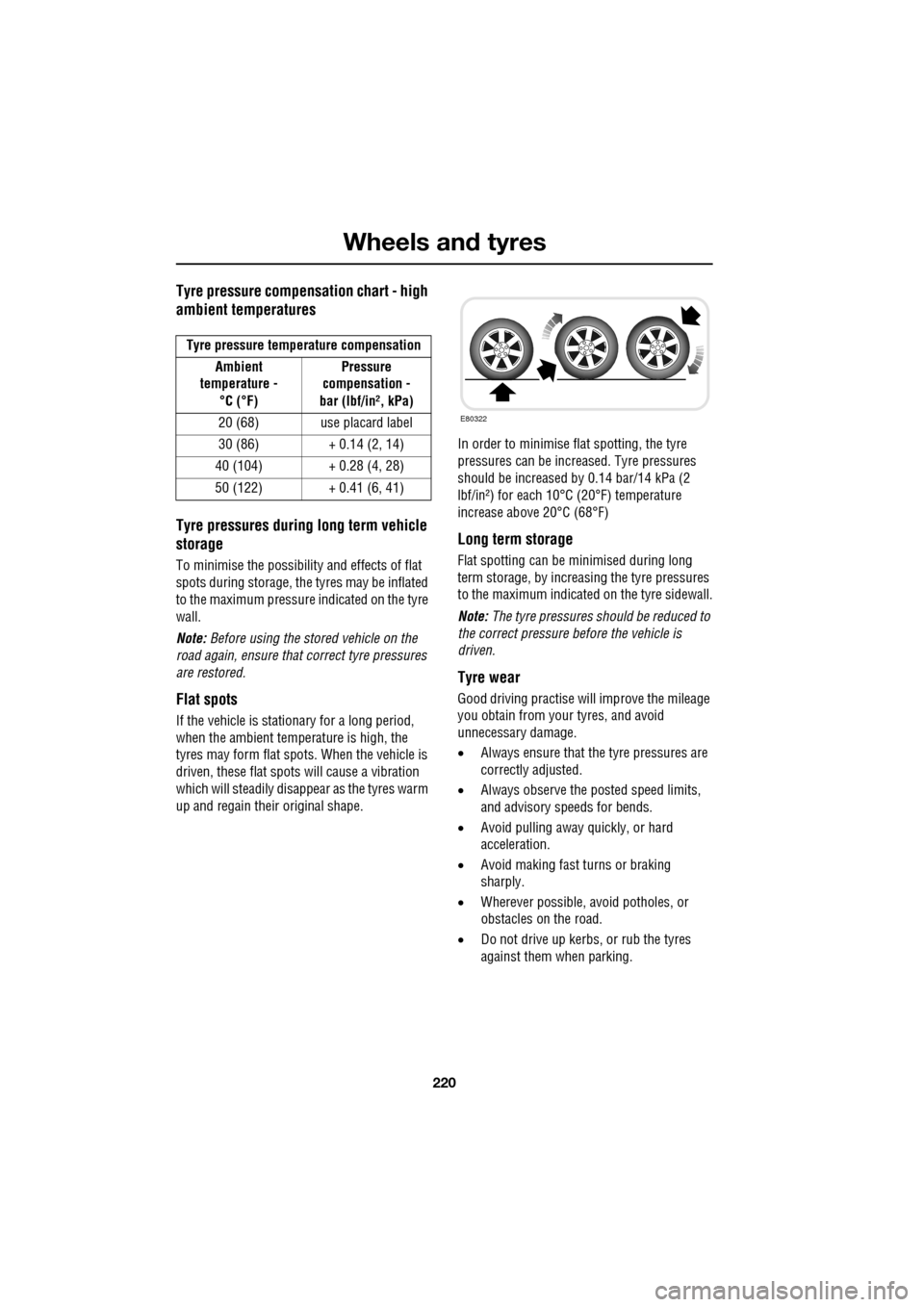
Tyre pressure compensation chart - high
ambient temperatures
Tyre pressures during long term vehicle
storage
To minimise the possibility and effects of flat
spots during storage, the tyres may be inflated
to the maximum pressure indicated on the tyre
wall.
Note: Before using the st ored vehicle on the
road again, ensure that correct tyre pressures
are restored.
Flat spots
If the vehicle is stati onary for a long period,
when the ambient temperature is high, the
tyres may form flat spots. When the vehicle is
driven, these flat spots will cause a vibration
which will steadily disappear as the tyres warm
up and regain their original shape. In order to minimise flat spotting, the tyre
pressures can be increa
sed. Tyre pressures
should be increased by 0.14 bar/14 kPa (2
lbf/in²) for each 10°C (20°F) temperature
increase above 20°C (68°F)
Long term storage
Flat spotting can be minimised during long
term storage, by increasing the tyre pressures
to the maximum indicated on the tyre sidewall.
Note: The tyre pressures s hould be reduced to
the correct pressure before the vehicle is
driven.
Tyre wear
Good driving practise will improve the mileage
you obtain from your tyres, and avoid
unnecessary damage.
• Always ensure that the tyre pressures are
correctly adjusted.
• Always observe the posted speed limits,
and advisory speeds for bends.
• Avoid pulling away quickly, or hard
acceleration.
• Avoid making fast turns or braking
sharply.
• Wherever possible, avoid potholes, or
obstacles on the road.
• Do not drive up kerbs, or rub the tyres
against them when parking.
Tyre pressure temperature compensation
Ambient
temperature -
°C (°F) Pressure
compensation -
bar (lbf/in², kPa)
20 (68) use placard label
30 (86) + 0.14 (2, 14)
40 (104) + 0.28 (4, 28)
50 (122) + 0.41 (6, 41)
E80322
Page 221 of 391
221
Wheels and tyres
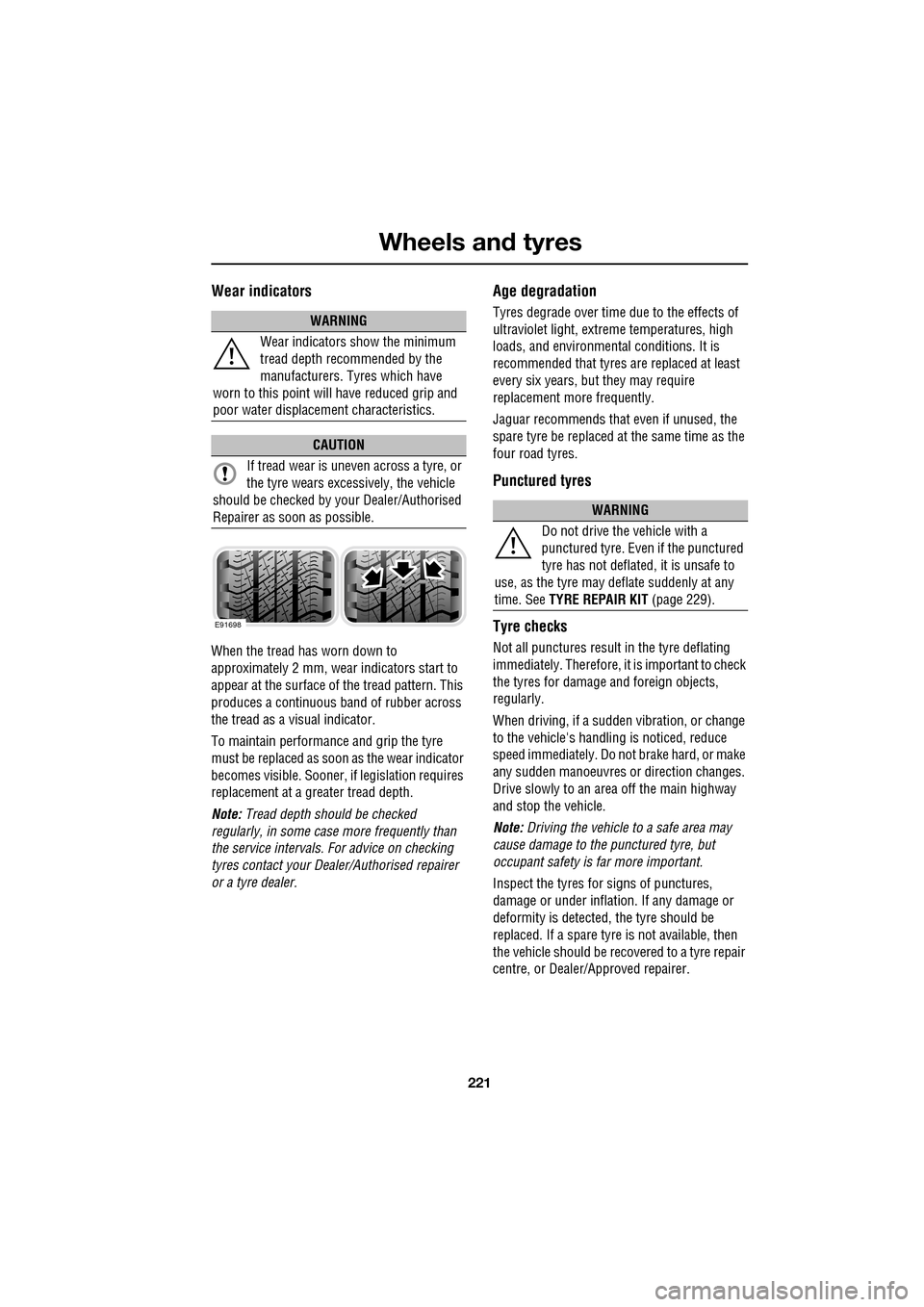
Wear indicators
When the tread has worn down to
approximately 2 mm, wear indicators start to
appear at the surface of the tread pattern. This
produces a continuous band of rubber across
the tread as a visual indicator.
To maintain performance and grip the tyre
must be replaced as soon as the wear indicator
becomes visible. Sooner, if legislation requires
replacement at a greater tread depth.
Note: Tread depth should be checked
regularly, in some case more frequently than
the service intervals. For advice on checking
tyres contact your Dealer/Authorised repairer
or a tyre dealer.
Age degradation
Tyres degrade over time due to the effects of
ultraviolet light, extreme temperatures, high
loads, and environmen tal conditions. It is
recommended that tyres are replaced at least
every six years, but they may require
replacement more frequently.
Jaguar recommends that even if unused, the
spare tyre be replaced at the same time as the
four road tyres.
Punctured tyres
Tyre checks
Not all punctures result in the tyre deflating
immediately. Therefore, it is important to check
the tyres for damage and foreign objects,
regularly.
When driving, if a sudden vibration, or change
to the vehicle's hand ling is noticed, reduce
speed immediately. Do not brake hard, or make
any sudden manoeuvres or direction changes.
Drive slowly to an area off the main highway
and stop the vehicle.
Note: Driving the vehicle to a safe area may
cause damage to th e punctured tyre, but
occupant safety is far more important.
Inspect the tyres for signs of punctures,
damage or under inflati on. If any damage or
deformity is detected, the tyre should be
replaced. If a spare tyre is not available, then
the vehicle should be reco vered to a tyre repair
centre, or Dealer/Approved repairer.
WARNING
Wear indicators show the minimum
tread depth recommended by the
manufacturers. Tyres which have
worn to this point will have reduced grip and
poor water displacement characteristics.
CAUTION
If tread wear is uneve n across a tyre, or
the tyre wears excessively, the vehicle
should be checked by your Dealer/Authorised
Repairer as soon as possible.
E91698
WARNING
Do not drive the vehicle with a
punctured tyre. Even if the punctured
tyre has not deflated, it is unsafe to
use, as the tyre may deflate suddenly at any
time. See TYRE REPAIR KIT (page 229).
Page 222 of 391
Wheels and tyres
222
Replacement tyres
Ideally, tyres should be replaced in sets of four.
If this is not possible, replace the tyres in pairs
(front and rear). When tyres are replaced, the
wheels should always be re-balanced and
alignment checked.
The correct tyre specification for your vehicle
can be found on the tyre information label.
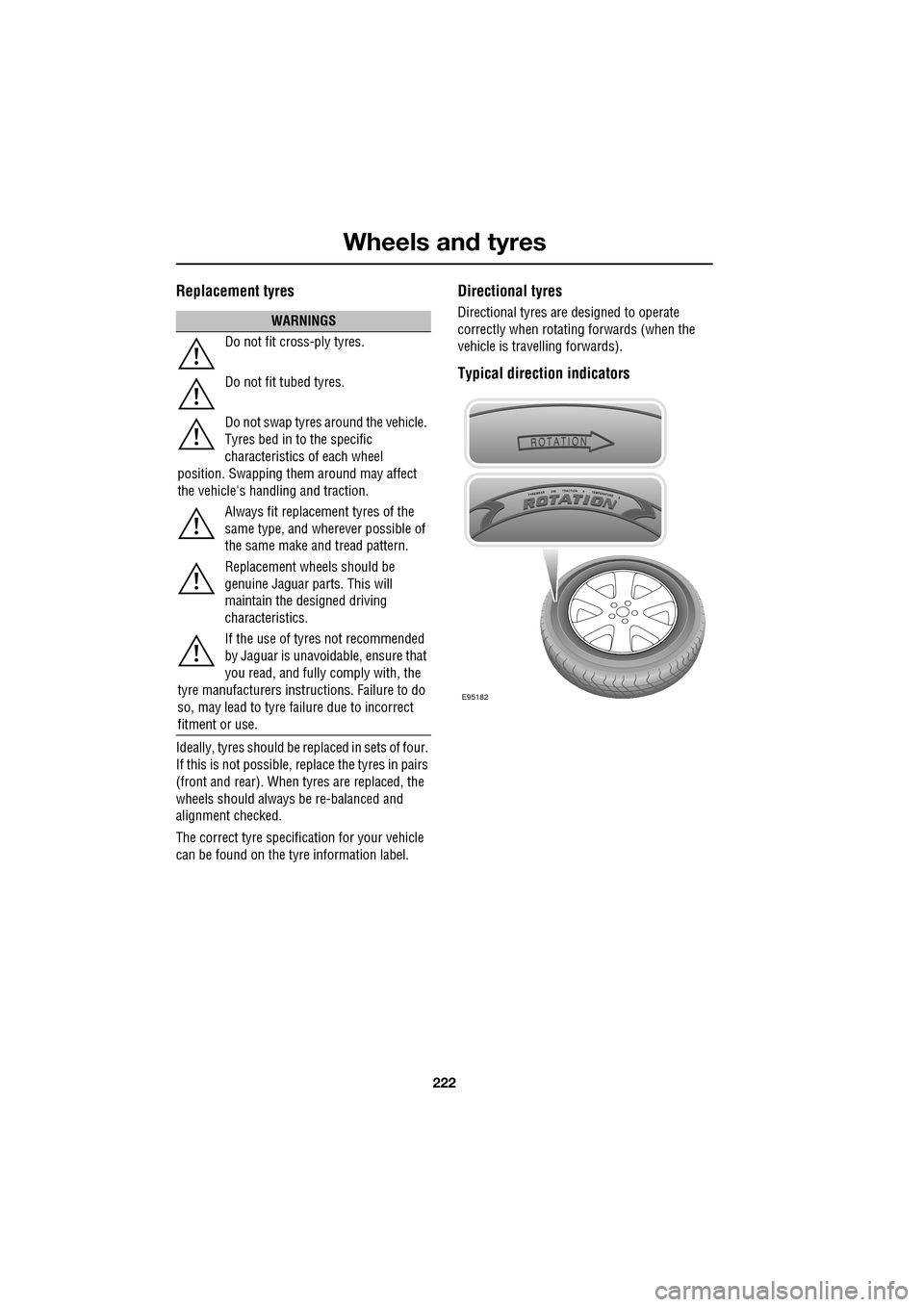
Directional tyres
Directional tyres are designed to operate
correctly when rotating forwards (when the
vehicle is travelling forwards).
Typical direction indicators
WARNINGS
Do not fit cross-ply tyres.
Do not fit tubed tyres.
Do not swap tyres around the vehicle.
Tyres bed in to the specific
characteristics of each wheel
position. Swapping them around may affect
the vehicle's handling and traction.
Always fit replacement tyres of the
same type, and wher ever possible of
the same make and tread pattern.
Replacement wheels should be
genuine Jaguar pa rts. This will
maintain the designed driving
characteristics.
If the use of tyres not recommended
by Jaguar is unavoidable, ensure that
you read, and fully comply with, the
tyre manufacturers inst ructions. Failure to do
so, may lead to tyre failure due to incorrect
fitment or use.
E95182
Page 224 of 391
Wheels and tyres
224
RUN FLAT TYRES
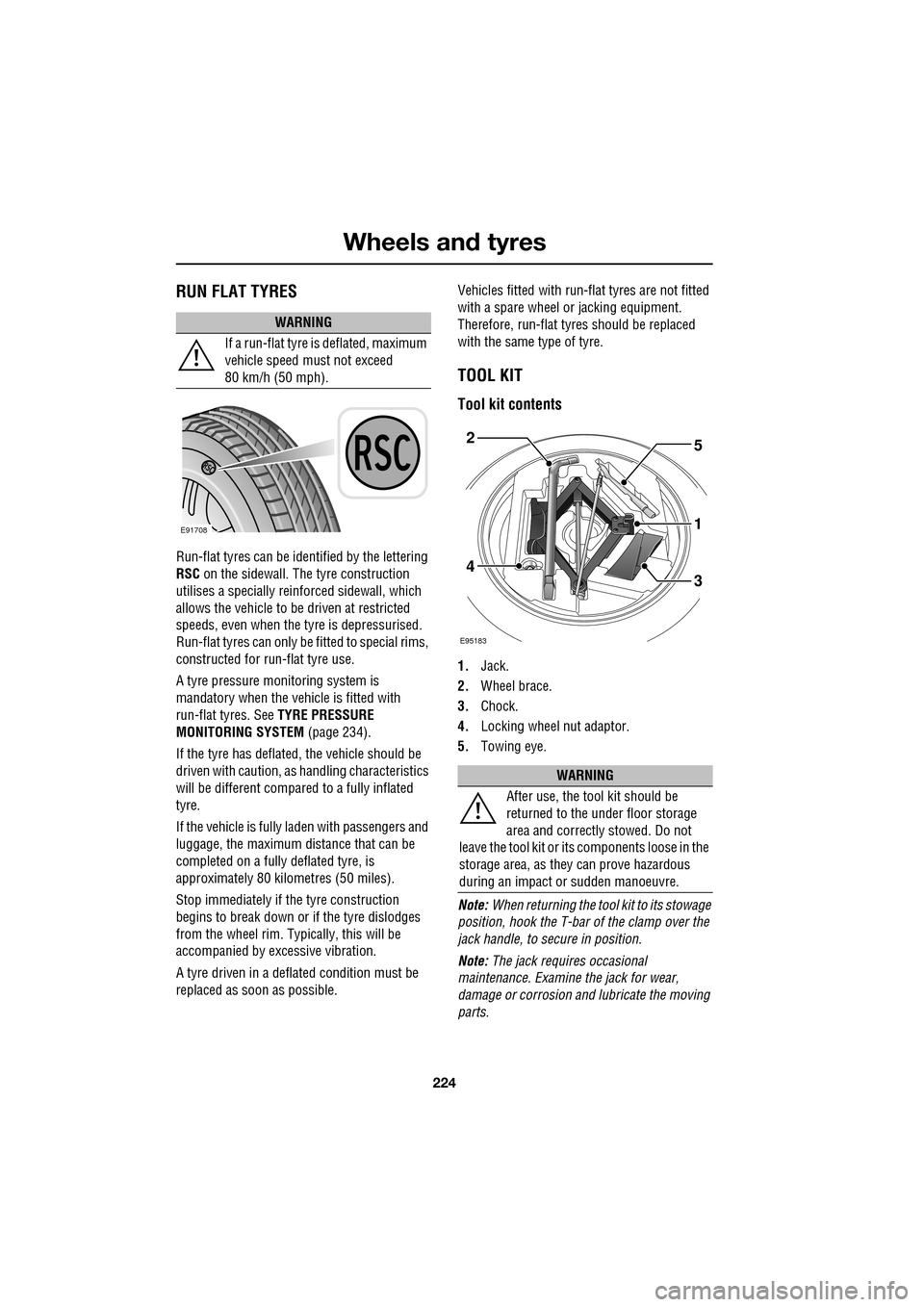
Run-flat tyres can be identified by the lettering
RSC on the sidewall. The tyre construction
utilises a specially reinforced sidewall, which
allows the vehicle to be driven at restricted
speeds, even when the tyre is depressurised.
Run-flat tyres can only be fitted to special rims,
constructed for ru n-flat tyre use.
A tyre pressure monitoring system is
mandatory when the vehicle is fitted with
run-flat tyres. See TYRE PRESSURE
MONITORING SYSTEM (page 234).
If the tyre has deflated, the vehicle should be
driven with caution, as handling characteristics
will be different compared to a fully inflated
tyre.
If the vehicle is fully la den with passengers and
luggage, the maximum di stance that can be
completed on a fully deflated tyre, is
approximately 80 kilo metres (50 miles).
Stop immediately if the tyre construction
begins to break down or if the tyre dislodges
from the wheel rim. Typi cally, this will be
accompanied by excessive vibration.
A tyre driven in a defl ated condition must be
replaced as s oon as possible. Vehicles fitted with run-flat tyres are not fitted
with a spare wheel or jacking equipment.
Therefore, run-flat tyre
s should be replaced
with the same type of tyre.
TOOL KIT
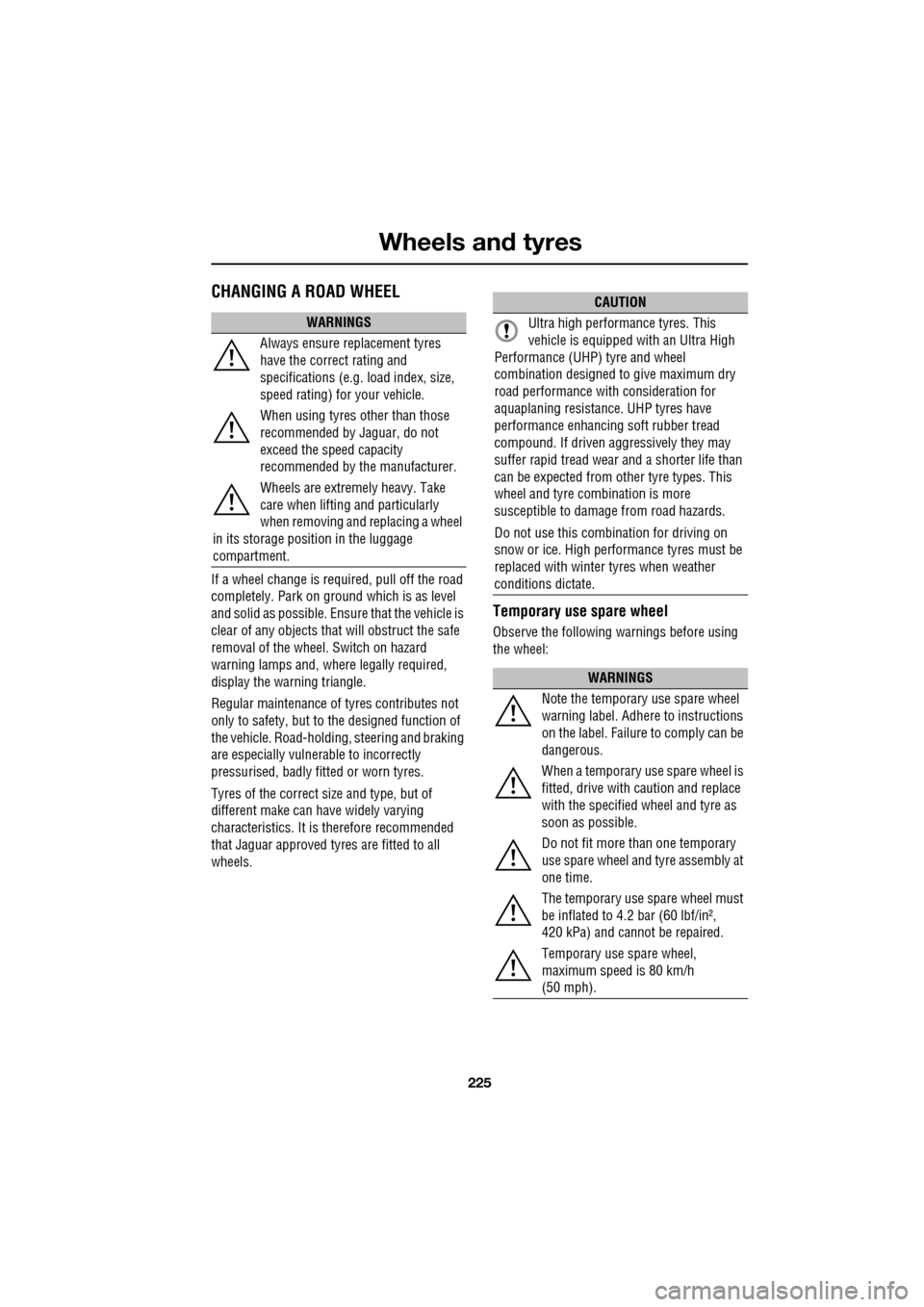
Tool kit contents
1. Jack.
2. Wheel brace.
3. Chock.
4. Locking wheel nut adaptor.
5. Towing eye.
Note: When returning the tool kit to its stowage
position, hook the T-bar of the clamp over the
jack handle, to se cure in position.
Note: The jack requi res occasional
maintenance. Examine the jack for wear,
damage or corrosion and lubricate the moving
parts.
WARNING
If a run-flat tyre is deflated, maximum
vehicle speed must not exceed
80 km/h (50 mph).
E91708
WARNING
After use, the tool kit should be
returned to the under floor storage
area and correctly stowed. Do not
leave the tool kit or it s components loose in the
storage area, as they can prove hazardous
during an impact or sudden manoeuvre.
E95183
5
1
34
2
Page 225 of 391
225
Wheels and tyres
CHANGING A ROAD WHEEL
If a wheel change is required, pull off the road
completely. Park on ground which is as level
and solid as possible. Ensure that the vehicle is
clear of any objects that will obstruct the safe
removal of the wheel. Switch on hazard
warning lamps and, where legally required,
display the warning triangle.
Regular maintenance of tyres contributes not
only to safety, but to the designed function of
the vehicle. Road-holdi ng, steering and braking
are especially vulnerable to incorrectly
pressurised, badly fitted or worn tyres.
Tyres of the correct size and type, but of
different make can have widely varying
characteristics. It is therefore recommended
that Jaguar approved tyres are fitted to all
wheels.
Temporary use spare wheel
Observe the following wa rnings before using
the wheel:
WARNINGS
Always ensure replacement tyres
have the correct rating and
specifications (e.g. load index, size,
speed rating) for your vehicle.
When using tyres other than those
recommended by Jaguar, do not
exceed the speed capacity
recommended by the manufacturer.
Wheels are extremely heavy. Take
care when lifting and particularly
when removing and replacing a wheel
in its storage position in the luggage
compartment.
CAUTION
Ultra high performance tyres. This
vehicle is equipped with an Ultra High
Performance (UHP) tyre and wheel
combination designed to give maximum dry
road performance with consideration for
aquaplaning resistan ce. UHP tyres have
performance enhancing soft rubber tread
compound. If driven aggressively they may
suffer rapid tread wear and a shorter life than
can be expected from other tyre types. This
wheel and tyre comb ination is more
susceptible to damage from road hazards.
Do not use this combination for driving on
snow or ice. High perf ormance tyres must be
replaced with winter tyres when weather
conditions dictate.
WARNINGS
Note the temporary use spare wheel
warning label. Adhere to instructions
on the label. Failure to comply can be
dangerous.
When a temporary use spare wheel is
fitted, drive with caution and replace
with the specified wheel and tyre as
soon as possible.
Do not fit more than one temporary
use spare wheel and tyre assembly at
one time.
The temporary use spare wheel must
be inflated to 4.2 bar (60 lbf/in²,
420 kPa) and cannot be repaired.
Temporary use spare wheel,
maximum speed is 80 km/h
(50 mph).
Page 226 of 391
Wheels and tyres
226
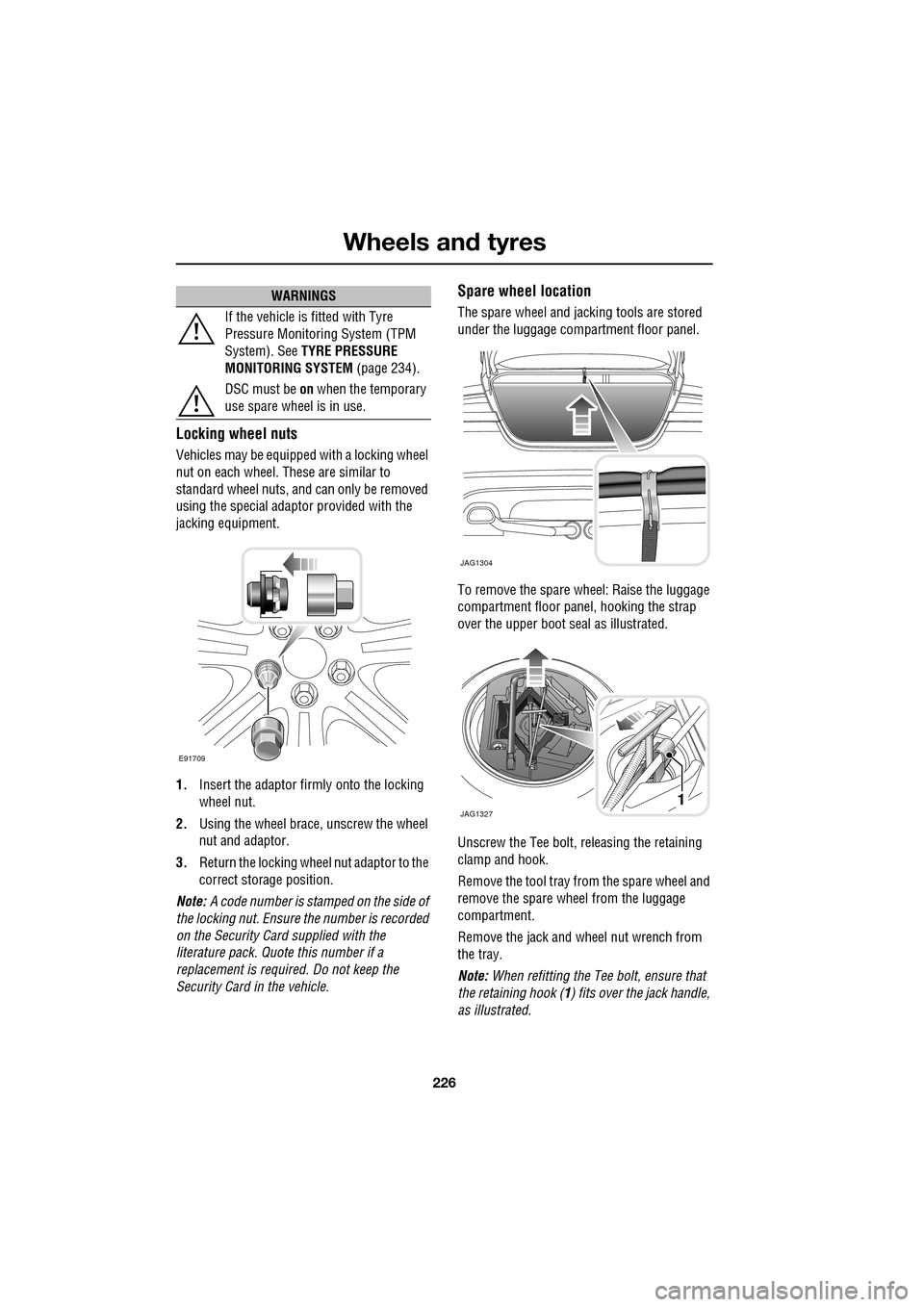
Locking wheel nuts
Vehicles may be equipped with a locking wheel
nut on each wheel. These are similar to
standard wheel nuts, and can only be removed
using the special adaptor provided with the
jacking equipment.
1. Insert the adaptor firmly onto the locking
wheel nut.
2. Using the wheel brace, unscrew the wheel
nut and adaptor.
3. Return the locking wheel nut adaptor to the
correct storage position.
Note: A code number is stam ped on the side of
the locking nut. Ensure the number is recorded
on the Security Card supplied with the
literature pack. Quot e this number if a
replacement is require d. Do not keep the
Security Card in the vehicle.
Spare wheel location
The spare wheel and jacking tools are stored
under the luggage compartment floor panel.
To remove the spare wheel: Raise the luggage
compartment floor panel, hooking the strap
over the upper boot seal as illustrated.
Unscrew the Tee bolt, re leasing the retaining
clamp and hook.
Remove the tool tray from the spare wheel and
remove the spare wheel from the luggage
compartment.
Remove the jack and wheel nut wrench from
the tray.
Note: When refitting the Tee bolt, ensure that
the retaining hook ( 1) fits over the jack handle,
as illustrated.
If the vehicle is fitted with Tyre
Pressure Monitoring System (TPM
System). See
TYRE PRESSURE
MONITORING SYSTEM (page 234).
DSC must be on when the temporary
use spare wheel is in use.
WARNINGS
E91709
JAG1304
JAG13271
Page 228 of 391
Wheels and tyres
228
Wheel changing procedure
1.Ensure that all passengers are in a safe
place, clear of the vehicle.
2. Apply the parking brake and select gear
position P (Park).
3. Ensure that the jack is placed on firm and
level ground.
Observe the instructions printed on the jack.
Use the jack only for lifting the vehicle during
wheel changing and only us e the jack which is
stored in the vehicle.
Before raising the vehi cle slacken but do not
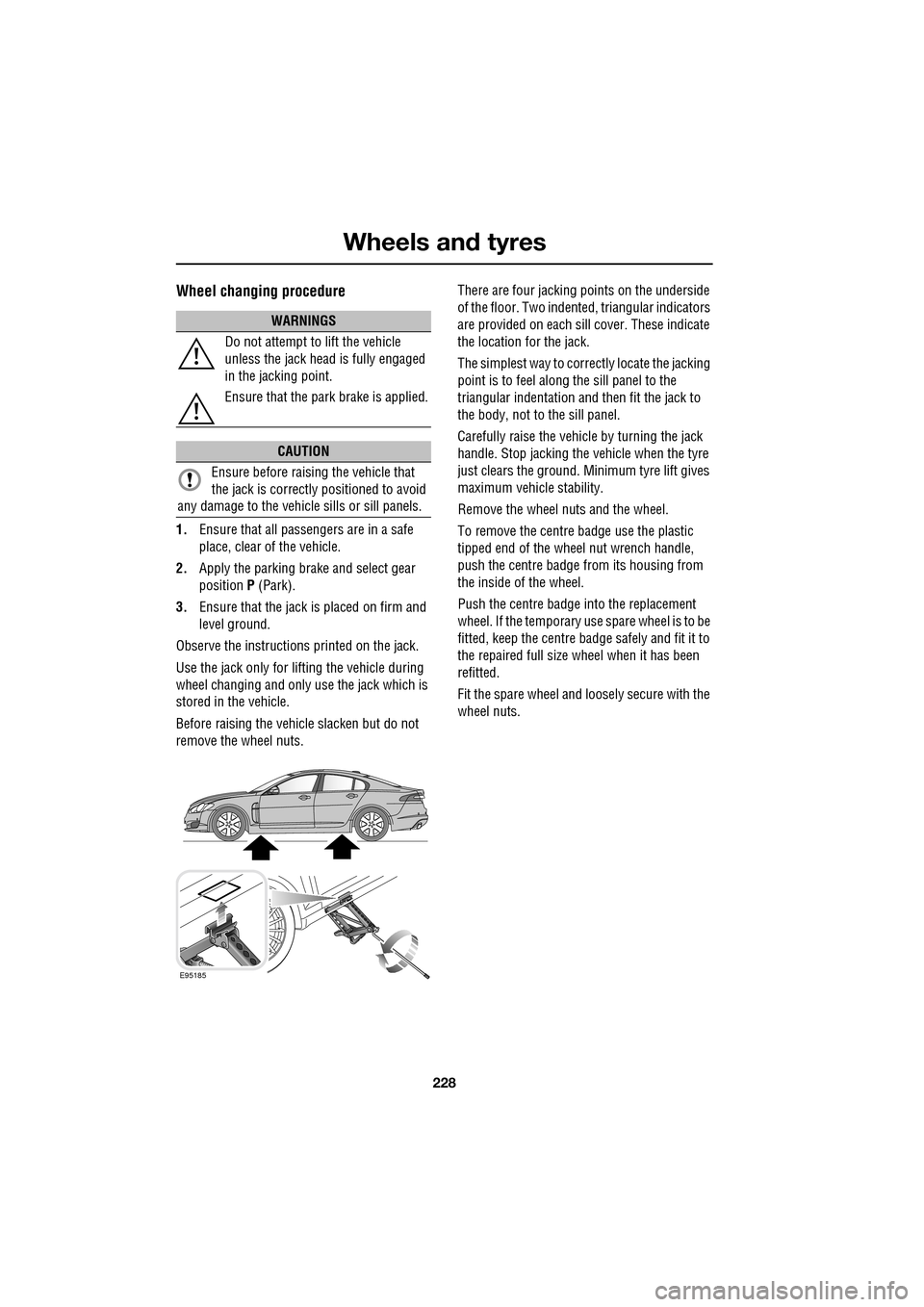
remove the wheel nuts. There are four jacking points on the underside
of the floor. Two indented, triangular indicators
are provided on each sill cover. These indicate
the location for the jack.
The simplest way to correctly locate the jacking
point is to feel along
the sill panel to the
triangular indentation and then fit the jack to
the body, not to the sill panel.
Carefully raise the vehicle by turning the jack
handle. Stop jacking the vehicle when the tyre
just clears the ground. Minimum tyre lift gives
maximum vehicle stability.
Remove the wheel nuts and the wheel.
To remove the centre badge use the plastic
tipped end of the wheel nut wrench handle,
push the centre badge from its housing from
the inside of the wheel.
Push the centre badge into the replacement
wheel. If the temporary use spare wheel is to be
fitted, keep the centre badge safely and fit it to
the repaired full size wheel when it has been
refitted.
Fit the spare wheel and loosely secure with the
wheel nuts.
WARNINGS
Do not attempt to lift the vehicle
unless the jack head is fully engaged
in the jacking point.
Ensure that the park brake is applied.
CAUTION
Ensure before raising the vehicle that
the jack is correctly positioned to avoid
any damage to the vehicle sills or sill panels.
E95185
Page 230 of 391
Wheels and tyres
230
Jaguar tyre repair kit safety information
WARNINGS
Some tyre damage may only be
partially sealed, or may not seal at all,
depending on the amount and type of
damage. Any loss of tyre pressure can
seriously affect vehicle safety.
Do not use the tyre repair kit if the tyre
has been damaged by driving while
under-inflated.
Only use the tyre repair kit to seal
damage located within the tyre tread
area.
Do not use the tyre repair kit to seal
damage to the tyre sidewall.
Do not exceed 80 km/h (50 mph)
when a repaired tyre is fitted to the
vehicle.
The maximum distan ce that should
be driven when a repaired tyre is
fitted, is 200 km (125 miles).
When a repaired tyre is fitted, drive
with caution and avoid sudden
braking or steering manoeuvres.
Only use the tyre repair kit for the
vehicle with which it was supplied.
Do not use the tyre repair kit for any
other purpose than tyre repair.
Never leave the tyre repair kit
unattended when in use.
Only use the tyre repair kit within the
-30 °C to +70 °C temperature range.
Always keep children and animals at a
safe distance from the tyre repair kit
when in use.
Do not stand dire ctly beside the
compressor when it is operating.Check the tyre sidewall prior to
inflation. If any cracks, damage or
deformities are apparent, do not
inflate the tyre.
Watch the tyre sidewall during
inflation. If any cracks, bumps or
similar damage, or deformities
appear, switch off the compressor and deflate
the tyre.
WARNINGS
Page 235 of 391
235
Wheels and tyres
Note: Different types of tyre may affect the
performance of the TPM system. Always
replace tyres in accordance with
recommendations. See TYRE
SPECIFICATIONS - ARDUOUS TERRAIN
(page 239).
Your vehicle may be equipped with a TPM
System which monitors pressure in each tyre
(temporary use spare wheels are not fitted with
sensors and are conseque ntly not monitored).
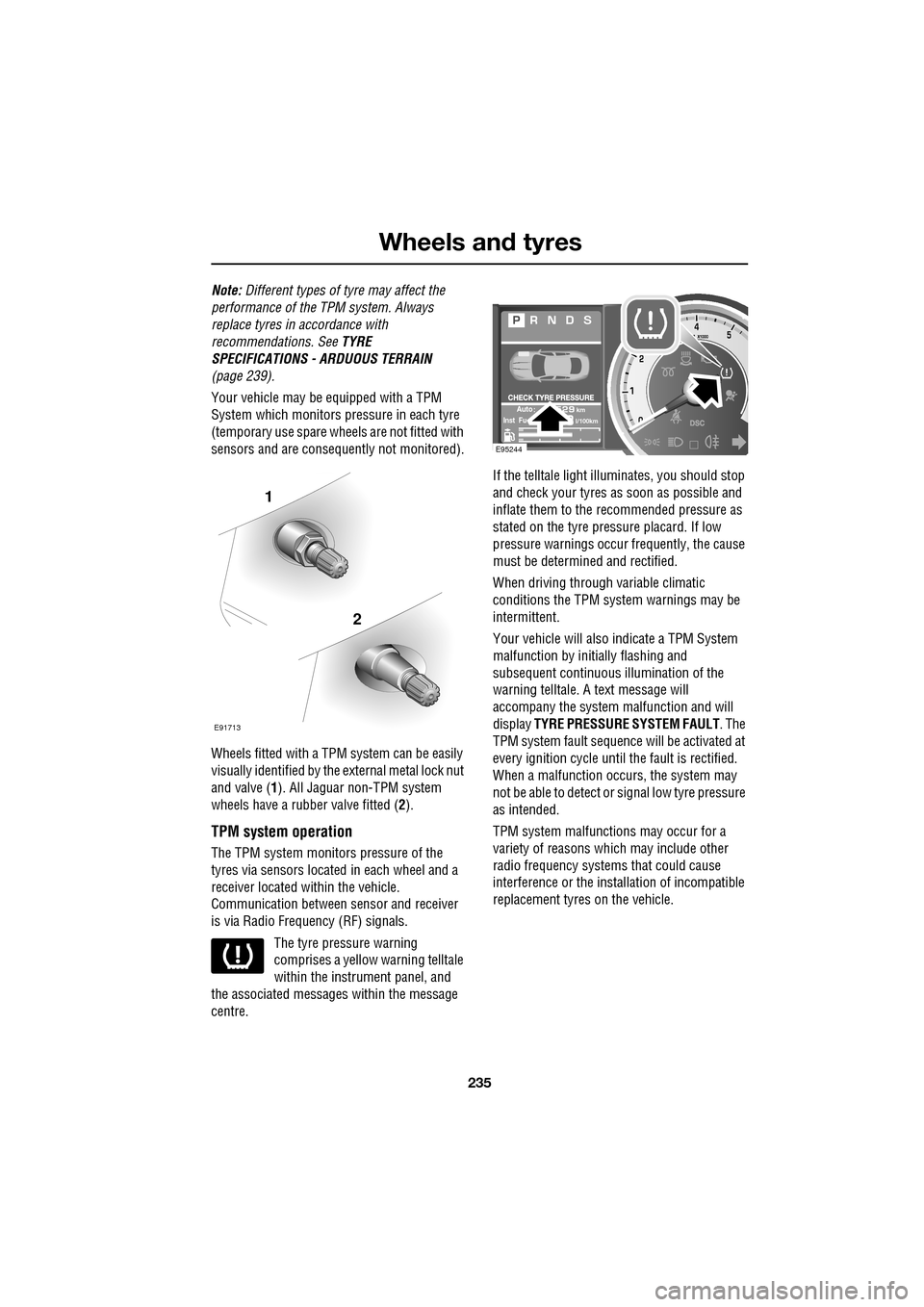
Wheels fitted with a TPM system can be easily
visually identified by the external metal lock nut
and valve ( 1). All Jaguar n on-TPM system
wheels have a rubber valve fitted (2).
TPM system operation
The TPM system monitors pressure of the
tyres via sensors located in each wheel and a
receiver located within the vehicle.
Communication between se nsor and receiver
is via Radio Frequency (RF) signals.
The tyre pressure warning
comprises a yellow warning telltale
within the instrument panel, and
the associated messages within the message
centre. If the telltale light illu
minates, you should stop
and check your tyres as soon as possible and
inflate them to the recommended pressure as
stated on the tyre pressure placard. If low
pressure warnings occur frequently, the cause
must be determined and rectified.
When driving through variable climatic
conditions the TPM syst em warnings may be
intermittent.
Your vehicle will also indicate a TPM System
malfunction by initially flashing and
subsequent continuous illumination of the
warning telltale. A text message will
accompany the system malfunction and will
display TYRE PRESSURE SYSTEM FAULT . The
TPM system fault sequence will be activated at
every ignition cycle until the fault is rectified.
When a malfunction occurs, the system may
not be able to de tect or signal low tyre pressure
as intended.
TPM system malfuncti ons may occur for a
variety of reasons which may include other
radio frequency systems that could cause
interference or the installation of incompatible
replacement tyres on the vehicle.
1
2
E91713
AutokmInst Ful/100km
E95244