Filler cap JAGUAR XF 2009 1.G User Guide
[x] Cancel search | Manufacturer: JAGUAR, Model Year: 2009, Model line: XF, Model: JAGUAR XF 2009 1.GPages: 391, PDF Size: 19.32 MB
Page 207 of 391
207
Maintenance
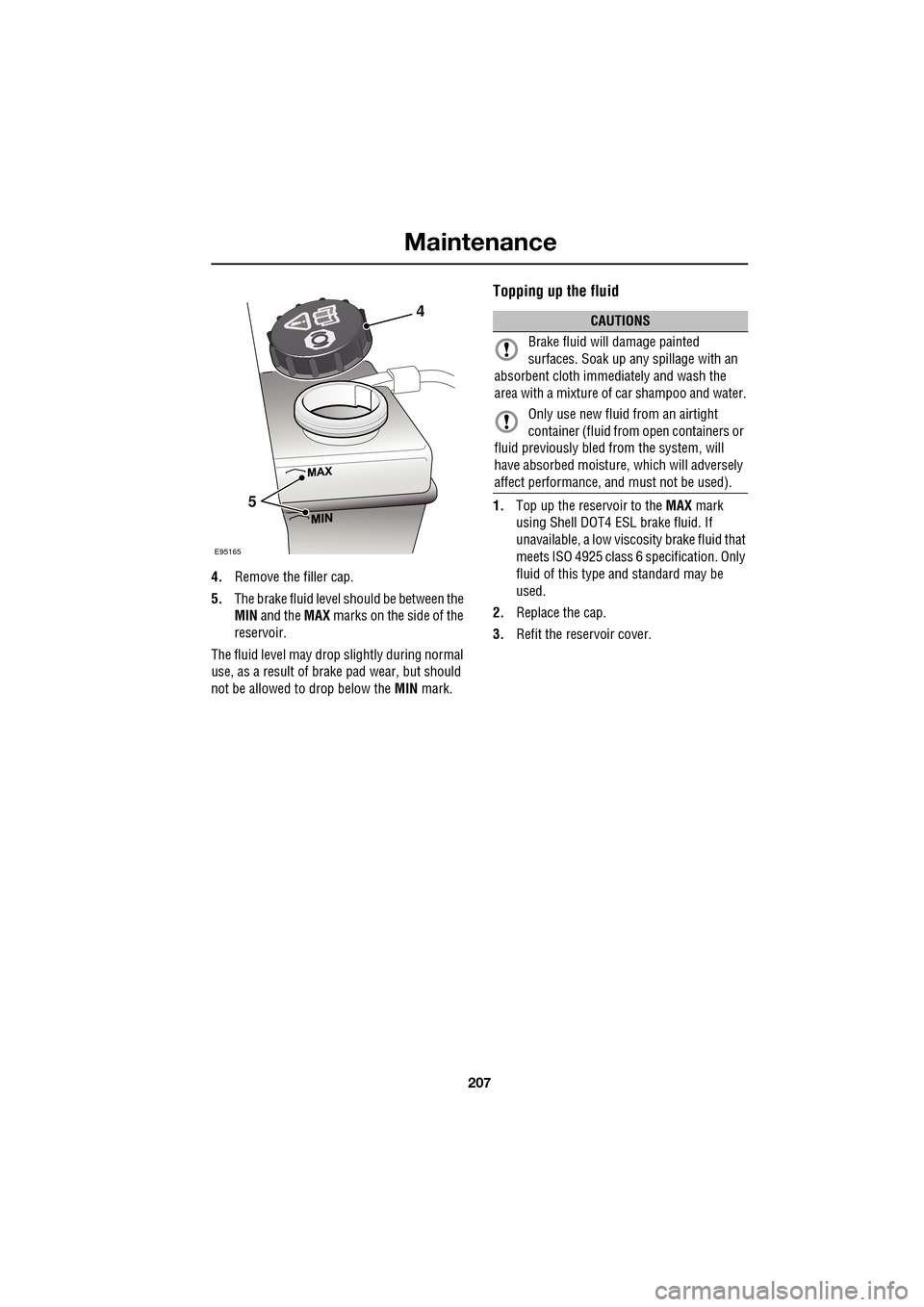
4.Remove the filler cap.
5. The brake fluid level should be between the
MIN and the MAX marks on the side of the
reservoir.
The fluid level may drop slightly during normal
use, as a result of brake pad wear, but should
not be allowed to drop below the MIN mark.
Topping up the fluid
1.Top up the reservoir to the MAX mark
using Shell DOT4 ESL brake fluid. If
unavailable, a low viscosity brake fluid that
meets ISO 4925 class 6 sp ecification. Only
fluid of this type and standard may be
used.
2. Replace the cap.
3. Refit the reservoir cover.
E95165
4
5
CAUTIONS
Brake fluid will damage painted
surfaces. Soak up an y spillage with an
absorbent cloth immediately and wash the
area with a mixture of car shampoo and water.
Only use new fluid from an airtight
container (fluid from open containers or
fluid previously bled from the system, will
have absorbed moisture, which will adversely
affect performa nce, and must not be used).
Page 208 of 391
Maintenance
208
POWER STEERING FLUID CHECK
Checking the fluid level
Check and top-up the fluid with the vehicle on
level ground, with the e ngine switched off and
the system cold. Ensure that the steering wheel
is not turned after stopping the engine.
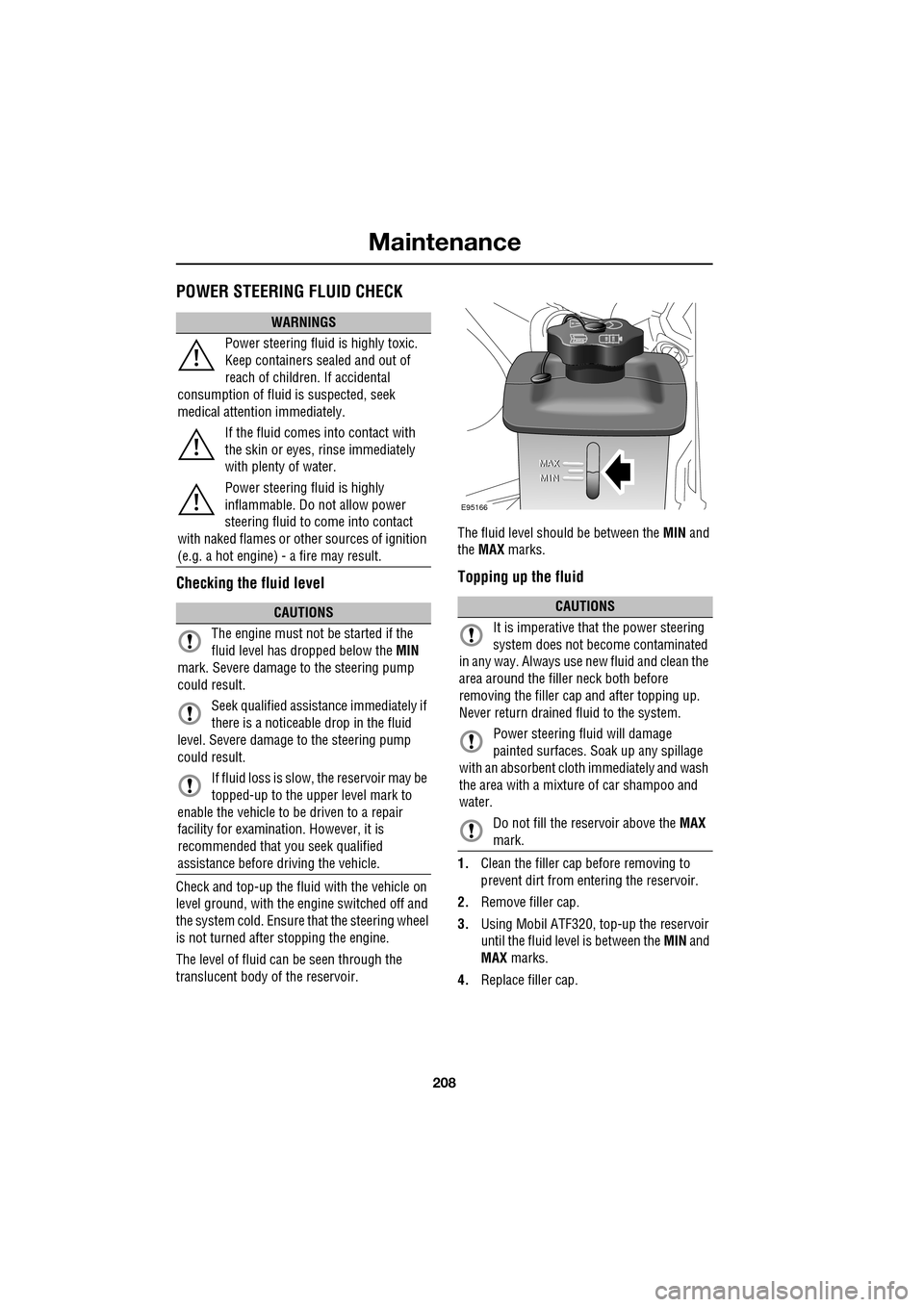
The level of fluid can be seen through the
translucent body of the reservoir. The fluid level shoul
d be between the MIN and
the MAX marks.
Topping up the fluid
1.Clean the filler cap before removing to
prevent dirt from entering the reservoir.
2. Remove filler cap.
3. Using Mobil ATF320, top-up the reservoir
until the fluid level is between the MIN and
MAX marks.
4. Replace filler cap.
WARNINGS
Power steering fluid is highly toxic.
Keep containers sealed and out of
reach of children. If accidental
consumption of fluid is suspected, seek
medical attenti on immediately.
If the fluid comes into contact with
the skin or eyes, rinse immediately
with plenty of water.
Power steering fluid is highly
inflammable. Do not allow power
steering fluid to come into contact
with naked flames or other sources of ignition
(e.g. a hot engine) - a fire may result.
CAUTIONS
The engine must not be started if the
fluid level has dropped below the MIN
mark. Severe damage to the steering pump
could result.
Seek qualified assistance immediately if
there is a noticeable drop in the fluid
level. Severe damage to the steering pump
could result.
If fluid loss is slow, the reservoir may be
topped-up to the upper level mark to
enable the vehicle to be driven to a repair
facility for examination. However, it is
recommended that you seek qualified
assistance before driving the vehicle.CAUTIONS
It is imperative that the power steering
system does not beco me contaminated
in any way. Always use new fluid and clean the
area around the filler neck both before
removing the filler ca p and after topping up.
Never return drained fluid to the system.
Power steering fluid will damage
painted surfaces. So ak up any spillage
with an absorbent cloth immediately and wash
the area with a mixture of car shampoo and
water.
Do not fill the reservoir above the MAX
mark.
E95166
Page 209 of 391
209
Maintenance
WASHER FLUID CHECK
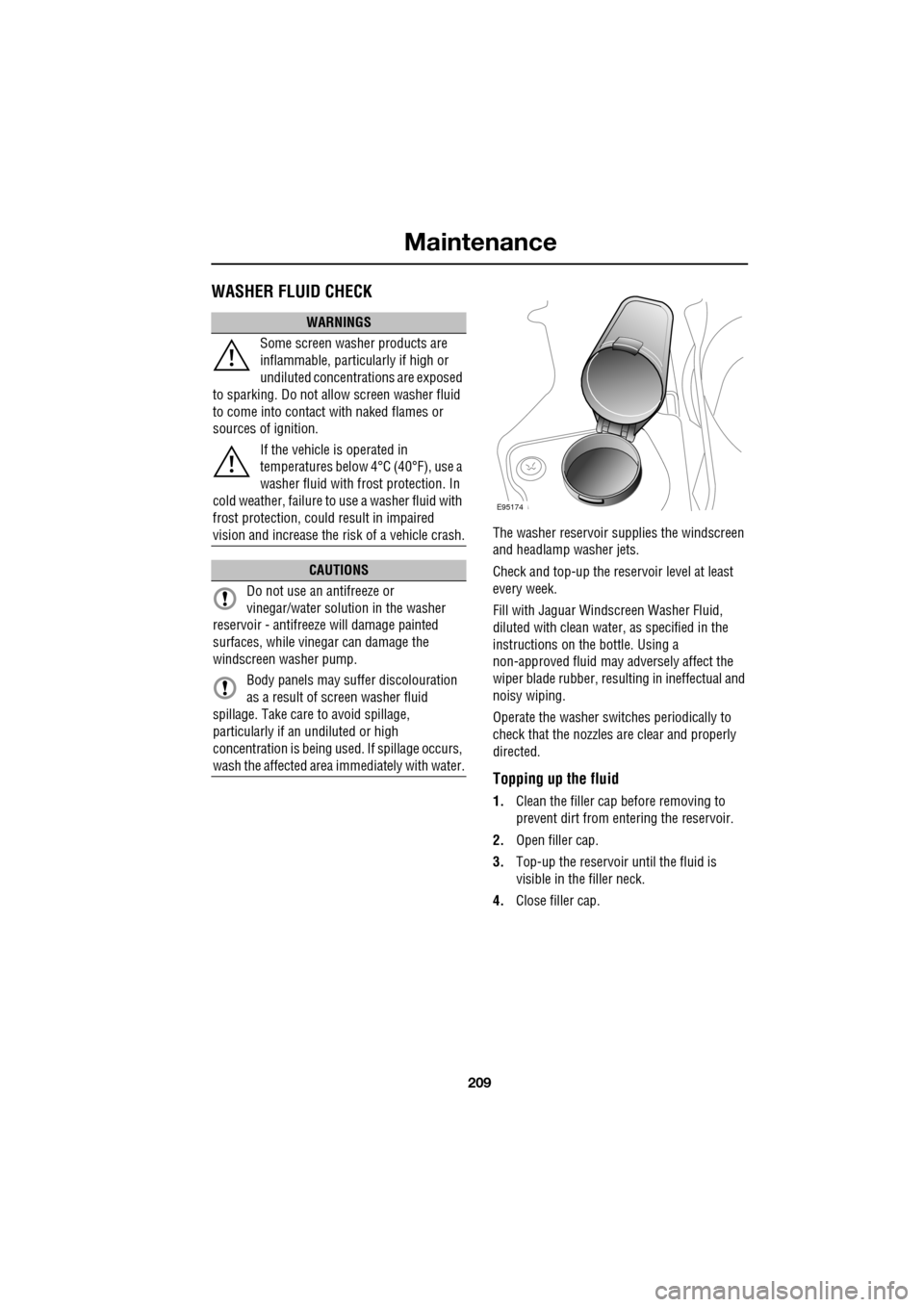
The washer reservoir supplies the windscreen
and headlamp washer jets.
Check and top-up the reservoir level at least
every week.
Fill with Jaguar Windscreen Washer Fluid,
diluted with clean water, as specified in the
instructions on the bottle. Using a
non-approved fluid may adversely affect the
wiper blade rubber, resulting in ineffectual and
noisy wiping.
Operate the washer switches periodically to
check that the nozzles are clear and properly
directed.
Topping up the fluid
1. Clean the filler cap before removing to
prevent dirt from entering the reservoir.
2. Open filler cap.
3. Top-up the reservoir until the fluid is
visible in the filler neck.
4. Close filler cap.
WARNINGS
Some screen washer products are
inflammable, particularly if high or
undiluted concentrations are exposed
to sparking. Do not allow screen washer fluid
to come into contact with naked flames or
sources of ignition.
If the vehicle is operated in
temperatures below 4°C (40°F), use a
washer fluid with frost protection. In
cold weather, failure to use a washer fluid with
frost protection, could result in impaired
vision and increase the risk of a vehicle crash.
CAUTIONS
Do not use an antifreeze or
vinegar/water solution in the washer
reservoir - antifreeze will damage painted
surfaces, while vinegar can damage the
windscreen washer pump.
Body panels may suffer discolouration
as a result of screen washer fluid
spillage. Take care to avoid spillage,
particularly if an undiluted or high
concentration is being us ed. If spillage occurs,
wash the affected area immediately with water.
E95174
Page 387 of 391
Index
387
R
Radio data system (RDS) . . . . . . . . . . . . 277alternative frequency (AF) . . . . . . . . . . 277
extended other networks (EON) . . . . . 277
FM text . . . . . . . . . . . . . . . . . . . . . . . . 278
options menu overview. . . . . . . . . . . . 277
regionalisation (REG) . . . . . . . . . . . . . 277
traffic . . . . . . . . . . . . . . . . . . . . . . . . . 277
Radio reception . . . . . . . . . . . . . . . . . . . . 268
Rain sensor . . . . . . . . . . . . . . . . . . . . . . . . 89
RDS-TMC . . . . . . . . . . . . . . . . . . . . . . . . 368 all traffic events . . . . . . . . . . . . . . . . . 371
display . . . . . . . . . . . . . . . . . . . . . . . . 368
dynamic navigation . . . . . . . . . . . . . . . 370
icons . . . . . . . . . . . . . . . . . . . . . . . . . . 368
on route events . . . . . . . . . . . . . . . . . . 371
surveillance setting . . . . . . . . . . . . . . . 372
traffic on route . . . . . . . . . . . . . . . . . . 370
using TMC . . . . . . . . . . . . . . . . . . . . . 370
voice guidance . . . . . . . . . . . . . . . . . . 370
Rear fog lamps . . . . . . . . . . . . . . . . . . . . . 77
Rear lamp removal . . . . . . . . . . . . . . . . . . 82
Rear seats . . . . . . . . . . . . . . . . . . . . . . . . . 45 folding the rear seats . . . . . . . . . . . . . . 46
raising the rear seats . . . . . . . . . . . . . . 47
Rear under floor storage . . . . . . . . . . . . . 182
Rear view camera
principle of operation . . . . . . . . . . . . . 152
Recommended towing weights . . . . . . . . 185
Refuelling . . . . . . . . . . . . . . . . . . . . . . . . 179
fuel consumption . . . . . . . . . . . . . . . . 181
fuel filler . . . . . . . . . . . . . . . . . . . . . . . 179
fuel tank capacity . . . . . . . . . . . . . . . . 179
Remote control . . . . . . . . . . . . . . . . . . . . . 17
Remote control battery . . . . . . . . . . . . . . . 24
Remote control programming . . . . . . . . . . 21
Removing a headlamp. . . . . . . . . . . . . . . . 81
Removing a rear lamp . . . . . . . . . . . . . . . . 82
Repairing minor paint damage . . . . . . . . 191
Repeat compact disc tracks . . . . . . . . . . 296
Run flat tyres. . . . . . . . . . . . . . . . . . . . . . 224
Running out of fuel . . . . . . . . . . . . . . . . . 177 diesel engines . . . . . . . . . . . . . . . . . . . 177 Running-in . . . . . . . . . . . . . . . . . . . . . . . . 154
brakes . . . . . . . . . . . . . . . . . . . . . . . . . 154
engine . . . . . . . . . . . . . . . . . . . . . . . . . 154
engine oil consumption . . . . . . . . . . . . 154
final drive unit . . . . . . . . . . . . . . . . . . . 154
S
Safety . . . . . . . . . . . . . . . . . . . . . . . . . . . . . 10
Safety precautions . . . . . . . . . . . . . . . . . . 174
Satellite signal reception. . . . . . . . . . . . . . 335
Satellite signals . . . . . . . . . . . . . . . . . . . . 334
Seat belt height adjustment . . . . . . . . . . . . 52
Seat belt reminder . . . . . . . . . . . . . . . . . . . 50
Seat beltsprinciple of operation . . . . . . . . . . . . . . . 49
Seats
front . . . . . . . . . . . . . . . . . . . . . . . . . . . . 42
head restraints . . . . . . . . . . . . . . . . . . . . 44
memory . . . . . . . . . . . . . . . . . . . . . . . . . 43
Service data recording . . . . . . . . . . . . . . . . 11
Setting avoid points . . . . . . . . . . . . . . . . . 355
Settings . . . . . . . . . . . . . . . . . . . . . . . . . . 288 announcements . . . . . . . . . . . . . . . . . . 288
DAB country. . . . . . . . . . . . . . . . . . . . . 290
DAB format . . . . . . . . . . . . . . . . . . . . . 291
DAB text . . . . . . . . . . . . . . . . . . . . . . . . 290
FM traffic . . . . . . . . . . . . . . . . . . . . . . . 289
link DAB . . . . . . . . . . . . . . . . . . . . . . . . 289
Shuffle/random. . . . . . . . . . . . . . . . . . . . . 295
Sitting in the correct position . . . . . . . . . . . 41
Smart key . . . . . . . . . . . . . . . . . . . . . . . . . . 17
Smog sensor . . . . . . . . . . . . . . . . . . . . . . 120
Snow chains . . . . . . . . . . . . . . . . . . . . . . . 223
Stability control . . . . . . . . . . . . . . . . . . . . 170 adaptive dynamics . . . . . . . . . . . . . . . . 172
Dynamic Stability Control (DSC) . . . . . 170
JaguarDrive Control scenarios . . . . . . . 173
stability control indicator . . . . . . . . . . . 172
switching between DSC and Trac DSC . 171
switching between DSC OFF and ON . . 171
tracDSC . . . . . . . . . . . . . . . . . . . . . . . . 171
Starting the engine general information . . . . . . . . . . . . . . . 132
Static bending lamps . . . . . . . . . . . . . . . . . 79