light JAGUAR XF 2009 1.G Workshop Manual
[x] Cancel search | Manufacturer: JAGUAR, Model Year: 2009, Model line: XF, Model: JAGUAR XF 2009 1.GPages: 391, PDF Size: 19.32 MB
Page 172 of 391
Driving dynamics
172
Note: In rare circumstances, when TracDSC is
selected or DSC is o ff, high acceleration on
rough roads may cause DSC to switch back on.
This prevents high loads on the vehicle
driveline. DSC will su bsequently remain on,
unless TracDSC is selected or DSC is switched
off manually.
Stability control indicator
If there is a fault, the warning
indicator will ill uminate in the
instrument panel and the message
centre will display DSC NOT AVAILABLE with
an amber backlight.
It is safe to drive the vehicle, but the DSC
system will not activa te under wheel spin or
slide conditions. You should seek qualified
assistance as soon as possible.
Adaptive dynamics
(Supercharged vehicles only)
Jaguar Adaptive dy namics continuously
monitors the road a nd driver inputs and
optimises the vehicle suspension settings for
ride comfort and control.
The adaptive dynamics system is linked to
Dynamic mode, modifying the suspension
settings for a more sporting character.
If the message centre displays the message
ADAPTIVE DYNAMICS FAULT , a fault has been
detected in the adaptive dynamics system.
Seek qualified assistan ce as soon as possible.
Active Differential Control (E-diff)
(Supercharged vehicles only)
The E-diff improves trac tion when one driven
wheel has more grip than the other. This
improves progress out of corners and on
patchy or uneven surfaces. The E-diff can also
increase stability in oversteer situations,
depending on road c onditions and driver
inputs. Settings for the E-diff are made automatically,
without the need for driver selection.
If there is a fault with the E-diff system, the
message centre will display
EDIFF SYSTEM
FAULT . If DSC is off, then TracDSC will be
selected automatically. The driver can still
switch between DSC mode s, as normal and the
vehicle is safe to dr ive, but seek qualified
assistance as soon as possible.
Note: If the E-diff is active continuously for an
extended period (e.g. on a patchy surface with
DSC off) then the E-diff may be temporarily
deactivated to prevent ov erheating. If DSC is
off, then TracDSC will be selected
automatically. The mess age centre will display
EDIFF NOT AVAILABLE . The driver can still
switch between DSC modes as normal and the
E-diff will become availa ble again automatically
when it has cool ed sufficiently.
Page 173 of 391
173
Driving dynamics
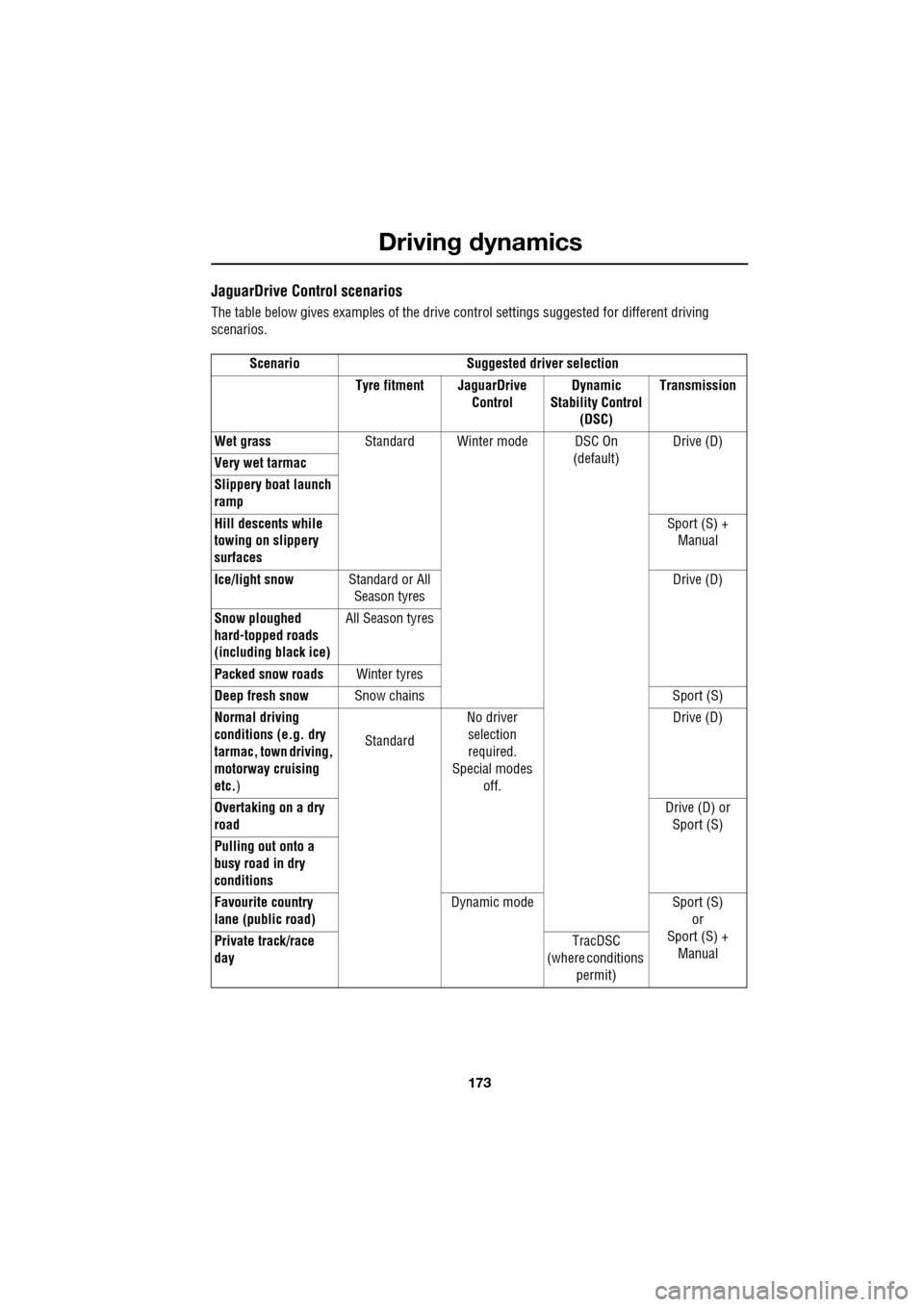
JaguarDrive Control scenarios
The table below gives examples of the drive control settings suggested for different driving
scenarios.
Scenario Suggested driver selection Tyre fitment JaguarDrive ControlDynamic
Stability Control (DSC) Transmission
Wet grass Standard Winter mode DSC On
(default)Drive (D)
Very wet tarmac
Slippery boat launch
ramp
Hill descents while
towing on slippery
surfaces Sport (S) +
Manual
Ice/light snow Standard or All
Season tyres Drive (D)
Snow ploughed
hard-topped roads
(including black ice) All Season tyres
Packed snow roads Winter tyres
Deep fresh snow Snow chains Sport (S)
Normal driving
conditions (e.g. dry
tarmac, town driving,
motorway cruising
etc. ) Standard
No driver
selection
required.
Special modes off. Drive (D)
Overtaking on a dry
road Drive (D) or
Sport (S)
Pulling out onto a
busy road in dry
conditions
Favourite country
lane (public road) Dynamic mode Sport (S)
or
Sport (S) + Manual
Private track/race
day TracDSC
(where conditions
permit)
Page 175 of 391
175
Fuel and refuelling
Unleaded fuel
Unleaded fuel must be used for the emission
control system to operate properly. Its use will
also reduce spark plug f ouling, exhaust system
corrosion and engine oil deterioration.
Octane rating
The recommended unleade d fuel should have
an octane rating of 95 RON (Research Octane
Number) or higher. Howe ver, you may also use
unleaded fuel with a lower RON, but
performance will be reduced. The minimum
octane rating for fuel to be used is 91 RON.
Note: Using unleaded fuel wi th a lower octane
rating than recommended, can cause
persistent heavy engi ne knock (a metallic
rapping noise). If severe , this can lead to
engine damage.
If a heavy knock is dete cted, even when using
fuel to the recommended octane rating, or if
you hear knock while ho lding a steady speed
on level roads, consult your Dealer/Authorised
Repairer to have the problem corrected. Failure
to do so is misuse of the vehicle, for which
Jaguar Cars is not responsible. However,
occasional, light knock for a short time while
accelerating or driv ing up hill, may occur.
ALTERNATIVE FUELS FOR PETROL
ENGINES
Fuels containing alcohol
Some fuel suppliers sell fuel containing alcohol
without advertising its presence. Where
uncertainty exists, check with the service
centre operator. Note:
Some difficulty in starting may be
encountered when using alcohol blended fuel.
Ethanol
Fuels containing up to 10% Ethanol (grain
alcohol) may be used. Ensure that the fuel has
octane ratings no lower than those
recommended for unleaded fuel. Most drivers
will not notice any opera ting difference with
fuel containing Ethanol. If a difference is
detected, the use of c onventional unleaded fuel
should be resumed.
Methanol
Some fuels contain Meth anol (Methyl or wood
alcohol). If you use fuels containing Methanol
the fuels must also contain co-solvents and
corrosion inhibitors fo r Methanol. Also, do not
use fuels which contain more than 10%
Methanol even if they contain co-solvents and
corrosion inhibitors. Fuel system damage or
vehicle performance pr oblems resulting from
the use of such fuels is not the responsibility of
Jaguar, and may not be covered under the
warranty.
CAUTIONS
Fuel containing alc ohol can cause paint
damage, which may not be covered
under the warranty.
CAUTIONS
This vehicle is not suitable for use with
fuels containing more than 10%
Ethanol.
Do not use E85 fuels (85% Ethanol
content). Equipment necessary for the
use of fuels containing more than 10% Ethanol
is not fitted to this vehicle. If E85 fuels are
used, serious engine a nd fuels system damage
will occur.
CAUTION
Wherever possible avoid using fuel
containing Methanol.
Page 176 of 391
Fuel and refuelling
176
Methyl Tertiary Butyl Ether (MTBE)
Unleaded fuel containing an oxygenate known
as MTBE can be used provided that the ratio of
MTBE to conventional fuel does not exceed
15%. MTBE is an Ether based compound
derived from Petroleum, which has been
specified by several refiners as the substance
to enhance the Octane rating of fuel.
Reformulated gasoline
Several petroleum comp anies have announced
the availability of reformulated fuels. These
fuels are specially formulated to further reduce
vehicle emissions. Jagua r fully supports all
efforts to protect and maintain ambient air
quality and encourages the use of reformulated
gasoline, where available.
DIESEL ENGINED VEHICLES
Use only high quality diesel fuel according to
EN590 or equivalent.
The quality of diesel fu el is variable, depending
on geographic location . Always use premium
or the highest quality fuel available in your
locality. High quality fuel ensures a longer life
for your engine components. Lower grade fuel
contains higher levels of sulphur, which is
detrimental to engine components. If low
quality fuel is used, light coloured smoke may
be evident at the exhaust.
Note: Jaguar vehicles ar e capable of running
with up to a 5% blend of bio-diesel, in
accordance with European Standard EN590. Prolonged use of additives is not
recommended. Do not add paraffin or petrol to
diesel fuels.
Winter grade diesel fuel
To make sure of relia
ble diesel engine
operation during cold seasonal periods, Winter
grade fuel must be used . This fuel is normally
available from fuel retailers during these
periods and the fuel companies adjust the fuel
quality to suit climatic conditions.
If the vehicle is not filled with Winter grade
diesel fuel, it is recommended that the engine
is idled for a period of over two minutes after
starting, to prevent fuel solidification during
operation.CAUTION
Do not use RME (bio-d iesel) except in
the case of those propr ietary diesel fuels
which contain a mix of up to 5%. Jaguar can
accept no responsibility for damage caused by
using RME in concentrat ions greater than 5%.
CAUTIONS
If you inadvertently fill your vehicle with
petrol instead of di esel, do not attempt
to start the engine. Contact your Dealer/
Authorised Repairer im mediately. Attempting
to start the engine with petrol in the fuel tank,
will cause extensive dama ge to the engine and
fuel system, which will not be covered by your
Jaguar warranty.
Jaguar cars can ac cept no responsibility
for any damage caused by running your
vehicle with petrol or ve getable oil in the fuel
tank.
Page 179 of 391
179
Fuel and refuelling
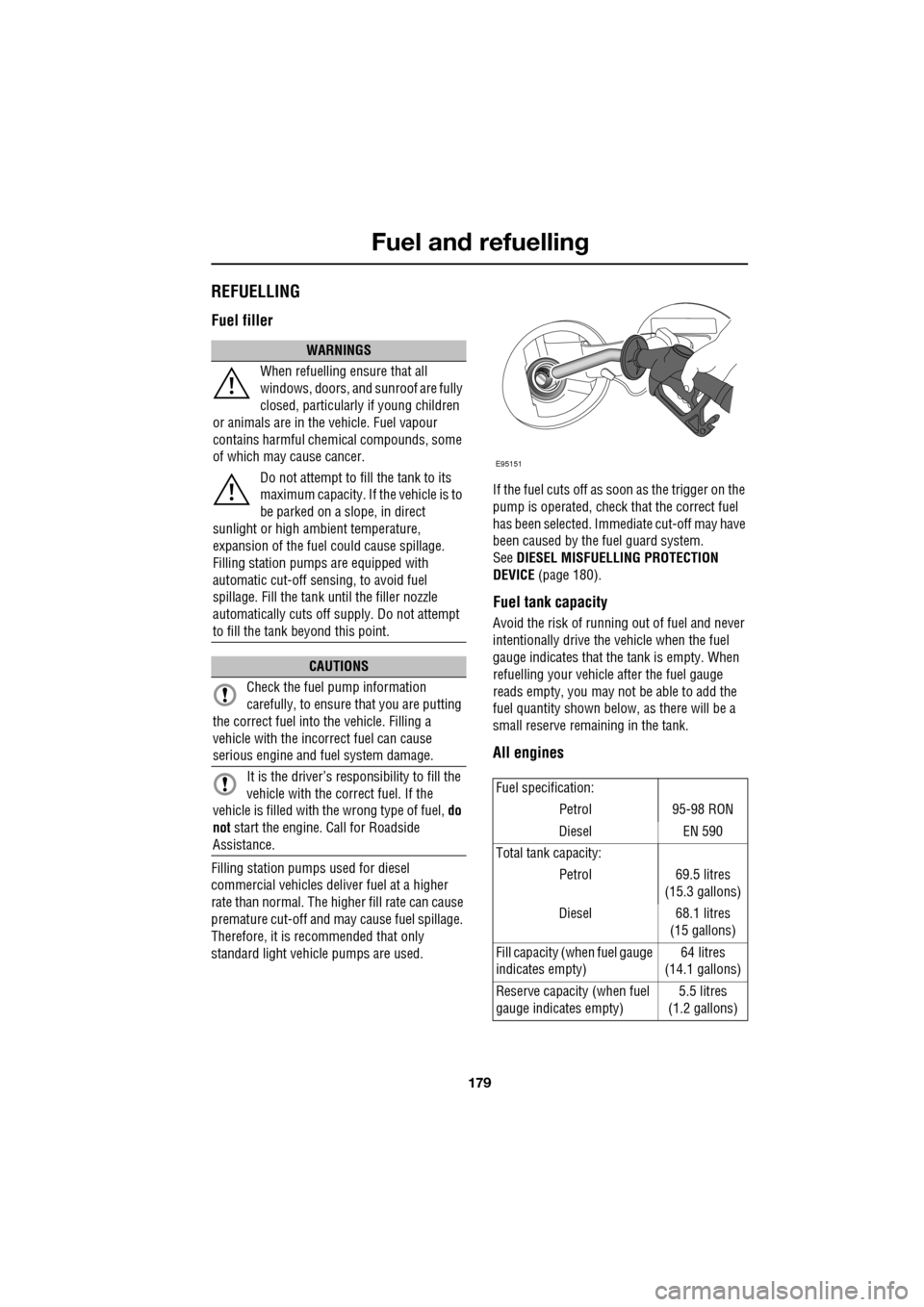
REFUELLING
Fuel filler
Filling station pumps used for diesel
commercial vehicles deliver fuel at a higher
rate than normal. The hi gher fill rate can cause
premature cut-off and ma y cause fuel spillage.
Therefore, it is recommended that only
standard light vehicle pumps are used. If the fuel cuts off as soon as the trigger on the
pump is operated, check that the correct fuel
has been selected. Immediate cut-off may have
been caused by the fuel guard system.
See
DIESEL MISFUELLING PROTECTION
DEVICE (page 180).
Fuel tank capacity
Avoid the risk of running out of fuel and never
intentionally drive the vehicle when the fuel
gauge indicates that the tank is empty. When
refuelling your vehicle after the fuel gauge
reads empty, you may not be able to add the
fuel quantity shown below, as there will be a
small reserve remaining in the tank.
All engines
WARNINGS
When refuelling ensure that all
windows, doors, and sunroof are fully
closed, particularly if young children
or animals are in the vehicle. Fuel vapour
contains harmful chemical compounds, some
of which may cause cancer.
Do not attempt to fill the tank to its
maximum capacity. If the vehicle is to
be parked on a slope, in direct
sunlight or high ambient temperature,
expansion of the fuel could cause spillage.
Filling station pumps are equipped with
automatic cut-off sensing, to avoid fuel
spillage. Fill the tank unt il the filler nozzle
automatically cuts off supply. Do not attempt
to fill the tank beyond this point.
CAUTIONS
Check the fuel pump information
carefully, to ensure that you are putting
the correct fuel into the vehicle. Filling a
vehicle with the incorrect fuel can cause
serious engine and fu el system damage.
It is the driver’s responsibility to fill the
vehicle with the correct fuel. If the
vehicle is filled with the wrong type of fuel, do
not start the engine. Call for Roadside
Assistance.
Fuel specification:
Petrol 95-98 RON
Diesel EN 590
Total tank capacity:
Petrol 69.5 litres
(15.3 gallons)
Diesel 68.1 litres
(15 gallons)
Fill capacity (when fuel gauge
indicates empty) 64 litres
(14.1 gallons)
Reserve capacity (when fuel
gauge indicates empty) 5.5 litres
(1.2 gallons)
E95151
Page 185 of 391
185
Towing
RECOMMENDED TOWING WEIGHTS
Nose/tongue weight must be the greater of
50 kg (110 lbs) or 7% of the actual trailer
weight, up to the maximum tow hitch load.
Nose/tongue weight can be measured using a
proprietary brand of nose weight indicator.
If it is necessary to increase the nose/tongue
weight up to the maximu m allowed, the vehicle
load should be reduced accordingly. This
ensures that the Gross Vehicle Weight (GVW),
and maximum rear axle load, are not exceeded.
Note: When towing the maximum permissible
gross vehicle weight can be increased by a
maximum of 100 kg (220 lb.) provided that the
road speed is limited to 100 km/h (60 mph).
Note: When calculating rear axle loading,
remember that the trailer nose/tongue weight,
the load in the vehicle's luggage area and the
weight of rear seat pa ssengers must all be
added together.
Towing weights - Australia only
The weight of a traile r must not exceed 1.5
times the towing vehicle’s weight. The
nose/tongue weight must be a minimum of 7%
of gross caravan/trai ler weight, up to a
maximum of 350 kg (722 lbs).
ESSENTIAL TOWING CHECKS
• The trailer should be parallel to the ground
when loaded and connected to the vehicle.
• When calculating the laden weight of the
trailer remember to include the weight of
the trailer, plus the weight of the load.
• If the load can be divided between the
vehicle and trailer, loading more weight
into the vehicle will generally improve
stability. Do not exceed the vehicle's
weight limits. See WEIGHTS (page 259).
• Ensure that all applic able regulations and
legislation are complied with when loading
and towing a trailer.
• Increase rear tyre pressures of the towing
vehicle to those for maximum vehicle
loading conditions.
• Ensure trailer tyre pressures are set to
trailer manufacturer' s recommendations.
• If the vehicle is loaded to maximum Gross
Vehicle Weight (GVW) the nose weight is
limited (see Towi ng weights table).
• Ensure that a suitable breakaway cable or
secondary coupling is used. Refer to the
trailer manufacturer' s instructions for
guidance.
• Ensure that the tow ball is secure.
• Check the operation of all trailer lights.
Maximum permissible
towing weights
Unbraked trailers 750 kg (1653 lb.) Trailers with
overrun brakes 1850 kg (4080 lb.)
Nose/Tongue weight 75 kg (165 lb.)
WARNING
Do not exceed the Gross Vehicle
Weight (GVW), m aximum rear axle
weight, maximum trailer weight, or
nose/tongue weight. Exceeding any of these
limits could cause inst ability and loss of
control. See WEIGHTS (page 259).
WARNING
Do not loop the breakaway cable over
the tow ball as it may slide off.
Page 187 of 391
187
Vehicle care
CLEANING THE ALLOY WHEELS
Wash the wheels with soap and water, this
should be done more frequently when the
wheels are exposed to heavy dirt deposits, salt,
clay etc. If you are unsure how often to clean
the wheels in particular conditions, seek advice
from your Dealer/A uthorised Repairer.
Jaguar approved wheel cleaner should be used
to remove heavy soiling.
CLEANING THE EXTERIOR
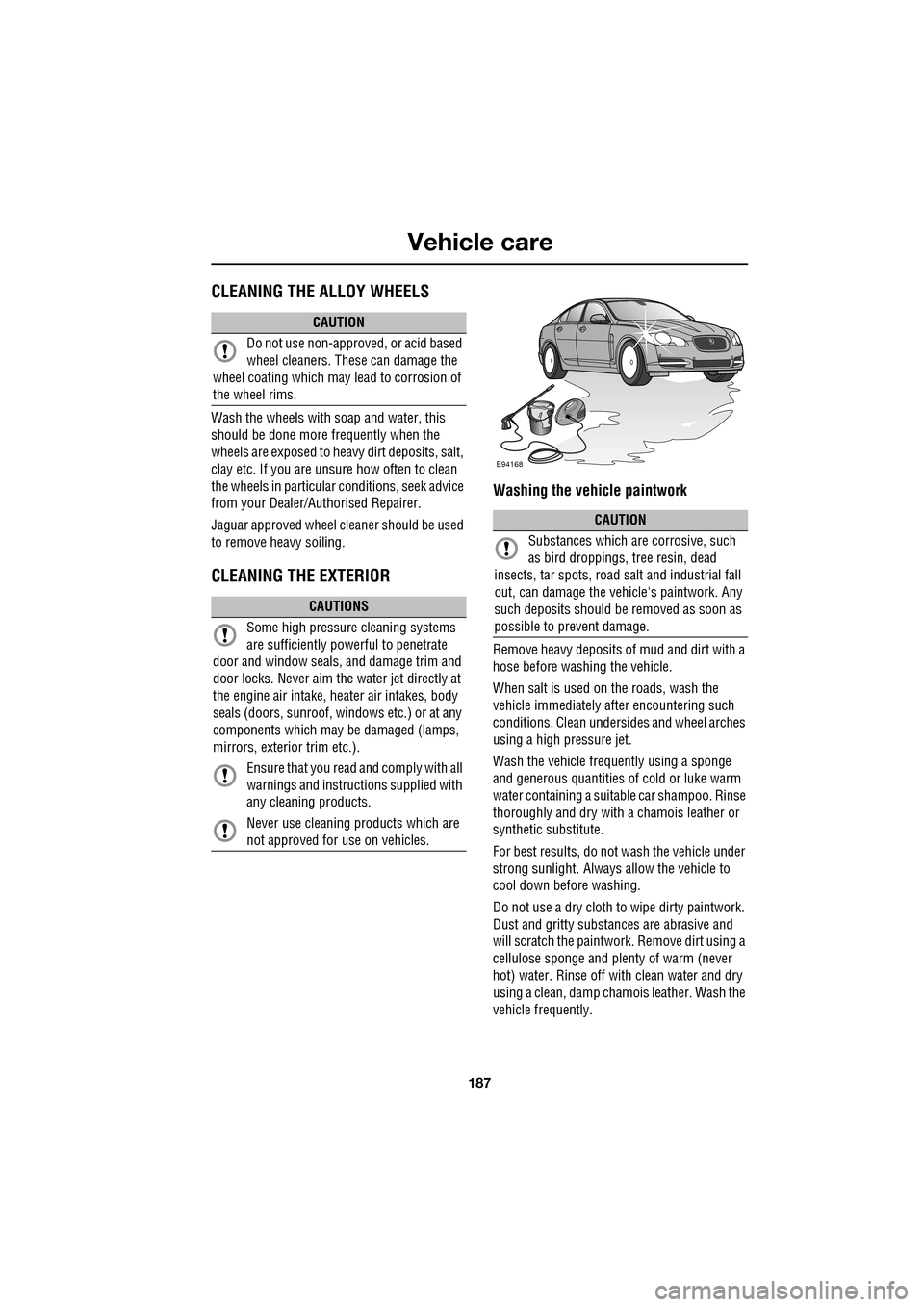
Washing the vehicle paintwork
Remove heavy deposits of mud and dirt with a
hose before washing the vehicle.
When salt is used on the roads, wash the
vehicle immediately after encountering such
conditions. Clean undersid es and wheel arches
using a high pressure jet.
Wash the vehicle frequently using a sponge
and generous quantities of cold or luke warm
water containing a suitable car shampoo. Rinse
thoroughly and dry with a chamois leather or
synthetic substitute.
For best results, do not wash the vehicle under
strong sunlight. Always allow the vehicle to
cool down before washing.
Do not use a dry cloth to wipe dirty paintwork.
Dust and gritty substances are abrasive and
will scratch the paintwork. Remove dirt using a
cellulose sponge and plen ty of warm (never
hot) water. Rinse off with clean water and dry
using a clean, damp cham ois leather. Wash the
vehicle frequently.
CAUTION
Do not use non-approved, or acid based
wheel cleaners. These can damage the
wheel coating which may lead to corrosion of
the wheel rims.
CAUTIONS
Some high pressure cleaning systems
are sufficiently powe rful to penetrate
door and window seals, and damage trim and
door locks. Never aim the water jet directly at
the engine air intake, he ater air intakes, body
seals (doors, sunroof, windows etc.) or at any
components which may be damaged (lamps,
mirrors, exterior trim etc.).
Ensure that you read and comply with all
warnings and instruct ions supplied with
any cleaning products.
Never use cleaning products which are
not approved for use on vehicles.
CAUTION
Substances which are corrosive, such
as bird droppings, tree resin, dead
insects, tar spots, road salt and industrial fall
out, can damage the vehic le's paintwork. Any
such deposits should be removed as soon as
possible to prevent damage.
E94168
Page 191 of 391
191
Vehicle care
Carpet and mats
Marks or stains can be removed by gentle
scrubbing with a weak solution of soap and
warm water.
For more stubborn stains a commercially
available carpet cleaner should be used.
Seat belts
Extend the seat belts fully, then use warm
water and a non-detergent soap to clean. Allow
the seat belts to dry naturally whilst fully
extended and do not allow the belts to retract
until fully dry.
Note: Whilst cleaning the seat belt, take the
opportunity to examine the webbing for
damage and wear. Any wear or damage should
be reported to, and rectified by, a Dealer/
Authorised Repairer.
Airbag module covers
REPAIRING MINOR PAINT DAMAGE
Regularly inspect the paintwork for damage.
Any stone chips, fractures, or deep scratches,
in the paint/bodywork should be repaired
promptly. Bare metal wi ll corrode quickly, and
if left untreated can resu lt in expensive repairs.
Minor chips and scratches can be touched up
using materials and advi ce available from a
Dealer/Authorised Repairer. Larger areas of
damage will require pr ofessional repair, and
you should consult a Dealer/Authorised
Repairer.
WARNING
Do not allow any water, cleaning
products, or fabric from cloths to
enter the seat belt mechanism. Any
substance which enters the mechanism may
affect the performance of the seat belt in an
impact.
WARNINGS
Airbag covers shoul d only be cleaned
using a slightly dampened cloth, and
a small amount of upholstery cleaner.
Do not allow the airbag covers, or
surrounding areas, to become
contaminated with liquids. Any
substance which enters the mechanism, can
prevent correct deploy ment of an airbag
during an impact.
Page 194 of 391
Maintenance
194
Safety in the garageFuel system
Poisonous fluids
Fluids used in motor vehicles are poisonous
and should not be consumed or brought into
contact with open wounds. These include;
battery acid, antifreeze, brake, clutch and
power steering fluid, petrol, diesel, engine oil
and windscreen washer additives.
For your own safety, always read and obey all
instructions printed on labels and containers.
Used engine oil
Prolonged contact with engine oil may cause
serious skin disorders, including dermatitis
and cancer of the skin. Always wash
thoroughly after contact.
It is illegal to pollute drains, water
courses or soil. Use authorised
waste disposal site s to dispose of
used oil and toxic chemicals.
WARNINGS
If the vehicle has been driven
recently, do not touch exhaust and
cooling system components until the
engine has cooled.
Never leave the engi ne running in an
unventilated area - exhaust gases are
poisonous and extremely dangerous.
Do not work beneath the vehicle with
the wheel changing jack as the only
means of support.
Keep your hands and clothing away
from drive belts, pulleys and fans.
Some fans may continue to operate
after the engi ne has stopped.
Remove metal wrist bands and
jewellery, before working in the
engine compartment.
Do not touch electrical leads or
components while the engine is
running, or with the starter switch
turned on.
Do not allow tools or metal parts of
the vehicle to make contact with the
battery leads or terminals.WARNINGS
Under no circumstances should any
part of the fuel system be dismantled
or replaced by anyone other than a
suitably qualified vehicle technician. Failure to
comply with this instruct ion, may result in fuel
spillage with a consequent serious risk of fire.
Ensure sparks and naked lights are
kept away from the engine
compartment.
Wear protective cl othing, including,
where practicable, gloves made from
an impervious material.
Page 197 of 391
197
Maintenance
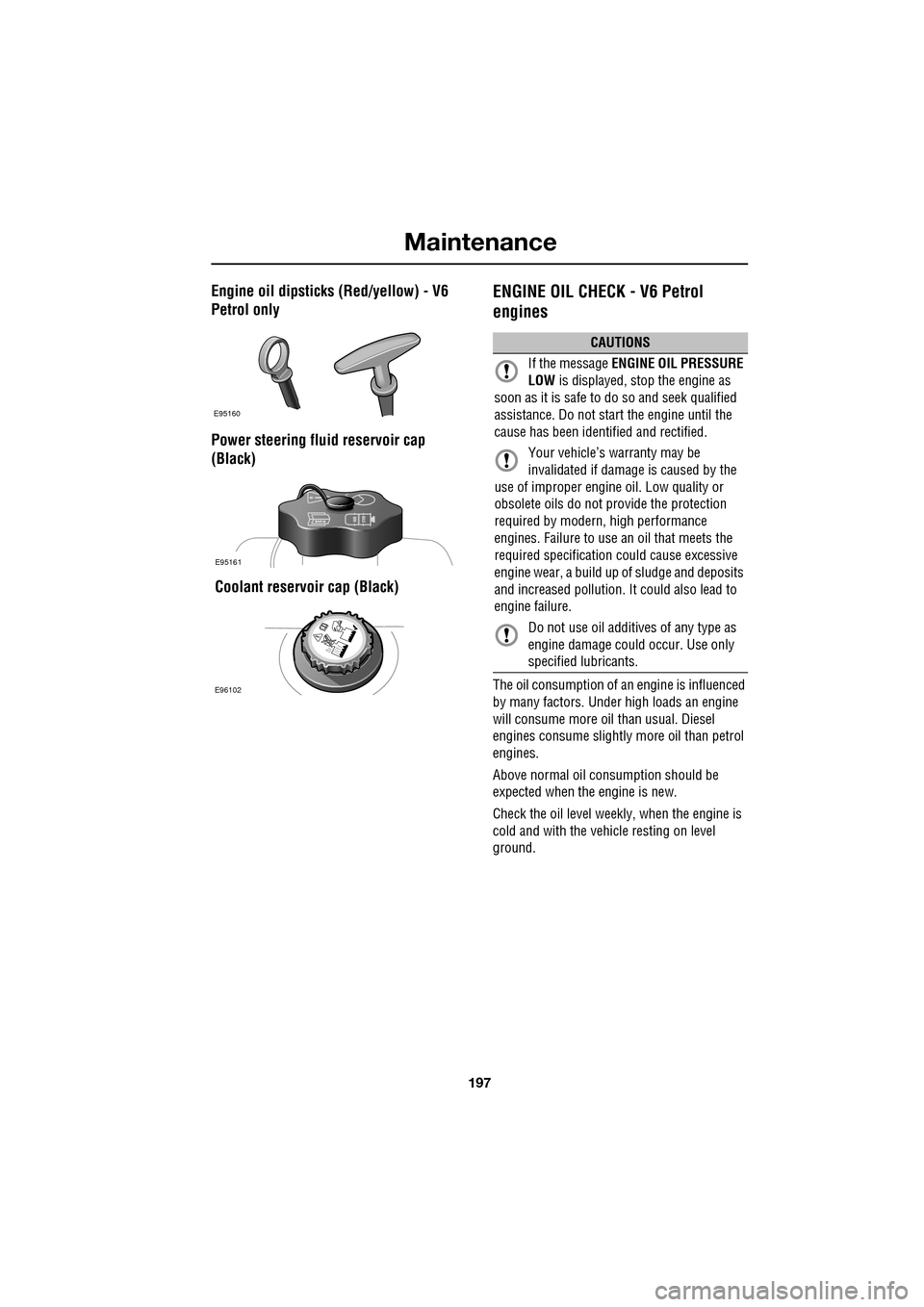
Engine oil dipsticks (Red/yellow) - V6
Petrol only
Power steering fluid reservoir cap
(Black)
Coolant reservoir cap (Black)ENGINE OIL CHECK - V6 Petrol
engines
The oil consumption of an engine is influenced
by many factors. Unde r high loads an engine
will consume more oil than usual. Diesel
engines consume slightly more oil than petrol
engines.
Above normal oil consumption should be
expected when the engine is new.
Check the oil level weekly , when the engine is
cold and with the vehicle resting on level
ground.
E95160
E95161
E96102
CAUTIONS
If the message ENGINE OIL PRESSURE
LOW is displayed, st op the engine as
soon as it is safe to do so and seek qualified
assistance. Do not start the engine until the
cause has been identified and rectified.
Your vehicle’s warranty may be
invalidated if damage is caused by the
use of improper engine oil. Low quality or
obsolete oils do not pr ovide the protection
required by modern, high performance
engines. Failure to use an oil that meets the
required specification could cause excessive
engine wear, a build up of sludge and deposits
and increased pollution. It could also lead to
engine failure.
Do not use oil additi ves of any type as
engine damage coul d occur. Use only
specified lubricants.