lock JAGUAR XFR 2010 1.G Workshop Manual
[x] Cancel search | Manufacturer: JAGUAR, Model Year: 2010, Model line: XFR, Model: JAGUAR XFR 2010 1.GPages: 3039, PDF Size: 58.49 MB
Page 728 of 3039

Steering nibble is a rotary oscillation or vibration of the steering wheel, which can be excited at a specific vehicle speed.
Nibble is driven by wheel and tire imbalance exciting a suspension recession mode, which then translates into steering gear
travel and finally steering wheel nibble.
Shudder (Judder)
Shudder is a low frequency oscillation of the entire steering system (tire, wheels, steering gear and linkage, etc.) when the
vehicle is steered during static-park or at low speeds. Shudder is very dependent on road surface.
Torque/Velocity Variation (Phasing/Effort Cycling)
Steering wheel torque variation occurring twice in one revolution is normally as a result of problems with the lower steering
column (intermediate shaft), but foul conditions generally result in either constant stiffness or single point stiffness.
Depending upon the orientation of the joints, the steering can feel asymmetric (torque falling off in one direction and rising in
the other) or else it can simply have pronounced peaks and troughs as the steering moves from lock to lock.
Wheel Fight (Kick Back)
Wheel fight is excess feedback of sudden road forces through the steering system and back to the driver. It is evaluated at all
vehicle speeds over cobblestones, rough roads, and potholes. The tires, wheels, and suspension generate forces into the
steering systems. Steering friction, hydraulic damping, hydraulic compliance, mechanical compliance, steering ratio, and assist
gain all affect how much is transmitted to the driver.
Page 729 of 3039
Published: 07-Jul-2011
Steering System - General Information - Power Steering System Bleeding
General Procedures
NOTE: Some variation in the illustrations may occur, but the essential information is always correct.
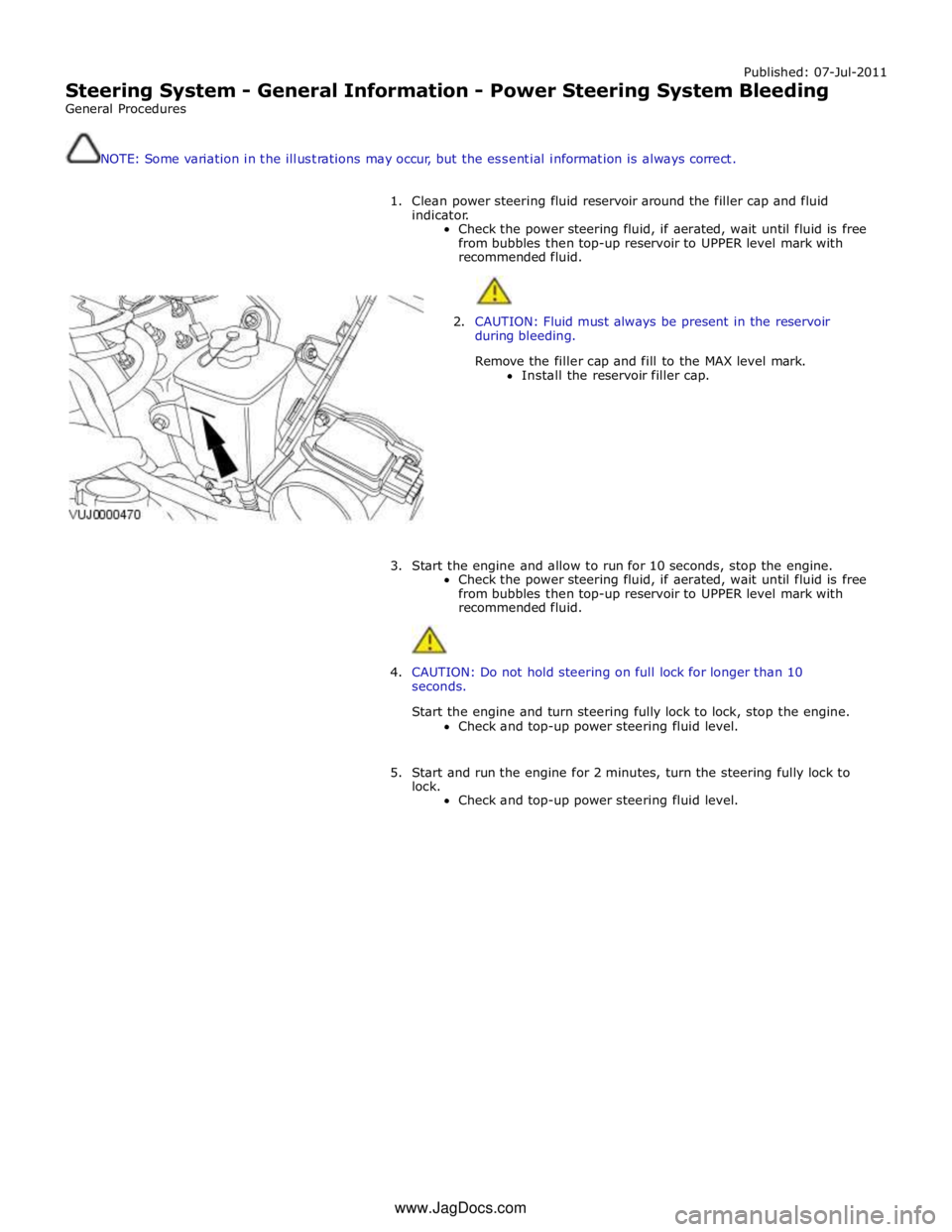
1. Clean power steering fluid reservoir around the filler cap and fluid
indicator.
Check the power steering fluid, if aerated, wait until fluid is free
from bubbles then top-up reservoir to UPPER level mark with
recommended fluid.
2. CAUTION: Fluid must always be present in the reservoir
during bleeding.
Remove the filler cap and fill to the MAX level mark.
Install the reservoir filler cap.
3. Start the engine and allow to run for 10 seconds, stop the engine.
Check the power steering fluid, if aerated, wait until fluid is free
from bubbles then top-up reservoir to UPPER level mark with
recommended fluid.
4. CAUTION: Do not hold steering on full lock for longer than 10
seconds.
Start the engine and turn steering fully lock to lock, stop the engine.
Check and top-up power steering fluid level.
5. Start and run the engine for 2 minutes, turn the steering fully lock to
lock.
Check and top-up power steering fluid level. www.JagDocs.com
Page 732 of 3039
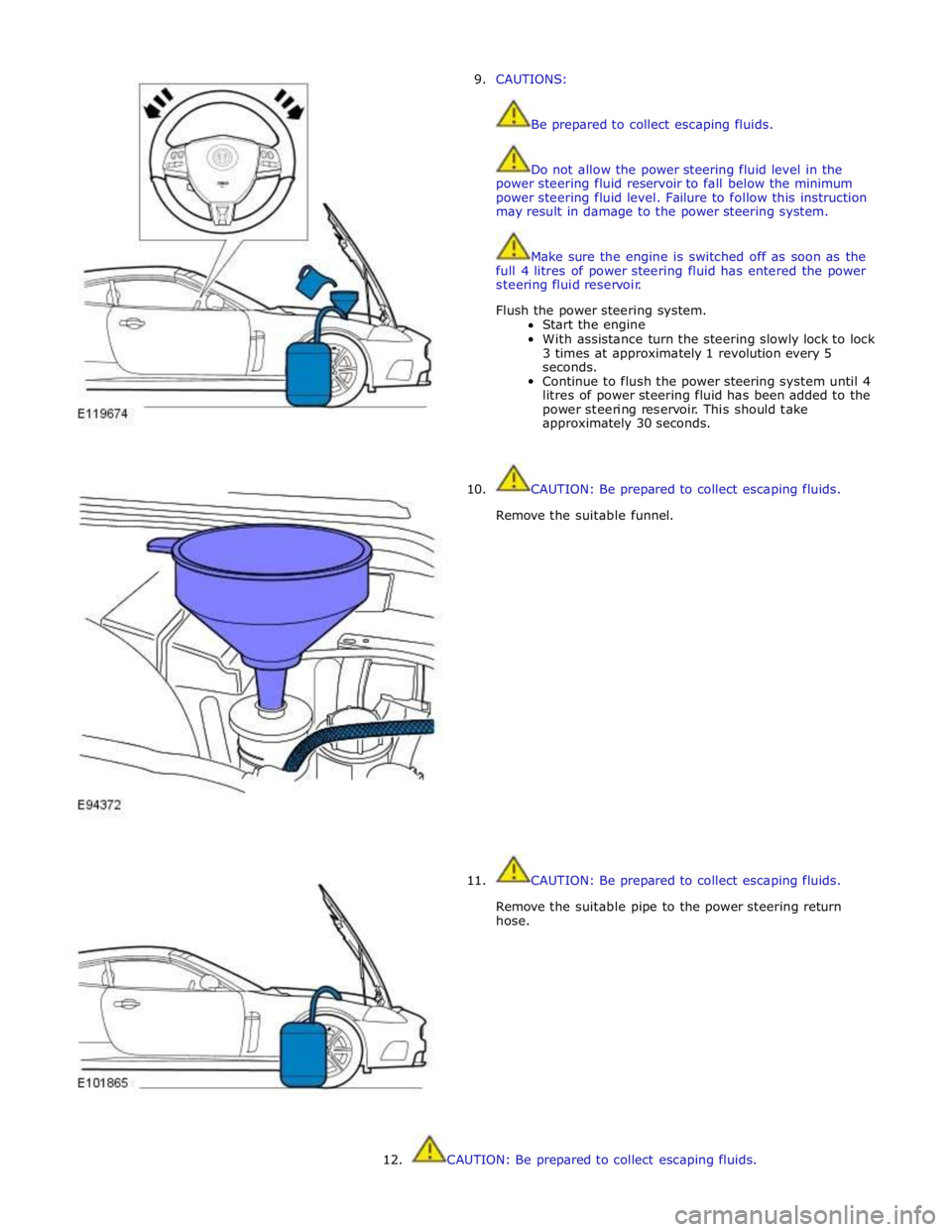
9. CAUTIONS:
Be prepared to collect escaping fluids.
Do not allow the power steering fluid level in the
power steering fluid reservoir to fall below the minimum
power steering fluid level. Failure to follow this instruction
may result in damage to the power steering system.
Make sure the engine is switched off as soon as the
full 4 litres of power steering fluid has entered the power
steering fluid reservoir.
Flush the power steering system.
Start the engine
With assistance turn the steering slowly lock to lock
3 times at approximately 1 revolution every 5
seconds.
Continue to flush the power steering system until 4
litres of power steering fluid has been added to the
power steering reservoir. This should take
approximately 30 seconds.
10.
11. CAUTION: Be prepared to collect escaping fluids.
Remove the suitable funnel.
CAUTION: Be prepared to collect escaping fluids.
Remove the suitable pipe to the power steering return
hose.
12.
CAUTION: Be prepared to collect escaping fluids.
Page 736 of 3039
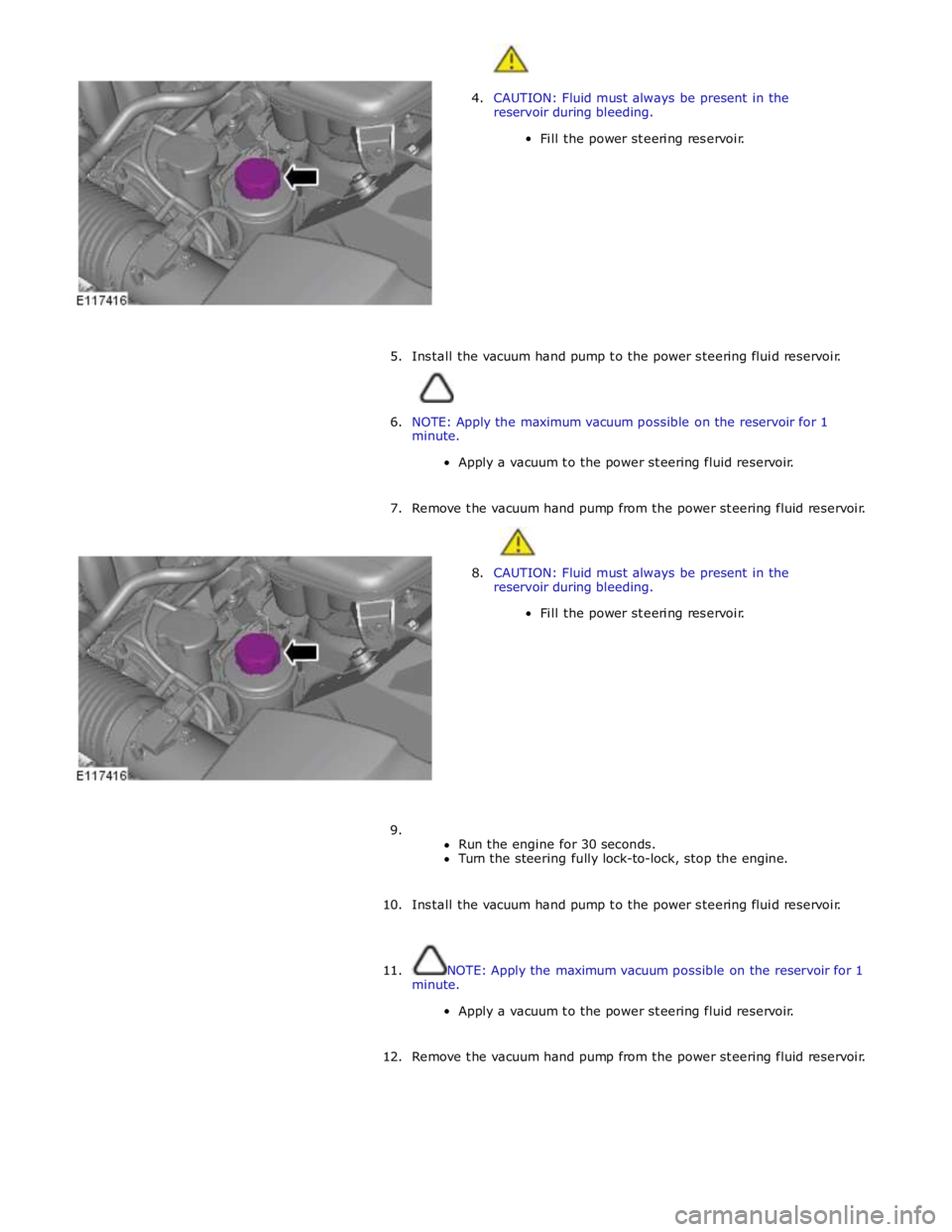
4. CAUTION: Fluid must always be present in the
reservoir during bleeding.
Fill the power steering reservoir.
5. Install the vacuum hand pump to the power steering fluid reservoir.
6. NOTE: Apply the maximum vacuum possible on the reservoir for 1
minute.
Apply a vacuum to the power steering fluid reservoir.
7. Remove the vacuum hand pump from the power steering fluid reservoir.
8. CAUTION: Fluid must always be present in the
reservoir during bleeding.
Fill the power steering reservoir.
9.
Run the engine for 30 seconds.
Turn the steering fully lock-to-lock, stop the engine.
10. Install the vacuum hand pump to the power steering fluid reservoir.
11. NOTE: Apply the maximum vacuum possible on the reservoir for 1
minute.
Apply a vacuum to the power steering fluid reservoir.
12. Remove the vacuum hand pump from the power steering fluid reservoir.
Page 737 of 3039
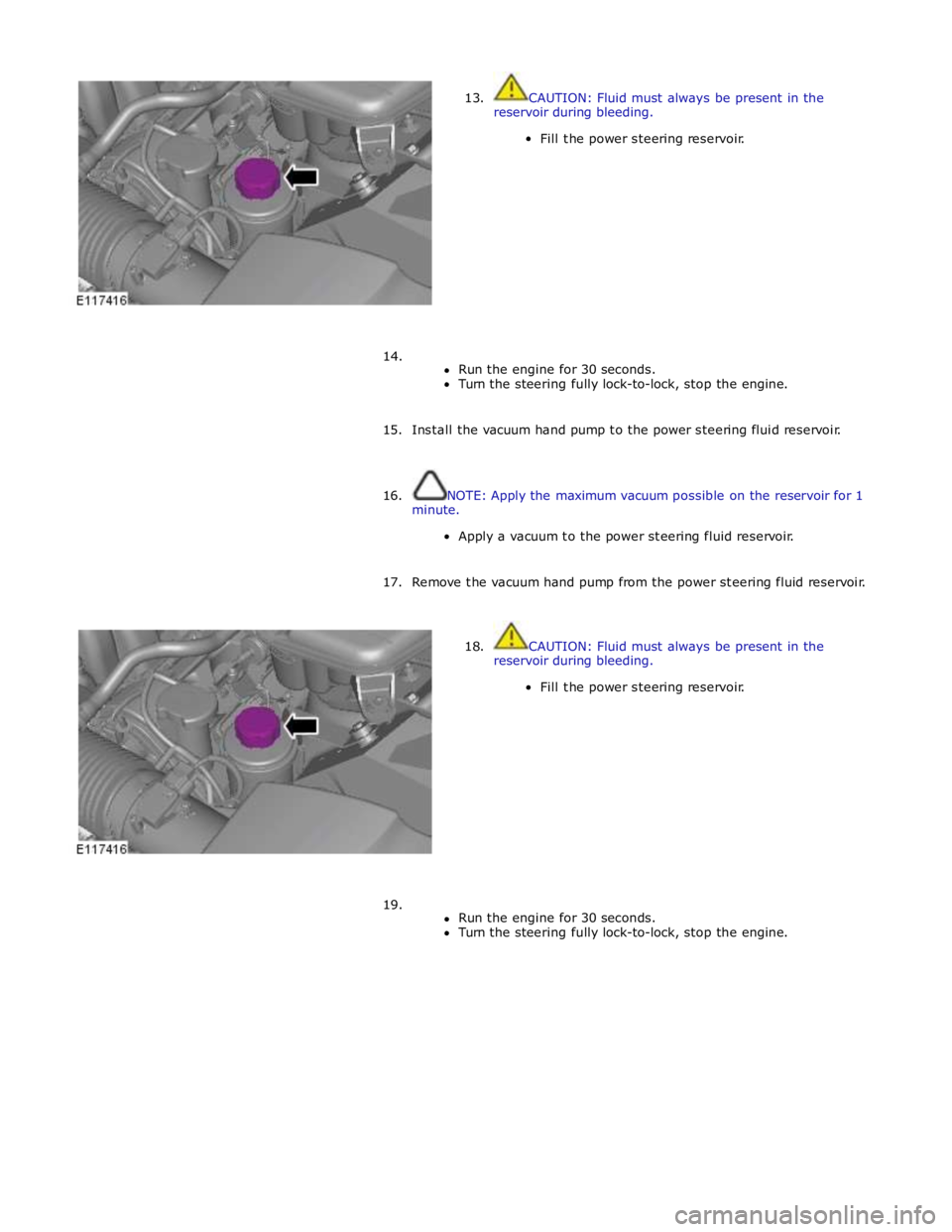
13. CAUTION: Fluid must always be present in the
reservoir during bleeding.
Fill the power steering reservoir.
14.
Run the engine for 30 seconds.
Turn the steering fully lock-to-lock, stop the engine.
15. Install the vacuum hand pump to the power steering fluid reservoir.
16. NOTE: Apply the maximum vacuum possible on the reservoir for 1
minute.
Apply a vacuum to the power steering fluid reservoir.
17. Remove the vacuum hand pump from the power steering fluid reservoir.
18. CAUTION: Fluid must always be present in the
reservoir during bleeding.
Fill the power steering reservoir.
19.
Run the engine for 30 seconds.
Turn the steering fully lock-to-lock, stop the engine.
Page 744 of 3039

1 Return fluid control groove 2 Radial groove 3 Feed fluid control groove 4 Radial groove 5 Axial groove 6 Feed fluid control edge 7 Feed fluid radial groove 8 Return fluid control edge 9 Return fluid chamber 10 Cut-off valve 11 Radial groove 12 Servotronic transducer valve 13 Feed fluid radial groove 14 Radial groove 15 Orifice 16 Balls 17 Compression spring 18 Torsion bar 19 Power steering fluid reservoir 20 Valve rotor 21 Reaction piston 22 Reaction chamber 23 Centering piece 24 Pressure relief/flow limiting valve 25 Power steering pump 26 Inner tie-rod 27 Pinion 28 Valve sleeve 29 Steering gear rack 30 Steering gear housing 31 Power assist cylinder - right 32 Piston 33 Power assist cylinder - left When the steering wheel is turned to the right, the steering rack and piston moves to the left in the piston bore. The valve
rotor is rotated to the right (clockwise) and pressurized fluid is directed over the further opened feed fluid control edges and to
the associated axial grooves, the radial groove and via an external pipe to the left power assist cylinder chamber. The pressure
applied to the piston from the left power assist cylinder chamber provides the hydraulic assistance.
An adaptable pressure build-up is achieved by the partially or fully closed feed fluid control edges restricting or preventing a
connection between the fluid pressure inlet and the other axial grooves connected to the radial groove.
Simultaneously, the fluid pressure outlet to the pressurized axial grooves are restricted or partially restricted by the closing
return fluid control edges. The fluid displaced by the piston from the right power assist cylinder chamber, flows through an
external pipe to the radial grooves. From there the fluid passes to the associated axial grooves and on to the return fluid
control grooves, via the further opened return fluid control edges.
The return flow of fluid to the reservoir passes via interconnecting bores which lead to the return fluid chamber. When the
steering wheel is turned to the left the operating sequence is as above but the pressure is applied to the opposite side of the
piston.
Servotronic Operation
The Servotronic software contains a number of steering maps which are selected via the car configuration file depending on the
vehicle mode and tire fitment.
If a failure of the Servotronic valve or software occurs, the system will suspend Servotronic assistance and only normal power
steering wheel be available. Fault codes relating to the fault are stored, but no warning lamps are illuminated and the driver
may be aware of the steering being 'heavier' than usual.
When the vehicle is manoeuvred into and out of a parking space (or other similar manoeuvre), the Servotronic software uses
road speed data from the ABS module to determine the vehicle speed, which in this case will be slow or stationary. The
Servotronic software analyses the signals and outputs an appropriate control current to the Servotronic transducer valve. The
Servotronic valve closes and prevents fluid flowing from the feed fluid radial groove to the reaction chamber. An orifice also
Page 745 of 3039
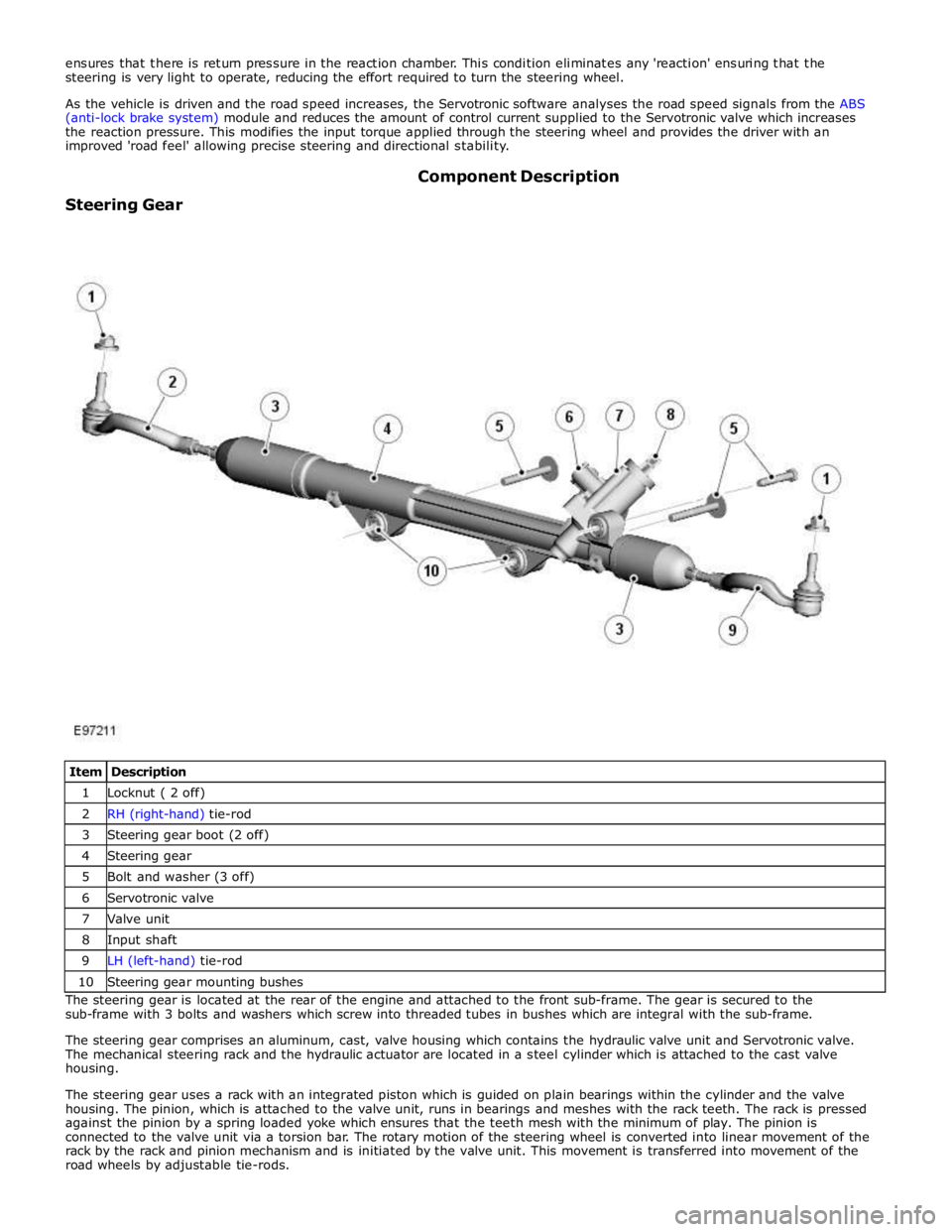
1 Locknut ( 2 off) 2 RH (right-hand) tie-rod 3 Steering gear boot (2 off) 4 Steering gear 5 Bolt and washer (3 off) 6 Servotronic valve 7 Valve unit 8 Input shaft 9 LH (left-hand) tie-rod 10 Steering gear mounting bushes The steering gear is located at the rear of the engine and attached to the front sub-frame. The gear is secured to the
sub-frame with 3 bolts and washers which screw into threaded tubes in bushes which are integral with the sub-frame.
The steering gear comprises an aluminum, cast, valve housing which contains the hydraulic valve unit and Servotronic valve.
The mechanical steering rack and the hydraulic actuator are located in a steel cylinder which is attached to the cast valve
housing.
The steering gear uses a rack with an integrated piston which is guided on plain bearings within the cylinder and the valve
housing. The pinion, which is attached to the valve unit, runs in bearings and meshes with the rack teeth. The rack is pressed
against the pinion by a spring loaded yoke which ensures that the teeth mesh with the minimum of play. The pinion is
connected to the valve unit via a torsion bar. The rotary motion of the steering wheel is converted into linear movement of the
rack by the rack and pinion mechanism and is initiated by the valve unit. This movement is transferred into movement of the
road wheels by adjustable tie-rods.
Page 750 of 3039
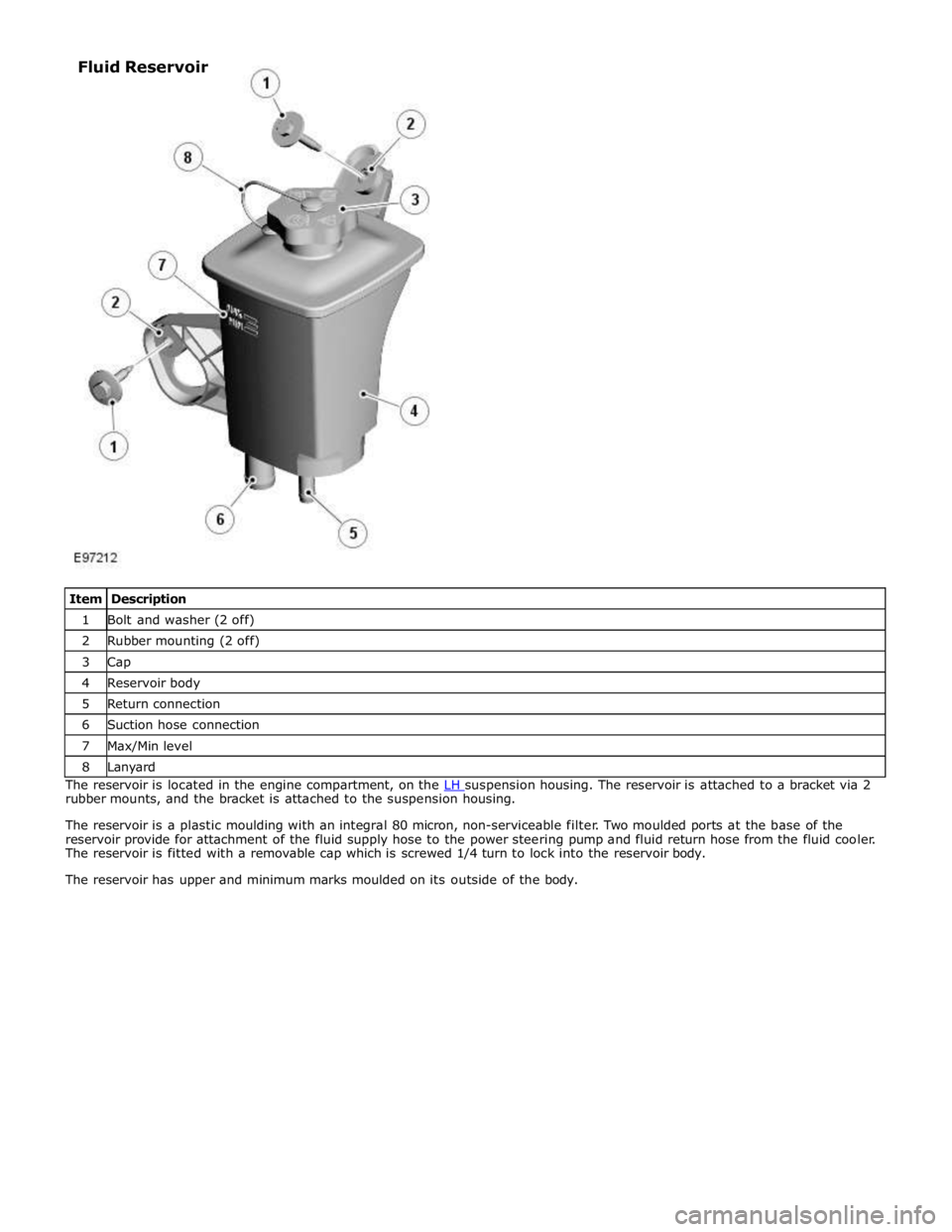
1 Bolt and washer (2 off) 2 Rubber mounting (2 off) 3 Cap 4 Reservoir body 5 Return connection 6 Suction hose connection 7 Max/Min level 8 Lanyard The reservoir is located in the engine compartment, on the LH suspension housing. The reservoir is attached to a bracket via 2 rubber mounts, and the bracket is attached to the suspension housing.
The reservoir is a plastic moulding with an integral 80 micron, non-serviceable filter. Two moulded ports at the base of the
reservoir provide for attachment of the fluid supply hose to the power steering pump and fluid return hose from the fluid cooler.
The reservoir is fitted with a removable cap which is screwed 1/4 turn to lock into the reservoir body.
The reservoir has upper and minimum marks moulded on its outside of the body. Fluid Reservoir
Page 753 of 3039

Power Steering - Steering Gear
Removal and Installation Published: 04-Jul-2013
CAUTIONS: Removal
Make sure that only the manufacturers' recommended four wheel alignment equipment is used.
Do not turn the steering wheel with the steering column lower shaft disconnected as damage to the clockspring and
steering wheel switches may occur.
NOTES:
Make sure the steering is in the straight ahead position.
RHD illustration shown, LHD is similar.
Some variation in the illustrations may occur, but the essential information is always correct.
1. Raise and support the vehicle.
2. Center the steering wheel.
Lock in position and remove the ignition key.
3. Remove the front wheels and tires.
For additional information, refer to: Wheel and Tire (204-04 Wheels and Tires, Removal and Installation).
4. Remove the air deflector.
For additional information, refer to: Air Deflector (501-02 Front End Body Panels, Removal and Installation).
Page 754 of 3039
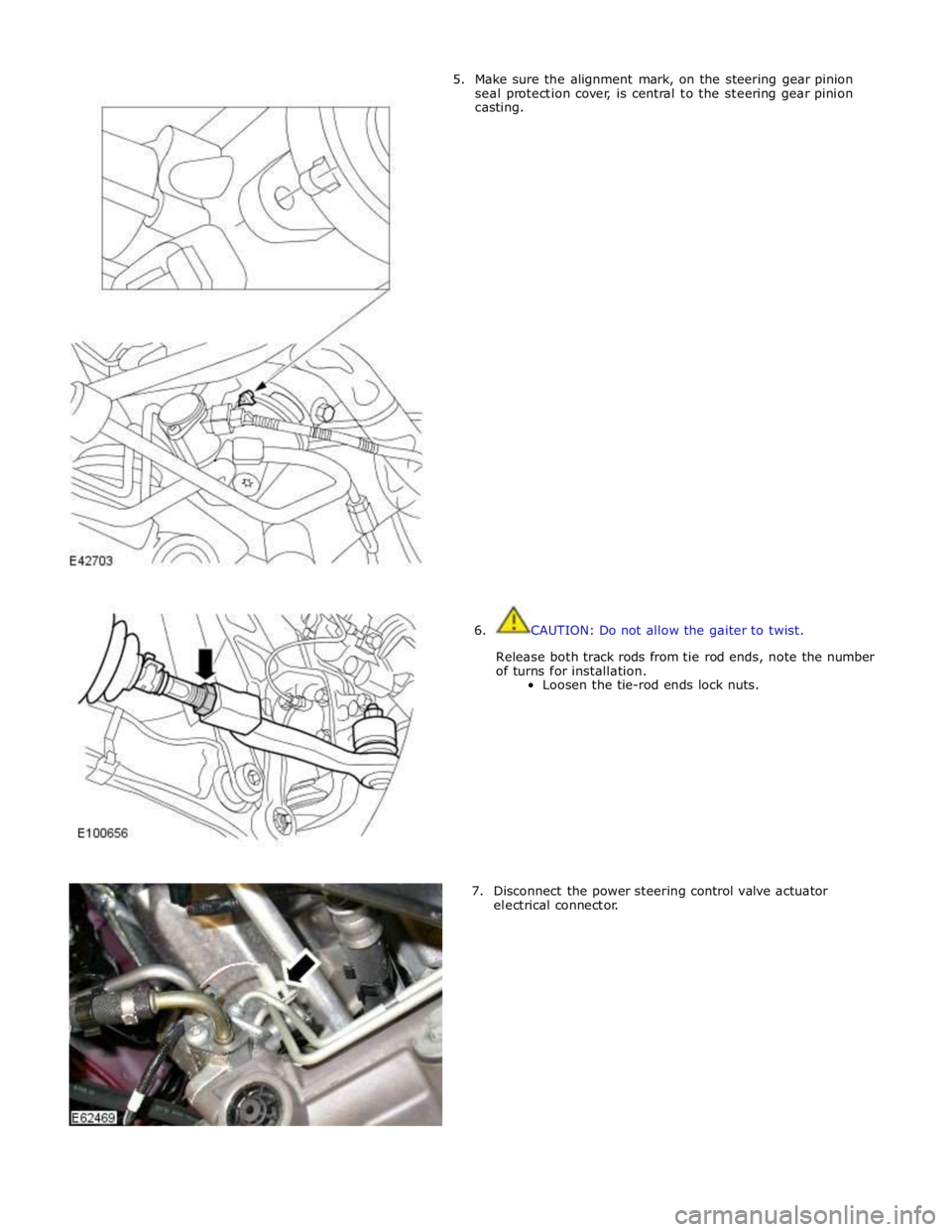
5. Make sure the alignment mark, on the steering gear pinion
seal protection cover, is central to the steering gear pinion
casting.
6. CAUTION: Do not allow the gaiter to twist.
Release both track rods from tie rod ends, note the number
of turns for installation.
Loosen the tie-rod ends lock nuts.
7. Disconnect the power steering control valve actuator
electrical connector.