clutch JAGUAR XJ6 1994 2.G Owner's Manual
[x] Cancel search | Manufacturer: JAGUAR, Model Year: 1994, Model line: XJ6, Model: JAGUAR XJ6 1994 2.GPages: 521, PDF Size: 17.35 MB
Page 129 of 521
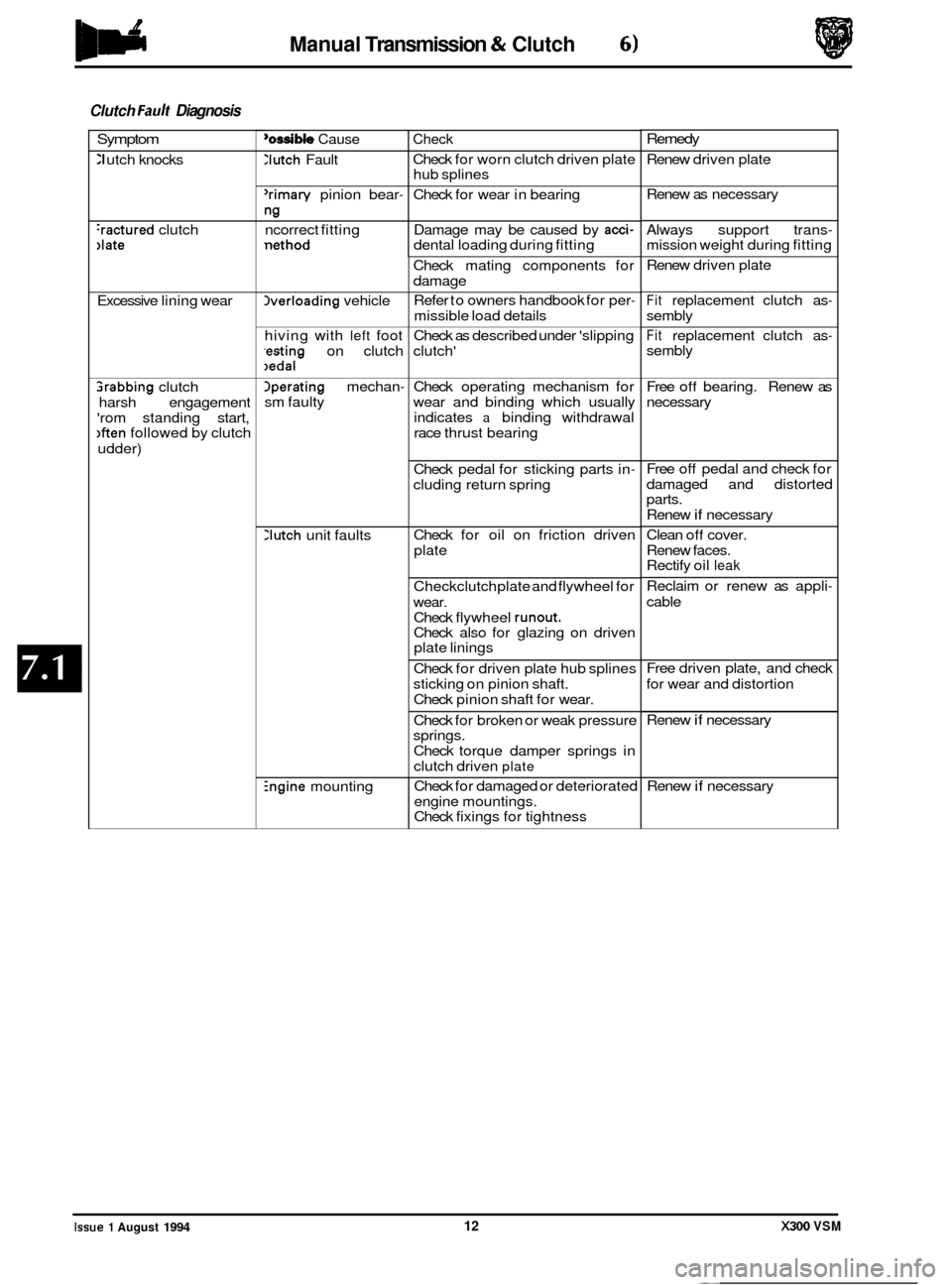
Manual Transmission & Clutch (AJ16)
'ossible Cause
:Iutch Fault
'rimary pinion bear-
ng
ncorrect fitting nethod
Clutch Fault Diagnosis
Check
Check for worn clutch driven plate
hub splines
Check for wear in bearing
Damage may be caused by
acci- dental loading during fitting
Symptom
:I utch knocks
herloading vehicle
hiving with
left foot
,esting on clutch )edal
:ractured clutch )late
Check mating components for
damage
Refer to owners handbook for per
-
missible load details
Check as described under 'slipping
clutch'
Excessive
lining wear
lperating mechan-
sm faulty
:Iutch unit faults
3rabbing clutch
harsh engagement
'rom standing start,
Iften followed by clutch
udder) Check
operating mechanism for
wear and binding which usually
indicates
a binding withdrawal
race thrust bearing
Check pedal for sticking parts in
-
cluding return spring
Check for oil on friction driven
plate
Checkclutch plate and flywheel for
wear. Check flywheel
runout. Check also for glazing on driven
plate linings
Check for driven plate hub splines
sticking on pinion shaft.
Check pinion shaft for wear.
Check for broken or weak pressure
springs.
Check torque damper springs in
clutch driven
plate
hgine mounting Check
for damaged or deteriorated
engine mountings.
Check fixings for tightness
Remedy
Renew driven plate
Renew as necessary
Always support trans
- mission weight during fitting
Renew driven plate
Fit replacement clutch as-
sembly
Fit replacement clutch as- sembly
Free
off bearing. Renew as
necessary
Free
off pedal and check for
damaged and distorted
parts.
Renew
if necessary
Clean
off cover.
Renew faces.
Rectify oil
leak
Reclaim or renew as appli-
cable
Free driven plate, and check
for wear and distortion
Renew
if necessary
Renew
if necessary
Issue 1 August 1994 12 X300 VSM
Page 130 of 521
![JAGUAR XJ6 1994 2.G Owners Manual Clutch Fault Diagnosis
Symptom
Slipping clutch
[indicated by vehicle
speed not responding to
engine speed increase)
]ragging or spinning :lutch
Manual Transmission & Clutch (AJ16)
Poss](/img/21/7690/w960_7690-129.png "JAGUAR XJ6 1994 2.G Owners Manual Clutch Fault Diagnosis
Symptom
Slipping clutch
[indicated by vehicle
speed not responding to
engine speed increase)
]ragging or spinning :lutch
Manual Transmission & Clutch (AJ16)
Poss")
Clutch Fault Diagnosis
Symptom
Slipping clutch
[indicated by vehicle
speed not responding to
engine speed increase)
]ragging or spinning :lutch
Manual Transmission & Clutch (AJ16)
Possible Cause
Poor driving tech- nique
Operating mechan
-
ism faulty
Clutch unit faults
Operating mechan
-
ism faulty
Zlutch unit faults
2lutch unit faults
Check
Ensure that none of the remedy
conditions prevail
Checkfor binding withdrawal lever
Check for binding of clutch pedal
movement components
Check for oil on friction faces
Check for binding withdrawal lever
Check for binding of clutch pedal
movement components
Check for oil on friction faces
Check for broken or weak pressure
springs
.-
Check clutch plates and flywheel
for wear and distortion
Check clutch driven plate for frac
- tures and distortion.
Damage may be caused by acci
-
dental loading during assembly of
transmission to engine.
Always support transmission
weight during refitting
Check for primary pinion bearing
seized
Check clutch driven hub for bind
- ing on primary pinion splines.
Check for too thick friction linings.
Ensure linings
are good
Check for foreign matter in clutch
unit
Remedv
Do not increase engine speed
with clutch paGially' en-
gaged. Do not drive with left foot
resting on clutch pedal.
Free lever and check for wear
and distortion
Free
off seized or binding
components
Clean
off metal faces.
Renew driven plate.
Rectify oil leak.
Free lever and check for wear
and distortion
Free
off seized or binding
components
Clean
off metal faces.
Renew driven plate.
Rectify oil leaks.
Renew cover as necessary
Reclaim or renewclutch
plate
as applicable
Renew driven plate and
check mating components
for damage
Rectify or renew as necess
-
ary
Renew as necessary
Clean and renew compo
-
nents as necessary
X300 VSM 13 Issue 1 August 1994
Page 131 of 521
Manual Transmission & Clutch (AJ16) IBh
7.1.14 ClUTCHASSEMBLY, RENEW
SRO 33.10.01
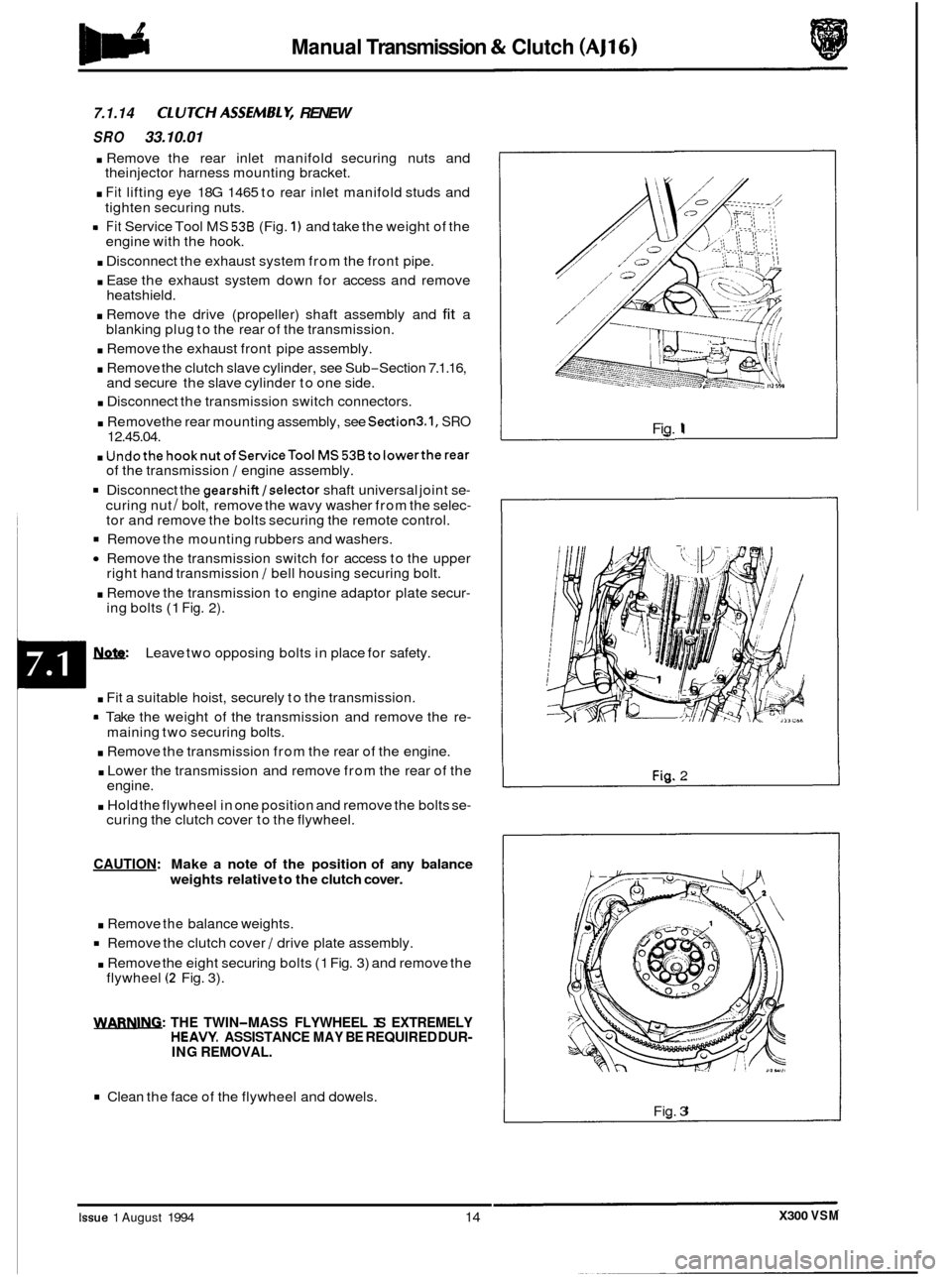
. Remove the rear inlet manifold securing nuts and
. Fit lifting eye 18G 1465 to rear inlet manifold studs and
rn Fit Service Tool MS 538 (Fig. 1) and take the weight of the
. Disconnect the exhaust system from the front pipe.
. Ease the exhaust system down for access and remove
. Remove the drive (propeller) shaft assembly and fit a
. Remove the exhaust front pipe assembly.
. Remove the clutch slave cylinder, see Sub-Section 7.1.16,
and secure the slave cylinder to one side.
. Disconnect the transmission switch connectors.
. Removethe rear mounting assembly, see Section3.1, SRO 12.45.04.
. Undothe hooknutofServiceTool MS53Btolowertherear of the transmission / engine assembly.
Disconnect the gearshift/selector shaft universal joint se-
curing nut / bolt, remove the wavy washer from the selec- tor and remove the bolts securing the remote control.
Remove the mounting rubbers and washers.
Remove the transmission switch for access to the upper
. Remove the transmission to engine adaptor plate secur-
theinjector harness mounting bracket.
tighten securing nuts.
engine with the hook.
heatshield.
blanking plug to the rear of the transmission.
right hand transmission
/ bell housing securing bolt.
ing bolts
(1 Fig. 2).
Leave two opposing bolts in place for safety.
m . Fit a suitable hoist, securely to the transmission.
= Take the weight of the transmission and remove the re-
. Remove the transmission from the rear of the engine.
. Lower the transmission and remove from the rear of the
. Hold the flywheel in one position and remove the bolts se-
maining two securing bolts.
engine.
curing the clutch cover to the flywheel.
CAUTION: Make a note of the position of any balance
weights relative to the clutch cover.
. Remove the balance weights.
Remove the clutch cover / drive plate assembly.
. Remove the eight securing bolts (1 Fig. 3) and remove the
flywheel (2 Fig. 3).
WARNING: THE TWIN-MASS FLYWHEEL IS EXTREMELY HEAVY. ASSISTANCE MAY BE REQUIRED DUR- ING REMOVAL.
Clean the face of the flywheel and dowels.
Fig. 1
Fig. 2
Fig. 3
X300 VSM Issue 1 August 1994 14
Page 132 of 521

Manual Transmission & Clutch (AJ16)
. Check the flywheel face for scoring; should this be excess-
Fit a new spigot bearing to the flywheel (2 Fig. 1).
. Refit the flywheel to the crankshaft and tighten the secur-
. Fit the clutch assembly to the flywheel ensuring that the
. Align the clutch with an input shaft.
. Fit the balance weights to the clutch cover and tighten the
. Remove the input shaft.
ive,
skim within tolerance.
ing bolts (1
Fig. 1).
larger, rounded boss faces the flywheel.
securing bolts. Remove the circlip
(1 Fig. 2) securing the clutch release
arm to the pivot and remove the assembly (2 Fig. 2).
. Slacken and remove the release arm pivot pin.
. Remove the bearing (3 Fig. 2) from the release arm assem- bly (2 Fig. 21, grease the bearing seat, fit the new bearing
to the release arm assembly.
Re-assemble the release arm ensuring that the pivots are
greased.
. Select third forward gear.
. Move the transmission under the ramp and raise it into
position against the adaptor plate and secure with the
bolts.
. Remove the securing chain from the unit lift and fit front
clamp.
. Refit the transmission switch and fit the multi-plug into
the securing clip.
. Refit the clutch slave cylinder, see 33.35 01.
. Fit the mounting rubbers and spacers, reconnect the re-
. Refit the selector to the gearshift lever.
. Refit the exhaust front pipes to the manifold.
. Remove the blanking plug from the rear of the trans-
. Refit the drive (propeller) shaft.
. Refit the heat shield and reconnect the exhaust system.
. Lower the ramp.
. Remove the Service Tool MS 53B.
. Remove the engine lifting eye 18G 1465.
= Refit the injector harness mounting bracket and tighten
the rear inlet manifold securing nuts.
mote control.
mission.
Fig. 2
Issue 1 August 1994 X300 VSM 15
-~
Page 133 of 521
Manual Transmission & clutch (AJ16)
7.1.15 CLUTCH MASTER CYLINDER, RENEW
SRO 33.20.01
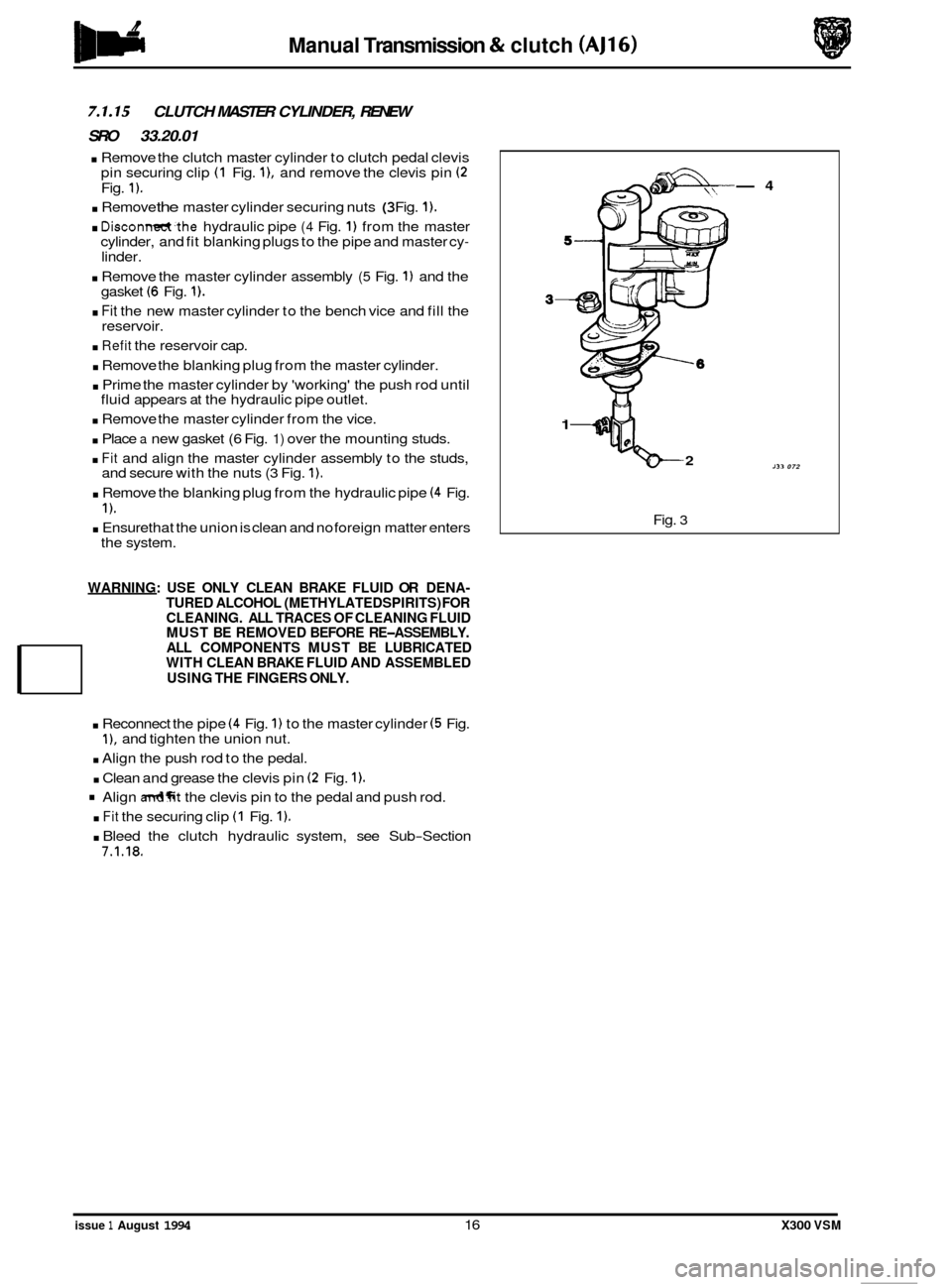
. Remove the clutch master cylinder to clutch pedal clevis
pin securing clip (1 Fig. I), and remove the clevis pin (2
Fig. 1).
. Remove the master cylinder securing nuts (3 Fig. 1).
. Disconm.the hydraulic pipe (4 Fig. 1) from the master
cylinder, and fit blanking plugs to the pipe and master cy- linder.
. Remove the master cylinder assembly (5 Fig. 1) and the
gasket (6 Fig. 1).
. Fit the new master cylinder to the bench vice and fill the
reservoir.
. Refit the reservoir cap.
. Remove the blanking plug from the master cylinder.
. Prime the master cylinder by 'working' the push rod until
fluid appears at the hydraulic pipe outlet.
. Remove the master cylinder from the vice.
. Place a new gasket (6 Fig. 1) over the mounting studs.
. Fit and align the master cylinder assembly to the studs,
. Remove the blanking plug from the hydraulic pipe (4 Fig.
. Ensure that the union is clean and no foreign matter enters
and secure
with the nuts
(3 Fig. 1).
1 ).
the system.
WARNING: USE ONLY CLEAN BRAKE FLUID OR DENA- TURED ALCOHOL (METHYLATED SPIRITS) FOR
CLEANING. ALL TRACES OF CLEANING FLUID
ALL COMPONENTS MUST BE LUBRICATED
WITH CLEAN BRAKE FLUID AND ASSEMBLED
USING THE FINGERS ONLY.
MUST
BE REMOVED BEFORE RE
-ASSEMBLY.
. Reconnect the pipe (4 Fig. 1) to the master cylinder (5 Fig. I), and tighten the union nut.
. Align the push rod to the pedal.
. Clean and grease the clevis pin (2 Fig. 1).
Align andfit the clevis pin to the pedal and push rod.
. Fit the securing clip (1 Fig. 1).
. Bleed the clutch hydraulic system, see Sub-Section
7.1.18.
-4
1
J33 072 2
Fig. 3
issue 1 August 1994 16 X300 VSM
Page 134 of 521
Manual Transmission & Clutch (AJ16)
e
7.1.16 CLUTCH SLAVE CYLINDER, RENEW
SRO 33.35.01
. Disconnect the pipe from the clutch slave cylinder, plug or
tape the pipe to prevent the ingress of any dirt.
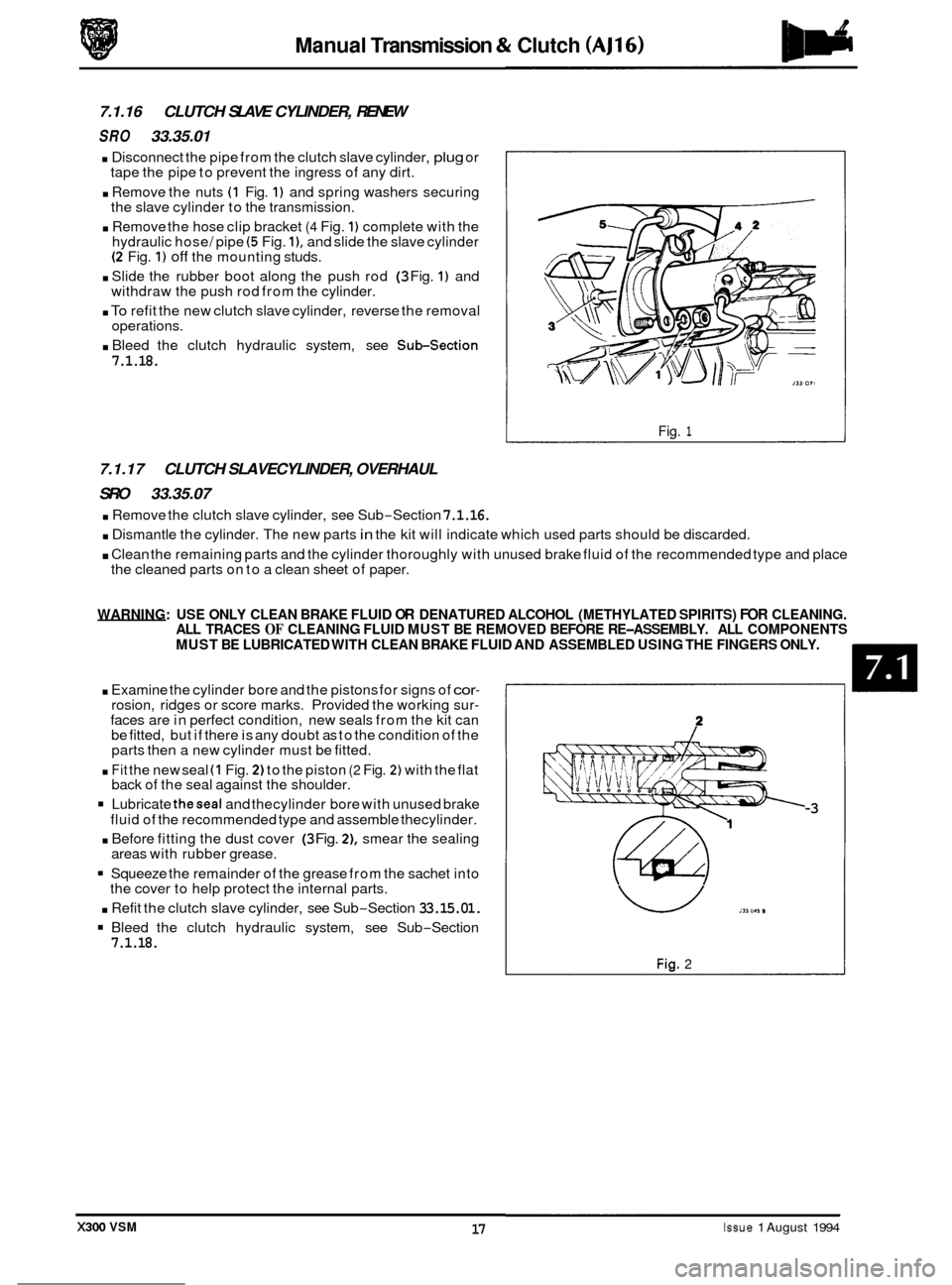
. Remove the nuts (1 Fig. 1) and spring washers securing
the slave cylinder to the transmission.
. Remove the hose clip bracket (4 Fig. 1) complete with the
hydraulic hose/ pipe (5 Fig. I), and slide the slave cylinder (2 Fig. 1) off the mounting studs.
. Slide the rubber boot along the push rod (3 Fig. 1) and
withdraw the push rod from the cylinder.
. To refit the new clutch slave cylinder, reverse the removal
operations.
. Bleed the clutch hydraulic system, see Subsection
7.1.18.
Fig. 1
7.1.17 CLUTCH SLAVECYLINDER, OVERHAUL
SRO 33.35.07
. Remove the clutch slave cylinder, see Sub-Section 7.1.16.
. Dismantle the cylinder. The new parts in the kit will indicate which used parts should be discarded.
. Clean the remaining parts and the cylinder thoroughly with unused brake fluid of the recommended type and place
the cleaned parts on to a clean sheet of paper.
WARNING: USE ONLY CLEAN BRAKE FLUID OR DENATURED ALCOHOL (METHYLATED SPIRITS) FOR CLEANING.
ALL TRACES OF CLEANING FLUID MUST BE REMOVED BEFORE RE-ASSEMBLY. ALL COMPONENTS
MUST BE LUBRICATED WITH CLEAN BRAKE FLUID AND ASSEMBLED USING THE FINGERS ONLY.
. Examine the cylinder bore and the pistons for signs of cor- rosion, ridges or score marks. Provided the working sur- faces are in perfect condition, new seals from the kit can
be fitted, but if there is any doubt as to the condition of the
parts then a new cylinder must be fitted.
. Fit the new seal (1 Fig. 2) to the piston (2 Fig. 2) with the flat
back of the seal against the shoulder.
Lubricate theseal and thecylinder bore with unused brake
fluid of the recommended type and assemble thecylinder.
. Before fitting the dust cover (3 Fig. 21, smear the sealing
areas with rubber grease.
Squeeze the remainder of the grease from the sachet into
the cover to help protect the internal parts.
. Refit the clutch slave cylinder, see Sub-Section 33.15.01.
Bleed the clutch hydraulic system, see Sub-Section 7.1.18.
U 111 "I, II
Fig. 2
-3
X300 VSM 17 Issue 1 August 1994
Page 135 of 521
Manual Transmission & Clutch (AJ16)
7.1.18 CLUTCH HYDRAULICSYSTEM, BLEED
SRO 33.15.01
CAUTION: Only use minimum DOT 4 brake fluid in the hy- draulic system.
. Remove the reservoir filler cap, and top up to the correct
level with hydraulic fluid.
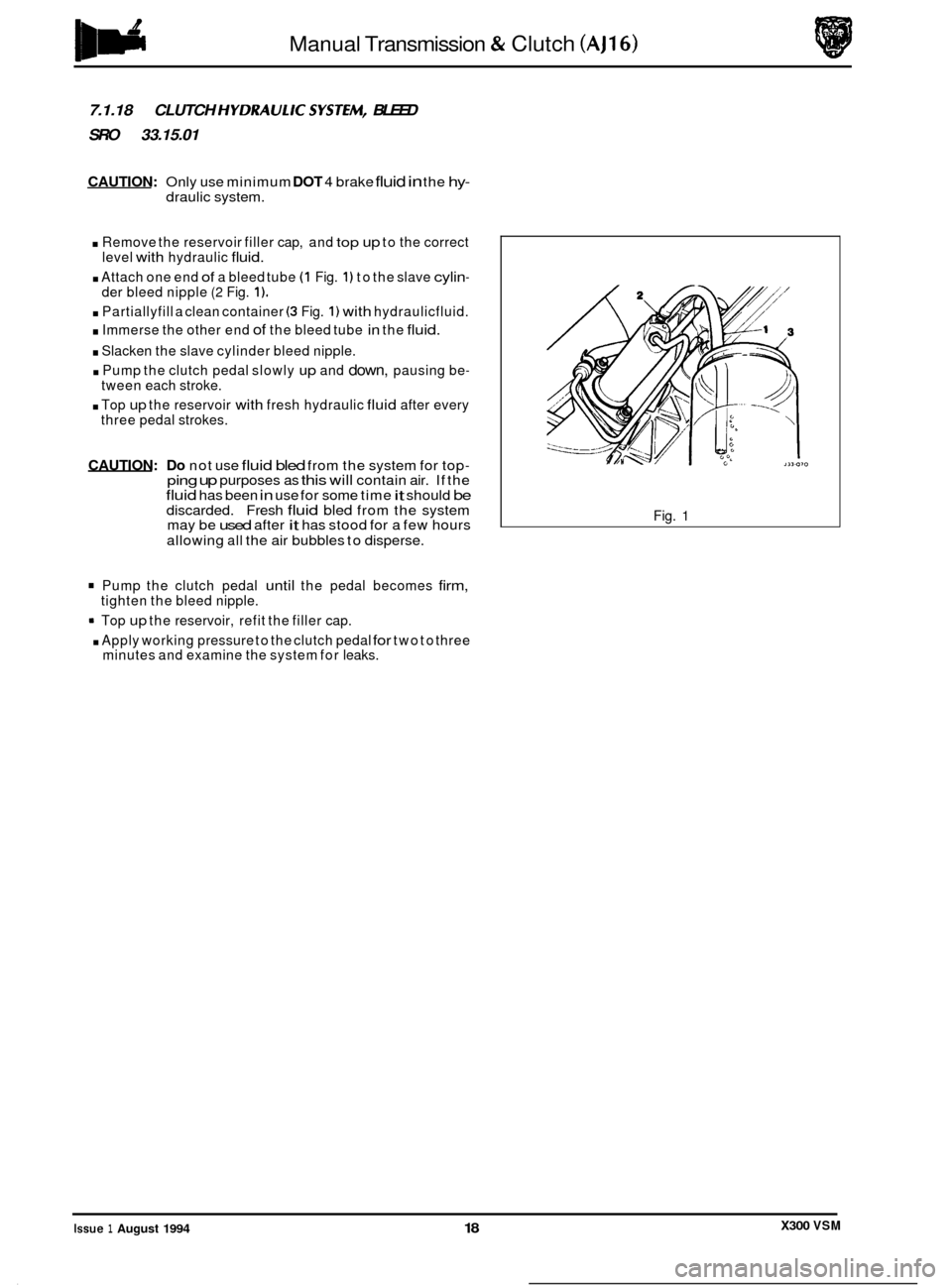
. Attach one end of a bleed tube (1 Fig. 1) to the slave cylin- der bleed nipple (2 Fig. 1).
. Partiallyfill a clean container (3 Fig. 1) with hydraulicfluid.
. Immerse the other end of the bleed tube in the fluid.
. Slacken the slave cylinder bleed nipple.
. Pump the clutch pedal slowly up and down, pausing be-
. Top up the reservoir with fresh hydraulic fluid after every
tween
each stroke.
three pedal strokes.
CAUTION: Do not use fluid bled from the system for top- ping up purposes as this will contain air. If the fluid has been in use for some time it should be discarded. Fresh fluid bled from the system
may be used after it has stood for a few hours
allowing
all the air bubbles to disperse.
Pump the clutch pedal until the pedal becomes firm,
a Top up the reservoir, refit the filler cap.
tighten
the bleed nipple.
. Apply working pressure to the clutch pedal for two to three
minutes and examine the system for leaks.
X300 VSM Issue 1 August 1994 18
Fig. 1
Page 141 of 521

Automatic Transmission (AJ16)
8.1.1.3 Shift Speeds
3,2 Liter
Up to 'kickdown point' D4 - D3 D3 - D2
D2 - D1 -
km/h 102 - 114 67 - 78
36 - 50 -
- mile / h 64-71 42 - 48 22 - 31
'Kick-down' available D4 - D3 D3 - D2 D2 - D1
mile I h 86-99 61 -67 30 - 37 -
kmlh 139 - 160 98- 108 48 - 60 -
available speed) -
km/h 108- 123 - -
- - Manual inhibit (maximum D4 - D3 D3 - D2
- - mile 1 h NOT INHIBITED 67 -76
TCC
- Torque converter clutch
Issue 1 August 1994 4 X300 VSM
Page 156 of 521
Automatic Transmission (V12 & AJl6 Supercharged) Pomrtrain
8.2.1 GENERAL DESCRIPTION
This section provides information relating to the Powertrain 4L80-E transmissions fitted to the 4,O liter supercharged
engine (4,OL SC) and to the 6,O liter engine (6,OL).
The Powertrain 4L80-E is a four-speed, high torque capacity, electronically controlled automatic transmission, which
comprises a torque converter with lock-up direct drive clutch and three planetary gear sets. Five multiple diskclutches,
one intermediate sprag clutch assembly, two roller clutch assemblies and two band assemblies provide the drive el- ements necessary for correct sequential gear engagement and operation.
The torque converter containing
a pump, a turbine (rotor), a stator assembly, and a clutch pressure disksplined to the
turbine, acts as a fluid coupling for smooth torque transmission from the engine. The converter also supplies addi- tional torque multiplication when necessary, and the torque converter clutch (TCC) pressure disk provides a mechan- ical direct drive or 'lock-up' above a certain speed in top gear for greater fuel economy.
Gearshift operations are controlled from the Transmission Control Module (TCM), which governs the electronically
controlled valve body situated within the transmission.
Three planetary gear sets provide reverse and the four forward ratios, the changing of which is fully automatic in rela
- tion to load, vehicle speed and throttle opening. The Transmission Control Module receives and integrates various ve- hicle sensor input signals, and transmits operating signals to the solenoids located in the control valve assembly.
These solenoids govern the transmission operating pressures, up-shift and down-shift gear selection patterns and
also the torque converter clutch operation by pulse width modulated control.
8.2.1.1 Gear Ranges
Selectable gear positions are: P - Park, R - Reverse, N - Neutral, D - Drive, 3, 2.
P - Park position of the shift lever provides a mechanical locking of the output shaft of the transmission, and as such,
must only be engaged when the the vehicle is stationary. In addition, and for
extra safety, the handbrake should also
be applied. It is necessary to have the ignition ON and the footbrake applied to move the shift lever from the Park
position. For ignition key removal the shift lever must be in the Park position. The engine can be started in the Park
position.
R - Reverse enables the vehicle to be operated in a rearwards direction. The engine cannot be started in the Reverse
position.
N
-Neutral position enables the engine to be started and operated without driving the vehicle. It also allows the vehicle
to be moved manually for access, ie for removal of the propeller shaft.
D
-Drive position allows the automatic selection of all four forward gear ratios during normal driving conditions for
maximum efficiency and fuel economy. On acceleration, down-shifts are obtained by depressing the accelerator pedal
or by manual selection. The engine cannot be started in this position.
3
- Manual third position allows automatic operation of the three lower gear ratios but inhibits selection of the fourth
ratio. This position is used for towing a trailer or negotiating hilly terrain when greater engine braking control is re- quired. The engine cannot be started in this position.
2 - Manual second position allows automatic operation of the two lower gear ratios but inhibits selection of the third
and fourth ratios. This position is used for heavy traffic congestion or negotiating hilly terrain when even greater en
- gine braking control is required than is provided by manual third. This ratio may be selected at any vehicle speed - even if the transmission is in third or fourth ratio, the transmission will immediately down-shift to second gear pro- vided the vehicle speed is below 137 km / h (85 mile / h). The engine cannot be started in this position.
N.g!b: With the Performance Mode switch in the NORMAL position, the vehicle will pull away in second gear. How- ever, if more than 75 per cent of throttle is applied when the vehicle speed is between zero and 13 km/ h (8 mile / h), then first gear will be selected. From 13 to 61 km/ h (8 to 38 mile/ h) first gear is obtainable by 'kick-down'.
In 'sport' mode thevehicle pulls away in first gear and the transmission operatesfully in all four forward gears.
X300 VSM 1 Issue 1 August 1994
Page 157 of 521
Automatic Transmission (V12 & AJ16 Supercharged) Powertrain
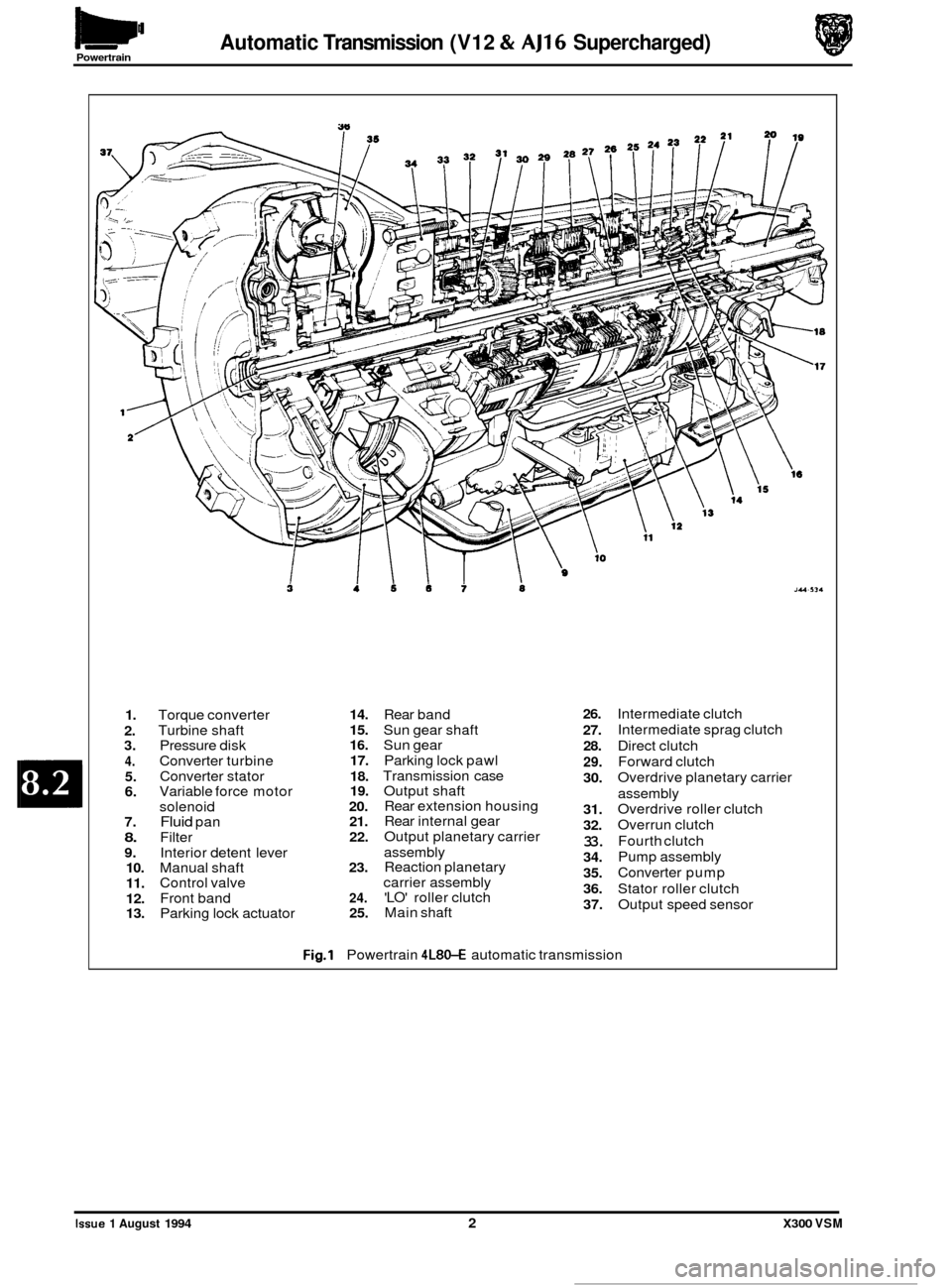
1.
2.
3.
4.
5. 6.
7.
8.
9. 10.
11.
12.
13.
Torque converter
Turbine shaft
Pressure disk
Converter turbine
Converter stator
Variable force motor
solenoid
Fluid pan
Filter
Interior detent lever
Manual shaft
Control valve
Front band
Parking lock actuator
3 4667 i JU-134
14.
15.
16.
17.
18.
19.
20. 21.
22.
23.
24. 25.
Rear band
Sun gear shaft
Sun gear
Parking lock pawl
Transmission case
Output shaft
Rear extension housing
Rear internal gear
Output planetary carrier
assembly Reaction planetary
carrier assembly
'LO' roller clutch
Main shaft
26.
27.
28.
29.
30.
31.
32.
33.
34.
35.
36.
37.
Intermediate clutch Intermediate sprag clutch
Direct clutch
Forward clutch
Overdrive planetary carrier
assembly
Overdrive roller clutch
Overrun clutch
Fourth clutch
Pump assembly
Converter pump
Stator roller clutch
Output speed sensor
Fig.1 Powertrain 4L8O-E automatic transmission
0
0
0
Issue 1 August 1994 2 X300 VSM