cooling JAGUAR XJ6 1994 2.G Owner's Manual
[x] Cancel search | Manufacturer: JAGUAR, Model Year: 1994, Model line: XJ6, Model: JAGUAR XJ6 1994 2.GPages: 521, PDF Size: 17.35 MB
Page 71 of 521
rn Cooling System (VI 2)
Diagnostic Procedures (continued)
Symptom
-0ss of cool-
ant
Possible Cause
Loose clips on hoses
Hoses perished
Radiator core leaking
Water pump seal leaking
Thermostat
gasket(s) leaking
Header tank cap defective
Porosity in castings
Corrosion caused by con
- centration of anti-freeze being
too low
Cylinder head
gasket(4 leak- ing
Cracked or damaged internal
engine component
Check
Check clips for correct tight-
ness
Visual check
Pressure
-test system
Pressure
-test system
Pressure
-test system. (Check
for distortion of thermostat
housing(s))
Inspect cap or test cap spring
pressure
Pressure
-test system
Pressure
-test system. Check
strength of coolant
Pressure
-test system. Check
for contamination of coolant
and engine lubrication system
Identify
component(s) affected. (Check for
contamination of engine
lubrication system)
Remedy
Tighten clips as required
Renew hoses as required
Repair or renew radiator
Renew water pump
Renew gasket. Renew
hous-
ing(s) if required
Renew cap Rectify as required
Rectify as required. Drain and
fill with coolant of correct con
-
centration
Renew head
gasket(s)
Rectify as required
Issue 1 August 1994 6 X300 VSM
Page 83 of 521
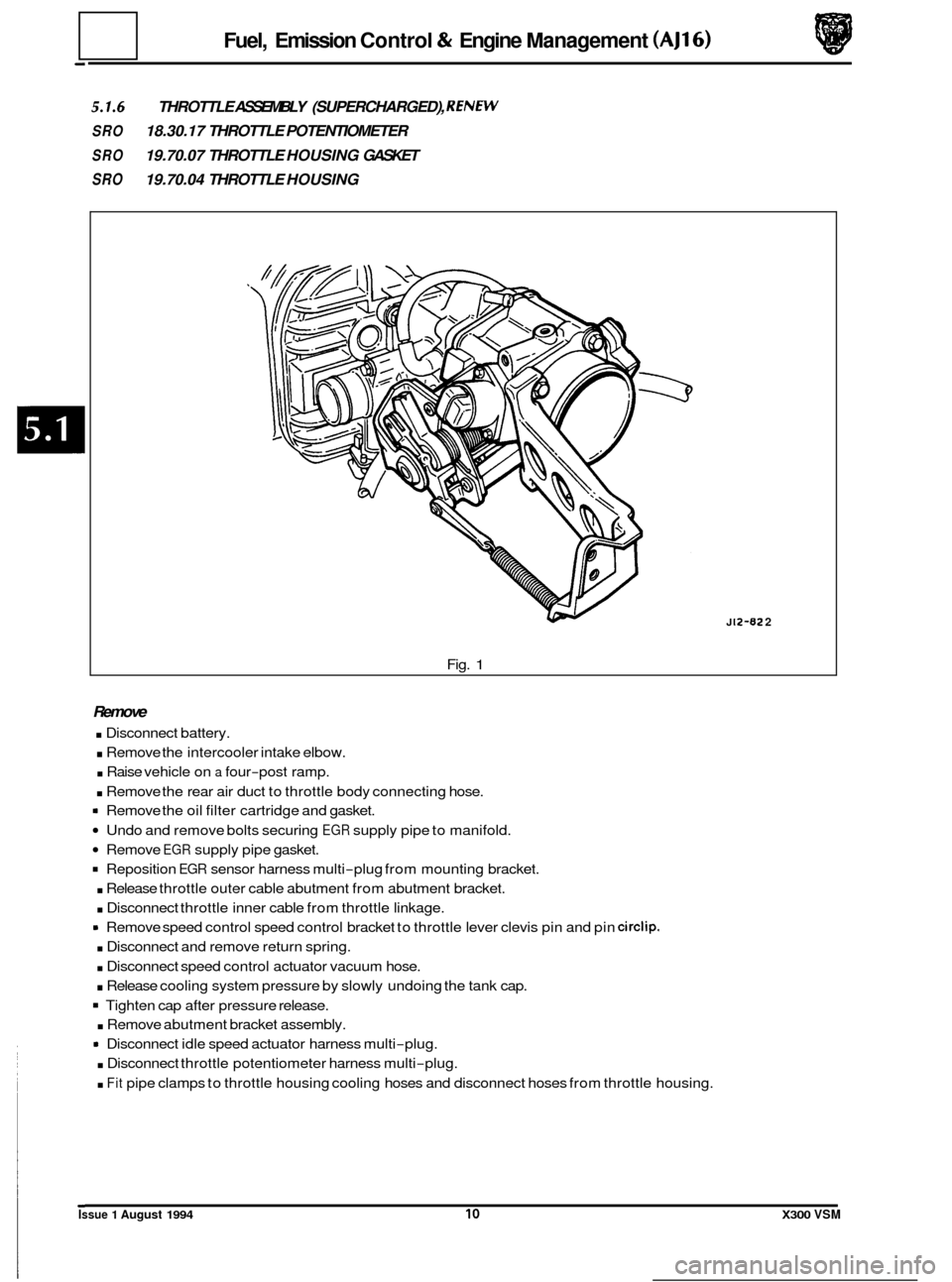
Fuel, Emission Control & Engine Management (AJ16)
5.1.6 THROTTLE ASSEMBLY (SUPERCHARGED), RENEW
SRO 18.30.17 THROTTLE POTENTIOMETER
SRO 19.70.07 THROTTLE HOUSING GASKET
SRO 19.70.04 THROTTLE HOUSING
J 12-62 2
Fig. 1
Remove
. Disconnect battery.
. Remove the intercooler intake elbow.
. Raise vehicle on a four-post ramp.
. Remove the rear air duct to throttle body connecting hose.
Undo and remove bolts securing EGR supply pipe to manifold.
Remove EGR supply pipe gasket.
Reposition EGR sensor harness multi-plug from mounting bracket.
. Release throttle outer cable abutment from abutment bracket.
. Disconnect throttle inner cable from throttle linkage.
. Disconnect and remove return spring.
. Disconnect speed control actuator vacuum hose.
. Release cooling system pressure by slowly undoing the tank cap.
Tighten cap after pressure release.
. Remove abutment bracket assembly.
Disconnect idle speed actuator harness multi
-plug.
. Disconnect throttle potentiometer harness multi-plug.
. Fit pipe clamps to throttle housing cooling hoses and disconnect hoses from throttle housing.
Remove
the oil filter cartridge and gasket.
Remove speed control speed control bracket to throttle lever clevis pin and pin
circlip.
e
0
0
0
Issue 1 August 1994 10 X300 VSM
Page 316 of 521
Climate Control Systems
CL /MATE CONTROL SYSTEM 0 14*2 14.2.1 Description
The climate control system in the 1995 model year saloon has a centre mounted heater / cooler unit with separate
blower assemblies, one LH and one RH. Heating temperature control is effected by means of a coolant flow valve and
circulation pump.
For models fitted with air conditioning, cooling is provide by passing air through the evaporator, which is situated im
- mediately behind the heater / cooler case inlet ducts.
Electric motors with integral potentiometers are used to position
all flaps.
W: There are no vacuum operated components in the system.
14.2.2 Features
o Self diagnostic control system with error codes.
0 Actuator 'self check'.
0 Display element check.
m: These features will be helpful for initial trouble shooting and where Jaguar Diagnostic Equipment (JDE) is not
available.
0 'Soft touch' logic controls. 0
0 Serial link from panel to control module (NCCM).
0 LCD display for temperature, status and fan speed.
0 Variable fan speed, whether in automatic or manual mode.
0 Manual air flow distribution over-rides.
0 Compensated air flow with regard to vehicle speed.
0 Rear footwell outlets.
0 Rear face outlets.
0 Scavenge system closed circuit temperature control.
0 Heated front screen (where fitted).
x300 VSM 3
Page 318 of 521
Climate Control Systems
8. AUTO selection display.
9. EXTERIOR temperature selection button. There are two modes:
a) Press and immediate release; provides timed display of four (4) seconds.
b) Press and hold for two (2) seconds; 'latches' the mode until operator over-ride.
10. A/C push-on / push-off button will either engage or disengage (as indicated by the state lamp) the refrigeration
system compressor. The state lamp is also used as a compressor speed fault indicator,see System protection, this
section.
11. AUTO push-on button and state lamp. When selected and the state lamp lit, the A/C mode is selected and control
of demand temperature, fans speed, and air distribution is automatic. AUTO is cancelled by selection of any 'dis- tribution' button, A/C off, or manual FANS SPEED.
12. DEFROST push
-on / push-off button and state lamp. When engaged, air is distributed to the screen at maximum
fans speed and the heated front screen elements (where fitted) are ener ized. The heated front screen is automati- cally timed for a six (6) minute cycle but may be cancelled by pressing tfe HEATED FRONT SCREEN button. Auto- matic temperature control is retained and the fans speed may be manually reduced. Deselection will return the
system to the previous state and selection of AUTO will resume automatic system control.
13. The push
-on / push-off (F) button with state lamp manually controls the HEATED FRONT SCREEN (where fitted).
This facility allows rapid screen de-icing using laminated electrical heating elements to supplement the hot air
defrost.
14. The push-on / push-off (R) button with state lamp manually controls the HEATED REAR SCREEN and door mirror
glass heating elements for a timed cycle of; screen twenty (20) minutes and mirrors eleven (1 1) minutes.
m: The state lamp will remain lit after the mirror timer has gone through its 11 minute cycle and will not go out
until either completion of the 20 minute screen cycle or manual override.
15. TEMPERATURE decrease button
in IoC or I0F steps.
16. TEMPERATURE increase button in
IoC or I0F steps.
w: Automatic temperature control operates over the range 17OC to 31OC (61OF to 90OF). Extreme limits selected
by items 15 and 16 ('Lo' and 'Hi') provide maximum cooling or heating at maximum fans speed.
17. FACE level manual distribution over
-ride push-on / push-off button and state lamp.
0 18. Bi LEVEL (foot and face) manual distribution over-ride push-on / push-off button and state lamp.
19. FOOT level manual distribution over
-ride push-on / push-off button and state lamp.
20. DEMIST (screen and foot) level manual distribution over
-ride push-on / push-off button and state lamp.
!Y&Q: Selection of AUTO will over-ride any manual setting and deselection of any manual distribution will revertthe
system to AUTO distribution.
21. FACE VENTTEMPERATURE CONTROL thumb
-wheel. Situated between dash centre face level vents to reduce face
air outlet temperature relative to that of the foot-well.
Issue 1 August 1994 X300 VSM 5
Page 319 of 521
Climate Control Systems
14.4 TEMPERATURE CONTROL
14.4.1 Coolant Circuit
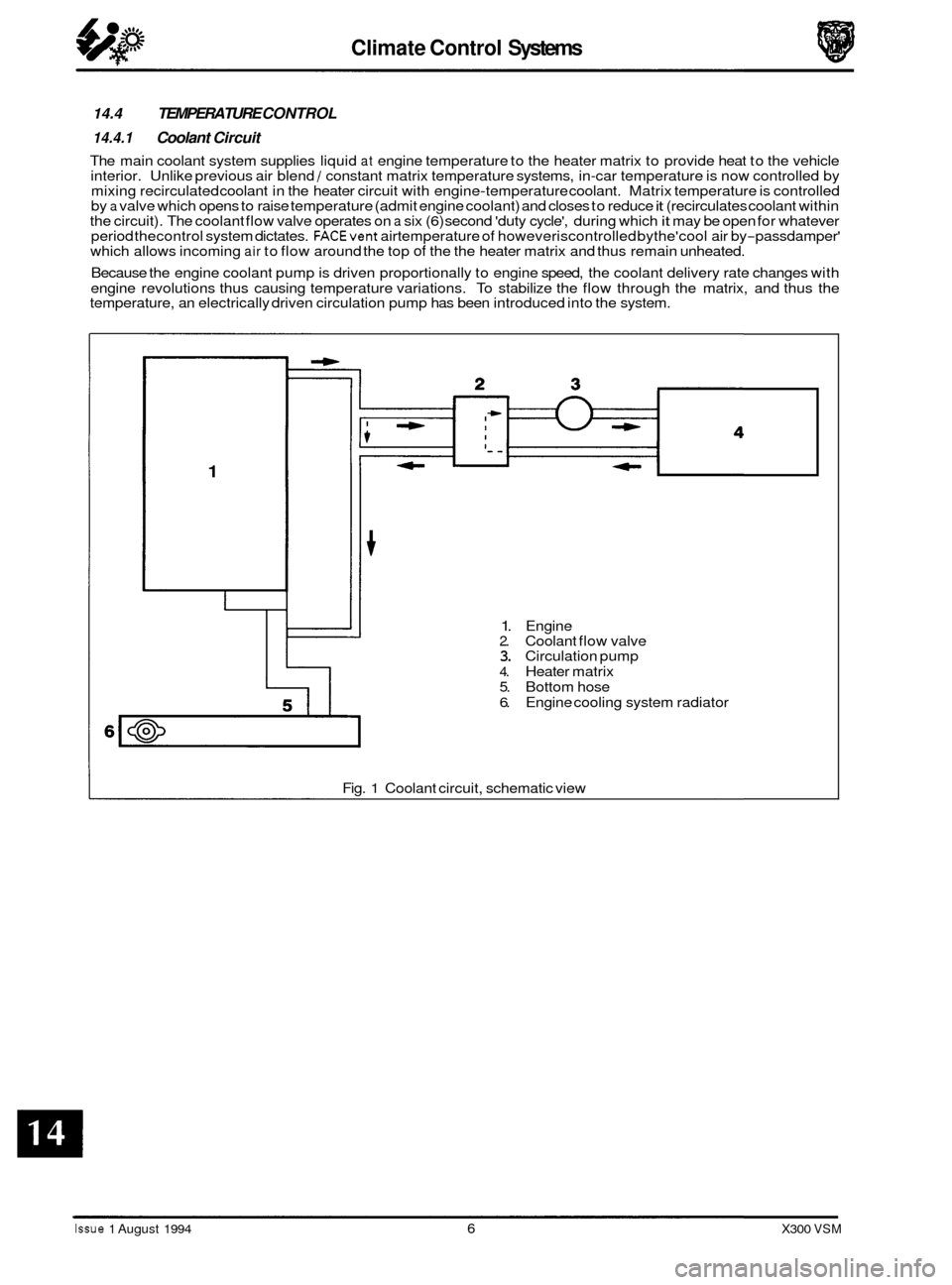
The main coolant system supplies liquid at engine temperature to the heater matrix to provide heat to the vehicle
interior. Unlike previous air blend / constant matrix temperature systems, in-car temperature is now controlled by
mixing recirculated coolant in the heater circuit with engine-temperature coolant. Matrix temperature is controlled
by a valve which opens to raise temperature (admit engine coolant) and closes to reduce it (recirculates coolant within
the circuit). The coolant flow valve operates on a six (6) second 'duty cycle', during which it may be open for whatever
period thecontrol system dictates. FACEvent airtemperature of howeveriscontrolled bythe'cool air by-passdamper'
which allows incoming air to flow around the top of the the heater matrix and thus remain unheated.
Because the engine coolant pump is driven proportionally to engine speed, the coolant delivery rate changes with
engine revolutions thus causing temperature variations. To stabilize the flow through the matrix, and thus the
temperature, an electrically driven circulation pump has been introduced into the system.
1
1. Engine 2. Coolant flow valve 3. Circulation pump
4. Heater matrix
5. Bottom hose
6. Engine cooling system radiator
Fig.
1 Coolant circuit, schematic view
Issue 1 August 1994 6 X300 VSM
Page 325 of 521
Climate Control Systems
14.8 REFRIGERATION CYCLE:
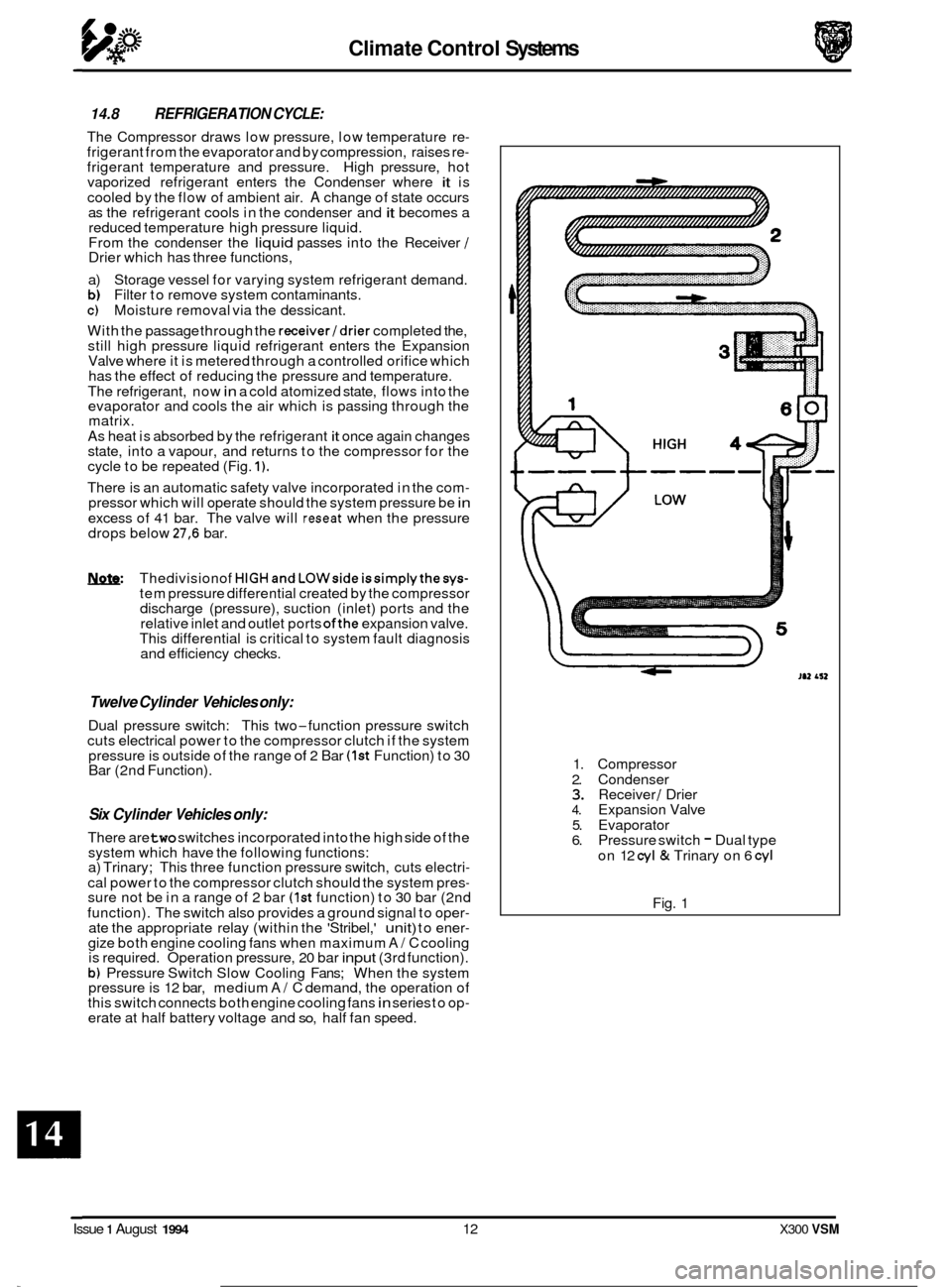
The Compressor draws low pressure, low temperature re- frigerant from the evaporator and by compression, raises re- frigerant temperature and pressure. High pressure, hot
vaporized refrigerant enters the Condenser where it is
cooled by the flow of ambient air.
A change of state occurs
as the refrigerant cools in the condenser and it becomes a
reduced temperature high pressure liquid.
From the condenser the
liquid passes into the Receiver / Drier which has three functions,
a) Storage vessel for varying system refrigerant demand.
b) Filter to remove system contaminants. c) Moisture removal via the dessicant.
With the passage through the
receiver/drier completed the,
still high pressure liquid refrigerant enters the Expansion
Valve where it is metered through a controlled orifice which
has the effect of reducing the pressure and temperature.
The refrigerant, now
in a cold atomized state, flows into the
evaporator and cools the air which is passing through the
matrix.
As heat is absorbed by the refrigerant
it once again changes
state, into a vapour, and returns to the compressor for the
cycle to be repeated (Fig.
1).
There is an automatic safety valve incorporated in the com- pressor which will operate should the system pressure be in
excess of 41 bar. The valve will reseat when the pressure
drops below 27,6 bar.
W Thedivisionof HIGHandLOWsideissimplythesys- tem pressure differential created by the compressor
discharge (pressure), suction (inlet) ports and the
relative inlet and outlet ports
ofthe expansion valve.
This differential is critical to system fault diagnosis
and efficiency checks.
Twelve Cylinder Vehicles only:
Dual pressure switch: This two-function pressure switch
cuts electrical power to the compressor clutch if the system
pressure is outside of the range
of 2 Bar (1st Function) to 30
Bar (2nd Function).
Six Cylinder Vehicles only:
There are two switches incorporated into the high side of the
system which have the following functions:
a) Trinary; This three function pressure switch, cuts electri
-
cal power to the compressor clutch should the system pres- sure not be in a range of 2 bar (1st function) to 30 bar (2nd
function). The switch also provides a ground signal to oper
- ate the appropriate relay (within the 'Stribel,' unit) to ener- gize both engine cooling fans when maximum A/ C cooling
is required. Operation pressure, 20 bar input (3rd function).
b) Pressure Switch Slow Cooling Fans; When the system
pressure is 12 bar, medium A/ C demand, the operation of
this switch connects both engine cooling fans in series to op- erate at half battery voltage and so, half fan speed. 1.
Compressor
2. Condenser
3. Receiver / Drier 4. Expansion Valve
5. Evaporator
6. Pressure switch - Dual type
on 12
cyl & Trinary on 6 cyl
Fig. 1
0
0
Issue 1 August 1994 12 X300 VSM
Page 328 of 521
Climate Control Systems
14.10 FAULT DIAGNOSIS
14.10.1 Introduction
It is very important to positively identifythe area of concern before starting a rectification procedure. A little time spent
with your customer to identify the conditions under which a problem occurs will be beneficial. Relevant criteria are:
Weather conditions, ambient temperature, intermittent or continuous fault, airflow fault, temperature control fault, dis
- tribution fault and air inlet problem.
14.10.2 Functional Check
This simple 'first line check' will allow you to ascertain whether the system is operating within its design parameters,
without recourse to (JDE). Please carry out the following, in order.
0 Start engine and attain normal running temperature.
0 Presss AUTO to display selected temperature and illuminate AUTO & AJC state lamps.
0 Rotate FAN to increase or decrease lower speed, verify bar graph representation.
0 Operate AJC to toggle on or off. Because the compressor can be inhibited by the engine management system,
ensure that the engine temperature is normal and that the ambient is above 5O C.
0 Operate RECIRC, state lamp should be lit and the flap behind the blower grille open.
0 Operate distribution buttons in turn, verify correct air distribution and relevant state lamp.
0 Operate DEFROST, check max fans and air to front screen.
0 Cycle TEMPERATURE to 'Hi' and 'Lo' to verify demanded variations and display operation. Note that extremes
will provide max heat or cold independent of in-car temperature.
0 Operate EX to toggle between ambient and control temperatures.
0 Operate HFS and HRW to note timer and mirror operation.
0 Initiate System Self Test to check for, and extract, stored faults should any of the above not perform as stated.
14.10.3 System symptoms
There are five basic symptoms associated with air conditioning fault diagnosis. The following conditions are not in order of priority.
No Cooling
0 Is the electrical circuit to the compressor clutch functional?
0 Is the electrical circuit to the blower motor(s) functional?
0 Slack or broken compressor drive belt.
0 Compressor partially or completely seized.
0 Compressor shaft seal leak.
0 Compressor valve or piston damage (may be indicated by small variation between HIGH &LOW side pressures
relative to engine speed).
0 Broken refrigerant pipe (causing total loss of refrigerant).
0 Leak in system (causing total loss of refrigerant) - possible code 23.
0 Blocked filter in the receiver drier.
0 Evaporator sensor disconnected - possible code 13.
0 Pressure switch faulty - possible code 23.
X300 VSM Issue 1 August 1994
Page 329 of 521
Climate Control Systems
lnsufficent Cooling
0 Sluggish blower motor(s).
0 Restricted blower inlet or outlet passage
0 Blocked or partially restricted condenser matrix or fins.
0 Blocked or partially restricted evaporator matrix.
0 Blocked or partially restricted filter in the receiver drier.
0 Blocked or partially restricted expansion valve.
0 Partially collapsed flexible pipe.
0 Expansion valve temperature sensor faulty (this sensor is integral with valve and is not serviceable).
0 Excessive moisture in the system.
0 Air in the system.
0 Low refrigerant charge - possible code 23.
0 Compressor clutch slipping.
0 Blower flaps or distribution vents closed or partially seized - possible codes 41 or 46.
0 Coolant flow valve not closed.
0 Evaporator sensor incorrectly positioned
m: Should a leakor low refrigerant be established as the cause of /NSUff/C/€NTCOOL/NG,followthe procedures
Recovery / Recycle / Recharge, this section, and observe all refrigerant and oil handling instructions.
lntermiffent Cooling
0 Is the electrical circuit to the compressor clutch consistent?
0 Is the electrical circuit to the blower motor(s) consistent?
0 Compressor clutch slipping?
0 Motorized in-car aspirator or evaporator temperature sensor faulty, causing temperature variations - possible
codes 11 or 13.
0 Blocked or partially restricted evaporator or condenser.
Noisy System
0 Loose or damaged compressor drive belt.
0 Loose or damaged compressor mountings.
0 Compressor oil level low, look for evidence of leakage.
0 Compressor damage caused by low oil level or internal debris.
0 Blower motor(s) noisy.
0 Excessive refrigerant charge, witnessed by vibration and 'thumping' in the high pressure line (may be indicated
by high HIGH & high LOW side pressures).
0 Low refrigerant charge causing 'hissing' at the expansion valve (may be indicated by low HIGH side pressure).
0 Excessive moisture in the system causing expansion valve noise.
0 Air-lock in water pump*.
lnsufficent Heating
0 Coolant flow valve stuck in the closed position.
0 Motorized in-car aspirator seized.
0 Cool air by-pass damper stuck or seized - possible code 43.
0 Blocked or restricted blower inlet or outlet.
0 Low coolant level.
0 Blower fan speed low.
0 Coolant thermostat faulty or seized open.
0 Water pump inoperative or blocked
0 Air-lock in matrix*.
m: * Please see Sections 4.1 and 4.2 for specific coolant fill / bleed procedures.
Electrical faults may be more rapidly traced using
(JDE), please refer to the (EDM).
Issue 1 August 1994 16 X300 VSM
Page 333 of 521
Climate Control Systems
14.13 SYSTEM CHECKING WITH MANIFOLD GAUGE Sm
14.13.1 Evacuating the Manifold Gauge Set
Attach the centre (service) hose to a vacuum pump and start the pump. Open fully both high anddow valves and allow
the vacuum to remove air and moisture from the manifold set for at least five minutes.
Turn the vacuum pump off and isolate it from the centre service hose but do not open the hose to atmosphere.
CAUTION: It is imperative that the vacuum pump is not subjected to a positive pressure of any degree. Therefore
the pump must be frtted with an isolation valve at the centre (service hose) connection and this valve
must be closed before the pump is switched off. This operation replaces the 'purge' procedure used on
previous systems. Observe the manufacturefs recommendation with regard to vacuum pump oil
changes.
14.13.2 Connecting the Manifold Gauge Set
CAUTION: Only use hoses with connectors which are dedicated to HFC 134A charge ports.
Attachment of the hose quick release connectors to the high and low side system ports is straightfotward, provided
that the high and low valves are closed and the system is NOT operational.
Assessment of system operating efficiency and fault classification may be achieved by using the facilities on your
Re- covery / Recharging / Recycling station, follow the manufacturers instructions implicitly and observe all safety con- siderations.
WARNING: UNDER NO CIRCUMSTANCES SHOULD THE CONNECTIONS BE MADE WITH THE SYSTEM IN
OPERATION OR THE VALVES OPEN. SHOULD THE VALVES BE OPEN AND A VACUUM PUMP OR
REFRIGERANT CONTAINER ATTACHED, AN EXPLOSION COULD OCCUR AS A RESULT OF HIGH
PRESSURE REFRIGERANT BEING FORCED BACK INTO THE VACUUM PUMP
OR CONTAINER.
14.13.3 Stabilizing the System
Accurate test gauge data will only be attained if the system temperatures and pressures are stabilized.
Ensure that equipment and hoses cannot come into contact with engine moving parts or sources of heat.
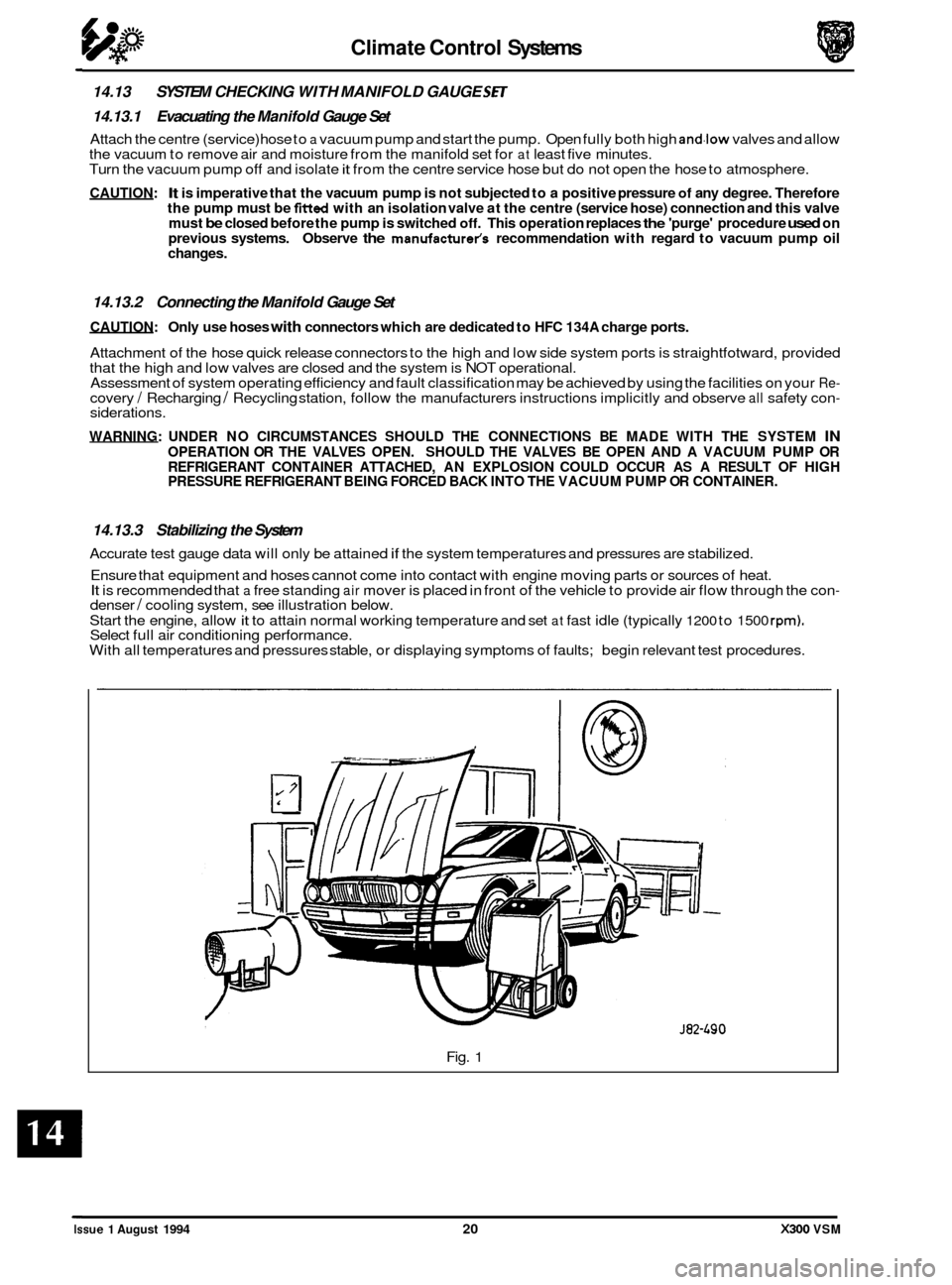
It is recommended that a free standing air mover is placed in front of the vehicle to provide air flow through the con- denser / cooling system, see illustration below.
Start the engine, allow
it to attain normal working temperature and set at fast idle (typically 1200 to 1500 rpm). Select full air conditioning performance.
With all temperatures and pressures stable, or displaying symptoms of faults; begin relevant test procedures.
Fig.
1
Issue 1 August 1994 20 X300 VSM
Page 336 of 521
Climate Control Systems
High Side Gauge
Normal
@ 14.16 SYSTEM PRESSURE FAULT CLASSIFICATION
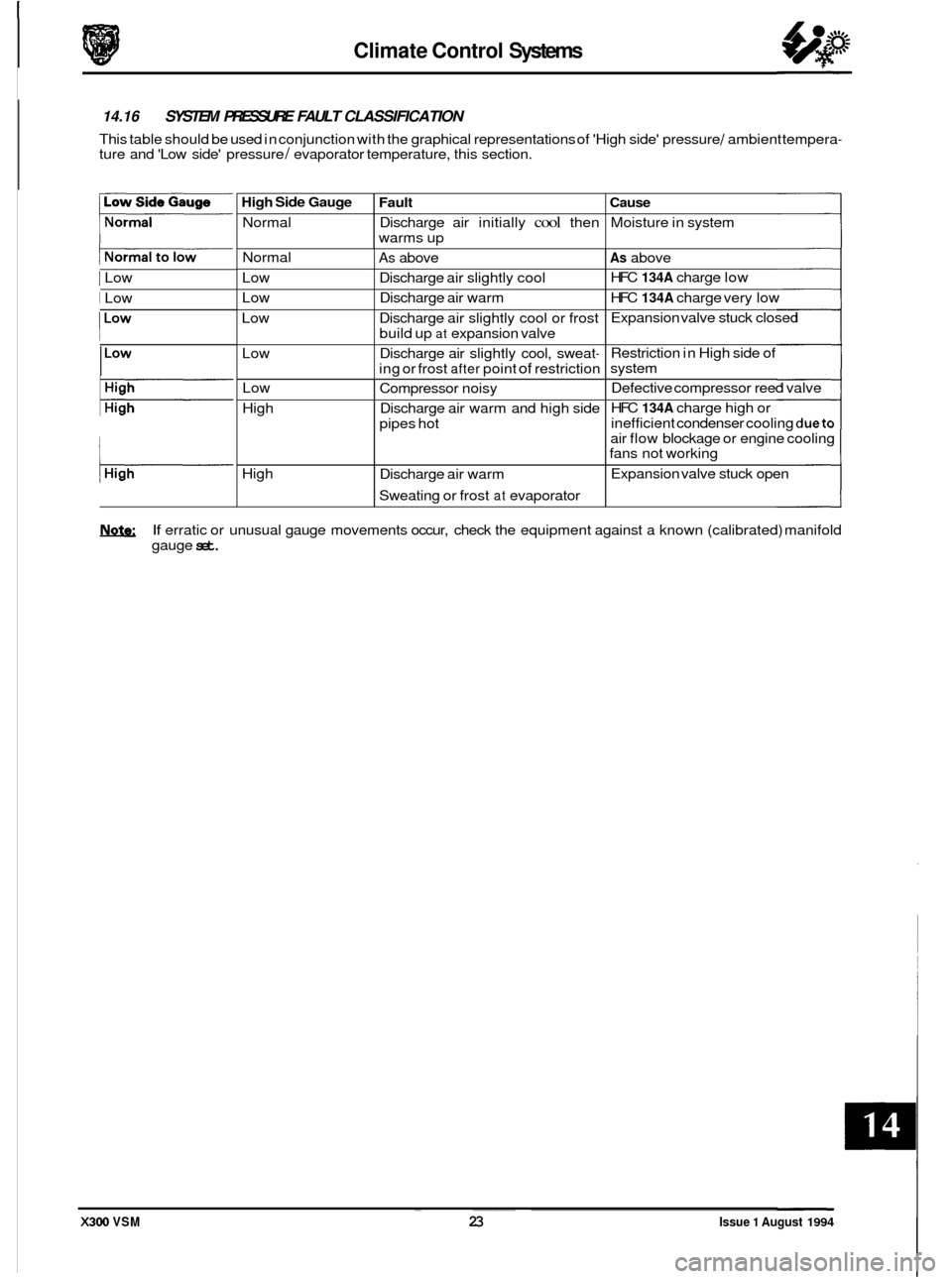
This table should be used in conjunction with the graphical representations of 'High side' pressure / ambient tempera- ture and 'Low side' pressure / evaporator temperature, this section.
Fault Cause
Discharge air initially cool then Moisture in system
warms up
1 Low Normal
Low
Low
Low
Low
I Low
As above As above
Discharge air slightly cool HFC
134A charge
low
Discharge air warm HFC
134A charge very low
Discharge air slightly cool or frost Expansion valve
stuck closed
build up
at expansion valve
Discharge air slightly cool, sweat
- Restriction in High side of
ing or frost
after point of restriction system
I
Low
High
High
I
Compressor noisy Defective compressor
reed valve
Discharge air warm and high side HFC
134A charge
high or
pipes hot inefficient
condenser cooling
dueto
air flow blockage or engine cooling
fans not working
Expansion valve stuck open
Discharge air warm
Sweating or frost
at evaporator
If erratic or unusual gauge movements occur, check the equipment against a known (calibrated) manifold
gauge
set. ~ ~~~
X300 VSM 23 Issue 1 August 1994