lock JAGUAR XJ6 1997 2.G Manual PDF
[x] Cancel search | Manufacturer: JAGUAR, Model Year: 1997, Model line: XJ6, Model: JAGUAR XJ6 1997 2.GPages: 227, PDF Size: 7.2 MB
Page 123 of 227
3261 Jaguar XJ6
9
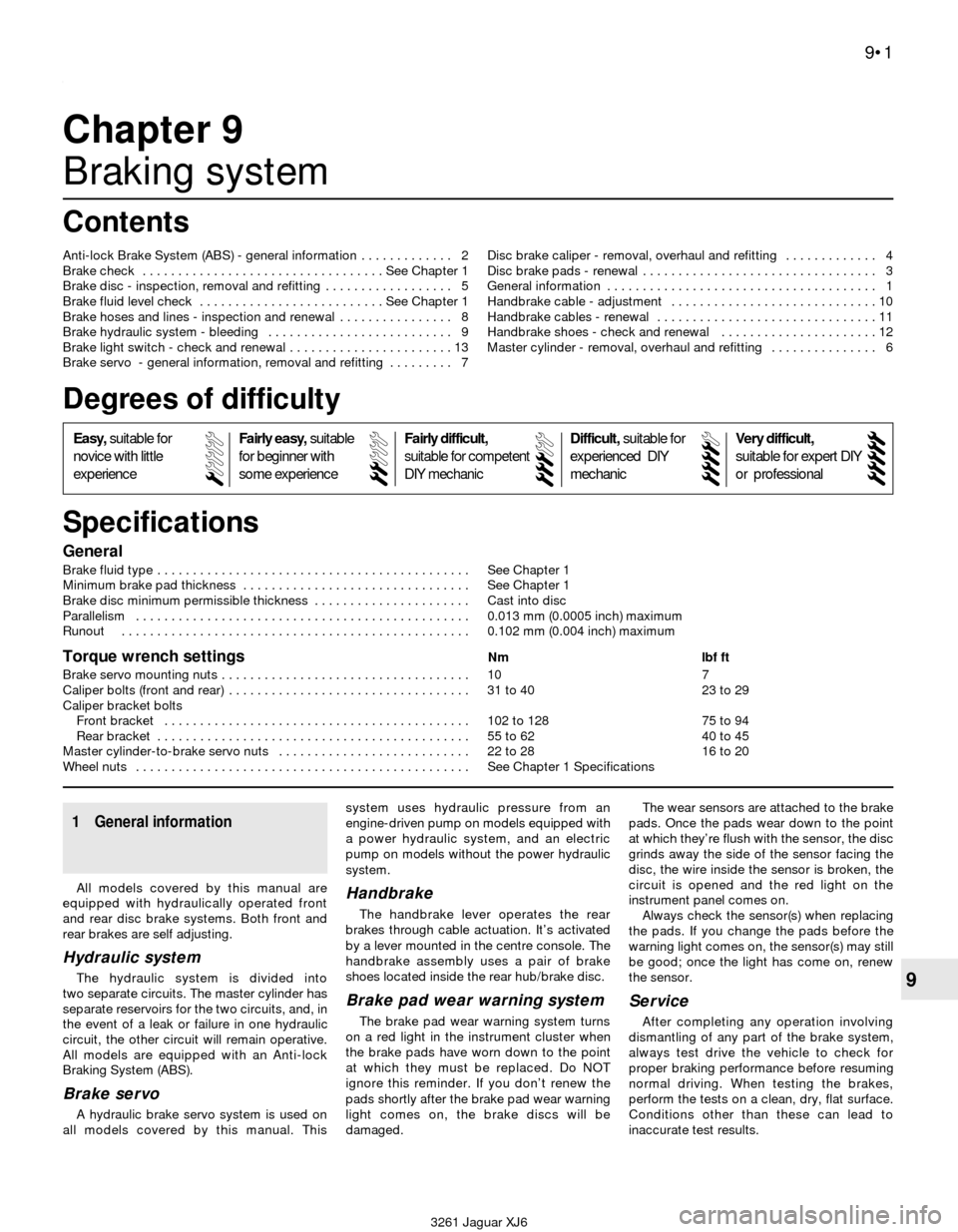
Chapter 9
Braking system
General
Brake fluid type . . . . . . . . . . . . . . . . . . . . . . . . . . . . . . . . . . . . . . . . . . . . See Chapter 1
Minimum brake pad thickness . . . . . . . . . . . . . . . . . . . . . . . . . . . . . . . . See Chapter 1
Brake disc minimum permissible thickness . . . . . . . . . . . . . . . . . . . . . . Cast into disc
Parallelism . . . . . . . . . . . . . . . . . . . . . . . . . . . . . . . . . . . . . . . . . . . . . . . 0.013 mm (0.0005 inch) maximum
Runout . . . . . . . . . . . . . . . . . . . . . . . . . . . . . . . . . . . . . . . . . . . . . . . . . 0.102 mm (0.004 inch) maximum
Torque wrench settingsNm lbf ft
Brake servo mounting nuts . . . . . . . . . . . . . . . . . . . . . . . . . . . . . . . . . . . 10 7
Caliper bolts (front and rear) . . . . . . . . . . . . . . . . . . . . . . . . . . . . . . . . . . 31 to 40 23 to 29
Caliper bracket bolts
Front bracket . . . . . . . . . . . . . . . . . . . . . . . . . . . . . . . . . . . . . . . . . . . 102 to 128 75 to 94
Rear bracket . . . . . . . . . . . . . . . . . . . . . . . . . . . . . . . . . . . . . . . . . . . . 55 to 62 40 to 45
Master cylinder-to-brake servo nuts . . . . . . . . . . . . . . . . . . . . . . . . . . . 22 to 28 16 to 20
Wheel nuts . . . . . . . . . . . . . . . . . . . . . . . . . . . . . . . . . . . . . . . . . . . . . . . See Chapter 1 Specifications Anti-lock Brake System (ABS) - general information . . . . . . . . . . . . . 2
Brake check . . . . . . . . . . . . . . . . . . . . . . . . . . . . . . . . . . See Chapter 1
Brake disc - inspection, removal and refitting . . . . . . . . . . . . . . . . . . 5
Brake fluid level check . . . . . . . . . . . . . . . . . . . . . . . . . . See Chapter 1
Brake hoses and lines - inspection and renewal . . . . . . . . . . . . . . . . 8
Brake hydraulic system - bleeding . . . . . . . . . . . . . . . . . . . . . . . . . . 9
Brake light switch - check and renewal . . . . . . . . . . . . . . . . . . . . . . . 13
Brake servo - general information, removal and refitting . . . . . . . . . 7Disc brake caliper - removal, overhaul and refitting . . . . . . . . . . . . . 4
Disc brake pads - renewal . . . . . . . . . . . . . . . . . . . . . . . . . . . . . . . . . 3
General information . . . . . . . . . . . . . . . . . . . . . . . . . . . . . . . . . . . . . . 1
Handbrake cable - adjustment . . . . . . . . . . . . . . . . . . . . . . . . . . . . . 10
Handbrake cables - renewal . . . . . . . . . . . . . . . . . . . . . . . . . . . . . . . 11
Handbrake shoes - check and renewal . . . . . . . . . . . . . . . . . . . . . . 12
Master cylinder - removal, overhaul and refitting . . . . . . . . . . . . . . . 6
9•1
Specifications Contents
Easy,suitable for
novice with little
experienceFairly easy,suitable
for beginner with
some experienceFairly difficult,
suitable for competent
DIY mechanic
Difficult,suitable for
experienced DIY
mechanicVery difficult,
suitable for expert DIY
or professional
Degrees of difficulty
54321
1 General information
All models covered by this manual are
equipped with hydraulically operated front
and rear disc brake systems. Both front and
rear brakes are self adjusting.
Hydraulic system
The hydraulic system is divided into
two separate circuits. The master cylinder has
separate reservoirs for the two circuits, and, in
the event of a leak or failure in one hydraulic
circuit, the other circuit will remain operative.
All models are equipped with an Anti-lock
Braking System (ABS).
Brake servo
A hydraulic brake servo system is used on
all models covered by this manual. Thissystem uses hydraulic pressure from an
engine-driven pump on models equipped with
a power hydraulic system, and an electric
pump on models without the power hydraulic
system.
Handbrake
The handbrake lever operates the rear
brakes through cable actuation. It’s activated
by a lever mounted in the centre console. The
handbrake assembly uses a pair of brake
shoes located inside the rear hub/brake disc.
Brake pad wear warning system
The brake pad wear warning system turns
on a red light in the instrument cluster when
the brake pads have worn down to the point
at which they must be replaced. Do NOT
ignore this reminder. If you don’t renew the
pads shortly after the brake pad wear warning
light comes on, the brake discs will be
damaged.The wear sensors are attached to the brake
pads. Once the pads wear down to the point
at which they’re flush with the sensor, the disc
grinds away the side of the sensor facing the
disc, the wire inside the sensor is broken, the
circuit is opened and the red light on the
instrument panel comes on.
Always check the sensor(s) when replacing
the pads. If you change the pads before the
warning light comes on, the sensor(s) may still
be good; once the light has come on, renew
the sensor.
Service
After completing any operation involving
dismantling of any part of the brake system,
always test drive the vehicle to check for
proper braking performance before resuming
normal driving. When testing the brakes,
perform the tests on a clean, dry, flat surface.
Conditions other than these can lead to
inaccurate test results.
Page 124 of 227
Test the brakes at various speeds with both
light and heavy pedal pressure. The vehicle
should stop evenly without pulling to one side
or the other. Avoid locking the brakes,
because this slides the tyres and diminishes
braking efficiency and control of the vehicle.
Tyres, vehicle load and wheel alignment are
factors which also affect braking performance.
2 Anti-lock Brake system
(ABS)- general information
The Anti-lock Brake System is designed to
maintain vehicle steerability, directional stability
and optimum deceleration under severe
braking conditions on most road surfaces. It
does so by monitoring the rotational speed of
each wheel and controlling the brake line
pressure to each wheel during braking. This
prevents the wheels from locking up.
The ABS system has three main units - the
wheel speed sensors, the electronic control unit
and the modulator (hydraulic control unit). The
sensors - one at each wheel - send a variable
voltage signal to the electronic control unit,
which monitors these signals, compares them
to its program and determines whether a wheel
is about to lock up. When a wheel is about to
lock up, the control unit signals the hydraulic
unit to reduce hydraulic pressure (or not
increase it further) at that wheel’s brake caliper.
Pressure modulation is handled by three
electrically-operated solenoid valves - one for
each front wheel and one for the rear wheels -
inside the modulator.
If a problem develops within the system, an
“ABS” warning light will glow on the dashboard.
Sometimes, a visual inspection of the ABS
system can help you locate the problem.
Carefully inspect the ABS wiring harness. Pay
particularly close attention to the harness and
connections near each wheel. Look for signs of
chafing and other damage caused by
incorrectly routed wires. If a wheel sensor
harness is damaged, the sensor should be
replaced (the harness and sensor are integral).
Warning: Do NOT try to repair an
ABS wiring harness. The ABS
system is sensitive to even thesmallest changes in resistance. Repairing
the harness could alter resistance values
and cause the system to malfunction. If the
ABS wiring harness is damaged in any way,
it must be replaced.
Caution: Make sure the ignition is turned
off before unplugging or reattaching any
electrical connections.
Diagnosis and repair
If a dashboard warning light comes on and
stays on while the vehicle is in operation, the
ABS system requires attention. Although
special electronic ABS diagnostic testing tools
are necessary to properly diagnose the system,
you can perform a few preliminary checks
before taking the vehicle to a dealer service
department or other qualified repair workshop.
a) Check the brake fluid level in the master
cylinder reservoir.
b) Verify that all ABS system electrical
connectors in the engine compartment
are plugged in.
c) Check the fuses.
d) Follow the wiring harness to each front
wheel and to the differential sensor and
verify that all connections are secure and
that the wiring is undamaged.
If the above preliminary checks do not
rectify the problem, the vehicle should be
diagnosed by a dealer service department.
Due to the complex nature of this system, all
actual repair work must be done by a dealer
service department or other qualified repair
workshop.
3 Disc brake pads- renewal
2
Warning: Disc brake pads must
be replaced on both front wheels
or both rear wheels at the same
time - never renew the pads on
only one wheel. Also, the dust created by
the brake system may contain asbestos,
which is harmful to your health. Never blow
it out with compressed air and don’t inhale
any of it. An approved filtering mask should
be worn when working on the brakes. Do
not, under any circumstances, use
petroleum-based solvents to clean brake
parts. Use brake system cleaner only!
Note:The following procedure applies to both
the front and rear brake pads.
1Remove the cap from the brake fluid
reservoir and siphon off about two-thirds of
the fluid from the reservoir. Failing to do this
could result in fluid overflowing when the
caliper pistons are pressed into their bores.
2Loosen the wheel nuts, raise the front of the
vehicle and support it securely on axle stands.
3Remove the front wheels. Work on one
brake assembly at a time, using the
assembled brake for reference if necessary.
4Inspect the brake disc (see Section 5).
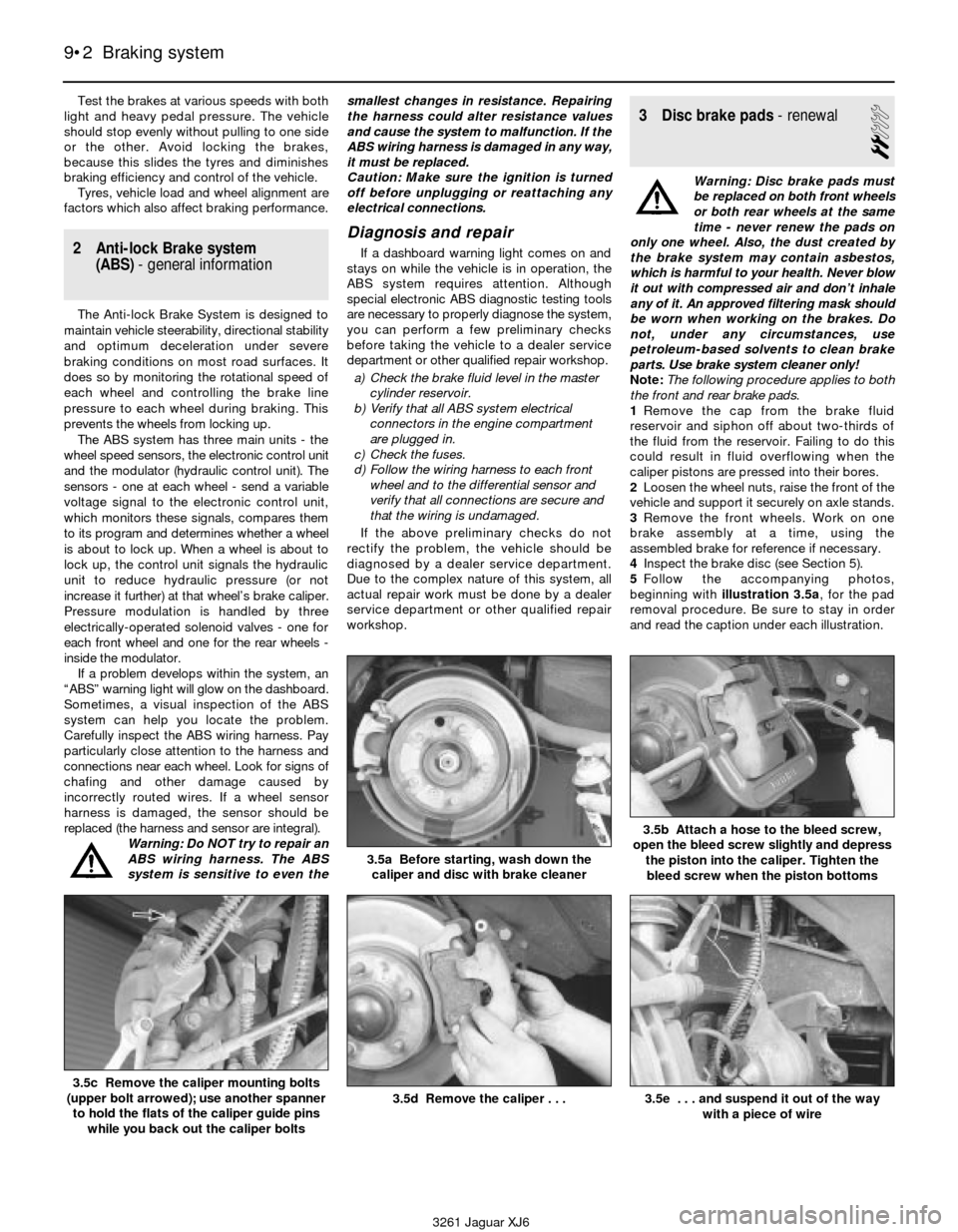
5Follow the accompanying photos,
beginning with illustration 3.5a, for the pad
removal procedure. Be sure to stay in order
and read the caption under each illustration.
9•2 Braking system
3.5a Before starting, wash down the
caliper and disc with brake cleaner
3.5b Attach a hose to the bleed screw,
open the bleed screw slightly and depress
the piston into the caliper. Tighten the
bleed screw when the piston bottoms
3.5c Remove the caliper mounting bolts
(upper bolt arrowed); use another spanner
to hold the flats of the caliper guide pins
while you back out the caliper bolts3.5d Remove the caliper . . .3.5e . . . and suspend it out of the way
with a piece of wire
3261 Jaguar XJ6
Page 126 of 227

necessary to detach the brake line. If you’re
removing the caliper for overhaul, detach the
hose from the metal line at the frame bracket
(see Section 8), then disconnect the brake line
from the caliper with a flare-nut spanner to
protect the fitting (see illustration). Plug the
metal line to keep contaminants out of the
brake system and to prevent losing brake
fluid.
3Refer to illustration 3.5c and unbolt the
front or rear caliper.
Overhaul
4Before you remove the piston, place a
wood block between the piston and caliper to
prevent damage as it is removed.
5To remove the piston from the caliper,
apply compressed air to the brake fluid hose
connection on the caliper body (see
illustration). Use only enough pressure to
ease the piston out of its bore. Remove the
dust boot.
Warning: Be careful not to place
your fingers between the piston
and the caliper as the piston
may come out with some force.
Be sure to wear eye protection when using
compressed air.
6Inspect the mating surfaces of the piston
and caliper bore wall. If there is any scoring,
rust, pitting or bright areas, renew the
complete caliper unit with a new one.
7If these components are in good condition,
remove the piston seal from the caliper bore
using a wooden or plastic tool (see
illustration). Metal tools may damage the
cylinder bore.
8Remove the caliper guide pins and the
rubber dust boots from the caliper bracket.
9Wash all the components in brake system
cleaner.
10Using the correct rebuild kit for your
vehicle, reassemble the caliper as follows.11Submerge the new rubber seal in clean
brake fluid and refit it in the lower groove in
the caliper bore, making sure it isn’t twisted.
12Coat the piston with clean brake fluid and
stretch the new dust boot over the bottom of
the piston. Hold the piston over the caliper
bore and insert the rubber flange of the dust
boot into the upper groove in the bore. Start
with the side farthest from you and work your
way around toward the front until it is
completely seated. Push the piston into the
caliper bore until it is bottomed in the bore,
then seat the top of the dust boot in the
groove in the piston.
13Lubricate the sliding surfaces of the guide
pins with silicone-based grease (usually
supplied in the kit), then refit the new dust
boots and pins into the caliper bracket.
Refitting
14Refit the caliper by reversing the removal
procedure (see Section 3).
15If the brake hose was disconnected from
the caliper, bleed the brake system (see
Section 9).
5 Brake disc- inspection,
removal and refitting
2
Note:The following procedure applies to both
the front and rear brake discs.
Inspection
1Loosen the wheel nuts, raise the vehicle
and support it securely on axle stands.
Remove the wheel and refit three nuts to hold
the disc in place. If the rear brake disc is being
worked on, release the handbrake.
2Remove the brake caliper as outlined in
Section 4. It is not necessary to disconnect
the brake hose. After removing the caliper,
suspend it out of the way with a piece of wire.
3Visually inspect the disc surface for scoring
or damage. Light scratches and shallow
grooves are normal after use and may not
always be detrimental to brake operation, but
deep scoring - over 0.015 inch - requires disc
removal and refinishing by an automotive
machine shop. Be sure to check both sides of
the disc (see illustration). If pulsating has
9•4 Braking system
4.7 Remove the piston seal from the
caliper bore using a wooden or plastic tool
(metal tools may damage the
cylinder bore)5.3 The brake pads on this vehicle were
obviously neglected, as they wore down to
the rivets and cut deep grooves into the
disc - this disc must be replaced
3261 Jaguar XJ6 4.2 Use a flare-nut spanner to protect the brake hose fitting when
unscrewing it from the caliper
4.5 With the caliper padded to catch the piston, use compressed
air to force the piston out of its bore - make sure your fingers are
not between the piston and the caliper
Page 129 of 227

Braking system 9•7
9
6.7d Pry off the end cap6.7e Locate the stopper pin (arrowed)
inside the forward grommet hole . . .6.7f . . . insert a punch into the pocket of
the primary piston, place the master
cylinder vertically as shown, push down
on the master cylinder to depress the
pistons and pull out the stopper pin
with a magnet
6.7g Remove the primary piston6.7h Remove the secondary piston6.7i If the secondary piston is stuck, rap
the master cylinder on a wood block to
dislodge it
3261 Jaguar XJ6
6.7j Remove the seals and cups from the
pistons - be very careful not to scratch the
piston surface - then wash the secondary
piston with clean brake fluid and inspect it;
if the secondary piston is damaged, you
must renew the master cylinder with a new
or rebuilt unit (a new primary piston is
included with the rebuild kit)6.7l The master cylinder assembly
1 Roll pin
2 Reservoir
3 Grommets
4 End plate
5 Primary piston
6 Secondary piston stopper pin
7 Secondary piston6.7k Refit the new O-ring seals and cups
as shown; make sure the cups on the
primary piston (the one on the left) face
forward as shown (toward the spring), and
the cups on the secondary piston (the one
on the right) face out, away from the piston
(the one on the left faces toward the
primary piston, the one on the right faces
toward the spring)
Page 131 of 227
being drawn back into the master cylinder.
Wait several seconds for brake fluid to be
drawn from the reservoir into the piston bore,
then depress the piston again, removing your
finger as brake fluid is expelled. Be sure to put
your finger back over the hole each time
before releasing the piston, and when the
bleeding procedure is complete for that outlet,
renew the plug and snug it up before going on
to the other port.
Refitting
16Refit the master cylinder over the studs on
the brake servo and tighten the mounting nuts
only finger tight at this time.
17Thread the brake line fittings into the
master cylinder. Since the master cylinder is
still a bit loose, it can be moved slightly to
allow the fitting threads to start easily. Do not
strip the threads as the fittings are tightened.
18Tighten the brake fittings securely and the
mounting nuts to the torque listed in this
Chapter’s Specifications.
19Fill the master cylinder reservoir with fluid,
then bleed the master cylinder and the brake
system (see Section 9).
20To bleed the master cylinder on the
vehicle, have an assistant pump the brake
pedal several times and then hold the pedal to
the floor. Loosen the fitting nut to allow air and
fluid to escape, then tighten the nut. Repeat
this procedure on both fittings until the fluid is
clear of air bubbles. Test the operation of the
brake system carefully before placing the
vehicle into service.
7 Brake servo-
general information,
removal and refitting
2
General information
1A hydraulic brake servo system assists
braking when the brake pedal is depressed.
The booster unit, located between the brake
pedal box and the master cylinder, is operated
by hydraulic pressure generated by an engine-
driven pump (on early models) or by an electric
pump (on later models). When the engine isrunning, the pump supplies hydraulic pressure
to an accumulator. The accumulator stores and
regulates the pressure to the hydraulic brake
servo. When you depress the brake pedal, the
pressure in the booster helps actuate the
master cylinder, reducing pedal effort.
2The hydraulic brake servo isn’t rebuildable;
if it fails, it must be replaced. Basic operation
can be checked (see Chapter 1, Section 15),
but in-depth testing of the system requires
special tools, so diagnosis is beyond the
scope of the home mechanic. If the system
fails, take it to a dealer service department or
other qualified repair workshop for repairs.
However, if the unit must be replaced, you
can do it yourself as follows.
Removal and refitting
3With the engine off, discharge the hydraulic
accumulator by depressing the brake pedal
several times until it feels hard to depress.
4Remove the master cylinder (see Section 6).
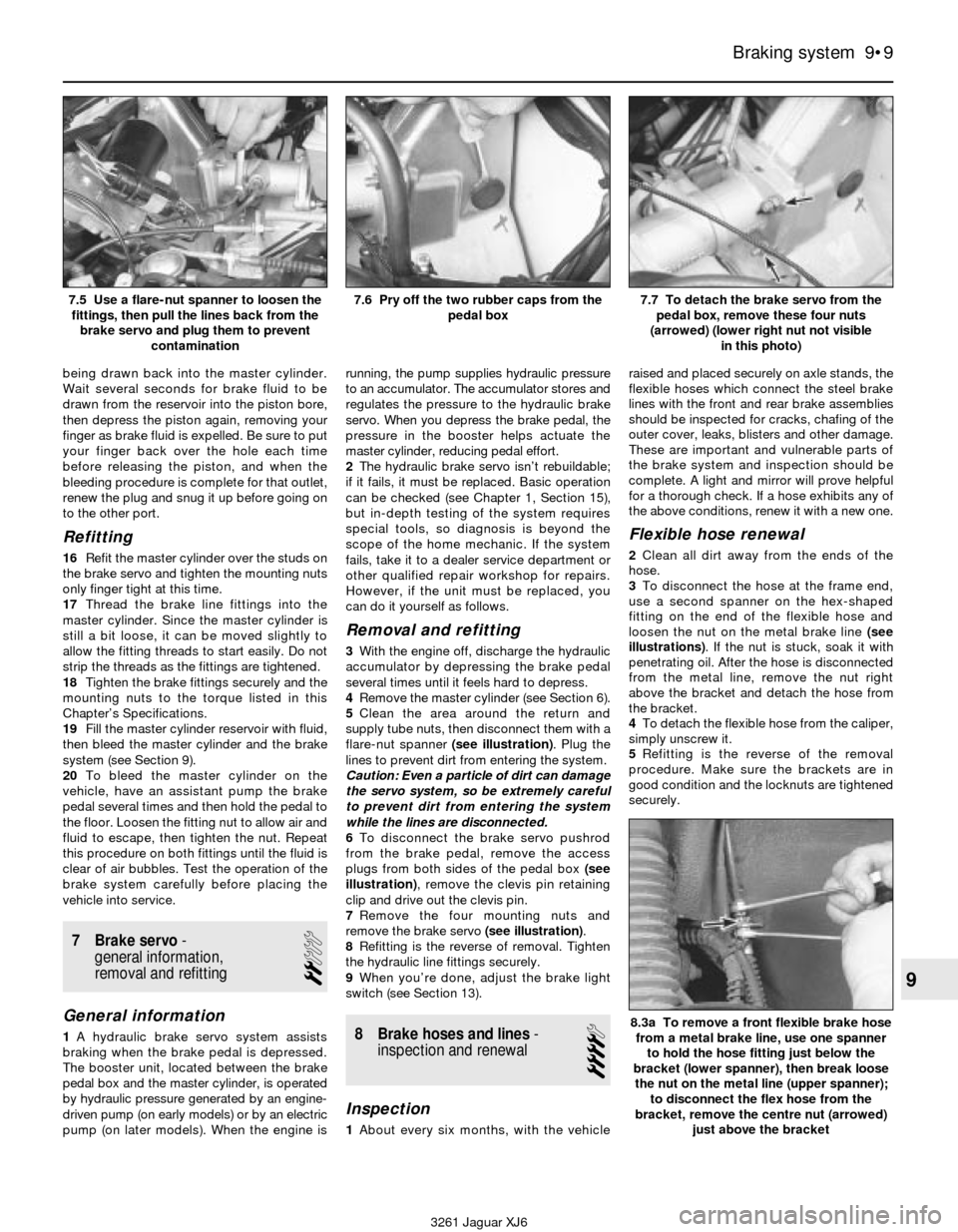
5Clean the area around the return and
supply tube nuts, then disconnect them with a
flare-nut spanner (see illustration). Plug the
lines to prevent dirt from entering the system.
Caution: Even a particle of dirt can damage
the servo system, so be extremely careful
to prevent dirt from entering the system
while the lines are disconnected.
6To disconnect the brake servo pushrod
from the brake pedal, remove the access
plugs from both sides of the pedal box (see
illustration), remove the clevis pin retaining
clip and drive out the clevis pin.
7Remove the four mounting nuts and
remove the brake servo (see illustration).
8Refitting is the reverse of removal. Tighten
the hydraulic line fittings securely.
9When you’re done, adjust the brake light
switch (see Section 13).
8 Brake hoses and lines-
inspection and renewal
4
Inspection
1About every six months, with the vehicleraised and placed securely on axle stands, the
flexible hoses which connect the steel brake
lines with the front and rear brake assemblies
should be inspected for cracks, chafing of the
outer cover, leaks, blisters and other damage.
These are important and vulnerable parts of
the brake system and inspection should be
complete. A light and mirror will prove helpful
for a thorough check. If a hose exhibits any of
the above conditions, renew it with a new one.
Flexible hose renewal
2Clean all dirt away from the ends of the
hose.
3To disconnect the hose at the frame end,
use a second spanner on the hex-shaped
fitting on the end of the flexible hose and
loosen the nut on the metal brake line (see
illustrations). If the nut is stuck, soak it with
penetrating oil. After the hose is disconnected
from the metal line, remove the nut right
above the bracket and detach the hose from
the bracket.
4To detach the flexible hose from the caliper,
simply unscrew it.
5Refitting is the reverse of the removal
procedure. Make sure the brackets are in
good condition and the locknuts are tightened
securely.
Braking system 9•9
9
7.5 Use a flare-nut spanner to loosen the
fittings, then pull the lines back from the
brake servo and plug them to prevent
contamination7.6 Pry off the two rubber caps from the
pedal box7.7 To detach the brake servo from the
pedal box, remove these four nuts
(arrowed) (lower right nut not visible
in this photo)
8.3a To remove a front flexible brake hose
from a metal brake line, use one spanner
to hold the hose fitting just below the
bracket (lower spanner), then break loose
the nut on the metal line (upper spanner);
to disconnect the flex hose from the
bracket, remove the centre nut (arrowed)
just above the bracket
3261 Jaguar XJ6
Page 132 of 227
6Carefully check to make sure the
suspension and steering components do not
make contact with the hoses. Have an
assistant push on the vehicle and also turn the
steering wheel from lock-to-lock during
inspection.
7Bleed the brake system (see Section 9).
Metal brake line renewal
8When replacing brake lines, use the proper
parts only. Do not use copper line for any
brake system connections. Purchase steel
brake lines from a dealer or motor factors..
9Unless you’re using factory renewal brake
lines, you may need a tubing bender to bend
the lines to the proper shape.
10First, remove the line you intend to renew,
lay it on a clean workbench and measure it
carefully. Obtain a new line of the same length
and bend it to match the pattern of the old
line.
Warning: Do not crimp or
damage the line. No bend should
have a smaller radius than
9/16-inch. Make sure the
protective coating on the new line is
undamaged at the bends.
11When refitting the new line, make sure it’s
well supported by the brackets, the routing
matches the original and there’s plenty of
clearance between moving or hot
components.
12After refitting, check the master cylinder
fluid level and add fluid as necessary. Bleed
the brake system as outlined in Section 9 and
test the brakes carefully before driving the
vehicle. Be sure there are no leaks.
9 Brake hydraulic system-
bleeding
2
Warning: Wear eye protection
when bleeding the brake
system. If the fluid comes in
contact with your eyes,
immediately rinse them with water and
seek medical attention.Note:Bleeding the hydraulic system is
necessary to remove any air which has entered
the system during removal and refitting of a
hose, line, caliper or master cylinder.
1It will probably be necessary to bleed the
system at all four brakes if air has entered the
system due to low fluid level or if the brake
lines have been disconnected at the master
cylinder.
2If a brake line was disconnected at only one
wheel, then only that caliper or wheel cylinder
must be bled.
3If a brake line is disconnected at a fitting
located between the master cylinder and any
of the brakes, that part of the system served
by the disconnected line must be bled.
4Bleed the right rear, the left rear, the right
front and the left front caliper, in that order,
when the entire system is involved.
5Remove any residual vacuum from the
servo and pressure in the anti-lock braking
system (if equipped) by applying the brake
about 30 times with the engine off.
6Remove the master cylinder reservoir cover
and fill the reservoir with brake fluid. Refit the
cover. Note:Check the fluid level often during
the bleeding operation and add fluid as
necessary to prevent the fluid level from falling
low enough to allow air into the master
cylinder.
7Have an assistant on hand, as well as a
supply of new brake fluid, an empty clear
plastic container, a length of 3/16-inch clear
tubing to fit over the bleed screws and a
spanner to open and close the bleed screws.
8Beginning at the right rear wheel, loosen the
bleed screw slightly, then tighten it to a point
where it is snug but can still be loosened
quickly and easily.
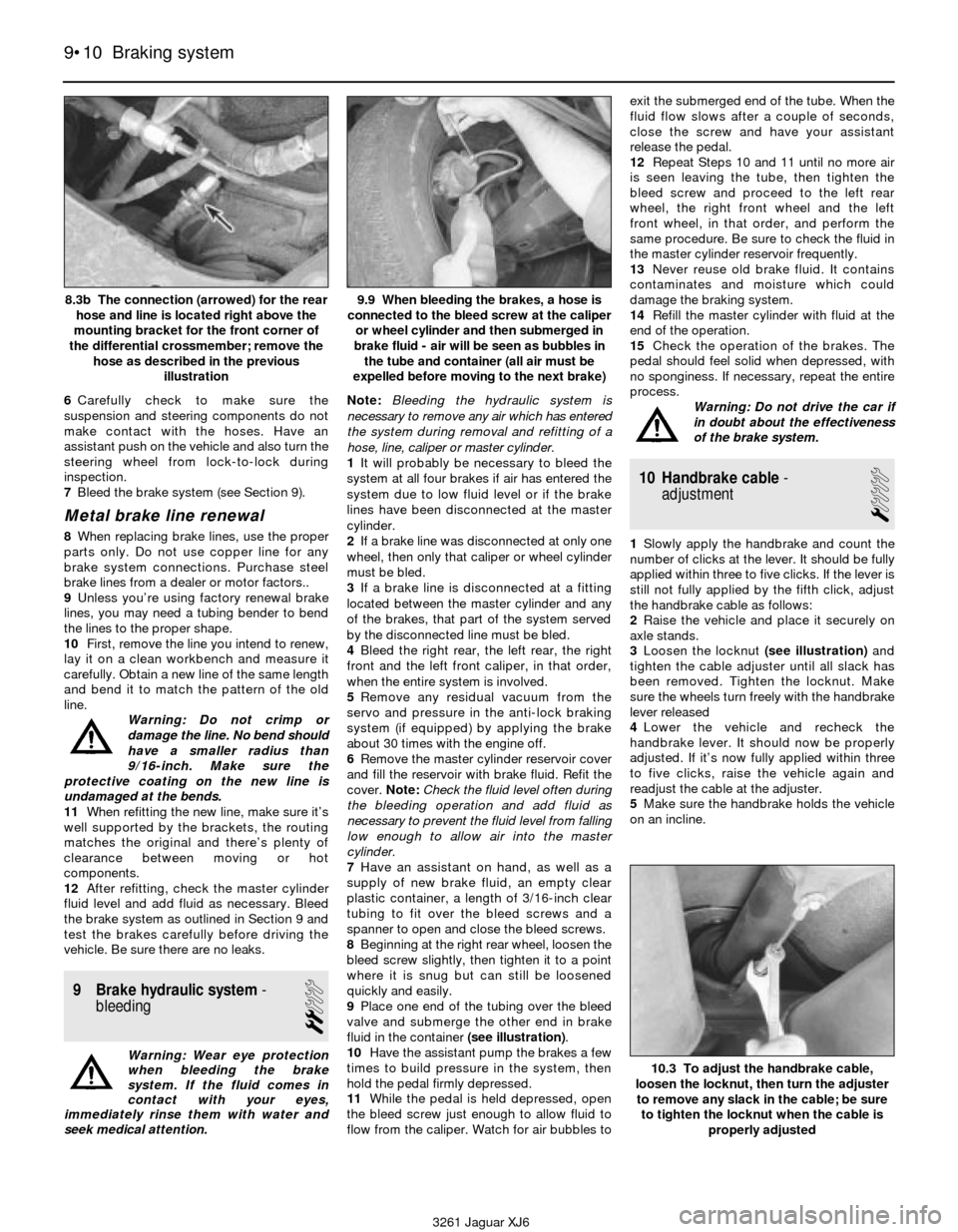
9Place one end of the tubing over the bleed
valve and submerge the other end in brake
fluid in the container (see illustration).
10Have the assistant pump the brakes a few
times to build pressure in the system, then
hold the pedal firmly depressed.
11While the pedal is held depressed, open
the bleed screw just enough to allow fluid to
flow from the caliper. Watch for air bubbles toexit the submerged end of the tube. When the
fluid flow slows after a couple of seconds,
close the screw and have your assistant
release the pedal.
12Repeat Steps 10 and 11 until no more air
is seen leaving the tube, then tighten the
bleed screw and proceed to the left rear
wheel, the right front wheel and the left
front wheel, in that order, and perform the
same procedure. Be sure to check the fluid in
the master cylinder reservoir frequently.
13Never reuse old brake fluid. It contains
contaminates and moisture which could
damage the braking system.
14Refill the master cylinder with fluid at the
end of the operation.
15Check the operation of the brakes. The
pedal should feel solid when depressed, with
no sponginess. If necessary, repeat the entire
process.
Warning: Do not drive the car if
in doubt about the effectiveness
of the brake system.
10 Handbrake cable-
adjustment
1
1Slowly apply the handbrake and count the
number of clicks at the lever. It should be fully
applied within three to five clicks. If the lever is
still not fully applied by the fifth click, adjust
the handbrake cable as follows:
2Raise the vehicle and place it securely on
axle stands.
3Loosen the locknut (see illustration)and
tighten the cable adjuster until all slack has
been removed. Tighten the locknut. Make
sure the wheels turn freely with the handbrake
lever released
4Lower the vehicle and recheck the
handbrake lever. It should now be properly
adjusted. If it’s now fully applied within three
to five clicks, raise the vehicle again and
readjust the cable at the adjuster.
5Make sure the handbrake holds the vehicle
on an incline.
9•10 Braking system
8.3b The connection (arrowed) for the rear
hose and line is located right above the
mounting bracket for the front corner of
the differential crossmember; remove the
hose as described in the previous
illustration9.9 When bleeding the brakes, a hose is
connected to the bleed screw at the caliper
or wheel cylinder and then submerged in
brake fluid - air will be seen as bubbles in
the tube and container (all air must be
expelled before moving to the next brake)
10.3 To adjust the handbrake cable,
loosen the locknut, then turn the adjuster
to remove any slack in the cable; be sure
to tighten the locknut when the cable is
properly adjusted
3261 Jaguar XJ6
Page 135 of 227
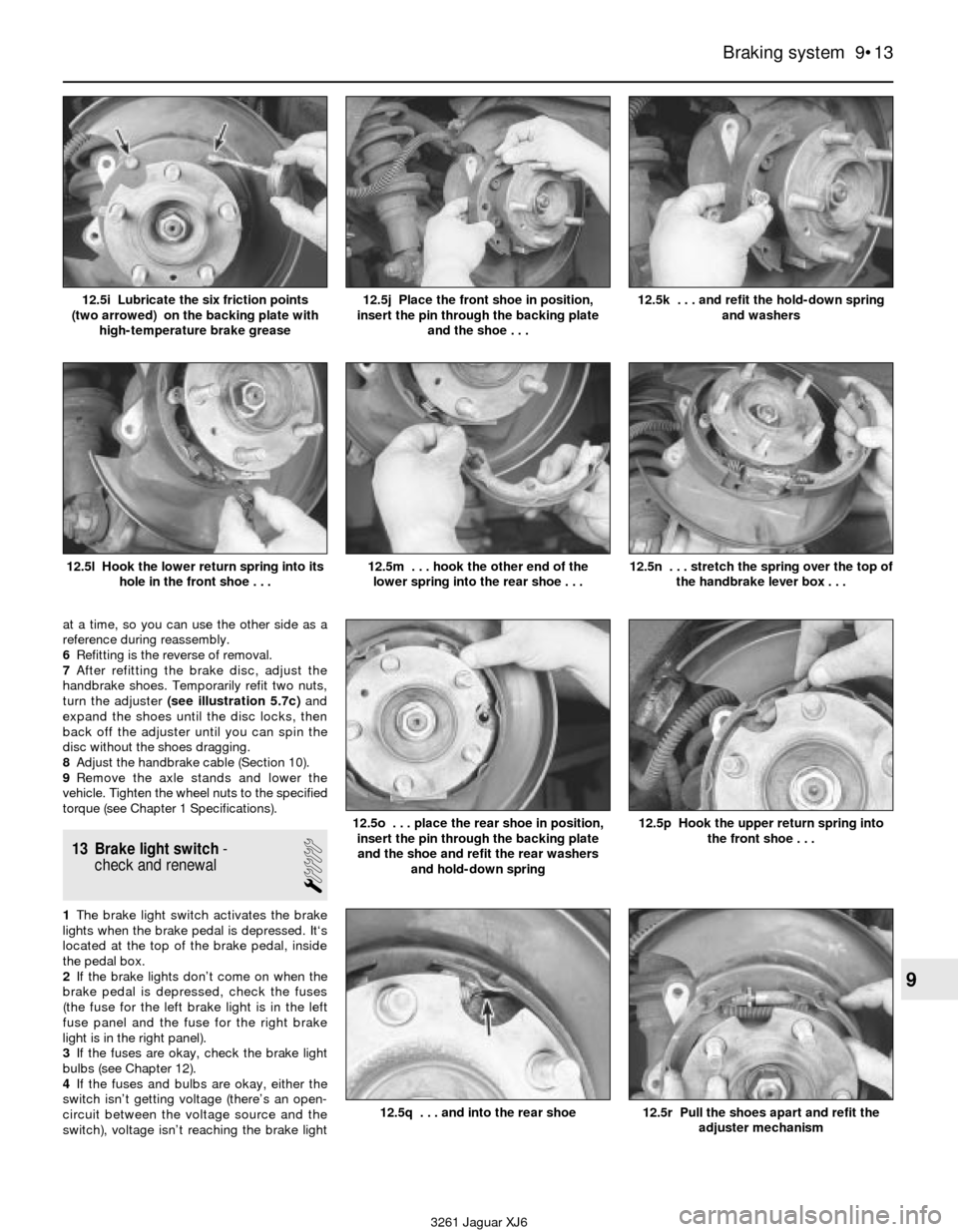
at a time, so you can use the other side as a
reference during reassembly.
6Refitting is the reverse of removal.
7After refitting the brake disc, adjust the
handbrake shoes. Temporarily refit two nuts,
turn the adjuster (see illustration 5.7c)and
expand the shoes until the disc locks, then
back off the adjuster until you can spin the
disc without the shoes dragging.
8Adjust the handbrake cable (Section 10).
9Remove the axle stands and lower the
vehicle. Tighten the wheel nuts to the specified
torque (see Chapter 1 Specifications).
13 Brake light switch-
check and renewal
1
1The brake light switch activates the brake
lights when the brake pedal is depressed. It‘s
located at the top of the brake pedal, inside
the pedal box.
2If the brake lights don’t come on when the
brake pedal is depressed, check the fuses
(the fuse for the left brake light is in the left
fuse panel and the fuse for the right brake
light is in the right panel).
3If the fuses are okay, check the brake light
bulbs (see Chapter 12).
4If the fuses and bulbs are okay, either the
switch isn’t getting voltage (there’s an open-
circuit between the voltage source and the
switch), voltage isn’t reaching the brake light
Braking system 9•13
9
12.5j Place the front shoe in position,
insert the pin through the backing plate
and the shoe . . .12.5k . . . and refit the hold-down spring
and washers12.5i Lubricate the six friction points
(two arrowed) on the backing plate with
high-temperature brake grease
3261 Jaguar XJ6 12.5l Hook the lower return spring into its
hole in the front shoe . . .
12.5m . . . hook the other end of the
lower spring into the rear shoe . . .12.5n . . . stretch the spring over the top of
the handbrake lever box . . .
12.5o . . . place the rear shoe in position,
insert the pin through the backing plate
and the shoe and refit the rear washers
and hold-down spring12.5p Hook the upper return spring into
the front shoe . . .
12.5q . . . and into the rear shoe12.5r Pull the shoes apart and refit the
adjuster mechanism
Page 140 of 227
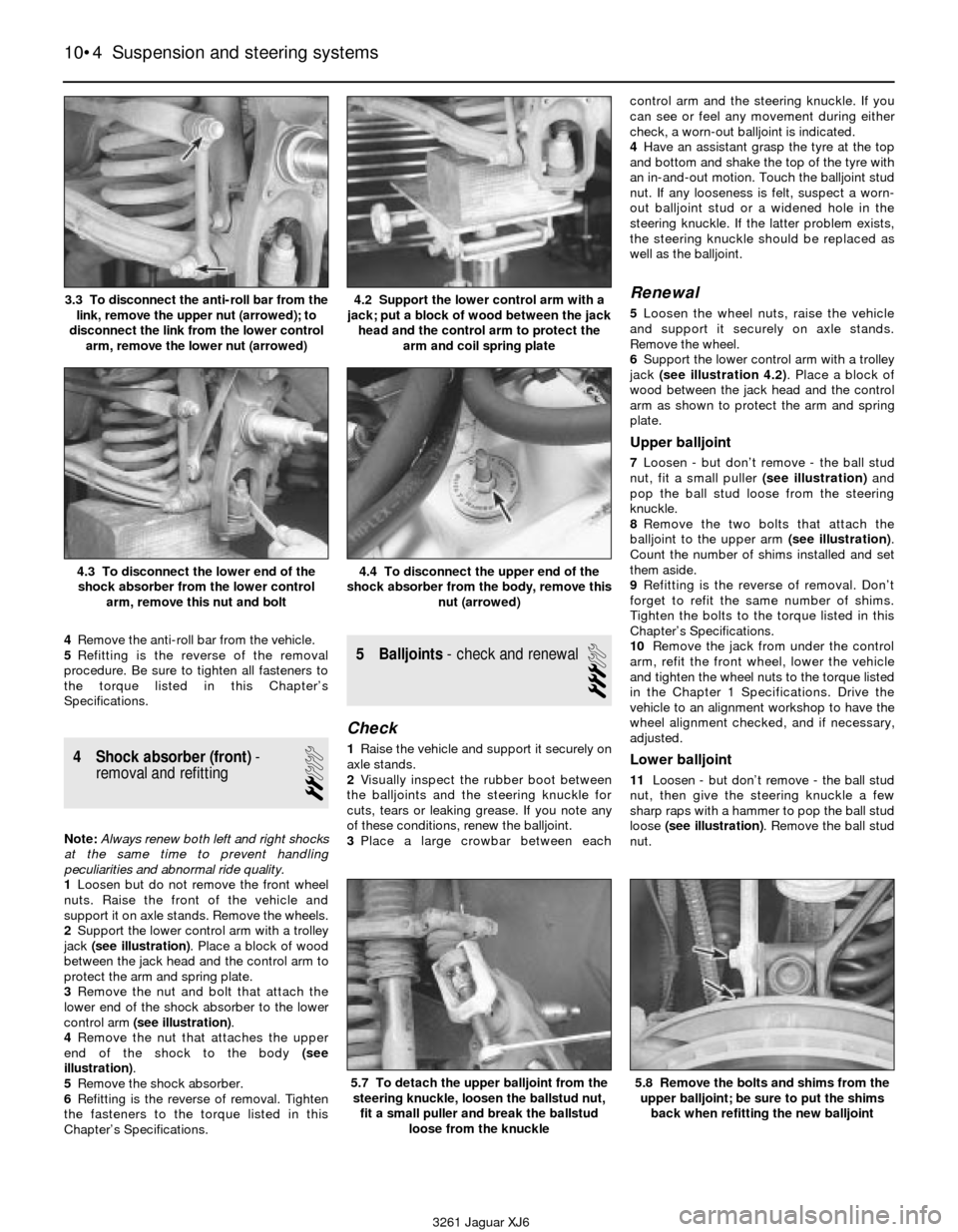
4Remove the anti-roll bar from the vehicle.
5Refitting is the reverse of the removal
procedure. Be sure to tighten all fasteners to
the torque listed in this Chapter’s
Specifications.
4 Shock absorber (front)-
removal and refitting
2
Note: Always renew both left and right shocks
at the same time to prevent handling
peculiarities and abnormal ride quality.
1Loosen but do not remove the front wheel
nuts. Raise the front of the vehicle and
support it on axle stands. Remove the wheels.
2Support the lower control arm with a trolley
jack (see illustration). Place a block of wood
between the jack head and the control arm to
protect the arm and spring plate.
3Remove the nut and bolt that attach the
lower end of the shock absorber to the lower
control arm (see illustration).
4Remove the nut that attaches the upper
end of the shock to the body (see
illustration).
5Remove the shock absorber.
6Refitting is the reverse of removal. Tighten
the fasteners to the torque listed in this
Chapter’s Specifications.
5 Balljoints- check and renewal
3
Check
1Raise the vehicle and support it securely on
axle stands.
2Visually inspect the rubber boot between
the balljoints and the steering knuckle for
cuts, tears or leaking grease. If you note any
of these conditions, renew the balljoint.
3Place a large crowbar between eachcontrol arm and the steering knuckle. If you
can see or feel any movement during either
check, a worn-out balljoint is indicated.
4Have an assistant grasp the tyre at the top
and bottom and shake the top of the tyre with
an in-and-out motion. Touch the balljoint stud
nut. If any looseness is felt, suspect a worn-
out balljoint stud or a widened hole in the
steering knuckle. If the latter problem exists,
the steering knuckle should be replaced as
well as the balljoint.
Renewal
5Loosen the wheel nuts, raise the vehicle
and support it securely on axle stands.
Remove the wheel.
6Support the lower control arm with a trolley
jack (see illustration 4.2). Place a block of
wood between the jack head and the control
arm as shown to protect the arm and spring
plate.
Upper balljoint
7Loosen - but don’t remove - the ball stud
nut, fit a small puller (see illustration)and
pop the ball stud loose from the steering
knuckle.
8Remove the two bolts that attach the
balljoint to the upper arm (see illustration).
Count the number of shims installed and set
them aside.
9Refitting is the reverse of removal. Don’t
forget to refit the same number of shims.
Tighten the bolts to the torque listed in this
Chapter’s Specifications.
10Remove the jack from under the control
arm, refit the front wheel, lower the vehicle
and tighten the wheel nuts to the torque listed
in the Chapter 1 Specifications. Drive the
vehicle to an alignment workshop to have the
wheel alignment checked, and if necessary,
adjusted.
Lower balljoint
11Loosen - but don’t remove - the ball stud
nut, then give the steering knuckle a few
sharp raps with a hammer to pop the ball stud
loose (see illustration). Remove the ball stud
nut.
10•4 Suspension and steering systems
3.3 To disconnect the anti-roll bar from the
link, remove the upper nut (arrowed); to
disconnect the link from the lower control
arm, remove the lower nut (arrowed)4.2 Support the lower control arm with a
jack; put a block of wood between the jack
head and the control arm to protect the
arm and coil spring plate
4.3 To disconnect the lower end of the
shock absorber from the lower control
arm, remove this nut and bolt4.4 To disconnect the upper end of the
shock absorber from the body, remove this
nut (arrowed)
5.7 To detach the upper balljoint from the
steering knuckle, loosen the ballstud nut,
fit a small puller and break the ballstud
loose from the knuckle5.8 Remove the bolts and shims from the
upper balljoint; be sure to put the shims
back when refitting the new balljoint
3261 Jaguar XJ6
Page 142 of 227
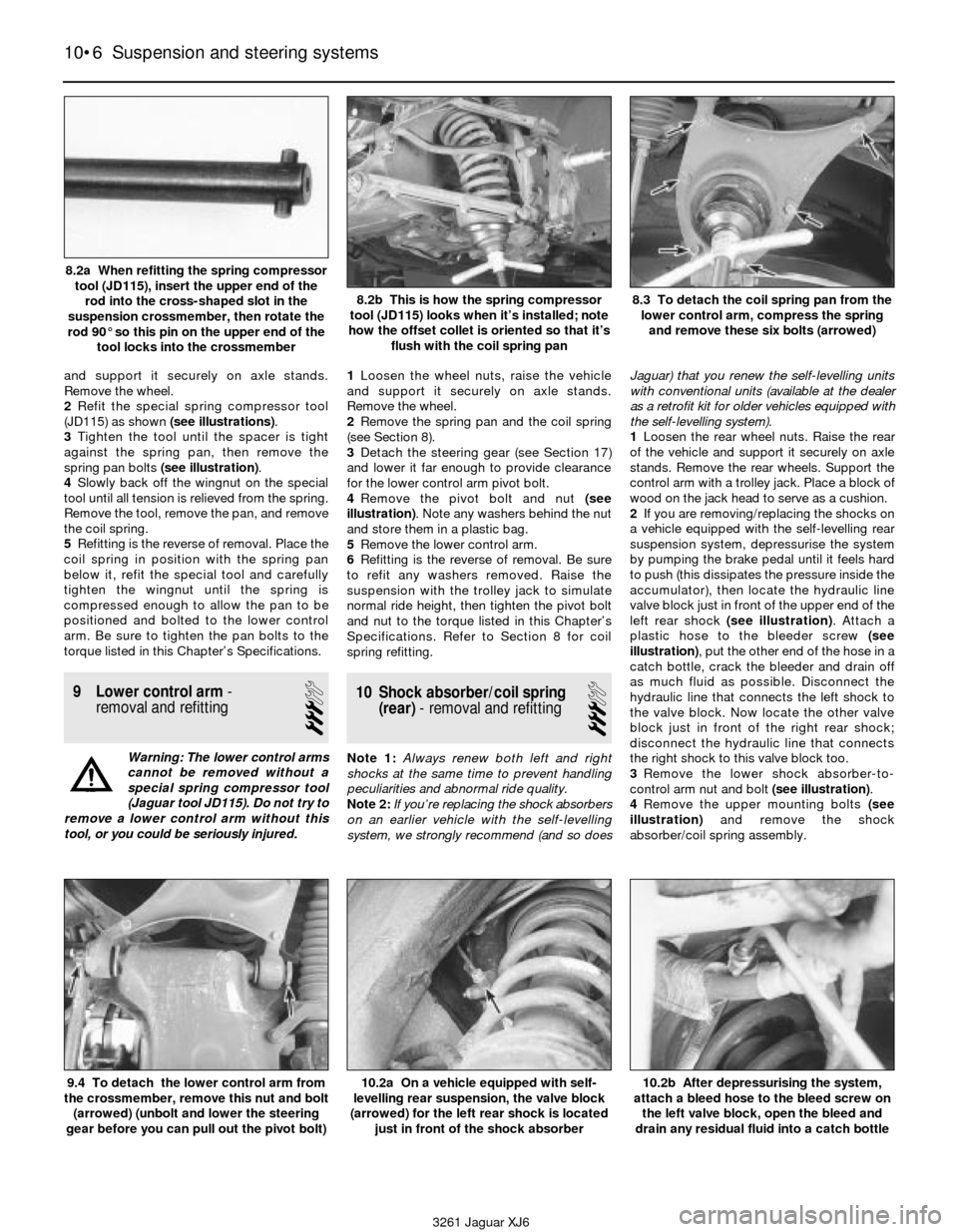
and support it securely on axle stands.
Remove the wheel.
2Refit the special spring compressor tool
(JD115) as shown (see illustrations).
3Tighten the tool until the spacer is tight
against the spring pan, then remove the
spring pan bolts (see illustration).
4Slowly back off the wingnut on the special
tool until all tension is relieved from the spring.
Remove the tool, remove the pan, and remove
the coil spring.
5Refitting is the reverse of removal. Place the
coil spring in position with the spring pan
below it, refit the special tool and carefully
tighten the wingnut until the spring is
compressed enough to allow the pan to be
positioned and bolted to the lower control
arm. Be sure to tighten the pan bolts to the
torque listed in this Chapter’s Specifications.
9 Lower control arm-
removal and refitting
3
Warning: The lower control arms
cannot be removed without a
special spring compressor tool
(Jaguar tool JD115). Do not try to
remove a lower control arm without this
tool, or you could be seriously injured.1Loosen the wheel nuts, raise the vehicle
and support it securely on axle stands.
Remove the wheel.
2Remove the spring pan and the coil spring
(see Section 8).
3Detach the steering gear (see Section 17)
and lower it far enough to provide clearance
for the lower control arm pivot bolt.
4Remove the pivot bolt and nut (see
illustration). Note any washers behind the nut
and store them in a plastic bag.
5Remove the lower control arm.
6Refitting is the reverse of removal. Be sure
to refit any washers removed. Raise the
suspension with the trolley jack to simulate
normal ride height, then tighten the pivot bolt
and nut to the torque listed in this Chapter’s
Specifications. Refer to Section 8 for coil
spring refitting.
10 Shock absorber/coil spring
(rear)- removal and refitting
3
Note 1: Always renew both left and right
shocks at the same time to prevent handling
peculiarities and abnormal ride quality.
Note 2:If you’re replacing the shock absorbers
on an earlier vehicle with the self-levelling
system, we strongly recommend (and so doesJaguar) that you renew the self-levelling units
with conventional units (available at the dealer
as a retrofit kit for older vehicles equipped with
the self-levelling system).
1Loosen the rear wheel nuts. Raise the rear
of the vehicle and support it securely on axle
stands. Remove the rear wheels. Support the
control arm with a trolley jack. Place a block of
wood on the jack head to serve as a cushion.
2If you are removing/replacing the shocks on
a vehicle equipped with the self-levelling rear
suspension system, depressurise the system
by pumping the brake pedal until it feels hard
to push (this dissipates the pressure inside the
accumulator), then locate the hydraulic line
valve block just in front of the upper end of the
left rear shock (see illustration). Attach a
plastic hose to the bleeder screw (see
illustration), put the other end of the hose in a
catch bottle, crack the bleeder and drain off
as much fluid as possible. Disconnect the
hydraulic line that connects the left shock to
the valve block. Now locate the other valve
block just in front of the right rear shock;
disconnect the hydraulic line that connects
the right shock to this valve block too.
3Remove the lower shock absorber-to-
control arm nut and bolt (see illustration).
4Remove the upper mounting bolts (see
illustration)and remove the shock
absorber/coil spring assembly.
10•6 Suspension and steering systems
9.4 To detach the lower control arm from
the crossmember, remove this nut and bolt
(arrowed) (unbolt and lower the steering
gear before you can pull out the pivot bolt)10.2a On a vehicle equipped with self-
levelling rear suspension, the valve block
(arrowed) for the left rear shock is located
just in front of the shock absorber10.2b After depressurising the system,
attach a bleed hose to the bleed screw on
the left valve block, open the bleed and
drain any residual fluid into a catch bottle
3261 Jaguar XJ6 8.2a When refitting the spring compressor
tool (JD115), insert the upper end of the
rod into the cross-shaped slot in the
suspension crossmember, then rotate the
rod 90° so this pin on the upper end of the
tool locks into the crossmember
8.2b This is how the spring compressor
tool (JD115) looks when it’s installed; note
how the offset collet is oriented so that it’s
flush with the coil spring pan8.3 To detach the coil spring pan from the
lower control arm, compress the spring
and remove these six bolts (arrowed)
Page 143 of 227
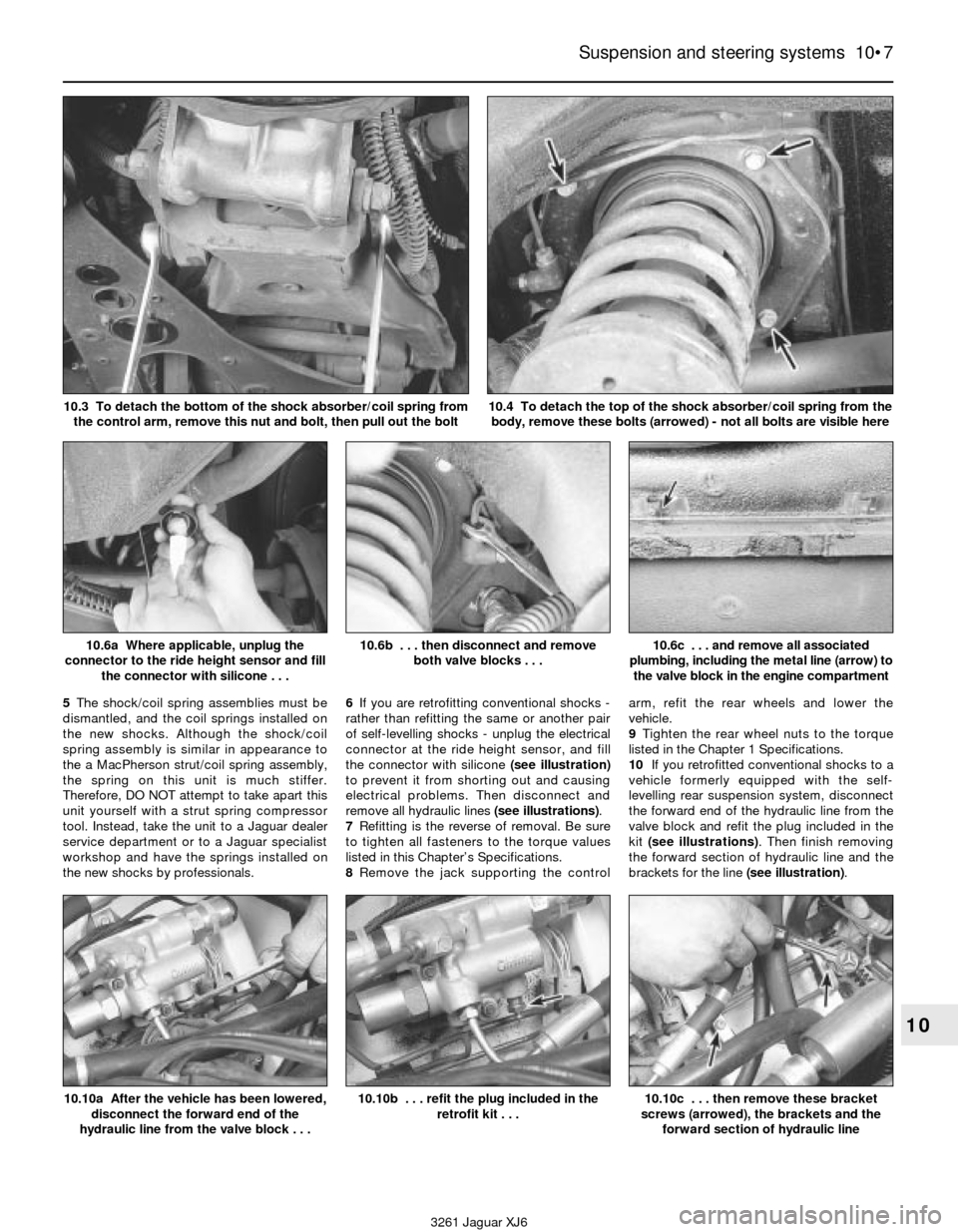
5The shock/coil spring assemblies must be
dismantled, and the coil springs installed on
the new shocks. Although the shock/coil
spring assembly is similar in appearance to
the a MacPherson strut/coil spring assembly,
the spring on this unit is much stiffer.
Therefore, DO NOT attempt to take apart this
unit yourself with a strut spring compressor
tool. Instead, take the unit to a Jaguar dealer
service department or to a Jaguar specialist
workshop and have the springs installed on
the new shocks by professionals.6If you are retrofitting conventional shocks -
rather than refitting the same or another pair
of self-levelling shocks - unplug the electrical
connector at the ride height sensor, and fill
the connector with silicone (see illustration)
to prevent it from shorting out and causing
electrical problems. Then disconnect and
remove all hydraulic lines (see illustrations).
7Refitting is the reverse of removal. Be sure
to tighten all fasteners to the torque values
listed in this Chapter’s Specifications.
8Remove the jack supporting the controlarm, refit the rear wheels and lower the
vehicle.
9Tighten the rear wheel nuts to the torque
listed in the Chapter 1 Specifications.
10If you retrofitted conventional shocks to a
vehicle formerly equipped with the self-
levelling rear suspension system, disconnect
the forward end of the hydraulic line from the
valve block and refit the plug included in the
kit (see illustrations). Then finish removing
the forward section of hydraulic line and the
brackets for the line (see illustration).
Suspension and steering systems 10•7
10
10.6a Where applicable, unplug the
connector to the ride height sensor and fill
the connector with silicone . . .10.6b . . . then disconnect and remove
both valve blocks . . .10.6c . . . and remove all associated
plumbing, including the metal line (arrow) to
the valve block in the engine compartment
3261 Jaguar XJ6 10.3 To detach the bottom of the shock absorber/coil spring from
the control arm, remove this nut and bolt, then pull out the bolt
10.4 To detach the top of the shock absorber/coil spring from the
body, remove these bolts (arrowed) - not all bolts are visible here
10.10a After the vehicle has been lowered,
disconnect the forward end of the
hydraulic line from the valve block . . .10.10b . . . refit the plug included in the
retrofit kit . . .10.10c . . . then remove these bracket
screws (arrowed), the brackets and the
forward section of hydraulic line