lock JAGUAR XJ6 1997 2.G Owners Manual
[x] Cancel search | Manufacturer: JAGUAR, Model Year: 1997, Model line: XJ6, Model: JAGUAR XJ6 1997 2.GPages: 227, PDF Size: 7.2 MB
Page 158 of 227
remove the door trim panel and watershield
as described in Section 18.
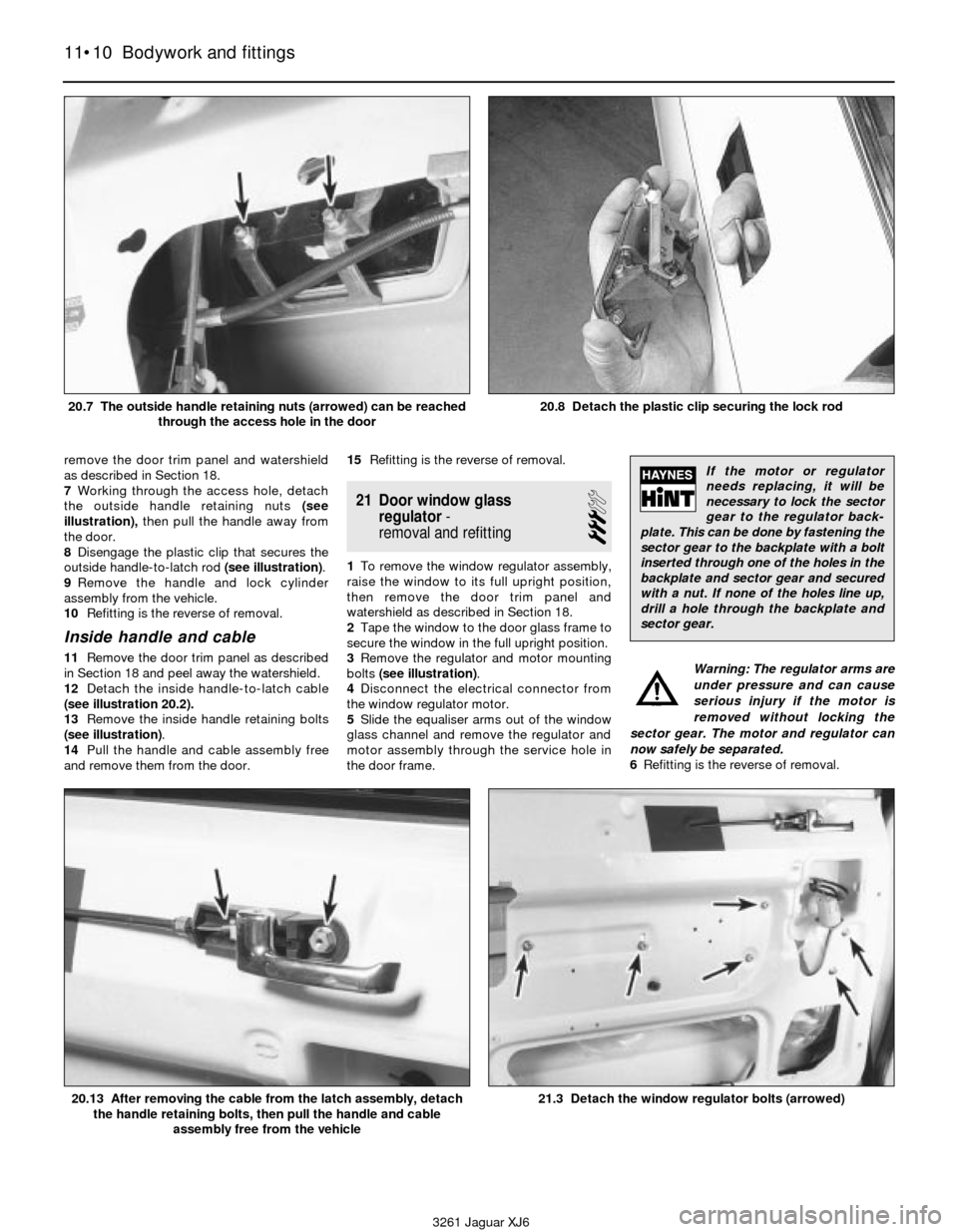
7Working through the access hole, detach
the outside handle retaining nuts (see
illustration),then pull the handle away from
the door.
8Disengage the plastic clip that secures the
outside handle-to-latch rod (see illustration).
9Remove the handle and lock cylinder
assembly from the vehicle.
10Refitting is the reverse of removal.
Inside handle and cable
11Remove the door trim panel as described
in Section 18 and peel away the watershield.
12Detach the inside handle-to-latch cable
(see illustration 20.2).
13Remove the inside handle retaining bolts
(see illustration).
14Pull the handle and cable assembly free
and remove them from the door.15Refitting is the reverse of removal.
21 Door window glass
regulator-
removal and refitting
3
1To remove the window regulator assembly,
raise the window to its full upright position,
then remove the door trim panel and
watershield as described in Section 18.
2Tape the window to the door glass frame to
secure the window in the full upright position.
3Remove the regulator and motor mounting
bolts (see illustration).
4Disconnect the electrical connector from
the window regulator motor.
5Slide the equaliser arms out of the window
glass channel and remove the regulator and
motor assembly through the service hole in
the door frame.Warning: The regulator arms are
under pressure and can cause
serious injury if the motor is
removed without locking the
sector gear. The motor and regulator can
now safely be separated.
6Refitting is the reverse of removal.
11•10 Bodywork and fittings
3261 Jaguar XJ6 20.7 The outside handle retaining nuts (arrowed) can be reached
through the access hole in the door
20.8 Detach the plastic clip securing the lock rod
20.13 After removing the cable from the latch assembly, detach
the handle retaining bolts, then pull the handle and cable
assembly free from the vehicle21.3 Detach the window regulator bolts (arrowed)
If the motor or regulator
needs replacing, it will be
necessary to lock the sector
gear to the regulator back-
plate. This can be done by fastening the
sector gear to the backplate with a bolt
inserted through one of the holes in the
backplate and sector gear and secured
with a nut. If none of the holes line up,
drill a hole through the backplate and
sector gear.
Page 163 of 227
3261 Jaguar XJ6
12
Chapter 12
Body electrical system
1 General information
The electrical system is a 12-volt, negative
earth type. Power for the lights and all
electrical accessories is supplied by a
lead/acid-type battery which is charged by
the alternator.
This Chapter covers repair and service
procedures for the various electrical
components not associated with the engine.
Information on the battery, alternator,
distributor and starter motor will be found in
Chapter 5.
It should be noted that when portions of the
electrical system are serviced, the cable
should be disconnected from the negative
battery terminal to prevent electrical shorts
and/or fires.
2 Electrical fault finding-
general information
A typical electrical circuit consists of an
electrical component, any switches, relays,
motors, fuses, fusible links, in-line fuses or
circuit breakers related to that component
and the wiring and electrical connectors that
link the component to both the battery andthe chassis. To help you pinpoint an electrical
circuit problem, wiring diagrams are included
at the end of this Chapter.
Before tackling any troublesome electrical
circuit, first study the appropriate wiring
diagrams to get a complete understanding of
what makes up that individual circuit. Trouble
spots, for instance, can often be narrowed
down by noting if other components related to
the circuit are operating properly. If several
components or circuits fail at one time,
chances are the problem is in a fuse or earth
connection, because several circuits are often
routed through the same fuse and earth
connections.
Electrical problems usually stem from
simple causes, such as loose or corroded
connections, a blown fuse, a melted fusible
link or a bad relay. Visually inspect the
condition of all fuses, wires and connections
in a problem circuit before diagnosing it.
If testing instruments are going to be
utilised, use the diagrams to plan ahead of
time where you will make the necessary
connections in order to accurately pinpoint
the trouble spot.
The basic tools needed for electrical fault
finding include a circuit tester or voltmeter (a
12-volt bulb with a set of test leads can also
be used), a continuity tester, which includes a
bulb, battery and set of test leads, and a
jumper wire, preferably with a circuit breaker
incorporated, which can be used to bypasselectrical components. Before attempting to
locate a problem with test instruments,
use the wiring diagram(s) to decide where to
make the connections.
Voltage checks
Voltage checks should be performed if a
circuit is not functioning properly. Connect
one lead of a circuit tester to either the
negative battery terminal or a known good
earth. Connect the other lead to a electrical
connector in the circuit being tested,
preferably nearest to the battery or fuse. If the
bulb of the tester lights, voltage is present,
which means that the part of the circuit
between the electrical connector and the
battery is problem free. Continue checking the
rest of the circuit in the same fashion. When
you reach a point at which no voltage is
present, the problem lies between that point
and the last test point with voltage. Most of
the time the problem can be traced to a loose
connection. Note:Keep in mind that some
circuits receive voltage only when the ignition
key is in the Accessory or Run position.
Finding a short
One method of finding shorts in a circuit is
to remove the fuse and connect a test light or
voltmeter in its place. There should be no
voltage present in the circuit. Move the wiring
harness from side to side while watching the
test light. If the bulb goes on, there is a short Airbag system - general information . . . . . . . . . . . . . . . . . . . . . . . . . 28
Bulb renewal . . . . . . . . . . . . . . . . . . . . . . . . . . . . . . . . . . . . . . . . . . . 21
Central locking system - description and check . . . . . . . . . . . . . . . . 25
Circuit breakers - general information . . . . . . . . . . . . . . . . . . . . . . . . 5
Cruise control system - description and check . . . . . . . . . . . . . . . . . 23
Direction indicators/hazard flashers - general information . . . . . . . . 7
Electric aerial - removal and refitting . . . . . . . . . . . . . . . . . . . . . . . . . 14
Electric side view mirrors - description and check . . . . . . . . . . . . . . 26
Electric sunroof - description and check . . . . . . . . . . . . . . . . . . . . . . 27
Electric window system - description and check . . . . . . . . . . . . . . . 24
Electrical fault finding - general information . . . . . . . . . . . . . . . . . . . 2
Fuel, oil and temperature gauges - check . . . . . . . . . . . . . . . . . . . . . 11
Fuses - general information . . . . . . . . . . . . . . . . . . . . . . . . . . . . . . . . 3
General information . . . . . . . . . . . . . . . . . . . . . . . . . . . . . . . . . . . . . . 1
Headlight housing (1992 to 1994 models) - removal and refitting . . . 19Headlights - adjustment . . . . . . . . . . . . . . . . . . . . . . . . . . . . . . . . . . 18
Headlights - renewal . . . . . . . . . . . . . . . . . . . . . . . . . . . . . . . . . . . . . 17
Heated rear window - check and repair . . . . . . . . . . . . . . . . . . . . . . 16
Horn - check and renewal . . . . . . . . . . . . . . . . . . . . . . . . . . . . . . . . . 20
Ignition switch and key lock cylinder - removal and refitting . . . . . . 9
Inertia switch - description and check . . . . . . . . . . . . . . . . . . . . . . . . 22
In-line fuses - general information . . . . . . . . . . . . . . . . . . . . . . . . . . . 4
Instrument cluster - removal and refitting . . . . . . . . . . . . . . . . . . . . . 12
Instrument panel switches - removal and refitting . . . . . . . . . . . . . . 10
Radio and speakers - removal and refitting . . . . . . . . . . . . . . . . . . . 13
Relays - general information and testing . . . . . . . . . . . . . . . . . . . . . . 6
Steering column switches - removal and refitting . . . . . . . . . . . . . . . 8
Windscreen wiper motor - removal and refitting . . . . . . . . . . . . . . . . 15
Wiring diagrams - general information . . . . . . . . . . . . . . . . . . . . . . . 29
12•1
Contents
Easy,suitable for
novice with little
experienceFairly easy,suitable
for beginner with
some experienceFairly difficult,
suitable for competent
DIY mechanic
Difficult,suitable for
experienced DIY
mechanicVery difficult,
suitable for expert DIY
or professional
Degrees of difficulty
54321
Page 164 of 227

to earth somewhere in that area, probably
where the insulation has rubbed through. The
same test can be performed on each
component in the circuit, even a switch.
Earth check
Perform an earth test to check whether a
component is properly earthed. Disconnect
the battery and connect one lead of a self-
powered test light, known as a continuity
tester, to a known good earth. Connect the
other lead to the wire or earth connection
being tested. If the bulb goes on, the earth is
good. If the bulb does not go on, the earth is
not good.
Continuity check
A continuity check is done to determine if
there are any breaks in a circuit - if it is
passing electricity properly. With the circuit off
(no power in the circuit), a self-powered
continuity tester can be used to check the
circuit. Connect the test leads to both ends of
the circuit (or to the “power” end and a good
earth), and if the test light comes on the circuit
is passing current properly. If the light doesn’t
come on, there is a break somewhere in the
circuit. The same procedure can be used
to test a switch, by connecting the continuity
tester to the power in and power out sides of
the switch. With the switch turned On, the test
light should come on.
Finding an open circuit
When diagnosing for possible open circuits,
it is often difficult to locate them by sight
because oxidation or terminal misalignment
are hidden by the electrical connectors.
Merely wiggling an electrical connector on a
sensor or in the wiring harness may correct
the open circuit condition. Remember this
when an open circuit is indicated when
diagnosing a circuit. Intermittent problems
may also be caused by oxidised or loose
connections.Electrical fault finding is simple if you keep
in mind that all electrical circuits are basically
electricity running from the battery, through
the wires, switches, relays, fuses and fusible
links to each electrical component (light bulb,
motor, etc.) and to earth, from which it is
passed back to the battery. Any electrical
problem is an interruption in the flow of
electricity to and from the battery.
3 Fuses- general information
The electrical circuits of the vehicle are
protected by a combination of fuses, circuit
breakers and In-line fuses. The fuse blocks
are located in the left and right side kick
panels and in the centre console glove box
(see illustrations).
Each of the fuses is designed to protect a
specific circuit, and the various circuits are
identified on the fuse panel cover.
Miniaturised fuses are employed in the fuse
blocks. These compact fuses, with blade
terminal design, allow fingertip removal and
renewal. If an electrical component fails,
always check the fuse first. The best way tocheck the fuses is with a test light. Check for
power at the exposed terminal tips of each
fuse. If power is present on one side of the
fuse but not the other, the fuse is blown. A
blown fuse can be confirmed by visual
inspection (see illustration).
Be sure to renew blown fuses with the
correct type. Fuses of different ratings are
physically interchangeable, but only fuses of
the proper rating should be used. Replacing a
fuse with one of a higher or lower value than
specified is not recommended. Each electrical
circuit needs a specific amount of protection.
The amperage value of each fuse is moulded
into the fuse body.
If the renewal fuse immediately fails, don’t
renew it again until the cause of the problem
is isolated and corrected. In most cases, this
will be a short circuit in the wiring caused by a
broken or deteriorated wire.
4 In-line fuses-
general information
Some circuits are protected by in-line
fuses. In-line fuses are used in such circuits
as the windscreen wiper system, headlight
12•2 Body electrical system
3261 Jaguar XJ6 3.1a The left side fusebox is located in the passenger’s side kick
panel, behind the fuse panel cover
3.1b The right side fusebox is located in the driver’s side kick
panel, behind the fuse panel cover
3.1c A third fusebox is located in the
centre console glove box3.3 When a fuse blows, the metal element
between the terminals melts - the fuse on
the left is blown, the one on the right is ok
Page 165 of 227
wash system, radio memory and the ABS
main feed and pump circuits.
In-line fuses are located through out the
vehicle depending on the year, make and
model. Consult the wiring diagrams at the end
of this Chapter for further information.
In-line fuses also have a blade terminal
design, which allow fingertip removal and
renewal. If an electrical component fails,
always check the fuse first. A blown fuse is
easily identified through the clear plastic
body. Inspect the element for evidence of
damage (see illustration 3.3).
Be sure to renew blown fuses with the
correct type. Fuses are usually colour-coded
to indicate their rating. Fuses of different
ratings are physically interchangeable, but
only fuses of the proper rating should be
used. Replacing a fuse with one of a different
value than specified is not recommended.
Each electrical circuit needs a specific
amount of protection. The amperage value of
each fuse is moulded into the fuse body.If the renewal fuse immediately fails, don’t
renew it again until the cause of the problem
is isolated and corrected. Don’t substitute
anything else for the fuse. In most cases, this
will be a short circuit in the wiring caused by a
broken or deteriorated wire.
5 Circuit breakers-
general information
Circuit breakers generally protect
components such as electric windows, central
locking and headlights. On some models the
circuit breaker resets itself automatically, so
an electrical overload in the circuit will cause it
to fail momentarily, then come back on. If the
circuit doesn’t come back on, check it
immediately. Once the condition is corrected,
the circuit breaker will resume its normal
function. Some circuit breakers have a button
on top and must be reset manually.To test a circuit breaker, use an ohmmeter
to check continuity between the terminals. A
reading of zero to 1.0 ohms indicates a good
circuit breaker. An open circuit reading on the
meter indicates a bad circuit breaker.
6 Relays- general information
and testing
2
General information
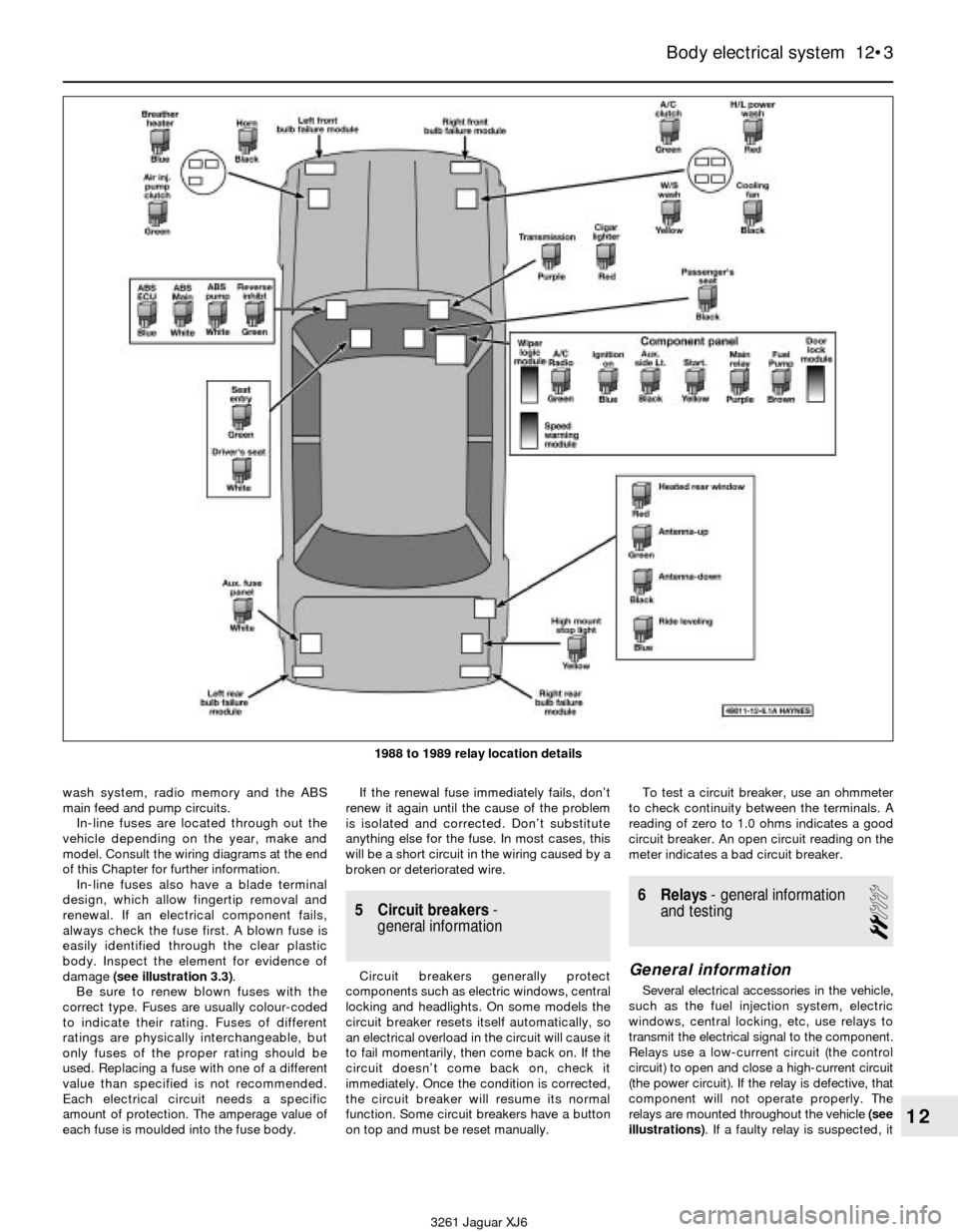
Several electrical accessories in the vehicle,
such as the fuel injection system, electric
windows, central locking, etc, use relays to
transmit the electrical signal to the component.
Relays use a low-current circuit (the control
circuit) to open and close a high-current circuit
(the power circuit). If the relay is defective, that
component will not operate properly. The
relays are mounted throughout the vehicle (see
illustrations). If a faulty relay is suspected, it
Body electrical system 12•3
12
3261 Jaguar XJ6 1988 to 1989 relay location details
Page 168 of 227
5Disconnect the electrical connectors from
underneath the steering column and remove
the switch or switches from the vehicle.
6Refitting is the reverse of removal.
9 Ignition switch
and key lock cylinder-
removal and refitting
2
Warning: Later models are
equipped with airbags. To
prevent accidental deployment
of the airbag, which could cause
personal injury or damage to the airbag
system, DO NOT work in the vicinity of the
steering column or instrument panel. The
manufacturer recommends that, on airbag
equipped models, the following procedure
be performed at a dealer service
department or other properly equipped
repair facility because of the special tools
and techniques required to disable the
airbag system.
Caution: If the stereo in your vehicle is
equipped with an anti-theft system, make
sure you have the correct activation code
before disconnecting the battery.1Disconnect the negative battery cable.
2Remove the steering wheel (Chapter 10).
3Remove the steering column trim covers
(see Chapter 11).
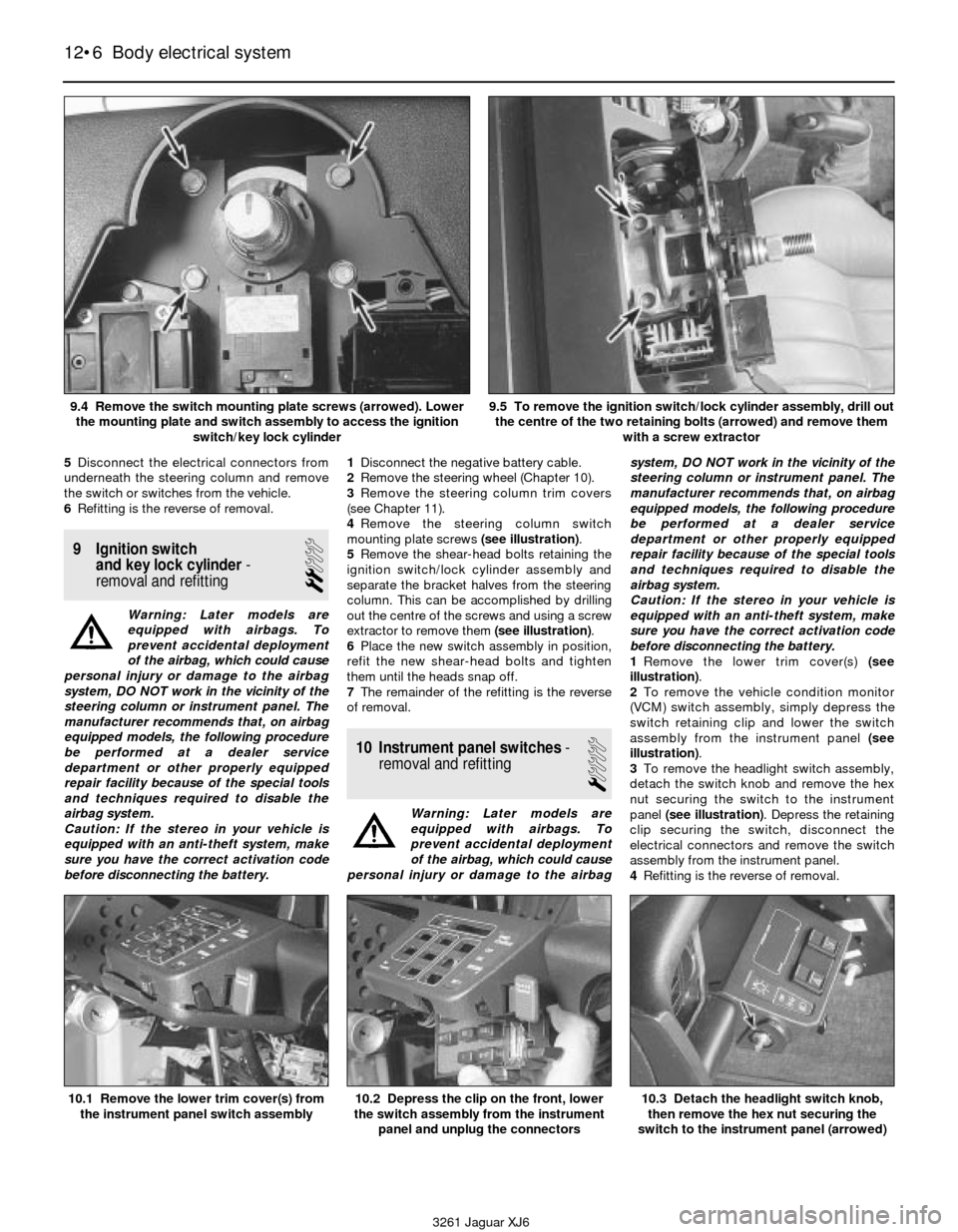
4Remove the steering column switch
mounting plate screws (see illustration).
5Remove the shear-head bolts retaining the
ignition switch/lock cylinder assembly and
separate the bracket halves from the steering
column. This can be accomplished by drilling
out the centre of the screws and using a screw
extractor to remove them (see illustration).
6Place the new switch assembly in position,
refit the new shear-head bolts and tighten
them until the heads snap off.
7The remainder of the refitting is the reverse
of removal.
10 Instrument panel switches-
removal and refitting
1
Warning: Later models are
equipped with airbags. To
prevent accidental deployment
of the airbag, which could cause
personal injury or damage to the airbagsystem, DO NOT work in the vicinity of the
steering column or instrument panel. The
manufacturer recommends that, on airbag
equipped models, the following procedure
be performed at a dealer service
department or other properly equipped
repair facility because of the special tools
and techniques required to disable the
airbag system.
Caution: If the stereo in your vehicle is
equipped with an anti-theft system, make
sure you have the correct activation code
before disconnecting the battery.
1Remove the lower trim cover(s) (see
illustration).
2To remove the vehicle condition monitor
(VCM) switch assembly, simply depress the
switch retaining clip and lower the switch
assembly from the instrument panel (see
illustration).
3To remove the headlight switch assembly,
detach the switch knob and remove the hex
nut securing the switch to the instrument
panel (see illustration). Depress the retaining
clip securing the switch, disconnect the
electrical connectors and remove the switch
assembly from the instrument panel.
4Refitting is the reverse of removal.
12•6 Body electrical system
10.1 Remove the lower trim cover(s) from
the instrument panel switch assembly10.2 Depress the clip on the front, lower
the switch assembly from the instrument
panel and unplug the connectors10.3 Detach the headlight switch knob,
then remove the hex nut securing the
switch to the instrument panel (arrowed)
3261 Jaguar XJ6 9.4 Remove the switch mounting plate screws (arrowed). Lower
the mounting plate and switch assembly to access the ignition
switch/key lock cylinder
9.5 To remove the ignition switch/lock cylinder assembly, drill out
the centre of the two retaining bolts (arrowed) and remove them
with a screw extractor
Page 172 of 227
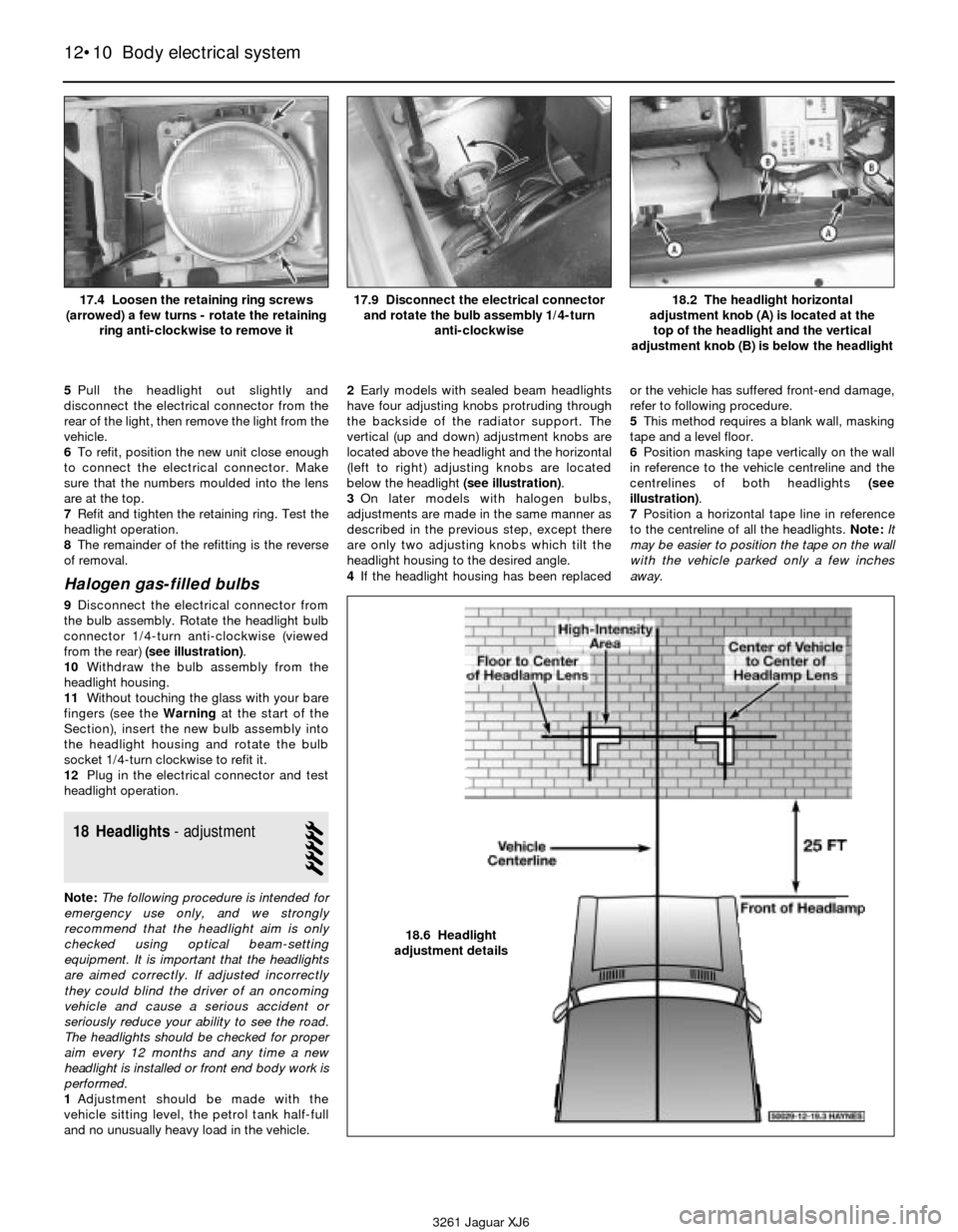
5Pull the headlight out slightly and
disconnect the electrical connector from the
rear of the light, then remove the light from the
vehicle.
6To refit, position the new unit close enough
to connect the electrical connector. Make
sure that the numbers moulded into the lens
are at the top.
7Refit and tighten the retaining ring. Test the
headlight operation.
8The remainder of the refitting is the reverse
of removal.
Halogen gas-filled bulbs
9Disconnect the electrical connector from
the bulb assembly. Rotate the headlight bulb
connector 1/4-turn anti-clockwise (viewed
from the rear) (see illustration).
10Withdraw the bulb assembly from the
headlight housing.
11Without touching the glass with your bare
fingers (see the Warningat the start of the
Section), insert the new bulb assembly into
the headlight housing and rotate the bulb
socket 1/4-turn clockwise to refit it.
12Plug in the electrical connector and test
headlight operation.
18 Headlights- adjustment
5
Note:The following procedure is intended for
emergency use only, and we strongly
recommend that the headlight aim is only
checked using optical beam-setting
equipment. It is important that the headlights
are aimed correctly. If adjusted incorrectly
they could blind the driver of an oncoming
vehicle and cause a serious accident or
seriously reduce your ability to see the road.
The headlights should be checked for proper
aim every 12 months and any time a new
headlight is installed or front end body work is
performed.
1Adjustment should be made with the
vehicle sitting level, the petrol tank half-full
and no unusually heavy load in the vehicle.2Early models with sealed beam headlights
have four adjusting knobs protruding through
the backside of the radiator support. The
vertical (up and down) adjustment knobs are
located above the headlight and the horizontal
(left to right) adjusting knobs are located
below the headlight (see illustration).
3On later models with halogen bulbs,
adjustments are made in the same manner as
described in the previous step, except there
are only two adjusting knobs which tilt the
headlight housing to the desired angle.
4If the headlight housing has been replacedor the vehicle has suffered front-end damage,
refer to following procedure.
5This method requires a blank wall, masking
tape and a level floor.
6Position masking tape vertically on the wall
in reference to the vehicle centreline and the
centrelines of both headlights (see
illustration).
7Position a horizontal tape line in reference
to the centreline of all the headlights. Note:It
may be easier to position the tape on the wall
with the vehicle parked only a few inches
away.
12•10 Body electrical system
3261 Jaguar XJ618.2 The headlight horizontal
adjustment knob (A) is located at the
top of the headlight and the vertical
adjustment knob (B) is below the headlight
17.4 Loosen the retaining ring screws
(arrowed) a few turns - rotate the retaining
ring anti-clockwise to remove it17.9 Disconnect the electrical connector
and rotate the bulb assembly 1/4-turn
anti-clockwise
18.6 Headlight
adjustment details
Page 173 of 227
8Adjustment should be made with the
vehicle parked 25 feet from the wall, sitting
level, the petrol tank half-full and no unusually
heavy load in the vehicle.
9Starting with the low beam adjustment,
position the high intensity zone so it is two
inches below the horizontal line and two
inches to the right of the headlight vertical
line. Adjustments are made by turning the
knobs located behind the headlight housings
(see illustration 18.2).
10With the high beams on, the high intensity
zone should be vertically centred with the
exact centre just below the horizontal line.
Note:It may not be possible to position the
headlight aim exactly for both high and low
beams. If a compromise must be made, keep
in mind that the low beams are the most used
and have the greatest effect on safety.
11Have the headlights adjusted by a dealer
service department or service station at the
earliest opportunity.
19 Headlight housing
(1992 to 1994 models)-
removal and refitting
1
Warning: These vehicles are
equipped with halogen gas-filled
headlight bulbs which are under
pressure and may shatter if the
surface is damaged or the bulb is dropped.
Wear eye protection and handle the bulbs
carefully, grasping only the base whenever
possible. Do not touch the surface of the
bulb with your fingers because the oil from
your skin could cause it to overheat and
fail prematurely. If you do touch the bulb
surface, clean it with rubbing alcohol.
1Remove the headlight bulb (Section 17).
2Remove the retaining nuts, detach the
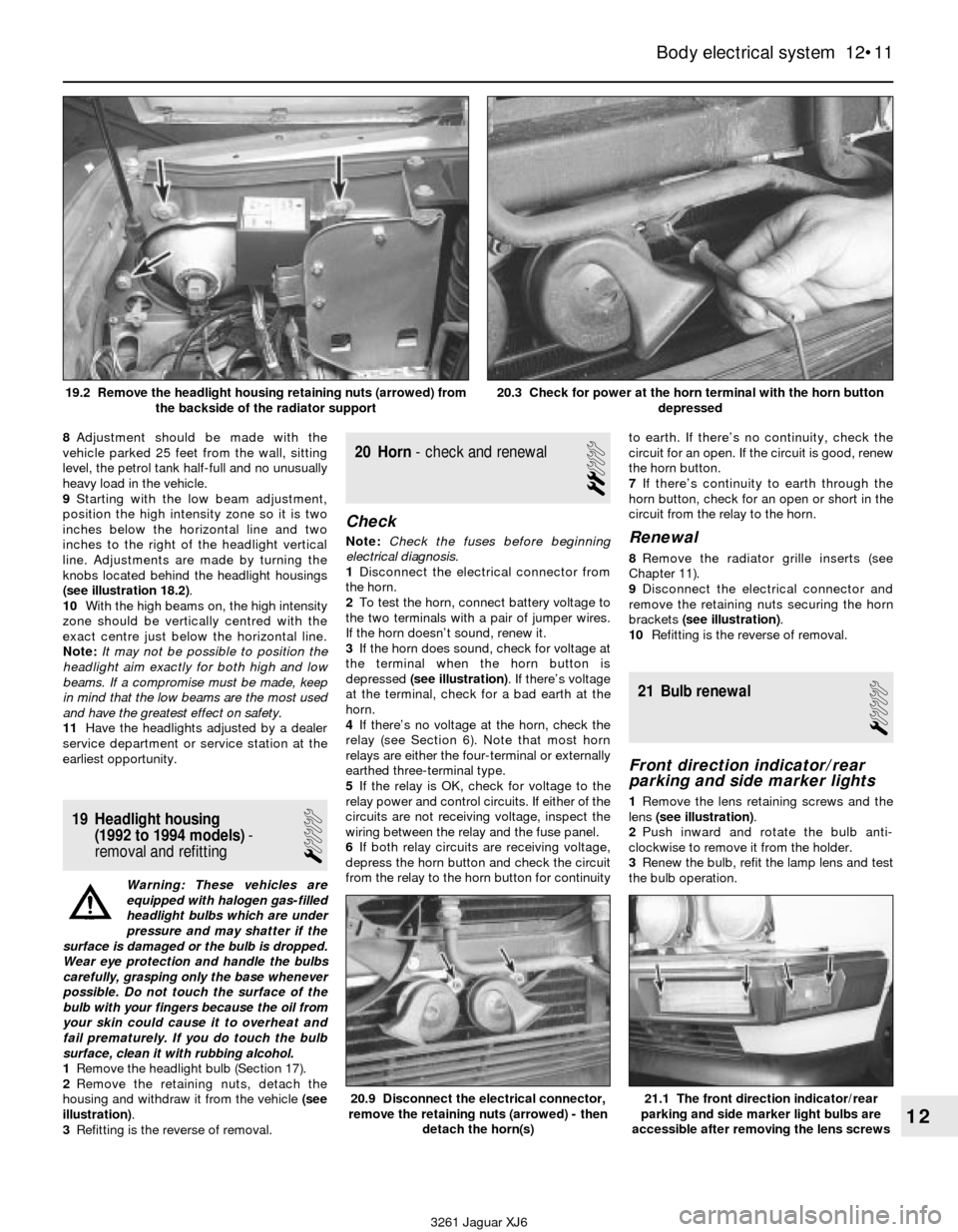
housing and withdraw it from the vehicle (see
illustration).
3Refitting is the reverse of removal.
20 Horn- check and renewal
2
Check
Note:Check the fuses before beginning
electrical diagnosis.
1Disconnect the electrical connector from
the horn.
2To test the horn, connect battery voltage to
the two terminals with a pair of jumper wires.
If the horn doesn’t sound, renew it.
3If the horn does sound, check for voltage at
the terminal when the horn button is
depressed (see illustration). If there’s voltage
at the terminal, check for a bad earth at the
horn.
4If there’s no voltage at the horn, check the
relay (see Section 6). Note that most horn
relays are either the four-terminal or externally
earthed three-terminal type.
5If the relay is OK, check for voltage to the
relay power and control circuits. If either of the
circuits are not receiving voltage, inspect the
wiring between the relay and the fuse panel.
6If both relay circuits are receiving voltage,
depress the horn button and check the circuit
from the relay to the horn button for continuityto earth. If there’s no continuity, check the
circuit for an open. If the circuit is good, renew
the horn button.
7If there’s continuity to earth through the
horn button, check for an open or short in the
circuit from the relay to the horn.Renewal
8Remove the radiator grille inserts (see
Chapter 11).
9Disconnect the electrical connector and
remove the retaining nuts securing the horn
brackets (see illustration).
10Refitting is the reverse of removal.
21 Bulb renewal
1
Front direction indicator/rear
parking and side marker lights
1Remove the lens retaining screws and the
lens (see illustration).
2Push inward and rotate the bulb anti-
clockwise to remove it from the holder.
3Renew the bulb, refit the lamp lens and test
the bulb operation.
Body electrical system 12•11
12
20.9 Disconnect the electrical connector,
remove the retaining nuts (arrowed) - then
detach the horn(s)21.1 The front direction indicator/rear
parking and side marker light bulbs are
accessible after removing the lens screws
3261 Jaguar XJ6 19.2 Remove the headlight housing retaining nuts (arrowed) from
the backside of the radiator support
20.3 Check for power at the horn terminal with the horn button
depressed
Page 174 of 227
Rear direction indicator,
brake, tail and reversing lights
4Open the boot and remove the plastic
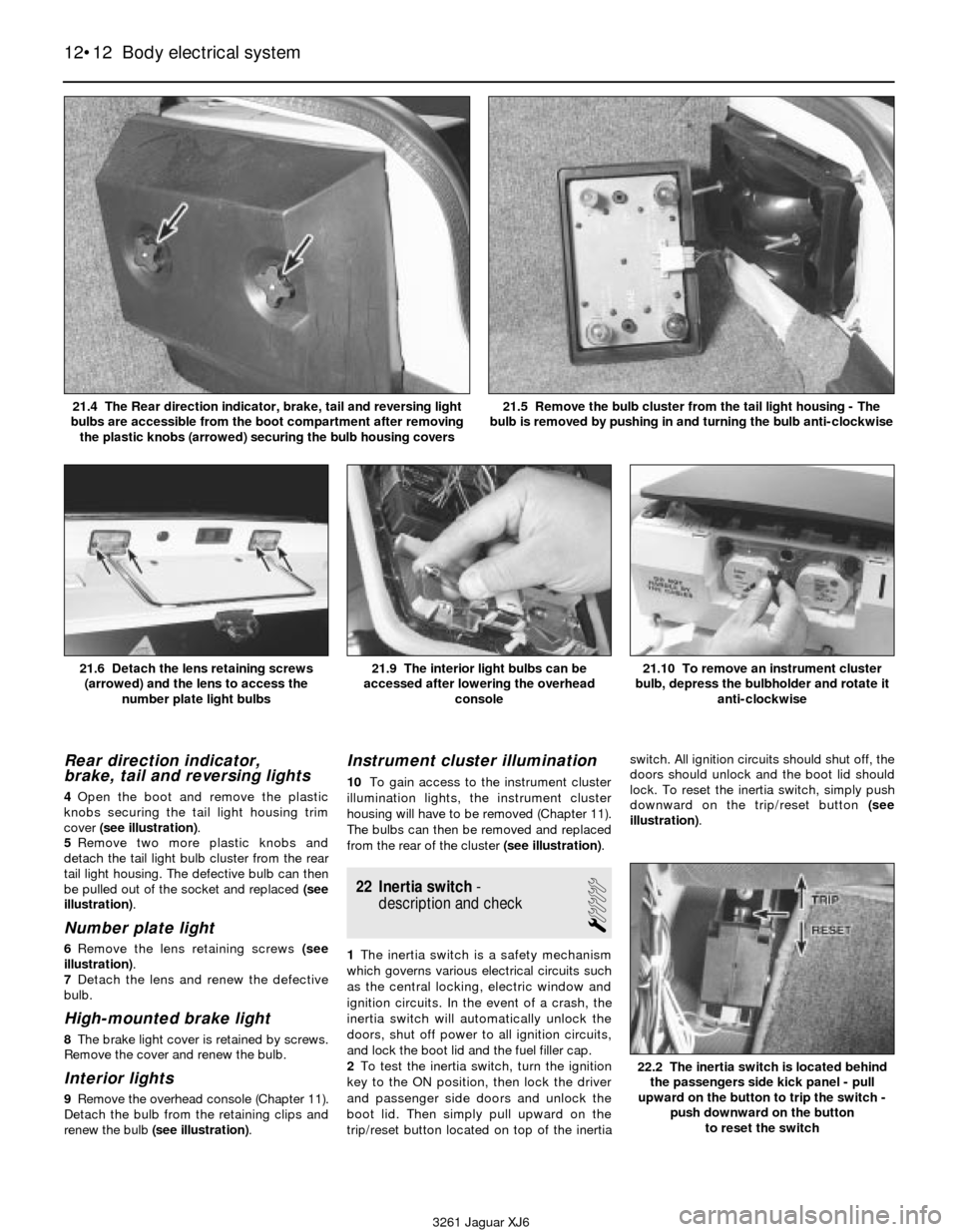
knobs securing the tail light housing trim
cover (see illustration).
5Remove two more plastic knobs and
detach the tail light bulb cluster from the rear
tail light housing. The defective bulb can then
be pulled out of the socket and replaced (see
illustration).
Number plate light
6Remove the lens retaining screws (see
illustration).
7Detach the lens and renew the defective
bulb.
High-mounted brake light
8The brake light cover is retained by screws.
Remove the cover and renew the bulb.
Interior lights
9Remove the overhead console (Chapter 11).
Detach the bulb from the retaining clips and
renew the bulb (see illustration).
Instrument cluster illumination
10To gain access to the instrument cluster
illumination lights, the instrument cluster
housing will have to be removed (Chapter 11).
The bulbs can then be removed and replaced
from the rear of the cluster (see illustration).
22 Inertia switch-
description and check
1
1The inertia switch is a safety mechanism
which governs various electrical circuits such
as the central locking, electric window and
ignition circuits. In the event of a crash, the
inertia switch will automatically unlock the
doors, shut off power to all ignition circuits,
and lock the boot lid and the fuel filler cap.
2To test the inertia switch, turn the ignition
key to the ON position, then lock the driver
and passenger side doors and unlock the
boot lid. Then simply pull upward on the
trip/reset button located on top of the inertiaswitch. All ignition circuits should shut off, the
doors should unlock and the boot lid should
lock. To reset the inertia switch, simply push
downward on the trip/reset button (see
illustration).
12•12 Body electrical system
21.6 Detach the lens retaining screws
(arrowed) and the lens to access the
number plate light bulbs21.9 The interior light bulbs can be
accessed after lowering the overhead
console21.10 To remove an instrument cluster
bulb, depress the bulbholder and rotate it
anti-clockwise
3261 Jaguar XJ6 21.4 The Rear direction indicator, brake, tail and reversing light
bulbs are accessible from the boot compartment after removing
the plastic knobs (arrowed) securing the bulb housing covers
21.5 Remove the bulb cluster from the tail light housing - The
bulb is removed by pushing in and turning the bulb anti-clockwise
22.2 The inertia switch is located behind
the passengers side kick panel - pull
upward on the button to trip the switch -
push downward on the button
to reset the switch
Page 175 of 227
23 Cruise control system-
description and check
5
1The cruise control system maintains vehicle
speed with an independently operated vacuum
motor located on the passenger’s side inner
wing in the engine compartment. When the
cruise control switch is turned on, a vacuum
actuator (connected the throttle linkage) is
activated by vacuum from the vacuum motor.
The system consists of the vacuum motor,
vacuum actuator, brake switch, control
switches, a relay and associated vacuum
hoses. Some features of the system require
special testers and diagnostic procedures
which are beyond the scope of this manual.
Listed below are some general procedures that
may be used to locate common problems.
2Locate and check the fuse (see Section 3).
3Have an assistant operate the brake lights
while you check their operation (voltage from
the brake light switch deactivates the cruise
control).
4If the brake lights don’t come on or don’t
shut off, correct the problem and re-test the
cruise control.
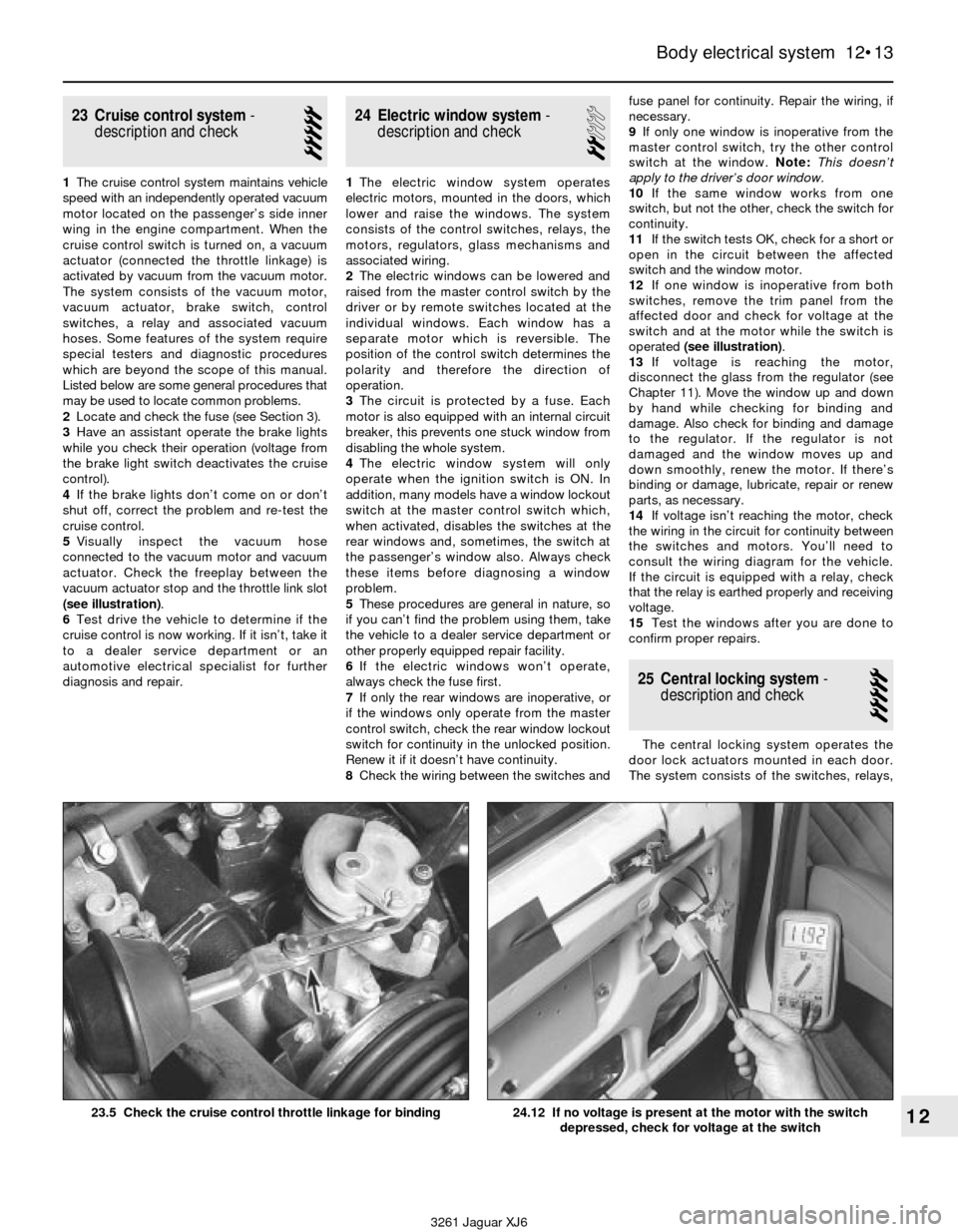
5Visually inspect the vacuum hose
connected to the vacuum motor and vacuum
actuator. Check the freeplay between the
vacuum actuator stop and the throttle link slot
(see illustration).
6Test drive the vehicle to determine if the
cruise control is now working. If it isn’t, take it
to a dealer service department or an
automotive electrical specialist for further
diagnosis and repair.
24 Electric window system-
description and check
2
1The electric window system operates
electric motors, mounted in the doors, which
lower and raise the windows. The system
consists of the control switches, relays, the
motors, regulators, glass mechanisms and
associated wiring.
2The electric windows can be lowered and
raised from the master control switch by the
driver or by remote switches located at the
individual windows. Each window has a
separate motor which is reversible. The
position of the control switch determines the
polarity and therefore the direction of
operation.
3The circuit is protected by a fuse. Each
motor is also equipped with an internal circuit
breaker, this prevents one stuck window from
disabling the whole system.
4The electric window system will only
operate when the ignition switch is ON. In
addition, many models have a window lockout
switch at the master control switch which,
when activated, disables the switches at the
rear windows and, sometimes, the switch at
the passenger’s window also. Always check
these items before diagnosing a window
problem.
5These procedures are general in nature, so
if you can’t find the problem using them, take
the vehicle to a dealer service department or
other properly equipped repair facility.
6If the electric windows won’t operate,
always check the fuse first.
7If only the rear windows are inoperative, or
if the windows only operate from the master
control switch, check the rear window lockout
switch for continuity in the unlocked position.
Renew it if it doesn’t have continuity.
8Check the wiring between the switches andfuse panel for continuity. Repair the wiring, if
necessary.
9If only one window is inoperative from the
master control switch, try the other control
switch at the window. Note:This doesn’t
apply to the driver’s door window.
10If the same window works from one
switch, but not the other, check the switch for
continuity.
11If the switch tests OK, check for a short or
open in the circuit between the affected
switch and the window motor.
12If one window is inoperative from both
switches, remove the trim panel from the
affected door and check for voltage at the
switch and at the motor while the switch is
operated (see illustration).
13If voltage is reaching the motor,
disconnect the glass from the regulator (see
Chapter 11). Move the window up and down
by hand while checking for binding and
damage. Also check for binding and damage
to the regulator. If the regulator is not
damaged and the window moves up and
down smoothly, renew the motor. If there’s
binding or damage, lubricate, repair or renew
parts, as necessary.
14If voltage isn’t reaching the motor, check
the wiring in the circuit for continuity between
the switches and motors. You’ll need to
consult the wiring diagram for the vehicle.
If the circuit is equipped with a relay, check
that the relay is earthed properly and receiving
voltage.
15Test the windows after you are done to
confirm proper repairs.
25 Central locking system-
description and check
5
The central locking system operates the
door lock actuators mounted in each door.
The system consists of the switches, relays,
Body electrical system 12•13
12
3261 Jaguar XJ6 23.5 Check the cruise control throttle linkage for binding
24.12 If no voltage is present at the motor with the switch
depressed, check for voltage at the switch
Page 176 of 227
actuators, a control unit and associated
wiring. Diagnosis can usually be limited to
simple checks of the wiring connections and
actuators for minor faults which can be easily
repaired. Since this system uses an electronic
control unit, in-depth diagnosis should be left
to a dealership service department.
Central locking systems are operated by bi-
directional solenoids located in the doors. The
lock switches have two operating positions;
Lock and Unlock. When activated, the switch
sends a signal to the door lock control unit to
lock or unlock the doors. Depending on which
way the switch is activated, the control unit
reverses polarity to the solenoids, allowing the
two sides of the circuit to be used alternately
as the feed (positive) and earth side.
Some vehicles may have an anti-theft
system incorporated into the locks. If you are
unable to locate the trouble using the following
general paragraphs, consult a dealer service
department or other properly equipped repair
facility.
1Always check the circuit protection first.
Some vehicles use a combination of circuit
breakers and fuses.
2Operate the door lock switches in both
directions (Lock and Unlock) with the engine off.
Listen for the click of the solenoids operating.
3Test the switches for continuity. Renew the
switch if there’s not continuity in both switch
positions.
4Check the wiring between the switches,
control unit and solenoids for continuity.
Repair the wiring if there’s no continuity.
5Check for a bad earth at the switches or the
control unit.
6If all but one lock solenoid operates,
remove the trim panel from the affected door
(see Chapter 11) and check for voltage at the
solenoid while the lock switch is operated
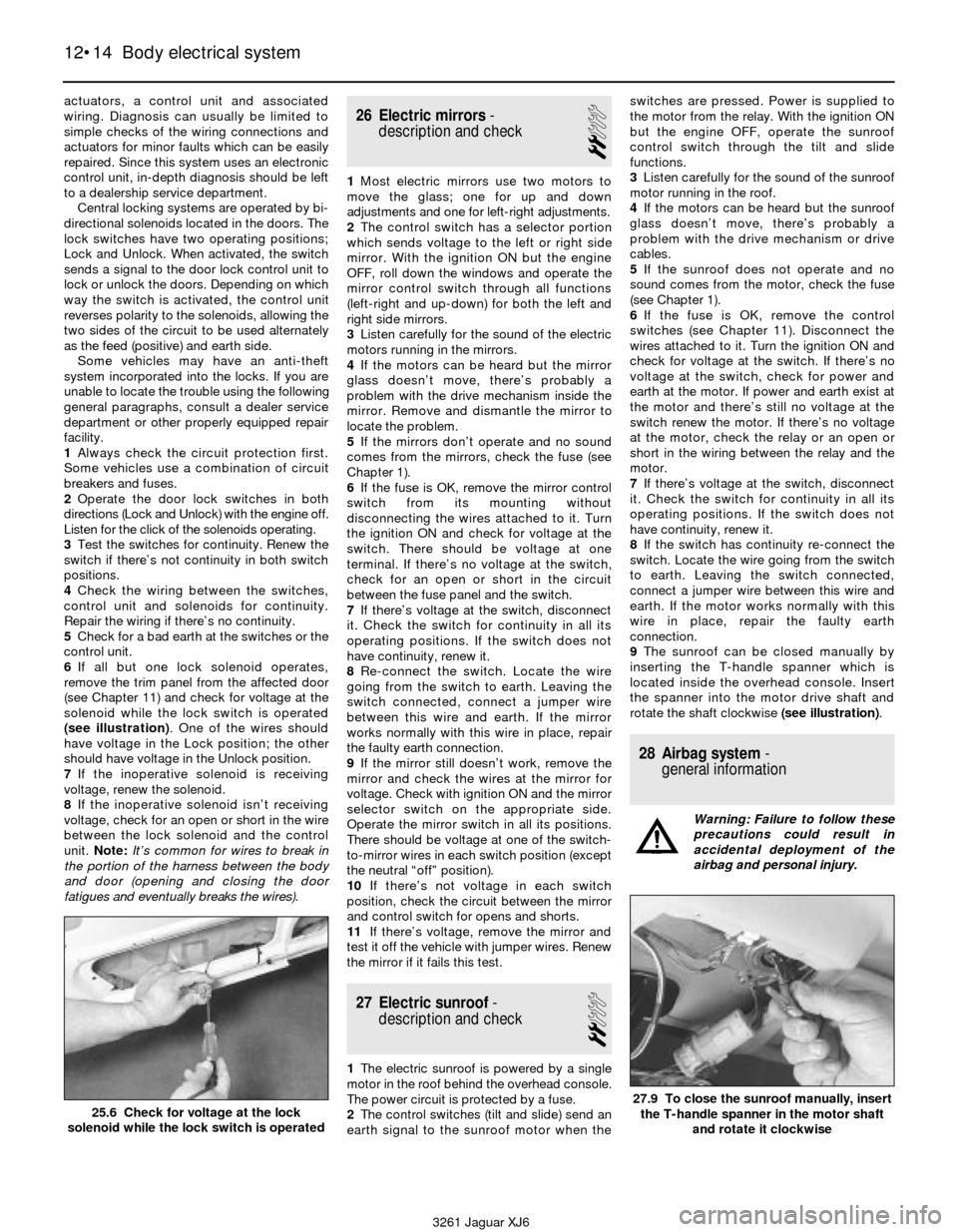
(see illustration). One of the wires should
have voltage in the Lock position; the other
should have voltage in the Unlock position.
7If the inoperative solenoid is receiving
voltage, renew the solenoid.
8If the inoperative solenoid isn’t receiving
voltage, check for an open or short in the wire
between the lock solenoid and the control
unit. Note:It’s common for wires to break in
the portion of the harness between the body
and door (opening and closing the door
fatigues and eventually breaks the wires).26 Electric mirrors-
description and check
2
1Most electric mirrors use two motors to
move the glass; one for up and down
adjustments and one for left-right adjustments.
2The control switch has a selector portion
which sends voltage to the left or right side
mirror. With the ignition ON but the engine
OFF, roll down the windows and operate the
mirror control switch through all functions
(left-right and up-down) for both the left and
right side mirrors.
3Listen carefully for the sound of the electric
motors running in the mirrors.
4If the motors can be heard but the mirror
glass doesn’t move, there’s probably a
problem with the drive mechanism inside the
mirror. Remove and dismantle the mirror to
locate the problem.
5If the mirrors don’t operate and no sound
comes from the mirrors, check the fuse (see
Chapter 1).
6If the fuse is OK, remove the mirror control
switch from its mounting without
disconnecting the wires attached to it. Turn
the ignition ON and check for voltage at the
switch. There should be voltage at one
terminal. If there’s no voltage at the switch,
check for an open or short in the circuit
between the fuse panel and the switch.
7If there’s voltage at the switch, disconnect
it. Check the switch for continuity in all its
operating positions. If the switch does not
have continuity, renew it.
8Re-connect the switch. Locate the wire
going from the switch to earth. Leaving the
switch connected, connect a jumper wire
between this wire and earth. If the mirror
works normally with this wire in place, repair
the faulty earth connection.
9If the mirror still doesn’t work, remove the
mirror and check the wires at the mirror for
voltage. Check with ignition ON and the mirror
selector switch on the appropriate side.
Operate the mirror switch in all its positions.
There should be voltage at one of the switch-
to-mirror wires in each switch position (except
the neutral “off” position).
10If there’s not voltage in each switch
position, check the circuit between the mirror
and control switch for opens and shorts.
11If there’s voltage, remove the mirror and
test it off the vehicle with jumper wires. Renew
the mirror if it fails this test.
27 Electric sunroof-
description and check
2
1The electric sunroof is powered by a single
motor in the roof behind the overhead console.
The power circuit is protected by a fuse.
2The control switches (tilt and slide) send an
earth signal to the sunroof motor when theswitches are pressed. Power is supplied to
the motor from the relay. With the ignition ON
but the engine OFF, operate the sunroof
control switch through the tilt and slide
functions.
3Listen carefully for the sound of the sunroof
motor running in the roof.
4If the motors can be heard but the sunroof
glass doesn’t move, there’s probably a
problem with the drive mechanism or drive
cables.
5If the sunroof does not operate and no
sound comes from the motor, check the fuse
(see Chapter 1).
6If the fuse is OK, remove the control
switches (see Chapter 11). Disconnect the
wires attached to it. Turn the ignition ON and
check for voltage at the switch. If there’s no
voltage at the switch, check for power and
earth at the motor. If power and earth exist at
the motor and there’s still no voltage at the
switch renew the motor. If there’s no voltage
at the motor, check the relay or an open or
short in the wiring between the relay and the
motor.
7If there’s voltage at the switch, disconnect
it. Check the switch for continuity in all its
operating positions. If the switch does not
have continuity, renew it.
8If the switch has continuity re-connect the
switch. Locate the wire going from the switch
to earth. Leaving the switch connected,
connect a jumper wire between this wire and
earth. If the motor works normally with this
wire in place, repair the faulty earth
connection.
9The sunroof can be closed manually by
inserting the T-handle spanner which is
located inside the overhead console. Insert
the spanner into the motor drive shaft and
rotate the shaft clockwise (see illustration).
28 Airbag system-
general information
Warning: Failure to follow these
precautions could result in
accidental deployment of the
airbag and personal injury.
12•14 Body electrical system
25.6 Check for voltage at the lock
solenoid while the lock switch is operated27.9 To close the sunroof manually, insert
the T-handle spanner in the motor shaft
and rotate it clockwise
3261 Jaguar XJ6