lock JAGUAR XJ6 1997 2.G Repair Manual
[x] Cancel search | Manufacturer: JAGUAR, Model Year: 1997, Model line: XJ6, Model: JAGUAR XJ6 1997 2.GPages: 227, PDF Size: 7.2 MB
Page 97 of 227
13Allow the bellcrank to return to the idle
position and test the adjustment once again
until the correct adjustment has been attained.
11 Electronic Fuel Injection
(EFI) system-
general information
1These models are equipped with an
Electronic Fuel Injection (EFI) system. This fuel
injection system is designed by Bosch butlicensed by Lucas and is called the Lucas LH
Engine Management system. The EFI system
is composed of three basic sub systems: fuel
system, air induction system and electronic
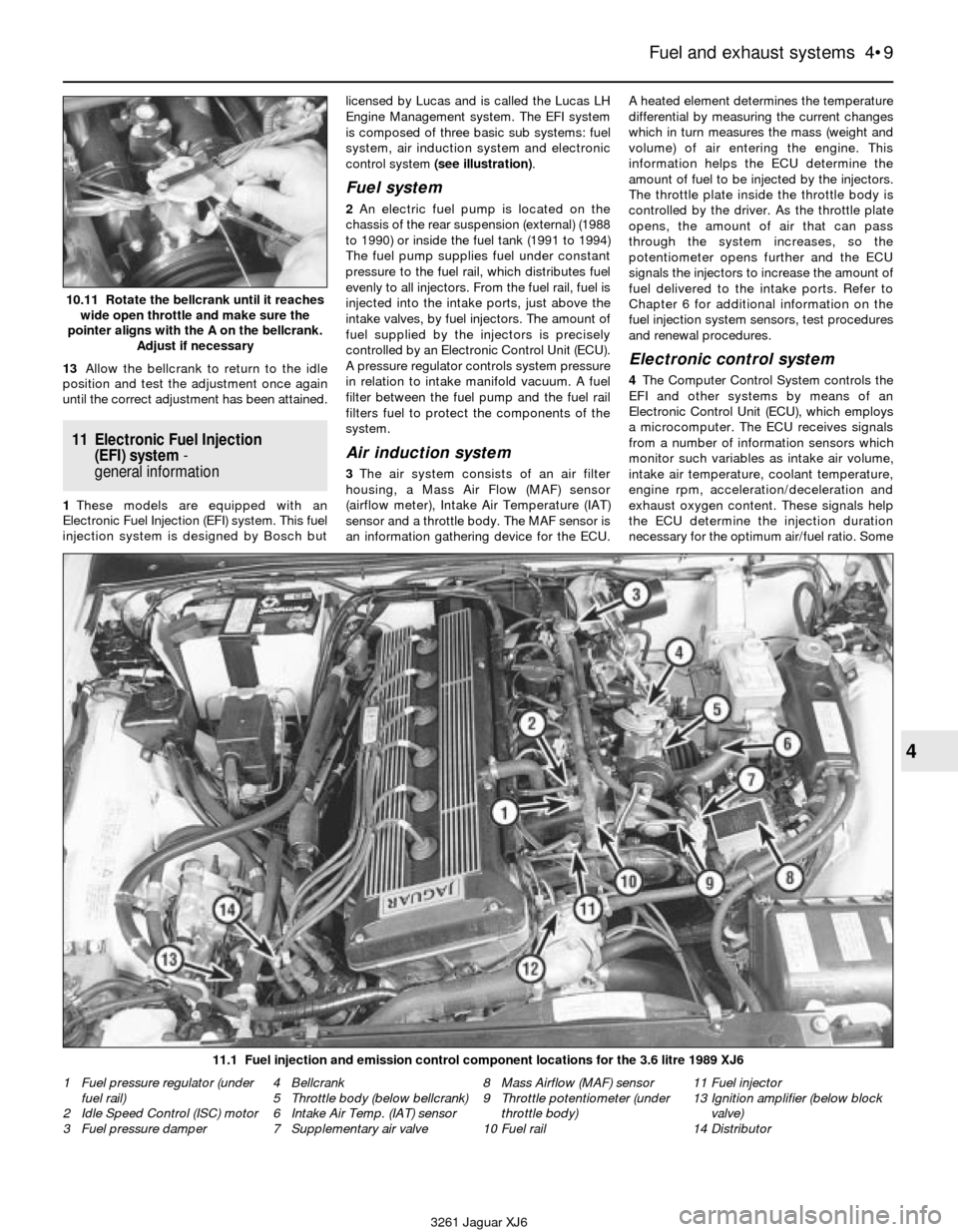
control system (see illustration).
Fuel system
2An electric fuel pump is located on the
chassis of the rear suspension (external) (1988
to 1990) or inside the fuel tank (1991 to 1994)
The fuel pump supplies fuel under constant
pressure to the fuel rail, which distributes fuel
evenly to all injectors. From the fuel rail, fuel is
injected into the intake ports, just above the
intake valves, by fuel injectors. The amount of
fuel supplied by the injectors is precisely
controlled by an Electronic Control Unit (ECU).
A pressure regulator controls system pressure
in relation to intake manifold vacuum. A fuel
filter between the fuel pump and the fuel rail
filters fuel to protect the components of the
system.
Air induction system
3The air system consists of an air filter
housing, a Mass Air Flow (MAF) sensor
(airflow meter), Intake Air Temperature (IAT)
sensor and a throttle body. The MAF sensor is
an information gathering device for the ECU.A heated element determines the temperature
differential by measuring the current changes
which in turn measures the mass (weight and
volume) of air entering the engine. This
information helps the ECU determine the
amount of fuel to be injected by the injectors.
The throttle plate inside the throttle body is
controlled by the driver. As the throttle plate
opens, the amount of air that can pass
through the system increases, so the
potentiometer opens further and the ECU
signals the injectors to increase the amount of
fuel delivered to the intake ports. Refer to
Chapter 6 for additional information on the
fuel injection system sensors, test procedures
and renewal procedures.
Electronic control system
4The Computer Control System controls the
EFI and other systems by means of an
Electronic Control Unit (ECU), which employs
a microcomputer. The ECU receives signals
from a number of information sensors which
monitor such variables as intake air volume,
intake air temperature, coolant temperature,
engine rpm, acceleration/deceleration and
exhaust oxygen content. These signals help
the ECU determine the injection duration
necessary for the optimum air/fuel ratio. Some
Fuel and exhaust systems 4•9
4
10.11 Rotate the bellcrank until it reaches
wide open throttle and make sure the
pointer aligns with the A on the bellcrank.
Adjust if necessary
11.1 Fuel injection and emission control component locations for the 3.6 litre 1989 XJ6
3261 Jaguar XJ6 1 Fuel pressure regulator (under
fuel rail)
2 Idle Speed Control (ISC) motor
3 Fuel pressure damper4 Bellcrank
5 Throttle body (below bellcrank)
6 Intake Air Temp. (IAT) sensor
7 Supplementary air valve8 Mass Airflow (MAF) sensor
9 Throttle potentiometer (under
throttle body)
10 Fuel rail11 Fuel injector
13 Ignition amplifier (below block
valve)
14 Distributor
Page 98 of 227

of these sensors and their corresponding
ECU-controlled relays are not contained
within EFI components, but are located
throughout the engine compartment. For
further information regarding the ECU and its
relationship to the engine electrical and
ignition system, see Chapter 6.
12 Electronic Fuel Injection
(EFI) system- check
2
1Check the earth wire connections for
tightness. Check all wiring and electrical
connectors that are related to the system.
Loose electrical connectors and poor grounds
can cause many problems that resemble
more serious malfunctions.
2Check to see that the battery is fully
charged, as the control unit and sensors
depend on an accurate supply voltage in
order to properly meter the fuel.
3Check the air filter element - a dirty or
partially blocked filter will severely impede
performance and economy (see Chapter 1).
4If a blown fuse is found, renew it and see if
it blows again. If it does, search for a shorted
wire in the harness related to the system.
5Check the air intake duct from the MAF
sensor to the intake manifold for leaks, which
will result in an excessively lean mixture. Also
check the condition of the vacuum hoses
connected to the intake manifold.
6Remove the air intake duct from the throttle
body and check for carbon and residue build-
up. If it’s dirty, clean with aerosol carburettor
cleaner (make sure the can says it’s safe for
use with oxygen sensors and catalytic
converters) and a toothbrush.
7With the engine running, place a
stethoscope against each injector, one at a
time, and listen for a clicking sound, indicating
operation (see illustration).8If there is a problem with an injector,
purchase a special injector test light (noid
light) and refit it into the injector electrical
connector (see illustration). Start the engine
and make sure that each injector connector
flashes the noid light. This will test for the
proper voltage signal to the injector.Caution:
If the engine will not start and the noid
light indicates that each injector is
receiving the proper signal, there is a good
possibility that the injector(s) is stuck open
and allowing fuel into the combustion
chamber in excessive amounts. If the spark
plugs are fouled, detach the primary (low
voltage) wires from the ignition coil, disable
the fuel pump by removing the fuel pump
relay (see Section 2), remove the spark plugs
and crank the engine over. If fuel sprays from
the spark plug holes, the engine is flooded
and the fuel must be removed from the
combustion chambers.
9With the engine OFF and the fuel injector
electrical connectors disconnected, measure
the resistance of each injector (see
illustration). Each injector should measure
about 2.0 to 3.0 ohms. If not, the injector is
probably faulty.10The remainder of the system checks
should be left to a Jaguar service department
or other qualified repair workshop, as there is
a chance that the control unit may be
damaged if not performed properly.
13 Electronic Fuel Injection
(EFI) system- component
check and renewal
3
Warning: Petrol is extremely
flammable, so take extra
precautions when you work on
any part of the fuel system. See
the Warning in Section 2.
Caution: If the stereo in your vehicle is
equipped with an anti-theft system, make
sure you have the correct activation code
before disconnecting the battery.
Throttle body
Check
1Verify that the throttle linkage operates
smoothly.
2Start the engine, detach each vacuum hose
and, using your finger, check the vacuum at
each port on the throttle body with the engine
at idle and above idle. The vacuum available
from the throttle body is ported. Raise the
engine rpm and watch as vacuum increases.
It may be necessary to use a vacuum gauge.
Refer to Chapter 2B for additional information
concerning vacuum checks.
Renewal
Warning: Wait until the engine is
completely cool before
beginning this procedure.
3Detach the cable from the negative terminal
of the battery (see the Cautionat the
beginning of this Section).
4Drain the radiator (see Chapter 1).
4•10 Fuel and exhaust systems
12.9 Using an ohmmeter, measure the
resistance across both terminals
of the injector
3261 Jaguar XJ6 12.7 Use a stethoscope or a screwdriver to determine if the
injectors are working properly - they should make a steady
clicking sound that rises and falls with engine speed changes
12.8 Refit the “noid” light into the fuel injector electrical
connector and check to see that it blinks with the engine running
Page 99 of 227

5Remove the air cleaner (see Chapter 1) and
the air cleaner housing (see Section 9).
6Remove the air intake duct.
7Detach the electrical connector from the
MAF sensor (see illustration).
8Remove the clamp that retains the MAF
sensor to the air intake duct (see illustration)
and lift the MAF sensor assembly from the
engine compartment.
9Detach the throttle cable from the bellcrank
(see Section 10), then remove the bellcrank
assembly from the throttle body (see
illustration).
10Detach the kickdown cable from the
bellcrank and set the cable and brackets
aside (see Chapter 7).
11Clearly label, then detach, all vacuum and
coolant hoses from the throttle body.
12Disconnect the electrical connector from
the throttle potentiometer.
13Remove the four throttle body mounting
bolts and detach the throttle body from the
intake manifold.
14Using a soft brush and carburettor
cleaner, thoroughly clean the throttle body
casting, then blow out all passages with
compressed air.
Caution: Do not clean the throttle position
sensor with any solvents or sprays. Just
wipe it off with a clean, soft cloth.
15Refitting of the throttle body is the reverse
of removal.
16Be sure to tighten the throttle body
mounting bolts to the torque listed in this
Chapter’s Specifications.
Adjustment
17Remove the air intake duct to expose the
throttle body and butterfly valve.
18Make sure the throttle body is clean and
free of burrs, nicks or carbon build-up (see
illustration).
19Measure the clearance between the
butterfly valve (throttle plate) and the wall of
the throttle body (see illustration). It should
be 0.05 mm (0.002 inch). 20If the gap is incorrect, loosen the throttle
stop locknut (see illustration)and turn the
throttle stop screw until the correct clearance
is attained.
21Refit the air intake duct and surrounding
components.
Idle Speed Control (ISC) motor
Note:The minimum idle speed is pre-set at
the factory and should not require adjustment
under normal operating conditions; however ifthe throttle body has been replaced or you
suspect the minimum idle speed has been
tampered with (for example, if the idle speed
screw was removed from the throttle body)
have the vehicle checked by a dealer service
department or a qualified automotive repair
workshop.Check
22Start the engine and allow it to reach
normal operating temperature. Switch on the
Fuel and exhaust systems 4•11
4
13.9 Remove the bellcrank assembly bolts
(arrowed) and separate it from the
throttle body13.18 The area inside the throttle body
near the throttle plate suffers from sludge
build-up because the PCV hose vents
crankcase vapour into the intake duct
13.19 Measure clearance between the
butterfly valve and the throttle body
3261 Jaguar XJ6 13.7 Push up on the clip and remove the harness connector from
the MAF sensor
13.8 Remove the air intake duct clamp from the
MAF sensor housing
13.20 Adjust the butterfly angle by
loosening the locknut on the throttle stop
and turning the adjustment bolt
Page 106 of 227

sure you have the correct activation code
before disconnecting the battery.
2Disconnect the electrical connectors and
the coil wire from the coil.
3Using an ohmmeter, check the coil
resistance:
a) Measure the resistance between the
positive and negative terminals (see
illustration). Compare your reading with
the specified coil primary resistance listed
in this Chapter’s Specifications.
b) Measure the resistance between the
positive terminal and the high tension (HT)
terminal(see illustration). Compare your
reading with the specified coil secondary
resistance listed in this Chapter’s
Specifications.
4If either of the above tests yield resistance
values outside the specified amount, renew
the coil.
Renewal
5Detach the battery negative cable.
Caution: If the stereo in your vehicle is
equipped with an anti-theft system, make
sure you have the correct activation code
before disconnecting the battery. 6Label and disconnect the electrical wires
from the coil terminals.
7Remove the coil mounting fasteners (see
illustration).
8Refitting is the reverse of removal.
9 Distributor-
removal and refitting
2
Note:The timing on this ignition system cannot
be adjusted by turning the distributor. Ignition
timing is maintained by the ECU at all times. In
the event the distributor must be removed from
the engine, be sure to follow the precautions
described in this section and mark the engine
and distributor with paint to ensure correct
refitting. If the distributor is not marked, and the
crankshaft is turned while the distributor is out of
the engine, have the distributor installed by a
dealer service department. The distributor must
be installed using a special alignment tool.
Removal
1Detach the battery negative cable. Caution: If the stereo in your vehicle is
equipped with an anti-theft system, make
sure you have the correct activation code
before disconnecting the battery.
2Disconnect the electrical connectors from
the distributor.
3Look for a raised “1” on the distributor cap.
This marks the location for the number one
cylinder spark plug lead terminal. If the cap
does not have a mark for the number one
terminal, locate the number one spark plug
and trace the wire back to the terminal on the
cap.
4Remove the distributor cap (see Chapter 1)
and rotate the engine until the rotor is pointing
toward the number one spark plug terminal.
5Make a mark on the edge of the distributor
base directly below the rotor tip and in line
with it. Also, mark the distributor base and the
engine block to ensure that the distributor is
installed correctly (see illustrations).
6Remove the distributor hold-down bolt,
then pull the distributor out to remove it.
Caution: DO NOT turn the crankshaft while
the distributor is out of the engine, or the
alignment marks will be useless.
5•4 Engine electrical systems
8.3a To check the primary resistance of
the coil, measure the resistance between
the positive and the negative terminals8.3b To check the secondary resistance of
the coil, measure the resistance between
the positive terminal and the HT terminal8.7 Remove the nuts from the coil
mounting bracket (arrowed)
3261 Jaguar XJ6
9.5a Paint or scribe a mark (arrowed) on the edge of the
distributor housing below the rotor tip to ensure that the rotor is
pointing in the same direction when the distributor is reinstalled9.5b Paint or scribe another mark across the cylinder head and
the distributor body (arrowed) to ensure that the distributor is
aligned correctly when it is reinstalled
Page 107 of 227
Refitting
7Insert the distributor into the engine in
exactly the same relationship to the block that
it was in when removed.
8If the distributor does not seat completely,
recheck the alignment marks between the
distributor base and the block to verify that
the distributor is in the same position it was in
before removal. Also check the rotor to see if
it’s aligned with the mark you made on the
edge of the distributor base.
9Refit the distributor hold-down bolt(s).
10The remainder of refitting is the reverse of
removal.
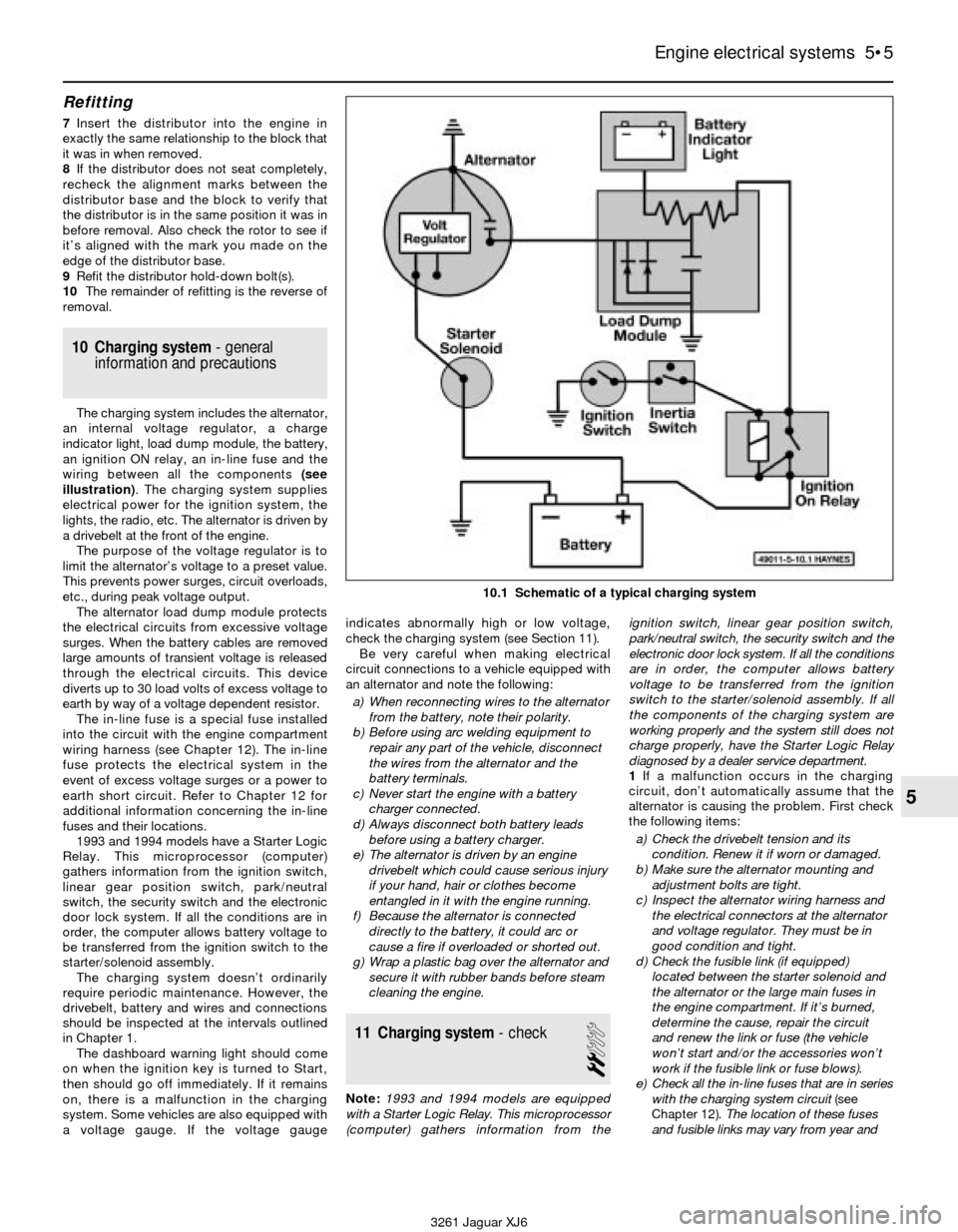
10 Charging system- general
information and precautions
The charging system includes the alternator,
an internal voltage regulator, a charge
indicator light, load dump module, the battery,
an ignition ON relay, an in-line fuse and the
wiring between all the components (see
illustration). The charging system supplies
electrical power for the ignition system, the
lights, the radio, etc. The alternator is driven by
a drivebelt at the front of the engine.
The purpose of the voltage regulator is to
limit the alternator’s voltage to a preset value.
This prevents power surges, circuit overloads,
etc., during peak voltage output.
The alternator load dump module protects
the electrical circuits from excessive voltage
surges. When the battery cables are removed
large amounts of transient voltage is released
through the electrical circuits. This device
diverts up to 30 load volts of excess voltage to
earth by way of a voltage dependent resistor.
The in-line fuse is a special fuse installed
into the circuit with the engine compartment
wiring harness (see Chapter 12). The in-line
fuse protects the electrical system in the
event of excess voltage surges or a power to
earth short circuit. Refer to Chapter 12 for
additional information concerning the in-line
fuses and their locations.
1993 and 1994 models have a Starter Logic
Relay. This microprocessor (computer)
gathers information from the ignition switch,
linear gear position switch, park/neutral
switch, the security switch and the electronic
door lock system. If all the conditions are in
order, the computer allows battery voltage to
be transferred from the ignition switch to the
starter/solenoid assembly.
The charging system doesn’t ordinarily
require periodic maintenance. However, the
drivebelt, battery and wires and connections
should be inspected at the intervals outlined
in Chapter 1.
The dashboard warning light should come
on when the ignition key is turned to Start,
then should go off immediately. If it remains
on, there is a malfunction in the charging
system. Some vehicles are also equipped with
a voltage gauge. If the voltage gaugeindicates abnormally high or low voltage,
check the charging system (see Section 11).
Be very careful when making electrical
circuit connections to a vehicle equipped with
an alternator and note the following:
a) When reconnecting wires to the alternator
from the battery, note their polarity.
b) Before using arc welding equipment to
repair any part of the vehicle, disconnect
the wires from the alternator and the
battery terminals.
c) Never start the engine with a battery
charger connected.
d) Always disconnect both battery leads
before using a battery charger.
e) The alternator is driven by an engine
drivebelt which could cause serious injury
if your hand, hair or clothes become
entangled in it with the engine running.
f) Because the alternator is connected
directly to the battery, it could arc or
cause a fire if overloaded or shorted out.
g) Wrap a plastic bag over the alternator and
secure it with rubber bands before steam
cleaning the engine.
11 Charging system- check
2
Note:1993 and 1994 models are equipped
with a Starter Logic Relay. This microprocessor
(computer) gathers information from theignition switch, linear gear position switch,
park/neutral switch, the security switch and the
electronic door lock system. If all the conditions
are in order, the computer allows battery
voltage to be transferred from the ignition
switch to the starter/solenoid assembly. If all
the components of the charging system are
working properly and the system still does not
charge properly, have the Starter Logic Relay
diagnosed by a dealer service department.
1If a malfunction occurs in the charging
circuit, don’t automatically assume that the
alternator is causing the problem. First check
the following items:
a) Check the drivebelt tension and its
condition. Renew it if worn or damaged.
b) Make sure the alternator mounting and
adjustment bolts are tight.
c) Inspect the alternator wiring harness and
the electrical connectors at the alternator
and voltage regulator. They must be in
good condition and tight.
d) Check the fusible link (if equipped)
located between the starter solenoid and
the alternator or the large main fuses in
the engine compartment. If it’s burned,
determine the cause, repair the circuit
and renew the link or fuse (the vehicle
won’t start and/or the accessories won’t
work if the fusible link or fuse blows).
e) Check all the in-line fuses that are in series
with the charging system circuit (see
Chapter 12).The location of these fuses
and fusible links may vary from year and
Engine electrical systems 5•5
5
10.1 Schematic of a typical charging system
3261 Jaguar XJ6
Page 108 of 227
model but the designations are the same.
Refer to the wiring diagrams at the end of
Chapter 12.
f) Start the engine and check the alternator
for abnormal noises (a shrieking or
squealing sound indicates a bad bushing).
g) Check the specific gravity of the battery
electrolyte. If it’s low, charge the battery
(doesn’t apply to maintenance free
batteries).
h) Make sure that the battery is fully charged
(one bad cell in a battery can cause
overcharging by the alternator).
i) Disconnect the battery cables (negative
first, then positive). Caution:If the stereo
in your vehicle is equipped with an anti-
theft system, make sure you have the
correct activation code before
disconnecting the battery. Inspect the
battery posts and the cable clamps for
corrosion. Clean them thoroughly if
necessary (see Chapter 1). Reconnect the
positive cable, then the negative cable.
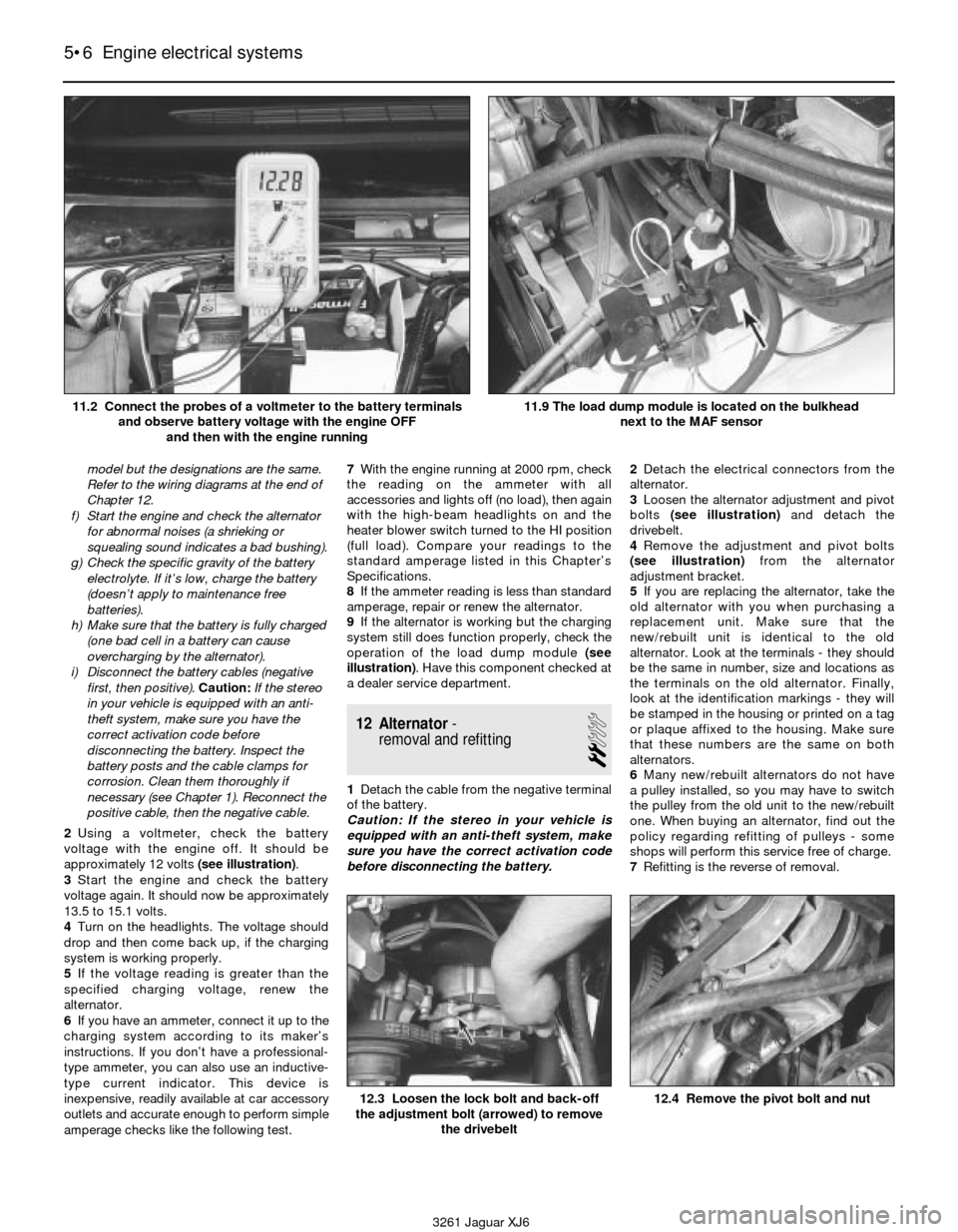
2Using a voltmeter, check the battery
voltage with the engine off. It should be
approximately 12 volts (see illustration).
3Start the engine and check the battery
voltage again. It should now be approximately
13.5 to 15.1 volts.
4Turn on the headlights. The voltage should
drop and then come back up, if the charging
system is working properly.
5If the voltage reading is greater than the
specified charging voltage, renew the
alternator.
6If you have an ammeter, connect it up to the
charging system according to its maker’s
instructions. If you don’t have a professional-
type ammeter, you can also use an inductive-
type current indicator. This device is
inexpensive, readily available at car accessory
outlets and accurate enough to perform simple
amperage checks like the following test.7With the engine running at 2000 rpm, check
the reading on the ammeter with all
accessories and lights off (no load), then again
with the high-beam headlights on and the
heater blower switch turned to the HI position
(full load). Compare your readings to the
standard amperage listed in this Chapter’s
Specifications.
8If the ammeter reading is less than standard
amperage, repair or renew the alternator.
9If the alternator is working but the charging
system still does function properly, check the
operation of the load dump module (see
illustration). Have this component checked at
a dealer service department.
12 Alternator-
removal and refitting
2
1Detach the cable from the negative terminal
of the battery.
Caution: If the stereo in your vehicle is
equipped with an anti-theft system, make
sure you have the correct activation code
before disconnecting the battery.2Detach the electrical connectors from the
alternator.
3Loosen the alternator adjustment and pivot
bolts (see illustration) and detach the
drivebelt.
4Remove the adjustment and pivot bolts
(see illustration)from the alternator
adjustment bracket.
5If you are replacing the alternator, take the
old alternator with you when purchasing a
replacement unit. Make sure that the
new/rebuilt unit is identical to the old
alternator. Look at the terminals - they should
be the same in number, size and locations as
the terminals on the old alternator. Finally,
look at the identification markings - they will
be stamped in the housing or printed on a tag
or plaque affixed to the housing. Make sure
that these numbers are the same on both
alternators.
6Many new/rebuilt alternators do not have
a pulley installed, so you may have to switch
the pulley from the old unit to the new/rebuilt
one. When buying an alternator, find out the
policy regarding refitting of pulleys - some
shops will perform this service free of charge.
7Refitting is the reverse of removal.
5•6 Engine electrical systems
12.3 Loosen the lock bolt and back-off
the adjustment bolt (arrowed) to remove
the drivebelt12.4 Remove the pivot bolt and nut
3261 Jaguar XJ6 11.2 Connect the probes of a voltmeter to the battery terminals
and observe battery voltage with the engine OFF
and then with the engine running
11.9 The load dump module is located on the bulkhead
next to the MAF sensor
Page 113 of 227
2The CHECK ENGINE warning light, which is
located on the instrument panel, comes on
when the ignition switch is turned to ON and
the engine is not running. When the engine is
started, the warning light should go out. If the
light remains on, the self-diagnosis system
has detected a malfunction. Note: The
CHECK ENGINE light on early models is
displayed on the dashboard VCM panel on the
right side. Later models are equipped with a
separate CHECK ENGINE light on the left side
of the instrument cluster.Note:Not all the
codes will cause the CHECK ENGINE light to
activate. When performing any fuel or
emissions systems diagnosis, always check
for codes that may be stored but not indicated
by the CHECK ENGINE light.
Obtaining fault code output
3To obtain an output of diagnostic codes,
verify first that the battery voltage is above 11
volts, the throttle is fully closed, the
transmission is in Park, the accessory
switches are off and the engine is at normal
operating temperature.
4Turn the ignition switch to ON but don’t
start the engine (Position II). Note:On 1988
and 1989 models, remember to turn the
ignition switch to position II without turning
the key to OFF.
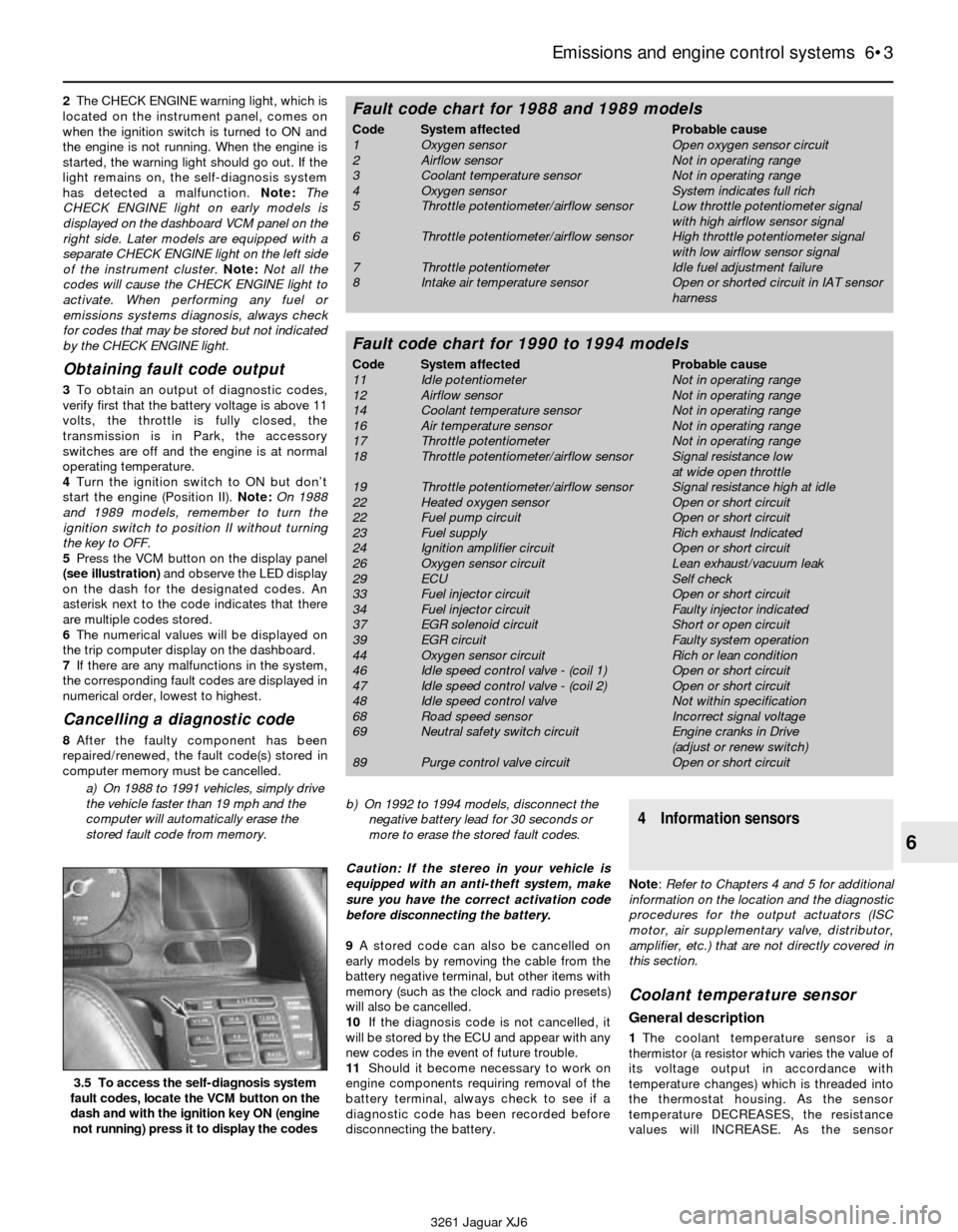
5Press the VCM button on the display panel
(see illustration)and observe the LED display
on the dash for the designated codes. An
asterisk next to the code indicates that there
are multiple codes stored.
6The numerical values will be displayed on
the trip computer display on the dashboard.
7If there are any malfunctions in the system,
the corresponding fault codes are displayed in
numerical order, lowest to highest.
Cancelling a diagnostic code
8After the faulty component has been
repaired/renewed, the fault code(s) stored in
computer memory must be cancelled.
a) On 1988 to 1991 vehicles, simply drive
the vehicle faster than 19 mph and the
computer will automatically erase the
stored fault code from memory.b) On 1992 to 1994 models, disconnect the
negative battery lead for 30 seconds or
more to erase the stored fault codes.
Caution: If the stereo in your vehicle is
equipped with an anti-theft system, make
sure you have the correct activation code
before disconnecting the battery.
9A stored code can also be cancelled on
early models by removing the cable from the
battery negative terminal, but other items with
memory (such as the clock and radio presets)
will also be cancelled.
10If the diagnosis code is not cancelled, it
will be stored by the ECU and appear with any
new codes in the event of future trouble.
11Should it become necessary to work on
engine components requiring removal of the
battery terminal, always check to see if a
diagnostic code has been recorded before
disconnecting the battery.
4 Information sensors
Note: Refer to Chapters 4 and 5 for additional
information on the location and the diagnostic
procedures for the output actuators (ISC
motor, air supplementary valve, distributor,
amplifier, etc.) that are not directly covered in
this section.
Coolant temperature sensor
General description
1The coolant temperature sensor is a
thermistor (a resistor which varies the value of
its voltage output in accordance with
temperature changes) which is threaded into
the thermostat housing. As the sensor
temperature DECREASES, the resistance
values will INCREASE. As the sensor
Emissions and engine control systems 6•3
6
3.5 To access the self-diagnosis system
fault codes, locate the VCM button on the
dash and with the ignition key ON (engine
not running) press it to display the codes
3261 Jaguar XJ6
Fault code chart for 1988 and 1989 models
Code System affected Probable cause
1 Oxygen sensor Open oxygen sensor circuit
2 Airflow sensor Not in operating range
3 Coolant temperature sensor Not in operating range
4 Oxygen sensor System indicates full rich
5 Throttle potentiometer/airflow sensor Low throttle potentiometer signal
with high airflow sensor signal
6 Throttle potentiometer/airflow sensor High throttle potentiometer signal
with low airflow sensor signal
7 Throttle potentiometer Idle fuel adjustment failure
8 Intake air temperature sensor Open or shorted circuit in IAT sensor
harness
Fault code chart for 1990 to 1994 models
Code System affected Probable cause
11 Idle potentiometer Not in operating range
12 Airflow sensor Not in operating range
14 Coolant temperature sensor Not in operating range
16 Air temperature sensor Not in operating range
17 Throttle potentiometer Not in operating range
18 Throttle potentiometer/airflow sensor Signal resistance low
at wide open throttle
19 Throttle potentiometer/airflow sensor Signal resistance high at idle
22 Heated oxygen sensor Open or short circuit
22 Fuel pump circuit Open or short circuit
23 Fuel supply Rich exhaust Indicated
24 Ignition amplifier circuit Open or short circuit
26 Oxygen sensor circuit Lean exhaust/vacuum leak
29 ECU Self check
33 Fuel injector circuit Open or short circuit
34 Fuel injector circuit Faulty injector indicated
37 EGR solenoid circuit Short or open circuit
39 EGR circuit Faulty system operation
44 Oxygen sensor circuit Rich or lean condition
46 Idle speed control valve - (coil 1) Open or short circuit
47 Idle speed control valve - (coil 2) Open or short circuit
48 Idle speed control valve Not within specification
68 Road speed sensor Incorrect signal voltage
69 Neutral safety switch circuit Engine cranks in Drive
(adjust or renew switch)
89 Purge control valve circuit Open or short circuit
Page 114 of 227
temperature INCREASES, the resistance
values will DECREASE. A failure in this sensor
circuit should set a Code 3 (1988 and 1989)
or 13 (1990 to 1994). This code indicates a
failure in the coolant temperature sensor
circuit, so in most cases the appropriate
solution to the problem will be either repair of
a connector or wire, or renewal of the sensor.
Check
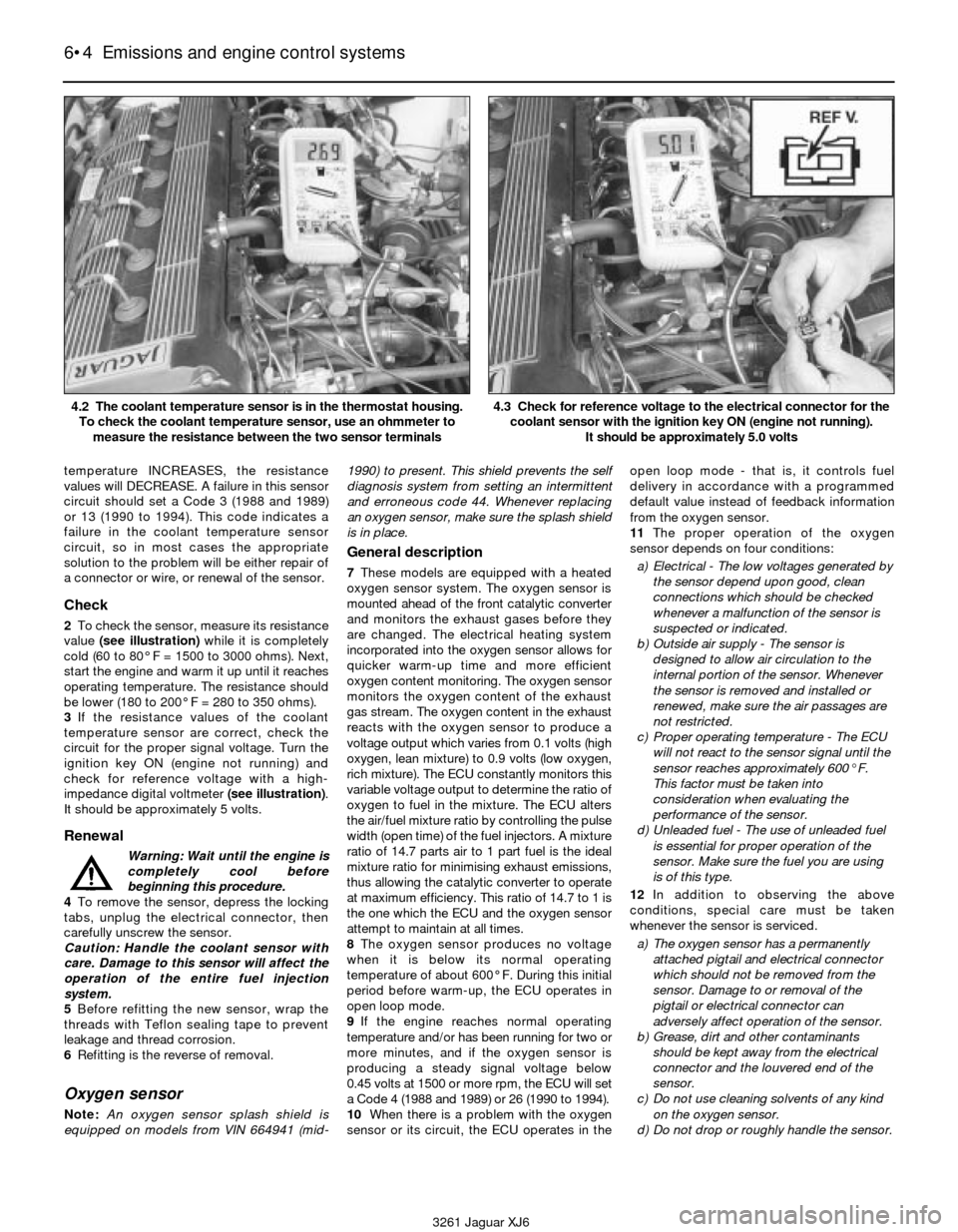
2To check the sensor, measure its resistance
value (see illustration)while it is completely
cold (60 to 80° F = 1500 to 3000 ohms). Next,
start the engine and warm it up until it reaches
operating temperature. The resistance should
be lower (180 to 200° F = 280 to 350 ohms).
3If the resistance values of the coolant
temperature sensor are correct, check the
circuit for the proper signal voltage. Turn the
ignition key ON (engine not running) and
check for reference voltage with a high-
impedance digital voltmeter (see illustration).
It should be approximately 5 volts.
Renewal
Warning: Wait until the engine is
completely cool before
beginning this procedure.
4To remove the sensor, depress the locking
tabs, unplug the electrical connector, then
carefully unscrew the sensor.
Caution: Handle the coolant sensor with
care. Damage to this sensor will affect the
operation of the entire fuel injection
system.
5Before refitting the new sensor, wrap the
threads with Teflon sealing tape to prevent
leakage and thread corrosion.
6Refitting is the reverse of removal.
Oxygen sensor
Note:An oxygen sensor splash shield is
equipped on models from VIN 664941 (mid-1990) to present. This shield prevents the self
diagnosis system from setting an intermittent
and erroneous code 44. Whenever replacing
an oxygen sensor, make sure the splash shield
is in place.
General description
7These models are equipped with a heated
oxygen sensor system. The oxygen sensor is
mounted ahead of the front catalytic converter
and monitors the exhaust gases before they
are changed. The electrical heating system
incorporated into the oxygen sensor allows for
quicker warm-up time and more efficient
oxygen content monitoring. The oxygen sensor
monitors the oxygen content of the exhaust
gas stream. The oxygen content in the exhaust
reacts with the oxygen sensor to produce a
voltage output which varies from 0.1 volts (high
oxygen, lean mixture) to 0.9 volts (low oxygen,
rich mixture). The ECU constantly monitors this
variable voltage output to determine the ratio of
oxygen to fuel in the mixture. The ECU alters
the air/fuel mixture ratio by controlling the pulse
width (open time) of the fuel injectors. A mixture
ratio of 14.7 parts air to 1 part fuel is the ideal
mixture ratio for minimising exhaust emissions,
thus allowing the catalytic converter to operate
at maximum efficiency. This ratio of 14.7 to 1 is
the one which the ECU and the oxygen sensor
attempt to maintain at all times.
8The oxygen sensor produces no voltage
when it is below its normal operating
temperature of about 600° F. During this initial
period before warm-up, the ECU operates in
open loop mode.
9If the engine reaches normal operating
temperature and/or has been running for two or
more minutes, and if the oxygen sensor is
producing a steady signal voltage below
0.45 volts at 1500 or more rpm, the ECU will set
a Code 4 (1988 and 1989) or 26 (1990 to 1994).
10When there is a problem with the oxygen
sensor or its circuit, the ECU operates in theopen loop mode - that is, it controls fuel
delivery in accordance with a programmed
default value instead of feedback information
from the oxygen sensor.
11The proper operation of the oxygen
sensor depends on four conditions:
a) Electrical - The low voltages generated by
the sensor depend upon good, clean
connections which should be checked
whenever a malfunction of the sensor is
suspected or indicated.
b) Outside air supply - The sensor is
designed to allow air circulation to the
internal portion of the sensor. Whenever
the sensor is removed and installed or
renewed, make sure the air passages are
not restricted.
c) Proper operating temperature - The ECU
will not react to the sensor signal until the
sensor reaches approximately 600° F.
This factor must be taken into
consideration when evaluating the
performance of the sensor.
d) Unleaded fuel - The use of unleaded fuel
is essential for proper operation of the
sensor. Make sure the fuel you are using
is of this type.
12In addition to observing the above
conditions, special care must be taken
whenever the sensor is serviced.
a) The oxygen sensor has a permanently
attached pigtail and electrical connector
which should not be removed from the
sensor. Damage to or removal of the
pigtail or electrical connector can
adversely affect operation of the sensor.
b) Grease, dirt and other contaminants
should be kept away from the electrical
connector and the louvered end of the
sensor.
c) Do not use cleaning solvents of any kind
on the oxygen sensor.
d) Do not drop or roughly handle the sensor.
6•4 Emissions and engine control systems
3261 Jaguar XJ6 4.2 The coolant temperature sensor is in the thermostat housing.
To check the coolant temperature sensor, use an ohmmeter to
measure the resistance between the two sensor terminals
4.3 Check for reference voltage to the electrical connector for the
coolant sensor with the ignition key ON (engine not running).
It should be approximately 5.0 volts
Page 118 of 227

5 Air Injector Reactor
(AIR) system
General information
1The air injection reactor system reduces
carbon monoxide and hydrocarbon content
in the exhaust gases by injecting fresh air into
the hot exhaust gases leaving the exhaust
ports. When fresh air is mixed with hot
exhaust gases, oxidation is increased,
reducing the concentration of hydrocarbons
and carbon monoxide and converting them
into harmless carbon dioxide and water.
2The air injection system is composed of an
air pump, diverter valve (bypass), check valve,
air injection manifold, vacuum delay valve,
vacuum control solenoid, air pump magnetic
clutch, air pump clutch relay and hoses (see
illustration). The air pump is driven by a belt
from the crankshaft and supplies compressed
air to the exhaust manifold(s). The check valve
prevents the reverse flow of exhaust gases into
the system. The vacuum-operated (early
models) or electrically-operated (later models)air cut-off valve prevents air from being drawn
into the exhaust when the air pump is switched
off. System vacuum to the air cut-off valve is
controlled by the solenoid vacuum valve in
parallel circuit with the air pump. A delay valve
prevents vacuum loss to the solenoid valve
during wide open throttle operation.
3Injected air is controlled by the computer,
the air pump clutch and the air pump clutch
relay. The AIR system is used during warm-up
(58 to 83° F) to control emissions while the
engine is running rich. The oxygen sensor
feedback system cannot function while the AIR
system is operating. The computer controls
both systems during warm-up and operating
temperatures. If problems occur with the
AIR system relay or circuit, the on-board
diagnosis system will set a code 66.
Check
4Check the condition of the air pump
drivebelt, the injection hoses and the injection
manifold. Make sure that all components are
intact and there are no leaks.
5Check the operation of the air pump clutch
relay (see illustration)and the air pump
clutch. First remove the relay and check forbattery voltage to the relay. Also, check the
relay itself. Refer to the relay checking
procedure in Chapter 12. Extract codes from
the self-diagnosis system (see Section 3) and
check for a code 66, AIR relay malfunction.
6Make sure the electrical connector is
securely fastened to the diverter valve (see
illustration). If everything appears OK but a
fault code still sets, have the system
diagnosed by a dealer service department or
other qualified repair workshop.
Air pump renewal
7Disconnect the cable from the negative
terminal of the battery.
Caution: If the stereo in your vehicle is
equipped with an anti-theft system, make
sure you have the correct activation code
before disconnecting the battery.
8Disconnect the electrical connector from
the air pump clutch.
9Loosen the clips from the air inlet and outlet
hose and separate them from the air injection
pump.
10Loosen the adjuster and pivot bolts (see
illustration)and nuts but do not remove them
from the air injection pump brackets.
6•8 Emissions and engine control systems
3261 Jaguar XJ6 5.2 Schematic of the Air Injection Reactor (AIR) system
5.6 Location of the AIR diverter valve on a 1992 model - check the
hoses for cracking and the electrical connector for security5.10 Loosen the pivot bolt and then the adjustment nut to remove
the drivebelt from the air pump. The adjustment nut has a lock bolt
that must be loosened before the pump will move down the adjuster
5.5 Location of the AIR pump relay on a 1992 model
Page 119 of 227

11Swing the pump toward the engine and
remove the drivebelt from the pump.
12Remove the link arm through-bolt.
13Remove the pivot bolt and front spacer,
rear cone and air injection pump from the
engine compartment.
14Remove the nut securing the front pulley
on the air injection pump.
15Remove the clutch snap-ring and the
clutch.
16Refitting is the reverse of removal.
6 Exhaust Gas Recirculation
(EGR) system
Note 1: Some 1990 models have the EGR
vacuum hose routed incorrectly through the
bulkhead securing straps, thereby restricting
the vacuum signal to the EGR valve. Remove
the EGR vacuum hose from the bulkhead
harness and refit a new hose. Secure it to the
engine compartment using tie-wraps and do
not allow any restrictions in the hose.Note 2: Some models have copper sealing
washers that soften and leak around the EGR
valve causing engine performance and
starting problems. Refit steel washers and
pipe adapters into the EGR system. Contact a
Jaguar dealer for the VIN numbers and years
of the models that are affected by this defect.
1To reduce oxides of nitrogen emissions,
some of the exhaust gases are recirculated
through the EGR valve to the intake manifold
to lower combustion temperatures.
2The EGR system consists of the EGR valve,
an EGR solenoid, an EGR gas temperature
sensor and the transfer pipe (see illustration).
Check
EGR valve
3Start the engine and allow it to idle.
4Detach the vacuum hose from the EGR
valve and attach a hand vacuum pump in its
place (see illustration).
5Apply vacuum to the EGR valve. Vacuum
should remain steady and the engine should
run poorly. Note:This action will raise the
pintle and allow exhaust gases to recirculateinto the intake system and cause rough
running condition at idle.Double-check the
movement of the pintle by checking the
diaphragm using the tip of your finger (see
illustration). If the EGR diaphragm moves
smoothly and holds steady when vacuum is
applied, the EGR valve is working properly.
Warning: Don’t burn yourself. If
the EGR valve is hot, wear a
glove or wait until it cools.
a) If the vacuum doesn’t remain steady and
the engine doesn’t run poorly, renew the
EGR valve and recheck it.
b) If the vacuum remains steady but the
engine doesn’t run poorly, remove the
EGR valve and check the valve and the
intake manifold for blockage. Clean or
renew parts as necessary and recheck.EGR system
6Disconnect the hose from the EGR valve,
refit a vacuum gauge and check for vacuum
to the EGR valve. There should be vacuum
present with the engine warmed to operating
temperature (above 140° F) and between
1000 and 4000 rpm (see illustration).
Emissions and engine control systems 6•9
6
3261 Jaguar XJ6 6.2 Schematic of the EGR system
6.4 Apply vacuum to the EGR valve and confirm that the valve
opens and allows exhaust gases to circulate. Once it is activated,
the EGR valve should hold steady (no loss in vacuum)
6.5 Use a fingertip to move the diaphragm inside the EGR valve6.6 Check for vacuum to the EGR valve from the throttle body