lock JAGUAR XJ6 1997 2.G Repair Manual
[x] Cancel search | Manufacturer: JAGUAR, Model Year: 1997, Model line: XJ6, Model: JAGUAR XJ6 1997 2.GPages: 227, PDF Size: 7.2 MB
Page 79 of 227

17A coolant recovery bottle is used on 1988
and 1989 models, located in the passenger’s
inner wing. The plastic inner wing splash
shield must be removed for access to the
recovery bottle (see Chapter 11). Disconnect
the recovery hose and remove the mounting
screws to renew the recovery bottle (see
illustration). Models from 1990 on do not
have the recovery bottle, but do have a larger
expansion tank.
18Refitting of either expansion tank or
recovery bottle is the reverse of removal.
6 Engine oil cooler- renewal
2
1Models from 1988 through 1991 have a
engine oil cooler, mounted ahead of the
radiator. The engine’s mechanical fan draws
air through the oil cooler, cooling off hot
engine oil that is circulated from the engine by
steel tubes. Access to the cooler is with the
grille removed (refer to Chapter 11 for grille
removal).
2To renew the oil cooler, first disconnect thetwo fittings connecting the lines to the cooler
(see illustration).
Caution: The engine should be cool for this
procedure, and you should have a small
drain pan handy because the fittings are
on the bottom of the cooler and will
probably drip some oil on dismantling.
3Remove the mounting nuts to take the
cooler out of the vehicle (see illustration).
4The other ends of the oil cooler tubes
mount to a block just below the oil filter. With
a drain pan handy, remove the nut retaining
both pipes to the block.
5Refitting the oil cooler and oil lines is the
reverse of removal. When refitting the lines to
the block or the cooler, use new O-rings.7 Water pump- check
1
1A failure in the water pump can cause
serious engine damage due to overheating.
2With the engine running and warmed to
normal operating temperature, squeeze the
upper radiator hose. If the water pump is
working properly, a pressure surge should be
felt as the hose is released.
Warning: Keep hands away from
fan blades!
3Water pumps are equipped with weep or
vent holes (see illustration). If a failure occurs
in the pump seal, coolant will leak from this
hole. In most cases it will be necessary to use
a flashlight to find the hole on the water pump
by looking through the space behind the
pulley just below the water pump shaft.
4If the water pump shaft bearings fail there
may be a howling sound at the front of the
engine while it is running. Bearing wear can be
felt if the water pump pulley is rocked up anddown. Do not mistake drivebelt slippage,
which causes a squealing sound, for water
pump failure. Spray automotive drivebelt
dressing on the belts to eliminate the belt as a
possible cause of the noise.
8 Water pump and pipes-
renewal
3
Warning: Do not start this
procedure until the engine is
completely cool.
1Disconnect the negative battery cable and
drain the cooling system (see Chapter 1).
Caution: If the stereo in your vehicle is
equipped with an anti-theft system, make
sure you have the correct activation code
before disconnecting the battery.
2Refer to Section 4 to remove the
mechanical fan and clutch (if applicable to
your model).
3Refer to Chapter 1 for removal of the
drivebelts.
3•6 Cooling, heating and air conditioning systems
6.3 Remove the mounting nuts (arrowed)
to take the oil cooler out
7.3 Check the weep hole (arrowed) for
signs of leakage (pump removed for
clarity) - grey discolouration is normal,
large brown stains indicates seal failure
3261 Jaguar XJ6 5.17 The recovery bottle (arrowed) on 1988 and 1989 models is
located in the footwell - disconnect the hoses and the two
mounting screws
6.2 Disconnect the two metal oil lines (arrowed) where they
mount to the bottom of the cooler - use two spanners
Page 80 of 227
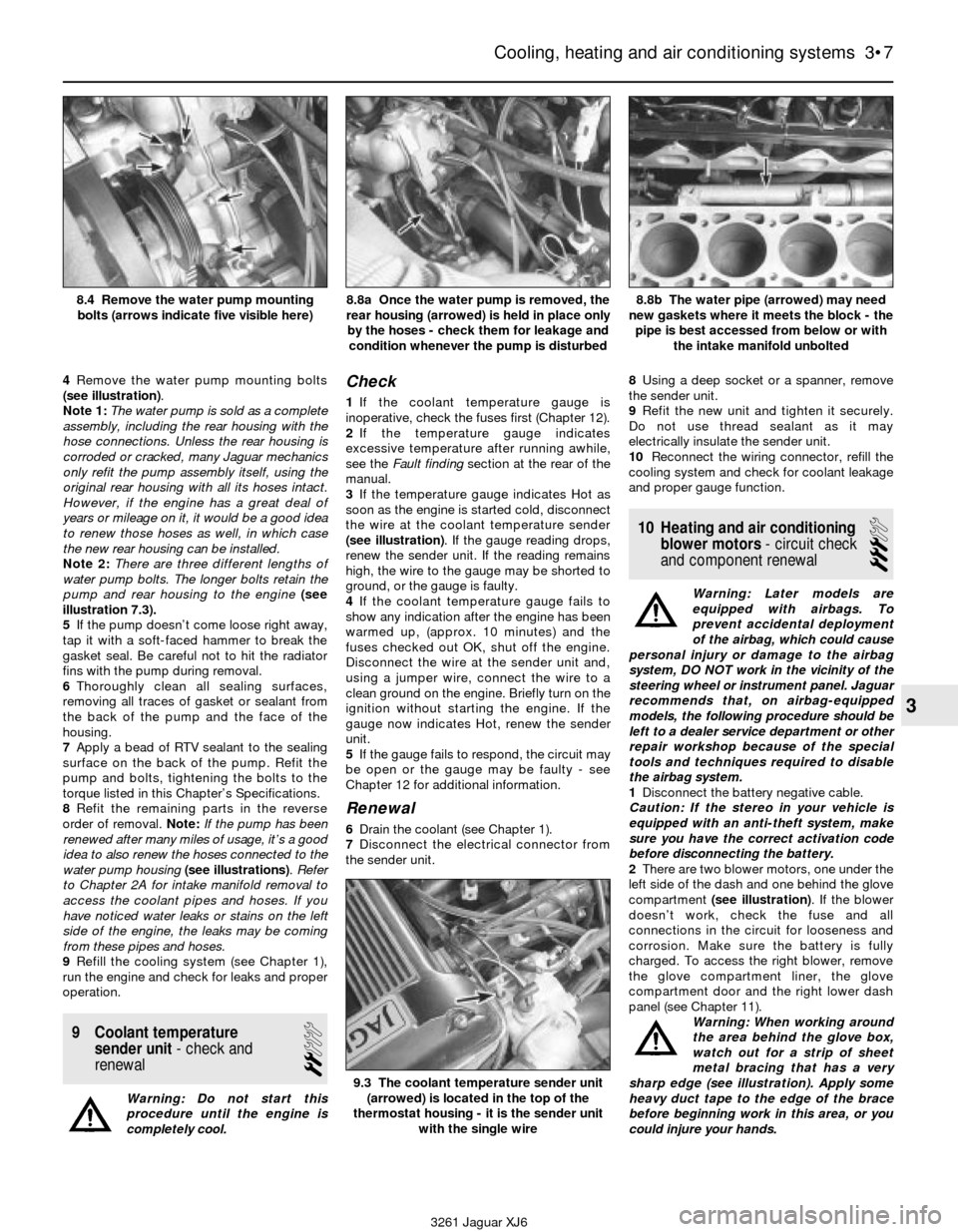
4Remove the water pump mounting bolts
(see illustration).
Note 1:The water pump is sold as a complete
assembly, including the rear housing with the
hose connections. Unless the rear housing is
corroded or cracked, many Jaguar mechanics
only refit the pump assembly itself, using the
original rear housing with all its hoses intact.
However, if the engine has a great deal of
years or mileage on it, it would be a good idea
to renew those hoses as well, in which case
the new rear housing can be installed.
Note 2:There are three different lengths of
water pump bolts. The longer bolts retain the
pump and rear housing to the engine(see
illustration 7.3).
5If the pump doesn’t come loose right away,
tap it with a soft-faced hammer to break the
gasket seal. Be careful not to hit the radiator
fins with the pump during removal.
6Thoroughly clean all sealing surfaces,
removing all traces of gasket or sealant from
the back of the pump and the face of the
housing.
7Apply a bead of RTV sealant to the sealing
surface on the back of the pump. Refit the
pump and bolts, tightening the bolts to the
torque listed in this Chapter’s Specifications.
8Refit the remaining parts in the reverse
order of removal. Note:If the pump has been
renewed after many miles of usage, it’s a good
idea to also renew the hoses connected to the
water pump housing(see illustrations). Refer
to Chapter 2A for intake manifold removal to
access the coolant pipes and hoses. If you
have noticed water leaks or stains on the left
side of the engine, the leaks may be coming
from these pipes and hoses.
9Refill the cooling system (see Chapter 1),
run the engine and check for leaks and proper
operation.
9 Coolant temperature
sender unit- check and
renewal
2
Warning: Do not start this
procedure until the engine is
completely cool.
Check
1If the coolant temperature gauge is
inoperative, check the fuses first (Chapter 12).
2If the temperature gauge indicates
excessive temperature after running awhile,
see the Fault finding section at the rear of the
manual.
3If the temperature gauge indicates Hot as
soon as the engine is started cold, disconnect
the wire at the coolant temperature sender
(see illustration). If the gauge reading drops,
renew the sender unit. If the reading remains
high, the wire to the gauge may be shorted to
ground, or the gauge is faulty.
4If the coolant temperature gauge fails to
show any indication after the engine has been
warmed up, (approx. 10 minutes) and the
fuses checked out OK, shut off the engine.
Disconnect the wire at the sender unit and,
using a jumper wire, connect the wire to a
clean ground on the engine. Briefly turn on the
ignition without starting the engine. If the
gauge now indicates Hot, renew the sender
unit.
5If the gauge fails to respond, the circuit may
be open or the gauge may be faulty - see
Chapter 12 for additional information.
Renewal
6Drain the coolant (see Chapter 1).
7Disconnect the electrical connector from
the sender unit.8Using a deep socket or a spanner, remove
the sender unit.
9Refit the new unit and tighten it securely.
Do not use thread sealant as it may
electrically insulate the sender unit.
10Reconnect the wiring connector, refill the
cooling system and check for coolant leakage
and proper gauge function.
10 Heating and air conditioning
blower motors- circuit check
and component renewal
3
Warning: Later models are
equipped with airbags. To
prevent accidental deployment
of the airbag, which could cause
personal injury or damage to the airbag
system, DO NOT work in the vicinity of the
steering wheel or instrument panel. Jaguar
recommends that, on airbag-equipped
models, the following procedure should be
left to a dealer service department or other
repair workshop because of the special
tools and techniques required to disable
the airbag system.
1Disconnect the battery negative cable.
Caution: If the stereo in your vehicle is
equipped with an anti-theft system, make
sure you have the correct activation code
before disconnecting the battery.
2There are two blower motors, one under the
left side of the dash and one behind the glove
compartment (see illustration). If the blower
doesn’t work, check the fuse and all
connections in the circuit for looseness and
corrosion. Make sure the battery is fully
charged. To access the right blower, remove
the glove compartment liner, the glove
compartment door and the right lower dash
panel (see Chapter 11).
Warning: When working around
the area behind the glove box,
watch out for a strip of sheet
metal bracing that has a very
sharp edge (see illustration). Apply some
heavy duct tape to the edge of the brace
before beginning work in this area, or you
could injure your hands.
Cooling, heating and air conditioning systems 3•7
3
8.4 Remove the water pump mounting
bolts (arrows indicate five visible here)8.8a Once the water pump is removed, the
rear housing (arrowed) is held in place only
by the hoses - check them for leakage and
condition whenever the pump is disturbed8.8b The water pipe (arrowed) may need
new gaskets where it meets the block - the
pipe is best accessed from below or with
the intake manifold unbolted
9.3 The coolant temperature sender unit
(arrowed) is located in the top of the
thermostat housing - it is the sender unit
with the single wire
3261 Jaguar XJ6
Page 84 of 227
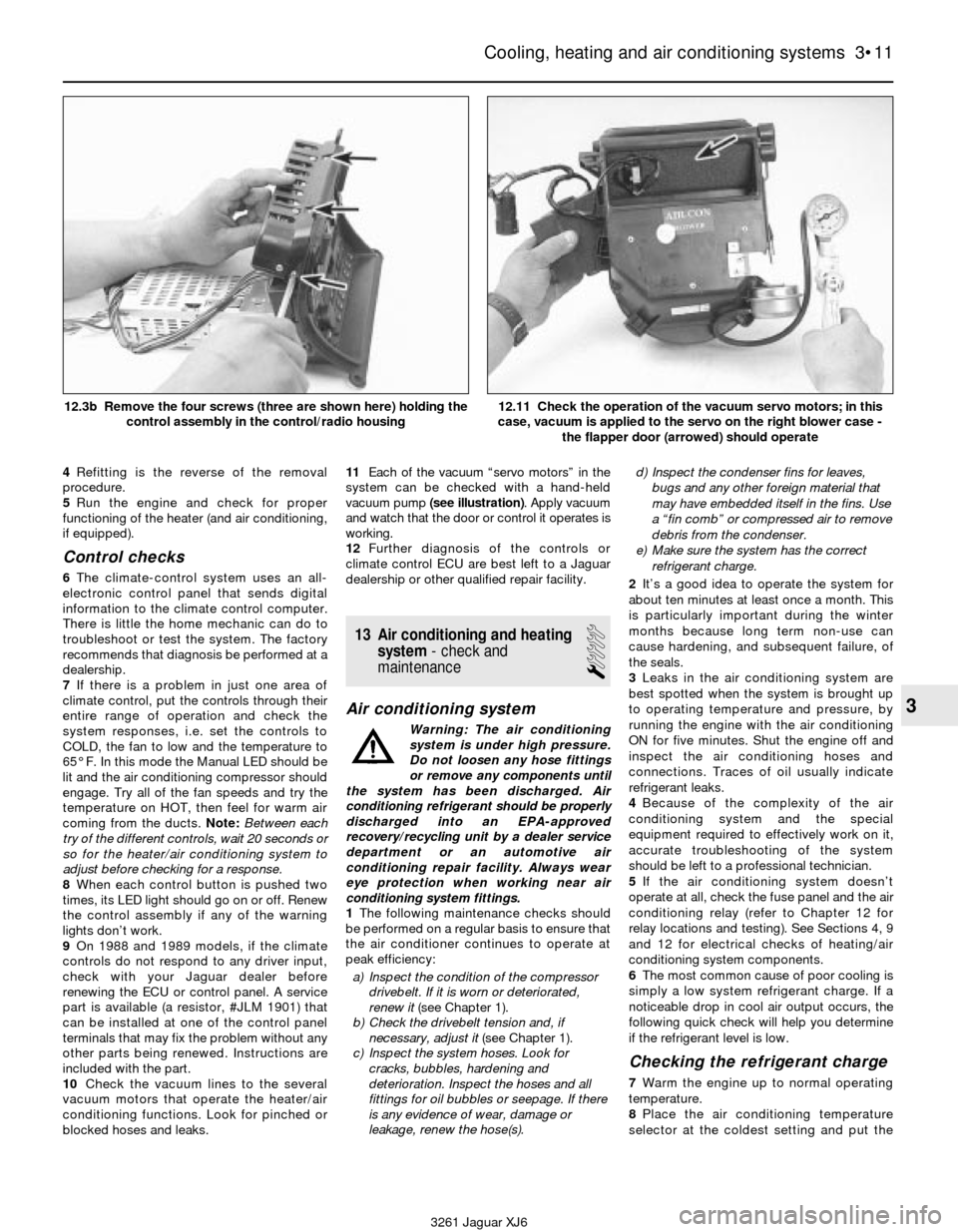
4Refitting is the reverse of the removal
procedure.
5Run the engine and check for proper
functioning of the heater (and air conditioning,
if equipped).
Control checks
6The climate-control system uses an all-
electronic control panel that sends digital
information to the climate control computer.
There is little the home mechanic can do to
troubleshoot or test the system. The factory
recommends that diagnosis be performed at a
dealership.
7If there is a problem in just one area of
climate control, put the controls through their
entire range of operation and check the
system responses, i.e. set the controls to
COLD, the fan to low and the temperature to
65° F. In this mode the Manual LED should be
lit and the air conditioning compressor should
engage. Try all of the fan speeds and try the
temperature on HOT, then feel for warm air
coming from the ducts. Note:Between each
try of the different controls, wait 20 seconds or
so for the heater/air conditioning system to
adjust before checking for a response.
8When each control button is pushed two
times, its LED light should go on or off. Renew
the control assembly if any of the warning
lights don’t work.
9On 1988 and 1989 models, if the climate
controls do not respond to any driver input,
check with your Jaguar dealer before
renewing the ECU or control panel. A service
part is available (a resistor, #JLM 1901) that
can be installed at one of the control panel
terminals that may fix the problem without any
other parts being renewed. Instructions are
included with the part.
10Check the vacuum lines to the several
vacuum motors that operate the heater/air
conditioning functions. Look for pinched or
blocked hoses and leaks.11Each of the vacuum “servo motors” in the
system can be checked with a hand-held
vacuum pump (see illustration). Apply vacuum
and watch that the door or control it operates is
working.
12Further diagnosis of the controls or
climate control ECU are best left to a Jaguar
dealership or other qualified repair facility.
13 Air conditioning and heating
system- check and
maintenance
1
Air conditioning system
Warning: The air conditioning
system is under high pressure.
Do not loosen any hose fittings
or remove any components until
the system has been discharged. Air
conditioning refrigerant should be properly
discharged into an EPA-approved
recovery/recycling unit by a dealer service
department or an automotive air
conditioning repair facility. Always wear
eye protection when working near air
conditioning system fittings.
1The following maintenance checks should
be performed on a regular basis to ensure that
the air conditioner continues to operate at
peak efficiency:
a) Inspect the condition of the compressor
drivebelt. If it is worn or deteriorated,
renew it (see Chapter 1).
b) Check the drivebelt tension and, if
necessary, adjust it (see Chapter 1).
c) Inspect the system hoses. Look for
cracks, bubbles, hardening and
deterioration. Inspect the hoses and all
fittings for oil bubbles or seepage. If there
is any evidence of wear, damage or
leakage, renew the hose(s).d) Inspect the condenser fins for leaves,
bugs and any other foreign material that
may have embedded itself in the fins. Use
a “fin comb” or compressed air to remove
debris from the condenser.
e) Make sure the system has the correct
refrigerant charge.
2It’s a good idea to operate the system for
about ten minutes at least once a month. This
is particularly important during the winter
months because long term non-use can
cause hardening, and subsequent failure, of
the seals.
3Leaks in the air conditioning system are
best spotted when the system is brought up
to operating temperature and pressure, by
running the engine with the air conditioning
ON for five minutes. Shut the engine off and
inspect the air conditioning hoses and
connections. Traces of oil usually indicate
refrigerant leaks.
4Because of the complexity of the air
conditioning system and the special
equipment required to effectively work on it,
accurate troubleshooting of the system
should be left to a professional technician.
5If the air conditioning system doesn’t
operate at all, check the fuse panel and the air
conditioning relay (refer to Chapter 12 for
relay locations and testing). See Sections 4, 9
and 12 for electrical checks of heating/air
conditioning system components.
6The most common cause of poor cooling is
simply a low system refrigerant charge. If a
noticeable drop in cool air output occurs, the
following quick check will help you determine
if the refrigerant level is low.
Checking the refrigerant charge
7Warm the engine up to normal operating
temperature.
8Place the air conditioning temperature
selector at the coldest setting and put the
Cooling, heating and air conditioning systems 3•11
3
3261 Jaguar XJ6 12.3b Remove the four screws (three are shown here) holding the
control assembly in the control/radio housing
12.11 Check the operation of the vacuum servo motors; in this
case, vacuum is applied to the servo on the right blower case -
the flapper door (arrowed) should operate
Page 85 of 227

blower at the highest setting. Open the doors
(to make sure the air conditioning system
doesn’t cycle off as soon as it cools the
passenger compartment).
9With the compressor engaged - the clutch
will make an audible click and the centre of
the clutch will rotate. After the system reaches
operating temperature, feel the two pipes
connected to the evaporator at the bulkhead
(see illustration).
10The pipe (thinner tubing) leading from the
condenser outlet to the evaporator should be
cold, and the evaporator outlet line (the
thicker tubing that leads back to the
compressor) should be slightly colder (3 to
10° F). If the evaporator outlet is considerably
warmer than the inlet, the system needs a
charge. Insert a thermometer in the centre air
distribution duct while operating the air
conditioning system - the temperature of the
output air should be 35 to 40° F below the
ambient air temperature (down to approxi-
mately 40° F). If the ambient (outside) air
temperature is very high, say 110° F, the duct
air temperature may be as high as 60° F, but
generally the air conditioning is 30 to 50° F
cooler than the ambient air. If the air isn’t as
cold as it used to be, the system probably
needs a charge. Further inspection or testing
of the system is beyond the scope of the
home mechanic and should be left to a
professional.
11Inspect the sight glass (see illustration).
If the refrigerant looks foamy when running,
it’s low. When ambient temperatures are very
hot, bubbles may show in the sight glass even
with the proper amount of refrigerant. With the
proper amount of refrigerant, when the air
conditioning is turned off, the sight glass
should show refrigerant that foams, then
clears. Note:1993 and 1994 models are
equipped with R-134a refrigerant systems and
do not have a sight glass.Heating systems
12If the air coming out of the heater vents
isn’t hot, the problem could stem from any of
the following causes:
a) The thermostat is stuck open, preventing
the engine coolant from warming up
enough to carry heat to the heater core.
Renew the thermostat (see Section 3).
b) A heater hose is blocked, preventing the
flow of coolant through the heater core.
Feel both heater hoses at the bulkhead.
They should be hot. If one of them is cold,
there is an obstruction in one of the hoses
or in the heater core, or the heater control
valve is shut. Detach the hoses and back
flush the heater core with a water hose. If
the heater core is clear but circulation is
impeded, remove the two hoses and flush
them out with a water hose.
c) If flushing fails to remove the blockage
from the heater core, the core must be
renewed.(see Section 11).
13If the blower motor speed does not
correspond to the setting selected on the
blower switch, the problem could be a badfuse, circuit, control panel or climate control
computer (see Sections 10 and 12).
14If there isn’t any air coming out of the
vents:
a) Turn the ignition ON and activate the fan
control. Place your ear at the heating/air
conditioning register (vent) and listen.
Most motors are audible. Can you hear
the motor running?
b) If you can’t (and have already verified that
the blower switch and the blower motor
resistor are good), the blower motor itself
is probably bad (see Section 10).
15If the carpet under the heater core is
damp, or if antifreeze vapour or steam is
coming through the vents, the heater core is
leaking. Remove it (see Section 11) and refit a
new unit (most radiator shops will not repair a
leaking heater core).
16Inspect the drain hose from the heat/AC
assembly at the right side of the bulkhead,
make sure it is not clogged (see illustration).
If there is a humid mist coming from the
system ducts, this hose may be plugged. In
some early models, the hose may have been
pinched during assembly or blocked with
insulation or underseal.
14 Air conditioning
receiver/drier-
removal and refitting
4
Warning: The air conditioning
system is under high pressure.
Do not loosen any hose fittings
or remove any components until
the system has been discharged. Air
conditioning refrigerant should be properly
discharged into an EPA-approved recovery/
recycling unit by a dealer service depart-
ment or an automotive air conditioning
3•12 Cooling, heating and air conditioning systems
13.16 This drain hose (arrowed) from the
heater/air conditioning unit should be kept
clear to allow drainage of condensation
3261 Jaguar XJ6 13.9 Feel the inlet (small arrow) and outlet (large arrow) pipes at
the bulkhead leading to the air conditioning evaporator (battery
removed here for clarity only)
13.11 The sight glass (arrowed) is located on the top of the
receiver/drier, to the right of the radiator
Page 90 of 227
special electrical device that provides circuit
protection by switching off the ignition and
fuel pump upon impact in the event of vehicle
collision. Later Jaguar models are equipped
with an additional specialised inertia switch.
This later device switches OFF all ignition fed
circuits, locks the fuel filler cap, locks the boot
(only if doors are locked) and unlocks the
doors if they are locked during the accident.
All these functions are directed by the inertia
switch. The inertia switch is located behind
the left kick panel. Refer to Chapter 12 for
more information.
Exhaust system
The exhaust system includes an exhaust
manifold equipped with an exhaust oxygen
sensor, a catalytic converter, an exhaust pipe,
and a silencer.
The catalytic converter is an emission
control device added to the exhaust system to
reduce pollutants. A single-bed converter is
used in combination with a three-way
(reduction) catalyst. See Chapter 6 for more
information regarding the catalytic converter.
2 Fuel pressure relief
1
Warning: Petrol is extremely
flammable, so take extra
precautions when you work on
any part of the fuel system.
Don’t smoke or allow open flames or bare
light bulbs near the work area, and don’t
work in a garage where a natural gas-type
appliance (such as a water heater or a
clothes dryer) with a pilot light is present.
Since petrol is carcinogenic, wear latex
gloves when there’s a possibility of being
exposed to fuel, and, if you spill any fuel on
your skin, rinse it off immediately with soap
and water. Mop up any spills immediately
and do not store fuel-soaked rags wherethey could ignite. The fuel system is under
constant pressure, so, if any fuel lines are
to be disconnected, the fuel pressure in
the system must be relieved first. When
you perform any kind of work on the fuel
system, wear safety glasses and have a
Class B type fire extinguisher on hand.
1Before servicing any fuel system
component, you must relieve the fuel pressure
to minimise the risk of fire or personal injury.
2Remove the fuel filler cap - this will relieve
any pressure built up in the tank.
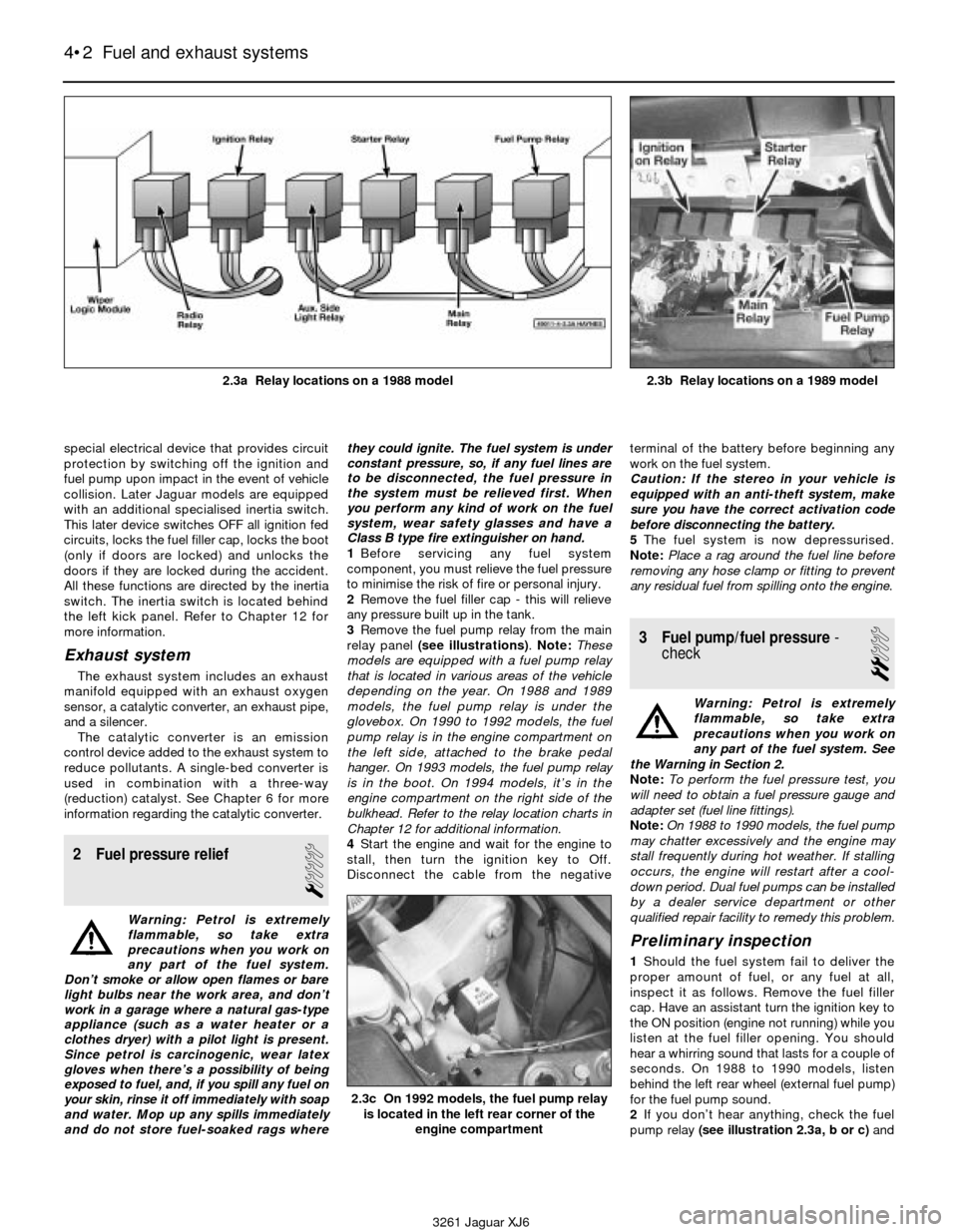
3Remove the fuel pump relay from the main
relay panel (see illustrations). Note:These
models are equipped with a fuel pump relay
that is located in various areas of the vehicle
depending on the year. On 1988 and 1989
models, the fuel pump relay is under the
glovebox. On 1990 to 1992 models, the fuel
pump relay is in the engine compartment on
the left side, attached to the brake pedal
hanger. On 1993 models, the fuel pump relay
is in the boot. On 1994 models, it’s in the
engine compartment on the right side of the
bulkhead. Refer to the relay location charts in
Chapter 12 for additional information.
4Start the engine and wait for the engine to
stall, then turn the ignition key to Off.
Disconnect the cable from the negativeterminal of the battery before beginning any
work on the fuel system.
Caution: If the stereo in your vehicle is
equipped with an anti-theft system, make
sure you have the correct activation code
before disconnecting the battery.
5The fuel system is now depressurised.
Note:Place a rag around the fuel line before
removing any hose clamp or fitting to prevent
any residual fuel from spilling onto the engine.
3 Fuel pump/fuel pressure-
check
2
Warning: Petrol is extremely
flammable, so take extra
precautions when you work on
any part of the fuel system. See
the Warning in Section 2.
Note: To perform the fuel pressure test, you
will need to obtain a fuel pressure gauge and
adapter set (fuel line fittings).
Note: On 1988 to 1990 models, the fuel pump
may chatter excessively and the engine may
stall frequently during hot weather. If stalling
occurs, the engine will restart after a cool-
down period. Dual fuel pumps can be installed
by a dealer service department or other
qualified repair facility to remedy this problem.
Preliminary inspection
1Should the fuel system fail to deliver the
proper amount of fuel, or any fuel at all,
inspect it as follows. Remove the fuel filler
cap. Have an assistant turn the ignition key to
the ON position (engine not running) while you
listen at the fuel filler opening. You should
hear a whirring sound that lasts for a couple of
seconds. On 1988 to 1990 models, listen
behind the left rear wheel (external fuel pump)
for the fuel pump sound.
2If you don’t hear anything, check the fuel
pump relay (see illustration 2.3a, b or c)and
4•2 Fuel and exhaust systems
2.3c On 1992 models, the fuel pump relay
is located in the left rear corner of the
engine compartment
3261 Jaguar XJ6 2.3a Relay locations on a 1988 model
2.3b Relay locations on a 1989 model
Page 91 of 227
circuit. If all circuits are intact and not
damaged, check the inertia switch. Note: The
inertia switch is a special device that shuts
down power to the ignition and the fuel pump
in the event of an accident. See Chapter 12 for
checking and resetting procedures for the
inertia switch.
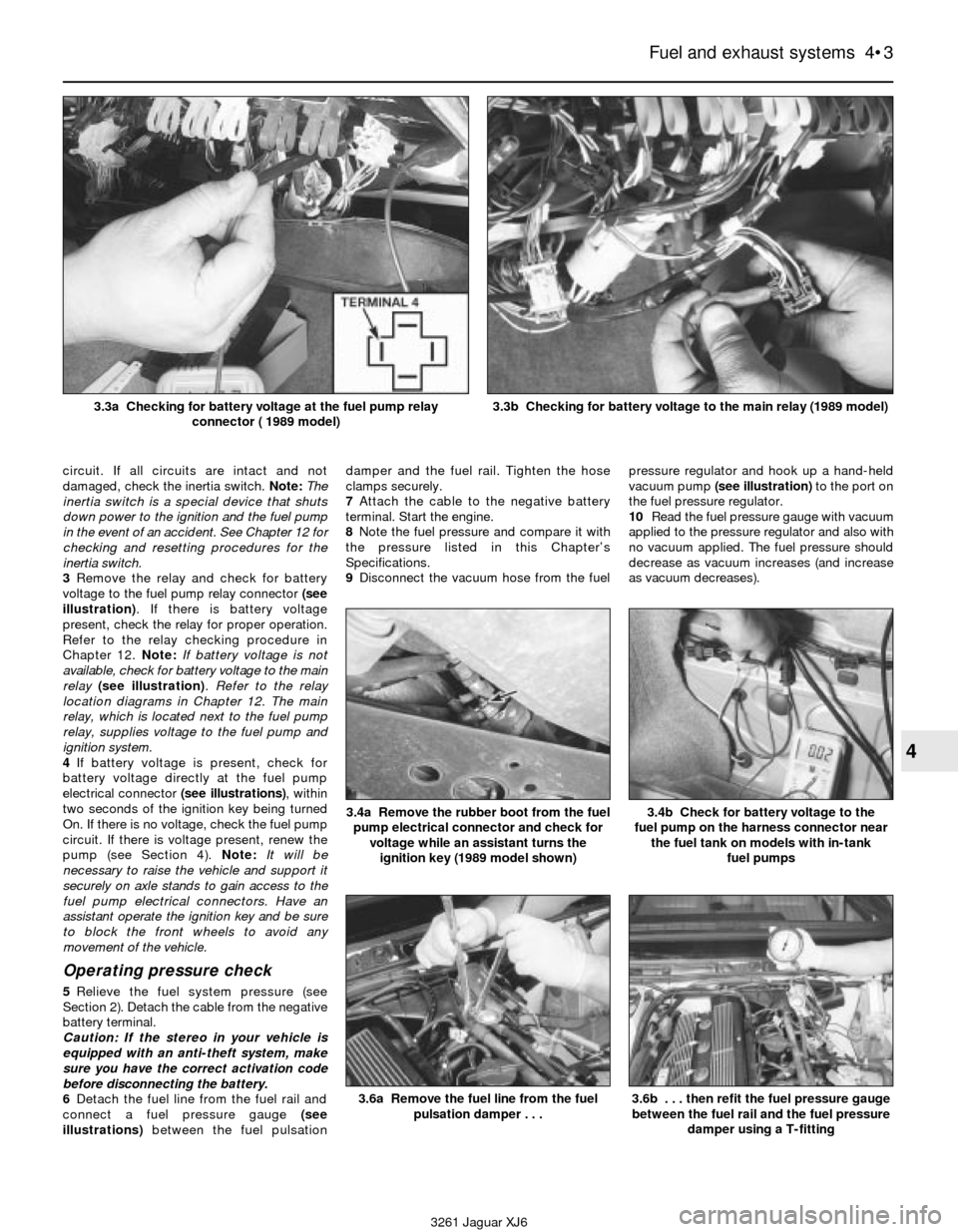
3Remove the relay and check for battery
voltage to the fuel pump relay connector (see
illustration). If there is battery voltage
present, check the relay for proper operation.
Refer to the relay checking procedure in
Chapter 12. Note:If battery voltage is not
available, check for battery voltage to the main
relay(see illustration). Refer to the relay
location diagrams in Chapter 12. The main
relay, which is located next to the fuel pump
relay, supplies voltage to the fuel pump and
ignition system.
4If battery voltage is present, check for
battery voltage directly at the fuel pump
electrical connector (see illustrations), within
two seconds of the ignition key being turned
On. If there is no voltage, check the fuel pump
circuit. If there is voltage present, renew the
pump (see Section 4). Note:It will be
necessary to raise the vehicle and support it
securely on axle stands to gain access to the
fuel pump electrical connectors. Have an
assistant operate the ignition key and be sure
to block the front wheels to avoid any
movement of the vehicle.
Operating pressure check
5Relieve the fuel system pressure (see
Section 2). Detach the cable from the negative
battery terminal.
Caution: If the stereo in your vehicle is
equipped with an anti-theft system, make
sure you have the correct activation code
before disconnecting the battery.
6Detach the fuel line from the fuel rail and
connect a fuel pressure gauge(see
illustrations)between the fuel pulsationdamper and the fuel rail. Tighten the hose
clamps securely.
7Attach the cable to the negative battery
terminal. Start the engine.
8Note the fuel pressure and compare it with
the pressure listed in this Chapter’s
Specifications.
9Disconnect the vacuum hose from the fuelpressure regulator and hook up a hand-held
vacuum pump (see illustration)to the port on
the fuel pressure regulator.
10Read the fuel pressure gauge with vacuum
applied to the pressure regulator and also with
no vacuum applied. The fuel pressure should
decrease as vacuum increases (and increase
as vacuum decreases).
Fuel and exhaust systems 4•3
4
3261 Jaguar XJ6 3.3a Checking for battery voltage at the fuel pump relay
connector ( 1989 model)
3.3b Checking for battery voltage to the main relay (1989 model)
3.6a Remove the fuel line from the fuel
pulsation damper . . .
3.4b Check for battery voltage to the
fuel pump on the harness connector near
the fuel tank on models with in-tank
fuel pumps3.4a Remove the rubber boot from the fuel
pump electrical connector and check for
voltage while an assistant turns the
ignition key (1989 model shown)
3.6b . . . then refit the fuel pressure gauge
between the fuel rail and the fuel pressure
damper using a T-fitting
Page 92 of 227
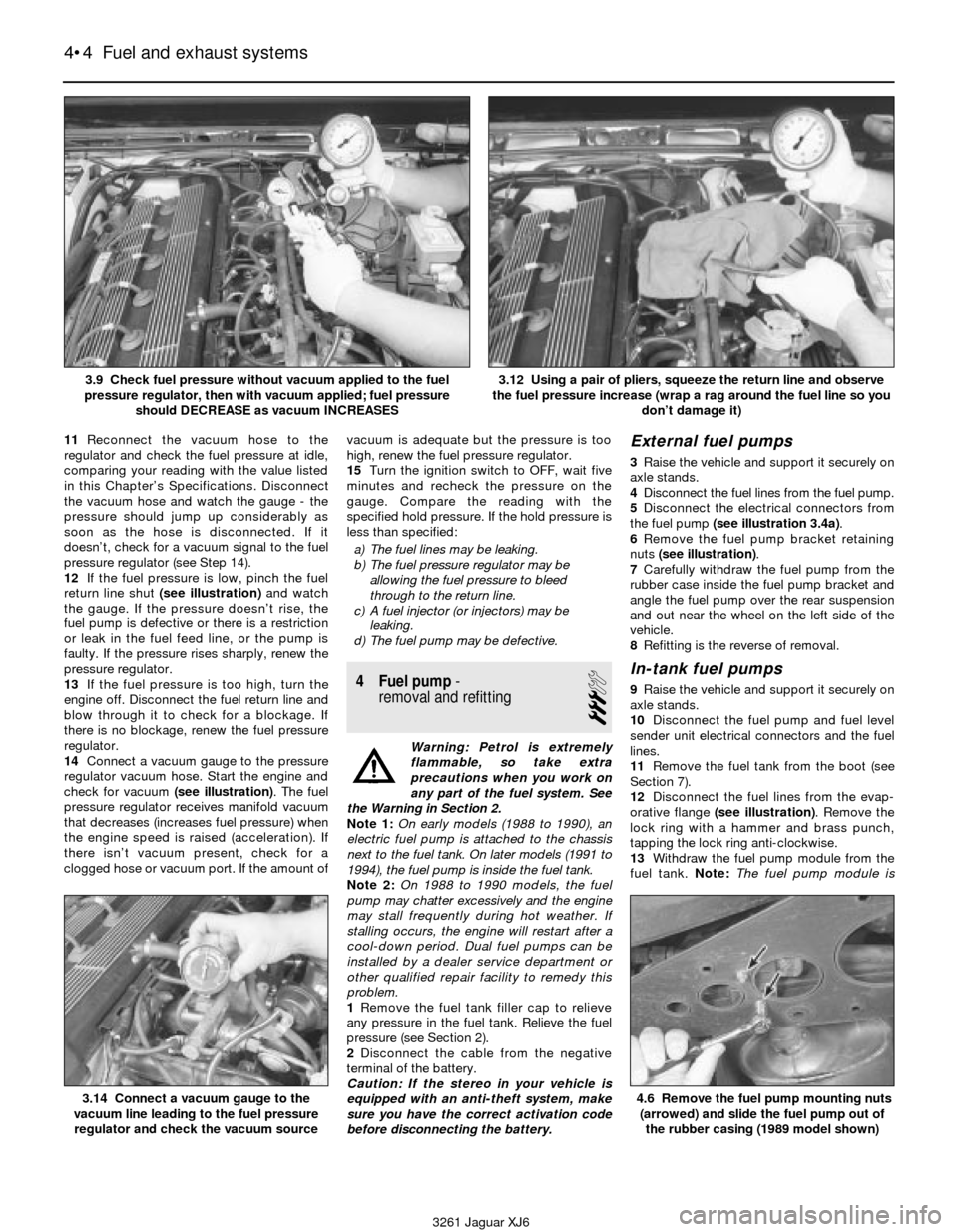
11Reconnect the vacuum hose to the
regulator and check the fuel pressure at idle,
comparing your reading with the value listed
in this Chapter’s Specifications. Disconnect
the vacuum hose and watch the gauge - the
pressure should jump up considerably as
soon as the hose is disconnected. If it
doesn’t, check for a vacuum signal to the fuel
pressure regulator (see Step 14).
12If the fuel pressure is low, pinch the fuel
return line shut (see illustration)and watch
the gauge. If the pressure doesn’t rise, the
fuel pump is defective or there is a restriction
or leak in the fuel feed line, or the pump is
faulty. If the pressure rises sharply, renew the
pressure regulator.
13If the fuel pressure is too high, turn the
engine off. Disconnect the fuel return line and
blow through it to check for a blockage. If
there is no blockage, renew the fuel pressure
regulator.
14Connect a vacuum gauge to the pressure
regulator vacuum hose. Start the engine and
check for vacuum (see illustration). The fuel
pressure regulator receives manifold vacuum
that decreases (increases fuel pressure) when
the engine speed is raised (acceleration). If
there isn’t vacuum present, check for a
clogged hose or vacuum port. If the amount ofvacuum is adequate but the pressure is too
high, renew the fuel pressure regulator.
15Turn the ignition switch to OFF, wait five
minutes and recheck the pressure on the
gauge. Compare the reading with the
specified hold pressure. If the hold pressure is
less than specified:
a) The fuel lines may be leaking.
b) The fuel pressure regulator may be
allowing the fuel pressure to bleed
through to the return line.
c) A fuel injector (or injectors) may be
leaking.
d) The fuel pump may be defective.
4 Fuel pump-
removal and refitting
3
Warning: Petrol is extremely
flammable, so take extra
precautions when you work on
any part of the fuel system. See
the Warning in Section 2.
Note 1:On early models (1988 to 1990), an
electric fuel pump is attached to the chassis
next to the fuel tank. On later models (1991 to
1994), the fuel pump is inside the fuel tank.
Note 2: On 1988 to 1990 models, the fuel
pump may chatter excessively and the engine
may stall frequently during hot weather. If
stalling occurs, the engine will restart after a
cool-down period. Dual fuel pumps can be
installed by a dealer service department or
other qualified repair facility to remedy this
problem.
1Remove the fuel tank filler cap to relieve
any pressure in the fuel tank. Relieve the fuel
pressure (see Section 2).
2Disconnect the cable from the negative
terminal of the battery.
Caution: If the stereo in your vehicle is
equipped with an anti-theft system, make
sure you have the correct activation code
before disconnecting the battery.
External fuel pumps
3Raise the vehicle and support it securely on
axle stands.
4Disconnect the fuel lines from the fuel pump.
5Disconnect the electrical connectors from
the fuel pump (see illustration 3.4a).
6Remove the fuel pump bracket retaining
nuts (see illustration).
7Carefully withdraw the fuel pump from the
rubber case inside the fuel pump bracket and
angle the fuel pump over the rear suspension
and out near the wheel on the left side of the
vehicle.
8Refitting is the reverse of removal.
In-tank fuel pumps
9Raise the vehicle and support it securely on
axle stands.
10Disconnect the fuel pump and fuel level
sender unit electrical connectors and the fuel
lines.
11Remove the fuel tank from the boot (see
Section 7).
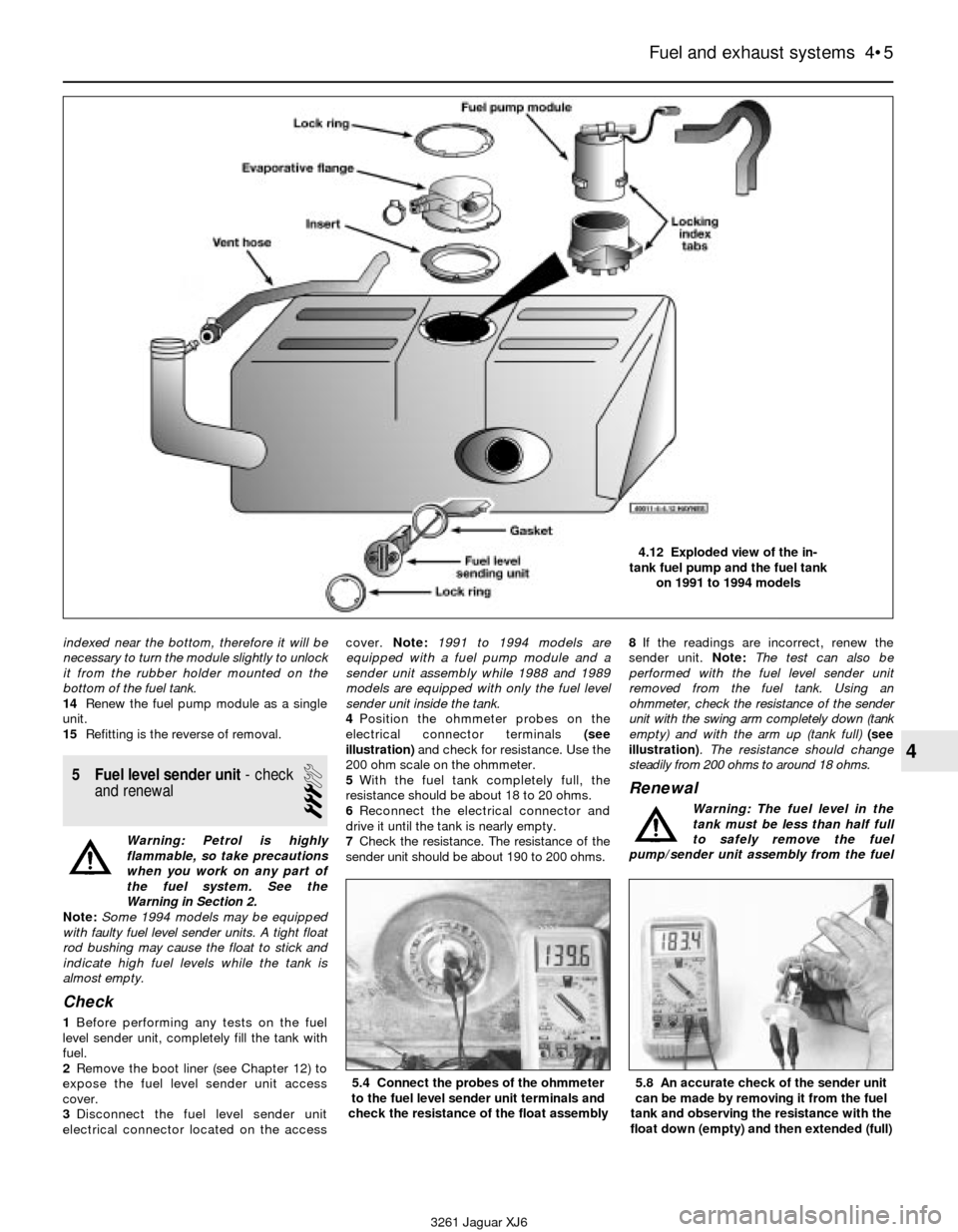
12Disconnect the fuel lines from the evap-
orative flange (see illustration). Remove the
lock ring with a hammer and brass punch,
tapping the lock ring anti-clockwise.
13Withdraw the fuel pump module from the
fuel tank. Note: The fuel pump module is
4•4 Fuel and exhaust systems
3.14 Connect a vacuum gauge to the
vacuum line leading to the fuel pressure
regulator and check the vacuum source4.6 Remove the fuel pump mounting nuts
(arrowed) and slide the fuel pump out of
the rubber casing (1989 model shown)
3261 Jaguar XJ6 3.9 Check fuel pressure without vacuum applied to the fuel
pressure regulator, then with vacuum applied; fuel pressure
should DECREASE as vacuum INCREASES
3.12 Using a pair of pliers, squeeze the return line and observe
the fuel pressure increase (wrap a rag around the fuel line so you
don’t damage it)
Page 93 of 227
indexed near the bottom, therefore it will be
necessary to turn the module slightly to unlock
it from the rubber holder mounted on the
bottom of the fuel tank.
14Renew the fuel pump module as a single
unit.
15Refitting is the reverse of removal.
5 Fuel level sender unit- check
and renewal
3
Warning: Petrol is highly
flammable, so take precautions
when you work on any part of
the fuel system. See the
Warning in Section 2.
Note:Some 1994 models may be equipped
with faulty fuel level sender units. A tight float
rod bushing may cause the float to stick and
indicate high fuel levels while the tank is
almost empty.
Check
1Before performing any tests on the fuel
level sender unit, completely fill the tank with
fuel.
2Remove the boot liner (see Chapter 12) to
expose the fuel level sender unit access
cover.
3Disconnect the fuel level sender unit
electrical connector located on the accesscover.Note:1991 to 1994 models are
equipped with a fuel pump module and a
sender unit assembly while 1988 and 1989
models are equipped with only the fuel level
sender unit inside the tank.
4Position the ohmmeter probes on the
electrical connector terminals (see
illustration)and check for resistance. Use the
200 ohm scale on the ohmmeter.
5With the fuel tank completely full, the
resistance should be about 18 to 20 ohms.
6Reconnect the electrical connector and
drive it until the tank is nearly empty.
7Check the resistance. The resistance of the
sender unit should be about 190 to 200 ohms.8If the readings are incorrect, renew the
sender unit. Note:The test can also be
performed with the fuel level sender unit
removed from the fuel tank. Using an
ohmmeter, check the resistance of the sender
unit with the swing arm completely down (tank
empty) and with the arm up (tank full) (see
illustration). The resistance should change
steadily from 200 ohms to around 18 ohms.
Renewal
Warning: The fuel level in the
tank must be less than half full
to safely remove the fuel
pump/sender unit assembly from the fuel
Fuel and exhaust systems 4•5
4
5.4 Connect the probes of the ohmmeter
to the fuel level sender unit terminals and
check the resistance of the float assembly5.8 An accurate check of the sender unit
can be made by removing it from the fuel
tank and observing the resistance with the
float down (empty) and then extended (full)
3261 Jaguar XJ6
4.12 Exploded view of the in-
tank fuel pump and the fuel tank
on 1991 to 1994 models
Page 94 of 227
tank. If there is any doubt about the
amount of fuel in the tank, drain the fuel
tank completely before attempting this
procedure (Section 7, paragraph 1).
9Disconnect the cable from the negative
terminal of the battery. Disconnect the fuel level
sender unit/fuel pump electrical connector.
Caution: If the stereo in your vehicle is
equipped with an anti-theft system, make
sure you have the correct activation code
before disconnecting the battery.
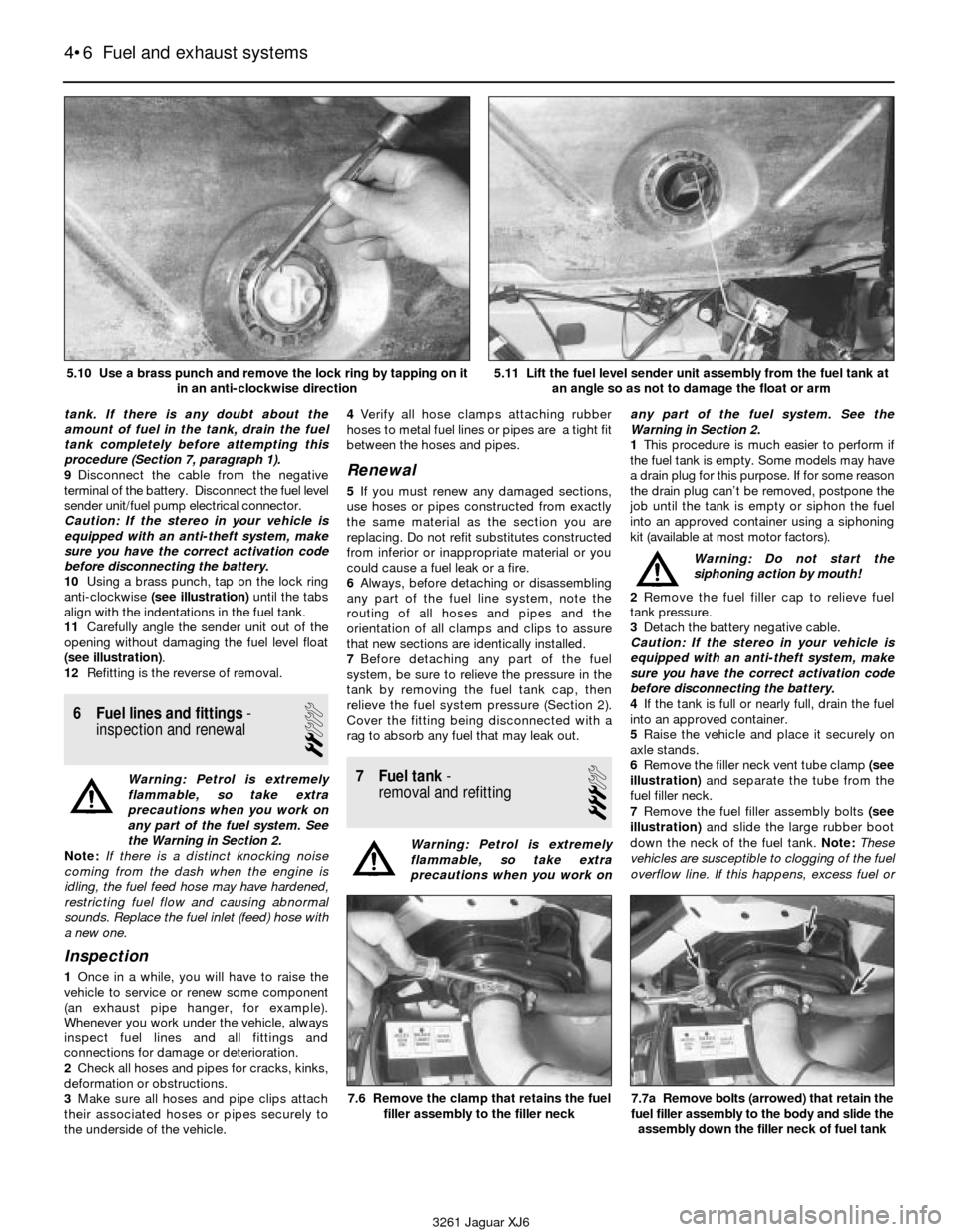
10Using a brass punch, tap on the lock ring
anti-clockwise (see illustration)until the tabs
align with the indentations in the fuel tank.
11Carefully angle the sender unit out of the
opening without damaging the fuel level float
(see illustration).
12Refitting is the reverse of removal.
6 Fuel lines and fittings-
inspection and renewal
2
Warning: Petrol is extremely
flammable, so take extra
precautions when you work on
any part of the fuel system. See
the Warning in Section 2.
Note:If there is a distinct knocking noise
coming from the dash when the engine is
idling, the fuel feed hose may have hardened,
restricting fuel flow and causing abnormal
sounds. Replace the fuel inlet (feed) hose with
a new one.
Inspection
1Once in a while, you will have to raise the
vehicle to service or renew some component
(an exhaust pipe hanger, for example).
Whenever you work under the vehicle, always
inspect fuel lines and all fittings and
connections for damage or deterioration.
2Check all hoses and pipes for cracks, kinks,
deformation or obstructions.
3Make sure all hoses and pipe clips attach
their associated hoses or pipes securely to
the underside of the vehicle.4Verify all hose clamps attaching rubber
hoses to metal fuel lines or pipes are a tight fit
between the hoses and pipes.
Renewal
5If you must renew any damaged sections,
use hoses or pipes constructed from exactly
the same material as the section you are
replacing. Do not refit substitutes constructed
from inferior or inappropriate material or you
could cause a fuel leak or a fire.
6Always, before detaching or disassembling
any part of the fuel line system, note the
routing of all hoses and pipes and the
orientation of all clamps and clips to assure
that new sections are identically installed.
7Before detaching any part of the fuel
system, be sure to relieve the pressure in the
tank by removing the fuel tank cap, then
relieve the fuel system pressure (Section 2).
Cover the fitting being disconnected with a
rag to absorb any fuel that may leak out.
7 Fuel tank-
removal and refitting
3
Warning: Petrol is extremely
flammable, so take extra
precautions when you work onany part of the fuel system. See the
Warning in Section 2.
1This procedure is much easier to perform if
the fuel tank is empty. Some models may have
a drain plug for this purpose. If for some reason
the drain plug can’t be removed, postpone the
job until the tank is empty or siphon the fuel
into an approved container using a siphoning
kit (available at most motor factors).
Warning: Do not start the
siphoning action by mouth!
2Remove the fuel filler cap to relieve fuel
tank pressure.
3Detach the battery negative cable.
Caution: If the stereo in your vehicle is
equipped with an anti-theft system, make
sure you have the correct activation code
before disconnecting the battery.
4If the tank is full or nearly full, drain the fuel
into an approved container.
5Raise the vehicle and place it securely on
axle stands.
6Remove the filler neck vent tube clamp (see
illustration)and separate the tube from the
fuel filler neck.
7Remove the fuel filler assembly bolts (see
illustration)and slide the large rubber boot
down the neck of the fuel tank. Note:These
vehicles are susceptible to clogging of the fuel
overflow line. If this happens, excess fuel or
4•6 Fuel and exhaust systems
7.6 Remove the clamp that retains the fuel
filler assembly to the filler neck7.7a Remove bolts (arrowed) that retain the
fuel filler assembly to the body and slide the
assembly down the filler neck of fuel tank
3261 Jaguar XJ6 5.10 Use a brass punch and remove the lock ring by tapping on it
in an anti-clockwise direction
5.11 Lift the fuel level sender unit assembly from the fuel tank at
an angle so as not to damage the float or arm
Page 96 of 227

10 Accelerator cable- removal,
refitting and adjustment
3
Removal
1Detach the cable from the negative terminal
of the battery.
Caution: If the stereo in your vehicle is
equipped with an anti-theft system, make
sure you have the correct activation code
before disconnecting the battery.
2Loosen the locknut on the threaded portion
of the throttle cable at the throttle body (see
illustration).
3Rotate the throttle lever, then slip the
throttle cable end out of the slot in the lever
(see illustration).
4Detach the throttle cable from the
accelerator pedal (see illustration).
5From inside the vehicle, pull the cable
through the bulkhead.
Refitting and adjustment
6Refitting is the reverse of removal.
7To adjust the cable, fully depress the
accelerator pedal and check that the throttle
is fully opened.
8If not fully opened, loosen the locknuts,
depress accelerator pedal and adjust the
cable until the throttle is fully open.
9Tighten the locknuts and recheck the
adjustment. Make sure the throttle closes fully
when the pedal is released (see illustration).
10After the cable is adjusted, check the
adjustment of the bellcrank. Use a small
clamp and a straight rod or stiff wire (coat
hanger) and attach it to the brake master
cylinder in such a way that the tip acts as a
pointer. Align the pointer with “A” (automatic
transmission) or “M” (manual transmission) on
the bellcrank (see illustration),depending on
what type of transmission is installed in the
vehicle.
11Slowly rotate the bellcrank until it reaches
the throttle stop (wide open throttle) andcheck to make sure the pointer aligns with the
notch in the bellcrank (see illustration).
12If necessary, adjust the position of
the throttle stop using a spanner and turn the
throttle stop screw until the bellcrank reaches
the correct position. Lock the throttle stop
screw in place.
4•8 Fuel and exhaust systems
3261 Jaguar XJ6 10.4 Remove circlip (arrowed) and separate cable from the
accelerator pedal by pulling the pin from the pedal assembly
10.2 Loosen the locknuts on the accelerator cable10.3 Rotate the bellcrank and remove the cable end from the slot
10.9 Make sure the throttle closes completely and there is a
slight amount of flex in the cable
10.10 Attach a strong wire (coat hanger)
to the master cylinder using a clamp and
align it with the notch on the bellcrank