service JEEP CJ 1953 Service Manual
[x] Cancel search | Manufacturer: JEEP, Model Year: 1953, Model line: CJ, Model: JEEP CJ 1953Pages: 376, PDF Size: 19.96 MB
Page 345 of 376
'Jeep'
UNIVERSAL
SERIES
SERVICE
MANUAL
s
SPRINGS
AND
SHOCK
ABSORBERS
Contents
SUBJECT
PAR. SUBJECT PAR.
Pivot Bolts S-3 Spring Removal S-4
Shock
Absorbers S-7 Spring Shackles S-2
Spring
Installation S-5 U-Shackles S-6
S-1.
GENERAL
Semielliptical
leaf springs are used for all models.
The
springs are hung longitudinally from the frame
side rails by means of brackets welded to the
rails.
All
axles are firmly attached to the springs by U-
bolts
(spring clips), spring saddles welded to the
underside of the axles, and spring plates under the
springs.
Early
model DJ-5 and DJ-6 front axles (I beam) are attached to the springs with conven
tional
bolts
and spring plates. Spring center
bolts
are
inserted in the axle spring saddles to prevent
shifting of the axle.
All
front springs, except as noted below, are provided with shackles at the front ends of the springs
and
pivot
bolts
at the
rear
ends of the springs. Model CJ-5 up to
Serial
No. 44437 and Model
CJ-6
up to
Serial
No. 11981 are provided with shackles at the
rear
ends of the front springs, and
pivot
bolts
at the front ends.
Note:
Models
CJ-5A
and
CJ-6A
are equipped with
the two
stage
type front and
rear
spring.
All
rear
springs are provided with shackles at the
rear
end and pivot
bolts
at the front end.
Springs
should be examined periodically for broken
or
shifted leaves,
loose
or missing rebound clips,
angle of spring shackles, and position of springs
on the saddles. Springs with shifted leaves do not have their normal strength. Missing rebound clips may permit the spring leaves to fan out or break
on rebound. Broken leaves may make the vehicle
hard
to handle or permit the axle to shift out of
line.
Weakened springs may break causing difficulty
in
steering. Spring attaching clips or
bolts
must be tight. It is
suggested
that they be checked at each
vehicle inspection and torqued 45 to 55 lb-ft. [6,2 a 7,6 kg-m.].
S-2.
Spring Shackles
Rubber-bushed
shackles are provided on all current
production vehicles. The steel-backed rubber (silent bloc) bushings are pressed into the spring
eyes
and mounting brackets. The shackle
bolts
tighten the side plates against the inner steel back
ing of the bushings. Oscillation of the springs is
taken in the rubber bushings.
All
vehicles produced before early 1957 were
equipped with U-shackles and threaded core bush-
*3(
21-
to It is
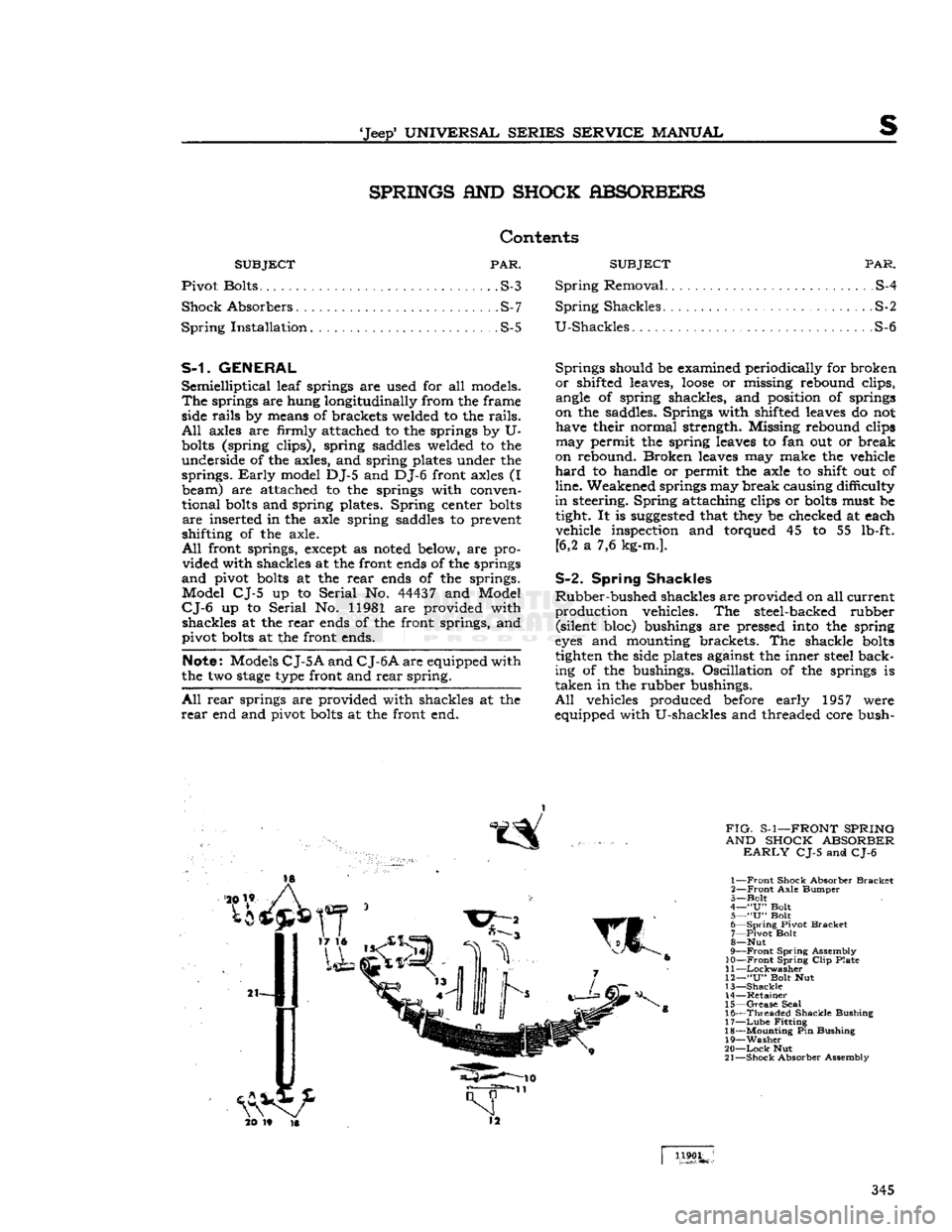
FIG-
S-1—FRONT SPRING
AND SHOCK ABSORBER
EARLY
CJ-5 and CJ-6
1—
Front
Shock Absorber
Bracket
2—
Front
Axle
Bumper
3—
Bolt
4—
"U"
Bolt
5—
"U"
Bolt
6—
Spring
Pivot
Bracket
7—
Pivot
Bolt
8—
Nut
9—
Front
Spring
Assembly
10—Front
Spring
Clip
Plate
11
—Lockwasher
12—
"U"
Bolt Nut
13—
Shackle
14—
Retainer
15—
Grease
Seal
16—
Threaded
Shackle
Bushing
17—
Lube
Fitting
18—
Mounting
Pin Bushing
19—
Washer
20—
Lock
Nut
21—
Shock
Absorber Assembly
1190L
345
Page 346 of 376
SPRINGS
AND
SHOCK
ABSORBERS
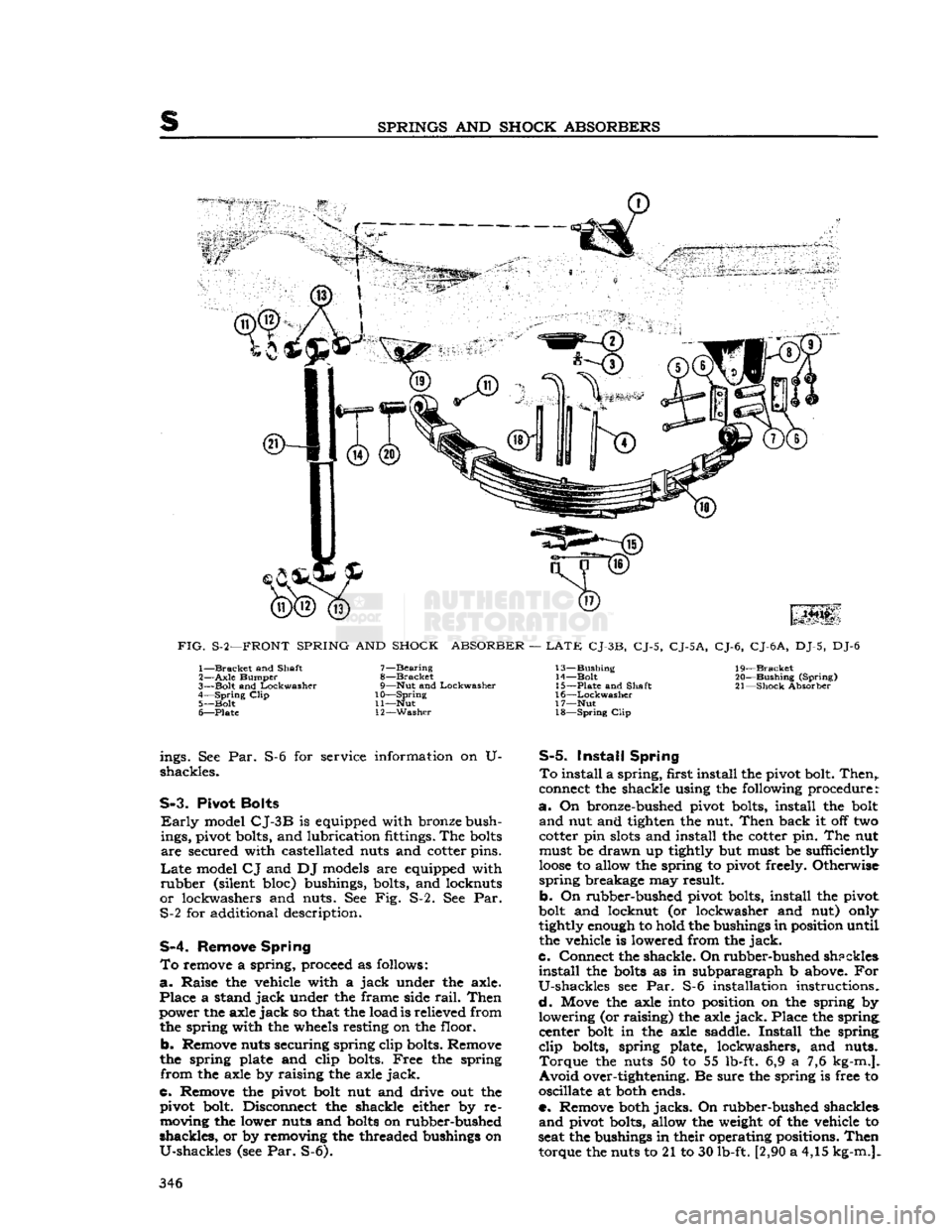
FIG.
S-2—FRONT
SPRING
AND
SHOCK
ABSORBER
—
LATE
CJ-3B,
CJ-5,
CJ-5A,
CJ-6,
CJ-6
A,
DJ-5, DJ-6 1—
Bracket
and Shaft
2—
Axle
Bumper
3—
Bolt
and
Lockwasher
4—
Spring
Clip
5—
Bolt
6—
Plate
7—
Bearing
8—
Bracket
9—
Nut
and
Lockwasher
10—
Spring
11—
Nut
12—
Washer
13—
Bushing
14—
Bolt
15—
Plate
and Shaft
16—
Lockwasher
17—
Nut
18—
Spring
Clip
19—
Bracket
20—
Bushing
(Spring)
21—
Shock
Absorber ings. See Par.
shackles.
S-6 for service information on U-
S-3.
Pivot
Bolts
Early
model
CJ-3B
is equipped with bronze bush
ings, pivot bolts, and lubrication fittings. The
bolts
are
secured with castellated nuts and cotter pins.
Late
model
CJ
and DJ models are equipped with
rubber
(silent bloc) bushings, bolts, and locknuts
or
lockwashers and nuts. See Fig. S-2. See Par. S-2 for additional description.
S-4.
Remove
Spring
To
remove a spring, proceed as follows:
a.
Raise
the vehicle with a
jack
under the axle.
Place
a stand
jack
under the frame side
rail.
Then
power the axle
jack
so that the load is relieved from the spring with the wheels resting on the floor.
b.
Remove nuts securing spring clip bolts. Remove
the spring plate and clip bolts.
Free
the spring
from
the axle by raising the axle
jack.
C.
Remove the pivot bolt nut and drive out the pivot bolt. Disconnect the shackle either by removing the lower nuts and
bolts
on rubber-bushed
shackles,
or by removing the threaded bushings on
U-shackles
(see Par. S-6).
S-5.
Install
Spring
To
install a
spring,
first install the pivot bolt.
Then,,
connect the shackle using the following procedure:
a.
On bronze-bushed pivot bolts, install the bolt
and
nut and tighten the nut.
Then
back it off two
cotter pin
slots
and install the cotter pin. The nut must be
drawn
up tightly but must be sufficiently
loose
to allow the spring to pivot freely. Otherwise
spring
breakage may result.
b.
On rubber-bushed pivot bolts, install the pivot
bolt and locknut (or lockwasher and nut) only
tightly enough to hold the bushings in position until
the vehicle is lowered from the
jack.
c.
Connect the shackle. On
rubber-bushed
shpckles
install
the
bolts
as in subparagraph b above. For
U-shackles
see Par. S-6 installation instructions.
d.
Move the axle into position on the spring by
lowering
(or raising) the axle
jack.
Place the spring, center bolt in the axle saddle.
Install
the spring
clip
bolts, spring plate, lockwashers, and nuts.
Torque
the nuts 50 to 55 lb-ft. 6,9 a 7,6 kg-m.].
Avoid
over-tightening. Be sure the spring is free to
oscillate at both ends.
e. Remove both
jacks.
On rubber-bushed shackles
and
pivot bolts, allow the weight of the vehicle to
seat the bushings in their operating positions.
Then
torque the nuts to 21 to 30 lb-ft. [2,90 a 4,15 kg-m.]. 346
Page 347 of 376
'Jeep'
UNIVERSAL
SERIES
SERVICE
MANUAL
S
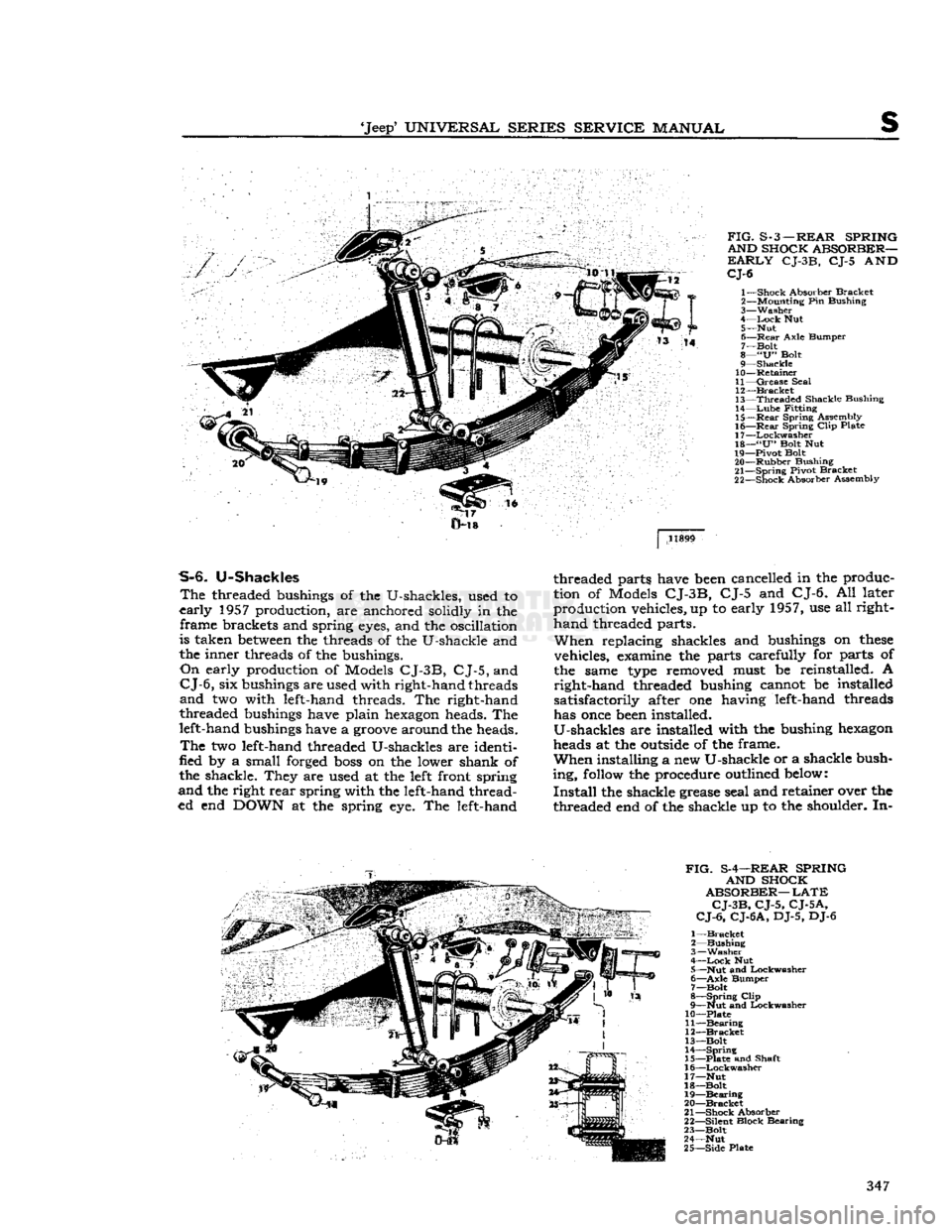
FIG.
S-3—REAR SPRING
AND SHOCK ABSORBER—
EARLY
CJ-3B,
CJ-5 AND
CJ-6
1— Shock Absorber Bracket
2— Mounting Pin Bushing
3—
Washer
4—
Lock
Nut 5— Nut
6—
Rear
Axle Bumper
7— Bolt
8—
"U"
Bolt
9—
Shackle
10—
Retainer
11—
Grease
Seal
12—
Bracket
13—
Threaded
Shackle Bushing
14—
Lube
Fitting
15—
Rear
Spring Assembly
16—
Rear
Spring
Clip
Plate
17—
Lockwasher
18—
"U"
Bolt Nut
19— Pivot Bolt 20—
Rubber
Bushing
21—
Spring
Pivot Bracket
22— Shock Absorber Assembly 11899
S-6. U-Shackles
The
threaded bushings of the U-shackles, used to
early
1957 production, are anchored solidly in the frame brackets and spring
eyes,
and the oscillation
is taken
between
the threads of the U-shackle and
the inner threads of the bushings.
On
early production of Models
CJ-3B, CJ-5,
and
CJ-6,
six bushings are used with right-hand threads
and
two with left-hand threads. The right-hand
threaded bushings have plain
hexagon
heads. The
left-hand bushings have a
groove
around the heads.
The
two left-hand threaded U-shackles are identi
fied by a small forged
boss
on the lower shank of
the shackle. They are used at the
left
front spring
and
the right
rear
spring with the left-hand thread
ed end
DOWN
at the spring eye. The left-hand threaded parts have
been
cancelled in the produc
tion of Models
CJ-3B,
CJ-5 and CJ-6. All later production vehicles, up to early 1957, use all right-
hand
threaded parts.
When
replacing shackles and bushings on
these
vehicles, examine the parts carefully for parts of
the same
type
removed must be reinstalled. A right-hand threaded bushing cannot be installed
satisfactorily after one having left-hand threads
has
once
been
installed.
U-shackles are installed with the bushing
hexagon
heads at the
outside
of the frame.
When
installing a new U-shackle or a shackle bush
ing,
follow
the procedure outlined
below:
Install
the shackle grease seal and retainer over the threaded end of the shackle up to the shoulder. In-
FIG.
S-4—REAR SPRING AND SHOCK
ABSORBER—
LATE
CJ-3B, CJ-5, CJ-5A,
CJ-6, CJ-6 A, DJ-5,
DJ-6
1—
Bracket
2—
Bushing
3—
Washer
4—
Lock
Nut
5— Nut and Lockwasher 6—
Axle
Bumper 7—Bolt
8—
Spring
Clip
9— Nut and Lockwasher
10— Plate 11—
Bearing
12—
Bracket
13— Bolt
14—
Spring
15— Plate and Shaft
16—
Lockwasher
17— Nut
18—Bolt 19—
Bearing
20—
Bracket
21— Shock Absorber
22— Silent Block Bearing
23—Bolt
24—Nut
25— Side Plate 347
Page 349 of 376
•Jeep'
UNIVERSAL SERIES SERVICE
MANUAL
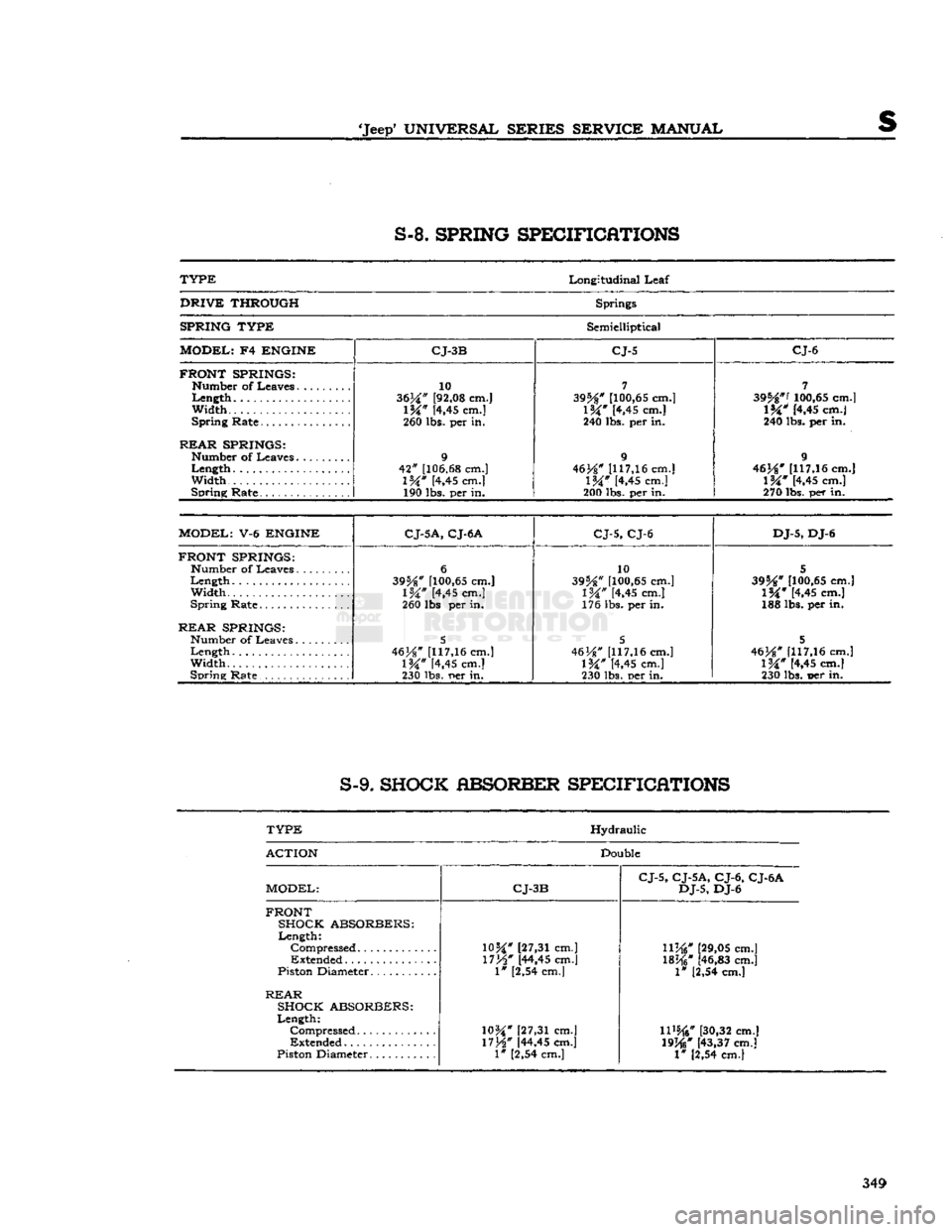
S-8.
SPRING SPECIFICATIONS
TYPE
Longitudinal
Leaf
DRIVE
THROUGH
Springs
SPRING TYPE
Semielliptical
MODEL;
F4
ENGINE CJ-3B CJ-5 CJ-6
FRONT SPRINGS:
Width...
REAR
SPRINGS:
Width
Spring
Rate
10
3634" [92,08 cm.]
\W
[4,45 cm.]
260 lbs. per in.
9
42"
[106.68 cm.]
l%"
[4,45 cm.] 190 lbs. per in.
7
395**
[100,65 cm.]
1&"
[4,45 cm.]
240 lbs. per in.
9
46J*#
[117,16 cm.]
IW
[4,45 cm.]
200 lbs. per in.
7
395*"'
100,65 cm.]
l%"
[4.45 cm.]
240 lbs. per in.
9
46}*"
1117,16 cm.]
l%"
[4,45 cm.]
270
lbs.
per in.
MODEL:
V-6
ENGINE
C
J-5A, CJ-6 A
CJ-5, CJ-6 DJ-5,
DJ-6
FRONT SPRINGS:
Number
of
Leaves
Width.....
Spring
Rate
REAR
SPRINGS:
Width
Spring
Rate
6
395*"
[100,65 cm.]
1%"
[4,45 cm.]
260 lbs per in.
5
46H"
[117,16 cm.]
\W
K,45
cm.]
230 lbs.
r»er
in. 10
39%"
[100,65 cm.]
IW
[4,45 cm.]
176 lbs. per in.
5
46
H"
[117,16 cm.]
IW
[4,45 cm.]
230 lbs. per in.
5
395**
[100,65 cm.]
1%"
[4,45 cm.]
188 lbs. per in.
5
463*"
[117,16 cm.]
1%"
[4,45 cm.]
230 lbs. t>er in.
S-9.
SHOCK ABSORBER SPECIFICATIONS
TYPE
Hydraulic
ACTION
Double
MODEL:
CJ-3B CJ-5, CJ-5A, CJ-6, CJ-6A
DJ-5,
DJ-6
FRONT SHOCK ABSORBERS:
Length:
"
[27,31 cm.]
Compressed
"
[27,31 cm.]
llj*i"
[29,05 cm.]
Extended
*
[44,45 cm.]
1%W
[46,83 cm.]
Piston Diameter
I" [2,54 cm.]
1* [2,54 cm.]
REAR
SHOCK ABSORBERS:
Length:
Compressed
10H
[27,31 cm.]
11%*
[30,32 cm.]
Extended
17H"
[44,45 cm.]
19j*j"
[43,37 cm.]
Piston Diameter
1"
[2,54 cm.] 1" [2,54 cm.]
349
Page 351 of 376
'Jeep'
UNIVERSAL
SERIES
SERVICE
MANUAL
T
BODY
Contents
SUBJECT
PAR.
Brake
and
Clutch
Pedal Pads T-7
Canvas
Tops T-5
Care
of
Fabric
Tops. : T-6
Front
Seat Adjustment. . . T-8
Passenger Seat Safety
Catch
. .T-9
Windshield
T-2, T-3
Windshield
Glass and Weatherstrip T-4
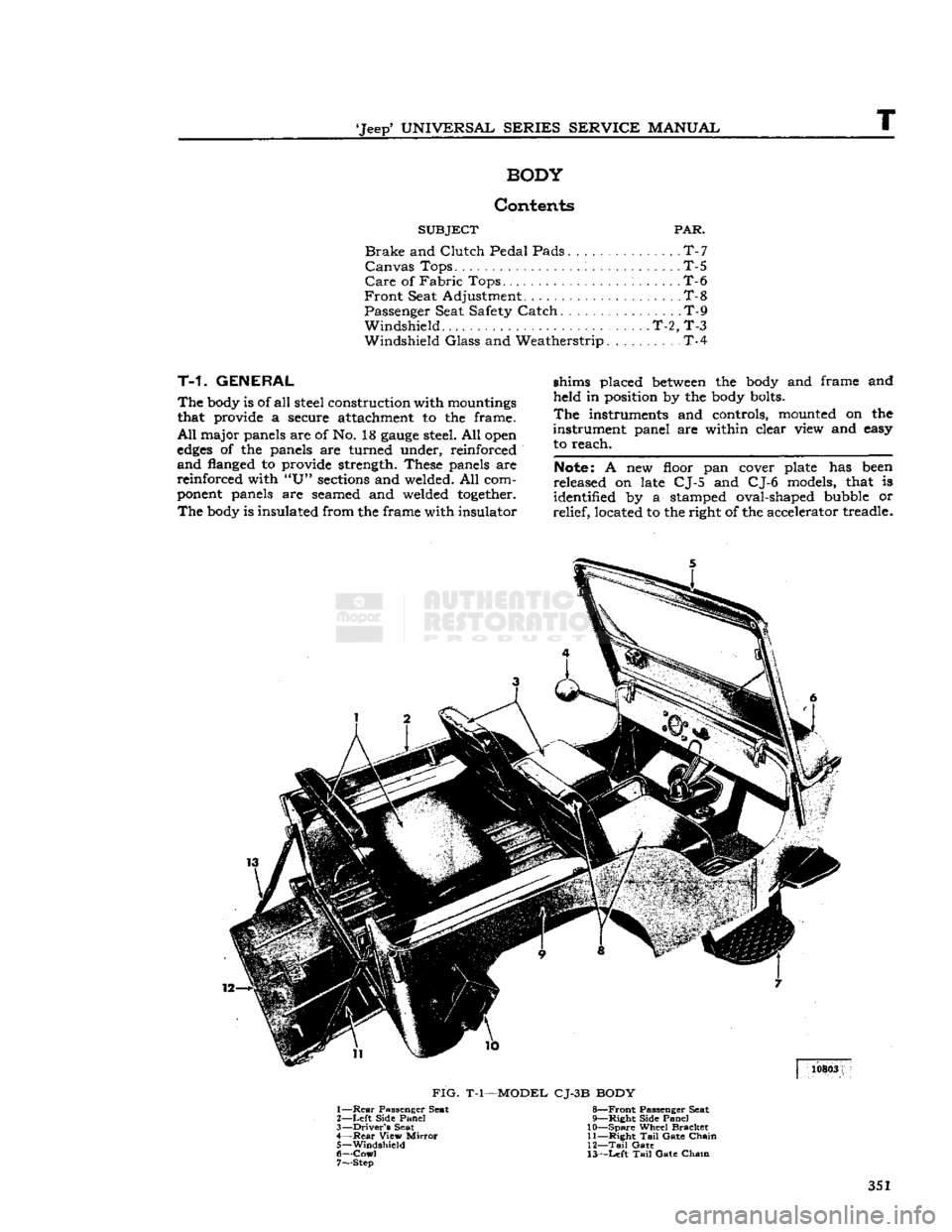
T-1.
GENERAL
The
body
is of
all
steel construction with mountings
that provide a secure attachment to the frame.
All
major panels are of No. 18
gauge
steel. All
open
edges
of the panels are turned under, reinforced
and
flanged to provide strength. These panels are reinforced with
"U"
sections
and welded. All com
ponent
panels are seamed and welded
together.
The
body
is insulated from the frame with insulator shims placed
between
the
body
and frame and
held in position by the
body
bolts.
The
instruments and controls, mounted on the
instrument panel are within clear view and easy
to reach.
Note:
A new floor pan cover plate has
been
released on late CJ-5 and CJ-6 models, that is
identified by a stamped oval-shaped bubble or
relief, located to the right of the accelerator treadle.
FIG.
T-l—MODEL CJ-3B BODY
1—
Rear
Passenger Seat 8—Front Passenger Seat
2—
Left
Side
Panel
9—Right Side
Panel
3—
Driver's
Seat 10—Spare Wheel
Bracket
4—
Rear
View
Mirror
11—Right
Tail
Gate
Chain
5—
Windshield
12—Tail
Gate
6—
Cowl
13—Left
Tail
Gate
Chain
7— Step
351
Page 353 of 376
'Jeep'
UNIVERSAL
SERIES SERVICE
MANUAL
T
353
Page 355 of 376
'Jeep'
UNIVERSAL
SERIES
SERVICE
MANUAL
T
FIG.
T-7—TAIL
GATE
ASSEMBLY
—
LATE
MODEL
CJ-5, CJ-6
T-6.
Care
of
Fabric
Tops
Remove fabric
tops
from their protective covering
immediately after they are received. Store in a
dry,
clean,
airy
place. If the material is damp, the
top should be installed on the vehicle immediately
and
washed with a mild soap; then
give
the top a
quick
and thorough rinsing.
T-7.
Brake
and
Clutch Pedal Pads
A
clutch and brake pedal pad cover has been re leased which has a .44" [11,18 mm.]
groove
molded into the back side of the pad cover. When installing,
the grooved opening is located down and to the
bottom
of the pedal. See Fig. T-ll. The purpose of the
groove
concerns models not listed in this
manual.
The pedal pad cover formerly used is
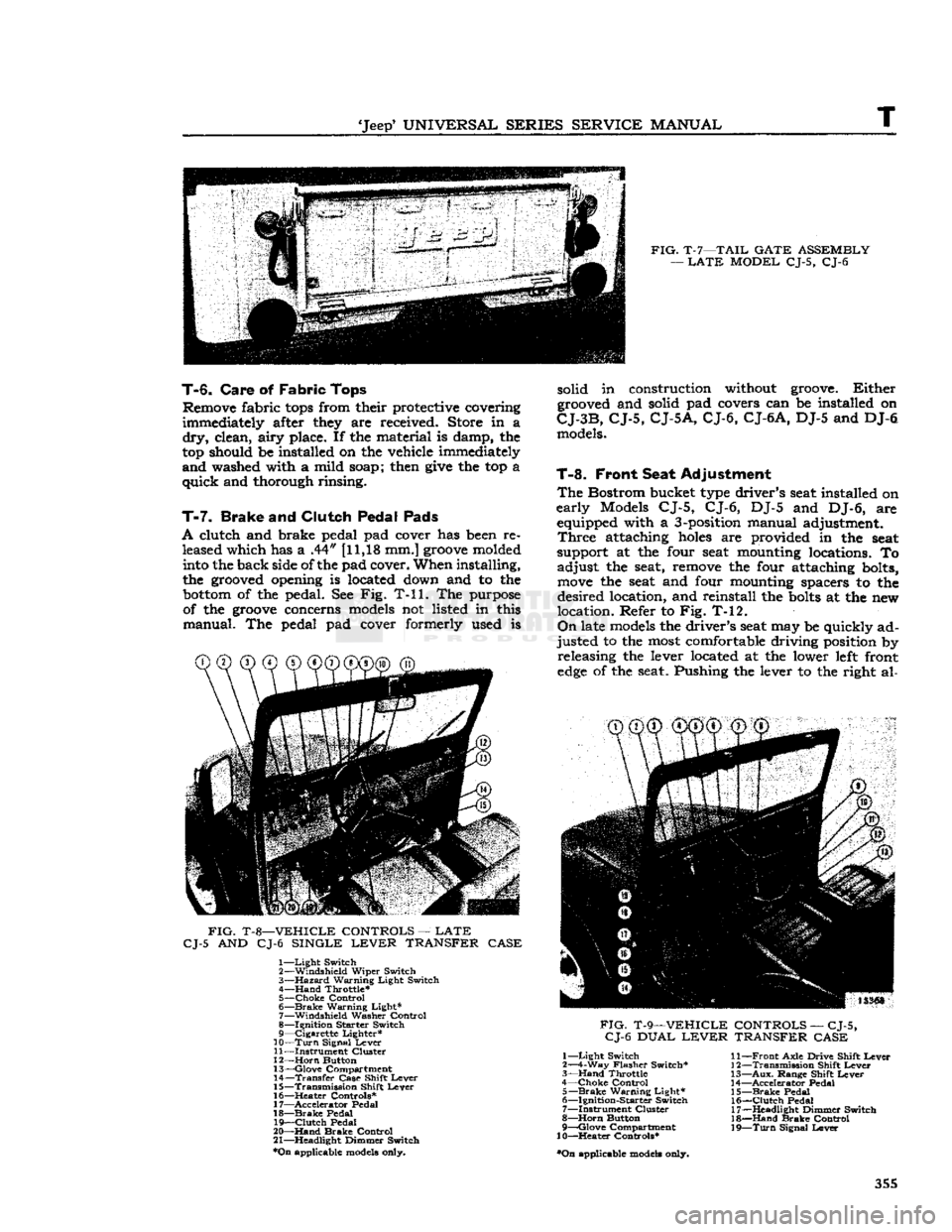
FIG.
T-8—VEHICLE
CONTROLS
—
LATE
CJ-5
AND CJ-6
SINGLE
LEVER
TRANSFER
CASE
1—
Light
Switch
2—
Windshield
Wiper
Switch
3—
Hazard
Warning
Light
Switch
4—
Hand
Throttle*
5—
Choke
Control
6—
Brake
Warning
Light*
7—
Windshield
Washer
Control
8—
Ignition
Starter
Switch
9—
Cigarette
Lighter*
10—
Turn
Signal
Lever
11—
Instrument
Cluster
12—
Horn
Button
13—
Glove
Compartment
14—
Transfer
Case
Shift
Lever
15—
Transmission
Shift
Lever
16—
^Heater
Controls*
17—
Accelerator
Pedal
18—
Brake
Pedal
19—
Clutch
Pedal
20—
Hand
Brake
Control
21—
Headlight
Dimmer
Switch
*On
applicable models only. solid in construction without groove.
Either
grooved and solid pad covers can be installed on
CJ-3B,
CJ-5,
CJ-5A,
CJ-6,
CJ-6A,
DJ-5 and DJ-6 models.
T-8.
Front Seat Adjustment
The
Bostrom bucket type driver's seat installed on
early
Models CJ-5, CJ-6, DJ-5 and DJ-6, are equipped with a 3-position manual adjustment.
Three
attaching
holes
are provided in the seat
support at the four seat mounting locations. To
adjust
the seat, remove the four attaching bolts,
move
the seat and four mounting spacers to the
desired
location, and reinstall the
bolts
at the new
location. Refer to Fig. T-12.
On
late models the driver's seat may be quickly ad
justed
to the most comfortable driving position by releasing the lever located at the lower left front
edge
of the seat. Pushing the lever to the right al-
CD CD®
®@©"®^
FIG.
T-9—VEHICLE
CONTROLS
—
CJ-5,
CJ-6
DUAL
LEVER
TRANSFER
CASE
1—
Light
Switch
2—4-Way
Flasher
Switch*
3—
Hand
Throttle
4—
Choke
Control
5—
Brake
Warning
Light*
6—
Ignition-Starter
Switch
7—
Instrument
Cluster
8—
Horn
Button
9—
Qlove
Compartment
10—Heater
Controls*
•On
applicable models only.
11—
Front
Axle
Drive
Shift
Lever
12—
Transmission
Shift
Lever
13—
Aux.
Range
Shift
Lever
14—
Accelerator
Pedal
15—
Brake
Pedal
16—
Clutch
Pedal
17—
Headlight
Dimmer
Switch
18—
Hand
Brake
Control
19—
Turn
Signal
Lever
355
Page 357 of 376
'Jeep'
UNIVERSAL SERIES SERVICE
MANUAL
u
MISCEIiLaNEOUS
Contents
SUBJECT
PAR.
Abbreviations
U-15
Extra
Equipment U-2
Front
Bumper Weight U-9
Governor
U-3
Governor
Adjustment U-4
Governor
Maintenance. U-6
U-1. GENERAL
Miscellaneous information included in this sectioi
includes coverage of extra equipment, special
tools,
torque specifications, and charts and tables.
U-2. EXTRA
EQUIPMENT
Much
of the utility of the
*
Jeep*
Universal
is due to
the extra equipment which has been designed to adapt it for farming and industry. The mainte
nance and use of
some
of this equipment is out
lined
in this section.
U-3.
Governor Assembly
The
Novi governor is supplied for models equipped
with
the F4 engine.
This
is a centrifugal type governor and is illustrated in Fig. U-2. Complete
installation
instructions are supplied with each
assembly. Adjustment and operating procedures
are
given below.
U-4.
Governor Adjustment
a.
Adjust the carburetor to obtain smooth
engine
idle at 600 rpm., then
stop
the engine.
b.
Check
throttle linkage to ensure maximum
throttle opening. Be certain that throttle and
governor linkage is free.
c.
Place the carburetor throttle in wide-open posi tion and
pull
the governor control handle out to
the last notch. Adjust the governor to bellcrank
rod
so that the linkage
will
hold the carburetor
throttle in wide-open position.
d.
Close the governor control and start the
engine
Again
pull
the control out to the last notch and
adjust
the length of the cable at adjusting yoke so
that the
engine
will
run at
2600
rpm. Close the
control
to recheck the linkage for free action and
to make sure the
engine
will
return to 600 rpm.
idle speed.
If
the
engine
runs faster than this speed,
loosen
the lock nut which locks the governor hand control
handle on the dash to the rod and back off the
handle until the carburetor idle speed adjusting
screw
bears on the stop. Tighten the lock nut.
In
the absence of electrical tachometer equipment,
engine
speed may be determined by the speedom
eter. Safely
jack
up the
rear
wheels and be sure the front wheel drive is not
engaged.
When driving
the
rear
wheels in high or direct transmission gear,
the
speedometer
will
read from 13j^ to 15 mph. [21.6 to 24.0 kph.] at an
engine
speed of from 900
to 1000 rpm.
SUBJECT
PAR.
Heater
U-10 Miscellaneous Data U-16
Pintle
Hook 1X7
Special
Tools. U-ll
Torque
Specifications U-13, 14, 15
Standard
and Recommended Tools
j.
.U-12
U-5.
Novi Governor Operation /
The
Novi governor is directly belted to the F4
engine
as no clutch is provided to disconnect the
drive.
To
operate the vehicle
WITHOUT
governor con
trol,
push the governor hand control all the way
IN
against the instrument panel.
To
operate the vehicle
WITH
governor control,
pull
the governor hand control handle out. The
hand
control has nine notched positions. Pulling the
control
out to the first notch
sets
the controlled
engine
speed at approximately 1000 rpm. and each successive notch increases the speed 200 rpm.
until
2600
rpm. is reached in the ninth notch. The
hand
control may be released by turning the han dle one-quarter
turn
in either direction.
When
the
engine
is being operated under governor
control
(hand control out) the controlled
engine
speed may be
exceeded
at any time by depressing
the
foot
accelerator in the conventional manner to
secure a greater carburetor throttle opening than
that determined by the governor hand control
setting.
U-6.
Governor Maintenance
The
belt tension may be adjusted by raising or
lowering the governor in the slotted
holes
in the mounting bracket. Keep the pulleys and belt free
of
dirt
and oil. Belt slippage
will
affect governor
operation and a tight belt may cause
rapid
wear
of the governor shaft and bearings. Adjust it to
allow Yi' [12,7 mm.] depression midway
between
the pulleys with thumb pressure.
There
is little wear of the internal parts for they
operate in oil. The governor housings are equipped
with
both
fill
and
drain
plugs and also with level
indicating
plugs.
Check
the oil level at each vehicle
lubrication
and change the oil each time the en
gine
oil is changed using the same grade oil used
in
the engine.
Caution:
Do not
fill
the governor housing above
the level plug. Overfilling
will
prevent governor
control
and possibly cause damage to governor in
ternal
parts. The capacity of
these
governors is two fluid ounces [59,15 cm3]. The filler plug is
also a vent which should be cleaned thoroughly at
each oil change to be sure that the vent operates.
U-7.
Pintle Hook
The
standard type pintle hook, Fig. U-1, affords a
safe, easy hitch for towing a
trailer
or other vehicle. 357
Page 359 of 376
'Jeep*
UNIVERSAL
SERIES
SERVICE
MANUAL
U
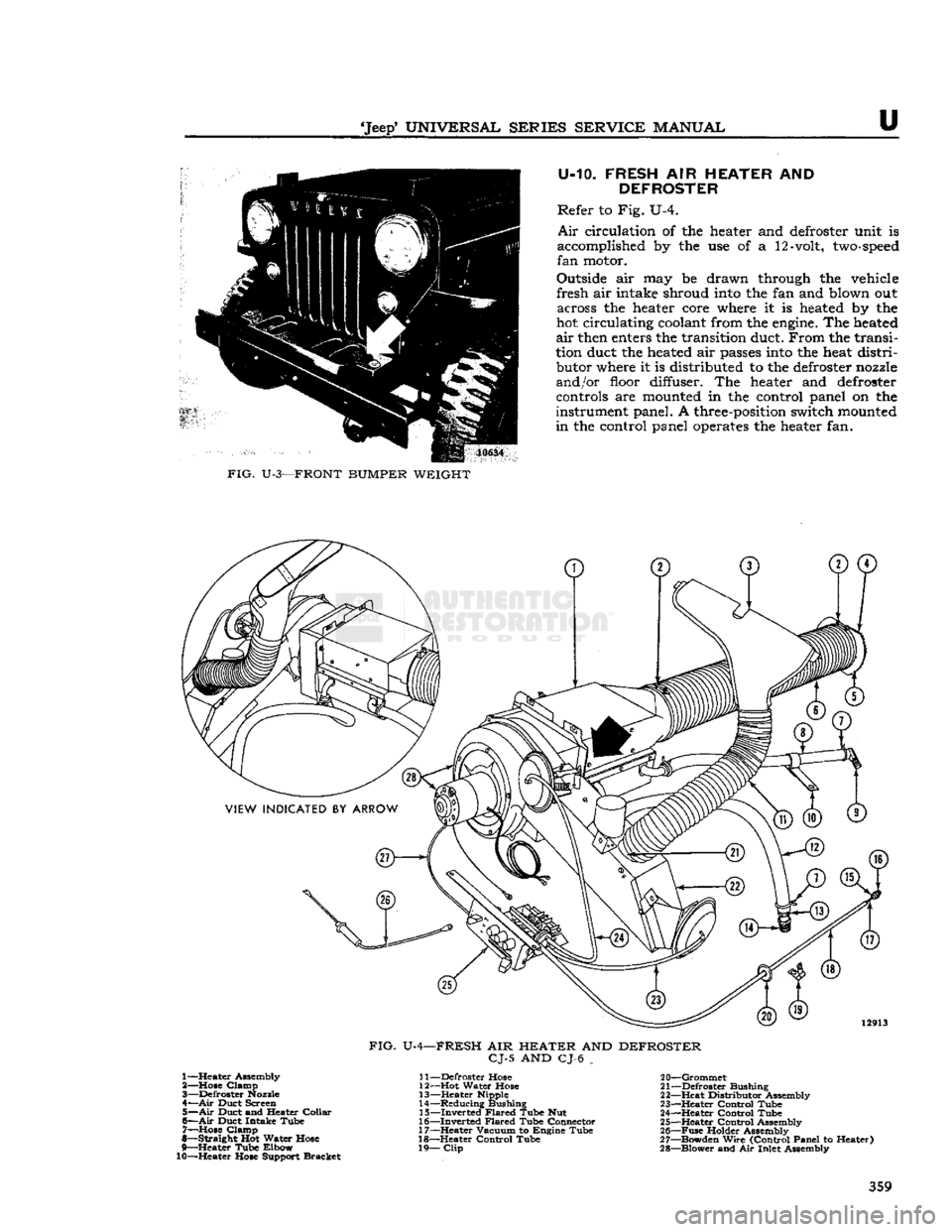
U-10. FRESH AIR HEATER AND
DEFROSTER
Refer to Fig. U-4.
Air
circulation of the
heater
and
defroster
unit
is
accomplished
by the use of a
12-volt,
two-speed
fan
motor.
Outside
air may be drawn
through
the
vehicle
fresh air
intake
shroud
into
the fan and
blown
out
across
the
heater
core
where
it is
heated
by the
hot circulating
coolant
from the
engine.
The
heated
air
then
enters
the transition
duct.
From the transi
tion
duct
the
heated
air
passes
into
the
heat
distri
butor
where
it is
distributed
to the
defroster
nozzle
and/or
floor
diffuser.
The
heater
and
defroster
controls
are
mounted
in the
control
panel
on the
instrument
panel. A
three-position
switch
mounted
in the
control
panel
operates
the
heater
fan.
FIG.
U-3—FRONT
BUMPER
WEIGHT
FIG.
U-4-
-FRESH
AIR
HEATER
AND
DEFROSTER
CJ-5
AND CJ-6 _ 1— Heater Assembly
2— Hose Clamp
3— Defroster
Nozzle
4—
Air
Duct Screen 5—
Air
Duct and Heater Collar
6—
Air
Duct Intake Tube 7— Hose Clamp
8— Straight Hot Water Hose
9— Heater Tube Elbow
10—Heater Hose Support Bracket
I
j—Defroster Hose
12— Hot Water Hose
13— Heater Nipple
14— Reducing Bushing
15— Inverted Flared Tube Nut
16— Inverted Flared Tube Connector
17— Heater Vacuum to Engine Tube
18— Heater Control Tube
19—
Clip
20— Grommet
21— Defroster Bushing
22— Heat Distributor Assembly
23— Heater Control Tube
24— Heater Control Tube
25— Heater Control Assembly
26—
Fuse
Holder Assembly
27— Bowden Wire (Control Panel to Heater)
28— Blower and Air Inlet Assembly 359
Page 361 of 376
'Jeep*
UNIVERSAL
SERIES
SERVICE
MANUAL
U
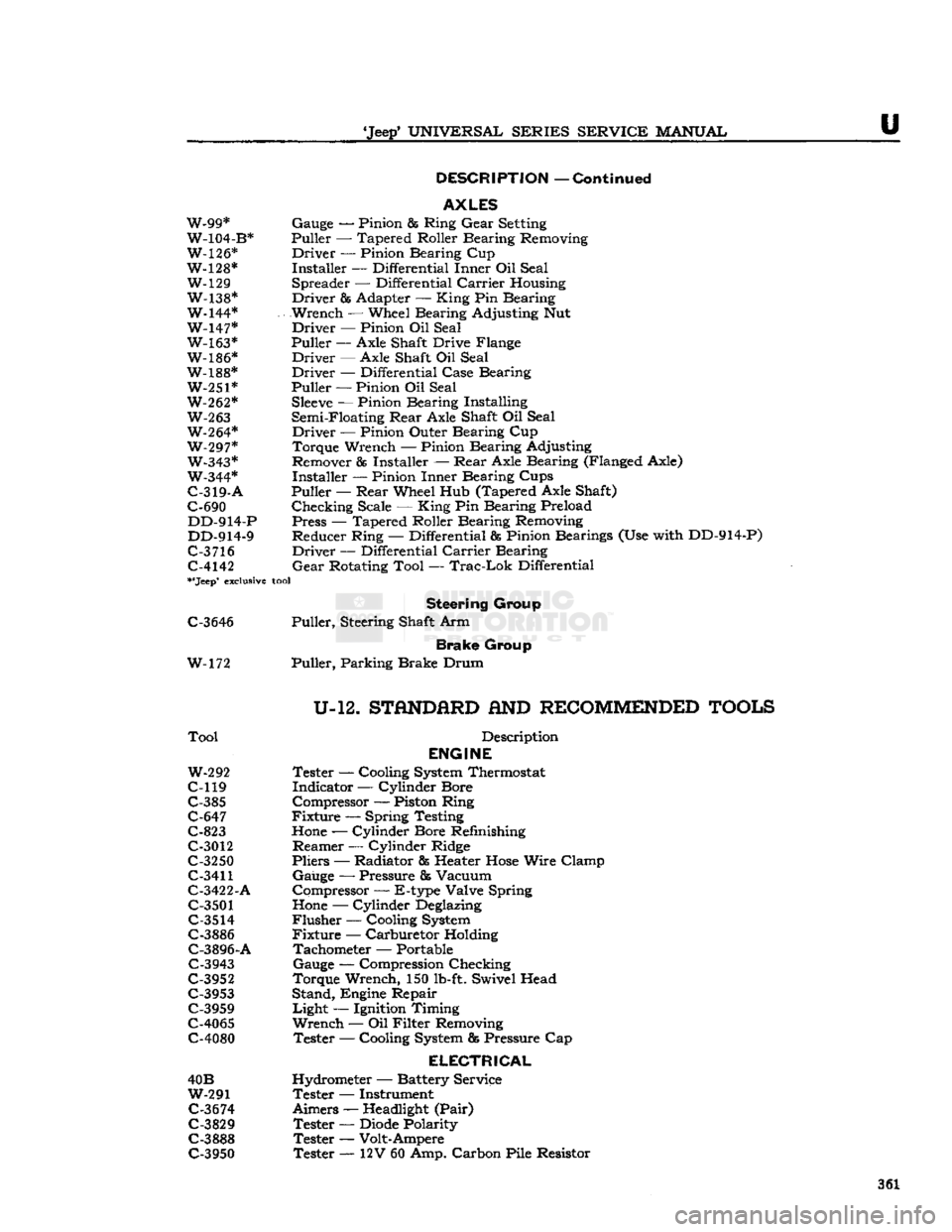
DESCRIPTION
—
Continued
AXLES
W-99* Gauge — Pinion & Ring
Gear
Setting
W-104-B* Puller — Tapered Roller Bearing Removing
W-126* Driver — Pinion Bearing Cup
W-128* Installer — Differential Inner Oil Seal W-129 Spreader — Differential
Carrier
Housing
W-138* Driver & Adapter —
King
Pin Bearing
W-144* Wrench — Wheel Bearing Adjusting Nut W-147* Driver — Pinion Oil Seal W-163* Puller
—-
Axle Shaft Drive Flange
W-186* Driver — Axle Shaft Oil Seal
W-188* Driver — Differential Case Bearing W-251* Puller — Pinion Oil Seal
W-262*
Sleeve
— Pinion Bearing Installing
W-263
Semi-Floating
Rear
Axle Shaft Oil Seal W-264* Driver — Pinion Outer Bearing Cup
W-297* Torque Wrench — Pinion Bearing Adjusting W-343* Remover
85
Installer —
Rear
Axle Bearing (Flanged Axle)
W-344* Installer — Pinion Inner Bearing Cups
C-319-A
Puller —
Rear
Wheel Hub (Tapered Axle Shaft)
C-690 Checking Scale —
King
Pin Bearing Preload DD-914-P Press — Tapered Roller Bearing Removing
DD-914-9 Reducer Ring — Differential & Pinion Bearings (Use with DD-914-P)
C-3
716 Driver — Differential
Carrier
Bearing C-4142
Gear
Rotating Tool —
Trac-Lok
Differential
**Jeep*
exclusive
tool
Steering
Group
C-3646 Puller, Steering Shaft Arm
Brake
Group
W-172 Puller, Parking Brake Drum
U-12.
STflNDfiRD
AND
RECOMMENDED
TOOLS
Tool
Description
ENGINE
W-292
Tester — Cooling
System
Thermostat
C-119 Indicator — Cylinder Bore C-385 Compressor — Piston Ring
C-647 Fixture — Spring Testing
C-823
Hone
— Cylinder Bore Refinishing
C-3012 Reamer — Cylinder Ridge
C-3250 Pliers — Radiator fis Heater
Hose
Wire Clamp
C-3411
Gauge — Pressure & Vacuum
C-3422-A Compressor — E-type Valve Spring
C-3501
Hone
— Cylinder
Deglazing
C-3514
Flusher — Cooling
System
C-3886 Fixture — Carburetor Holding C-3896-A Tachometer — Portable
C-3943 Gauge — Compression Checking
C-3952 Torque Wrench, 150
lb-ft.
Swivel Head C-3953 Stand, Engine Repair
C-3959 Light — Ignition Timing
C-4065 Wrench — Oil Filter Removing
C-4080 Tester — Cooling
System
fig
Pressure Cap
ELECTRICAL
40B Hydrometer — Battery Service
W-291 Tester — Instrument
C-3674
Aimers —
Headlight
(Pair)
C-3829 Tester —
Diode
Polarity
C-3888 Tester — Volt-Ampere C-3950 Tester — 12V 60 Amp. Carbon Pile Resistor 361