ECU JEEP CJ 1953 Repair Manual
[x] Cancel search | Manufacturer: JEEP, Model Year: 1953, Model line: CJ, Model: JEEP CJ 1953Pages: 376, PDF Size: 19.96 MB
Page 215 of 376
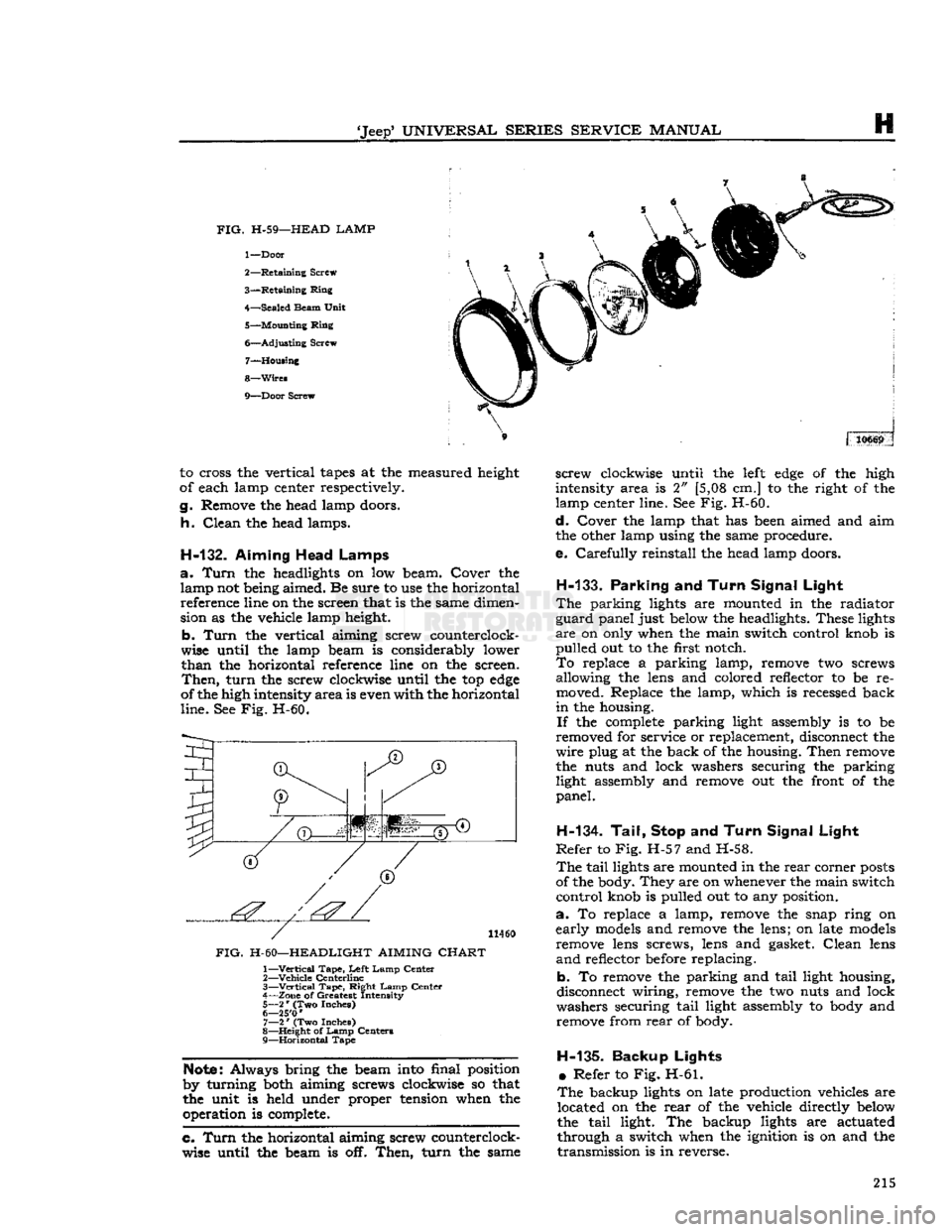
'Jeep*
UNIVERSAL
SERIES
SERVICE
MANUAL
H
FIG.
H-59—HEAD LAMP
1—
Door
2—
Retaining
Screw
3—
Retaining
Ring
4—
Sealed
Beam
Unit
5—
Mounting
Ring
6—
Adjusting
Screw 7—
Housing
8—
Wires
9—
Door
Screw 310669
to cross the vertical
tapes
at the measured height
of each lamp center respectively.
g.
Remove the head lamp doors.
h.
Clean
the head lamps.
H-132.
Aiming Head Lamps
a.
Turn
the headlights on low beam. Cover the lamp not being aimed. Be sure to use the horizontal reference line on the screen that is the same dimen
sion as the vehicle lamp height.
b.
Turn
the vertical aiming screw counterclock
wise until the lamp beam is considerably lower
than
the horizontal reference line on the screen.
Then,
turn
the screw clockwise until the top
edge
of the high intensity
area
is even with the horizontal
line.
See Fig. H-60.
I
(T)
JT)
1'.'' | '':'
11460
FIG.
H-60—HEADLIGHT AIMING
CHART
1—
Vertical
Tape,
Left
Lamp
Center
2—
Vehicle
Centerline
3—
—Vertical
Tape,
Right
Lamp
Center
4—
Zone
of Greatest Intensity
5—
2
*
(Two Inches)
6— 25'0
'
7—
2
*
(Two Inches)
8—
Height
of
Lamp
Centers
9—
Horizontal
Tape
Note:
Always bring the beam into final position
by turning both aiming screws clockwise so that
the unit is held under proper tension when the operation is complete.
c. Turn
the horizontal aiming screw counterclock
wise until the beam is off.
Then,
turn
the same
screw
clockwise until the
left
edge
of the high
intensity area is 2" [5,08 cm.] to the right of the
lamp center line. See Fig. H-60.
d.
Cover the lamp that has been aimed and aim
the other lamp using the same procedure.
e.
Carefully
reinstall the head lamp doors.
H-133.
Parking
and
Turn Signal Light
The
parking lights are mounted in the radiator
guard
panel just below the headlights. These lights
are
on only when the main switch control knob is
pulled
out to the first notch.
To
replace a parking lamp, remove two screws allowing the lens and colored reflector to be re
moved. Replace the lamp, which is recessed back
in
the housing.
If
the
complete
parking light assembly is to be
removed for service or replacement, disconnect the
wire
plug at the back of the housing.
Then
remove
the nuts and lock washers securing the parking light assembly and remove out the front of the
panel.
H-134. Tail, Stop
and
Turn Signal Light
Refer
to Fig. H-57 and H-58.
The
tail
lights are mounted in the
rear
corner
posts
of the body. They are on whenever the main switch
control
knob is pulled out to any position.
a.
To replace a lamp, remove the snap ring on
early
models
and remove the lens; on late
models
remove lens screws, lens and gasket.
Clean
lens
and
reflector before replacing.
b. To remove the parking and
tail
light housing,
disconnect wiring, remove the two nuts and lock
washers securing
tail
light assembly to body and remove from
rear
of body.
H-135-
Backup Lights •
Refer to Fig. H-61.
The
backup lights on late production vehicles are located on the
rear
of the vehicle directly below
the
tail
light. The backup lights are actuated
through a switch when the ignition is on and the
transmission
is in reverse. 215
Page 217 of 376
'Jeep'
UNIVERSAL
SERIES
SERVICE
MANUAL
H
cuit
lights,
the
signal switch
is
inoperative
and
must
be
replaced.
H-139.
Hazard
Warning Lights
All
current production vehicles
are
equipped with
a
four-way flasher warning system.
The
control switch
is
located
on the
instrument panel left
of
the steering column.
With
the
switch pulled
out,
the
two
front and
two
rear
turn
signal lights flash
on and
off
simultaneously,
as do
both
turn
signal
indicator
lights
on the
instrument clusters.
H-140.
Marker
Lights and Reflector Assembly
The
marker
lights
and
reflector assemblies
on
current
production vehicles
are
mounted
on the
side
of
the front fender and
on the
side
of
the
rear
quarter
panel.
The
spare wheel also mounts
a
marker
light. Some earlier production vehicles have
reflex reflectors mounted on the side of the hood and
on
the
side
of
the
rear
quarter panel. determine
if
dash wiper switch or wiring
is at
fault,
disconnect wiring harness from wiper motor
and
try
operating wiper independently
of
dash switch.
If
still
inoperative
see
procedure under
Par.
H-145.
b. Wiper
will
not
shut
off
— Determine
if
wiper
has both
low
and high speeds, slow speed only,
or
high speed only.
It is
important that
the
wiper
operates
at low
speed during parking cycle.
Dis
connect wiring harness from wiper motor
and try
operating wiper independently
of
dash switch.
If
wiper
shuts
off
correctly with
crank
arm
in
park
position and wiper has both speeds, check
the
lead
between
terminal
and
dash switch ground
and
check
for
defective dash switch.
If
wiper shuts
off
correctly,
but has
high speed only, check lead
be
tween wiper terminal and dash switch
for an
open
circuit
and check
for
defective dash switch.
If
still
inoperative,
see
Par. H-145.
c. Wiper
has
only fast speed.
Check
for
defective dash switch
or
open lead
between
terminal
and
dash switch.
H-141.
Windshield Wiper System
Early
production vehicles equipped with
the
Dauntless V-6
engine
have
two
single speed wind
shield wiper motors mounted above
the
windshield inside
the
vehicle. The wiper motors
are
operated
and
controlled
by a
switch located
on the
instru
ment panel.
Current
production vehicles with stationary wind
shield have
a
two-speed
electric windshield wiper motor mounted below
the
windshield outside
the
vehicle on the driver's side. The wiper motor switch is located
on the
instrument panel
to the
left
of
the steering column.
H-142.
Two-Speed Wiper Motor
The
two-speed
electric wiper motor
is
operated and
controlled
by a
turn
type, three poled, dash switch,
containing
a 6
amp. circuit breaker.
Current
flow
is directed from
the
battery through
the
ignition
switch
to the
wiper dash switch assembly
to the
two-speed
wiper motor, which passes current from the designated motor brush (high,
low or
park)
to
the armature circuit
to
ground.
H-143.
Troubleshooting Procedure
Troubleshooting procedures
are
divided into
two
categories: wiper troubleshooting
in
vehicle; wiper
troubleshooting
on
bench.
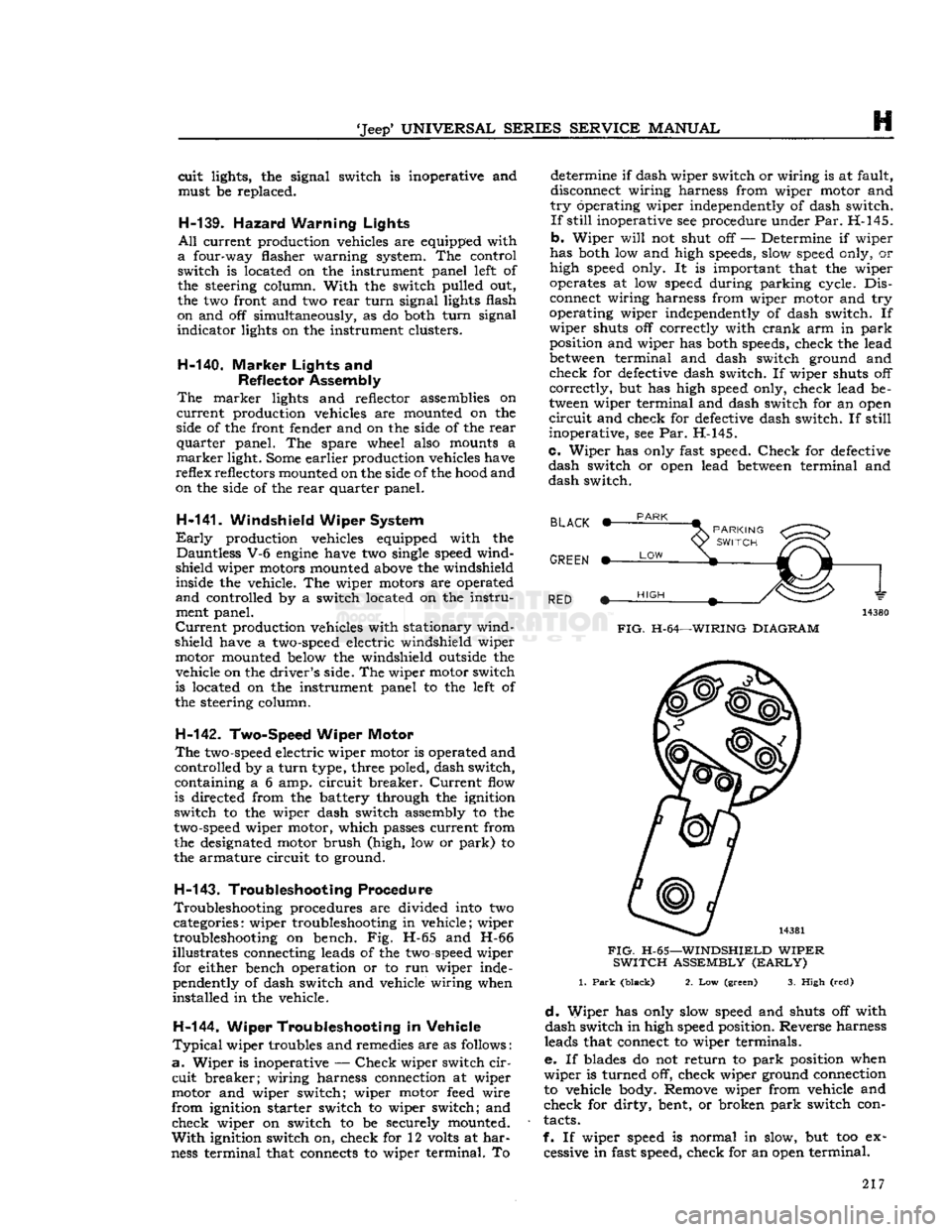
Fig. H-65 and H-66
illustrates connecting leads
of the
two-speed
wiper for either bench operation
or to run
wiper inde
pendently
of
dash switch and vehicle wiring when
installed
in the
vehicle.
H-144. Wiper Troubleshooting
in
Vehicle
Typical
wiper troubles and remedies are
as
follows
:
a.
Wiper
is
inoperative
—
Check
wiper switch
cir
cuit
breaker; wiring harness connection
at
wiper
motor
and
wiper switch; wiper motor
feed
wire
from
ignition starter switch
to
wiper switch;
and
check wiper
on
switch
to be
securely mounted.
With
ignition switch
on,
check
for 12
volts
at
har
ness
terminal that connects
to
wiper terminal.
To
BLACK
PARK
GREEN *-
RED m~
LOW
PARKING
<^^>
SWITCH
V^-O*'
HIGH
FIG.
H-64—WIRING
DIAGRAM
FIG.
H-65—WINDSHIELD
WIPER
SWITCH
ASSEMBLY
(EARLY)
1.
Park
(black)
2. Low (green)
3.
High (red)
d.
Wiper
has
only slow speed
and
shuts
off
with
dash switch in high speed position. Reverse harness
leads that connect
to
wiper terminals.
e. If
blades
do not
return
to
park
position when
wiper
is
turned
off,
check wiper ground connection
to vehicle body. Remove wiper from vehicle
and
check
for
dirty, bent,
or
broken
park
switch con
tacts.
f.
If
wiper speed
is
normal
in
slow,
but too ex
cessive
in
fast speed, check for an open terminal. 217
Page 219 of 376
'Jeep'
UNIVERSAL
SERIES SERVICE
MANUAL
H
a
0"—®
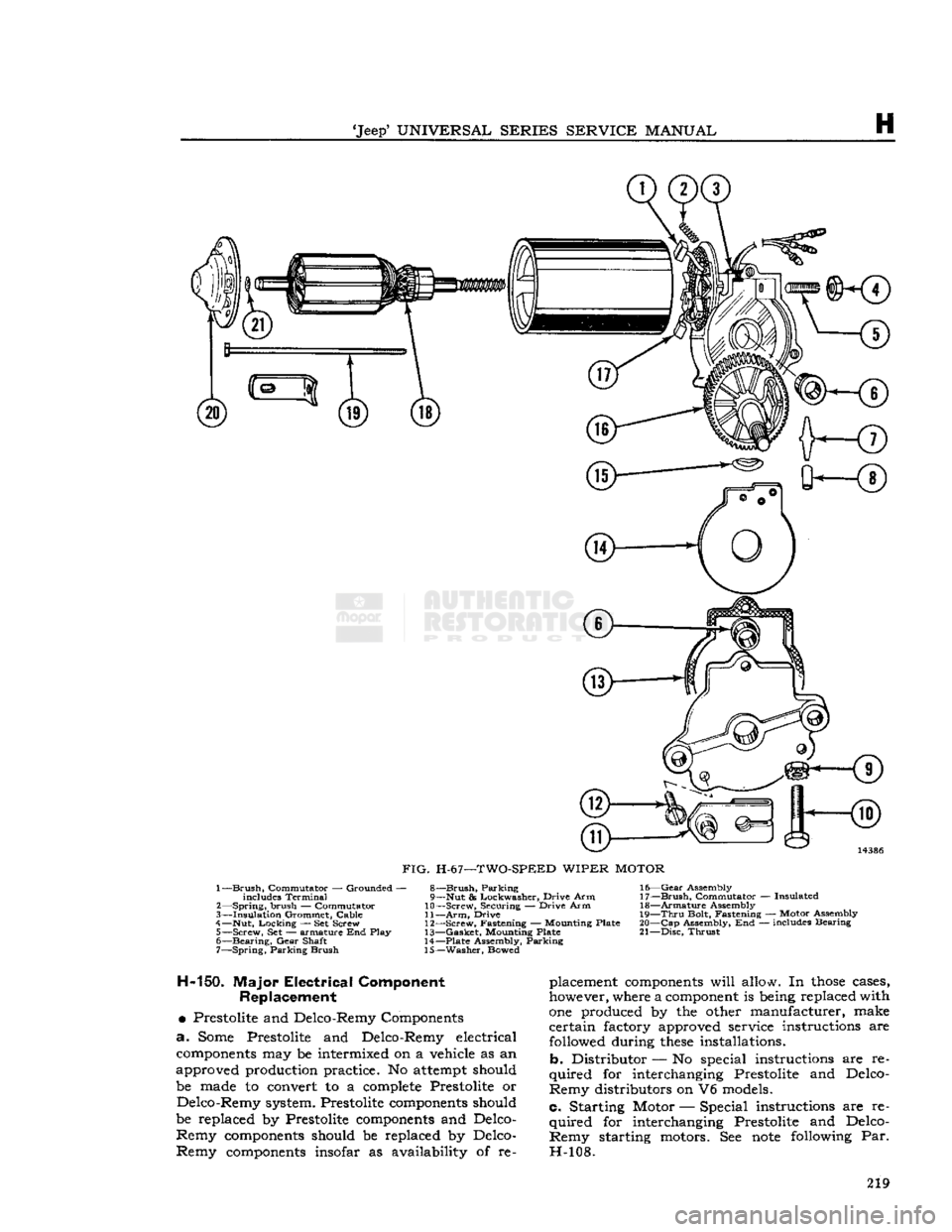
FIG.
H-67—-TWO-SPEED
WIPER
MOTOR
1—
Brush,
Commutator — Grounded - includes Terminal
2—
Spring,
brush — Commutator
3—
Insulation
Grommet, Cable
4—
Nut,
Locking
— Set Screw
5— Screw, Set — armature End Play
6—
Bearing,
Gear
Shaft
7—
Spring,
Parking Brush 8—
Brush,
Parking
9—
Nut
& Lockwasher,
Drive
Arm
10—
Screw, Securing —
Drive
Arm
11—
Arm,
Drive
12—
Screw, Fastening — Mounting
Plate
13—
Gasket,
Mounting
Plate
14—
Plate
Assembly, Parking
15—
Washer, Bowed
16—
Gear
Assembly
17—
Brush,
Commutator — Insulated
18—
Armature
Assembly
19—
Thru
Bolt,
Fastening — Motor Assembly
20—
Cap Assembly, End — includes Bearing
21—
Disc,
Thrust H-150. Major
Electrical
Component
Replacement
•
Prestolite and Delco-Remy Components
a.
Some
Prestolite and Delco-Remy electrical
components may be intermixed on a vehicle as an
approved production practice. No attempt should
be
made
to convert to a complete Prestolite or Delco-Remy system. Prestolite components should
be replaced by Prestolite components and Delco- Remy components should be replaced by Delco-
Remy components insofar as
availability
of re placement components
will
allow.
In
those
cases,
however, where a component is being replaced
with
one produced by the other manufacturer, make
certain factory approved service instructions are
followed
during
these
installations.
b. Distributor — No special instructions are re
quired
for interchanging Prestolite and Delco-
Remy distributors on V6 models.
c. Starting Motor — Special instructions are re
quired
for interchanging Prestolite and Delco-
Remy starting motors. See note
following
Par.
H-108. 219
Page 230 of 376
CLUTCH
is deeply scored or grooved, the part should be
replaced.
b. Inspect driven plate for wear or damage to fac
ings,
loose
rivets, broken or
loose
torsion springs,
and
flattened cushion springs. If facings are worn
near
rivets or are oily, replace the plate assembly.
A
slight amount of oil on clutch facings
will
cause
clutch
grab and chatter; excessive oil on facings
will
cause slippage. It is not practical to remove
oil
with solvents or by buffing since oil
will
con
tinue to bleed from facing material when hot. If
oil
is found on driven plate facings, examine trans
mission drainback hole, pilot bushing,
engine
rear
main
bearing and other points of possible oil leakage. Test the fit of driven plate hub on trans
mission main drive gear for an easy sliding fit.
c. Inspect clutch release bearing for scoring or ex cessive wear on front contact face. Test for rough
ness
of balls and races by pressing and turning
front race slowly. Inspect main drive gear pilot
bushing in crankshaft. Replace bushing if it is rough or worn. Regardless of whether the old plate
or
a new plate is to be installed, check the plate
for runout. Slide the driven plate, front side first,
over the transmission main drive gear shaft so that
it
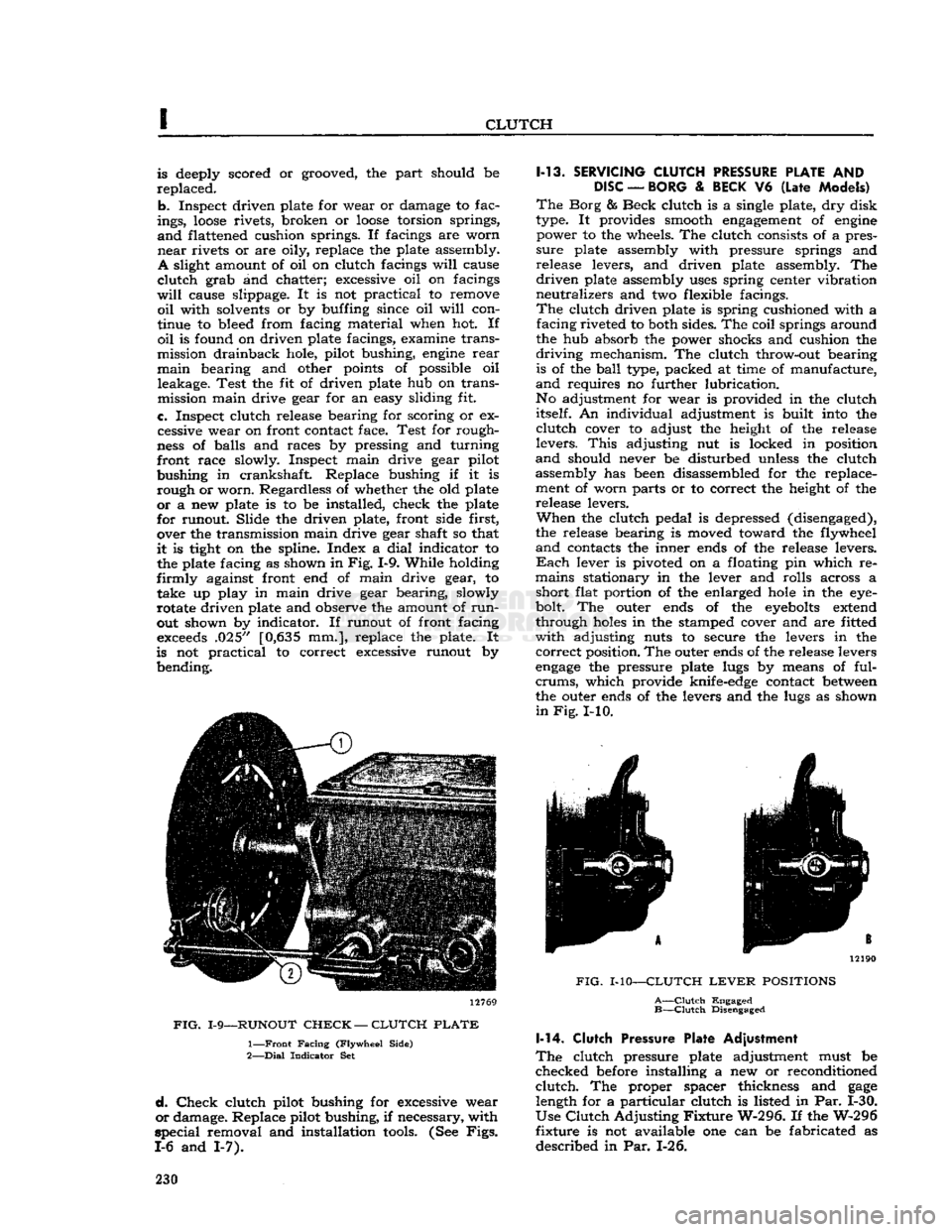
is tight on the spline. Index a
dial
indicator to the plate facing as shown in
Fig.
1-9. While holding
firmly
against front end of main drive gear, to take up play in main drive gear bearing, slowly
rotate driven plate and observe the amount of
run
out shown by indicator. If runout of front facing
exceeds
.025" [0,635 mm.], replace the plate. It
is not practical to correct excessive runout by bending. 12769
FIG.
1-9—RUNOUT
CHECK
—
CLUTCH
PLATE
1—
Front
Facing
(Flywheel
Side)
2—
Dial
Indicator
Set
d.
Check
clutch pilot bushing for excessive wear
or
damage. Replace pilot bushing, if necessary, with
special
removal and installation
tools.
(See
Figs.
1-6 and 1-7). 1-13.
SERVICING
CLUTCH
PRESSURE
PLATE
AND
DISC
—
BORG
&
BECK
V6
(Late
Models)
The
Borg & Beck clutch is a single plate, dry disk
type. It provides smooth
engagement
of
engine
power to the wheels. The clutch consists of a pres
sure
plate assembly with pressure springs and
release levers, and driven plate assembly. The
driven
plate assembly
uses
spring center vibration
neutralizes and two flexible facings.
The
clutch driven plate is spring cushioned with a facing riveted to both sides. The coil springs around
the hub absorb the power shocks and cushion the
driving
mechanism. The clutch throw-out bearing is of the
ball
type, packed at time of manufacture,
and
requires no further lubrication.
No adjustment for wear is provided in the clutch itself. An individual adjustment is built into the
clutch
cover to adjust the height of the release
levers.
This
adjusting nut is locked in position
and
should never be disturbed unless the clutch assembly has been disassembled for the replace
ment of worn parts or to correct the height of the release levers.
When
the clutch pedal is depressed (disengaged),
the release bearing is moved toward the flywheel
and
contacts the inner ends of the release levers.
Each
lever is pivoted on a floating pin which re
mains stationary in the lever and rolls across a short flat portion of the enlarged
hole
in the eye-
bolt. The outer ends of the
eyebolts
extend
through
holes
in the stamped cover and are fitted
with
adjusting nuts to secure the levers in the
correct
position. The outer ends of the release levers
engage
the pressure plate lugs by means of ful-
crums,
which provide knife-edge contact
between
the outer ends of the levers and the lugs as shown
in
Fig.
I-10. 12190
FIG.
MO—CLUTCH
LEVER
POSITIONS
A—Clutch
Engaged
B—Clutch
Disengaged 1-14.
Clutch
Pressure Plate Adjustment
The
clutch pressure plate adjustment must be
checked before installing a new or reconditioned
clutch.
The proper spacer thickness and
gage
length for a particular clutch is listed in Par. 1-30.
Use
Clutch
Adjusting
Fixture
W-296. If the W-296
fixture is not available one can be fabricated as
described in Par. 1-26. 230
Page 242 of 376
THREE-SPEED
TRANSMISSION
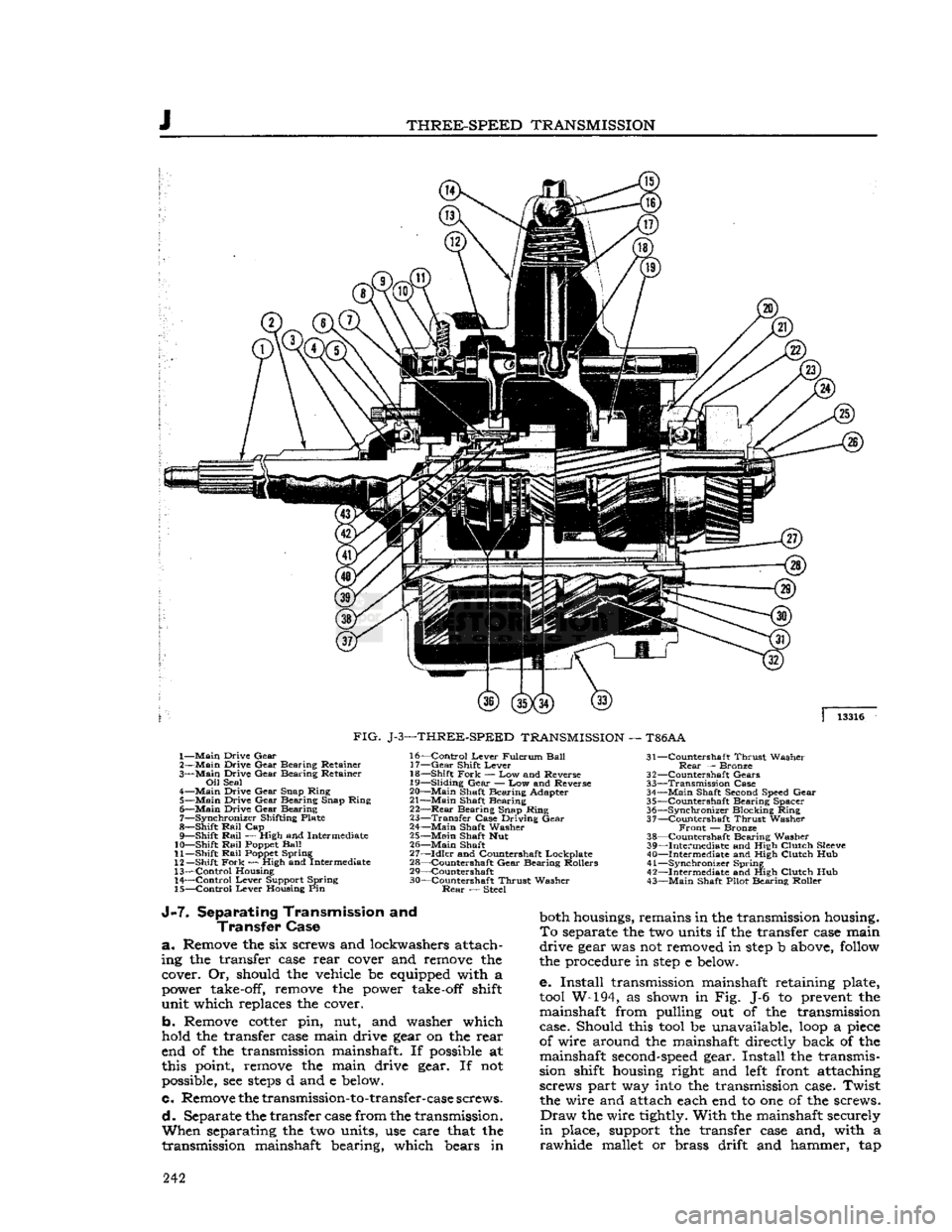
FIG.
J-3—THREE-SPEED
TRANSMISSION
—
T86AA
1—
Main
Drive
Gear
2—
Main
Drive
Gear
Bearing Retainer
3—
Main
Drive
Gear
Bearing Retainer
Oil
Seal
4—
Main
Drive
Gear
Snap Ring
5—
Main
Drive
Gear
Bearing Snap Ring
6—
Main
Drive
Gear
Bearing 7— Synchronizer Shifting Plate
8— Shift
Rail
Cap
9— Shift
Rail
— High and Intermediate
10— Shift
Rail
Poppet
Ball
11— Shift
Rail
Poppet
Spring
12— Shift
Fork
— High and Intermediate
13—
Control
Housing 14—
Control
Lever Support Spring
15—
Control
Lever Housing Pin 16—
Control
Lever
Fulcrum
Ball
17—
Gear
Shift Lever
18— Shift
Fork
— Low and Reverse
19— Sliding
Gear
— Low and Reverse
20—
Main
Shaft Bearing Adapter 21—
Main
Shaft Bearing
22—
Rear
Bearing Snap Ring
23—
Transfer
Case Driving
Gear
24—
Main
Shaft Washer
25—Main Shaft Nut
26—
Main
Shaft
27—
Idler
and Countershaft Lockplate
28— Countershaft
Gear
Bearing Rollers
29— Countershaft
30— Countershaft Thrust Washer
Rear
— Steel 31— Countershaft Thrust Washer
Rear
— Bronze
32— Countershaft Gears
33—
Transmission
Case
34—
Main
Shaft Second Speed
Gear
35— Countershaft Bearing Spacer
36— Synchronizer Blocking Ring 37— Countershaft Thrust Washer
Front
— Bronze
38— Countershaft Bearing Washer
39— Intermediate and High Clutch
Sleeve
40— Intermediate and High Clutch Hub
41
—Synchronizer Spring
42— Intermediate and High Clutch Hub
43—
Main
Shaft Pilot Bearing Roller J-7.
Separating Transmission
and
Transfer Case
a.
Remove the six screws and lockwashers attach
ing the transfer case rear cover and remove the cover. Or, should the vehicle be equipped with a
power
take-off,
remove the power take-off shift
unit which replaces the cover.
b. Remove
cotter
pin, nut, and washer which
hold the transfer case main drive gear on the rear
end of the transmission mainshaft. If
possible
at
this point, remove the main drive gear. If not possible, see
steps
d and e
below.
c. Remove the transmission-to-transfer-case screws.
d.
Separate the transfer case from the transmission.
When separating the two units, use care that the
transmission mainshaft bearing, which bears in
both
housings, remains in the transmission housing.
To
separate the two units if the transfer case main
drive gear was not removed in
step
b
above,
follow
the procedure in
step
e
below.
e.
Install transmission mainshaft retaining plate,
tool
W-194, as shown in Fig. J-6 to prevent the mainshaft from pulling out of the transmission
case. Should this
tool
be unavailable,
loop
a
piece
of wire around the mainshaft directly back of the mainshaft
second-speed
gear. Install the transmis
sion shift housing right and
left
front attaching
screws part way
into
the transmission case. Twist
the wire and attach each end to one of the screws.
Draw
the wire tightly. With the mainshaft securely
in
place, support the transfer case and, with a rawhide mallet or brass drift and hammer, tap 242
Page 250 of 376
THREE-SPEED
TRANSMISSION
14271
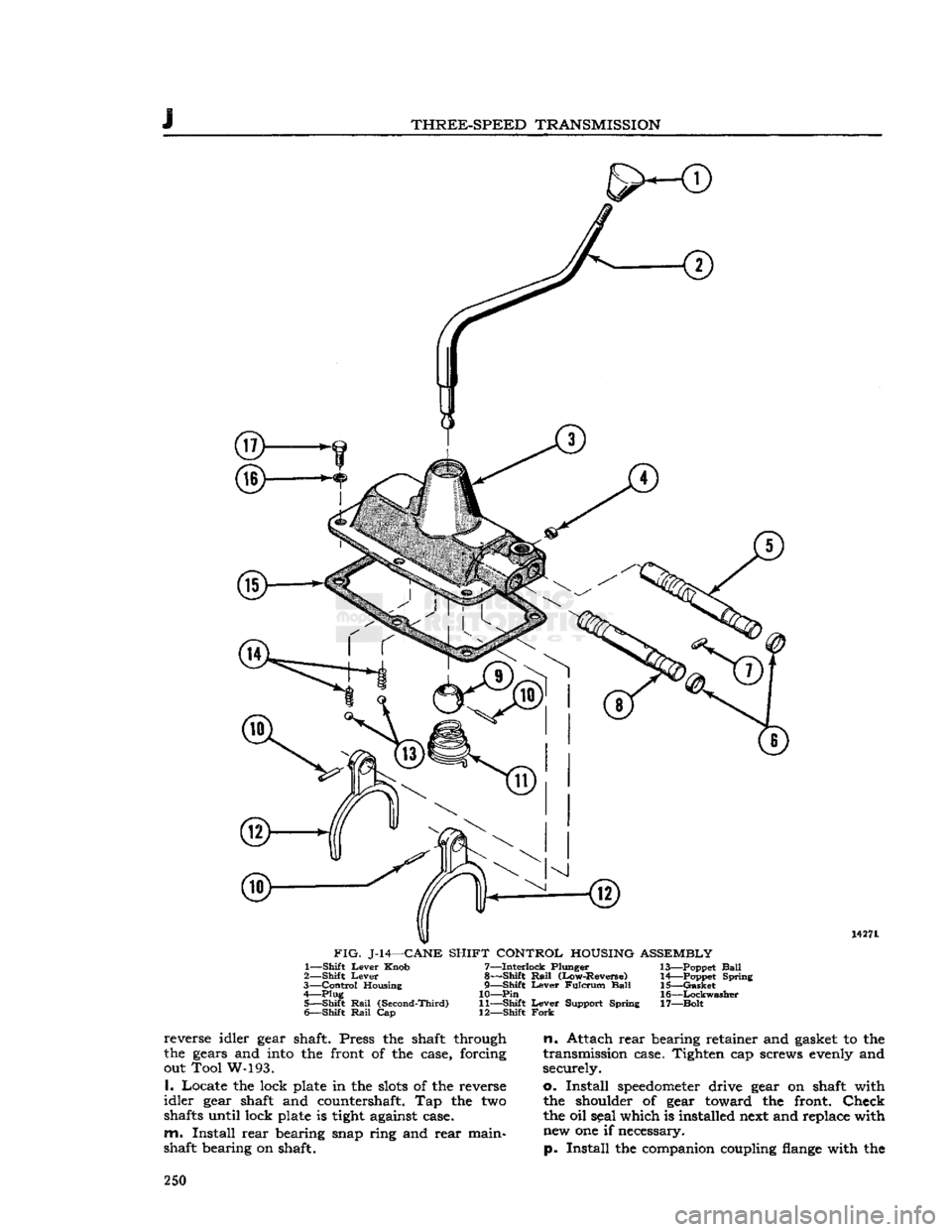
FIG.
J-14—-CANE
SHIFT
CONTROL
HOUSING
ASSEMBLY
1—
Shift
Lever
Knob
2—
Shift
Lever
3—
Control
Housing
4—
Plug
5—
Shift
Rail
(Second-Third) 6—
Shift
Rail
Cap 7—
Interlock
Plunger
8—
Shift
Rail
(Low-Reverse)
9—
Shift
Lever
Fulcrum
Ball
10—
-Pin
11—
Shift
Lever
Support Spring
12—
Shift
Fork
13— Poppet
Ball
14— Poppet Spring
15—
Gasket
16—
Lockwasher
17—Bolt reverse idler gear shaft. Press the shaft through
the gears and
into
the front of the case, forcing out Tool W-193.
I.
Locate the lock plate in the
slots
of the reverse
idler
gear shaft and countershaft. Tap the two
shafts until lock plate is
tight
against case, m. Install rear bearing snap ring and rear main-
shaft bearing on shaft.
n.
Attach rear bearing retainer and gasket to the
transmission case. Tighten cap screws evenly and
securely.
Install
speedometer
drive gear on shaft with
o.
the shoulder of gear toward the front. Check
the oil seal which is installed next and replace with
new one if necessary.
p.
Install the companion coupling
flange
with the 250
Page 251 of 376
'Jeep'
UNIVERSAL
SERIES
SERVICE
MANUAL
J
flat washer, lock washer and nut.
q.
Check
the
complete
transmission for operation.
r.
Install
transmission case cover.
J-15.
T14A
TRANSMISSION
The
T14A is a three
speed
fully synchronized (all
forward
gears) transmission with helical drive gears
throughout.
The
main drive gear is supported by a
ball
bearing at the front end of the transmission case and is
piloted at its front end in an oil impregnated bush
ing mounted in the crankshaft.
The
front end of the mainshaft is piloted in a row
of
roller
bearings set
into
the hollow end of the main
drive
gear and the
rear
end is
carried
by a
ball
bearing
mounted in the
rear
transmission case.
The
counter gear is
carried
on a single row of
rollers
at both ends. The reverse idler gear is
carried
on a single row of rollers in the center.
Thrust
is
taken
on thrust washers located
between
the
ends
of the counter and reverse idler gear and the thrust
bosses
in the case.
The
three forward gears (low, second, third) are
fully
synchronized. The synchronizer assemblies
consist of
clutch
hubs, clutch
sleeves,
clutch springs,
and
three synchronizer plates and are retained on
the mainshaft by a
select
fit snap
ring.
The
shift is manual through a cane shift lever and
interlock
assembly to the
rearward
shift fork
operating low and reverse gear and to the forward
shift fork operating second and
third
gear.
J-16.
TRANSMISSION
DISASSEMBLY
—
T14A
Refer
to Fig. J-13.
a.
If the transfer case is attached, separate it from
the transmission by removing the five capscrews
and
lockwashers.
b.
Remove cane shift housing cover and gasket
from
top of transmission case. The shift housing
cover can be disassembled if necessary, at this
point, by removing the shift
rails,
poppet
balls,
springs,
and shift forks. Refer to Fig. J-14.
c.
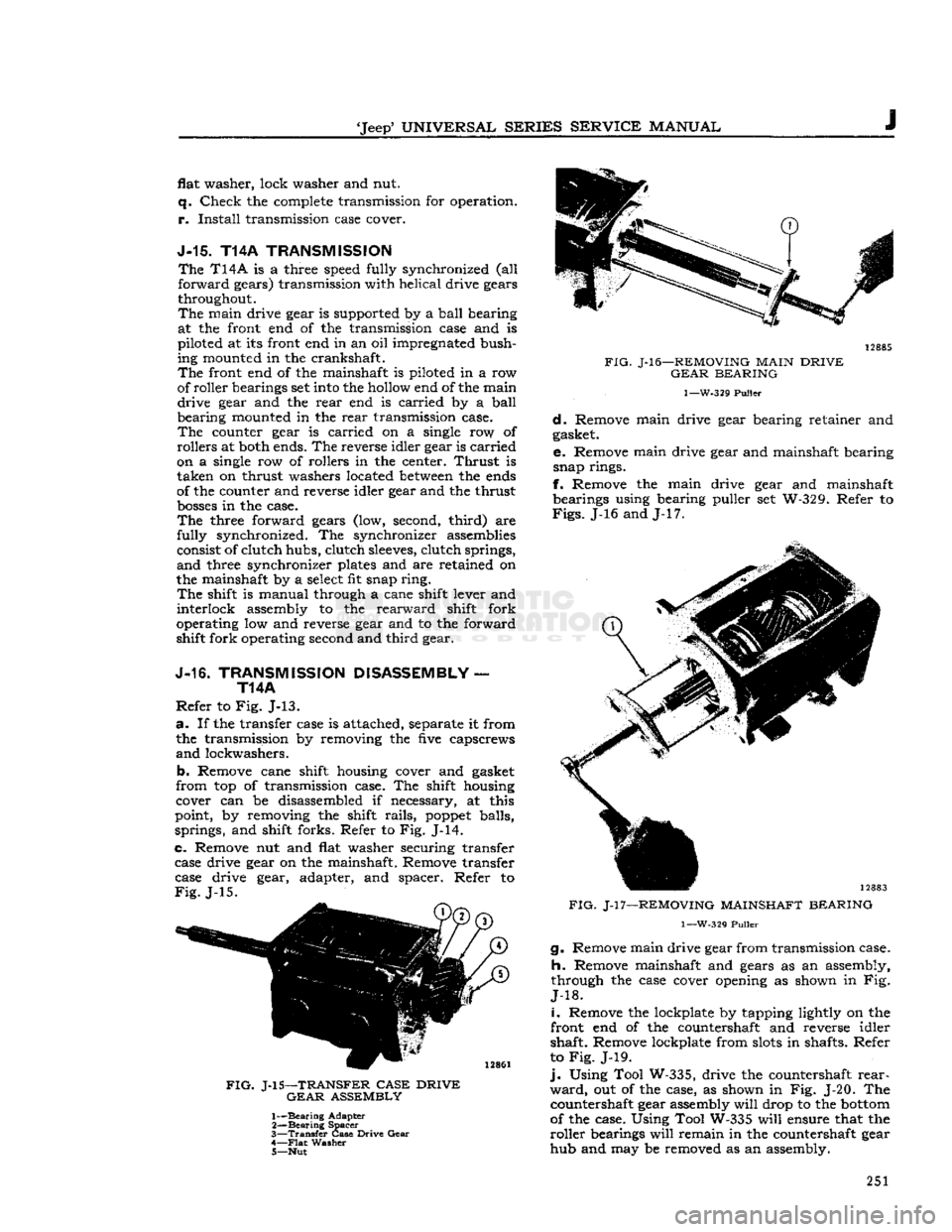
Remove nut and flat washer securing transfer case drive gear on the mainshaft. Remove transfer case drive gear, adapter, and spacer. Refer to
Fig.
J-15.
FIG.
J-15—TRANSFER
CASE
DRIVE
GEAR
ASSEMBLY
1—
Bearing
Adapter
2—
Bearing
Spacer
3—
Transfer
Case
Drive
Gear
4—
Flat
Washer 5— Nut
12885
FIG.
J-16—REMOVING
MAIN
DRIVE
GEAR
BEARING
1—W-329 Puller
d.
Remove main drive gear bearing retainer and
gasket. e. Remove main drive gear and mainshaft bearing snap rings.
f. Remove the main drive gear and mainshaft
bearings using bearing puller set W-329. Refer to
Figs.
J-16 and J-l7.
FIG.
J-17—REMOVING
MAINSHAFT
BEARING
1—W-329
Puller g. Remove main drive gear from transmission case.
h.
Remove mainshaft and gears as an assembly,
through the case cover opening as shown in Fig.
J-18.
i.
Remove the lockplate by tapping lightly on the
front end of the countershaft and reverse idler
shaft. Remove lockplate from
slots
in shafts. Refer
to
Fig.
J-19.
j.
Using Tool W-335, drive the countershaft
rear
ward,
out of the case, as shown in Fig. J-20. The countershaft gear assembly
will
drop to the
bottom
of the case. Using Tool W-335
will
ensure that the
roller
bearings
will
remain in the countershaft gear
hub and may be removed as an assembly. 251
Page 263 of 376
![JEEP CJ 1953 Repair Manual
Jeep*
UNIVERSAL
SERIES
SERVICE
MANUAL
Jl
necessity for assembly, one should be made at this
time to assist on disassembly. One can be made by
using a \Y%N [2,86 cm.] diameter steel rod cut](/img/16/57040/w960_57040-262.png "JEEP CJ 1953 Repair Manual
Jeep*
UNIVERSAL
SERIES
SERVICE
MANUAL
Jl
necessity for assembly, one should be made at this
time to assist on disassembly. One can be made by
using a \Y%N [2,86 cm.] diameter steel rod cut")
'Jeep*
UNIVERSAL
SERIES
SERVICE
MANUAL
Jl
necessity for assembly, one should be made at this
time to assist on disassembly. One can be made by
using a \Y%N [2,86 cm.] diameter steel rod cut to
9.850*
{25,02
cm.] long.
Break
sharp
edges
with a
mill
file.) Keep the dummy shaft in contact with
the countershaft at all times to prevent dropping
the bearing rollers or thrust washers,
z.
With
the dummy shaft in position, place the
transmission
case on its side and carefully
roll
the countershaft gear cluster out of the case,
aa.
Complete the disassembly by removing the dummy shaft, thrust washers, four
sets
of bearing
rollers,
and spacers.
bb.
To disassemble the reverse idler gear assembly,
remove one of the snap rings and tap out the
washers,
both
sets
of bearing rollers, center spacer,
and
sleeve.
Remove the remaining snap
ring.
J1-4.
4-Speed
Transmission
Control
Housing
Disassembly
•
Refer to Fig. Jl-5.
The
gearshift lever, spring, and spring seat were previously removed for removal of the transmission
from
the vehicle.
a.
Remove the lock pins from the gearshift forks
and
gearshift rod ends. Remove the expansion plugs
from
the front and
rear
of the gearshift lever base. Remove back-up light switch.
b.
Remove the center (third and high) gearshift
rod
first. Drive this gearshift rod out the
rear
of the gearshift lever base. As the gearshift rod is
withdrawn
from the center section of the gearshift base, remove the interlock pin from the cross
over
hole
in the gearshift rod. Before the gearshift
rod
is removed from the center section of the gear
shift base, place a finger over the
hole
to prevent
loss
of the
ball
and spring.
Then
remove the rod.
c»
Remove the low- and second-speed gearshift rod
in
the same manner.
d.
Remove the gearshift rod lock balls and springs
and.
with a piece of
wire,
push the two gearshift rod
interlock
plungers out of the pockets in the center
section of the gearshift base.
In
the reverse gearshift rod end is a spring-loaded
plunger which prevents the
driver
from accidentally
shifting into reverse gear. Should this part require
servicing,
proceed as follows:
Remove the cotter key from the rod end assembly
and
at the same time hold a finger over the
hole
to prevent
loss
of the spring.
Then
shake out the
spring
and
ball.
Compress the plunger and spring
until
the C-washer
groove
just clears the end of
the casting. Remove the C-washer.
J1-5.
4-speed
Transmission Reassembly •
Refer to Fig. Jl-1.
Assemble the unit in the reverse order of dis
assembly noting the following points:
a.
Assemble the countershaft assembly with the
fabricated
dummy shaft. The bronze front thrust
washer
and the steel backed bronze
rear
thrust
washer
should be coated with stiff lubricant and
installed
with the lugs
engaged
in the notches
in
the end of the gear cluster. Place the assembly
in
the transmission case and install the counter
shaft from the
rear,
keeping the countershaft and
dummy shaft in contact to prevent dropping
bearing
rollers or washers. Tap the countershaft
lightly into position in the front of the case but
do not seat it until the reverse idler gear assembly
and
shaft have been installed in the case.
b.
Install
the reverse idler gear shaft in the case
until
the lock plate slot is adjacent to the slot in
the countershaft. Insert the lock plate in the
slots
of the shafts making sure the plate ends are square
with
the slots.
Install
the lock plate screw and
lockwasher
to act as a pilot while tapping the
shafts alternately into position in the case. Tighten
the lock plate screw securely.
c.
Begin assembly of the second speed synchronizer assembly (see
Fig.
Jl-6) by installing the low-and
-
second-speed clutch hub in the low-and-second-
speed gear.
Install
the retaining ring in the speed gear.
Install
the retaining ring in the low and
FIG.
Jl
-6—ASSEMBLING
SECOND-SPEED
SYNCHRONIZER
1—
Low
and Second
Clutch
Gear
2—
Ball
3—
Low
and Second
Clutch
Hub
4—
Shifting
Plate
second speed gear. Slide the hub out of the gear
in
the direction
opposite
the shift fork
groove
until
the
holes
in the hub are clear of the gear.
Install
the shifter plates and springs. Push the
hub back into the gear until the springs touch the
internal
teeth
of the gear. Push one of the shifter
plates toward the center of the gear while installing
ball.
See
Fig.
Jl-6 .
This
will
hold the
ball
in position.
Install
the other two balls in the same manner.
Be
careful when rotating the assembly to prevent the hub from slipping out of the gear. When the
balls
are installed, push the hub into the gear
until
the balls snap into the neutral position.
d.
Assemble the
direct
-
and
-
third
synchronizer as
sembly in accordance with the instructions given
in
Section J, Par.
J-lle.
e.
Start
assembly of the mainshaft assembly by 263
Page 265 of 376
'Jeep'
UNIVERSAL SERIES SERVICE
MANUAL
Jl
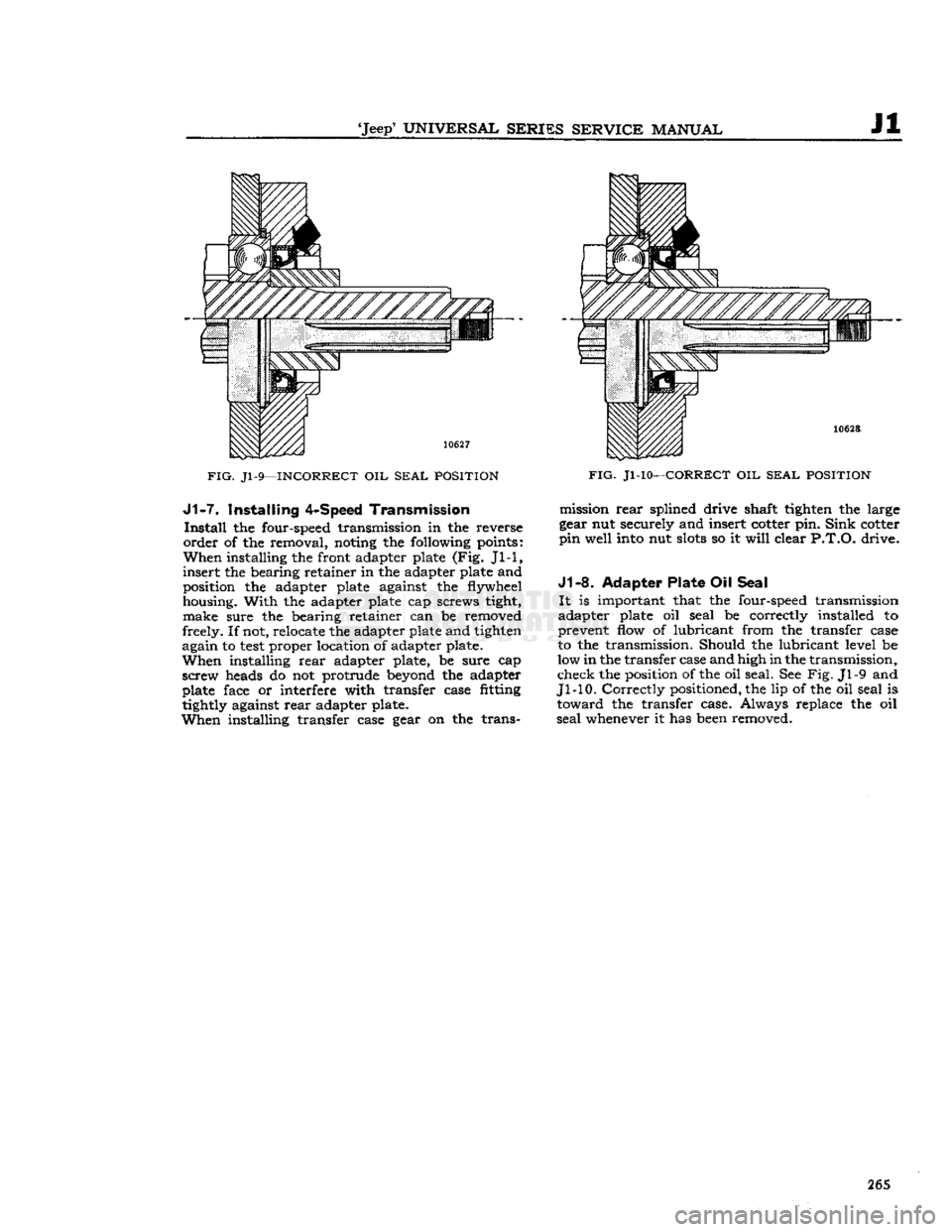
FIG.
Jl-9—INCORRECT
OIL
SEAL POSITION J1-7.
Installing
4-Speed
Transmission
Install
the four-speed transmission in the reverse
order
of the removal, noting the following points:
When
installing the front adapter plate (Fig. Jl-1,
insert
the bearing retainer in the adapter plate and
position the adapter plate against the flywheel
housing.
With
the adapter plate cap screws tight, make sure the bearing retainer can be removed
freely. If not, relocate the adapter plate and tighten
again to
test
proper location of adapter plate.
When
installing
rear
adapter plate, be sure cap
screw heads do not protrude beyond the adapter
plate face or interfere with transfer case fitting
tightly against
rear
adapter plate.
When
installing transfer case gear on the trans-
FIG.
Jl-10—CORRECT
OIL
SEAL POSITION
mission
rear
splined drive shaft tighten the large
gear nut securely and insert cotter pin.
Sink
cotter
pin
well into nut
slots
so it
will
clear
P.T.O.
drive.
J1-8.
Adapter Plate
Oil
Seal
It
is important that the four-speed transmission
adapter plate oil seal be correctly installed to
prevent flow of lubricant from the transfer case
to the transmission. Should the lubricant level be
low in the transfer case and high in the transmission,
check the position of the oil seal. See Fig. Jl-9 and
Jl-10.
Correctly
positioned, the lip of the oil seal is
toward
the transfer case. Always replace the oil
seal
whenever it has been removed. 265
Page 279 of 376
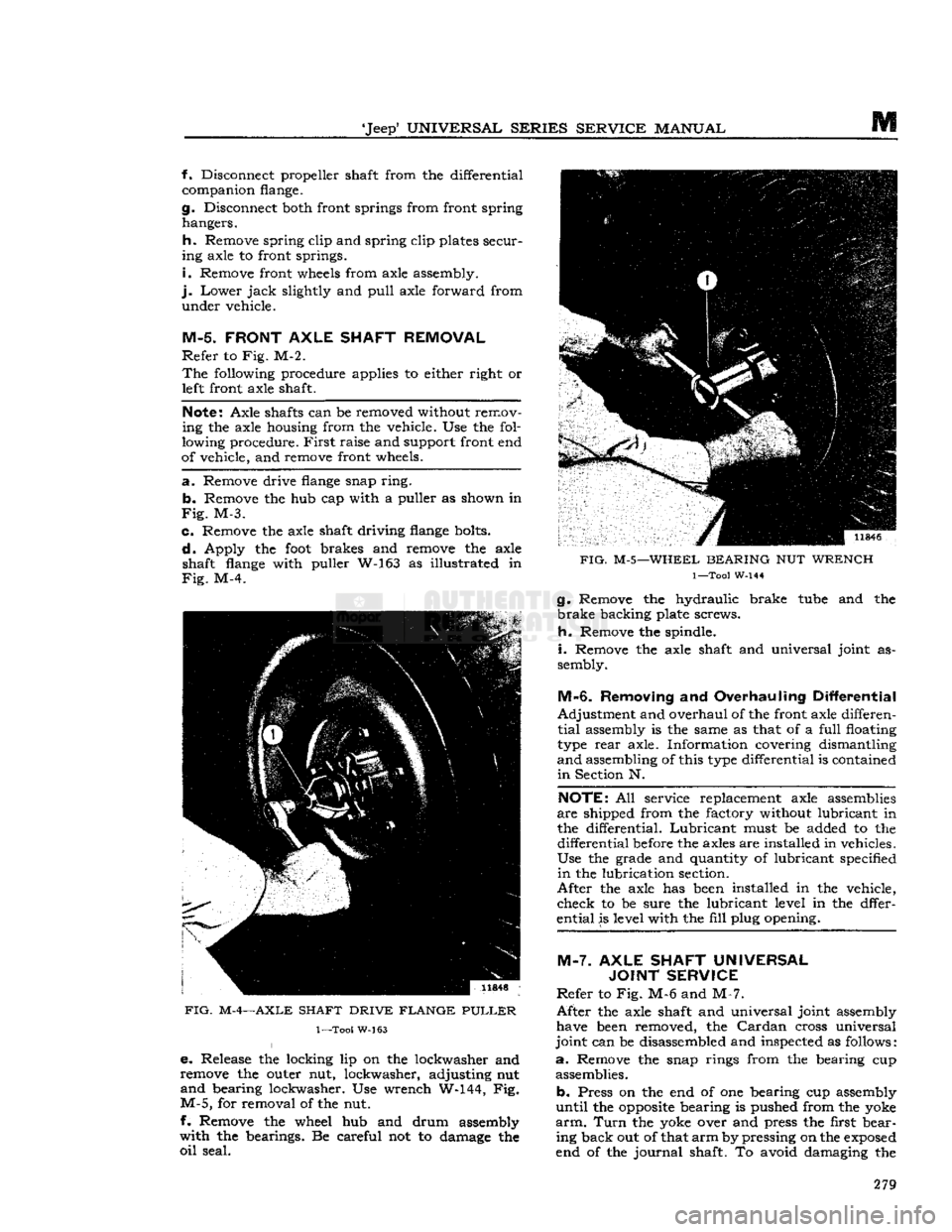
'Jeep*
UNIVERSAL
SERIES
SERVICE
MANUAL
m f. Disconnect propeller shaft from the differential
companion flange.
g.
Disconnect both front springs from front spring hangers.
h.
Remove spring clip and spring clip plates secur
ing axle to front springs.
i.
Remove front
wheels
from axle assembly.
j.
Lower
jack
slightly and
pull
axle forward from
under
vehicle.
M-5.
FRONT AXLE SHAFT REMOVAL
Refer
to Fig. M-2.
The
following procedure applies to either right or
left
front axle shaft.
Note:
Axle shafts can be removed without remov
ing the axle housing from the vehicle. Use the fol
lowing procedure.
First
raise and support front end
of vehicle, and remove front wheels.
a.
Remove drive
flange
snap
ring.
b-
Remove the hub cap with a puller as shown in
Fig.
M-3.
c.
Remove the axle shaft driving
flange
bolts.
d.
Apply the
foot
brakes and remove the axle shaft
flange
with puller W-163 as illustrated in
Fig.
M-4.
FIG.
M-4—AXLE
SHAFT
DRIVE
FLANGE
PULLER
1—Too!
W-163
e.
Release the locking lip on the lockwasher and
remove the outer nut, lockwasher, adjusting nut
and
bearing lockwasher. Use wrench W-144, Fig.
M-5,
for removal of the nut.
f- Remove the wheel hub and drum assembly
with
the bearings. Be careful not to damage the
oil
seal.
FIG.
M-5—WHEEL
BEARING
NUT
WRENCH
1—Tool
W-144
g.
Remove the hydraulic brake
tube
and the
brake
backing plate screws.
h.
Remove the spindle.
i.
Remove the axle shaft and universal joint as
sembly.
M-6.
Removing
and
Overhauling Differential
Adjustment
and overhaul of the front axle differen
tial
assembly is the same as that of a
full
floating
type
rear
axle. Information covering dismantling
and
assembling of this
type
differential is contained
in
Section N.
NOTE:
All service replacement axle assemblies
are
shipped from the factory without lubricant in
the differential.
Lubricant
must be added to the
differential
before
the axles are installed in vehicles.
Use
the grade and quantity of lubricant specified
in
the lubrication section.
After
the axle has
been
installed in the vehicle,
check
to be sure the lubricant level in the dffer-
ential
is level with the
fill
plug opening.
M-7.
AXLE SHAFT UNIVERSAL JOINT SERVICE
Refer
to Fig. M-6 and M-7.
After
the axle shaft and universal joint assembly have
been
removed, the
Cardan
cross universal
joint
can be disassembled and inspected as follows:
a.
Remove the snap rings from the bearing cup assemblies.
b.
Press on the end of one bearing cup assembly
until
the
opposite
bearing is pushed from the yoke
arm.
Turn
the yoke over and press the first bear ing back out of that
arm
by pressing on the
exposed
end of the
journal
shaft. To avoid damaging the 279