Wiper JEEP COMPASS 2020 Owner handbook (in English)
[x] Cancel search | Manufacturer: JEEP, Model Year: 2020, Model line: COMPASS, Model: JEEP COMPASS 2020Pages: 328, PDF Size: 8.85 MB
Page 9 of 328
7
WINDSHIELD WIPERS AND WASHERS ..... 34
Windshield Wiper Operation............. 35
Rain Sensing Wipers — If
Equipped ...................................... 35 Rear Window Wiper/Washer ............ 36
CLIMATE CONTROLS............................... 36
Automatic Climate Controls
Overview ........................................ 37 Automatic Temperature Control
(ATC) ........................................... 43 Operating Tips ............................... 44
WINDOWS ............................................ 45
Power Window Controls ................... 45
Auto-Down Feature ........................ 45
Auto-Up Feature With Anti-Pinch
Protection ..................................... 45 Window Lockout Switch .................. 46
Wind Buffeting .............................. 46
POWER SUNROOF WITH POWER SHADE — IF
EQUIPPED ............................................ 46
Opening Sunroof ............................ 47
Opening Sunroof — Vent ................. 47
Closing Sunroof .............................. 47
Opening Power Shade ..................... 47
Closing Power Shade....................... 48
Pinch Protect Feature ..................... 48
Sunroof Maintenance ...................... 48
Ignition Off Operation ..................... 48
HOOD ....................................................49
Opening The Hood ......................... 49
Closing The Hood ........................... 49
LIFTGATE...............................................50
Opening ........................................ 50
Closing .......................................... 50
Power Liftgate — If Equipped ......... 50
INTERNAL EQUIPMENT ........................... 52
Power Outlets ................................ 52
Power Inverter — If Equipped ......... 53
ROOF LUGGAGE RACK — IF EQUIPPED ....54
GETTING TO KNOW YOUR INSTRUMENT
PANEL
INSTRUMENT CLUSTER DISPLAY ............ 55
Instrument Cluster Display Location And
Controls ....................................... 55 Oil Change Indicator System — If
Equipped ...................................... 56 Gear Shift Indicator (GSI) — If
Equipped ...................................... 56 Instrument Cluster Display Menu
Items ........................................... 56 Diesel Displays .............................. 57
Fuel System Messages .................... 57
TRIP COMPUTER ...................................59 WARNING LIGHTS AND MESSAGES ..........59
Red Warning Lights .........................59
Yellow Warning Lights .....................62
Yellow Indicator Lights ....................66
Green Indicator Lights .....................68
White Indicator Lights .....................69
Blue Indicator Lights .......................70
Gray Indicator Lights .......................71
ONBOARD DIAGNOSTIC SYSTEM —
OBD II ...................................................71
Onboard Diagnostic System (OBD II)
Cybersecurity..................................71
SAFETY
SAFETY FEATURES .................................72
Anti-Lock Brake System (ABS) ........72
Electronic Brake Control System ......73
AUXILIARY DRIVING SYSTEMS ................80
Blind Spot Monitoring (BSM) — If
Equipped .......................................80 Forward Collision Warning (FCW) With
Mitigation — If Equipped ................84 Tire Pressure Monitoring System
(TPMS) .........................................86
2020_JEEP_M6_UG_UK.book Page 7
Page 12 of 328
10
DEALER SERVICE ................................ 227
Air Conditioner Maintenance.......... 227
Wiper Blades ............................... 228
Exhaust System ........................... 228
Cooling System ............................ 229
Brake System .............................. 230
Manual Transmission — If
Equipped ..................................... 231 Automatic Transmission ................ 231
RAISING THE VEHICLE .......................... 232TIRES ................................................. 232
Tires — General Information ......... 232
Tire Types .................................... 236
Spare Tires — If Equipped ............ 237
Tire Chains (Traction Devices) ....... 239
Tire Rotation Recommendations .... 239
STORING THE VEHICLE ......................... 240
BODYWORK ......................................... 241
Preserving The Bodywork ............... 241
INTERIORS ......................................... 242
Seats And Fabric Parts .................. 242
Plastic And Coated Parts ............... 243
Leather Parts ............................... 243
Glass Surfaces ............................ 243
TECHNICAL SPECIFICATIONS
IDENTIFICATION DATA .......................... 244
Vehicle Identification Number ....... 244
WHEEL AND TIRE TORQUE
SPECIFICATIONS ..................................244
Torque Specifications ................... 244
DIMENSIONS .......................................245
WHEELS ..............................................247
WEIGHTS ............................................249
FUEL REQUIREMENTS — GASOLINE
ENGINE ...............................................250
1.4L Turbo Gasoline Engine .......... 250
Ethanol ....................................... 250
Materials Added To Fuel ............... 250
Gasoline/Oxygenate Blends............ 250
Fuel Icon Identification Compliant To
EN16942 .................................... 251 Fuel System Cautions ................... 252
Carbon Monoxide Warnings ........... 252
FUEL REQUIREMENTS — DIESEL
ENGINE ..............................................252
Diesel Engine .............................. 252
Fuel Icon Identification Compliant To
EN16942 .................................... 253
FLUID CAPACITIES ..............................254 FLUIDS AND LUBRICANTS .....................255
Engine ........................................ 255
Chassis ...................................... 259
FUEL CONSUMPTION AND CO2
EMISSIONS ........................................260 MOPAR ACCESSORIES .........................260
Authentic Accessories By Mopar .... 260
MULTIMEDIA
UCONNECT SYSTEMS ...........................262
CYBERSECURITY .................................262
UCONNECT 3 WITH 5–INCH DISPLAY — IF
EQUIPPED............................................263
Uconnect 3 With 5–inch Display At A
Glance .........................................263 Clock Setting ...............................263
Audio Setting ...............................263
Radio Operation ...........................264
USB/Audio Jack (AUX)/Bluetooth®
Operation .....................................265 Voice Text Reply (Not Compatible With
iPhone®) ....................................266 Apps — If Equipped......................267
UCONNECT 4 WITH 7-INCH DISPLAY ....267
Uconnect 4 At A Glance ...............267
Drag & Drop Menu Bar .................268
Radio ..........................................269
Media Hub — USB/Audio Jack (AUX) —
If Equipped ..................................270 Android Auto™ — If Equipped .......271
Apple CarPlay® Integration — If
Equipped .....................................272 Apps — If Equipped......................273
2020_JEEP_M6_UG_UK.book Page 10
Page 36 of 328
GETTING TO KNOW YOUR VEHICLE
34
NOTE:
If either light remains on and does not
flash, or there is a very fast flash rate,
check for a defective outside light bulb. If
an indicator fails to light when the lever is
moved, it would suggest that the indicator
bulb is defective.
A “Turn Signal On” message will appear in
the instrument cluster display and a
continuous chime will sound if the vehicle
is driven more than 1 mile (1.6 km) witheither turn signal on.
When the Daytime Running Lights are on
and a turn signal is activated, the Daytime
Running Lamp will turn off on the side of
the vehicle in which the turn signal is
flashing. The Daytime Running Lamp will
turn back on when the turn signal is
turned off.
Headlight Leveling System — If Equipped
This system allows the driver to maintain
proper headlight beam position with the road
surface regardless of vehicle load.
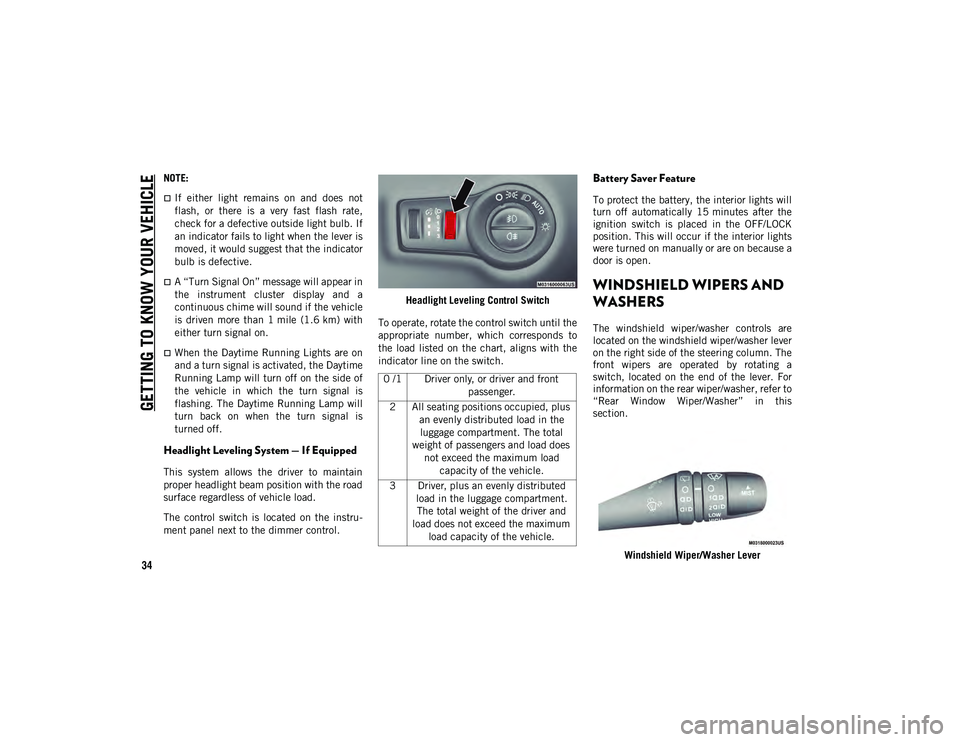
The control switch is located on the instru -
ment panel next to the dimmer control. Headlight Leveling Control Switch
To operate, rotate the control switch until the
appropriate number, which corresponds to
the load listed on the chart, aligns with the
indicator line on the switch.
Battery Saver Feature
To protect the battery, the interior lights will
turn off automatically 15 minutes after the
ignition switch is placed in the OFF/LOCK
position. This will occur if the interior lights
were turned on manually or are on because a
door is open.
WINDSHIELD WIPERS AND
WASHERS
The windshield wiper/washer controls are
located on the windshield wiper/washer lever
on the right side of the steering column. The
front wipers are operated by rotating a
switch, located on the end of the lever. For
information on the rear wiper/washer, refer to
“Rear Window Wiper/Washer” in this
section.
Windshield Wiper/Washer Lever
0 /1 Driver only, or driver and front
passenger.
2 All seating positions occupied, plus an evenly distributed load in the luggage compartment. The total
weight of passengers and load does not exceed the maximum load capacity of the vehicle.
3 Driver, plus an evenly distributed load in the luggage compartment. The total weight of the driver and
load does not exceed the maximum load capacity of the vehicle.
2020_JEEP_M6_UG_UK.book Page 34
Page 37 of 328
35
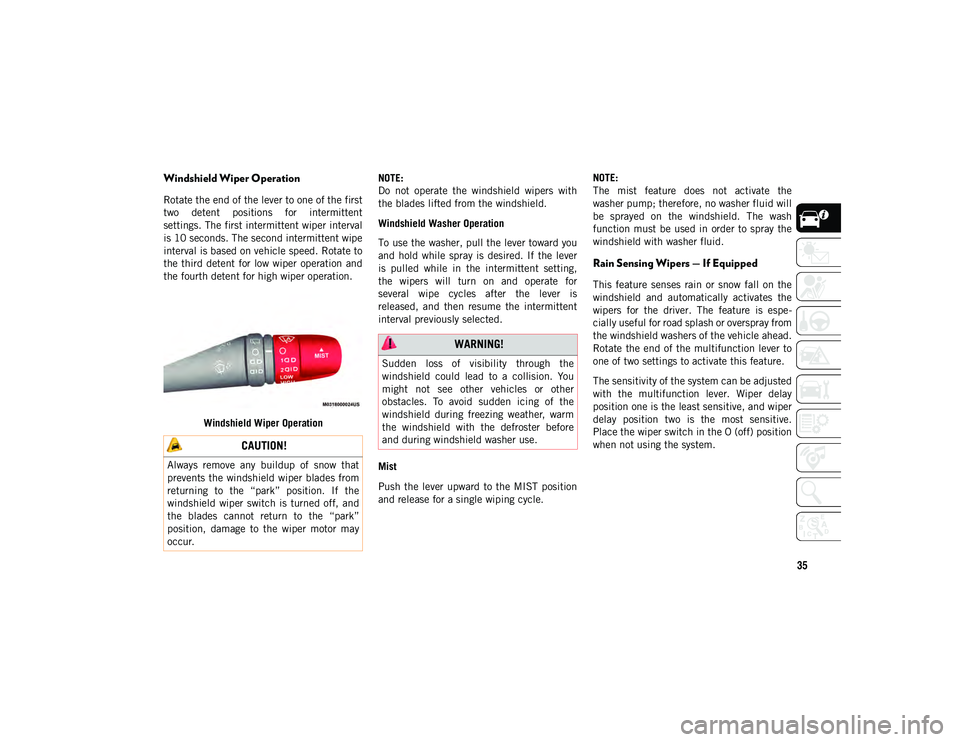
Windshield Wiper Operation
Rotate the end of the lever to one of the first
two detent positions for intermittent
settings. The first intermittent wiper interval
is 10 seconds. The second intermittent wipe
interval is based on vehicle speed. Rotate to
the third detent for low wiper operation and
the fourth detent for high wiper operation.Windshield Wiper Operation NOTE:
Do not operate the windshield wipers with
the blades lifted from the windshield.
Windshield Washer Operation
To use the washer, pull the lever toward you
and hold while spray is desired. If the lever
is pulled while in the intermittent setting,
the wipers will turn on and operate for
several wipe cycles after the lever is
released, and then resume the intermittent
interval previously selected.
Mist
Push the lever upward to the MIST position
and release for a single wiping cycle. NOTE:
The mist feature does not activate the
washer pump; therefore, no washer fluid will
be sprayed on the windshield. The wash
function must be used in order to spray the
windshield with washer fluid.
Rain Sensing Wipers — If Equipped
This feature senses rain or snow fall on the
windshield and automatically activates the
wipers for the driver. The feature is espe
-
cially useful for road splash or overspray from
the windshield washers of the vehicle ahead.
Rotate the end of the multifunction lever to
one of two settings to activate this feature.
The sensitivity of the system can be adjusted
with the multifunction lever. Wiper delay
position one is the least sensitive, and wiper
delay position two is the most sensitive.
Place the wiper switch in the O (off) position
when not using the system.
CAUTION!
Always remove any buildup of snow that
prevents the windshield wiper blades from
returning to the “park” position. If the
windshield wiper switch is turned off, and
the blades cannot return to the “park”
position, damage to the wiper motor may
occur.
WARNING!
Sudden loss of visibility through the
windshield could lead to a collision. You
might not see other vehicles or other
obstacles. To avoid sudden icing of the
windshield during freezing weather, warm
the windshield with the defroster before
and during windshield washer use.
2020_JEEP_M6_UG_UK.book Page 35
Page 38 of 328
GETTING TO KNOW YOUR VEHICLE
36
NOTE:
The Rain Sensing feature will not operate
when the wiper switch is in the low or
high-speed position.
The Rain Sensing feature may not func-
tion properly when ice, or dried salt water
is present on the windshield.
Use of products containing wax or silicone
may reduce Rain Sensing performance.
The Rain Sensing feature can be turned on
and off using the Uconnect System, refer
to “Uconnect Settings” in “Multimedia”
in the Owner’s Manual for further informa-
tion.
The Rain Sensing system has protection
features for the wiper blades and arms, and
will not operate under the following condi -
tions:
Change In Ignition Position — If the vehicle
is in Rain Sensing mode and the ignition
is cycled from OFF to ON, the auto wiper
will be suppressed until vehicle speed is
greater than 3 mph (5 km/h), or the wiper
switch is moved out of and back into the
Intermittent wipe position.
Transmission In NEUTRAL Position — The
Rain Sensing system will not operate if the
NEUTRAL gear is selected at speeds of
3 mph (5 km/h) or less unless the wiper
switch is moved or the gear selector is
moved out of NEUTRAL.
Remote Start Mode Inhibit — On vehicles
equipped with Remote Starting system,
Rain Sensing wipers are not operational
when the vehicle is in the remote start
mode. Once the operator is in the vehicle
and has placed the ignition switch in the
ON/RUN position, Rain Sensing wiper
operation can resume, if it has been
selected, and no other inhibit conditions
(mentioned previously) exist.
Rear Window Wiper/Washer
The rear wiper/washer controls are located on
the windshield wiper/washer lever on the
right side of the steering column. The rear
wiper/washer is operated by rotating a
switch, located at the middle of the lever. Rotate the center portion of the lever upward
to the first detent for intermittent operation
and to the second detent for continuous rear
wiper operation.
To use the washer, push the lever forward
and hold while spray is desired. If the lever
is pushed while the wiper is in the off posi
-
tion, the wiper will operate for several wipe
cycles, then turn off.
CLIMATE CONTROLS
The Climate Control System allows you to
regulate the temperature, air flow, and direc -
tion of air circulating throughout the vehicle.
The controls are located on the touchscreen
(if equipped) and on the instrument panel
below the radio.
2020_JEEP_M6_UG_UK.book Page 36
Page 81 of 328
79
The gear selection must match vehicle
uphill direction (i.e., vehicle facing uphill
is in forward gear; vehicle backing uphill is
in REVERSE gear).
HSA will work in REVERSE gear and all
forward gears. The system will not activate
if the transmission is in PARK or
NEUTRAL. For vehicles equipped with a
manual transmission, if the clutch is
pressed, HSA will remain active.
Towing With HSA
HSA will also provide assistance to mitigate
roll back while towing a trailer.
Disabling And Enabling HSA
This feature can be turned on or turned off.
To change the current setting, proceed as
follows:
If disabling HSA using Uconnect Settings,
refer to “Uconnect Settings” in “Multi-
media” for further information.
Rain Brake Support (RBS)
Rain Brake Support (RBS) may improve
braking performance in wet conditions. It
will periodically apply a small amount of
brake pressure to remove any water buildup
on the front brake rotors. It functions when
the windshield wipers are in LO or HI speed.
When Rain Brake Support is active, there is
no notification to the driver and no driver
interaction is required.
Ready Alert Braking (RAB)
Ready Alert Braking (RAB) may reduce the
time required to reach full braking during
emergency braking situations. It anticipates
when an emergency braking situation may
occur by monitoring how fast the throttle is
released by the driver. The EBC will prepare
the brake system for a panic stop.
WARNING!
There may be situations where the Hill
Start Assist (HSA) will not activate and
slight rolling may occur, such as on minor
hills or with a loaded vehicle, or while
pulling a trailer. HSA is not a substitute for
active driving involvement. It is always the
driver’s responsibility to be attentive to
distance to other vehicles, people, and
objects, and most importantly brake
operation to ensure safe operation of the
vehicle under all road conditions. Your
complete attention is always required
while driving to maintain safe control of
your vehicle. Failure to follow these
warnings can result in a collision or serious
personal injury.
WARNING!
If you use a trailer brake controller with
your trailer, the trailer brakes may be
activated and deactivated with the brake
switch. If so, there may not be enough
brake pressure to hold both the vehicle
and the trailer on a hill when the brake
pedal is released. In order to avoid
rolling down an incline while resuming
acceleration, manually activate the
trailer brake or apply more vehicle brake
pressure prior to releasing the brake
pedal.
HSA is not a parking brake. Always apply
the parking brake fully when exiting your
vehicle. Also, be certain to place the
transmission in PARK.
Failure to follow these warnings can
result in a collision or serious personal
injury.
2020_JEEP_M6_UG_UK.book Page 79
Page 113 of 328
111
NOTE:
Air bag covers may not be obvious in the
interior trim, but they will open during air
bag deployment.
After any collision, the vehicle should be
taken to an authorized dealer immedi-
ately.
Enhanced Accident Response System
In the event of an impact, if the communica -
tion network remains intact, and the power
remains intact, depending on the nature of
the event, the ORC will determine whether to
have the Enhanced Accident Response
System perform the following functions:
Cut off fuel to the engine (If Equipped)
Cut off battery power to the electric motor
(If Equipped)
Flash hazard lights as long as the battery
has power
Turn on the interior lights, which remain
on as long as the battery has power or for
15 minutes from the intervention of the
Enhanced Accident Response System.
Unlock the power door locks. Your vehicle may also be designed to perform
any of these other functions in response to
the Enhanced Accident Response System:
Turn off the Fuel Filter Heater, turn off the
HVAC Blower Motor, close the HVAC
Circulation Door
Cut off battery power to the:
Engine
Electric motor (if equipped)
Electric power steering
Brake booster
Electric park brake
Automatic transmission gear selector
Horn
Front wiper
Headlamp washer pump
NOTE:
After an accident, remember to place the
ignition to the STOP (OFF/LOCK) position
and remove the key from the ignition switch
to avoid draining the battery. Carefully check
the vehicle for fuel leaks in the engine
compartment and on the ground near the
engine compartment and fuel tank before resetting the system and starting the engine.
If there are no fuel leaks or damage to the
vehicle electrical devices (e.g. headlights)
after an accident, reset the system by
following the procedure described below. If
you have any doubt, contact an authorized
dealer.
Enhanced Accident Response System Reset
Procedure
After the event occurs, when the system is
active, a message regarding fuel cutoff is
displayed. Turn the ignition switch from igni
-
tion AVV/START or MAR/ACC/ON/RUN to
ignition STOP/OFF/LOCK. Carefully check
the vehicle for fuel leaks in the engine
compartment and on the ground near the
engine compartment and fuel tank before
resetting the system and starting the engine.
Depending on the nature of the event the left
and right turn signal lights, located in the
instrument panel, may both be blinking and
will continue to blink. In order to move your
vehicle to the side of the road, you must
follow the system reset procedure.
2020_JEEP_M6_UG_UK.book Page 111
Page 184 of 328
IN CASE OF EMERGENCY
182
FUSES
General Information
The fuses protect electrical systems against
excessive current.
When a device does not work, you must
check the fuse element inside the blade fuse
for a break/melt.
Also, please be aware that when using power
outlets for extended periods of time with the
engine off may result in vehicle battery
discharge.
Fuse Location
The fuses are grouped into controllers
located in the engine compartment.
Engine Compartment Fuses/Distribution
Unit
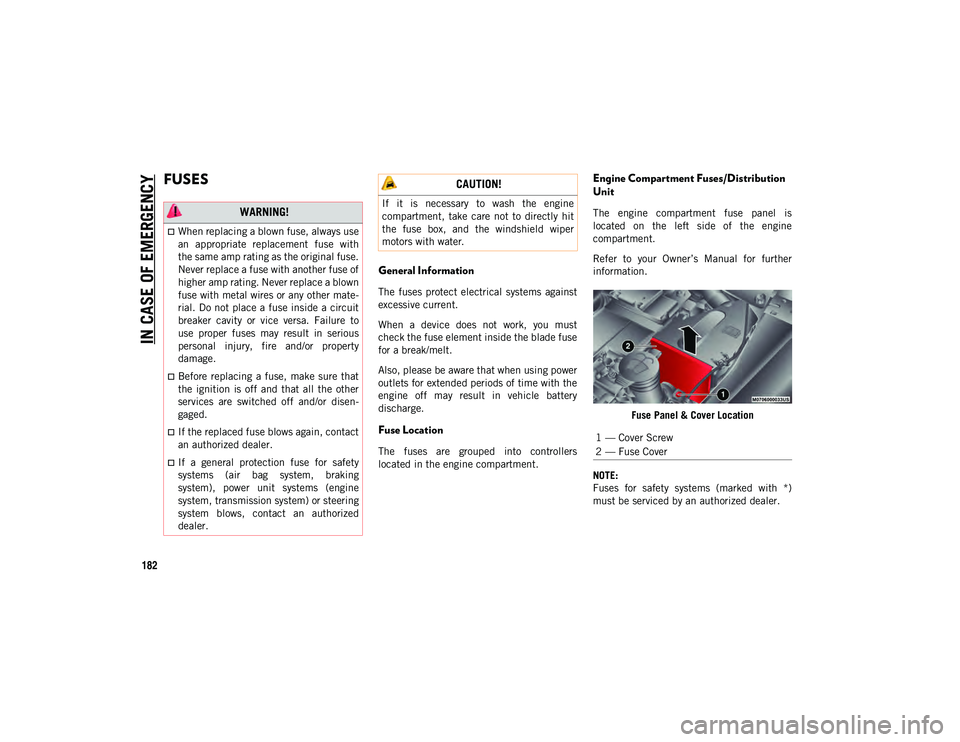
The engine compartment fuse panel is
located on the left side of the engine
compartment.
Refer to your Owner’s Manual for further
information.Fuse Panel & Cover Location
NOTE:
Fuses for safety systems (marked with *)
must be serviced by an authorized dealer. WARNING!
When replacing a blown fuse, always use
an appropriate replacement fuse with
the same amp rating as the original fuse.
Never replace a fuse with another fuse of
higher amp rating. Never replace a blown
fuse with metal wires or any other mate-
rial. Do not place a fuse inside a circuit
breaker cavity or vice versa. Failure to
use proper fuses may result in serious
personal injury, fire and/or property
damage.
Before replacing a fuse, make sure that
the ignition is off and that all the other
services are switched off and/or disen -
gaged.
If the replaced fuse blows again, contact
an authorized dealer.
If a general protection fuse for safety
systems (air bag system, braking
system), power unit systems (engine
system, transmission system) or steering
system blows, contact an authorized
dealer.
CAUTION!
If it is necessary to wash the engine
compartment, take care not to directly hit
the fuse box, and the windshield wiper
motors with water.
1 — Cover Screw
2 — Fuse Cover
2020_JEEP_M6_UG_UK.book Page 182
Page 209 of 328
207
(Continued)
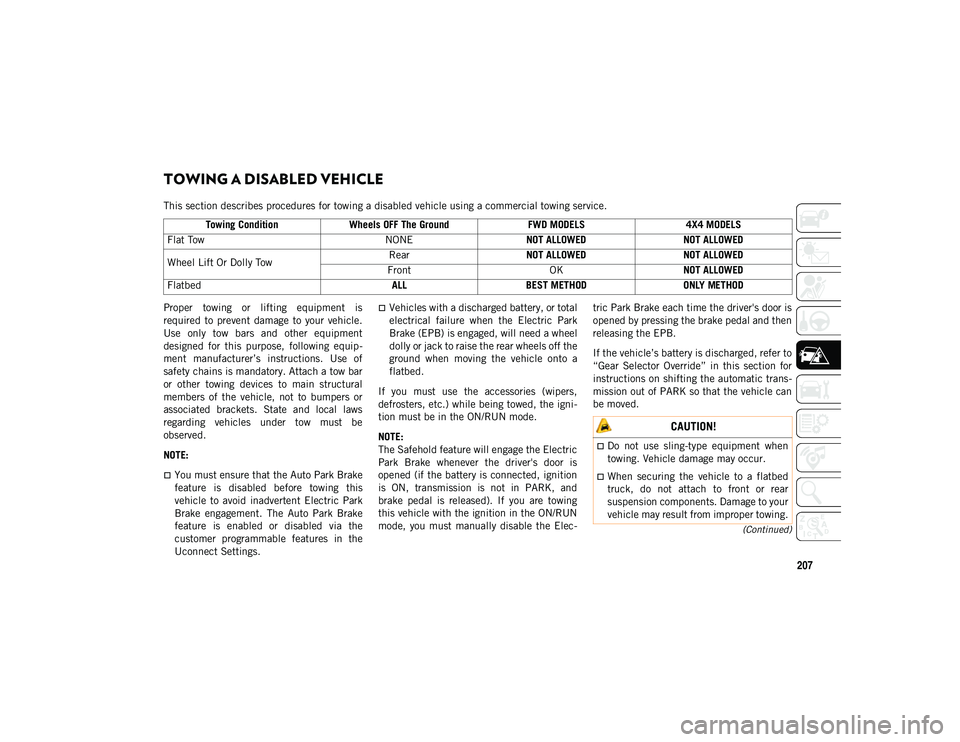
TOWING A DISABLED VEHICLE
This section describes procedures for towing a disabled vehicle using a commercial towing service.
Proper towing or lifting equipment is
required to prevent damage to your vehicle.
Use only tow bars and other equipment
designed for this purpose, following equip-
ment manufacturer’s instructions. Use of
safety chains is mandatory. Attach a tow bar
or other towing devices to main structural
members of the vehicle, not to bumpers or
associated brackets. State and local laws
regarding vehicles under tow must be
observed.
NOTE:
You must ensure that the Auto Park Brake
feature is disabled before towing this
vehicle to avoid inadvertent Electric Park
Brake engagement. The Auto Park Brake
feature is enabled or disabled via the
customer programmable features in the
Uconnect Settings.
Vehicles with a discharged battery, or total
electrical failure when the Electric Park
Brake (EPB) is engaged, will need a wheel
dolly or jack to raise the rear wheels off the
ground when moving the vehicle onto a
flatbed.
If you must use the accessories (wipers,
defrosters, etc.) while being towed, the igni -
tion must be in the ON/RUN mode.
NOTE:
The Safehold feature will engage the Electric
Park Brake whenever the driver's door is
opened (if the battery is connected, ignition
is ON, transmission is not in PARK, and
brake pedal is released). If you are towing
this vehicle with the ignition in the ON/RUN
mode, you must manually disable the Elec -tric Park Brake each time the driver's door is
opened by pressing the brake pedal and then
releasing the EPB.
If the vehicle’s battery is discharged, refer to
“Gear Selector Override” in this section for
instructions on shifting the automatic trans
-
mission out of PARK so that the vehicle can
be moved.
Towing Condition
Wheels OFF The Ground FWD MODELS4X4 MODELS
Flat Tow NONENOT ALLOWED NOT ALLOWED
Wheel Lift Or Dolly Tow Rear
NOT ALLOWED NOT ALLOWED
Front OKNOT ALLOWED
Flatbed ALLBEST METHOD ONLY METHOD
CAUTION!
Do not use sling-type equipment when
towing. Vehicle damage may occur.
When securing the vehicle to a flatbed
truck, do not attach to front or rear
suspension components. Damage to your
vehicle may result from improper towing.
2020_JEEP_M6_UG_UK.book Page 207
Page 227 of 328
225
(Continued)
Checking Oil Level
To assure proper engine lubrication, the
engine oil must be maintained at the correct
level. Check the oil level at regular intervals,
such as every fuel stop. The best time to
check the engine oil level is about five
minutes after a fully warmed up engine is
shut off.
Checking the oil while the vehicle is on level
ground will improve the accuracy of the oil
level readings.
There are three possible dipstick types,
Crosshatched zone.
Crosshatched zone marked SAFE.
Crosshatched zone marked with MIN at
the low end of the range and MAX at the
high end of the range.
Crosshatched zone marked with dimples
at the MIN and the MAX ends of the range.
NOTE:
Always maintain the oil level within the
crosshatch markings on the dipstick.
Adding 1 quart (1.0 liters) of oil when the
reading is at the low end of the dipstick
range will raise the oil level to the high end
of the range marking.
Adding Washer Fluid
The fluid reservoir is located in the front of
the engine compartment. Be sure to check
the fluid level in the reservoir at regular inter -
vals. Fill the reservoir with windshield washer
solvent (not radiator antifreeze) and operate
the system for a few seconds to flush out the
residual washer fluid.
When refilling the washer fluid reservoir,
take some washer fluid, apply it to a cloth or
towel, and wipe clean the wiper blades; this
will help blade performance.
WARNING!
Never smoke while working in the engine
compartment: gas and inflammable
vapors may be present, with the risk of
fire.
Be very careful when working in the
engine compartment when the engine is
hot: you may get burned. Do not get too
close to the radiator cooling fan: the
electric fan may start; danger of injury.
Scarves, ties and other loose clothing
might be pulled by moving parts.
CAUTION!
Be careful not to confuse the various
types of fluids while topping up: they are
not compatible with each other! Topping
up with an unsuitable fluid could
severely damage your car.
The oil level must never exceed the MAX
mark.
Always top up using engine oil of the
same specifications as that already in
the engine.
If the engine oil is being topped up, wait
for the engine to cool down before loos-
ening the filler cap, particularly for vehi -
cles with aluminium cap (if equipped).
WARNING: risk of burns!
Overfilling or underfilling the crankcase
will cause aeration or loss of oil pressure.
This could damage your engine.
CAUTION! (Continued)
2020_JEEP_M6_UG_UK.book Page 225