air filter JEEP GRAND CHEROKEE 2013 Owner handbook (in English)
[x] Cancel search | Manufacturer: JEEP, Model Year: 2013, Model line: GRAND CHEROKEE, Model: JEEP GRAND CHEROKEE 2013Pages: 408, PDF Size: 3.21 MB
Page 178 of 408
•Power Steering System Over Temp — If
Equipped
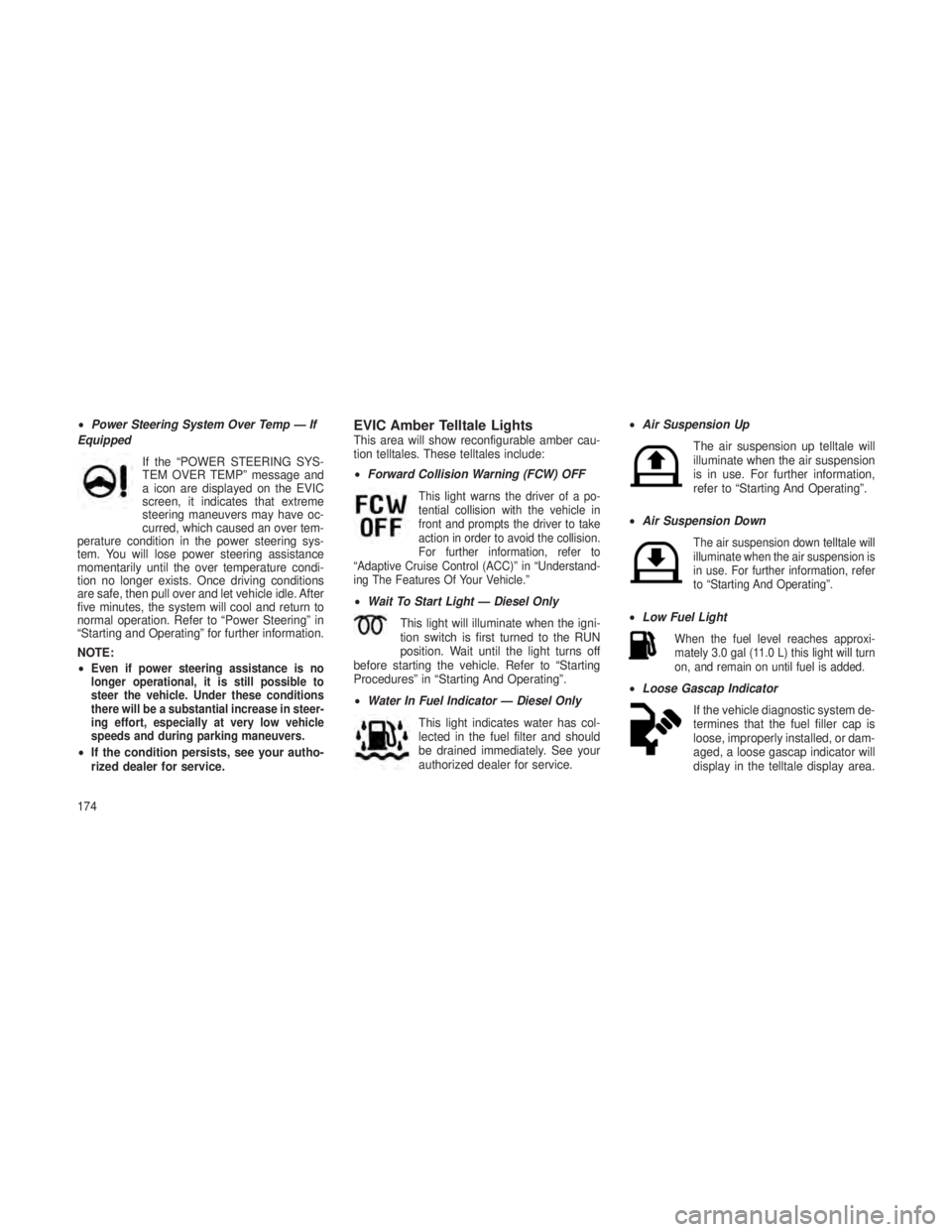
If the “POWER STEERING SYS-
TEM OVER TEMP” message and
a icon are displayed on the EVIC
screen, it indicates that extreme
steering maneuvers may have oc-
curred, which caused an over tem-
perature condition in the power steering sys-
tem. You will lose power steering assistance
momentarily until the over temperature condi-
tion no longer exists. Once driving conditions
are safe, then pull over and let vehicle idle. After
five minutes, the system will cool and return to
normal operation. Refer to “Power Steering” in
“Starting and Operating” for further information.
NOTE:
•
Even if power steering assistance is no
longer operational, it is still possible to
steer the vehicle. Under these conditions
there will be a substantial increase in steer-
ing effort, especially at very low vehicle
speeds and during parking maneuvers.
• If the condition persists, see your autho-
rized dealer for service.
EVIC Amber Telltale LightsThis area will show reconfigurable amber cau-
tion telltales. These telltales include:
•Forward Collision Warning (FCW) OFF
This light warns the driver of a po-
tential collision with the vehicle in
front and prompts the driver to take
action in order to avoid the collision.
For further information, refer to
“Adaptive Cruise Control (ACC)” in “Understand-
ing The Features Of Your Vehicle.”
• Wait To Start Light — Diesel Only
This light will illuminate when the igni-
tion switch is first turned to the RUN
position. Wait until the light turns off
before starting the vehicle. Refer to “Starting
Procedures” in “Starting And Operating”.
• Water In Fuel Indicator — Diesel Only
This light indicates water has col-
lected in the fuel filter and should
be drained immediately. See your
authorized dealer for service. •
Air Suspension Up
The air suspension up telltale will
illuminate when the air suspension
is in use. For further information,
refer to “Starting And Operating”.
• Air Suspension Down
The air suspension down telltale will
illuminate when the air suspension is
in use. For further information, refer
to “Starting And Operating”.
•Low Fuel Light
When the fuel level reaches approxi-
mately 3.0 gal (11.0 L) this light will turn
on, and remain on until fuel is added.
•Loose Gascap Indicator
If the vehicle diagnostic system de-
termines that the fuel filler cap is
loose, improperly installed, or dam-
aged, a loose gascap indicator will
display in the telltale display area.
174
Page 279 of 408
WARNING!
Carbon monoxide (CO) in exhaust gases is
deadly. Follow the precautions below to pre-
vent carbon monoxide poisoning:
•Do not inhale exhaust gases. They contain
carbon monoxide, a colorless and odor-
less gas which can kill. Never run the
engine in a closed area, such as a garage,
and never sit in a parked vehicle with the
engine running for an extended period. If
the vehicle is stopped in an open area with
the engine running for more than a short
period, adjust the ventilation system to
force fresh, outside air into the vehicle.
• Guard against carbon monoxide with
proper maintenance. Have the exhaust
system inspected every time the vehicle is
raised. Have any abnormal conditions re-
paired promptly. Until repaired, drive with
all side windows fully open.
(Continued)
WARNING!(Continued)
•Keep the liftgate closed when driving your
vehicle to prevent carbon monoxide and
other poisonous exhaust gases from en-
tering the vehicle.
FUEL REQUIREMENTS —
DIESEL ENGINE
Use good quality diesel fuel from a reputable
supplier. For most year-round service, No. 2
diesel fuel, meeting ASTM specification D-975
Grade S15, will provide good performance. If
the vehicle is exposed to extreme cold (below
20° F or -7° C), or is required to operate at
colder-than-normal conditions for prolonged pe-
riods, use climatized No. 2 diesel fuel or dilute
the No. 2 diesel fuel with 50% No. 1 diesel fuel. This will provide better protection from fuel
gelling or wax-plugging of the fuel filters.
This
vehicle must only use premium diesel fuel
that meets the requirements of EN 590. Bio-
diesel blends that meet EN 590 may also be
used.
CAUTION!
The manufacturer requires that you must fuel
this vehicle with Ultra Low Sulfur Highway
Diesel fuel (15 ppm Sulfur maximum) and
prohibits the use of Low Sulfur Highway Diesel
fuel (500 ppm Sulfur maximum) to avoid dam-
age to the emissions control system.
275
Page 289 of 408
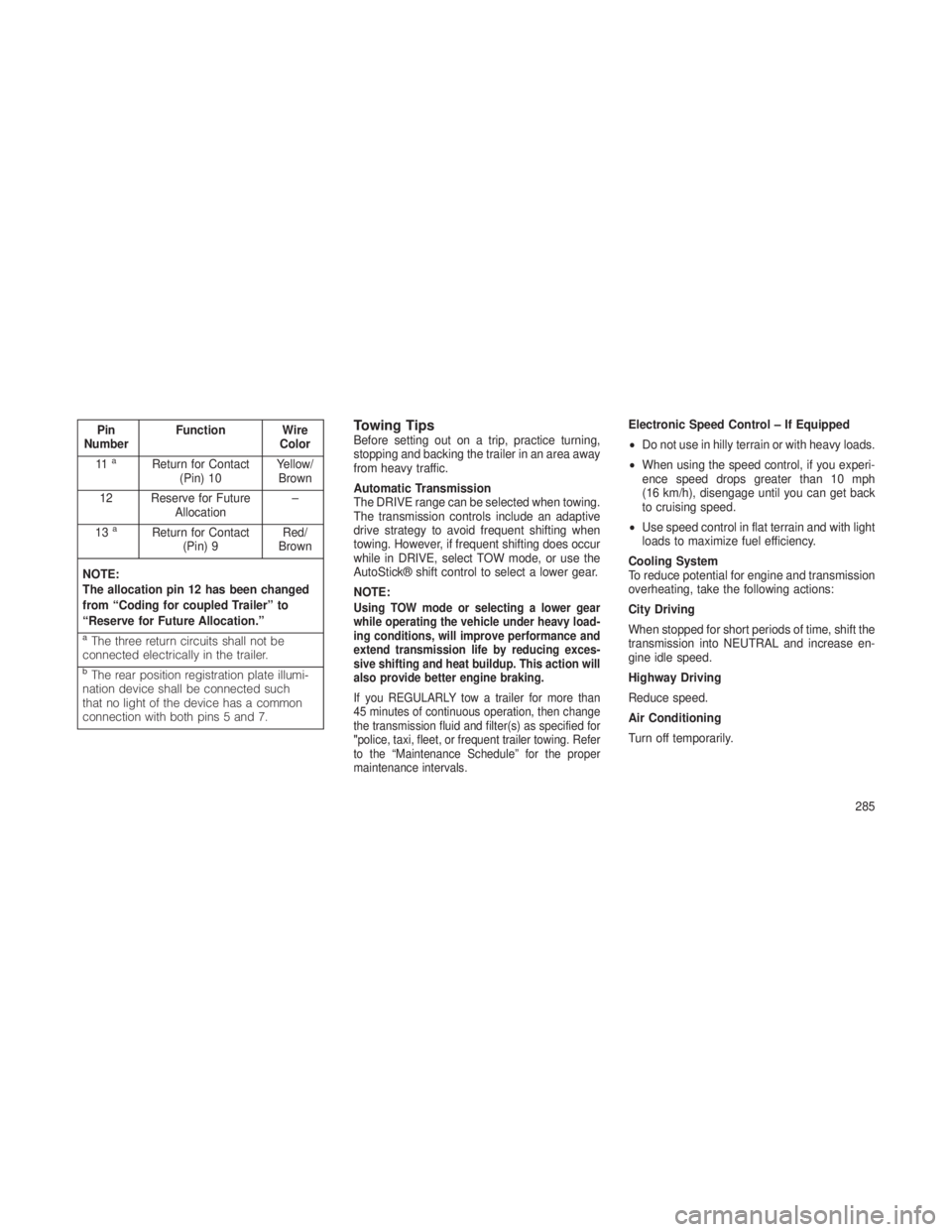
Pin
Number Function Wire
Color
11
aReturn for Contact (Pin) 10 Yellow/
Brown
12 Reserve for Future Allocation –
13
aReturn for Contact (Pin) 9 Red/
Brown
NOTE:
The allocation pin 12 has been changed
from “Coding for coupled Trailer” to
“Reserve for Future Allocation.”
aThe three return circuits shall not be
connected electrically in the trailer.
bThe rear position registration plate illumi-
nation device shall be connected such
that no light of the device has a common
connection with both pins 5 and 7.
Towing TipsBefore setting out on a trip, practice turning,
stopping and backing the trailer in an area away
from heavy traffic.
Automatic Transmission
The DRIVE range can be selected when towing.
The transmission controls include an adaptive
drive strategy to avoid frequent shifting when
towing. However, if frequent shifting does occur
while in DRIVE, select TOW mode, or use the
AutoStick® shift control to select a lower gear.
NOTE:
Using TOW mode or selecting a lower gear
while operating the vehicle under heavy load-
ing conditions, will improve performance and
extend transmission life by reducing exces-
sive shifting and heat buildup. This action will
also provide better engine braking.
If you REGULARLY tow a trailer for more than
45 minutes of continuous operation, then change
the transmission fluid and filter(s) as specified for
"police, taxi, fleet, or frequent trailer towing. Refer
to the “Maintenance Schedule” for the proper
maintenance intervals.
Electronic Speed Control – If Equipped
• Do not use in hilly terrain or with heavy loads.
• When using the speed control, if you experi-
ence speed drops greater than 10 mph
(16 km/h), disengage until you can get back
to cruising speed.
• Use speed control in flat terrain and with light
loads to maximize fuel efficiency.
Cooling System
To reduce potential for engine and transmission
overheating, take the following actions:
City Driving
When stopped for short periods of time, shift the
transmission into NEUTRAL and increase en-
gine idle speed.
Highway Driving
Reduce speed.
Air Conditioning
Turn off temporarily.
285
Page 311 of 408
7
MAINTAINING YOUR VEHICLE
•ENGINE COMPARTMENT — 3.6L ...................309
• ENGINE COMPARTMENT — 5.7L ...................310
• ENGINE COMPARTMENT — 3.0L DIESEL ..............311
• ONBOARD DIAGNOSTIC SYSTEM (OBD II) .............312
•Loose Fuel Filler Cap Message ...................312•REPLACEMENT PARTS .........................312
• MAINTENANCE PROCEDURES ....................312
•Engine Oil – Gasoline Engines ....................313
• Engine Oil – Diesel Engine ..................... .314
• Synthetic Engine Oils ........................ .315
• Materials Added To Engine Oil ....................315
• Disposing Of Used Engine Oil And Oil Filters ...........315
• Engine Oil Filter ........................... .315
• Engine Air Cleaner Filter ...................... .315
• Maintenance-Free Battery ...................... .316
• Air Conditioner Maintenance .................... .316
• Body Lubrication ........................... .318
• Windshield Wiper Blades ...................... .318
• Adding Washer Fluid ........................ .319
307
Page 313 of 408
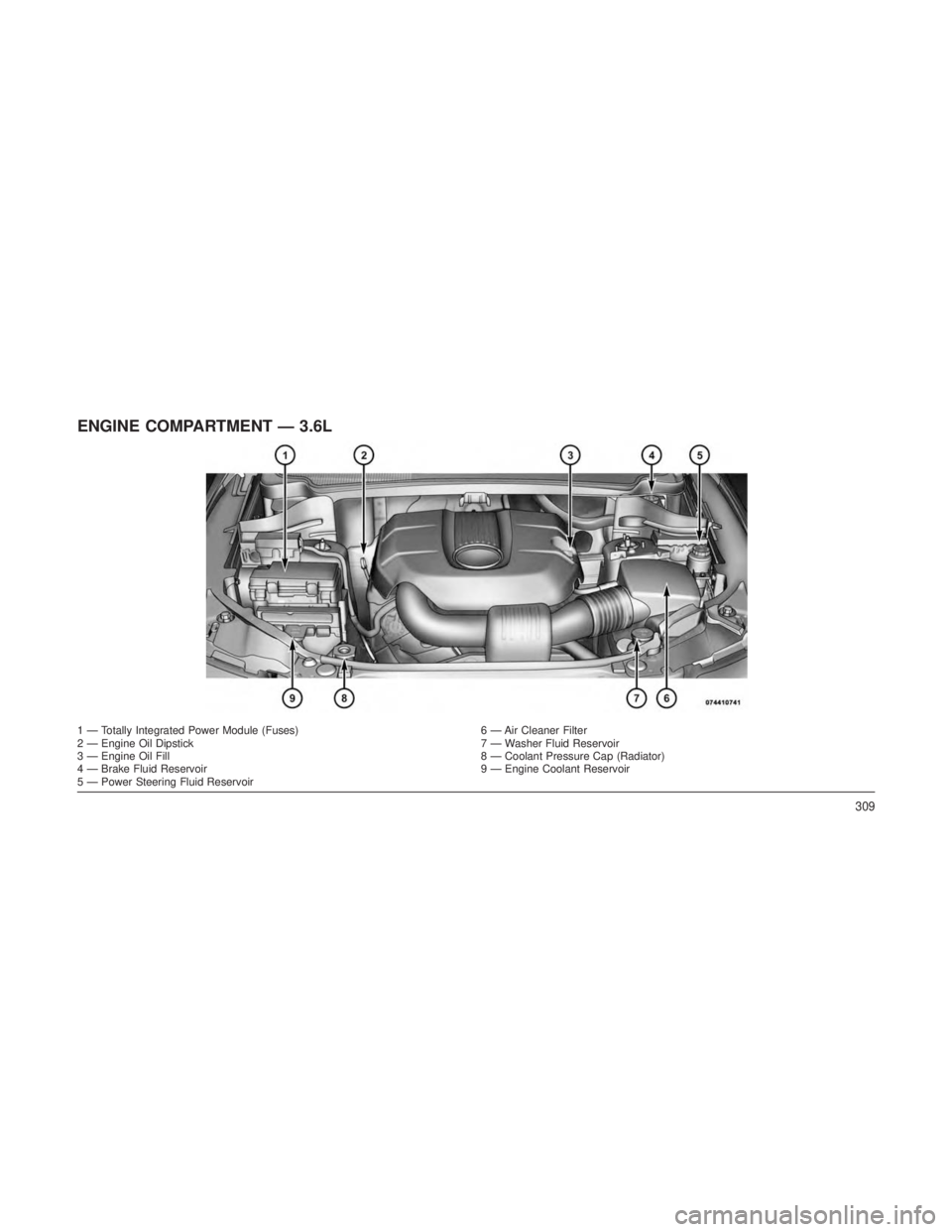
ENGINE COMPARTMENT — 3.6L
1 — Totally Integrated Power Module (Fuses)6 — Air Cleaner Filter
2 — Engine Oil Dipstick 7 — Washer Fluid Reservoir
3 — Engine Oil Fill 8 — Coolant Pressure Cap (Radiator)
4 — Brake Fluid Reservoir 9 — Engine Coolant Reservoir
5 — Power Steering Fluid Reservoir
309
Page 314 of 408
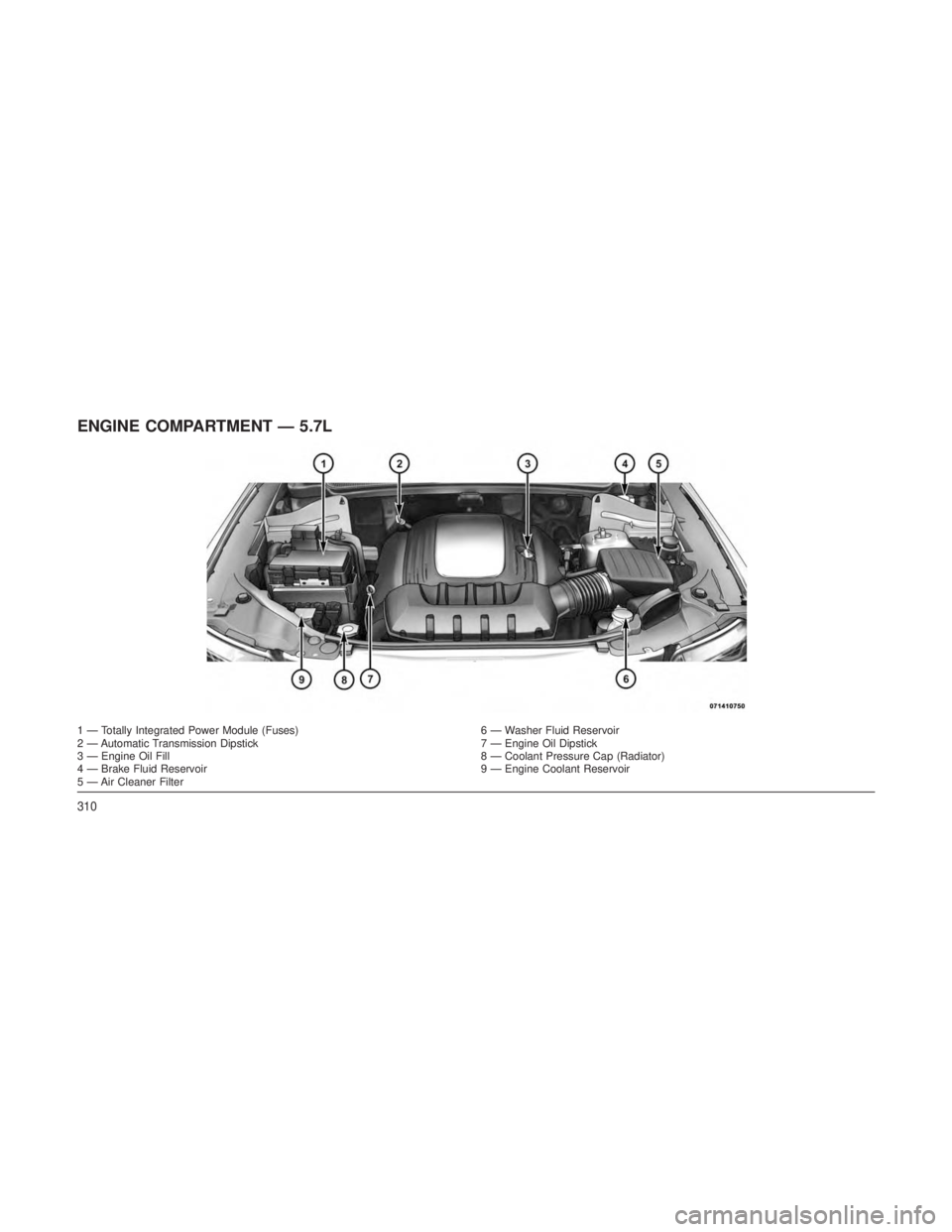
ENGINE COMPARTMENT — 5.7L
1 — Totally Integrated Power Module (Fuses)6 — Washer Fluid Reservoir
2 — Automatic Transmission Dipstick 7 — Engine Oil Dipstick
3 — Engine Oil Fill 8 — Coolant Pressure Cap (Radiator)
4 — Brake Fluid Reservoir 9 — Engine Coolant Reservoir
5 — Air Cleaner Filter
310
Page 315 of 408
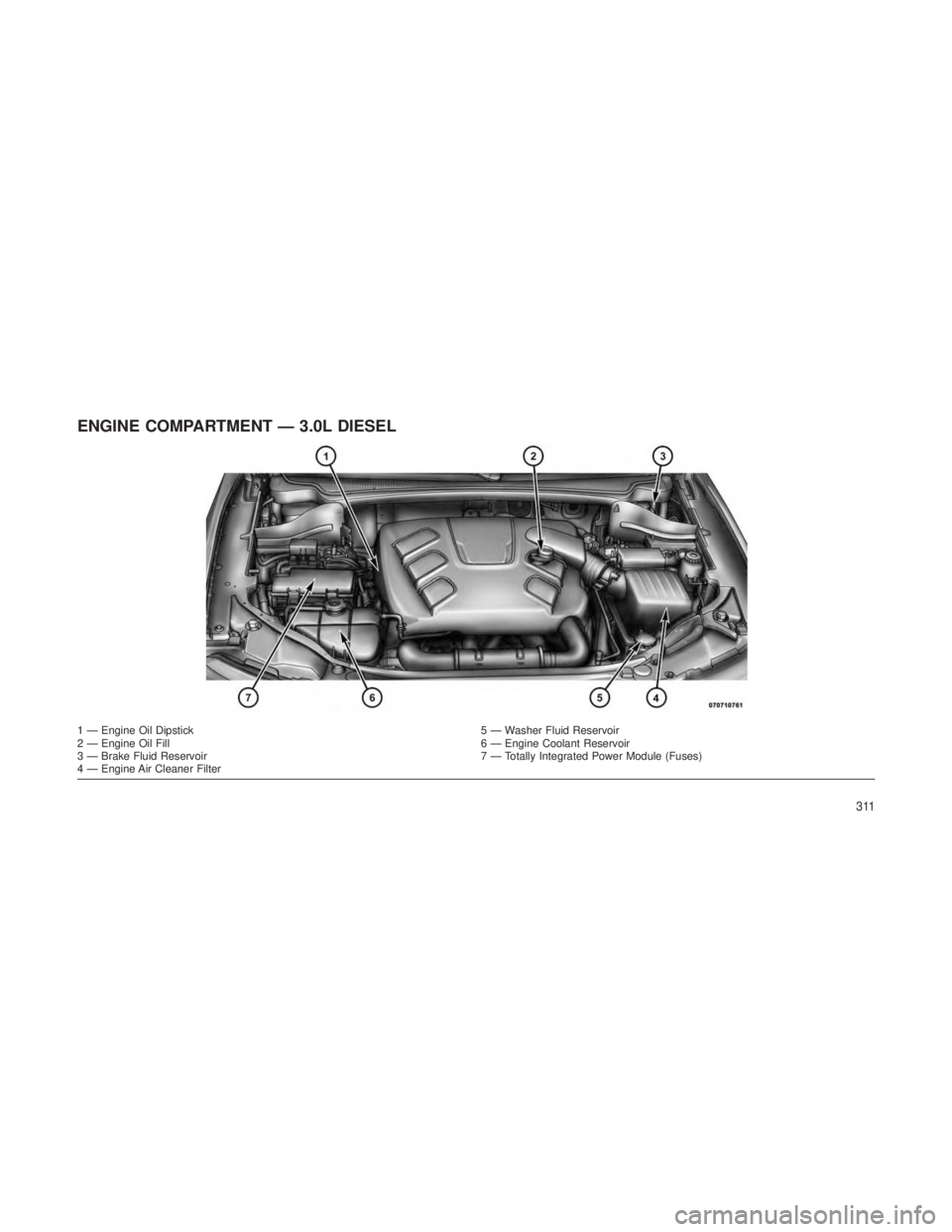
ENGINE COMPARTMENT — 3.0L DIESEL
1 — Engine Oil Dipstick5 — Washer Fluid Reservoir
2 — Engine Oil Fill 6 — Engine Coolant Reservoir
3 — Brake Fluid Reservoir 7 — Totally Integrated Power Module (Fuses)
4 — Engine Air Cleaner Filter
311
Page 319 of 408
SAE 5W-30 Synthetic Low Ash Engine Oil is
recommended for all operating temperatures.
This engine oil improves low temperature start-
ing and vehicle fuel economy.
The engine oil filler cap also shows the recom-
mended engine oil viscosity for your engine. For
information on engine oil filler cap location, refer
to “Engine Compartment” in “Maintaining Your
Vehicle” for further information.
Synthetic Engine OilsYou may use synthetic engine oils provided the
recommended oil quality requirements are met,
and the recommended maintenance intervals
for oil and filter changes are followed.
Materials Added To Engine OilThe manufacturer strongly recommends
against the addition of any additives (other than
leak detection dyes) to the engine oil. Engine oil
is an engineered product and its performance
may be impaired by supplemental additives.
Disposing Of Used Engine Oil And
Oil Filters
Care should be taken in disposing of used
engine oil and oil filters from your vehicle. Used
oil and oil filters, indiscriminately discarded, can
present a problem to the environment. Contact
your authorized dealer, service station or gov-
ernmental agency for advice on how and where
used oil and oil filters can be safely discarded in
your area.
Engine Oil FilterThe engine oil filter should be replaced with a
new filter at every engine oil change.
Engine Oil Filter Selection
This manufacturer’s engines have a full-flow
type disposable oil filter. Use a filter of this type
for replacement. The quality of replacement
filters varies considerably. Only high quality
filters should be used to assure most efficient
service. MOPAR® engine oil filters are high
quality oil filters and are recommended.
Engine Air Cleaner FilterRefer to the “Maintenance Schedule” for the
proper maintenance intervals.
WARNING!
The air induction system (air cleaner, hoses,
etc.) can provide a measure of protection in
the case of engine backfire. Do not remove
the air induction system (air cleaner, hoses,
etc.) unless such removal is necessary for
repair or maintenance. Make sure that no
one is near the engine compartment before
starting the vehicle with the air induction
system (air cleaner, hoses, etc.) removed.
Failure to do so can result in serious per-
sonal injury.
Engine Air Cleaner Filter Selection
The quality of replacement engine air cleaner
filters varies considerably. Only high quality
filters should be used to assure most efficient
service. MOPAR® engine air cleaner filters are
a high quality filter and are recommended.
315
Page 321 of 408
WARNING!
•Use only refrigerants and compressor lu-
bricants approved by the manufacturer for
your air conditioning system. Some unap-
proved refrigerants are flammable and can
explode, injuring you. Other unapproved
refrigerants or lubricants can cause the
system to fail, requiring costly repairs.
• The air conditioning system contains re-
frigerant under high pressure. To avoid risk
of personal injury or damage to the sys-
tem, adding refrigerant or any repair re-
quiring lines to be disconnected should be
done by an experienced repairman.
NOTE:
Use only manufacturer approved A/C Sys-
tem Sealers, Stop Leak Products, Seal Con-
ditioners, Compressor Oil, and Refrigerants. Refrigerant Recovery And Recycling
R-134a Air Conditioning Refrigerant is a hydro-
fluorocarbon (HFC) that is endorsed by the
Environmental Protection Agency and is an
ozone-saving product. However, the manufac-
turer recommends that air conditioning service
be performed by authorized dealer or other
service facilities using recovery and recycling
equipment.
NOTE:
Use only manufacturer approved A/C sys-
tem sealers, stop leak products, seal condi-
tioners, compressor oil, and refrigerants.
A/C Air Filter
Refer to the “Maintenance Schedule” for the
proper maintenance intervals.
WARNING!
Do not remove the A/C air filter while the
blower is operating or personal injury may
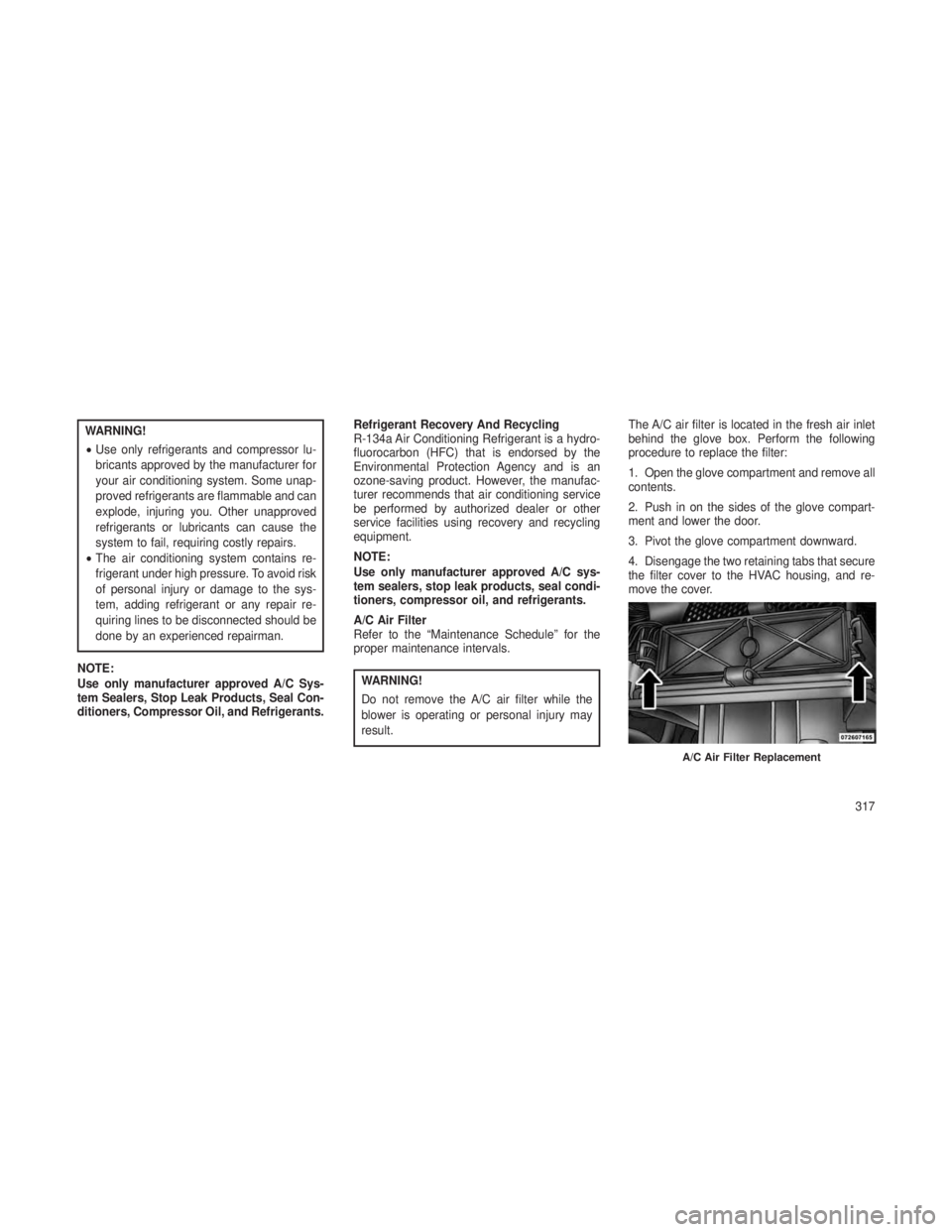
result.The A/C air filter is located in the fresh air inlet
behind the glove box. Perform the following
procedure to replace the filter:
1. Open the glove compartment and remove all
contents.
2. Push in on the sides of the glove compart-
ment and lower the door.
3. Pivot the glove compartment downward.
4. Disengage the two retaining tabs that secure
the filter cover to the HVAC housing, and re-
move the cover.
A/C Air Filter Replacement
317
Page 322 of 408
5. Remove the A/C air filter by pulling it straight
out of the housing.
6. Install the A/C air filter with the arrow on the
filter pointing toward the floor. When installing
the filter cover, make sure the retaining tabs
fully engage the cover.
CAUTION!
The A/C air filter is identified with an arrow to
indicate airflow direction through the filter.
Failure to properly install the filter will result
in the need to replace it more often.
7. Rotate the glove compartment door back
into position.
Body LubricationLocks and all body pivot points, including such
items as seat tracks, door hinge pivot points
and rollers, liftgate, tailgate, sliding doors and
hood hinges, should be lubricated periodically
with a lithium based grease, such as MOPAR®
Spray White Lube to assure quiet, easy opera-
tion and to protect against rust and wear. Prior
to the application of any lubricant, the parts
concerned should be wiped clean to remove
dust and grit; after lubricating excess oil and
grease should be removed. Particular attention
should also be given to hood latching compo-
nents to ensure proper function. When perform-
ing other underhood services, the hood latch,
release mechanism and safety catch should be
cleaned and lubricated.
The external lock cylinders should be lubricated
twice a year, preferably in the Fall and Spring.
Apply a small amount of a high quality lubricant,
such as MOPAR® Lock Cylinder Lubricant di-
rectly into the lock cylinder.Windshield Wiper BladesClean the rubber edges of the wiper blades and
the windshield periodically with a sponge or soft
cloth and a mild nonabrasive cleaner. This will
remove accumulations of salt or road film.
Operation of the wipers on dry glass for long
periods may cause deterioration of the wiper
blades. Always use washer fluid when using the
wipers to remove salt or dirt from a dry wind-
shield.
Avoid using the wiper blades to remove frost or
ice from the windshield. Keep the blade rubber
out of contact with petroleum products such as
engine oil, gasoline, etc.
NOTE:
Life expectancy of wiper blades varies de-
pending on geographical area and fre-
quency of use. Poor performance of blades
may be present with chattering, marks, wa-
ter lines or wet spots. If any of these condi-
tions are present, clean the wiper blades or
replace as necessary.
318