oil JEEP RENEGADE 2018 Owner handbook (in English)
[x] Cancel search | Manufacturer: JEEP, Model Year: 2018, Model line: RENEGADE, Model: JEEP RENEGADE 2018Pages: 356, PDF Size: 6.11 MB
Page 49 of 356
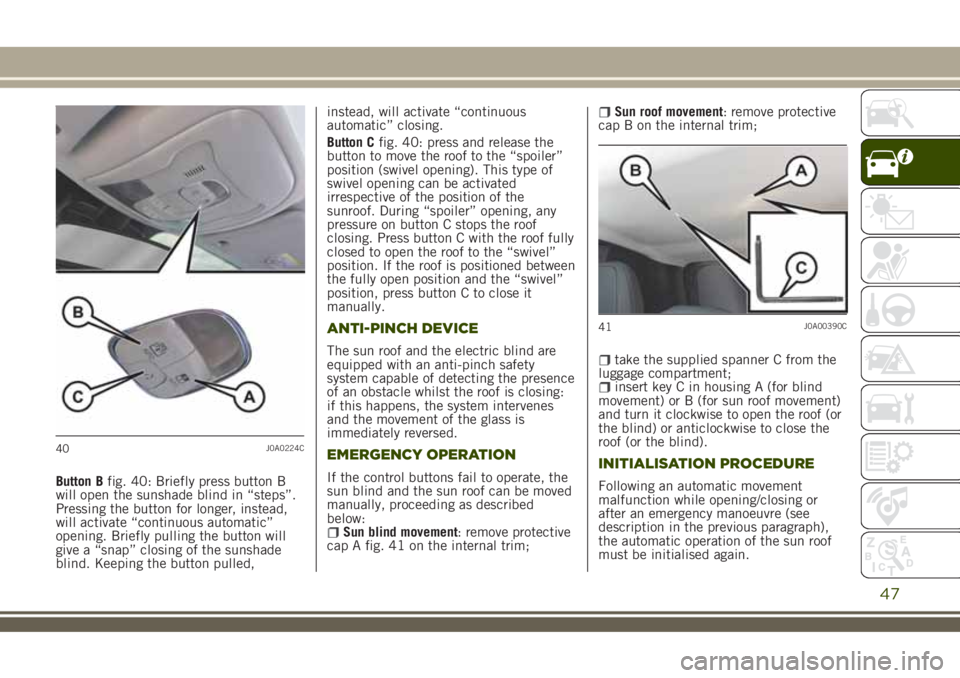
Button Bfig. 40: Briefly press button B
will open the sunshade blind in “steps”.
Pressing the button for longer, instead,
will activate “continuous automatic”
opening. Briefly pulling the button will
give a “snap” closing of the sunshade
blind. Keeping the button pulled,instead, will activate “continuous
automatic” closing.
Button Cfig. 40: press and release the
button to move the roof to the “spoiler”
position (swivel opening). This type of
swivel opening can be activated
irrespective of the position of the
sunroof. During “spoiler” opening, any
pressure on button C stops the roof
closing. Press button C with the roof fully
closed to open the roof to the “swivel”
position. If the roof is positioned between
the fully open position and the “swivel”
position, press button C to close it
manually.
ANTI-PINCH DEVICE
The sun roof and the electric blind are
equipped with an anti-pinch safety
system capable of detecting the presence
of an obstacle whilst the roof is closing:
if this happens, the system intervenes
and the movement of the glass is
immediately reversed.
EMERGENCY OPERATION
If the control buttons fail to operate, the
sun blind and the sun roof can be moved
manually, proceeding as described
below:
Sun blind movement: remove protective
cap A fig. 41 on the internal trim;
Sun roof movement: remove protective
cap B on the internal trim;
take the supplied spanner C from the
luggage compartment;
insert key C in housing A (for blind
movement) or B (for sun roof movement)
and turn it clockwise to open the roof (or
the blind) or anticlockwise to close the
roof (or the blind).
INITIALISATION PROCEDURE
Following an automatic movement
malfunction while opening/closing or
after an emergency manoeuvre (see
description in the previous paragraph),
the automatic operation of the sun roof
must be initialised again.
40J0A0224C
41J0A00390C
47
Page 85 of 356
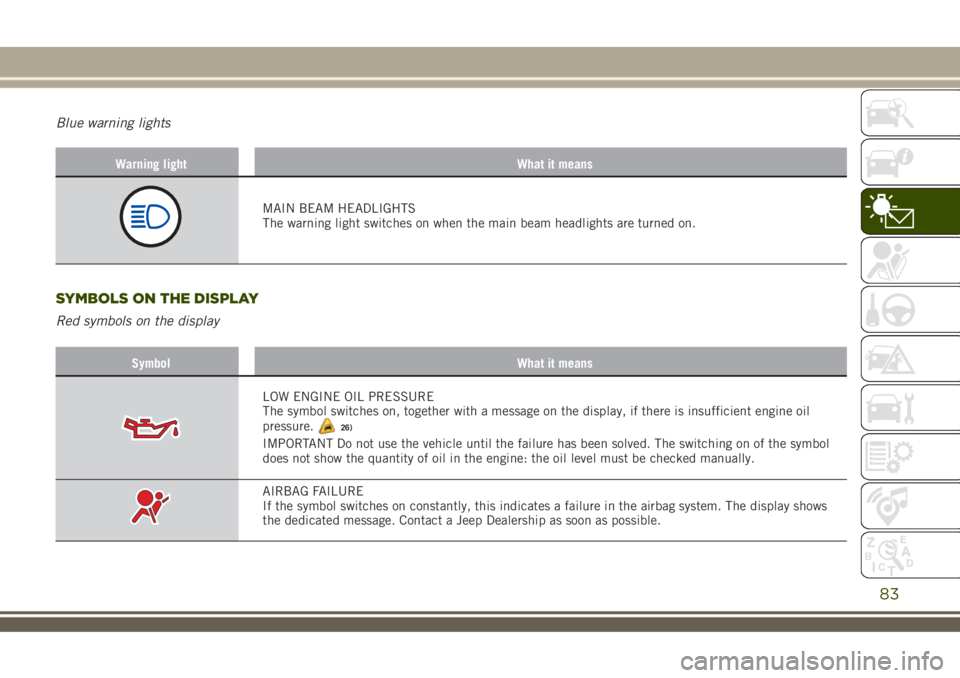
Blue warning lights
Warning light What it means
MAIN BEAM HEADLIGHTS
The warning light switches on when the main beam headlights are turned on.
SYMBOLS ON THE DISPLAY
Red symbols on the display
Symbol What it means
LOW ENGINE OIL PRESSURE
The symbol switches on, together with a message on the display, if there is insufficient engine oil
pressure.
26)
IMPORTANT Do not use the vehicle until the failure has been solved. The switching on of the symbol
does not show the quantity of oil in the engine: the oil level must be checked manually.
AIRBAG FAILURE
If the symbol switches on constantly, this indicates a failure in the airbag system. The display shows
the dedicated message. Contact a Jeep Dealership as soon as possible.
83
Page 87 of 356
Symbol What it means
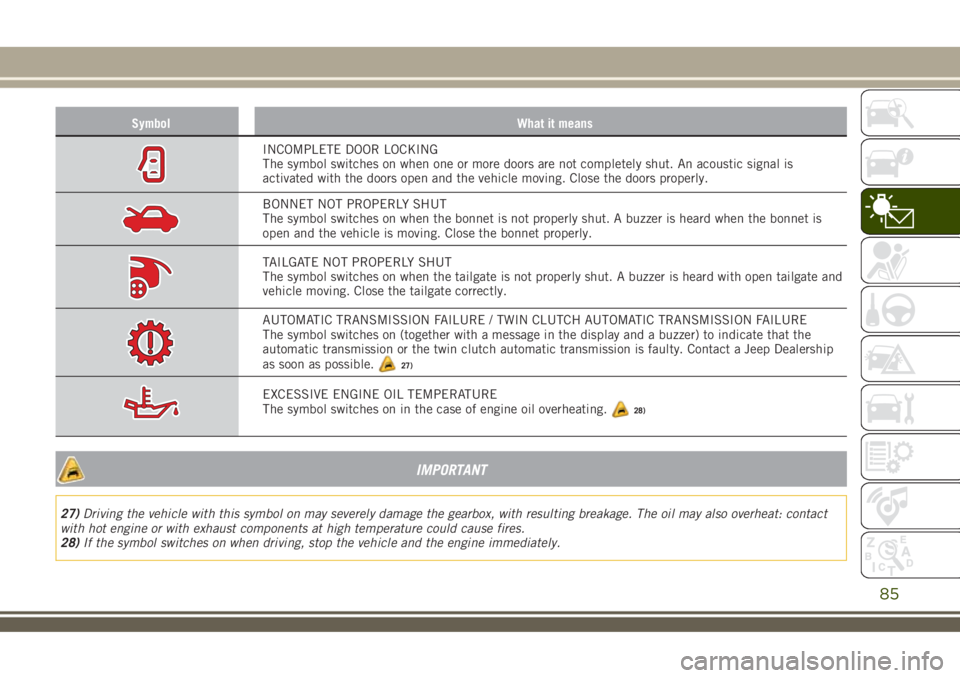
INCOMPLETE DOOR LOCKING
The symbol switches on when one or more doors are not completely shut. An acoustic signal is
activated with the doors open and the vehicle moving. Close the doors properly.
BONNET NOT PROPERLY SHUT
The symbol switches on when the bonnet is not properly shut. A buzzer is heard when the bonnet is
open and the vehicle is moving. Close the bonnet properly.
TAILGATE NOT PROPERLY SHUT
The symbol switches on when the tailgate is not properly shut. A buzzer is heard with open tailgate and
vehicle moving. Close the tailgate correctly.
AUTOMATIC TRANSMISSION FAILURE / TWIN CLUTCH AUTOMATIC TRANSMISSION FAILURE
The symbol switches on (together with a message in the display and a buzzer) to indicate that the
automatic transmission or the twin clutch automatic transmission is faulty. Contact a Jeep Dealership
as soon as possible.
27)
EXCESSIVE ENGINE OIL TEMPERATURE
The symbol switches on in the case of engine oil overheating.28)
IMPORTANT
27)Driving the vehicle with this symbol on may severely damage the gearbox, with resulting breakage. The oil may also overheat: contact
with hot engine or with exhaust components at high temperature could cause fires.
28)If the symbol switches on when driving, stop the vehicle and the engine immediately.
85
Page 89 of 356
Symbol What it means
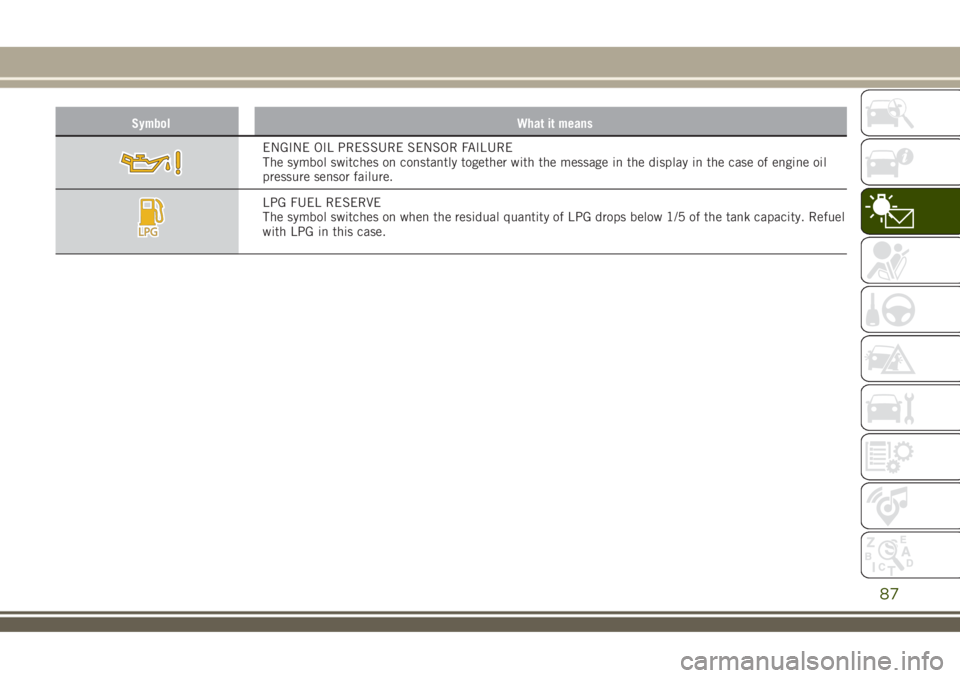
ENGINE OIL PRESSURE SENSOR FAILURE
The symbol switches on constantly together with the message in the display in the case of engine oil
pressure sensor failure.
LPG FUEL RESERVE
The symbol switches on when the residual quantity of LPG drops below 1/5 of the tank capacity. Refuel
with LPG in this case.
87
Page 95 of 356
Symbol What it means
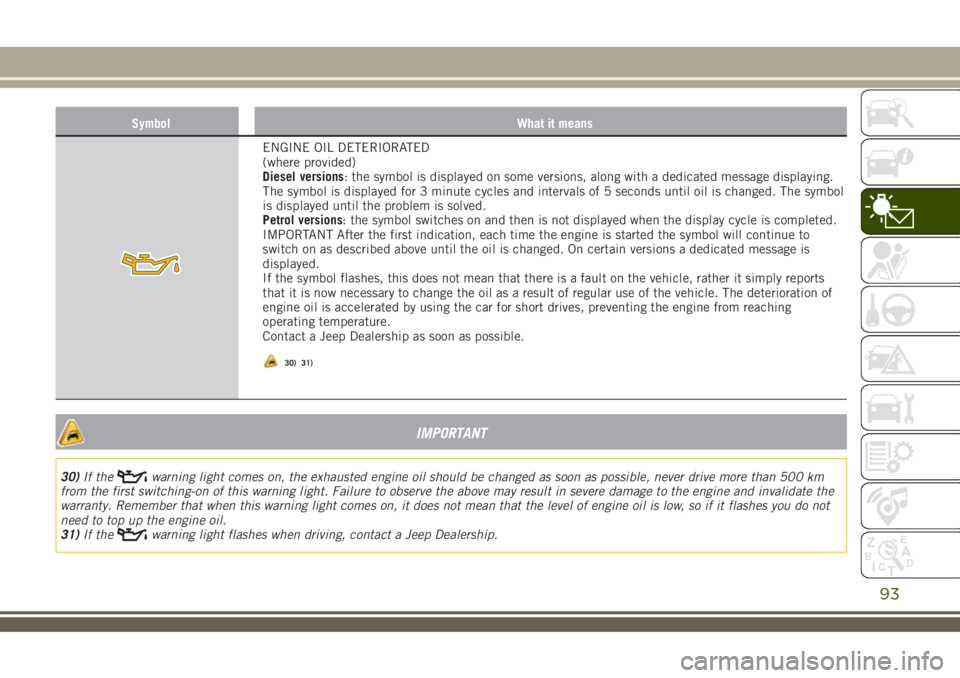
ENGINE OIL DETERIORATED
(where provided)
Diesel versions: the symbol is displayed on some versions, along with a dedicated message displaying.
The symbol is displayed for 3 minute cycles and intervals of 5 seconds until oil is changed. The symbol
is displayed until the problem is solved.
Petrol versions: the symbol switches on and then is not displayed when the display cycle is completed.
IMPORTANT After the first indication, each time the engine is started the symbol will continue to
switch on as described above until the oil is changed. On certain versions a dedicated message is
displayed.
If the symbol flashes, this does not mean that there is a fault on the vehicle, rather it simply reports
that it is now necessary to change the oil as a result of regular use of the vehicle. The deterioration of
engine oil is accelerated by using the car for short drives, preventing the engine from reaching
operating temperature.
Contact a Jeep Dealership as soon as possible.
IMPORTANT
30)If thewarning light comes on, the exhausted engine oil should be changed as soon as possible, never drive more than 500 km
from the first switching-on of this warning light. Failure to observe the above may result in severe damage to the engine and invalidate the
warranty. Remember that when this warning light comes on, it does not mean that the level of engine oil is low, so if it flashes you do not
need to top up the engine oil.
31)If the
warning light flashes when driving, contact a Jeep Dealership.
93
30)
31)
Page 97 of 356
Symbol What it means
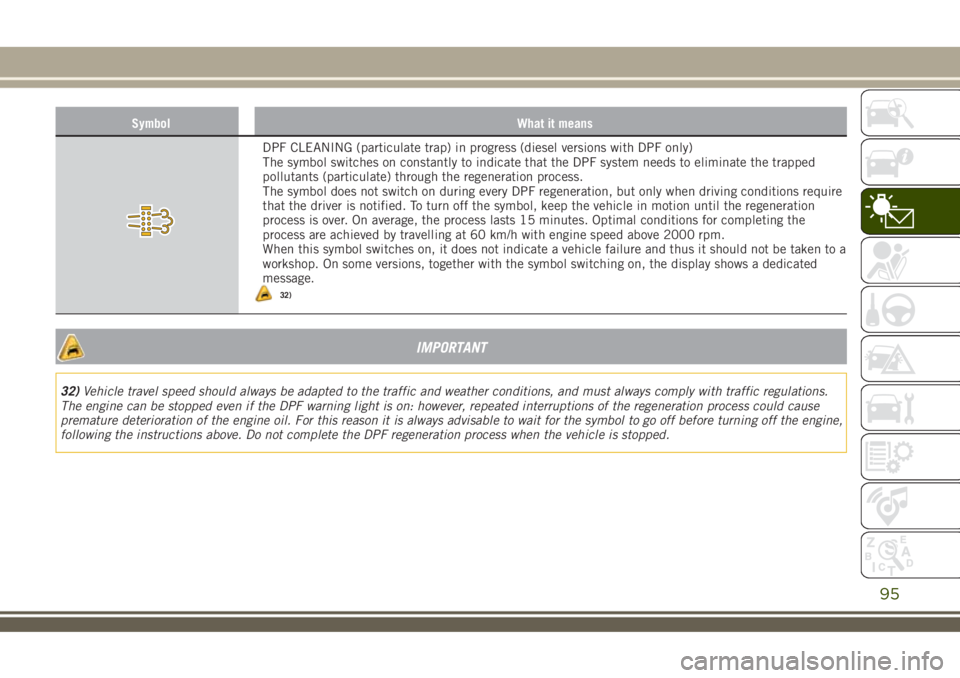
DPF CLEANING (particulate trap) in progress (diesel versions with DPF only)
The symbol switches on constantly to indicate that the DPF system needs to eliminate the trapped
pollutants (particulate) through the regeneration process.
The symbol does not switch on during every DPF regeneration, but only when driving conditions require
that the driver is notified. To turn off the symbol, keep the vehicle in motion until the regeneration
process is over. On average, the process lasts 15 minutes. Optimal conditions for completing the
process are achieved by travelling at 60 km/h with engine speed above 2000 rpm.
When this symbol switches on, it does not indicate a vehicle failure and thus it should not be taken to a
workshop. On some versions, together with the symbol switching on, the display shows a dedicated
message.
IMPORTANT
32)Vehicle travel speed should always be adapted to the traffic and weather conditions, and must always comply with traffic regulations.
The engine can be stopped even if the DPF warning light is on: however, repeated interruptions of the regeneration process could cause
premature deterioration of the engine oil. For this reason it is always advisable to wait for the symbol to go off before turning off the engine,
following the instructions above. Do not complete the DPF regeneration process when the vehicle is stopped.
95
32)
Page 191 of 356
Important
Apply the plate in a highly visible point
of the vehicle, near the mounting pipe or
inside the luggage compartment.
To ensure correct operation of the
system, periodically remove all deposits
of dirt which may have accumulated on
the ball head bar and from the mounting
pipe. The lock must only be treated with
graphite.
Periodically lubricate the joints, the
sliding surfaces and the balls with grease
without resin or oil. Lubrication is also a
further corrosion protection.
if the vehicle is washed with
high-pressure jets, the ball head bar
must be removed and the dedicated plug
fitted. The ball head bar must never be
treated with high-pressure jets.
Two keys are supplied together with the
removable ball tow bar. Note down the
four-digit key number and keep it in a
safe place. This number is to be used for
ordering any duplicate keys that may be
required.
IMPORTANT To install a tow hook
contact a Jeep Dealership.
WARNING
148)The ABS with which the car is
equipped will not control the braking
system of the trailer. Particular caution is
required on slippery roads.
149)Never modify the braking system of
the vehicle to control the trailer brake.
The trailer braking system must be fully
independent of the car’s hydraulic system.
189
Page 230 of 356
SCHEDULED SERVICING
Correct servicing is crucial for
guaranteeing a long life for the car under
the best conditions. For this reason, Jeep
has planned a series of checks and
services at fixed distance intervals and,
where provided, at fixed time intervals,
as described in the Scheduled Servicing
Plan.
Before each coupon however you always
need to pay attention to what is written
in the Scheduled Servicing Plan (e.g.
periodically check liquid levels, tire
pressure, etc.).
The Scheduled Servicing is carried out
by the Jeep Assistance Network at
pre-set times. If, during each operation,
in addition to the ones scheduled, the
need arises for further replacements or
repairs, these may be carried out with the
owner's explicit agreement only. If your
car is used frequently for towing, the
interval between one scheduled servicing
operation and the next should be
reduced.
IMPORTANT Scheduled Servicing
interventions are set out by the
Manufacturer. Failure to have them
carried out may invalidate the
warranty. It is advisable to inform aJeep Dealership of any small operating
irregularities without waiting for the
next service.
PERIODIC CHECKS
Every1,000km or before long trips
check and, if necessary, top up:
engine coolant level;brake fluid level;windscreen washer fluid level;tyre inflation pressure and condition;operation of lighting system
(headlights, direction indicators, hazard
warning lights, etc.);
operation of screen washer/wiper
system and positioning/wear of
windscreen/rear window wiper blades.
Every3,000km, check and top up if
required: engine oil level.
DEMANDING USE OF THE CAR
If the vehicle is used in one of the
following conditions:
Law enforcement (or security service),
taxi service
towing a trailer or caravan;dusty roads;short, repeated journeys (less than
7-8 km) at sub-zero outside
temperatures;
engine often idling or driving long
distances at low speeds or long periods
of inactivity;the following checks must be carried out
more often than indicated in the
Scheduled Service Plan:
check front disc brake pad condition
and wear;
check cleanliness of bonnet and
luggage compartment locks, cleanliness
and lubrication of linkage;
visually inspect conditions of: engine,
gearbox, transmission, pipes and hoses
(exhaust/fuel system/brakes) and rubber
elements (gaiters/sleeves/bushes, etc.);
check battery charge and battery fluid
level (electrolyte);
visually inspect conditions of the
accessory drive belts;
check and, if necessary, change
engine oil and replace oil filter;
check and, if necessary, replace pollen
filter;
check and, if necessary, replace air
cleaner.
228
SERVICING AND MAINTENANCE
Page 232 of 356
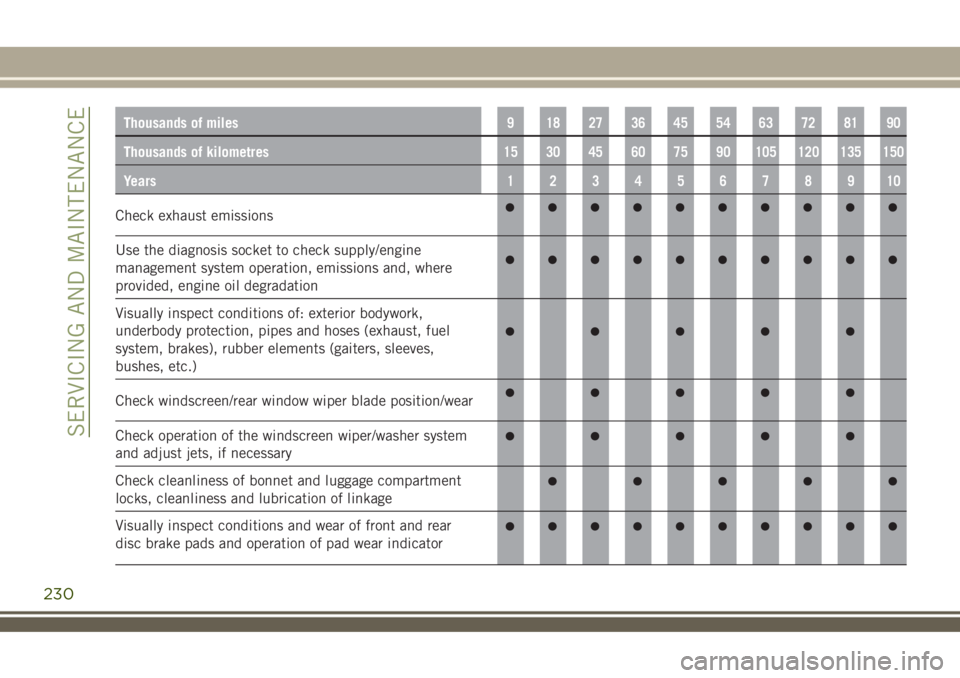
Thousands of miles9 182736455463728190
Thousands of kilometres15 30 45 60 75 90 105 120 135 150
Years12345678910
Check exhaust emissions
Use the diagnosis socket to check supply/engine
management system operation, emissions and, where
provided, engine oil degradation
Visually inspect conditions of: exterior bodywork,
underbody protection, pipes and hoses (exhaust, fuel
system, brakes), rubber elements (gaiters, sleeves,
bushes, etc.)
Check windscreen/rear window wiper blade position/wear
Check operation of the windscreen wiper/washer system
and adjust jets, if necessary
Check cleanliness of bonnet and luggage compartment
locks, cleanliness and lubrication of linkage
Visually inspect conditions and wear of front and rear
disc brake pads and operation of pad wear indicator
230
SERVICING AND MAINTENANCE
Page 233 of 356
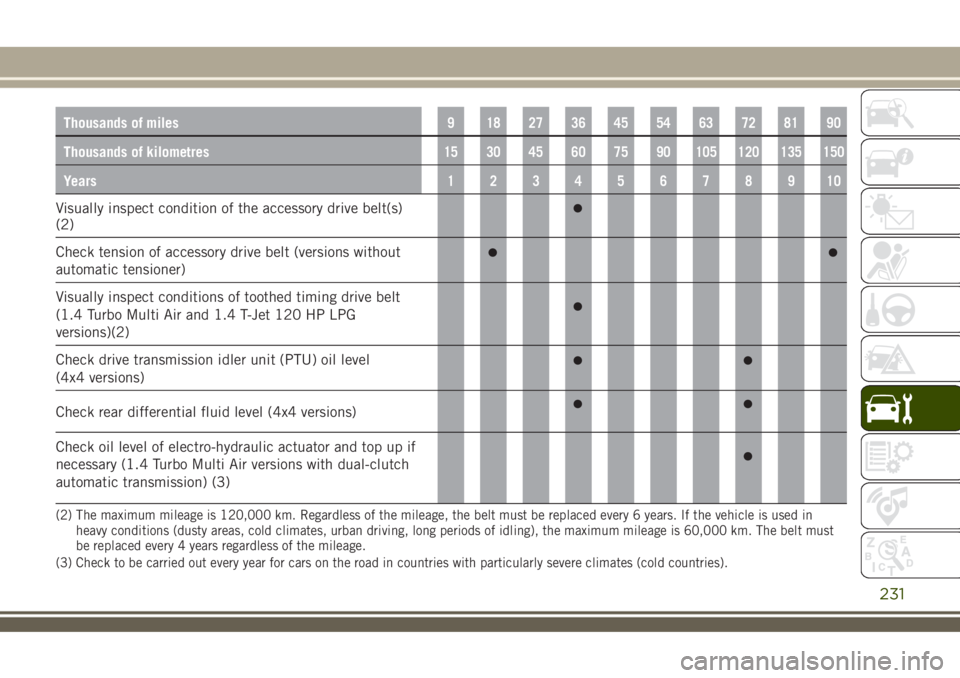
Thousands of miles9 182736455463728190
Thousands of kilometres15 30 45 60 75 90 105 120 135 150
Years12345678910
Visually inspect condition of the accessory drive belt(s)
(2)
Check tension of accessory drive belt (versions without
automatic tensioner)
Visually inspect conditions of toothed timing drive belt
(1.4 Turbo Multi Air and 1.4 T-Jet 120 HP LPG
versions)(2)
Check drive transmission idler unit (PTU) oil level
(4x4 versions)
Check rear differential fluid level (4x4 versions)
Check oil level of electro-hydraulic actuator and top up if
necessary (1.4 Turbo Multi Air versions with dual-clutch
automatic transmission) (3)
(2) The maximum mileage is 120,000 km. Regardless of the mileage, the belt must be replaced every 6 years. If the vehicle is used in
heavy conditions (dusty areas, cold climates, urban driving, long periods of idling), the maximum mileage is 60,000 km. The belt must
be replaced every 4 years regardless of the mileage.
(3) Check to be carried out every year for cars on the road in countries with particularly severe climates (cold countries).
231