battery JEEP WAGONEER 2023 Service Manual
[x] Cancel search | Manufacturer: JEEP, Model Year: 2023, Model line: WAGONEER, Model: JEEP WAGONEER 2023Pages: 396, PDF Size: 15.17 MB
Page 304 of 396
302IN CASE OF EMERGENCY
3. Disconnect the positive (+) end of the jumper cable
from the positive (+) post of the booster battery.
4. Disconnect the opposite end of the positive (+)
jumper cable from the positive (+) post of the
discharged vehicle.
5. Reinstall the protective cover over the positive (+)
post of the discharged vehicle.
If frequent jump starting is required to start your vehicle
have the battery and charging system tested at an
authorized dealer.
REFUELING IN EMERGENCY
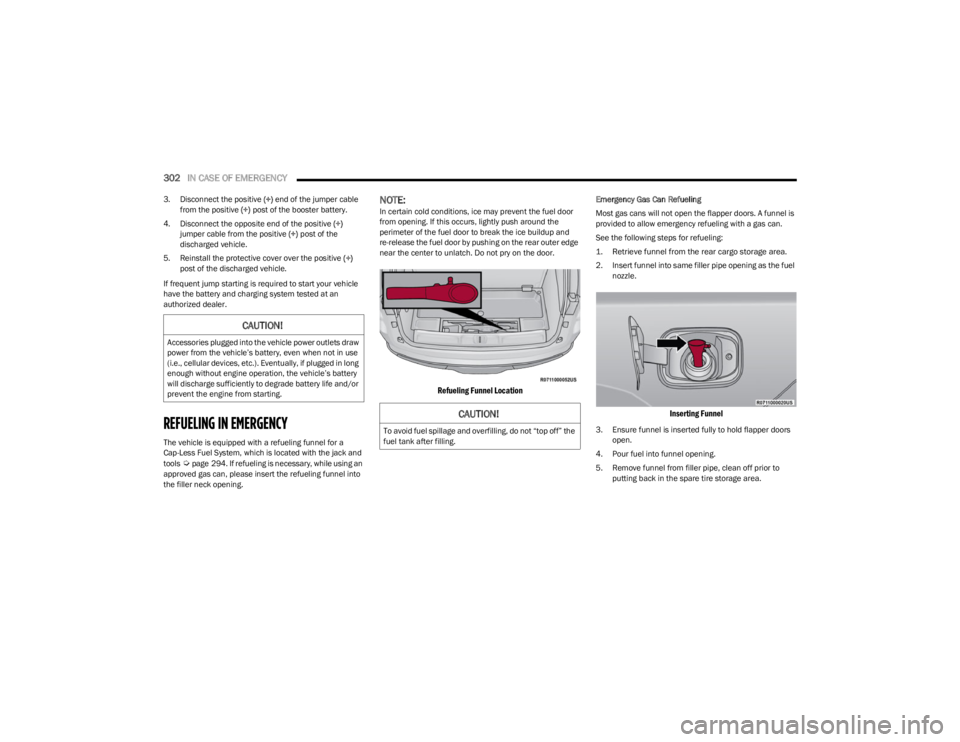
The vehicle is equipped with a refueling funnel for a
Cap-Less Fuel System, which is located with the jack and
tools
Úpage 294. If refueling is necessary, while using an
approved gas can, please insert the refueling funnel into
the filler neck opening.
NOTE:In certain cold conditions, ice may prevent the fuel door
from opening. If this occurs, lightly push around the
perimeter of the fuel door to break the ice buildup and
re-release the fuel door by pushing on the rear outer edge
near the center to unlatch. Do not pry on the door.
Refueling Funnel Location
Emergency Gas Can Refueling
Most gas cans will not open the flapper doors. A funnel is
provided to allow emergency refueling with a gas can.
See the following steps for refueling:
1. Retrieve funnel from the rear cargo storage area.
2. Insert funnel into same filler pipe opening as the fuel nozzle.
Inserting Funnel
3. Ensure funnel is inserted fully to hold flapper doors open.
4. Pour fuel into funnel opening.
5. Remove funnel from filler pipe, clean off prior to putting back in the spare tire storage area.
CAUTION!
Accessories plugged into the vehicle power outlets draw
power from the vehicle’s battery, even when not in use
(i.e., cellular devices, etc.). Eventually, if plugged in long
enough without engine operation, the vehicle’s battery
will discharge sufficiently to degrade battery life and/or
prevent the engine from starting.
CAUTION!
To avoid fuel spillage and overfilling, do not “top off” the
fuel tank after filling.
23_WS_OM_EN_USC_t.book Page 302
Page 305 of 396

IN CASE OF EMERGENCY303
IF YOUR ENGINE OVERHEATS
If the vehicle is overheating, it will need to be serviced by
an authorized dealer.
Potential signs of vehicle overheating can be:
Temperature gauge is at HOT (H)
Strong smell of coolant
White smoke coming from engine or exhaust
Coolant bottle coolant has bubbles present In the event it is observed that the temperature gauge is
moving towards or close to the HOT (H) position, you can
reduce the potential for overheating by taking the
appropriate action.
On the highways — slow down.
In city traffic — while stopped, place the transmission in
NEUTRAL (N), but do not increase the engine idle speed
while preventing vehicle motion with the brakes.
If your Air Conditioner (A/C) is on, turn it off. The A/C
system adds heat to the engine cooling system and
turning the A/C off can help remove this heat.
You can also turn the temperature control to maximum
heat, the mode control to floor and the blower control
to high. This allows the heater core to act as a supple -
ment to the radiator and aids in removing heat from the
engine cooling system.
MANUAL PARK RELEASE
To move the vehicle in cases where the transmission will
not shift out of PARK (P) (such as a depleted battery), a
Manual Park Release is available.
WARNING!
Never have any smoking materials lit in or near the
vehicle when the fuel door is open or the tank is
being filled.
Never add fuel when the engine is running. This is in
violation of most state and federal fire regulations
and may cause the Malfunction Indicator Light to
turn on.
A fire may result if fuel is pumped into a portable
container that is inside of a vehicle. You could be
burned. Always place fuel containers on the ground
while filling.
WARNING!
You or others can be badly burned by hot engine
coolant (antifreeze) or steam from your radiator. If you
see or hear steam coming from under the hood, do not
open the hood until the radiator has had time to cool.
Never try to open a cooling system pressure cap when
the radiator or coolant bottle is hot.
CAUTION!
Driving with a hot cooling system could damage your
vehicle. If the temperature gauge reads HOT (H), as
soon as it’s safe, pull over and stop the vehicle. Idle the
vehicle with the air conditioner turned off until the
pointer drops back into the normal range. If the pointer
remains on HOT (H), and you hear continuous chimes,
turn the engine off immediately and call for service.
WARNING!
You should be seated in the driver’s seat with your foot
firmly placed on the brake pedal to maintain control of
the vehicle before activating the Manual Park Release.
If possible, you should apply the parking brake.
Activating the Manual Park Release will allow your
vehicle to roll away if it is not secured or properly
connected to a tow vehicle. Activating the Manual Park
Release on an unsecured vehicle could lead to serious
injury or death for those in or around the vehicle.
7
23_WS_OM_EN_USC_t.book Page 303
Page 308 of 396

306IN CASE OF EMERGENCY
TOWING A DISABLED VEHICLE
This section describes procedures for towing a disabled vehicle using a commercial towing service.
If the transmission and drivetrain are operable, disabled 4x4 vehicles may also be towed as described on
Úpage 190.
Proper towing or lifting equipment is required to prevent damage to your vehicle. Use only tow bars and other equipment designed for this purpose, following equipment manufacturer’s
instructions. Use of safety chains is mandatory. Attach a tow bar or other towing device to main structural members of the vehicle, not to fascia/bumpers or associated brackets. State
and local laws regarding vehicles under tow must be observed.
NOTE:Vehicle’s equipped with air suspension, must have Tire Jack Mode Úpage 215 enabled to prevent air suspension movement during towing.
If you must use the accessories (wipers, defrosters, etc.) while being towed, the ignition must be in the ON/RUN mode.
If the vehicle's battery is discharged, instructions on shifting the automatic transmission out of PARK (P) in order to move the vehicle
Úpage 303.
Towing Condition Wheels OFF The Ground Rear-Wheel Drive Models
Four-Wheel Drive Models
With Single-Speed Transfer
Case Four-Wheel Drive Models With Two-Speed
Transfer Case
Flat Tow NONE NOT ALLOWEDNOT ALLOWEDDetailed Instructions
Úpage 190
Transmission in PARK
Transfer case in N (Neutral)
Tow in forward direction
Wheel Lift Or Dolly Tow Front
NOT ALLOWEDNOT ALLOWEDNOT ALLOWED
Rear OKNOT ALLOWEDNOT ALLOWED
Flatbed ALL BEST METHODOKBEST METHOD
23_WS_OM_EN_USC_t.book Page 306
Page 312 of 396

310SERVICING AND MAINTENANCE
MAINTENANCE PLAN
Refer to the Maintenance Plans for the required maintenance intervals.
At Every Oil Change Interval As Indicated By Oil Change Indicator System
Change oil and filter.
Rotate the tires at the first sign of irregular wear, even if it occurs before the oil indicator system turns on.
Inspect battery and clean and tighten terminals as required.
Inspect the CV/Universal joints.
Inspect brake pads, shoes, rotors, drums, hoses and parking brake.
Inspect engine cooling system protection and hoses.
Inspect exhaust system.
Inspect engine air cleaner filter if using in dusty or off-road conditions. Replace engine air cleaner filter, as necessary.
Mileage Or Time Passed (Whichever
Comes First)
20,000
30,000
40,000
50,000
60,000
70,000
80,000
90,000
100,000
110,000
120,000
130,000
140,000
150,000
Or Years: 2 3 4 5 6 7 8 9 10 11 12 13 14 15
Or Kilometers:
32,000
48,000
64,000
80,000
96,000
112,000
128,000
144,000
160,000
176,000
192,000
208,000
224,000
240,000
Additional Inspections
Inspect the CV/Universal joints. X X X X X X X X X X X X X X
Inspect front suspension, tie rod ends, and
replace if necessary. X
X X XX XX
23_WS_OM_EN_USC_t.book Page 310
Page 315 of 396
SERVICING AND MAINTENANCE313
ENGINE COMPARTMENT
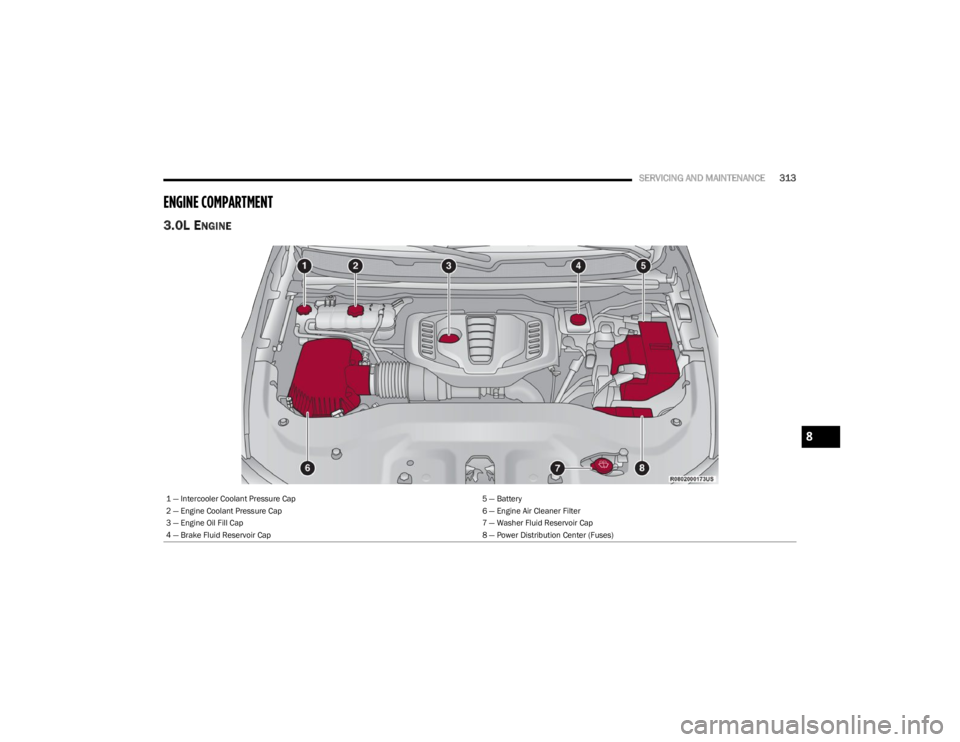
3.0L ENGINE
1 — Intercooler Coolant Pressure Cap 5 — Battery
2 — Engine Coolant Pressure Cap 6 — Engine Air Cleaner Filter
3 — Engine Oil Fill Cap 7 — Washer Fluid Reservoir Cap
4 — Brake Fluid Reservoir Cap 8 — Power Distribution Center (Fuses)
8
23_WS_OM_EN_USC_t.book Page 313
Page 316 of 396
314SERVICING AND MAINTENANCE
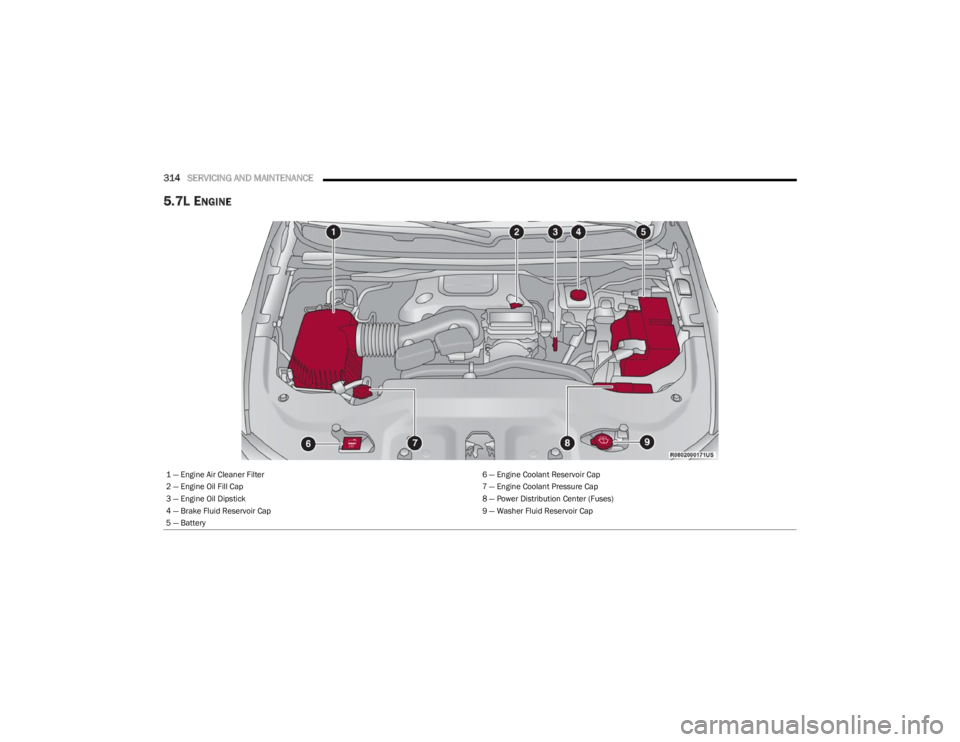
5.7L ENGINE
1 — Engine Air Cleaner Filter 6 — Engine Coolant Reservoir Cap
2 — Engine Oil Fill Cap 7 — Engine Coolant Pressure Cap
3 — Engine Oil Dipstick 8 — Power Distribution Center (Fuses)
4 — Brake Fluid Reservoir Cap 9 — Washer Fluid Reservoir Cap
5 — Battery
23_WS_OM_EN_USC_t.book Page 314
Page 317 of 396
SERVICING AND MAINTENANCE315
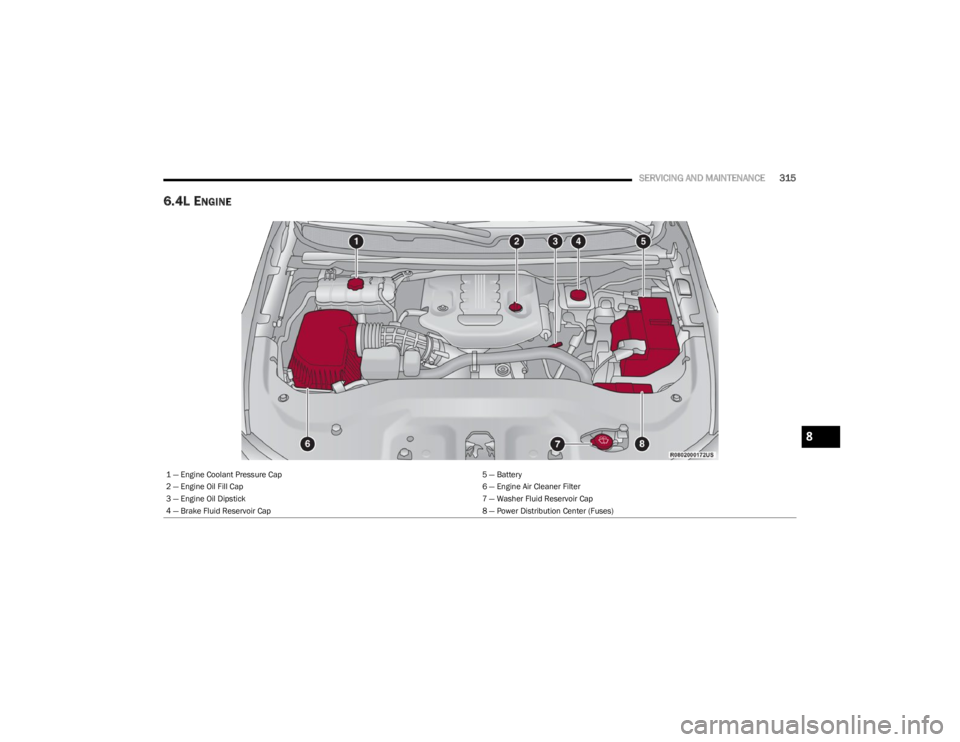
6.4L ENGINE
1 — Engine Coolant Pressure Cap 5 — Battery
2 — Engine Oil Fill Cap 6 — Engine Air Cleaner Filter
3 — Engine Oil Dipstick 7 — Washer Fluid Reservoir Cap
4 — Brake Fluid Reservoir Cap 8 — Power Distribution Center (Fuses)
8
23_WS_OM_EN_USC_t.book Page 315
Page 320 of 396

318SERVICING AND MAINTENANCE
MAINTENANCE-FREE BATTERY
Your vehicle is equipped with a maintenance-free battery.
Water will never have to be added, and periodic
maintenance is not required.
PRESSURE WASHING
Cleaning the engine compartment with a high pressure
washer is not recommended.
VEHICLE MAINTENANCE
An authorized dealer has the qualified service personnel,
special tools, and equipment to perform all service
operations in an expert manner. Service Manuals are
available which include detailed service information for
your vehicle. Refer to these Service Manuals before
attempting any procedure yourself.
NOTE:Intentional tampering with emissions control systems may
void your warranty and could result in civil penalties being
assessed against you.
WARNING!
Battery fluid is a corrosive acid solution and can burn
or even blind you. Do not allow battery fluid to
contact your eyes, skin, or clothing. Do not lean over
a battery when attaching clamps. If acid splashes in
eyes or on skin, flush the area immediately with large
amounts of water. Refer to Jump Starting Procedure
Úpage 301.
Battery gas is flammable and explosive. Keep flame
or sparks away from the battery. Do not use a
booster battery or any other booster source with an
output greater than 12 Volts. Do not allow cable
clamps to touch each other.
Battery posts, terminals, and related accessories
contain lead and lead compounds. Wash hands after
handling.
CAUTION!
It is essential when replacing the cables on the
battery that the positive cable is attached to the posi -
tive post and the negative cable is attached to the
negative post. Battery posts are marked positive (+)
and negative (-) and are identified on the battery
case. Cable clamps should be tight on the terminal
posts and free of corrosion.
If a “fast charger” is used while the battery is in the
vehicle, disconnect both vehicle battery cables
before connecting the charger to the battery. Do not
use a “fast charger” to provide starting voltage.
CAUTION!
Precautions have been taken to safeguard all parts and
connections however, the pressures generated by these
machines is such that complete protection against
water ingress cannot be guaranteed.
WARNING!
You can be badly injured working on or around a motor
vehicle. Only do service work for which you have the
knowledge and the proper equipment. If you have any
doubt about your ability to perform a service job, take
your vehicle to a competent mechanic.
23_WS_OM_EN_USC_t.book Page 318
Page 333 of 396
SERVICING AND MAINTENANCE331
FUSES
General Information
The fuses protect electrical systems against excessive
current.
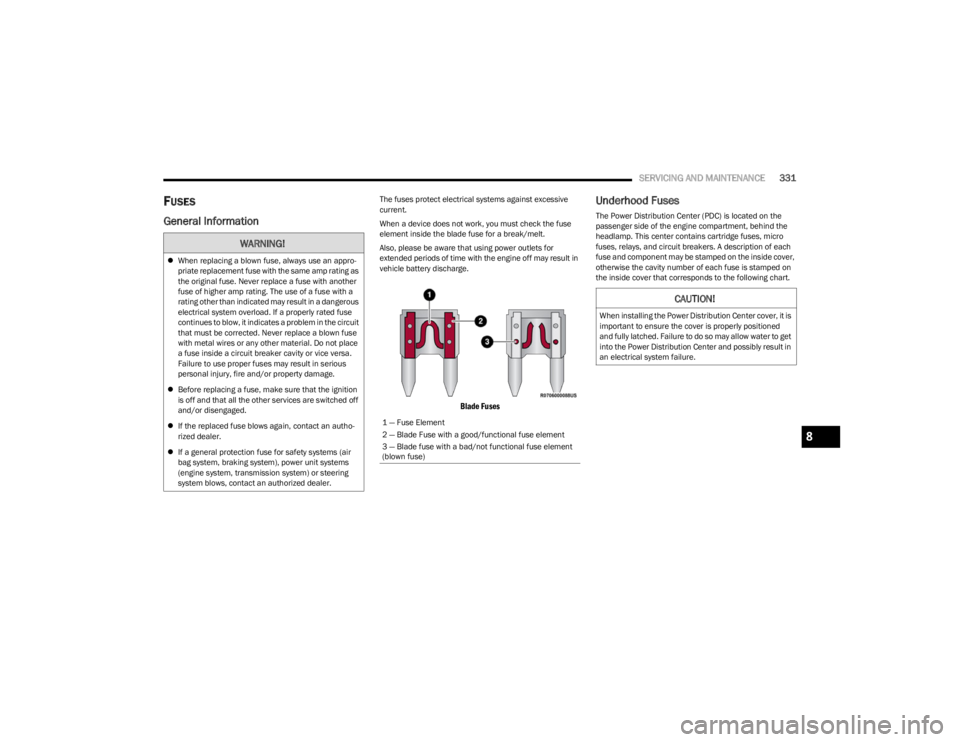
When a device does not work, you must check the fuse
element inside the blade fuse for a break/melt.
Also, please be aware that using power outlets for
extended periods of time with the engine off may result in
vehicle battery discharge.
Blade Fuses
Underhood Fuses
The Power Distribution Center (PDC) is located on the
passenger side of the engine compartment, behind the
headlamp. This center contains cartridge fuses, micro
fuses, relays, and circuit breakers. A description of each
fuse and component may be stamped on the inside cover,
otherwise the cavity number of each fuse is stamped on
the inside cover that corresponds to the following chart.
WARNING!
When replacing a blown fuse, always use an appro -
priate replacement fuse with the same amp rating as
the original fuse. Never replace a fuse with another
fuse of higher amp rating. The use of a fuse with a
rating other than indicated may result in a dangerous
electrical system overload. If a properly rated fuse
continues to blow, it indicates a problem in the circuit
that must be corrected. Never replace a blown fuse
with metal wires or any other material. Do not place
a fuse inside a circuit breaker cavity or vice versa.
Failure to use proper fuses may result in serious
personal injury, fire and/or property damage.
Before replacing a fuse, make sure that the ignition
is off and that all the other services are switched off
and/or disengaged.
If the replaced fuse blows again, contact an autho -
rized dealer.
If a general protection fuse for safety systems (air
bag system, braking system), power unit systems
(engine system, transmission system) or steering
system blows, contact an authorized dealer.
1 — Fuse Element
2 — Blade Fuse with a good/functional fuse element
3 — Blade fuse with a bad/not functional fuse element
(blown fuse)
CAUTION!
When installing the Power Distribution Center cover, it is
important to ensure the cover is properly positioned
and fully latched. Failure to do so may allow water to get
into the Power Distribution Center and possibly result in
an electrical system failure.
8
23_WS_OM_EN_USC_t.book Page 331
Page 335 of 396

SERVICING AND MAINTENANCE333
F04250 Amp Gray –Alternator
F05 80 Amp Gray –Elec Pwr Str #2
F06 Shunt –Aux Battery *
F07 100 Amp Gray –Rad Fan
F08 ––Spare
F09 80 Amp Gray –IPDC
F10 150 Amp Gray –RPDC
F11 150 Amp Gray –PCR *
F12 ––Spare
F13 40 Amp Green –Starter
F14 –10 Amp RedGNMM */ VPMS *
F15 –10 Amp RedECM *
F16 –15 Amp BlueCluster
F17A –10 Amp RedEPS
F17B –10 Amp RedATMM *
F18 ––Spare
F19 30 Amp Pink –BSM #2 Valves *
F20 ––Spare
F21 ––Spare
F22 ––Spare
F23A –10 Amp RedECM / PPU * / MGU * / BSM / SLM
F23B –10 Amp RedAIR SUSPENSION / ELSD-RR / EPS
Cavity Cartridge Fuse Micro Fuse Description
* If Equipped
8
23_WS_OM_EN_USC_t.book Page 333