reset KIA NIRO 2017 Owner's Manual
[x] Cancel search | Manufacturer: KIA, Model Year: 2017, Model line: NIRO, Model: KIA NIRO 2017Pages: 552, PDF Size: 14.92 MB
Page 338 of 552
Driving your vehicle
50
6
Each of these actions will cancel
cruise control operation (the SETindicator light in the instrument clus-ter will go off), but it will not turn thesystem off. If you wish to resumecruise control operation, move thelever up (to RES+). You will return toyour previously preset speed.To resume cruising speed at
more than approximately 20
mph (30 km/h):
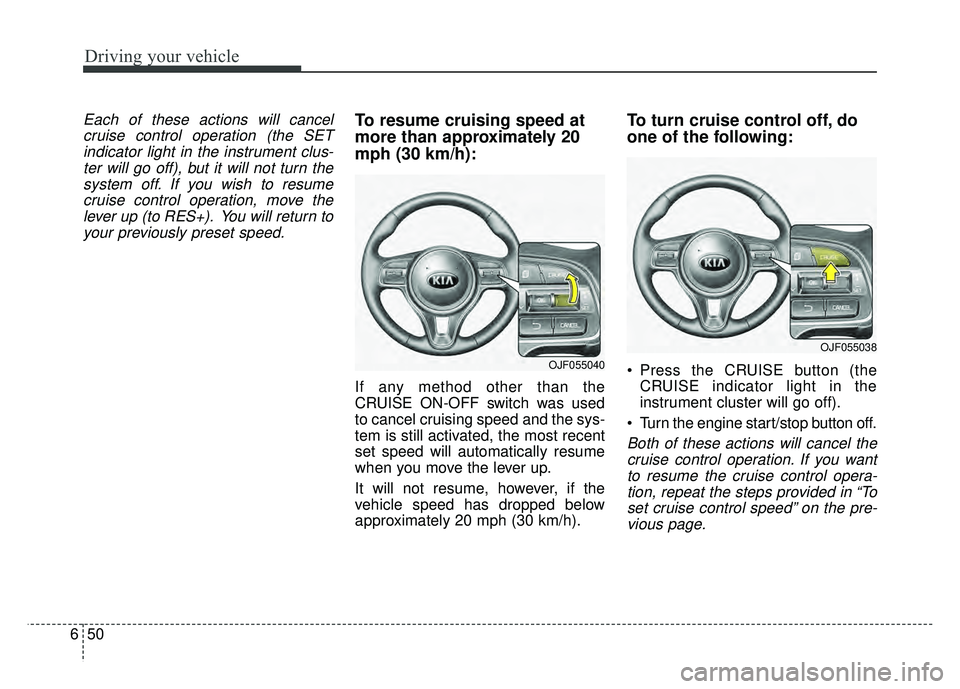
If any method other than the
CRUISE ON-OFF switch was used
to cancel cruising speed and the sys-
tem is still activated, the most recent
set speed will automatically resume
when you move the lever up.
It will not resume, however, if the
vehicle speed has dropped below
approximately 20 mph (30 km/h).
To turn cruise control off, do
one of the following:
Press the CRUISE button (the CRUISE indicator light in the
instrument cluster will go off).
Turn the engine start/stop button off.
Both of these actions will cancel the cruise control operation. If you wantto resume the cruise control opera-tion, repeat the steps provided in “Toset cruise control speed” on the pre-vious page.
OJF055040
OJF055038
Page 344 of 552
Driving your vehicle
56
6
To resume cruise control set
speed:
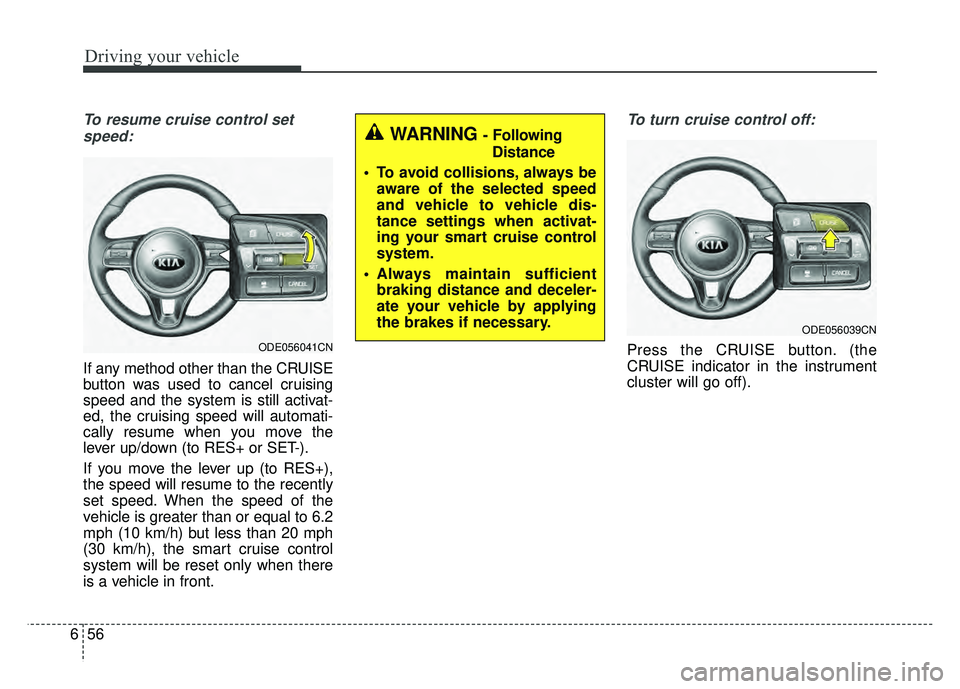
If any method other than the CRUISE
button was used to cancel cruising
speed and the system is still activat-
ed, the cruising speed will automati-
cally resume when you move the
lever up/down (to RES+ or SET-).
If you move the lever up (to RES+),
the speed will resume to the recently
set speed. When the speed of the
vehicle is greater than or equal to 6.2
mph (10 km/h) but less than 20 mph
(30 km/h), the smart cruise control
system will be reset only when there
is a vehicle in front.
To turn cruise control off:
Press the CRUISE button. (the
CRUISE indicator in the instrument
cluster will go off).
ODE056039CN
WARNING - Following Distance
To avoid collisions, always be aware of the selected speed
and vehicle to vehicle dis-
tance settings when activat-
ing your smart cruise control
system.
Always maintain sufficient braking distance and deceler-
ate your vehicle by applying
the brakes if necessary.
ODE056041CN
Page 384 of 552
73
What to do in an emergency
If the engine stalls at a cross-
road or crossing
If the engine stalls at a crossroad or
crossing, set the shift lever in the N
(Neutral) position and then push the
vehicle to a safe place.
If you have a flat tire while
driving
If a tire goes flat while you are driv-
ing:
1. Take your foot off the acceleratorpedal and let the vehicle slow
down while driving straight ahead.
Do not apply the brakes immedi-
ately or attempt to pull off the road
as this may cause a loss of con-
trol. When the vehicle has slowed
to such a speed that it is safe to do
so, brake carefully and pull off the
road. Drive off the road as far as
possible and park on firm level
ground. If you are on a divided
highway, do not park in the median
area between the two traffic lanes. 2. When the vehicle is stopped, turn
on your emergency hazard flash-
ers, set the parking brake and put
the transaxle in P.
3. Have all passengers get out of the vehicle. Be sure they all get out on
the side of the vehicle that is away
from traffic.
4. When changing a flat tire, follow the instruction provided later in
this section.
If the engine stalls while driv-
ing
1. Reduce your speed gradually,keeping a straight line. Move cau-
tiously off the road to a safe place.
2. Turn on your emergency flashers.
3. Try to start the hybrid system again. If your vehicle will not start,
contact an authorized Kia dealer
or seek other qualified assistance.
✽ ✽NOTICE
If there was a check engine light and
loss of power or stall and if safe to do
so, wait at least 10 seconds to restart
the vehicle after it stalls. This may
reset the car so it will no longer run
at low power (limp home) condition.
IN CASE OF AN EMERGENCY WHILE DRIVING
Page 386 of 552
75
What to do in an emergency
EMERGENCY STARTING
Before Jump Starting
Over discharge of 12V battery
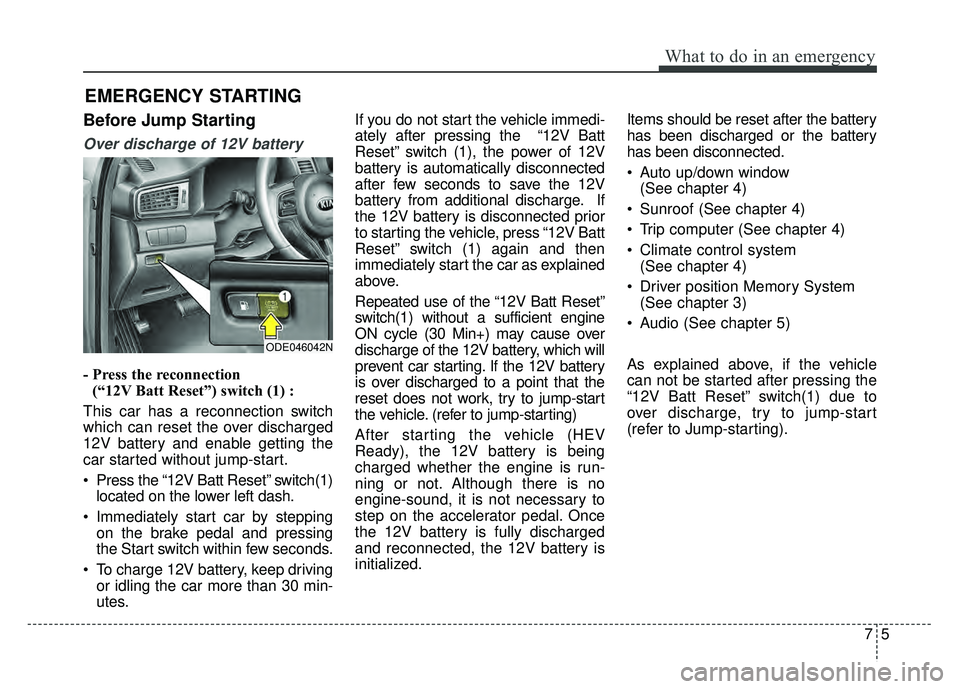
- Press the reconnection(“12V Batt Reset”) switch (1) :
This car has a reconnection switch
which can reset the over discharged
12V battery and enable getting the
car started without jump-start.
Press the “12V Batt Reset” switch(1) located on the lower left dash.
Immediately start car by stepping on the brake pedal and pressing
the Start switch within few seconds.
To charge 12V battery, keep driving or idling the car more than 30 min-
utes. If you do not start the vehicle immedi-
ately after pressing the “12V Batt
Reset” switch (1), the power of 12V
battery is automatically disconnected
after few seconds to save the 12V
battery from additional discharge. If
the 12V battery is disconnected prior
to starting the vehicle, press “12V Batt
Reset” switch (1) again and then
immediately start the car as explained
above.
Repeated use of the “12V Batt Reset”
switch(1) without a sufficient engine
ON cycle (30 Min+) may cause over
discharge of the 12V battery, which will
prevent car starting. If the 12V battery
is over discharged to a point that the
reset does not work, try to jump-start
the vehicle. (refer to jump-starting)
After starting the vehicle (HEV
Ready), the 12V battery is being
charged whether the engine is run-
ning or not. Although there is no
engine-sound, it is not necessary to
step on the accelerator pedal. Once
the 12V battery is fully discharged
and reconnected, the 12V battery is
initialized.
Items should be reset after the battery
has been discharged or the battery
has been disconnected.
Auto up/down window
(See chapter 4)
Sunroof (See chapter 4)
Trip computer (See chapter 4)
Climate control system (See chapter 4)
Driver position Memory System (See chapter 3)
Audio (See chapter 5)
As explained above, if the vehicle
can not be started after pressing the
“12V Batt Reset” switch(1) due to
over discharge, try to jump-start
(refer to Jump-starting).
ODE046042N
Page 387 of 552
What to do in an emergency
67
Charging method for 12V battery
(A) It is recommended to charge the12V battery by starting and run-
ning the vehicle (HEV Ready
Mode) for a minimum of 30 min-
utes if a 12V reset, or jump start
has been used.
(B) If you can not start the vehicle :
After connecting the jumper cables at the recommended locations, you
should press “12V batt Reset”
switch(1) to charge the battery.
The voltage range of the charger should be 13.3~14V and its current
range should be less than 60A.
(13.8V is recommended).
External power source using 12V
battery(Except the use of dash cameras)
The use of external power acces-
sories may reduce performance and
function of the vehicle. Especially,
the use of dash cameras may cause
a shut off the power of the vehicle
prior to the dash camera’s automatic
shut-down.
If the power of the car is shut off,
start the vehicle as explained above
(refer to “Over discharge of 12V bat-
tery”)
CAUTION
• The use of an improper charg- er with a voltage and currentrange higher than specifiedmay cause overheating anddamage to the 12V battery.
The use of an incorrect charg- er will lead to a power shut-offto save the 12V battery. Stopusing the incorrect chargeronce the power of the vehicleis shut off.
Page 469 of 552
Maintenance
46
8
Disc brake pads should be inspected
for wear whenever tires are rotated.
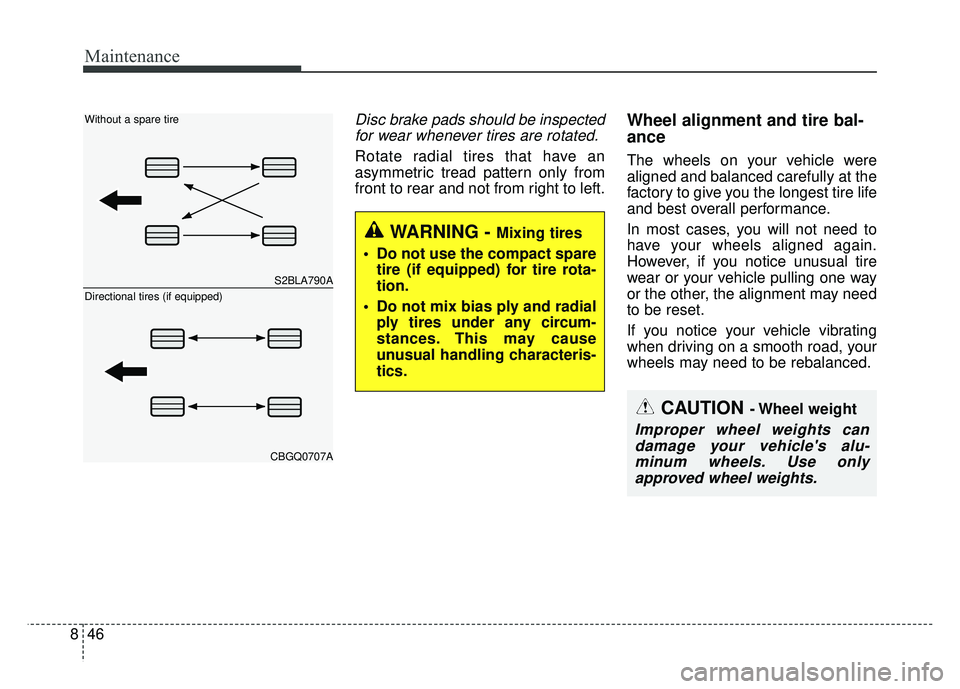
Rotate radial tires that have an
asymmetric tread pattern only from
front to rear and not from right to left.
Wheel alignment and tire bal-
ance
The wheels on your vehicle were
aligned and balanced carefully at the
factory to give you the longest tire life
and best overall performance.
In most cases, you will not need to
have your wheels aligned again.
However, if you notice unusual tire
wear or your vehicle pulling one way
or the other, the alignment may need
to be reset.
If you notice your vehicle vibrating
when driving on a smooth road, your
wheels may need to be rebalanced.
WARNING - Mixing tires
Do not use the compact spare tire (if equipped) for tire rota-
tion.
Do not mix bias ply and radial ply tires under any circum-
stances. This may cause
unusual handling characteris-
tics.
CAUTION - Wheel weight
Improper wheel weights candamage your vehicle's alu-minum wheels. Use onlyapproved wheel weights.
S2BLA790A
CBGQ0707A
Without a spare tire
Directional tires (if equipped)
Page 484 of 552
861
Maintenance
Fuse switch
Always set the fuse switch to the ON
position before using the vehicle.
If you move the switch to the OFF
position, some items such as audio
and digital clock must be reset and
transmitter (or smart key) may not
work properly. When the switch is
Off, the caution indicator will be dis-
played on the instrument cluster.
Always place the fuse switch in the
ON position while driving the vehicle.
If the switch is located in the “OFF”
position, a caution indicator will be
displayed in the cluster.
Engine compartment fuse
replacement
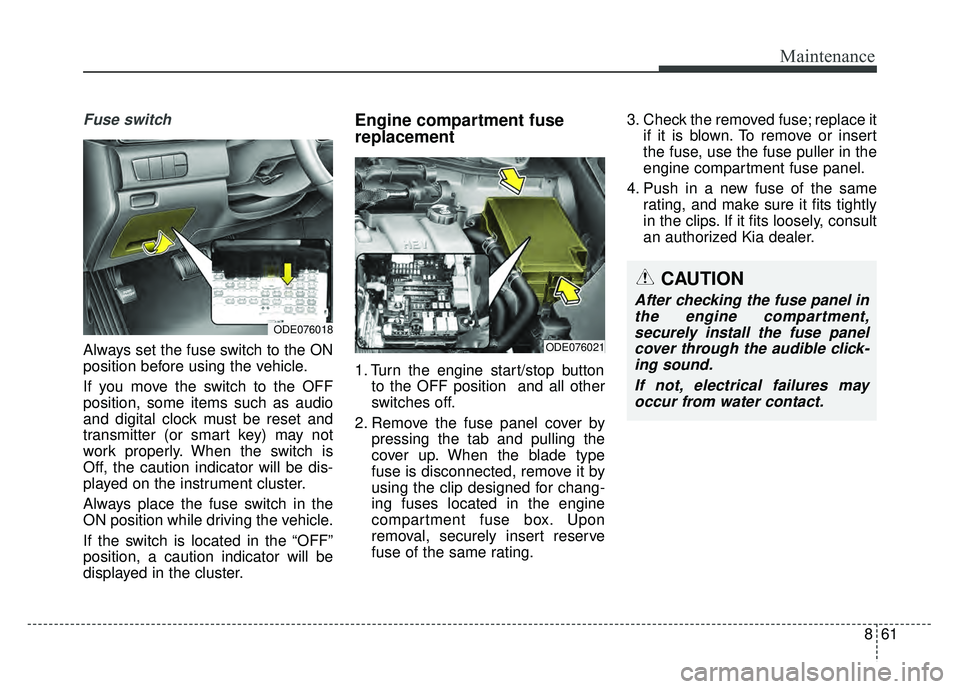
1. Turn the engine start/stop buttonto the OFF position and all other
switches off.
2. Remove the fuse panel cover by pressing the tab and pulling the
cover up. When the blade type
fuse is disconnected, remove it by
using the clip designed for chang-
ing fuses located in the engine
compartment fuse box. Upon
removal, securely insert reserve
fuse of the same rating. 3. Check the removed fuse; replace it
if it is blown. To remove or insert
the fuse, use the fuse puller in the
engine compartment fuse panel.
4. Push in a new fuse of the same rating, and make sure it fits tightly
in the clips. If it fits loosely, consult
an authorized Kia dealer.
CAUTION
After checking the fuse panel inthe engine compartment,securely install the fuse panelcover through the audible click-ing sound.
If not, electrical failures mayoccur from water contact.
ODE076018
ODE076021
Page 548 of 552
I11
Index
Self-diagnosis . . . . . . . . . . . . . . . . . . . . . . . . . . . . . . 4-93
Rear seat Folding the rear seat . . . . . . . . . . . . . . . . . . . . . . . . . 3-16
Rear view camera . . . . . . . . . . . . . . . . . . . . . . . . . . . . . 4-99
Recommended lubricants and capacities . . . . . . . . . . . . 9-6 Recommended SAE viscosity number. . . . . . . . . . . . 9-7
Reducing the risk of a rollover . . . . . . . . . . . . . . . . . . . 6-80
Refrigerant label . . . . . . . . . . . . . . . . . . . . . . . . . . . . . . 9-10
Remote control (outside rear view mirror) . . . . . . . . . . 4-48
Reporting safety defects . . . . . . . . . . . . . . . . . . . . . . . . 9-15
Resetting the sunroof . . . . . . . . . . . . . . . . . . . . . . . . . . 4-40
Road warning . . . . . . . . . . . . . . . . . . . . . . . . . . . . . . . . . 7-2
Rocking the vehicle . . . . . . . . . . . . . . . . . . . . . . . . . . . 6-81
Room lamp . . . . . . . . . . . . . . . . . . . . . . . . . . . . . . . . . 4-109
Room lamp bulb replacement . . . . . . . . . . . . . . . . . . . . 8-86
Rotation (Tire) . . . . . . . . . . . . . . . . . . . . . . . . . . . . . . . 8-45
Scheduled maintenance service . . . . . . . . . . . . . . . . . . . 8-8 Maintenance Under Severe Usage Conditions. . . . . 8-20
Normal Maintenance Schedule . . . . . . . . . . . . . . . . . 8-9
Seat belt restraint system . . . . . . . . . . . . . . . . . . . . . . . 3-19
Seat belts . . . . . . . . . . . . . . . . . . . . . . . . . . . . . . . . . . . . \
3-19 Care of seat belts . . . . . . . . . . . . . . . . . . . . . . . . . . . 3-30
"Driver's 3-point systemwith emergencylocking retractor" . . . . . . . . . . . . . . . . . . . . . . . . . . 3-22 "Front passenger andrear seat 3-point system
withcombination locking retractor" . . . . . . . . . . . . 3-23
Front seat belt warning. . . . . . . . . . . . . . . . . . . . . . . 3-21
Precautions . . . . . . . . . . . . . . . . . . . . . . . . . . . . . . . . 3-28
Pre-tensioner seat belt . . . . . . . . . . . . . . . . . . . . . . . 3-25
Seat belt restraint system . . . . . . . . . . . . . . . . . . . . . 3-19
Seat warmer . . . . . . . . . . . . . . . . . . . . . . . . . . . . . . . . 4-136
Seatback pocket (front) . . . . . . . . . . . . . . . . . . . . . . . . . 3-14
Seats . . . . . . . . . . . . . . . . . . . . . . . . . . . . . . . . . . . . \
. . . . 3-4 Front seat adjustment (manual) . . . . . . . . . . . . . . . . . 3-7
Front seat adjustment (power) . . . . . . . . . . . . . . . . . . 3-8
Headrest (rear) . . . . . . . . . . . . . . . . . . . . . . . . . . . . . 3-14
Headrest(front) . . . . . . . . . . . . . . . . . . . . . . . . . . . . . 3-11
Seatback pocket (front) . . . . . . . . . . . . . . . . . . . . . . 3-14
Service Mode . . . . . . . . . . . . . . . . . . . . . . . . . . . . . . . . 4-66
Shift-lock override - Dual clutch transmission. . . . . . . 6-20
Side air bag . . . . . . . . . . . . . . . . . . . . . . . . . . . . . . . . . . 3-60\
Side repeater lamp (LED type) bulb replacement . . . . 8-85
Sliding the sunroof . . . . . . . . . . . . . . . . . . . . . . . . . . . . 4-38
Smart cruise control system . . . . . . . . . . . . . . . . . . . . . 6-51 Limitations of the system . . . . . . . . . . . . . . . . . . . . . 6-61
Speed setting . . . . . . . . . . . . . . . . . . . . . . . . . . . . . . 6-52
To adjust the sensitivity of Smart Cruise Control . . 6-60
To convert to cruise control mode . . . . . . . . . . . . . . 6-60
Vehicle to vehicle distance setting . . . . . . . . . . . . . . 6-57
Smart key . . . . . . . . . . . . . . . . . . . . . . . . . . . . . . . . . . . 4-\
11 Battery replacement . . . . . . . . . . . . . . . . . . . . . . . . . 4-15
Loss of the smart key . . . . . . . . . . . . . . . . . . . . . . . . 4-14
S
Page 549 of 552
Index
12I
Record your key number . . . . . . . . . . . . . . . . . . . . . 4-11
Smart key function . . . . . . . . . . . . . . . . . . . . . . . . . . 4-11
Smart key immobilizer system. . . . . . . . . . . . . . . . . 4-15
Smart key precautions . . . . . . . . . . . . . . . . . . . . . . . 4-14
Smooth cornering . . . . . . . . . . . . . . . . . . . . . . . . . . . . . 6-82
Snow tires . . . . . . . . . . . . . . . . . . . . . . . . . . . . . . . . . . . 6-\
85
Spare tire Changing tires . . . . . . . . . . . . . . . . . . . . . . . . . . . . . 7-20
Compact spare tire . . . . . . . . . . . . . . . . . . . . . . . . . . 7-24
Removing the spare tire . . . . . . . . . . . . . . . . . . . . . . 7-19
Storing the spare tire . . . . . . . . . . . . . . . . . . . . . . . . 7-19
Special driving conditions . . . . . . . . . . . . . . . . . . . . . . 6-80 Driving at night . . . . . . . . . . . . . . . . . . . . . . . . . . . . 6-82
Driving in flooded areas. . . . . . . . . . . . . . . . . . . . . . 6-83
Driving in the rain . . . . . . . . . . . . . . . . . . . . . . . . . . 6-83
Driving off-road . . . . . . . . . . . . . . . . . . . . . . . . . . . . 6-83
Hazardous driving conditions . . . . . . . . . . . . . . . . . 6-80
Highway driving . . . . . . . . . . . . . . . . . . . . . . . . . . . . 6-84
Reducing the risk of a rollover. . . . . . . . . . . . . . . . . 6-80
Rocking the vehicle . . . . . . . . . . . . . . . . . . . . . . . . . 6-81
Smooth cornering . . . . . . . . . . . . . . . . . . . . . . . . . . . 6-82
Speedometer . . . . . . . . . . . . . . . . . . . . . . . . . . . . . . . . . 4-53
SRS Care. . . . . . . . . . . . . . . . . . . . . . . . . . . . . . . . . . . . \
3-66
SRS components and functions . . . . . . . . . . . . . . . . . . 3-46
Starting difficulties, see engine will not start . . . . . . . . . 7-4
Starting the engine - With a smart key . . . . . . . . . . . . . . 6-9
Starting the hybrid system - With an ignition key . . . . . 6-7
Steering wheel . . . . . . . . . . . . . . . . . . . . . . . . . . . . . . . 4-42 Electronic power steering. . . . . . . . . . . . . . . . . . . . . 4-42
Heated steering wheel . . . . . . . . . . . . . . . . . . . . . . . 4-44
Horn . . . . . . . . . . . . . . . . . . . . . . . . . . . . . . . . . . . . \
. 4-45
Tilt and telescopic steering. . . . . . . . . . . . . . . . . . . . 4-43
Stop and tail lamp (LED type) bulb replacement. . . . . 8-83
Stop and tail lamp bulb replacement . . . . . . . . . . . . . . 8-81
Storage compartment . . . . . . . . . . . . . . . . . . . . . . . . . 4-133 Center console storage . . . . . . . . . . . . . . . . . . . . . . 4-133
Glove box . . . . . . . . . . . . . . . . . . . . . . . . . . . . . . . . 4-133
Sunglass holder . . . . . . . . . . . . . . . . . . . . . . . . . . . 4-134
Sunglass holder . . . . . . . . . . . . . . . . . . . . . . . . . . . . . . 4-134
Sunroof . . . . . . . . . . . . . . . . . . . . . . . . . . . . . . . . . . . . \
4-37 Resetting the sunroof . . . . . . . . . . . . . . . . . . . . . . . . 4-40
Sliding the sunroof . . . . . . . . . . . . . . . . . . . . . . . . . . 4-38
Sunroof open warning . . . . . . . . . . . . . . . . . . . . . . . 4-38
Sunshade. . . . . . . . . . . . . . . . . . . . . . . . . . . . . . . . . . 4-40\
Tilting the sunroof . . . . . . . . . . . . . . . . . . . . . . . . . . 4-39
Sunroof open warning . . . . . . . . . . . . . . . . . . . . . . . . . 4-38
Sunshade . . . . . . . . . . . . . . . . . . . . . . . . . . . . . . . . . . . . \
4-40
Sunvisor . . . . . . . . . . . . . . . . . . . . . . . . . . . . . . . . . . . 4-\
139
Tail lamp (inside) bulb replacement . . . . . . . . . . . . . . . 8-82
Tailgate room lamp bulb replacement . . . . . . . . . . . . . 8-87
Tether Anchor system . . . . . . . . . . . . . . . . . . . . . . . . . . 3-38
Theft-alarm stage . . . . . . . . . . . . . . . . . . . . . . . . . . . . . 4-18
Theft-alarm system . . . . . . . . . . . . . . . . . . . . . . . . . . . . 4-17
T