display KIA NIRO HYBRID EV 2022 Workshop Manual
[x] Cancel search | Manufacturer: KIA, Model Year: 2022, Model line: NIRO HYBRID EV, Model: KIA NIRO HYBRID EV 2022Pages: 684, PDF Size: 9.67 MB
Page 356 of 684
529
Driving your vehicle
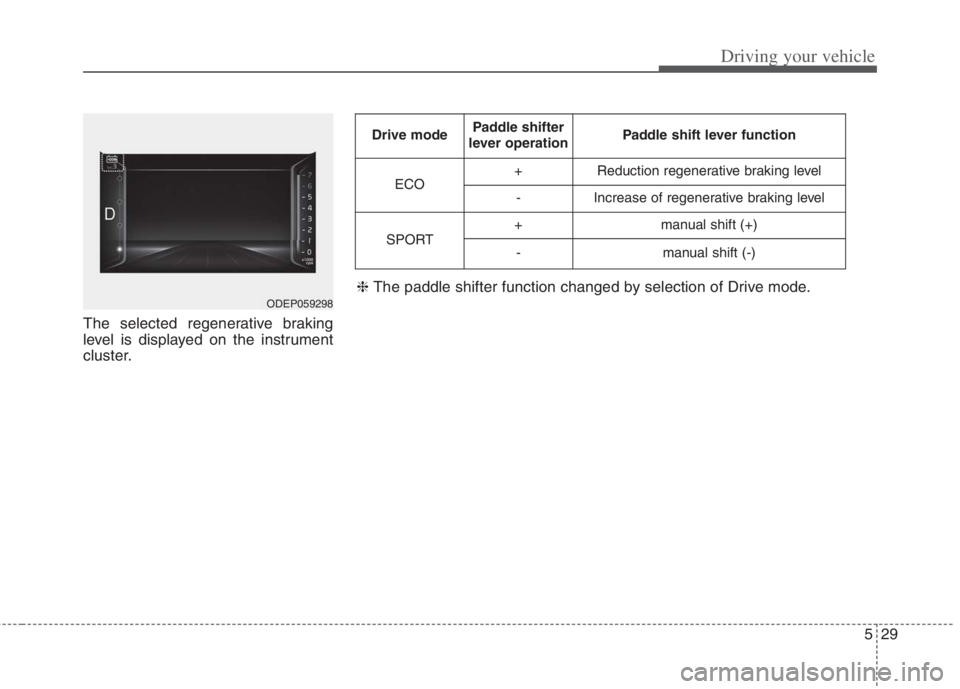
The selected regenerative braking
level is displayed on the instrument
cluster.
ODEP059298
Drive modePaddle shifter
lever operationPaddle shift lever function
ECO+Reduction regenerative braking level
-Increase of regenerative braking level
SPORT+manual shift (+)
-manual shift (-)
❈ The paddle shifter function changed by selection of Drive mode.
Page 357 of 684
Driving your vehicle
30 5
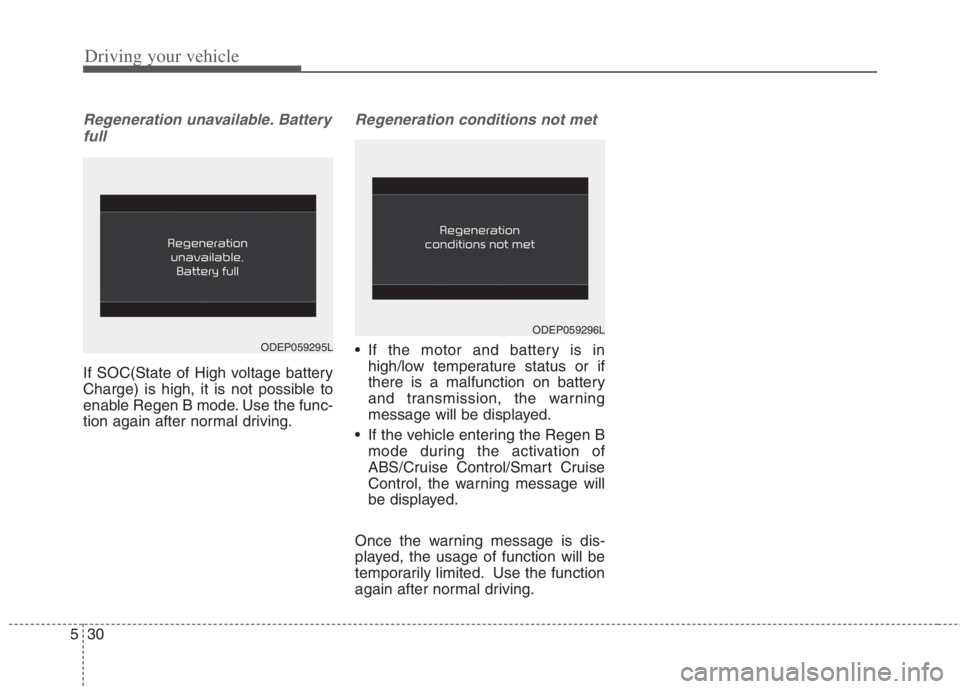
Regeneration unavailable. Battery
full
If SOC(State of High voltage battery
Charge) is high, it is not possible to
enable Regen B mode. Use the func-
tion again after normal driving.
Regeneration conditions not met
If the motor and battery is in
high/low temperature status or if
there is a malfunction on battery
and transmission, the warning
message will be displayed.
If the vehicle entering the Regen B
mode during the activation of
ABS/Cruise Control/Smart Cruise
Control, the warning message will
be displayed.
Once the warning message is dis-
played, the usage of function will be
temporarily limited. Use the function
again after normal driving.
ODEP059296L
ODEP059295L
Page 371 of 684
Driving your vehicle
44 5
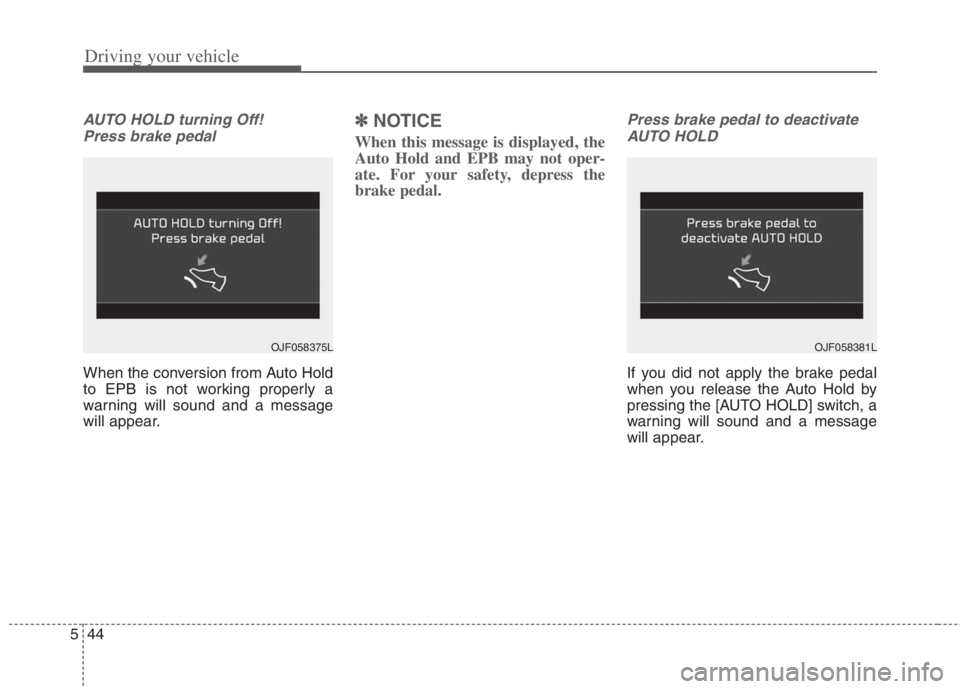
AUTO HOLD turning Off!
Press brake pedal
When the conversion from Auto Hold
to EPB is not working properly a
warning will sound and a message
will appear.
✽ ✽
NOTICE
When this message is displayed, the
Auto Hold and EPB may not oper-
ate. For your safety, depress the
brake pedal.
Press brake pedal to deactivate
AUTO HOLD
If you did not apply the brake pedal
when you release the Auto Hold by
pressing the [AUTO HOLD] switch, a
warning will sound and a message
will appear.
OJF058375LOJF058381L
Page 372 of 684
![KIA NIRO HYBRID EV 2022 Workshop Manual 545
Driving your vehicle
AUTO HOLD conditions not met.
Close door and hood
When you press the [AUTO HOLD]
switch, if the driver’s door, engine
hood are not closed, a warning will
sound and a message](/img/2/58909/w960_58909-371.png "KIA NIRO HYBRID EV 2022 Workshop Manual 545
Driving your vehicle
AUTO HOLD conditions not met.
Close door and hood
When you press the [AUTO HOLD]
switch, if the driver’s door, engine
hood are not closed, a warning will
sound and a message")
545
Driving your vehicle
AUTO HOLD conditions not met.
Close door and hood
When you press the [AUTO HOLD]
switch, if the driver’s door, engine
hood are not closed, a warning will
sound and a message will appear on
the LCD display. At this moment,
press the [AUTO HOLD] button after
closing the driver’s door and hood.
Anti-lock brake system (ABS)
ABS (or ESC) will not prevent acci-
dents due to improper or dangerous
driving maneuvers. Even though
vehicle control is improved during
emergency braking, always maintain
a safe distance between you and
objects ahead. Vehicle speeds
should always be reduced during
extreme road conditions. The vehicle
should be driven at reduced speeds
in the following circumstances:
When driving on rough, gravel or
snow-covered roads
When driving on roads where the
road surface is pitted or has differ-
ent surface heights.
Driving in these conditions increases
the stopping distance for your vehicle.The ABS continuously senses the
speed of the wheels. If the wheels
are going to lock, the ABS system
repeatedly modulates the hydraulic
brake pressure to the wheels.
When you apply your brakes under
conditions which may lock the
wheels, you may hear a “tik-tik’’
sound from the brakes, or feel a cor-
responding sensation in the brake
pedal. This is normal and it means
your ABS is active.
In order to obtain the maximum benefit
from your ABS in an emergency situa-
tion, do not attempt to modulate your
brake pressure and do not try to pump
your brakes. Press your brake pedal as
hard as possible to allow the ABS to
control the force being delivered to the
brakes.
✽ ✽
NOTICE
A click sound may be heard in the
engine compartment when the vehi-
cle begins to move after the engine is
started. These conditions are normal
and indicate that the anti-lock brake
system is functioning properly.
ODEP059313L
Page 382 of 684
555
Driving your vehicle
The warning light illumi-
nates on the LCD display,
when you cancel Forward
Collision-Avoidance
Assist. The driver can monitor the
Forward Collision-Avoidance Assist
ON/OFF status on the LCD display.
Also, the warning light illuminates
when the ESC (Electronic Stability
Control) is turned off. When the
warning light remains ON with
Forward Collision-Avoidance Assist
activated, have your vehicle inspect-
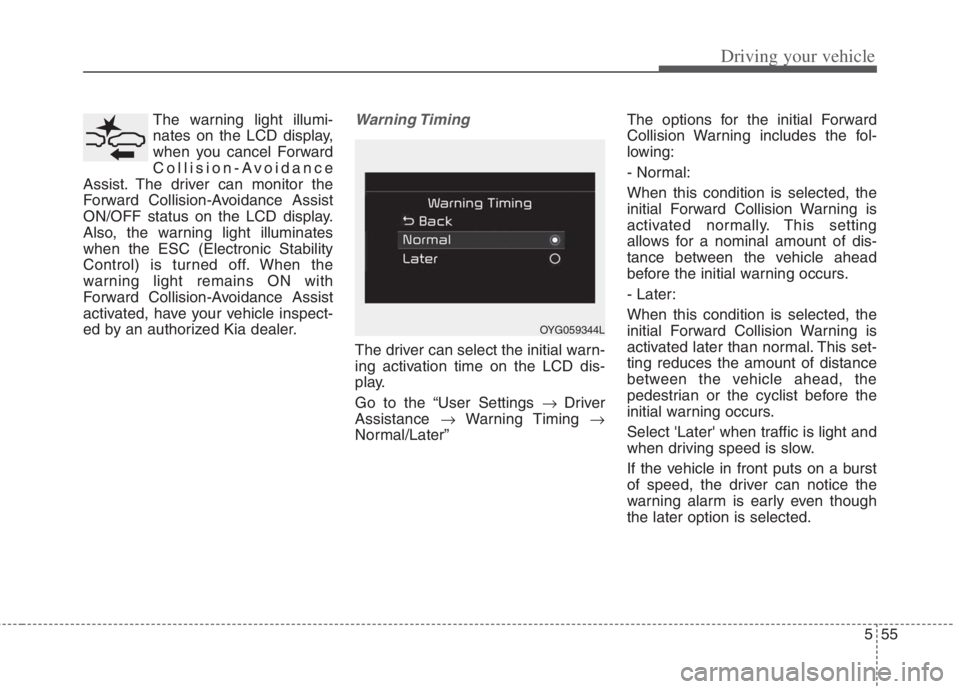
ed by an authorized Kia dealer.Warning Timing
The driver can select the initial warn-
ing activation time on the LCD dis-
play.
Go to the “User Settings Driver
Assistance Warning Timing
Normal/Later”The options for the initial Forward
Collision Warning includes the fol-
lowing:
- Normal:
When this condition is selected, the
initial Forward Collision Warning is
activated normally. This setting
allows for a nominal amount of dis-
tance between the vehicle ahead
before the initial warning occurs.
- Later:
When this condition is selected, the
initial Forward Collision Warning is
activated later than normal. This set-
ting reduces the amount of distance
between the vehicle ahead, the
pedestrian or the cyclist before the
initial warning occurs.
Select 'Later' when traffic is light and
when driving speed is slow.
If the vehicle in front puts on a burst
of speed, the driver can notice the
warning alarm is early even though
the later option is selected.
OYG059344L
Page 383 of 684
Driving your vehicle
56
5
✽
✽
NOTICE
If you change the warning timing,
the warning timing of other func-
tions may change. Always be aware
of warning timing before changing
the warning timing.
Prerequisite for activation
Forward Collision-Avoidance Assist
gets ready to be activated, when the
“Active assist” or “Warning only”
under the Forward Safety is selected
on the LCD display, and when the fol-
lowing prerequisites are satisfied.
- The ESC is activated.
- The driving speed is over 8 km/h (5
mph). (However, Forward Collision-
Avoidance Assist is activated with-
in certain driving speed.)
- When recognizing the vehicle or the pedestrian or the cyclist in front.
(However, Forward Collision-
Avoidance Assist does not activate
according to conditions in front and
vehicle functions, but it notices only
certain warnings.)
- Forward Collision-Avoidance Assist does not operate properly or it only
produces a warning alarms in
accordance with the driving or vehi-
cle condition.
- If the warning only under the Forward Safety is selected, Forward
Collision-Avoidance Assist pro-
duces only warning alarms in accor-
dance with the collision risk levels.
✽ ✽ NOTICE
Forward Collision-Avoidance Assist
may not operate properly according
to the frontal situation, the direction
of pedestrian or cyclist and speed.
Page 384 of 684
557
Driving your vehicle
Forward Collision-Avoidance
Assist warning message and
function control
Forward Collision-Avoidance Assist
produces warning messages and
warning alarms in accordance with
the collision risk levels of followings
like vehicle’s sudden braking in front
or lack of vehicle distance or collision
to pedestrian or cyclist. Also, it con-
trols the brakes in accordance with
the collision risk levels.
The driver can select the initial warn-
ing activation time in the User set-
tings in the LCD display. The
options for the initial Forward
Collision Warning include Normal or
Late initial warning time.
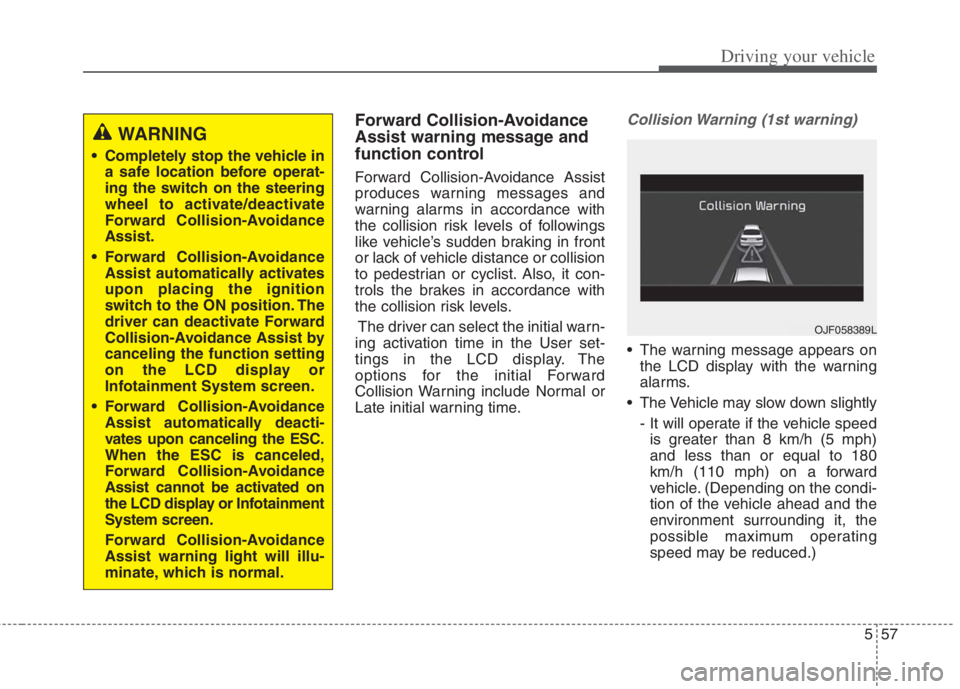
Collision Warning (1st warning)
The warning message appears on
the LCD display with the warning
alarms.
The Vehicle may slow down slightly
- It will operate if the vehicle speed
is greater than 8 km/h (5 mph)
and less than or equal to 180
km/h (110 mph) on a forward
vehicle. (Depending on the condi-
tion of the vehicle ahead and the
environment surrounding it, the
possible maximum operating
speed may be reduced.)
WARNING
Completely stop the vehicle in
a safe location before operat-
ing the switch on the steering
wheel to activate/deactivate
Forward Collision-Avoidance
Assist.
Forward Collision-Avoidance
Assist automatically activates
upon placing the ignition
switch to the ON position. The
driver can deactivate Forward
Collision-Avoidance Assist by
canceling the function setting
on the LCD display or
Infotainment System screen.
Forward Collision-Avoidance
Assist automatically deacti-
vates upon canceling the ESC.
When the ESC is canceled,
Forward Collision-Avoidance
Assist cannot be activated on
the LCD display or Infotainment
System screen.
Forward Collision-Avoidance
Assist warning light will illu-
minate, which is normal.
OJF058389L
Page 385 of 684
Driving your vehicle
58 5
- For pedestrian and cyclist, the
vehicle speed is greater than or
equal to 8 km/h (5 mph) and less
than 70 km/h (45 mph).
(Depending on the condition of
pedestrian and bike riders and
the surrounding environment the
possible maximum operating
speed may be reduced.)
Forward Collision-Avoidance Assist
controls the brakes within certain
limit to release shock from the colli-
sion.
- If you select “Warning Only”,
Forward Collision-Avoidance
Assist activates and produces
only warning alarms in accor-
dance with the collision risk lev-
els. You should control the brake
directly because Forward
Collision-Avoidance Assist do not
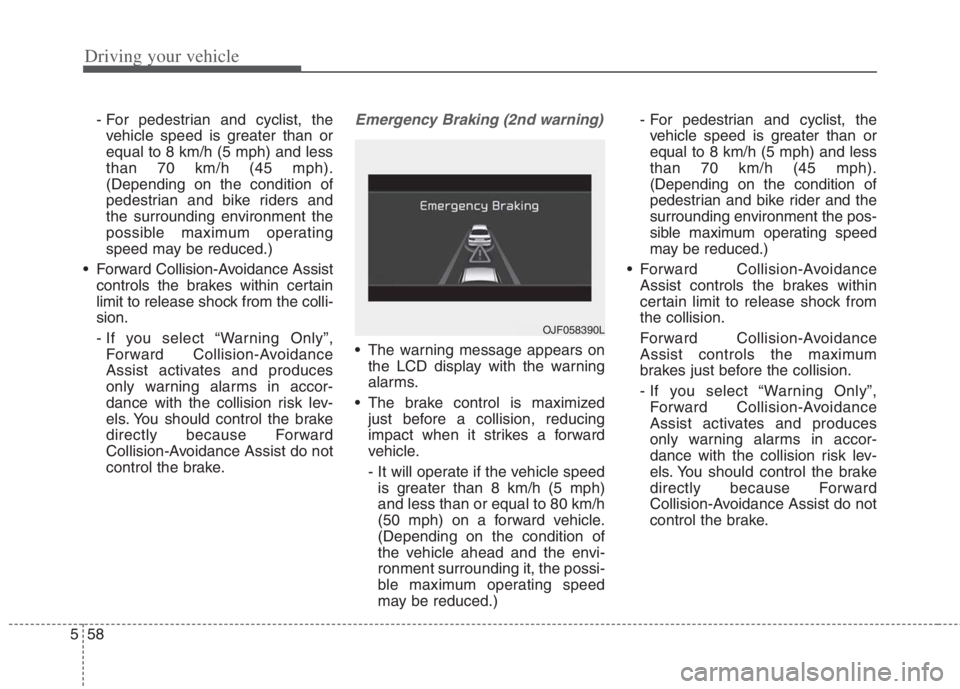
control the brake.Emergency Braking (2nd warning)
The warning message appears on
the LCD display with the warning
alarms.
The brake control is maximized
just before a collision, reducing
impact when it strikes a forward
vehicle.
- It will operate if the vehicle speed
is greater than 8 km/h (5 mph)
and less than or equal to 80 km/h
(50 mph) on a forward vehicle.
(Depending on the condition of
the vehicle ahead and the envi-
ronment surrounding it, the possi-
ble maximum operating speed
may be reduced.)- For pedestrian and cyclist, the
vehicle speed is greater than or
equal to 8 km/h (5 mph) and less
than 70 km/h (45 mph).
(Depending on the condition of
pedestrian and bike rider and the
surrounding environment the pos-
sible maximum operating speed
may be reduced.)
Forward Collision-Avoidance
Assist controls the brakes within
certain limit to release shock from
the collision.
Forward Collision-Avoidance
Assist controls the maximum
brakes just before the collision.
- If you select “Warning Only”,
Forward Collision-Avoidance
Assist activates and produces
only warning alarms in accor-
dance with the collision risk lev-
els. You should control the brake
directly because Forward
Collision-Avoidance Assist do not
control the brake.
OJF058390L
Page 389 of 684
Driving your vehicle
62 5
WARNING
Forward Collision-Avoidance
Assist is only a supplemental
function for the driver’s con-
venience. The driver has the
ultimate responsibility to con-
trol and operate the vehicle
safely. Do not solely depend on
Forward Collision-Avoidance
Assist. Rather, maintain a safe
braking distance, and, if neces-
sary, depress the brake pedal
to lower the driving speed.
In certain instances and under
certain driving conditions,
Forward Collision-Avoidance
Assist may activate uninten-
tionally. This initial warning
message appears on the LCD
display with a warning chime.
(Continued)
(Continued)
Also, in certain instances the
front view camera or front
radar recognition function may
not detect the vehicle, pedestri-
an or cyclist (if equipped)
ahead. Forward Collision-
Avoidance Assist may not acti-
vate and the warning message
will not be displayed.
Forward Collision-Avoidance
Assist may unnecessarily pro-
duce the warning message
and the warning alarms. Also,
due to the sensing limitation,
Forward Collision-Avoidance
Assist may not produce the
warning message and the
warning alarm at all.
When there is a malfunction
with Forward Collision-
Avoidance Assist, the braking
control does not operate upon
detecting a collision risk even
with other braking systems
normally operating.
(Continued)(Continued)
Forward Collision-Avoidance
Assist operates only for the
vehicle/pedestrian in front, while
driving forward. It does not oper-
ate for any animals or vehicles
in the opposite direction.
Forward Collision-Avoidance
Assist does not recognize the
vehicle, which transversally
drives across the crossroad,
or the vehicle, which is parked
in the transversal direction.
If the vehicle in front stops
suddenly, you may have less
control of the brake system.
Therefore, always keep safe
distance between your vehicle
and the vehicle in front of you.
Forward Collision-Avoidance
Assist may activate during
braking and the vehicle may
stop suddenly. And the load in
the vehicle may endanger pas-
sengers. Therefore, always be
mindful of the load volume in
the vehicle.
(Continued)
Page 399 of 684
Driving your vehicle
72 5
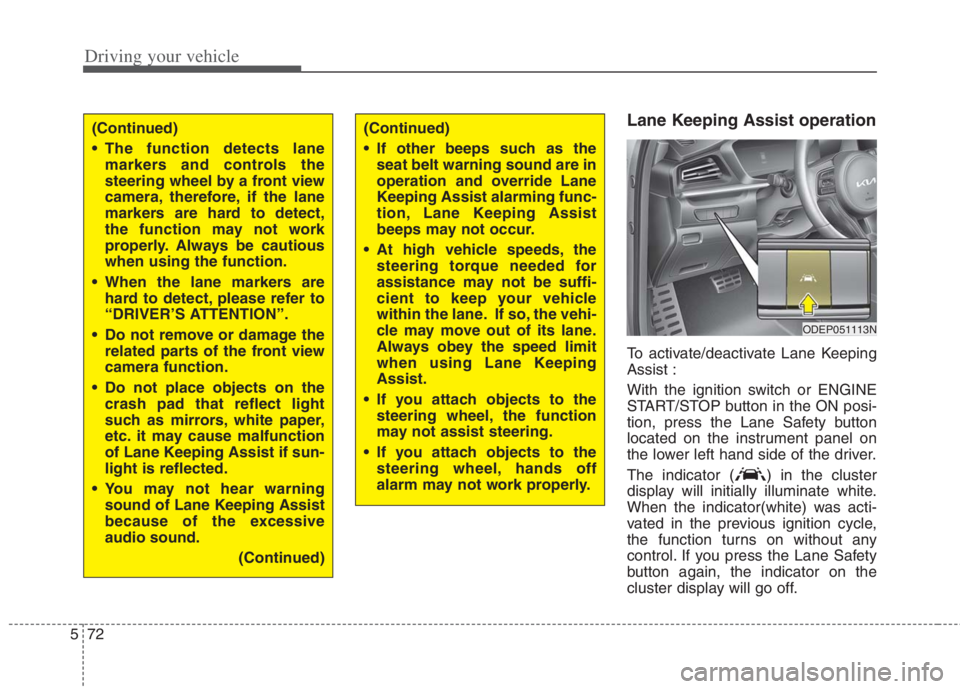
Lane Keeping Assist operation
To activate/deactivate Lane Keeping
Assist :
With the ignition switch or ENGINE
START/STOP button in the ON posi-
tion, press the Lane Safety button
located on the instrument panel on
the lower left hand side of the driver.
The indicator ( ) in the cluster
display will initially illuminate white.
When the indicator(white) was acti-
vated in the previous ignition cycle,
the function turns on without any
control. If you press the Lane Safety
button again, the indicator on the
cluster display will go off.
(Continued)
The function detects lane
markers and controls the
steering wheel by a front view
camera, therefore, if the lane
markers are hard to detect,
the function may not work
properly. Always be cautious
when using the function.
When the lane markers are
hard to detect, please refer to
“DRIVER’S ATTENTION”.
Do not remove or damage the
related parts of the front view
camera function.
Do not place objects on the
crash pad that reflect light
such as mirrors, white paper,
etc. it may cause malfunction
of Lane Keeping Assist if sun-
light is reflected.
You may not hear warning
sound of Lane Keeping Assist
because of the excessive
audio sound.
(Continued)(Continued)
If other beeps such as the
seat belt warning sound are in
operation and override Lane
Keeping Assist alarming func-
tion, Lane Keeping Assist
beeps may not occur.
At high vehicle speeds, the
steering torque needed for
assistance may not be suffi-
cient to keep your vehicle
within the lane. If so, the vehi-
cle may move out of its lane.
Always obey the speed limit
when using Lane Keeping
Assist.
If you attach objects to the
steering wheel, the function
may not assist steering.
If you attach objects to the
steering wheel, hands off
alarm may not work properly.
ODEP051113N