warning KIA SPORTAGE 2020 Owners Manual
[x] Cancel search | Manufacturer: KIA, Model Year: 2020, Model line: SPORTAGE, Model: KIA SPORTAGE 2020Pages: 611, PDF Size: 15.85 MB
Page 562 of 611
779
Maintenance
LIGHT BULBS
Bulb replacement precaution
Please keep extra bulbs on hand
with appropriate wattage ratings in
case of emergencies.
Refer to “Bulb Wattage” in chapter 8.
When changing lamps, first turn off
the engine at a safe place, firmly
apply the parking brake and detach
the battery’s negative (-) terminal.
Use only bulbs of the specifiedwattage. net-work failure
The headlamp, taillight, and fog light
may light up when the head lamp
switch is turned ON, and not light up
when the taillight or for light switch is
turned ON. This may be cause by
network failure or vehicle electrical
control system malfunction. If there is
a problem, we recommend the sys-
tem be serviced by an authorized Kia
dealer.
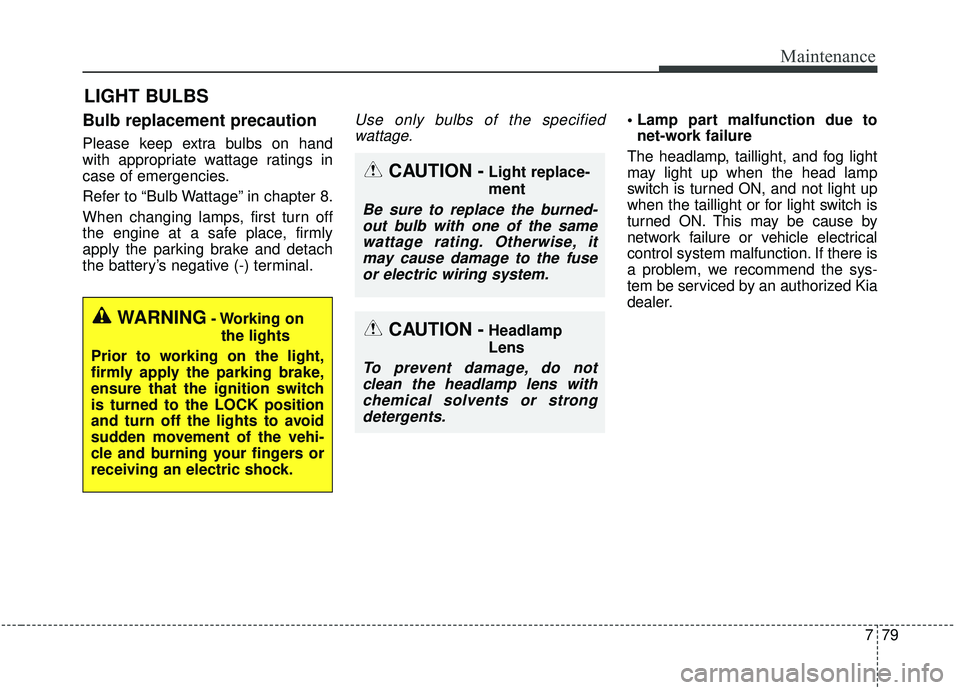
WARNING- Working on the lights
Prior to working on the light,
firmly apply the parking brake,
ensure that the ignition switch
is turned to the LOCK position
and turn off the lights to avoid
sudden movement of the vehi-
cle and burning your fingers or
receiving an electric shock.
CAUTION -Light replace-
ment
Be sure to replace the burned- out bulb with one of the samewattage rating. Otherwise, itmay cause damage to the fuseor electric wiring system.
CAUTION -Headlamp
Lens
To prevent damage, do notclean the headlamp lens withchemical solvents or strongdetergents.
Page 567 of 611
Maintenance
84
7
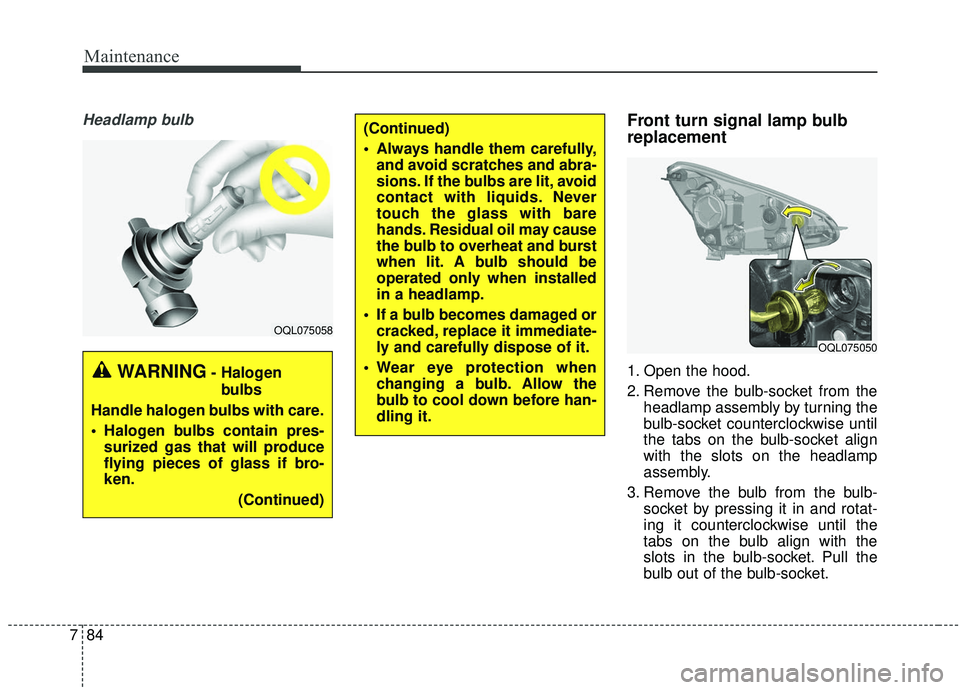
Headlamp bulbFront turn signal lamp bulb
replacement
1. Open the hood.
2. Remove the bulb-socket from the
headlamp assembly by turning the
bulb-socket counterclockwise until
the tabs on the bulb-socket align
with the slots on the headlamp
assembly.
3. Remove the bulb from the bulb- socket by pressing it in and rotat-
ing it counterclockwise until the
tabs on the bulb align with the
slots in the bulb-socket. Pull the
bulb out of the bulb-socket.
OQL075058
WARNING- Halogen
bulbs
Handle halogen bulbs with care.
Halogen bulbs contain pres- surized gas that will produce
flying pieces of glass if bro-
ken.
(Continued)
(Continued)
Always handle them carefully,and avoid scratches and abra-
sions. If the bulbs are lit, avoid
contact with liquids. Never
touch the glass with bare
hands. Residual oil may cause
the bulb to overheat and burst
when lit. A bulb should be
operated only when installed
in a headlamp.
If a bulb becomes damaged or cracked, replace it immediate-
ly and carefully dispose of it.
Wear eye protection when changing a bulb. Allow the
bulb to cool down before han-
dling it.
OQL075050
Page 574 of 611

791
Maintenance
Vanity mirror lamp (Bulb type)
bulb replacement 1. Using a flat-blade screwdriver,gently pry the lamp assembly from
interior.
2. Remove the bulb by pulling it straight out.
3. Install a new bulb in the socket.
4. Install the lamp assembly to interior.
✽ ✽ NOTICE
Be careful not to dirty or damage the
lens, lens tab, and plastic housings.
Room lamp (Bulb type) bulb
replacement
WARNING
Prior to working on the Interior
lamps, ensure that the “OFF”
button is depressed to avoid
burning your fingers or receiv-
ing an electric shock.
OQL075067
WARNING
Prior to working on the Interior
lamps, ensure that the “OFF”
button is depressed to avoid
burning your fingers or receiv-
ing an electric shock.
OQL075068
Page 577 of 611
Maintenance
94
7
APPEARANCE CARE
Exterior care
Exterior general caution
It is very important to follow the label
directions when using any chemical
cleaner or polish. Read all warning
and caution statements that appear
on the label.
Finish maintenance
Washing
To help protect your vehicle’s finish
from rust and deterioration, wash it
thoroughly and frequently at least
once a month with lukewarm or cold
water.
If you use your vehicle for off-road
driving, you should wash it after each
off-road trip. Pay special attention to
the removal of any accumulation of
salt, dirt, mud, and other foreign mate-
rials. Make sure the drain holes in the
lower edges of the doors and rocker
panels are kept clear and clean.
Insects, tar, tree sap, bird droppings,
industrial pollution and similar
deposits can damage your vehicle’s
finish if not removed immediately.
Even prompt washing with plain water
may not completely remove all these
deposits. A mild soap, safe for use on
painted surfaces, may be used.
After washing, rinse the vehicle thor-
oughly with lukewarm or cold water.
Do not allow soap to dry on the finish. After washing the vehicle, test the
brakes while driving slowly to see if
they have been affected by water. If
braking performance is impaired, dry
the brakes by applying them lightly
while maintaining a slow forward
speed.
Page 586 of 611
7103
Maintenance
Canister
Fuel vapors generated inside the fuel
tank are absorbed and stored in the
onboard canister. When the engine is
running, the fuel vapors absorbed in
the canister are drawn into the surge
tank through the purge control sole-
noid valve.
Purge Control Solenoid Valve(PCSV)
The purge control solenoid valve is
controlled by the Engine Control
Module (ECM); when the engine
coolant temperature is low during
idling, the PCSV closes so that evap-
orated fuel is not taken into the
engine. After the engine warms up
during ordinary driving, the PCSV
opens to introduce evaporated fuel to
the engine.
3. Exhaust emission control system
The Exhaust Emission Control
System is a highly effective system
which controls exhaust emissions
while maintaining good vehicle per-
formance.
Engine exhaust gas precautions
(carbon monoxide)
Carbon monoxide can be present with other exhaust fumes.
Therefore, if you smell exhaust
fumes of any kind inside your vehi-
cle, have it inspected and repaired
immediately. If you ever suspect
exhaust fumes are coming into
your vehicle, drive it only with all
the windows fully open. Have your
vehicle checked and repaired
immediately.
WARNING - Exhaust
Engine exhaust gases contain
carbon monoxide (CO). Though
colorless and odorless, it is
dangerous and could be lethal if
inhaled. Follow the instructions
on this page to avoid CO poi-
soning.
Page 587 of 611
Maintenance
104
7
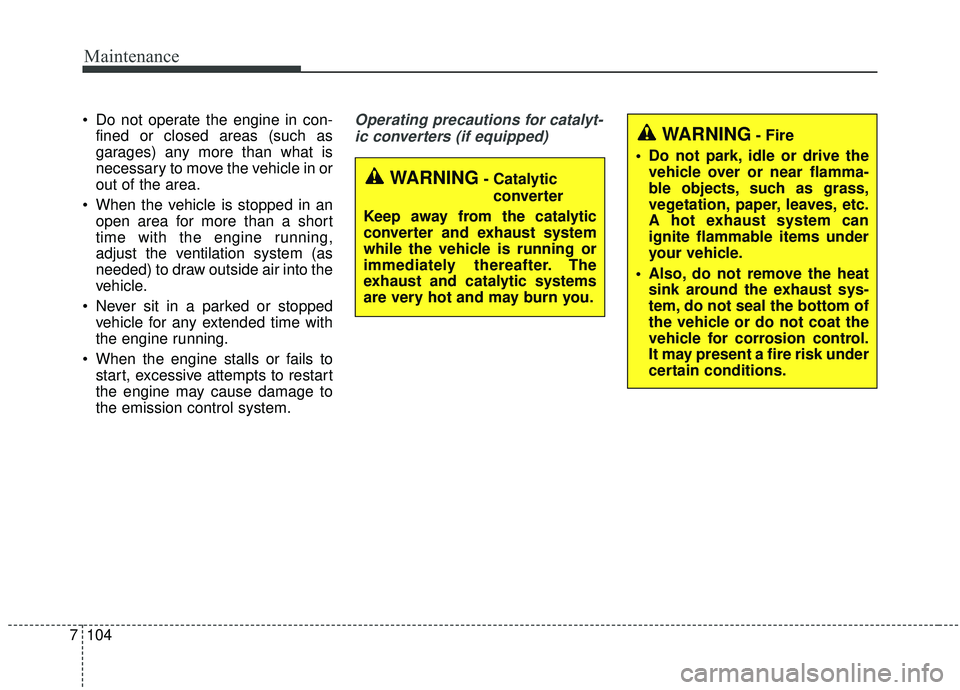
Do not operate the engine in con-
fined or closed areas (such as
garages) any more than what is
necessary to move the vehicle in or
out of the area.
When the vehicle is stopped in an open area for more than a short
time with the engine running,
adjust the ventilation system (as
needed) to draw outside air into the
vehicle.
Never sit in a parked or stopped vehicle for any extended time with
the engine running.
When the engine stalls or fails to start, excessive attempts to restart
the engine may cause damage to
the emission control system.Operating precautions for catalyt-
ic converters (if equipped)
WARNING- Catalytic converter
Keep away from the catalytic
converter and exhaust system
while the vehicle is running or
immediately thereafter. The
exhaust and catalytic systems
are very hot and may burn you.
WARNING- Fire
Do not park, idle or drive the vehicle over or near flamma-
ble objects, such as grass,
vegetation, paper, leaves, etc.
A hot exhaust system can
ignite flammable items under
your vehicle.
Also, do not remove the heat sink around the exhaust sys-
tem, do not seal the bottom of
the vehicle or do not coat the
vehicle for corrosion control.
It may present a fire risk under
certain conditions.
Page 602 of 611
Index
2I
Air bag - advanced supplemental restraint system ........3-45Adding equipment to or modifying your air bag-equipped vehicle ..........................................3-72
Air bag warning label ................................................3-72
Air bag warning light ..................................................3-48
Curtain air bag ............................................................3-64
Driver's and passenger's front air bag ........................3-60
How does the air bag system operate? ......................3-46
Occupant Detection System (ODS) ............................3-52
Side air bag ................................................................3-62
SRS Care ....................................................................3-71\
SRS components and functions ..................................3-49
Air cleaner ....................................................................7-36\
Filter replacement ......................................................7-36
Air conditioning system ..................................................8-7
All Wheel Drive (AWD) ................................................5-23 All Wheel Drive (AWD) transfer mode selection ......5-25
For safe all wheel drive operation ..............................5-26
Reducing the risk of a rollover ..................................5-29
Tight corner brake effect ............................................5-24
Appearance care ............................................................7-94 Exterior care ................................................................7-94
Interior care ................................................................7-99
Audio system ..............................................................4-188 Antenna ....................................................................4-18\
8
How vehicle radio works ..........................................4-190 Steering wheel audio controls ..................................4-188
USB port ..................................................................4-190
Automatic climate control system ..............................4-154 Automatic heating and air conditioning ..................4-155
Checking the amount of air conditioner refrigerant and compressor lubricant ......................4-165
Climate control air filter ..........................................4-164
Manual heating and air conditioning ........................4-156
System operation ......................................................4-162
Automatic transmission ................................................5-15 Automatic transmission operation ..............................5-15
Good driving practices ................................................5-22
Battery........................................................................\
....7-43 For best battery service ..............................................7-43
Recharging the battery ................................................7-44
Reset items ..................................................................7-45
Before driving ..................................................................5-5 Before entering vehicle ................................................5-5
Before starting ..............................................................5-5
Necessary inspections ..................................................5-5
Blind spot Collision Warning (BCW)/Rear Cross-traffic Collision Warning (RCCW) ......................................5-120Blind-spot Collision Warning (BCW) ......................5-120
Limitations of the system..........................................5-129\
Rear Cross-traffic Collision Warning (RCCW) ........5-124
A
B
Page 603 of 611
I3
Index
Rear/side detecting sensors ......................................5-127
System setting and activation ..................................5-121
System setting and activation ..................................5-124
Brake fluid ....................................................................7-33\
Checking the brake fluid level ....................................7-33
Brake system..................................................................5-31 Anti-lock Brake System (ABS) ..................................5-45
Auto hold ....................................................................5-41\
Electronic Parking Brake (EPB) ................................5-34
Electronic Stability Control (ESC) ............................5-47
Good braking practices ..............................................5-53
Hill-start Assist Control (HAC) ..................................5-52
Parking brake – Foot type ..........................................5-33
Power brakes ..............................................................5-31
Vehicle Stability Management (VSM)........................5-51
Warning messages ......................................................5-43
Bulb wattage ....................................................................8-3
Checking fluid levels ....................................................7-26
Child restraint system (CRS) ........................................3-34 Children Always in the Rear ......................................3-34
Installing a Child Restraint System (CRS) ................3-38
Selecting a Child Restraint System (CRS) ................3-35
Clean air ......................................................................4-\
170
Climate control air filter ................................................7-38 Filter inspection ..........................................................7-38 Cruise Control system ..................................................5-84
To cancel cruise control, do one of the following ......5-86
To decrease the cruising speed ..................................5-86
To increase cruise control set speed ..........................5-85
To resume cruising speed at more than approximately 30 km/h (20 mph) ....................................................5-87
To set cruise control speed..........................................5-85
To temporarily accelerate with the cruise control on ..5-86
To turn cruise control off, do one of the following ....5-87
Declaration of Conformity ..........................................4-193 IC ........................................................................\
......4-193
Defroster ......................................................................4-\
143 Rear window defroster ..............................................4-143
Dimensions ......................................................................8-\
2
Door locks......................................................................4-\
23 Child-protector rear door lock ....................................4-27
Impact sensing door unlock system ............................4-26
Operating door locks from inside the vehicle ............4-24
Operating door locks from outside the vehicle ..........4-23
Drive mode integrated control system ........................5-109 Drive mode................................................................5-109
Driver Attention Warning (DAW)................................5-136 Resetting the system ................................................5-138
System malfunction ..................................................5-138
C
D
Page 605 of 611
I5
Index
FCA warning message and system control ................5-56
Limitation of the system ............................................5-61
System malfunction ....................................................5-60
System setting and activation ....................................5-54
Forward Collision-avoidance Assist (FCA) system sensor fusion type (front radar+front view camera) ..............5-67Brake operation ..........................................................5-71
Downhill Brake Control (DBC)..................................5-81
FCA sensor (front radar + front view Ccamera) ........5-71
FCA warning message and system control ................5-69
Good braking practices ..............................................5-83
Limitation of the system ............................................5-75
System malfunction ....................................................5-74
System setting and activation ....................................5-67
Fuel filler lid ..................................................................4-48 Closing the fuel filler lid ............................................4-49
Opening the fuel filler lid ..........................................4-48
Fuel requirements ............................................................1-2 Do not use methanol ....................................................1-4
Fuel Additives ..............................................................1-5
Gasoline containing alcohol and methanol ..................1-3
Operation in foreign countries ......................................1-5
Fuses ........................................................................\
......7-61 Engine compartment fuse replacement ......................7-65
Fuse/relay panel description ......................................7-67
Inner panel fuse replacement ......................................7-63 Gross vehicle weight........................................................8-7\
Hood ........................................................................\
......4-46
Closing the hood ........................................................4-47
Opening the hood ........................................................4-46
How to use this manual ..................................................1-2
If the engine overheats ....................................................6-7
If the engine will not start ..............................................6-4 If engine doesn't turn over or turns over slowly ..........6-4
If engine turns over normally but does not start ..........6-4
If you have a flat tire (with spare tire) ..........................6-15 Changing tires ............................................................6-17
Jack and tools ..............................................................6-15
Removing and storing the spare tire ..........................6-16
If you have a flat tire (with Tire Mobility Kit)..............6-24 Checking the tire inflation pressure ............................6-31
Components of the Tire Mobility Kit (TMK) ............6-27
Distributing the sealant ..............................................6-31
Introduction ................................................................6-25
Notes on the safe use of the Tire Mobility Kit ..........6-25
H
G
I
Page 608 of 611

Index
8I
Mirrors ........................................................................\
..4-62Inside rearview mirror ................................................4-62
Outside rearview mirror ..............................................4-76
Owner maintenance ........................................................7-7 Owner maintenance schedule ......................................7-7
Panoramic sunroof ........................................................4-52 Closing the sunroof ....................................................4-56
Resetting the sunroof ..................................................4-56
Sliding the sunroof ......................................................4-54
Sunroof open warning ................................................4-53
Sunshade ....................................................................4-53\
Tilting the sunroof ......................................................4-56
Parking brake ................................................................7-35 Checking the parking brake ........................................7-35
Parking distance warning ............................................4-121 Non-operational conditions of parking distance warning ..................................................................4-123
Operation of the parking distance warning ..............4-121
Self-diagnosis............................................................4-125 Parking distance warning-reverse ................................4-117
Non-operational conditions of parking distance warning-reverse ......................................................4-118
Operation of the parking distance warning-reverse ..4-117
Parking distance warning-reverse precautions..........4-119
Self-diagnosis............................................................4-120
Power liftgate ................................................................4-31 Closing the liftgate ......................................................4-33
Opening the liftgate ....................................................4-32
Smart Power Liftgate ..................................................4-36
Rear view monitor ......................................................4-126
Recommended lubricants and capacities ........................8-8 Recommended SAE viscosity number ......................8-10
Road warning ..................................................................6-2 Hazard warning flasher ................................................6-2
Scheduled maintenance service ......................................7-9
Seat ........................................................................\
..........3-4 Front seat adjustment - manual ....................................3-8
Front seat adjustment - power ....................................3-10
Headrest (for front seat) ..............................................3-12
Rear seat adjustment ..................................................3-15
Seatback pocket ..........................................................3-15
P
O
R
S