brake LAND ROVER DISCOVERY 2002 Service Manual
[x] Cancel search | Manufacturer: LAND ROVER, Model Year: 2002, Model line: DISCOVERY, Model: LAND ROVER DISCOVERY 2002Pages: 1672, PDF Size: 46.1 MB
Page 398 of 1672

ENGINE MANAGEMENT SYSTEM - TD5
DESCRIPTION AND OPERATION 18-1-5
1Mass air flow sensor
2Ambient air pressure sensor
3Manifold absolute pressure/ inlet air
temperature sensor
4Engine coolant temperature sensor
5Crankshaft speed and position sensor
6Throttle position sensor
7Fuel temperature sensor
8Brake pedal switch
9Clutch switch
10High/ Low ratio switch
11Main relay
12Malfunction indicator lamp
13Fuel pump relay
14Glow plug warning lamp
15Glow plugs16Electronic unit injectors
17Turbocharger wastegate modulator
18EGR modulator
19Diagnostic connector
20Engine control module
21Cruise control master switch
22Cruise control SET+ switch
23Cruise control RES switch
24Air conditioning clutch relay
25Air conditioning cooling fan relay
26Electronic automatic transmission ECU
27Self levelling and anti-lock brakes ECU
28Instrument cluster
29Body control unit
Page 399 of 1672

ENGINE MANAGEMENT SYSTEM - TD5
18-1-6 DESCRIPTION AND OPERATION
Description
General
An engine control module (ECM) controls the five-cylinder direct injection diesel engine, and works on the drive by
wire principle. This means there is no throttle cable, the ECM controls the drivers needs via a signal from the Throttle
Position (TP) sensor on the throttle pedal.
The ECM is a full authoritative diesel specific microprocessor that also incorporates features for cruise control and air
conditioning control. In addition, the ECM supplies output control for the exhaust gas recirculation and turbocharger
boost pressure. The ECM has a self-diagnostic function, which is able to provide backup strategies for most sensor
failures.
The ECM processes information from the following input sources:
lMass air flow sensor.
lAmbient air pressure sensor.
lManifold absolute pressure/inlet air temperature sensor.
lEngine coolant temperature sensor.
lCrankshaft speed and position sensor.
lThrottle position sensor.
lFuel temperature sensor.
lAir conditioning request.
lAir conditioning fan request.
lBrake pedal switch.
lClutch switch.
lCruise control master switch.
lCruise control SET+ switch.
lCruise control RES switch.
lHigh/low ratio switch.
The input from the sensors constantly updates the ECM with the current operating condition of the engine. Once the
ECM has compared current information with stored information within its memory, it can make any adjustment it
requires to the operation of the engine via the following:
lAir conditioning clutch relay.
lAir conditioning cooling fan relay.
lElectronic vacuum regulator solenoid.
lMalfunction indicator lamp.
lFuel pump relay.
lGlow plug warning lamp.
lGlow plugs.
lFuel injectors.
lMain relay.
lTurbocharger wastegate modulator.
lTemperature gauge.
The ECM interfaces with the following:
lElectronic Automatic Transmission (EAT).
lSelf Levelling and Anti-lock Brakes System (SLABS).
lSerial communication link.
lInstrument cluster.
lBody Control Unit (BCU).
Page 402 of 1672

ENGINE MANAGEMENT SYSTEM - TD5
DESCRIPTION AND OPERATION 18-1-9
Connector C0658
Pin No. Input/Output Function Signal type Value Interfaces
B1 Input Earth 1 0 volts 0 volts
B2 Input Earth 4 0 volts 0 volts
B3 Input Supply battery voltage 12 volts 12 volts
B4 Output Cooling fan relay Switch 12-0 volts A/C ECU
B5 Output Fuel pump relay Switch 12-0 volts
B6 Output MIL Switch 12-0 volts Instruments
B7 Output Temperature gauge Digital 0-12 volts Instruments
B8 Not used
B9 Input A/C clutch request Switch 12-0 volts A/C ECU
B10 Input Normally closed brake
switchSwitch 12-0 volts
B11 Input Cruise control SET+ switch Switch 12-0 volts
B12 Input TP sensor 1 Analogue 0- 5 volts
B13 Input Vehicle speed Digital 0-12 volts
B14 Input TP sensor supply 5 volts 5 volts
B15 Input Cruise control master switch Switch 12-0 volts
B16 Input Normally open brake switch Switch 0-12 volts
B17 Input Cruise control RES switch Switch 12-0 volts
B18 Input/Output Serial communication link Digital 0-12 volts All ECU's
B19 Output Tachometer engine speed Digital 0-12 volts Instrument
Cluster
B20 Not used
B21 Output Main relay Switch 0-12 volts
B22 Input Supply battery voltage 12 volts 12 volts
B23 Input A/C fan request Switch 12-0 volts
B24 Input Earth 3 0 volts 0 volt
B25 Input Earth 2 0 volts 0 volts
B26 Input TP sensor earth 0 volts 0 volts
B27 Input Supply 2 12 volts 12 volts
B28 Not used
B29 Output A/C relay Switch 12-0 volts
B30 Output Glow plug warning light Switch 12-0 volts Instrument
Cluster
B31 Not used
B32 Output ABS digital 0-5 volts SLABS
B33 Input Ignition Switch 0-12 volts
B34 Input Security code digital 0-5 volts
B35 Input Clutch switch Switch 12-0 volts
B36 Input TP sensor 2 Analogue 5-0 volts
Page 419 of 1672
ENGINE MANAGEMENT SYSTEM - TD5
18-1-26 DESCRIPTION AND OPERATION
Brake pedal switch
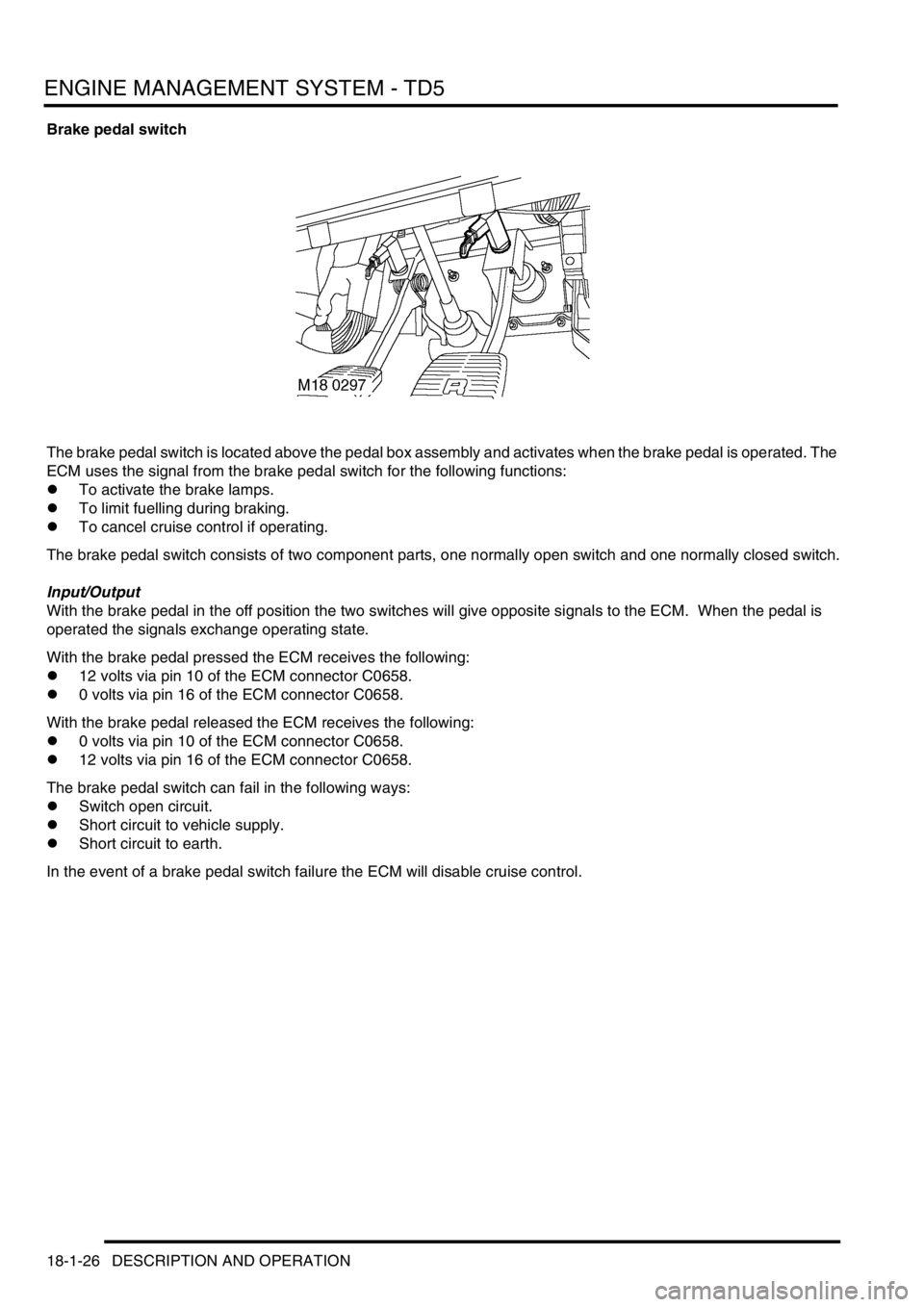
The brake pedal switch is located above the pedal box assembly and activates when the brake pedal is operated. The
ECM uses the signal from the brake pedal switch for the following functions:
lTo activate the brake lamps.
lTo limit fuelling during braking.
lTo cancel cruise control if operating.
The brake pedal switch consists of two component parts, one normally open switch and one normally closed switch.
Input/Output
With the brake pedal in the off position the two switches will give opposite signals to the ECM. When the pedal is
operated the signals exchange operating state.
With the brake pedal pressed the ECM receives the following:
l12 volts via pin 10 of the ECM connector C0658.
l0 volts via pin 16 of the ECM connector C0658.
With the brake pedal released the ECM receives the following:
l0 volts via pin 10 of the ECM connector C0658.
l12 volts via pin 16 of the ECM connector C0658.
The brake pedal switch can fail in the following ways:
lSwitch open circuit.
lShort circuit to vehicle supply.
lShort circuit to earth.
In the event of a brake pedal switch failure the ECM will disable cruise control.
Page 429 of 1672
ENGINE MANAGEMENT SYSTEM - TD5
18-1-36 DESCRIPTION AND OPERATION
Cruise control set/accelerate (SET+) switch
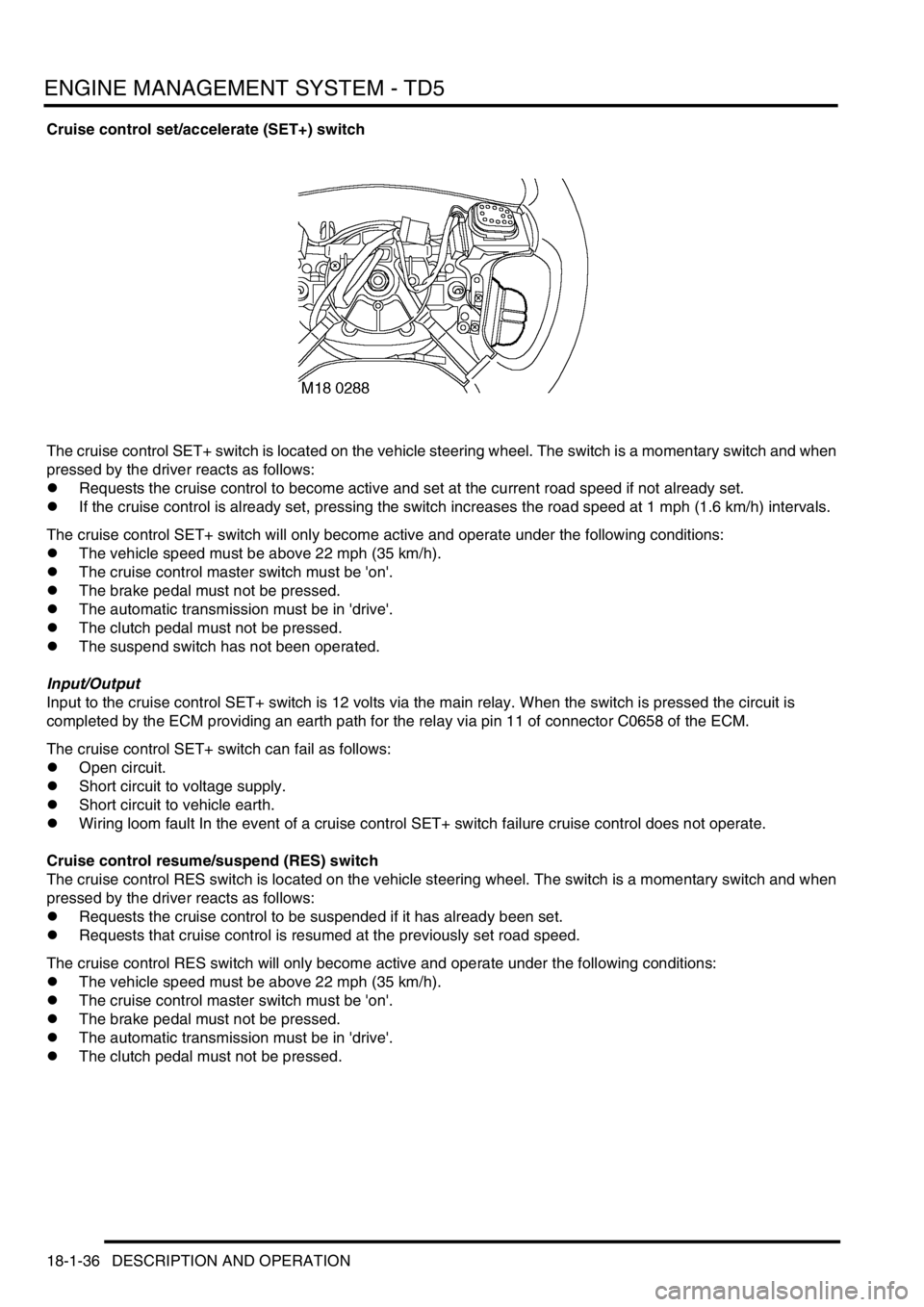
The cruise control SET+ switch is located on the vehicle steering wheel. The switch is a momentary switch and when
pressed by the driver reacts as follows:
lRequests the cruise control to become active and set at the current road speed if not already set.
lIf the cruise control is already set, pressing the switch increases the road speed at 1 mph (1.6 km/h) intervals.
The cruise control SET+ switch will only become active and operate under the following conditions:
lThe vehicle speed must be above 22 mph (35 km/h).
lThe cruise control master switch must be 'on'.
lThe brake pedal must not be pressed.
lThe automatic transmission must be in 'drive'.
lThe clutch pedal must not be pressed.
lThe suspend switch has not been operated.
Input/Output
Input to the cruise control SET+ switch is 12 volts via the main relay. When the switch is pressed the circuit is
completed by the ECM providing an earth path for the relay via pin 11 of connector C0658 of the ECM.
The cruise control SET+ switch can fail as follows:
lOpen circuit.
lShort circuit to voltage supply.
lShort circuit to vehicle earth.
lWiring loom fault In the event of a cruise control SET+ switch failure cruise control does not operate.
Cruise control resume/suspend (RES) switch
The cruise control RES switch is located on the vehicle steering wheel. The switch is a momentary switch and when
pressed by the driver reacts as follows:
lRequests the cruise control to be suspended if it has already been set.
lRequests that cruise control is resumed at the previously set road speed.
The cruise control RES switch will only become active and operate under the following conditions:
lThe vehicle speed must be above 22 mph (35 km/h).
lThe cruise control master switch must be 'on'.
lThe brake pedal must not be pressed.
lThe automatic transmission must be in 'drive'.
lThe clutch pedal must not be pressed.
Page 434 of 1672

ENGINE MANAGEMENT SYSTEM - TD5
DESCRIPTION AND OPERATION 18-1-41
In the case of a VSS failure on vehicles with automatic transmissions the ECM applies default values derived from
the EAT ECU. There is no default value for manual transmission vehicle.
The VSS can fail in the following ways:
lWiring short circuit to vehicle supply.
lWiring short circuit to vehicle earth.
lWiring open circuit.
In the event of a VSS failure any of the following symptoms may be observed:
lVehicle speed limiting disabled (manual transmission only).
lHill Descent Control (HDC) warning lamp on and audible warning.
Cruise control
All markets have a common cruise control system. The cruise control system, when activated, regulates vehicle
speed. The ECM controls the cruise control system.
Cruise control activation
Cruise control is a passive system, and must be activated by the driver. Cruise control is activated by switching on
the cruise control master switch located on the instrument panel. A LED in the switch illuminates indicating cruise
control is available. The driver must accelerate the vehicle to the desired speed using the accelerator pedal. When
the desired speed is reached, cruise control can be activated by pressing the SET+ switch.
Cruise control will only activate if the following conditions are met:
lVehicle speed is above 22 mph (35 km/h).
lThe brake pedal is not pressed.
lThe clutch pedal is not pressed (manual transmission only).
lThe transmission is not in Park, Reverse or Neutral (automatic transmission only).
The ECM receives the set signal and determines the vehicle speed provided by the SLABS ECU. The ECM then
maintains current road speed.
Cruise control cancellation
Cancelling cruise control enables the driver to regain control of the vehicle speed by using the accelerator pedal.
Cruise control is cancelled if any of the following conditions occur:
lThe brake pedal is pressed.
lThe RES switch is pressed.
lThe clutch pedal is pressed (manual transmission only).
lThe cruise control master switch is switched off.
lThe transmission is placed in Park, Neutral, or Reverse (automatic transmission only).
The ECM cancels cruise control operation and returns it to the control of the accelerator pedal.
The set speed will be stored in the ECM unless:
lThe cruise control master switch is switched off.
lThe ignition is switched off.
If cruise control is deactivated using either of the above methods, the set speed will be erased from the memory of
the ECM.
Page 435 of 1672

ENGINE MANAGEMENT SYSTEM - TD5
18-1-42 DESCRIPTION AND OPERATION
Cruise control resumption
Cruise control can be resumed at the previously set speed, provided the set speed has not been erased from the
ECM's memory as described above.
To resume cruise control operation to the previously set speed, depress the RES switch once when the following
conditions are met:
lA set speed is stored in the ECM.
lVehicle speed is above 22 mph (35 km/h).
lThe brake pedal is not pressed.
lThe clutch pedal is not pressed (manual transmission only).
lThe transmission is not in Park, Reverse or Neutral (automatic transmission only).
The ECM activates the cruise control system at the stored speed.
Accelerating while cruise control is active
There are three ways of increasing vehicle speed when cruise control is active:
lTemporarily increase vehicle speed (e.g. when overtaking another vehicle).
lIncrease vehicle set speed in 1 mph (1.5 km/h) increments.
lIncrease vehicle set speed.
To temporarily increase vehicle speed press the accelerator pedal until the desired speed is reached.
When the accelerator pedal is released, the vehicle coasts back to the set speed. When it reaches the set speed,
cruise control operation continues.
To increase the vehicle set speed in 1 mph (1.5 km/h) increments, tap the SET+ switch. Each tap on the switch
increases vehicle speed.
To increase the vehicle set speed, press and hold the SET+ switch until the desired set speed is reached.
Vehicle set speed will increase if the following conditions are met:
lThe vehicle is under cruise control operation.
lVehicle speed is above 22 mph (35 km/h).
lThe brake pedal is not pressed.
lThe clutch pedal is not pressed (manual transmission only).
lThe transmission is not in Park, Reverse or Neutral (automatic transmission only).
The vehicle responds as follows:
lIf the driver accelerates using the throttle pedal, the ECM increases vehicle speed using the TP sensor signal.
When the driver releases the accelerator pedal, the vehicle returns to the set speed.
lIf the SET+ switch is tapped the stored speed and vehicle speed increases by 1 mph (1.5 km/h) per tap on the
switch.
lIf the driver presses and holds the SET+ switch the vehicle speed will increase and will hold the speed when the
switch is released.
Switching off cruise control
Switching off cruise control allows the driver to regain control of vehicle speed, and erases the set road speed from
the ECM's memory.
To switch off cruise control, press the cruise control master switch to the off position.
When the cruise control master switch is switched off, the ECM deactivates cruise control and the driver regains
control of vehicle speed.
Page 496 of 1672

ENGINE MANAGEMENT SYSTEM - V8
DESCRIPTION AND OPERATION 18-2-39
Hill Decent Control (HDC)
Refer to Brakes for description of the hill descent control.
+ BRAKES, DESCRIPTION AND OPERATION, Description.
High/Low ratio switch
Refer to Transfer Box for description of the high/ low ratio switch transfer box components.
+ TRANSFER BOX - LT230SE, DESCRIPTION AND OPERATION, Description.
Malfunction Indicator Lamp (MIL)/ service engine soon warning lamp
The MIL/ service engine soon warning lamp is located in the instrument cluster. It illuminates to alert the driver to
system malfunctions. Service engine soon warning lamp is the name for this warning lamp in NAS only, it is called
MIL in all other markets.
During ignition a self-test function of the lamp is carried out. The lamp will illuminate for 3 seconds then it will
extinguish if no faults exist.
+ INSTRUMENTS, DESCRIPTION AND OPERATION, Description.
Input/Output
The MIL is supplied with battery voltage from the instrument cluster. When the ECM detects a fault, it provides an
earth path to illuminate the MIL. Output to the MIL is via pin 20 of connector C0637 of the ECM.
Page 512 of 1672

ENGINE MANAGEMENT SYSTEM - V8
DESCRIPTION AND OPERATION 18-2-55
DESCRIPTION AND OPERAT ION
Cruise control component layout
1Cruise control ECU
2Cruise control master switch
3SET+ switch
4RES switch
5Brake pedal switch
6Clutch pedal switch7BCU
8Vacuum pump assembly
9Pneumatic actuator
10SLABS ECU
11Automatic gear selector lever
Page 513 of 1672
ENGINE MANAGEMENT SYSTEM - V8
18-2-56 DESCRIPTION AND OPERATION
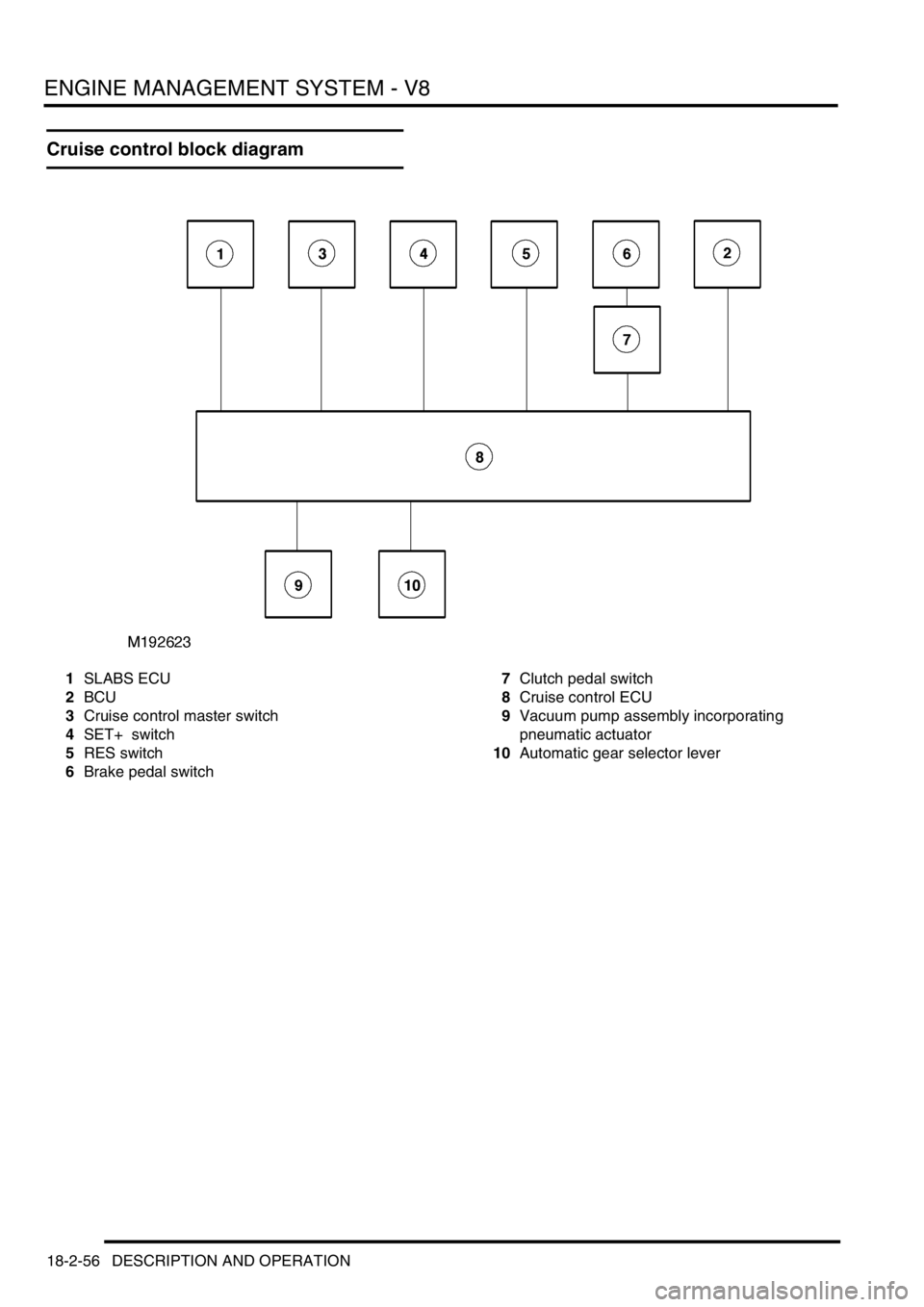
Cruise control block diagram
1SLABS ECU
2BCU
3Cruise control master switch
4SET+ switch
5RES switch
6Brake pedal switch7Clutch pedal switch
8Cruise control ECU
9Vacuum pump assembly incorporating
pneumatic actuator
10Automatic gear selector lever