lock LAND ROVER FREELANDER 2001 Service Manual
[x] Cancel search | Manufacturer: LAND ROVER, Model Year: 2001, Model line: FREELANDER, Model: LAND ROVER FREELANDER 2001Pages: 1007, PDF Size: 23.47 MB
Page 129 of 1007

TORQUE WRENCH SETTINGS
06-26
Front Suspension and Subframe
1 Use NEW nuts
2 Tighten with weight of vehicle on suspension
3 Tighten in diagonal sequence
TORQUE DESCRIPTION METRIC IMPERIAL
Anti-roll bar saddle clamp to subframe bolts 23 Nm 17 lbf.ft
Anti-roll bar link to damper nut 45 Nm 33 lbf.ft
Anti-roll bar to link nut 55 Nm 41 lbf.ft
Damper assembly to body top mounting nuts
245 Nm 33 lbf.ft
Damper to hub nuts and bolts
2205 Nm 151 lbf.ft
Damper shaft locking nut 57 Nm 42 lbf.ft
Engine lower steady to support beam bolt 100 Nm 74 lbf.ft
Engine tie-bar to sump bolts 100 Nm 74 lbf.ft
Front subframe to body front bolts 190 Nm 140 lbf.ft
Hub drive shaft nut
1400 Nm 295 lbf.ft
Hub assembly to lower swivel joint nut 65 Nm 48 lbf.ft
Lower arm front bush to subframe bolt
2190 Nm 140 lbf.ft
Lower arm rear bush housing bolts to body
2105 Nm 77 lbf.ft
Lower arm to rear bush housing nut
2140 Nm 103 lbf.ft
Road wheel nuts
3115 Nm 85 lbf.ft
Support beam to body bolts 190 Nm 140 lbf.ft
Page 130 of 1007

TORQUE WRENCH SETTINGS
06-27
Rear Suspension and Subframe
1 Tighten with weight of vehicle on suspension
TORQUE DESCRIPTION METRIC IMPERIAL
Backplate to hub bolts 45 Nm 33 lbf.ft
Brake pipe to wheel cylinder union 14 Nm 10 lbf.ft
Damper shaft self locking nut 57 Nm 42 lbf.ft
Damper top mounting nuts 45 Nm 33 lbf.ft
Differential mountings to casing bolts 65 Nm 48 lbf.ft
Differential mountings to subframe 120 Nm 89 lbf.ft
Hub to damper nuts and bolts
2205 Nm 151 lbf.ft
Hub drive shaft nut
1400 Nm 295 lbf.ft
Propeller shaft to rear axle bolts 65 Nm 48 lbf.ft
Road wheel nuts 115 Nm 85 lbf.ft
Subframe to body bolts 190 Nm 140 lbf.ft
Trailing link to rear hub nut and bolt
1120 Nm 89 lbf.ft
Transverse links to hub nut and bolt
1120 Nm 89 lbf.ft
Transverse link to subframe nuts and bolts
1105 Nm 77 lbf.ft
Page 133 of 1007

TORQUE WRENCH SETTINGS
06-30
Body
TORQUE DESCRIPTION METRIC IMPERIAL
Doors
Door lock striker to body screws 10 Nm 7 lbf.ft
Door stiffener Torx screws 9 Nm 7 lbf.ft
Front door control unit to glass clamp bolts 9 Nm 7 lbf.ft
Front door hinge bolts 30 Nm 22 lbf.ft
Rear door glass clamp bolts 8 Nm 6 lbf.ft
Tail door exterior handle nuts 5 Nm 3.7 lbf.ft
Tail door glass clamp bolts 8 Nm 6 lbf.ft
Tail door glass regulator lock nuts 14 Nm 10 lbf.ft
Tail door hinge bolts 30 Nm 22 lbf.ft
Exterior Fittings
Bonnet hinge, bolts 9 Nm 6.5 lbf.ft
Bonnet release lever to 'A' post bolt 9 Nm 6.5 lbf.ft
Exterior mirror to door Torx screws 6 Nm 4.4 lbf.ft
Front wing bolts5 Nm 3.7 lbf.ft
Spare wheel mounting bracket:
⇒ Bolts13 Nm 10 lbf.ft
⇒ Nuts25 Nm 18 lbf.ft
Spare wheel to bracket retention nuts 45 Nm 33 lbf.ft
Splash shield bolts 10 Nm 7 lbf.ft
Underbelly panel to body bolts 45 Nm 33 lbf.ft
Underbelly panel to body rear screws 8 Nm 6 lbf.ft
3 door vehicles
Hard back catch Torx screws 10 Nm 7.5 lbf.ft
Hard back retainer Torx screws 10 Nm 7.5 lbf.ft
Soft back support bracket bolts 25 Nm 18 lbf.ft
5 door vehicles
Roof rack side rail bolts 22 Nm 16 lbf.ft
Interior Trim Components
Engine compartment fusebox bolts 8 Nm 6 lbf.ft
Passenger compartment fusebox mounting plate to body and steering column
bracket bolts8 Nm 6 lbf.ft
Passenger compartment fusebox to mounting plate bolts 8 Nm 6 lbf.ft
Seats
Front seat runner to body bolts 45 Nm 33 lbf.ft
Front seat squab frame to cushion frame Torx bolts 45 Nm 33 lbf.ft
Rear bench seat to body bolts 25 Nm 18 lbf.ft
Rear seat cushion to squab Torx bolts 28 Nm 21 lbf.ft
Rear seat catch assembly Torx bolts 32 Nm 24 lbf.ft
Rear seat squab lock Torx screws 20 Nm 15 lbf.ft
Rear seat squab to cushion Torx bolts 28 Nm 21 lbf.ft
Rear seat hinge Torx bolts 25 Nm 18 lbf.ft
Page 134 of 1007

TORQUE WRENCH SETTINGS
06-31
Seat belts (3-door models)
Front seat belt loop to 'B' post bolt 31 Nm 23 lbf.ft
Front seat belt pre-tensioner and buckle to seat frame Torx bolt 32 Nm 24 lbf.ft
Front seat belt reel bolt 31 Nm 23 lbf.ft
Front seat belt slider bar bolts 40 Nm 30 lbf.ft
Front seat belt lower mounting Torx bolts 40 Nm 30 lbf.ft
Front seat belt upper mounting Torx bolt 31 Nm 23 lbf.ft
Rear seat belt and buckle to frame Torx bolts 32 Nm 24 lbf.ft
Rear seat belt lower fixing to body bolt 50 Nm 37 lbf.ft
Rear seat belt reel to squab nut 32 Nm 24 lbf.ft
Rear seat belt upper mounting bolt 32 Nm 24 lbf.ft
Rear seat squab lock Torx screws 20 Nm 15 lbf.ft
Seat belt pre-tensioner to seat bolt 32 Nm 24 lbf.ft
Seat belts (5-door models)
Front seat belt adjuster to 'B' post Torx bolts 26 Nm 19 lbf.ft
Front seat belt upper anchorage to adjuster mounting nut 31 Nm 23 lbf.ft
Front seat belt lower fixing to 'B' post bolt 40 Nm 30 lbf.ft
Front seat belt pre-tensioner and buckle to seat frame Torx bolt 32 Nm 24 lbf.ft
Front seat belt reel bolt 31 Nm 23 lbf.ft
Rear centre seat belt reel to seat squab nut 32 Nm 24 lbf.ft
Rear seat belt and buckle bolts 32 Nm 24 lbf.ft
Rear side seat belt lower fixing bolt 40 Nm 30 lbf.ft
Rear side seat belt reel bolt 50 Nm 37 lbf.ft
Rear side seat belt buckle to catch assembly bolt 32 Nm 24 lbf.ft
Rear side seat belt upper mounting bolt 32 Nm 24 lbf.ft
Seat belt height adjuster bolts 26 Nm 19 lbf.ft
Screens
Sun roof side rail Torx bolts 22 Nm 16 lbf.ft TORQUE DESCRIPTION METRIC IMPERIAL
Page 136 of 1007

TORQUE WRENCH SETTINGS
06-33
Air Conditioning
TORQUE DESCRIPTION METRIC IMPERIAL
A/C compressor to mounting bracket bolts (Td4 & K1.8) 25 Nm 18 lbf.ft
A/C compressor mounting bracket to cylinder block bolts (Td4 & K1.8) 45 Nm 33 lbf.ft
A/C compressor mounting bracket to cylinder block bolts (KV6) 45 Nm 33 lbf.ft
A/C compressor support bracket to sump bolt (Td4) 10 Nm 7.5 lbf.ft
A/C compressor drive belt tensioner clamp bolt (Td4) 24 Nm 18 lbf.ft
A/C compressor drive belt tensioner pivot bolt (Td4) 24 Nm 18 lbf.ft
A/C compressor upper and lower securing bolts (KV6) 25 Nm 18 lbf.ft
A/C pipe rail to condenser bolt (KV6) 8 Nm 6 lbf.ft
A/C pipe rail to condenser bolt (KV6) 8 Nm 6 lbf.ft
Condenser bracket to radiator bolts 8 Nm 6 lbf.ft
Receiver drier to condenser bolts 12 Nm 9 lbf.ft
Refrigerant pressure sensor 10 Nm 7.5 lbf.ft
TXV to bulkhead Allen screws 25 Nm 18 lbf.ft
Page 141 of 1007
LIFTING AND TOWING
08-2
Raising the front of a vehicle
Position the cup of the hydraulic arm under the
centre of the front body crossmember assembly.
Use jack to raise front road wheels to enable safety
stands to be installed under the front end of each
longitudinal member.
Carefully lower jack until vehicle sits securely on
safety stands.
Before working on the underside of a vehicle re-
check the stability of the vehicle on the stands.
Use the reverse procedure when removing a vehicle
from stands.
NOTE: For some repair operations it may be
necessary to use a jack to support the engine under
the sump. In this case, a block of wood should be
used on the jack to protect the sump.
Raising the rear of a vehicle
Position cup of hydraulic arm under the centre of the
rear subframe crossmember at the position
identified by the embossed arrows.
Use jack to raise rear road wheels to enable safety
stands to be installed under the rear ends of the
body longitudinal members.
Carefully lower jack until vehicle sits securely on
safety stands.
Before working on the underside of a vehicle, re-
check the stability of the vehicle on the stands.
Use the reverse procedure when removing a vehicle
from stands.
Wheel-free lift
Locate the lifting pads under the ends of the body
longitudinal members. Raise the ramp to support the
weight of the vehicle, ensure the vehicle is secure on
the lifting pads, then raise the ramp to the required
height.
Towing
General
The vehicle has permanent four wheel drive. The
following instructions must be adhered to:
Towing the vehicle on all four wheels with driver
operating steering and brakes
lTurn ignition key to position '1' to release
steering lock and then to position 'II' to enable
the brake lights, wipers and direction indicators
to be operated, if necessary.
l Select neutral in gearbox and ensure HDC (hill
descent control) is deselected.
lSecure tow rope, chain or cable to towing eye.
lRelease the parking brake.
CAUTION: The brake servo and power assisted
steering system will not be functional without the
engine running. Greater pedal pressure will be
required to apply the brakes and the steering
system will require greater effort to turn the front
road wheels. The vehicle tow connection should
only be used under normal road conditions,
'snatch' recovery should be avoided.
Suspended tow by breakdown vehicle
Mark propeller shaft drive flanges and mating flanges
with identification lines to enable the propeller shaft
to be refitted in its original position.
Remove the propeller shaft fixings then remove the
shaft from the vehicle.
CAUTION: To prevent vehicle damage, rear
propeller shaft MUST BE removed.
Page 142 of 1007
LIFTING AND TOWING
08-3
If the front of the vehicle is to be trailed, turn ignition
key to position 'I' to release steering lock.
WARNING: Do not turn the starter switch to
position '0' or remove the ignition key while the
vehicle is being towed.
CAUTION: If it is considered unsafe to turn the
starter switch to position '1' due to accident
damage or an electrical fault; disconnect the
battery before turning the ignition switch.
CAUTION: The steering wheel and/or linkage
must be secured in a straight ahead position. DO
NOT use the steering lock mechanism for this
purpose.
CAUTION: Under no circumstances should the
vehicle be towed or recovered by means of
lashing to the rear subframe. Serious damage to
the subframe and body could result.
CAUTION: Only use the rear towing eye for
towing another vehicle.
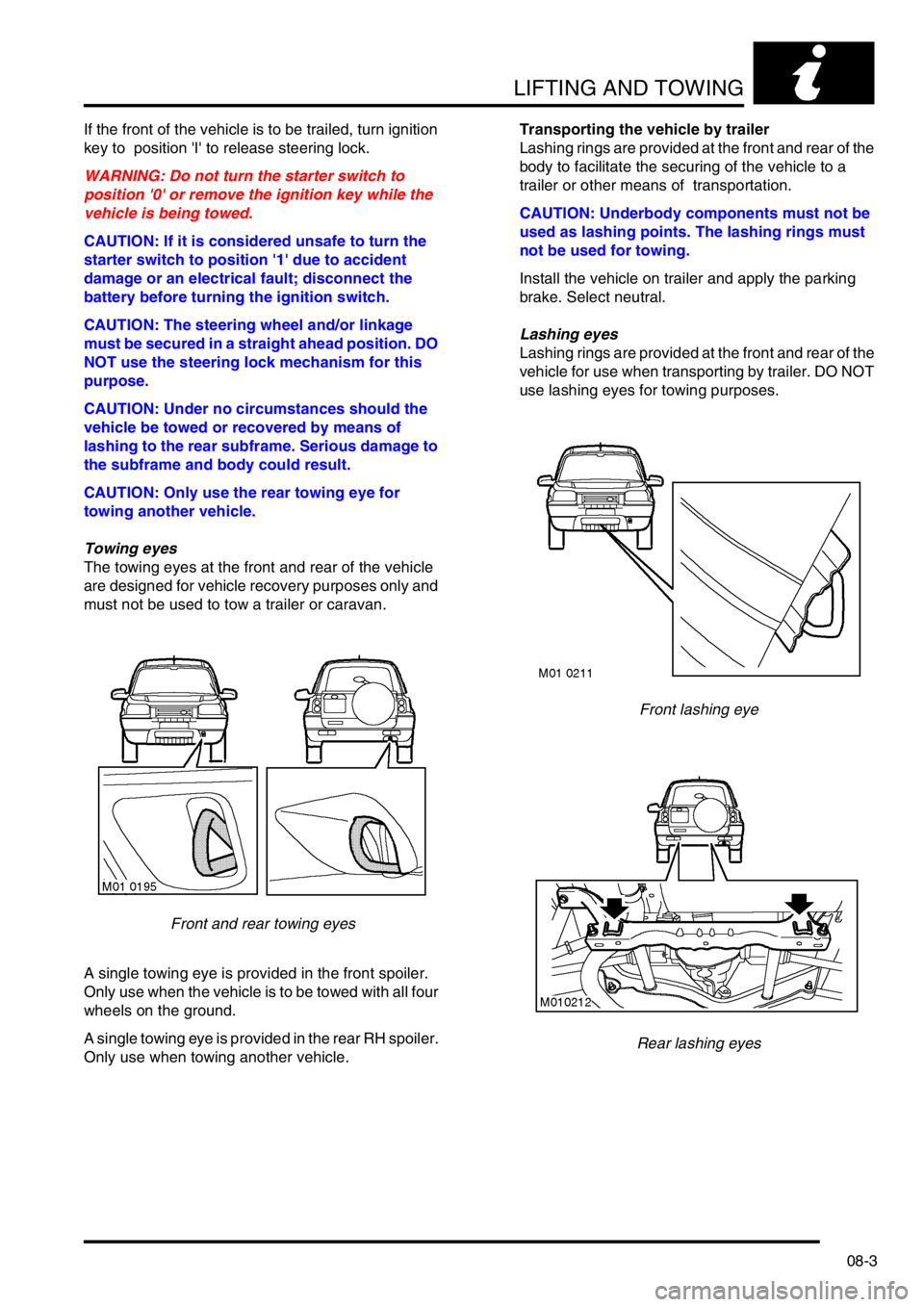
Towing eyes
The towing eyes at the front and rear of the vehicle
are designed for vehicle recovery purposes only and
must not be used to tow a trailer or caravan.
Front and rear towing eyes
A single towing eye is provided in the front spoiler.
Only use when the vehicle is to be towed with all four
wheels on the ground.
A single towing eye is provided in the rear RH spoiler.
Only use when towing another vehicle.Transporting the vehicle by trailer
Lashing rings are provided at the front and rear of the
body to facilitate the securing of the vehicle to a
trailer or other means of transportation.
CAUTION: Underbody components must not be
used as lashing points. The lashing rings must
not be used for towing.
Install the vehicle on trailer and apply the parking
brake. Select neutral.
Lashing eyes
Lashing rings are provided at the front and rear of the
vehicle for use when transporting by trailer. DO NOT
use lashing eyes for towing purposes.
Front lashing eye
Rear lashing eyes
Page 146 of 1007
CAPACITIES, FLUIDS, LUBRICANTS AND SEALANTS
09-3
Lubrication
The engine and other lubricating systems are filled
with high- performance lubricants giving prolonged
life.
CAUTION: Always use a high quality oil of the
correct viscosity range in the engine. The use of
oil of the incorrect specification can lead to high
oil and fuel consumption and ultimately to
damaged components.
Oil to the correct specification contains additives
which disperse the corrosive acids formed by
combustion and prevent the formation of sludge
which can block the oil ways. Additional oil additives
should not be used.
Always adhere to the recommended servicing
intervals.
Engine oil
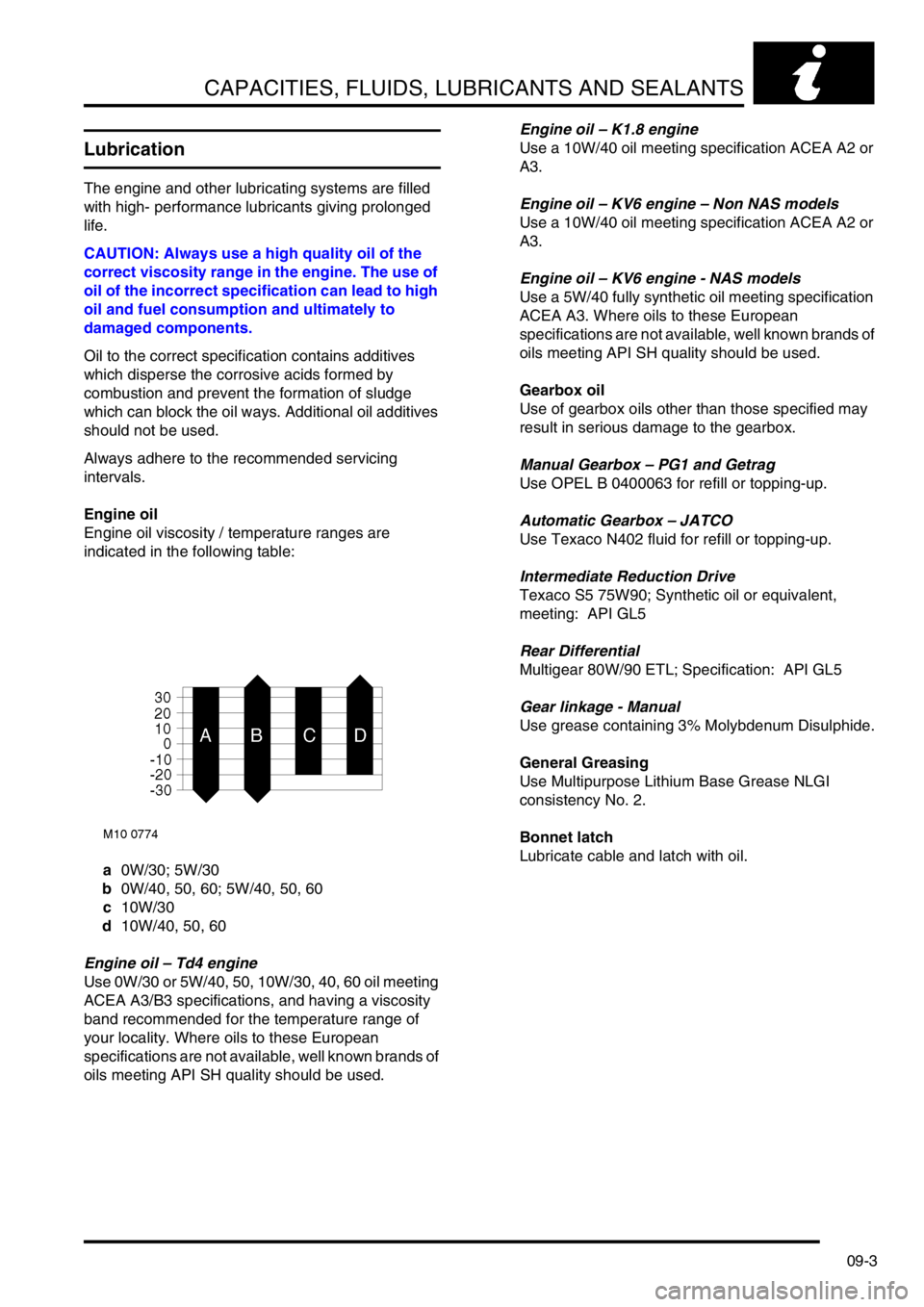
Engine oil viscosity / temperature ranges are
indicated in the following table:
a0W/30; 5W/30
b0W/40, 50, 60; 5W/40, 50, 60
c10W/30
d10W/40, 50, 60
Engine oil – Td4 engine
Use 0W/30 or 5W/40, 50, 10W/30, 40, 60 oil meeting
ACEA A3/B3 specifications, and having a viscosity
band recommended for the temperature range of
your locality. Where oils to these European
specifications are not available, well known brands of
oils meeting API SH quality should be used.Engine oil – K1.8 engine
Use a 10W/40 oil meeting specification ACEA A2 or
A3.
Engine oil – KV6 engine – Non NAS models
Use a 10W/40 oil meeting specification ACEA A2 or
A3.
Engine oil – KV6 engine - NAS models
Use a 5W/40 fully synthetic oil meeting specification
ACEA A3. Where oils to these European
specifications are not available, well known brands of
oils meeting API SH quality should be used.
Gearbox oil
Use of gearbox oils other than those specified may
result in serious damage to the gearbox.
Manual Gearbox – PG1 and Getrag
Use OPEL B 0400063 for refill or topping-up.
Automatic Gearbox – JATCO
Use Texaco N402 fluid for refill or topping-up.
Intermediate Reduction Drive
Texaco S5 75W90; Synthetic oil or equivalent,
meeting: API GL5
Rear Differential
Multigear 80W/90 ETL; Specification: API GL5
Gear linkage - Manual
Use grease containing 3% Molybdenum Disulphide.
General Greasing
Use Multipurpose Lithium Base Grease NLGI
consistency No. 2.
Bonnet latch
Lubricate cable and latch with oil.
Page 147 of 1007

CAPACITIES, FLUIDS, LUBRICANTS AND SEALANTS
09-4
Sealants
The following table lists those sealants which are
used during repair / overhaul procedures covered in
this manual; it is essential that the sealant specified
for a particular procedure is used at all times.
Component Application Land Rover
Part No.
Td4 Engine Camshaft cover
gasket joint linesSTC 50550
Td4 Engine Sump gasket joint
linesSTC 50550
K 1.8 Engine Oil pressure switch
threadsSTC 50552
K 1.8 Engine Oil pressure relief
valve plug threadsSTC 50552
K 1.8 Engine Oil temperature
sensor threadsSTC 50552
K 1.8 Engine Oil pump cover
plate screwsSTC 50552
K 1.8 Engine Camshaft carrier to
cylinder headSTC 4600
K 1.8 Engine Bearing ladder to
cylinder blockSTC 4600
K 1.8 Engine Sump to bearing
ladderSTC 4600
K 1.8 Engine Oil rail to bearing
ladderSTC 4600
K 1.8 Engine Crankshaft rear oil
seal STC 50550
K 1.8 Engine Cylinder liners to
cylinder blockRTC 3347
KV6 Engine Camshaft timing
belt backplate
cover boltsSTC 50552
KV6 Engine Oil pressure relief
valve plug threadsSTC 50552
KV6 Engine Oil pump cover
plate screwsSTC 50552
KV6 Engine Camshaft carrier to
cylinder headSTC 4600
KV6 Engine Sump to lower
crankcaseSTC 4600
KV6 Engine Oil pick-up strainer
boltSTC 50552
KV6 Engine Lower crankcase to
cylinder blockSTC 50550
KV6 Engine Cylinder liners to
cylinder blockRTC 3347
KV6 Engine Coolant stub pipe to
cylinder blockSTC 50554
Engine
Management
System -
MEMSSensor - Engine
Coolant
temperature (ECT)STC 50552
Cooling
System - KV6Cylinder block drain
plugSTC 50552
Manual
Gearbox - PG12 top bolts -
gearbox to engineSTC 50552
Manual
Gearbox -
GetragRear cover to
gearcaseSTC 4600
Manual
Gearbox -
GetragGearshift cover STC 4600
Intermediate
Reduction
DriveEnd cover gasket -
IRD housingSTC 4600
Automatic
Gearbox -
JatcoFluid pan to
gearcaseSTC 4600
Rear Axle and
Final DriveDifferential cover to
casingSTC 3811
Page 158 of 1007
MAINTENANCE
MAINTENANCE 10-11
Door Locks, Hinges, Check Straps and
Bonnet Catch
Check
1.Check operation of each door, door lock,
bonnet catch and fuel filler flap.Lubricate Front and Rear Doors
1.Open each door in turn and lubricate door
hinges and check strap using recommended
lubricant.
+ CAPACITIES, FLUIDS,
LUBRICANTS AND SEALANTS,
Lubrication.
2.Lubricate door lock, striker and private lock
using PTFE lubricant. Remove excessive
lubricant, particularly from door striker area, to
avoid customer complaint.
3.Check tightness of accessible door lock and
striker fixings.
4.Open and close door to check for smooth,
noise-free operation. Ensure door closes
securely.
5.Check for smooth operation of private lock.
Lubricate Tail Door
1.Open tail door and lubricate hinges using
recommended lubricant.
+ CAPACITIES, FLUIDS,
LUBRICANTS AND SEALANTS,
Lubrication.
2.Grease tail door check slide.
3.Lubricate rear door lock and striker using PTFE
lubricant. Remove excessive lubricant to avoid
customer complaint, particularly from door
striker area.
4.Check tightness of accessible tail door lock and
striker fixings.
Lubricate Bonnet
1.With bonnet open, lubricate hinges, striker, lock
and safety catch using a suitable lubricant.
+ CAPACITIES, FLUIDS,
LUBRICANTS AND SEALANTS,
Lubrication.
Sunroof Guide Rails, Slides and Seal
1.With sunroof open, lubricate accessible guide
rails, slides and seals. Remove any excess
lubricant to avoid contaminating roof lining and
trim.
2.Ensure sunroof closes correctly.
Sunroof Drain Tubes and Channels
1.Remove any debris from sunroof tray.
2.Ensure that all accessible sunroof drain tubes
are clear using a low pressure air line.