ABS LAND ROVER FRELANDER 2 2006 Repair Manual
[x] Cancel search | Manufacturer: LAND ROVER, Model Year: 2006, Model line: FRELANDER 2, Model: LAND ROVER FRELANDER 2 2006Pages: 3229, PDF Size: 78.5 MB
Page 2800 of 3229
Lighting
80
L
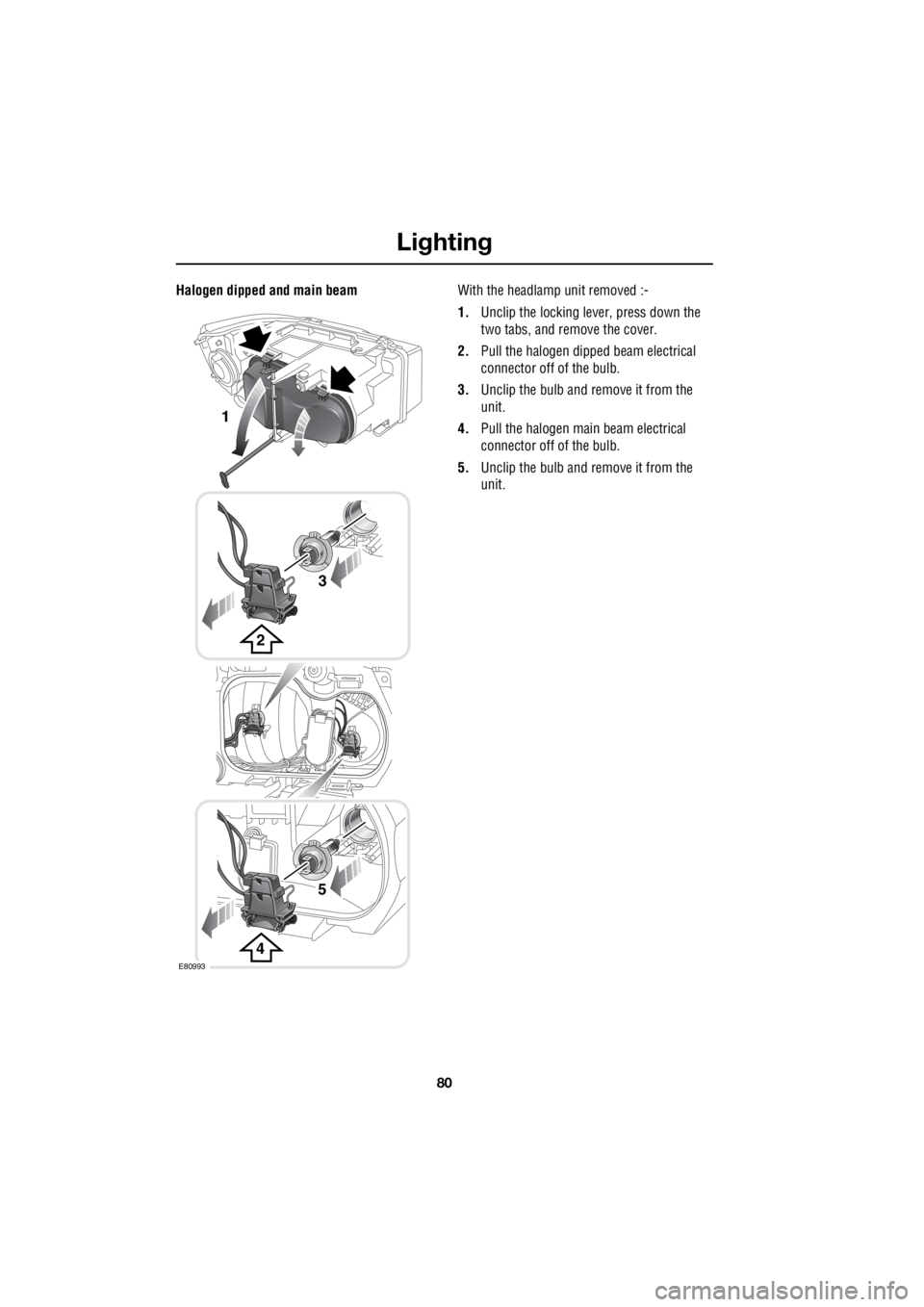
Halogen dipped and main beam With the headlamp unit removed :-
1. Unclip the locking lever, press down the
two tabs, and remove the cover.
2. Pull the halogen dipped beam electrical
connector off of the bulb.
3. Unclip the bulb and remove it from the
unit.
4. Pull the halogen main beam electrical
connector off of the bulb.
5. Unclip the bulb and remove it from the
unit.
2
3
1
4
5
E80993
Page 2843 of 3229

123
Brakes
R
BrakesPRINCIPLE OF OPERATION
Brake pads
Brake pads require a period of bedding in when
new. Drive with extra caution for the first 800
km (500 miles) to avoi d then need for heavy
braking.
Wet conditions
Driving through heavy rain or water can have
an adverse effect on braking efficiency. Under
those circumstances it is recommended that
you lightly apply the brak es intermittently to
dry the brakes.
HINTS ON DRIVING WITH ABS
ABS (Anti-Lock Braki ng System) allows
maximum brake pressure, and thus maximum
braking efficiency, to be applied, and prevents
the road wheels locking. This allows the driver
to retain steering control during heavy braking
under most road conditions.
During emergency brak ing conditions ABS
constantly monitors the speed of each wheel.
ABS varies the brake pressure to individual
wheels, according to the grip available. The
constant alteration of brake pressure can be
felt as a pulsing sensat ion through the brake
pedal. This is not a cause for concern, as it is
designed to demonstrate to the driver that ABS
is operating.
ABS warning indicator
If this amber warning indicator
illuminates, driv e with extra
caution, avoid heavy braking where
possible, and seek qualified assistance as soon
as possible.
WARNINGS
Do not rest your foot on the brake
pedal whilst the vehicle is in motion.
This may cause a light application of
the brakes, which can re sult in overheating,
reduced brake performance, and excessive
brake wear.
Never allow the vehicle to coast
(freewheel) with the engine turned off.
The engine must be running to provide
full braking assistance. The brakes will still
function with the engine off, but far more
pressure will be required to operate them.
If the red brake warning indicator
illuminates, safely bring the vehicle to
a stop, as quickly as possible. Seek
qualified assistance before proceeding.
Never place non-approved floor
matting or any ot her obstructions
under the brake pedal. This restricts
pedal travel and braking efficiency.WARNINGS
ABS cannot overcome the physical
limitations of brak ing distance. Nor
can it overcome the lack of grip on a
road surface, aquaplaning on water for
example.
Braking distance is increased on a
slippery surface. This applies to all
vehicles, even those fitted with ABS.
The driver should not be tempted to
take risks when driving, in the hope
that ABS will correct errors of
judgement. In all cases it remains the driver's
responsibility to driv e with due care and
attention, paying partic ular attention to the
effects of speed, weather, road conditions etc.
Page 2844 of 3229

Brakes
124
L
ABS and off-road driving
ABS will operate when driving off-road,
however it may be unw ise to rely on it's
assistance under some conditions.
Stopping distances will be increased when
travelling over rough, or bumpy terrain.
Soft surfaces
On soft or deep surfaces such as powdery
snow, sand, or gravel, the braking distance
required will be increased. This is because the
natural action of a lock ed wheel (which cannot
happen when ABS is operating) is to form a
wedge of surface material in front of the wheel,
which reduces the stopping distance.
Steep slopes
If the vehicle is stationary on a steep, slippery
slope, it may begin to slide even with the
brakes applied. This is because without wheel
rotation the ABS cannot determine vehicle
movement.
To counteract this, briefl y release the brakes to
allow some wheel rota tion. Then re-apply the
brakes to allow ABS to gain control.
Emergency Brake Assist (EBA)
If the driver rapidly applies the brakes, EBA
automatically boosts the braking force to it's
maximum in order to bring the vehicle to a halt
as quickly as possible. If the driver applies the
brakes slowly, but condi tions mean that ABS
operates on the front wheels, EBA will increase
the braking force in order to apply ABS control
to the rear wheels.
EBA stops operating as soon as the brake pedal
is released.
A fault with the EBA system is
indicated by the red brake warning
indicator illuminating.
Electronic Brake Distribution (EBD)
EBD controls the balanc e of braking forces
supplied to the front and rear wheels, in order
to maintain maximum braking efficiency.
If the vehicle has a light load (only the driver in
the vehicle for example) the EBD will reduce the
braking force applied to the rear wheels. If the
vehicle is heavily laden then EBD will increase
the braking force to the rear wheels.
A fault with the EBD system is
indicated by the red brake warning
indicator illuminating.
PARKING BRAKE
Parking on a slope
Facing uphill
If the vehicle is parked facing uphill, select first
gear (manual gearbox), or Park (automatic
gearbox), and turn the steering wheel so that
the front wheels face away from the kerb.
Facing downhill
If the vehicle is parked facing downhill, select
reverse gear (manual gearbox), or Park
(automatic gearbox), and turn the steering
wheel so that the front wheels face towards the
kerb.
Page 2852 of 3229

Terrain response
132
L
Terrain responsePRINCIPLE OF OPERATION
The Terrain Response System provides an
opportunity for the driver to feed back terrain
information to the vehicle by choosing a
general setting or on e of three special
programs. It then uses that information to
optimise the vehicle's systems for improved
traction and driveability. It does this by
bringing together vehicle drive control systems
which usually opera te individually.
The drive systems optimised by the Terrain
Response Syst em are :-
• Engine management.
• Gearbox management.
• Intelligent coupling control.
• Dynamic stability, trac tion and Hill Descent
controls.
The system will provide a variable accelerator
pedal response, ranging fr om very cautious for
slippery conditions (w here a large pedal
movement has only a small effect on engine
power) to very respon sive (where engine
power is allowed to rise more quickly).
Note: Changing from one special program to
another will introduce noticeably different
responses. For example, the engine revs
produced by the current accelerator pedal
position, may increase or decrease in the new
program.
To familiarise y ourself and get the best from
the system you should try out the programs in
circumstances which are safe for you and other
road users.
Terrain response has been designed to benefit
the driver no matter what their level of off-road
driving experience. The system will aid those
with less experience, a nd enhance the skills of
those with more experience.
USING TERRAIN RESPONSE
Note: The Terrain Response System is
designed to be engaged before crossing
difficult terrain. Do not wait until control has
been lost before usi ng the special programs.
When the vehicle is started, the Terrain
Response System will be in its General
program. The General program will allow the
vehicle to operate capa bly in most conditions,
as some of the sub-systems will react to the
conditions where appropriate. When
conditions change, and more difficult
conditions are encountered, the appropriate
special program should be selected.
Before driving off-road
Before venturing off-road it is absolutely
essential that inexperi enced drivers become
fully familiar with the vehicle's controls. In
particular, CommandShift , Hill Descent Control
(HDC), and the Terra in Response system.
Basic information and off-road driving
techniques can be found in the off-road driving
handbook available on-line at
http://www.ownerinfo.landrover.com
Off-road driver traini ng should be undertaken
by anyone intending to drive off-road. Training
is available at your nearest Land Rover
Experience centre. More details can be found at
http://www.landroverexperience.com
Driver override options
All systems will be se t to their optimum
parameters for the condi tions reflected in the
choice of special program. However, if
required, Hill Descent c ontrol can be operated
independently. See USING HDC (page 137). If
it has not been automatically selected by the
special program, it may be engaged as
required. Converse ly, if it has been selected,
but is not required, it may be turned off.
Page 2856 of 3229

Hill descent control (HDC)
136
L
Hill descent control (HDC)PRINCIPLE OF OPERATION
HDC operates in conjunction with ABS to
provide greater control when off-road,
particularly when desc ending steep slopes.
HDC operation is fully automatic when
engaged.
During a hill descent when driving off-road,
engine braking is used to control the speed of
descent. If engine braki ng alone is insufficient
to control the vehicle's speed, HDC will slow
the vehicle using the braking system. HDC will
control the descent speed relative to the gear
selected and accelerator position.
If the vehicle is fitted with a manual
transmission, HDC should onl y be used in first,
or reverse gears. If the vehicle is fitted with an
automatic transmission, HDC should only be
used in D, R , or CommandShift 1. When in D
the vehicle will select the most appropriate
gear.
Note: HDC is automatically selected by some
of the Terrain response special programs.
Gradient release control (GRC)
With HDC activated, if the vehicle is stopped on
a slope using the footbrake, GRC will become
active. When the footbrake is released GRC will
automatically delay the brake release to allow
take up of drive, and build up of engine torque.
The brakes will then gradually release to allow
the vehicle to move smoothly away under the
control of HDC.
GRC operates in forwar d and reverse, and
requires no driver intervention.
Before driving off-road
Before venturing off-road it is absolutely
essential that inexperi enced drivers become
fully familiar with the vehicle's controls. In
particular, CommandShift , Hill Descent Control
(HDC), and the Terra in Response system.
Basic information and off-road driving
techniques can be found in the off-road driving
handbook available on-line at
http://www.ownerinfo.landrover.com
Off-road driver traini ng should be undertaken
by anyone intending to drive off-road. Training
is available at your nearest Land Rover
Experience centre. More details can be found at
http://www.landroverexperience.com
Page 2859 of 3229

139
Traction control
R
Traction controlUSING TRACTION CONTROL
Electronic Traction Control (ETC)
ETC operates in conjunction with Dynamic
Stability Control (DSC) and is designed to
assist when one, or more, wheels have lost
traction.
If a wheel looses tracti on, ETC will operate the
brake on that wheel until it regains traction.
Warning indicator If a fault is detected within the ETC
system the warning indicator will
illuminate.
Before driving off-road
Before venturing off-ro ad it is absolutely
essential that inexperienced drivers become
fully familiar with the vehicle's controls. In
particular, CommandShift , Hill Descent Control
(HDC), and the Terrain Response system.
Basic information a nd off-road driving
techniques can be found in the off-road driving
handbook available on-line at
http://www.ownerinfo.landrover.com
Off-road driver traini ng should be undertaken
by anyone intending to drive off-road. Training
is available at your nearest Land Rover
Experience centre. More details can be found at
http://www.landroverexperience.com
Page 2860 of 3229
Stability control
140
L
Stability controlPRINCIPLE OF OPERATION
Dynamic Stability Control (DSC)
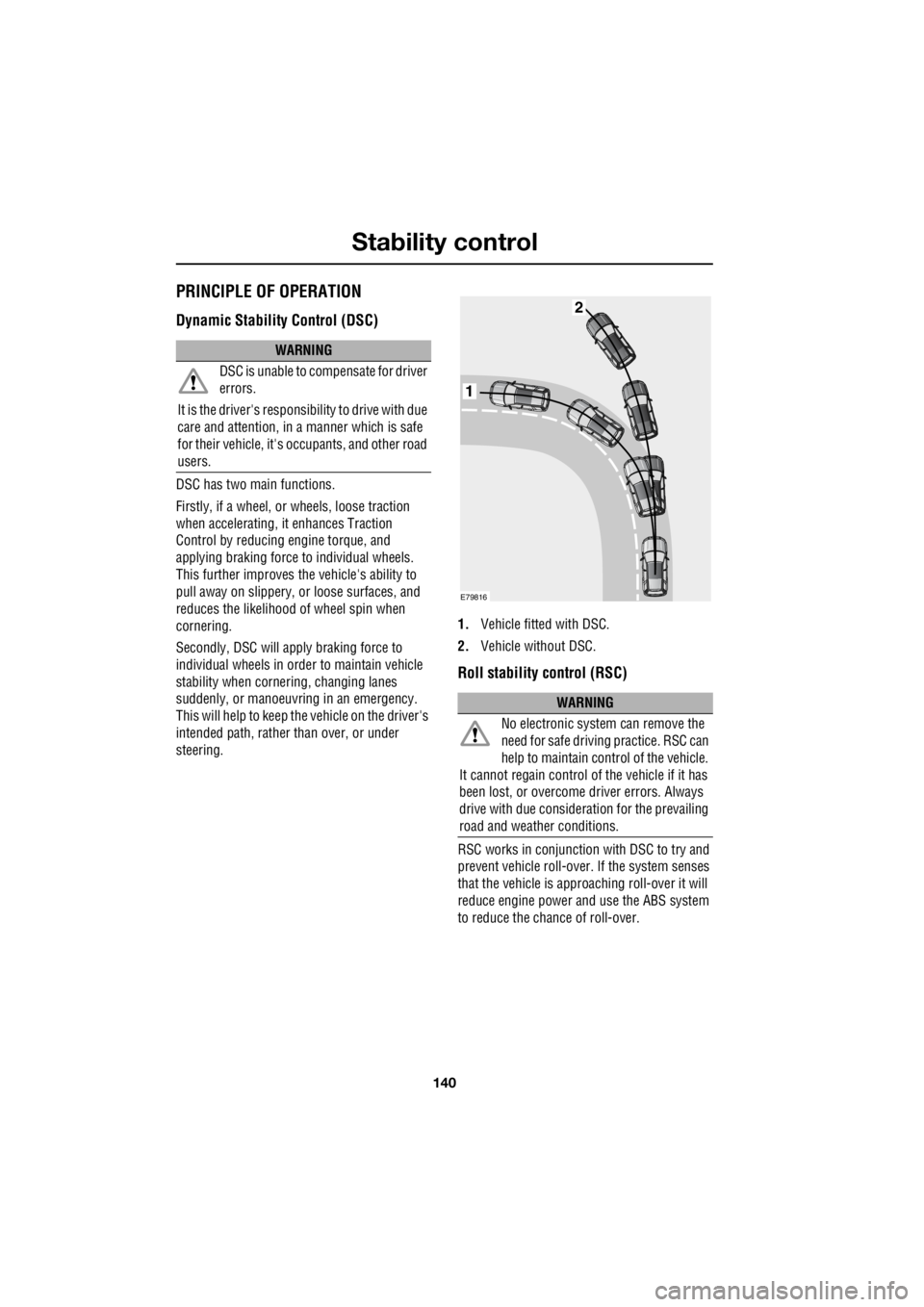
DSC has two main functions.
Firstly, if a wheel, or wheels, loose traction
when accelerating, it enhances Traction
Control by reducing engine torque, and
applying braking force to individual wheels.
This further improves the vehicle's ability to
pull away on slippery, or loose surfaces, and
reduces the likelihood of wheel spin when
cornering.
Secondly, DSC will apply braking force to
individual wheels in orde r to maintain vehicle
stability when cornering, changing lanes
suddenly, or manoeuvring in an emergency.
This will help to keep the vehicle on the driver's
intended path, rather than over, or under
steering. 1.
Vehicle fitted with DSC.
2. Vehicle without DSC.
Roll stability control (RSC)
RSC works in conjunction with DSC to try and
prevent vehicle roll-over. If the system senses
that the vehicle is approaching roll-over it will
reduce engine power and use the ABS system
to reduce the chance of roll-over.
WARNING
DSC is unable to compensate for driver
errors.
It is the driver's responsibility to drive with due
care and attention, in a manner which is safe
for their vehicle, it's oc cupants, and other road
users.
WARNING
No electronic system can remove the
need for safe drivin g practice. RSC can
help to maintain control of the vehicle.
It cannot regain control of the vehicle if it has
been lost, or overcome driver errors. Always
drive with due consideration for the prevailing
road and weather conditions.
1
2
E79816
Page 2884 of 3229

Maintenance
164
L
If the level has fallen appreciably, suspect
leakage or overheatin g and arrange for the
vehicle to be exam ined by a qualified
technician.
Topping up the coolant
Top-up to the upper le vel indicator mark
located on the side of the expansion tank. Use
only a 50% mix of water and Texaco XLC
antifreeze.
Note: In an emergency - and only if the
approved antifreeze is unavailable - top-up the
cooling system with clea n water, but be aware
of the resultant reduction in frost protection.
Do not top-up or refill with conventional
antifreeze formulations. If in doubt consult a
qualified technician.
Ensure the cap is tightened fully after top-up is
completed by turning the cap until the ratchet
cap clicks. Antifreeze
Antifreeze contains important corrosion
inhibitors. The antifreeze content of the coolant
must be maintained at 50% ± 5% all year round
(not just in cold conditions). To ensure that the
anti-corrosion properties of the coolant are
retained, the antifreeze content should be
checked once a year and completely renewed
every ten years, regardless of distance
travelled. Failure to do so may cause corrosion
of the radiator and engine components.
The specific gravity of a 50% antifreeze
solution at 20°C (68°F) is 1.068 and protects
against frost down to -40°C (-40°F).
WARNINGS
Never remove the filler cap when the
engine is hot - escaping steam or
scalding water could ca use serious personal
injury.
Avoid spilling antifreeze onto a hot
engine - a fire may result.
Unscrew the filler cap slowly, allowing
the pressure to escape before removing
completely.
CAUTION
When travelling in territories where the
water supply contains salt, always
ensure you carry a supply of fresh (rain or
distilled) water. Topping up with salt water will
cause serious engine damage.
WARNINGS
Antifreeze is poisonous and can be fatal
if swallowed - keep containers sealed
and out of the reach of children. If accidental
consumption is suspec ted, seek medical
attention immediately.
If the fluid comes into contact with the
skin or eyes, rinse immediately with
plenty of water.
CAUTIONS
The use of non-approved antifreeze will
have an adverse ef fect on the engine
cooling system and therefore engine
durability.
Antifreeze will damage painted surfaces;
soak up any spillage with an absorbent
cloth immediately and wash the area with a
mixture of car shampoo and water.
Page 2886 of 3229
Maintenance
166
L
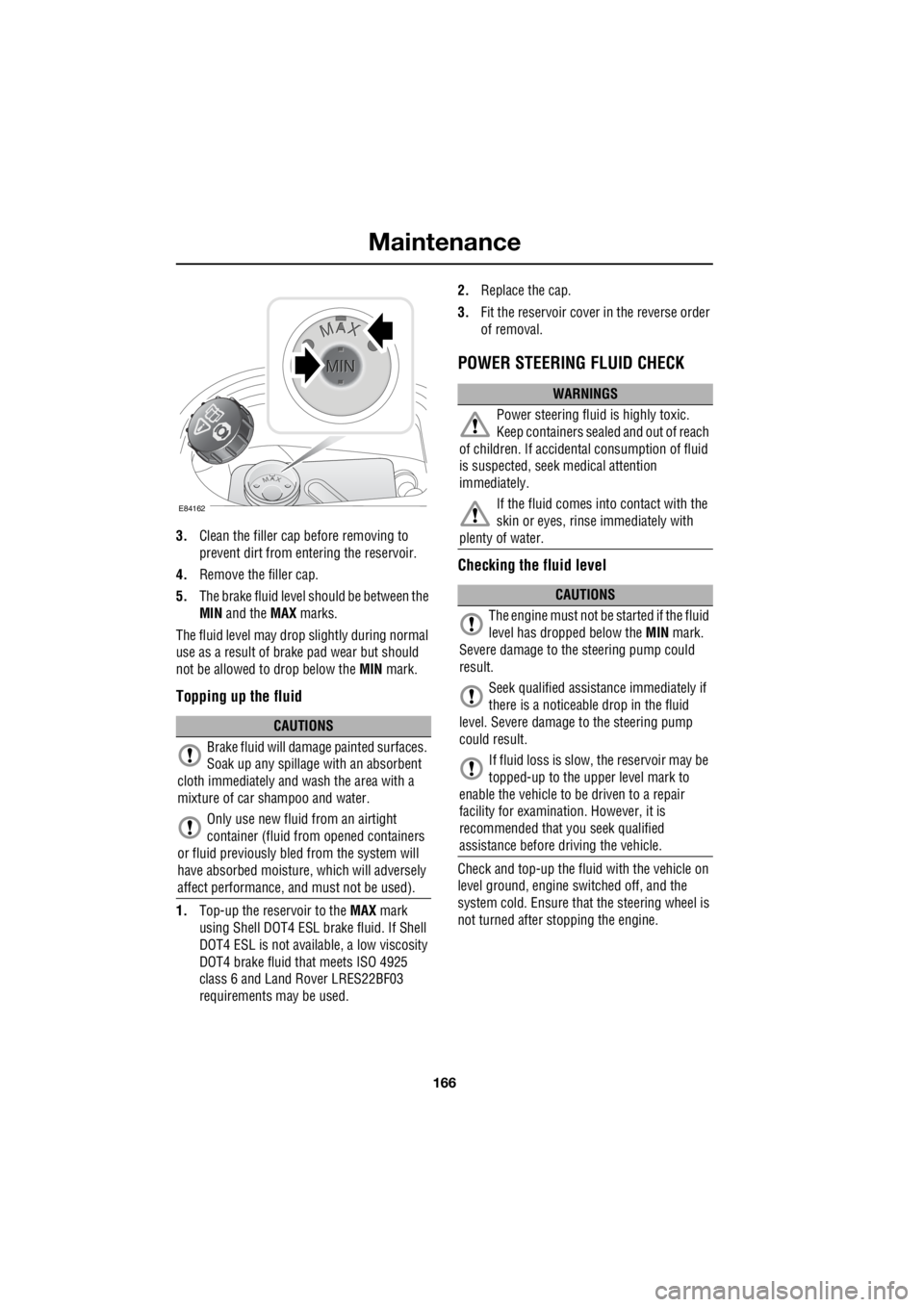
3. Clean the filler cap before removing to
prevent dirt from entering the reservoir.
4. Remove the filler cap.
5. The brake fluid level should be between the
MIN and the MAX marks.
The fluid level may drop slightly during normal
use as a result of brake pad wear but should
not be allowed to drop below the MIN mark.
Topping up the fluid
1.Top-up the reservoir to the MAX mark
using Shell DOT4 ESL brake fluid. If Shell
DOT4 ESL is not availa ble, a low viscosity
DOT4 brake fluid that meets ISO 4925
class 6 and Land Rover LRES22BF03
requirements ma y be used. 2.
Replace the cap.
3. Fit the reservoir cover in the reverse order
of removal.
POWER STEERING FLUID CHECK
Checking the fluid level
Check and top-up the fluid with the vehicle on
level ground, engine switched off, and the
system cold. Ensure that the steering wheel is
not turned after stopping the engine.
CAUTIONS
Brake fluid will damage painted surfaces.
Soak up any spillage with an absorbent
cloth immediately and wash the area with a
mixture of car sh ampoo and water.
Only use new fluid from an airtight
container (fluid from opened containers
or fluid previously bled from the system will
have absorbed moisture, which will adversely
affect performance, and must not be used).
E84162
WARNINGS
Power steering fluid is highly toxic.
Keep containers sealed and out of reach
of children. If accidental consumption of fluid
is suspected, seek medical attention
immediately.
If the fluid comes into contact with the
skin or eyes, rinse immediately with
plenty of water.
CAUTIONS
The engine must not be started if the fluid
level has dropped below the MIN mark.
Severe damage to th e steering pump could
result.
Seek qualified assistance immediately if
there is a noticeable drop in the fluid
level. Severe damage to the steering pump
could result.
If fluid loss is slow, the reservoir may be
topped-up to the uppe r level mark to
enable the vehicle to be driven to a repair
facility for examinatio n. However, it is
recommended that you seek qualified
assistance before driving the vehicle.
Page 2887 of 3229
167
Maintenance
R
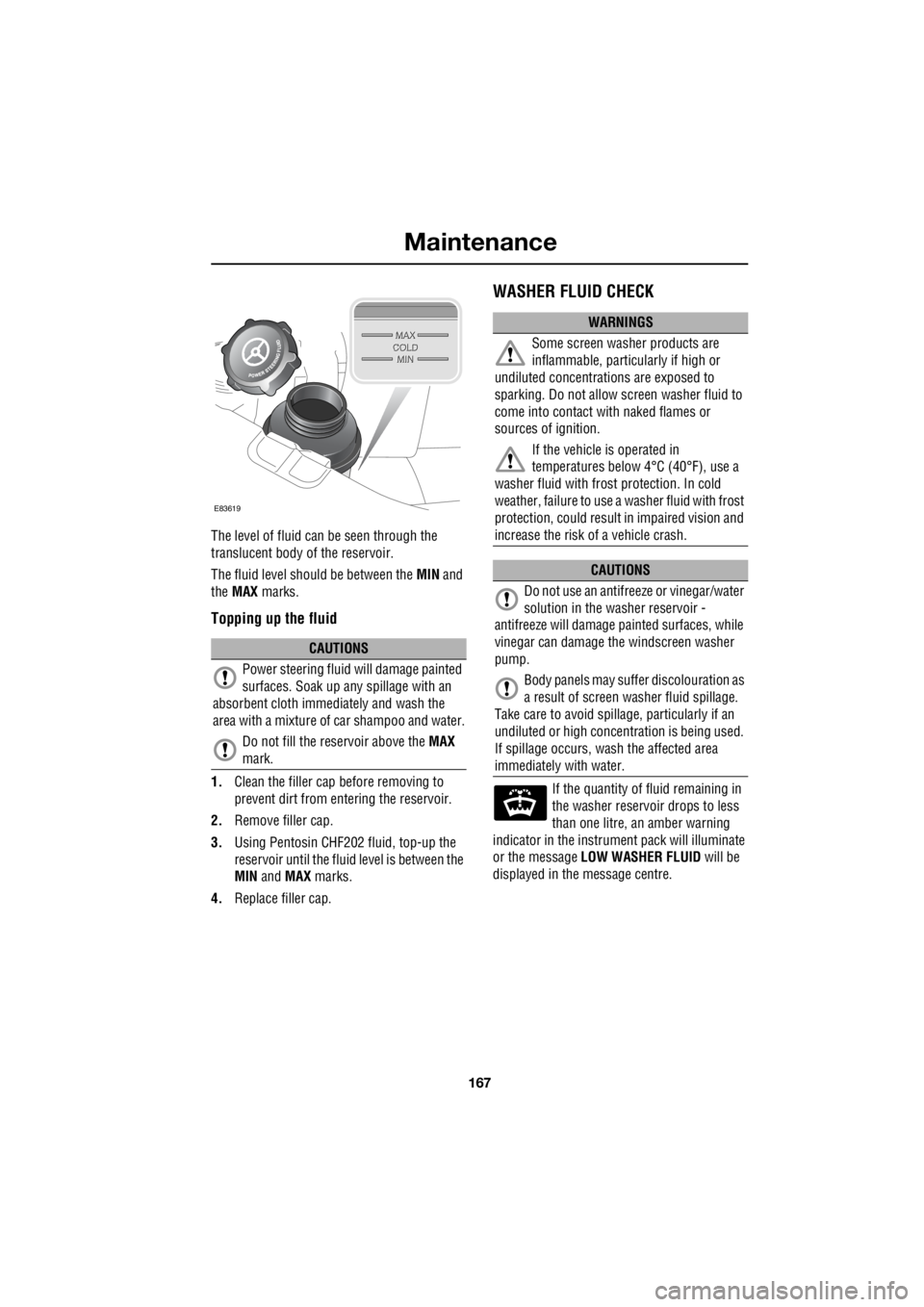
The level of fluid can be seen through the
translucent body of the reservoir.
The fluid level should be between the MIN and
the MAX marks.
Topping up the fluid
1.Clean the filler cap before removing to
prevent dirt from entering the reservoir.
2. Remove filler cap.
3. Using Pentosin CHF202 fluid, top-up the
reservoir until the flui d level is between the
MIN and MAX marks.
4. Replace filler cap.
WASHER FLUID CHECK
If the quantity of fluid remaining in
the washer reservoir drops to less
than one litre, an amber warning
indicator in the instrument pack will illuminate
or the message LOW WASHER FLUID will be
displayed in the message centre.
CAUTIONS
Power steering fluid will damage painted
surfaces. Soak up any spillage with an
absorbent cloth immediately and wash the
area with a mixture of car shampoo and water.
Do not fill the reservoir above the MAX
mark.
E83619
WARNINGS
Some screen washer products are
inflammable, particul arly if high or
undiluted concentrati ons are exposed to
sparking. Do not allow screen washer fluid to
come into contact with naked flames or
sources of ignition.
If the vehicle is operated in
temperatures below 4°C (40°F), use a
washer fluid with frost protection. In cold
weather, failure to use a washer fluid with frost
protection, could result in impaired vision and
increase the risk of a vehicle crash.
CAUTIONS
Do not use an antifree ze or vinegar/water
solution in the washer reservoir -
antifreeze will damage painted surfaces, while
vinegar can damage th e windscreen washer
pump.
Body panels may suff er discolouration as
a result of screen washer fluid spillage.
Take care to avoid spilla ge, particularly if an
undiluted or high concentr ation is being used.
If spillage occurs, wash the affected area
immediately with water.