tow LAND ROVER FRELANDER 2 2006 Workshop Manual
[x] Cancel search | Manufacturer: LAND ROVER, Model Year: 2006, Model line: FRELANDER 2, Model: LAND ROVER FRELANDER 2 2006Pages: 3229, PDF Size: 78.5 MB
Page 2871 of 3229
151
Towing
R
LEVELLING
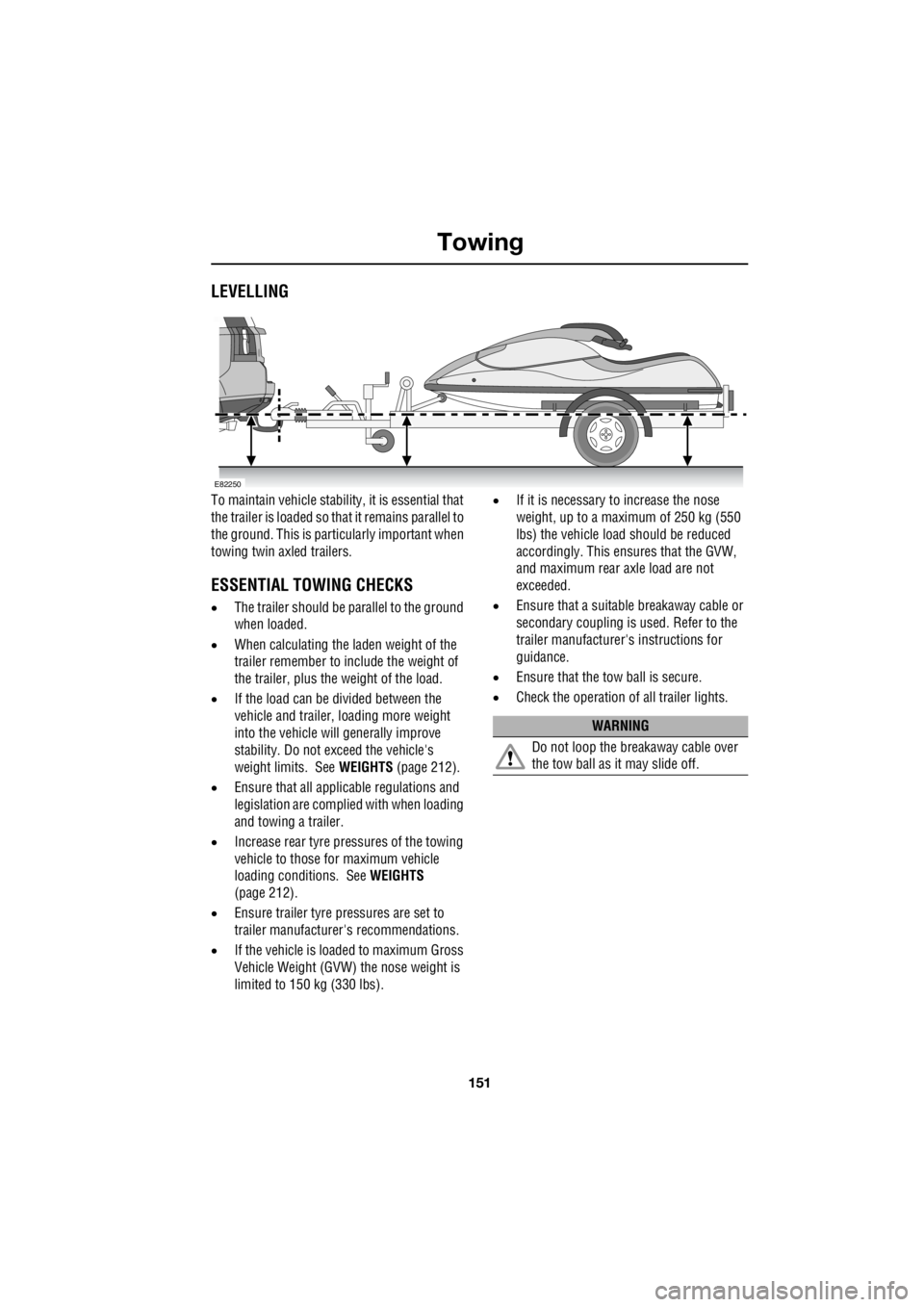
To maintain vehicle stability, it is essential that
the trailer is loaded so that it remains parallel to
the ground. This is partic ularly important when
towing twin axled trailers.
ESSENTIAL TOWING CHECKS
• The trailer should be pa rallel to the ground
when loaded.
• When calculating the laden weight of the
trailer remember to include the weight of
the trailer, plus the weight of the load.
• If the load can be divided between the
vehicle and trailer, loading more weight
into the vehicle will generally improve
stability. Do not exceed the vehicle's
weight limits. See WEIGHTS (page 212).
• Ensure that all applic able regulations and
legislation are complied with when loading
and towing a trailer.
• Increase rear tyre pressures of the towing
vehicle to those for maximum vehicle
loading conditions. See WEIGHTS
(page 212).
• Ensure trailer tyre pressures are set to
trailer manufacture r's recommendations.
• If the vehicle is loaded to maximum Gross
Vehicle Weight (GVW) the nose weight is
limited to 150 kg (330 lbs). •
If it is necessary to increase the nose
weight, up to a maximum of 250 kg (550
lbs) the vehicle load should be reduced
accordingly. This ensures that the GVW,
and maximum rear axle load are not
exceeded.
• Ensure that a suitable breakaway cable or
secondary coupling is used. Refer to the
trailer manufacturer' s instructions for
guidance.
• Ensure that the tow ball is secure.
• Check the operation of all trailer lights.
E82250
WARNING
Do not loop the breakaway cable over
the tow ball as it may slide off.
Page 2872 of 3229

Towing
152
L
RECOMMENDED TOWING WEIGHTS
Note: When towing the maximum permissible
gross vehicle weight can be increased by a
maximum of 100 kg (220 lbs) provided that the
road speed is limited to 100 km/h (60 mph).
Note: When calculating rear axle loading,
remember that the trailer nose weight, the load
in the vehicle's luggage area, weight on the
roof rack, and the weight of rear seat
passengers must all be added together.
Maximum permissible towing
weights On-road Off-road
Unbraked trailers 750 kg (1650 lbs) 750 kg (1650 lbs)
Trailers with overrun brakes 2000 kg (4400 lbs) 750 kg (1650 lbs)
Nose weight 150 kg (330 lbs) 150 kg (330 lbs)
WARNING
Do not exceed the Gross Vehicle
Weight (GVW), maximum rear axle
weight, maximum trai ler weight, or nose
weight. Exceeding any of these limits could
cause instability and lo ss of control. See
WEIGHTS (page 212).
Page 2873 of 3229
153
Towing
R
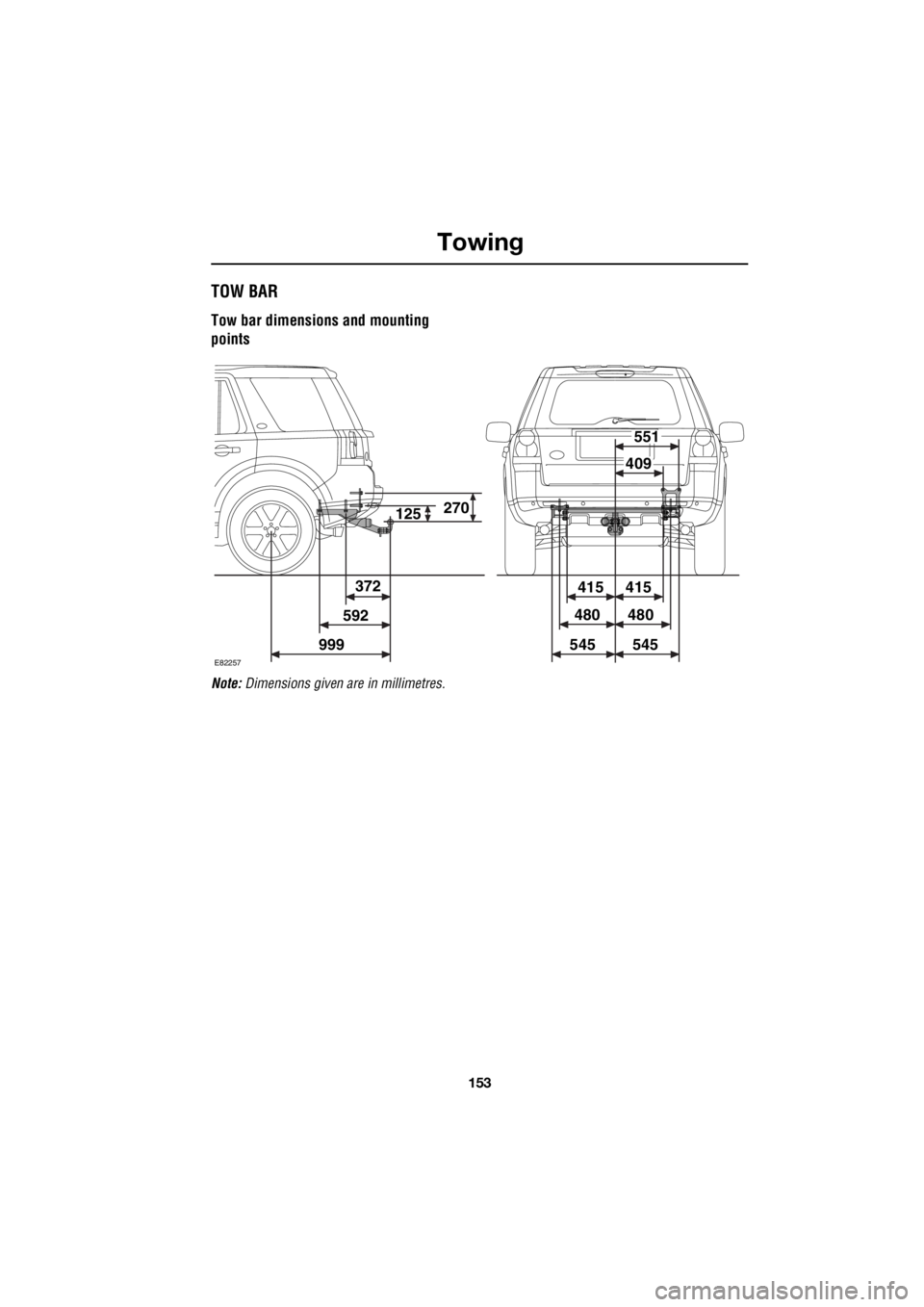
TOW BAR
Tow bar dimensions and mounting
points
Note: Dimensions given are in millimetres.
125270
415415
480480
545545
409
551
E82257
372
592
999
Page 2878 of 3229

Maintenance
158
L
One or both types of serv ice interval (distance
and time) may be displayed. For example, if an
engine oil service is du e based on mileage, and
a brake fluid change is due based on time, both
distance and time c ountdowns will display.
Service Portfolio
The Service Portfolio book includes a Service
Record section, which enables a record to be
kept of all the servicing and inspections that are
carried out on the vehicle. This section of the
book also has an area for brake fluid changes
to be recorded.
Ensure your service provider signs and stamps
the book after each se rvice and inspection.
Owner Maintenance
In addition to the routine maintenance, a
number of simple checks must be carried out
more frequently. Advice is given on the pages
that follow.
Daily checks
• Operation of lamps, horn, direction
indicators, wipers, washers and warning
indicators.
• Operation of seat belts and brakes.
• Look for fluid deposits underneath the
vehicle that might indicate a leak.
Weekly checks
• Engine oil level. See ENGINE OIL CHECK
(page 162).
• Engine coolant check. See ENGINE
COOLANT CHECK (page 163).
• Brake/clutch fluid level. See BRAKE AND
CLUTCH FLUID CHECK (page 165). •
Power steering fluid level. See POWER
STEERING FLUID CHECK (page 166).
• Screen washer fluid level. See WASHER
FLUID CHECK (page 167).
• Tyre pressure s and condition.
• Operate air conditioning.
Note: The engine oil leve l should be checked
more frequently if the vehicle is driven for
prolonged periods at high speeds.
Driving in arduous conditions
When a vehicle is operated in extremely
arduous conditions, more frequent attention
must be paid to servicing requirements.
For example, if your vehicle experiences deep
wading conditions, even daily servicing could
be necessary to ensure the continued safe and
reliable operation of the vehicle.
Arduous driving conditions include:
• Driving in dusty and/or sandy conditions.
• Driving on rough and/or muddy roads
and/or wading.
• Driving in extremely hot conditions.
• Towing a trailer or driving in mountainous
conditions.
Contact a Land Rover Dealer/Authorised
Repairer for advice.
Emission control
Your vehicle is fitted with various items of
emission and evaporative control equipment,
designed to meet sp ecific territorial
requirements. You should be aware that
unauthorised replacemen t, modification or
tampering with this equipment by an owner or
repair shop, may be unlawful and subject to
legal penalties.
CAUTION
Any significant or sudden drop in fluid
levels, or uneven tyre wear, should be
reported to a qualified technician without
delay.
Page 2903 of 3229
183
Wheels and tyres
R
USING WINTER TYRES
If winter tyres are fitted to the vehicle, the tyre
manufacturers instructions should be
followed. Pay particular attention to
instructions regarding the maximum speed
that the vehicle can be driven, and the correct
pressures for the tyres.
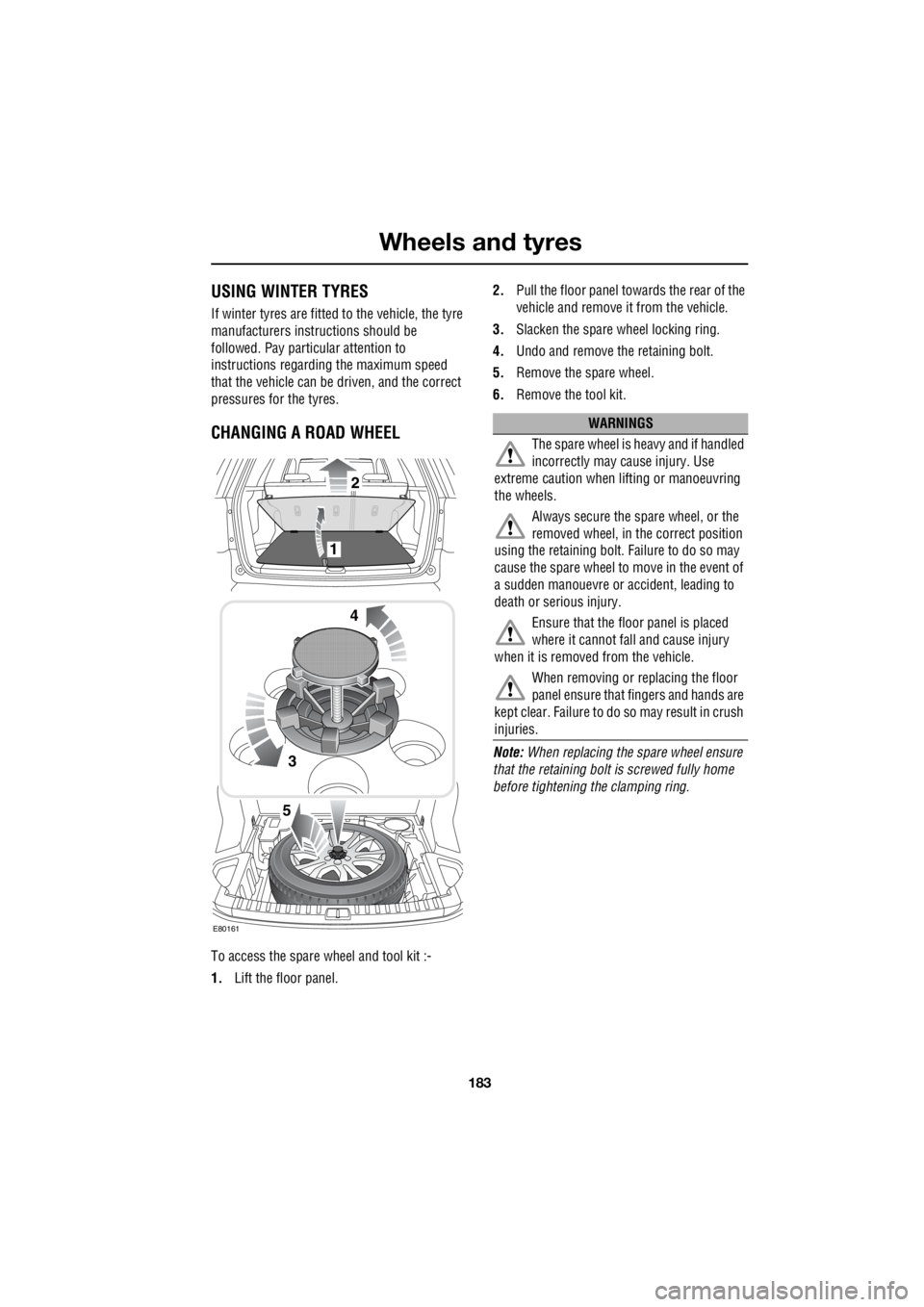
CHANGING A ROAD WHEEL
To access the spare wheel and tool kit :-
1. Lift the floor panel. 2.
Pull the floor panel towards the rear of the
vehicle and remove it from the vehicle.
3. Slacken the spare wheel locking ring.
4. Undo and remove the retaining bolt.
5. Remove the spare wheel.
6. Remove the tool kit.
Note: When replacing the spare wheel ensure
that the retaining bolt is screwed fully home
before tightening the clamping ring.
3
4
1
2
5
E80161
WARNINGS
The spare wheel is heavy and if handled
incorrectly may cause injury. Use
extreme caution when lifting or manoeuvring
the wheels.
Always secure the spare wheel, or the
removed wheel, in the correct position
using the retaining bolt. Failure to do so may
cause the spare wheel to move in the event of
a sudden manouevre or accident, leading to
death or serious injury.
Ensure that the floo r panel is placed
where it cannot fall and cause injury
when it is removed from the vehicle.
When removing or replacing the floor
panel ensure that fingers and hands are
kept clear. Failure to do so may result in crush
injuries.
Page 2904 of 3229

Wheels and tyres
184
L
Wheel changing safety
Before raising the vehicl e, or changing a wheel
ensure that you read, and comply with the
following warnings.
WARNINGS
Always find a safe pl ace to stop, off of
the highway and away from traffic.
Ensure that the vehicle is on firm level
ground.
Disconnect traile r/caravan from
vehicle.
Switch on the hazard warning lamps.
Ensure that all passengers, and
animals, are out of the vehicle, and in a
safe place away from the highway.
Place a warning triangle at a suitable
distance behind th e vehicle, facing
towards oncoming traffic.
Ensure that the front wheels are in the
straight ahead positi on, and engage the
steering lock.
Apply the parking br ake, and engage
Park in vehicles fitted with an automatic
transmission.
Apply the parking br ake, and engage
1st or reverse gear in vehicles fitted
with a manual transmission.
Ensure that the jack is on firm level
ground.
Never place anything between the jack
and the ground, or the jack and the
vehicle.
Always chock the whee ls using suitable
wheel chocks. Place the chocks on both
sides of the wheel diagonally opposite the
wheel to be changed.
If jacking the vehicle on a slight slope is
unavoidable, place the chocks on the
downhill side of the two opposite wheels.
Take care when lifting the spare wheel,
and removing the punctured wheel. The
wheels are heavy, and ca n cause injuries if not
handled correctly.
Remove the spare wheel prior to
jacking the vehicle. To avoid
destabilising the vehicle when raised.
Take care when loosening the wheel
nuts. The wheel brace may slip off if not
properly attached, and the wheel nuts may
give way suddenly. Either unexpected
movement may cause an injury.
WARNINGS
Page 2906 of 3229
Wheels and tyres
186
L
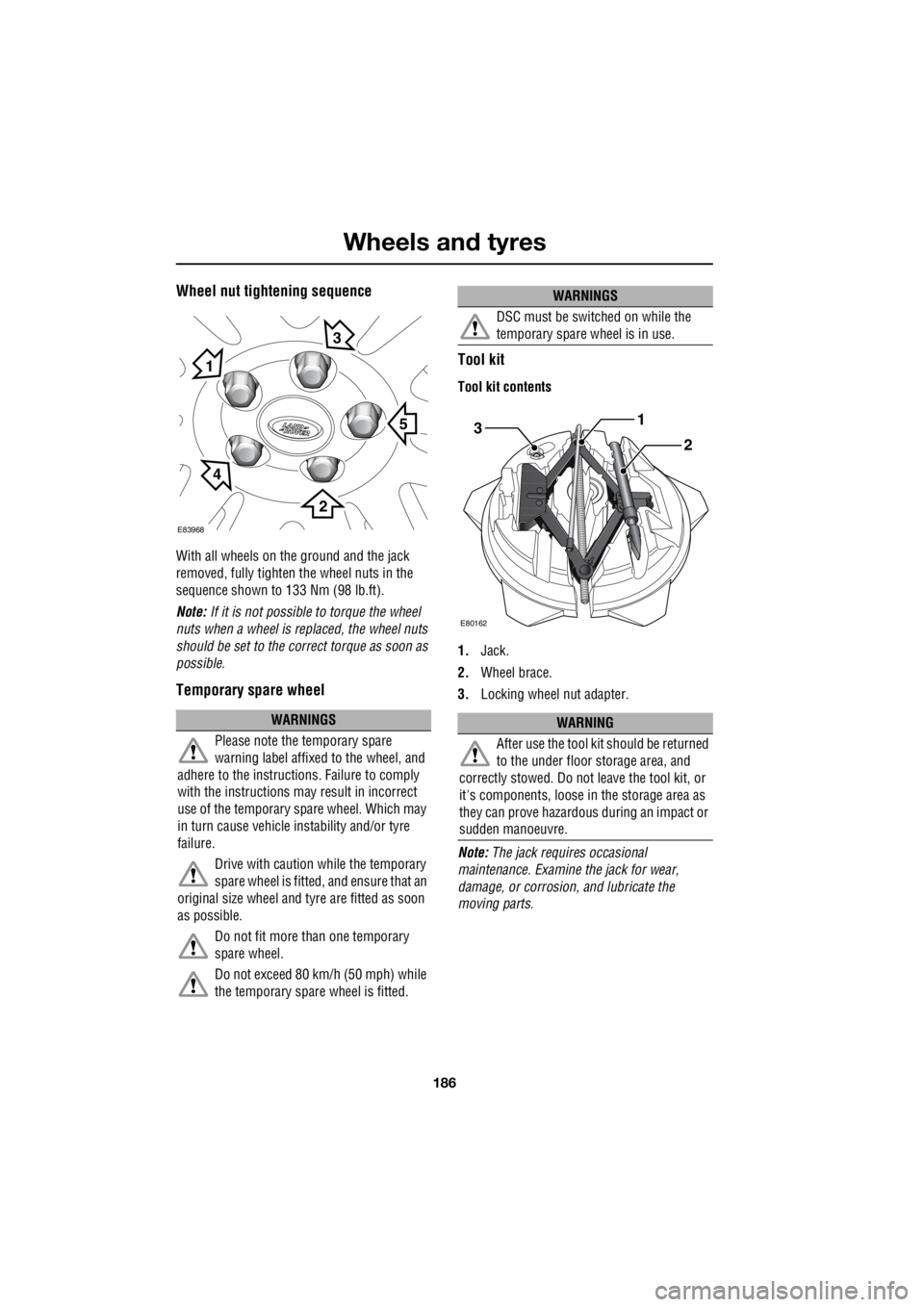
Wheel nut tightening sequence
With all wheels on the ground and the jack
removed, fully tighten the wheel nuts in the
sequence shown to 133 Nm (98 lb.ft).
Note: If it is not possible to torque the wheel
nuts when a wheel is replaced, the wheel nuts
should be set to the correct torque as soon as
possible.
Temporary spare wheel Tool kit
Tool kit contents
1.
Jack.
2. Wheel brace.
3. Locking wheel nut adapter.
Note: The jack requi res occasional
maintenance. Examine the jack for wear,
damage, or corrosion, and lubricate the
moving parts.
WARNINGS
Please note the temporary spare
warning label affixed to the wheel, and
adhere to the instructions. Failure to comply
with the instructions may result in incorrect
use of the temporary spare wheel. Which may
in turn cause vehicle instability and/or tyre
failure.
Drive with caution while the temporary
spare wheel is fitted, and ensure that an
original size wheel and tyre are fitted as soon
as possible.
Do not fit more than one temporary
spare wheel.
Do not exceed 80 km/h (50 mph) while
the temporary spare wheel is fitted.
E83968
5
1
3
2
4
DSC must be switched on while the
temporary spare wheel is in use.
WARNING
After use the tool kit should be returned
to the under floor storage area, and
correctly stowed. Do not leave the tool kit, or
it's components, loose in the storage area as
they can prove hazardous during an impact or
sudden manoeuvre.
WARNINGS
3
E80162
1
2
Page 2913 of 3229

193
Wheels and tyres
R
• Avoid tyre/vehicle damage by removing
the traction devices as soon as the
conditions allow.
TYRE GLOSSARY
Terms used
lbf/in² or psi
Pounds per square inch, an imperial unit of
measure for pressure.
kPa
Kilo Pascal, a metric unit of measure for
pressure.
Cold tyre pressure
The air pressure in a tyre which has been
standing in excess of th ree hours, or driven for
less than one mile.
Maximum inflation pressure
The maximum pressure to which the tyre
should be inflated. This pressure is given on
the tyre side wall in lbf/in² (psi) and kPa.
Note: This pressure is the maximum allowed
by the tyre manufacturer. It is not the pressure
recommended for use. See TECHNICAL
SPECIFICATIONS (page 194).
Kerb weight
The weight of a standa rd vehicle, including a
full tank of fuel, any optional equipment fitted,
and with the correct coolant and oil levels.
Gross vehicle weight
The maximum permissible weight of a vehicle
with driver, passengers, load, luggage,
equipment, and towbar load.
Accessory weight
The combined weight (in excess of those items
replaced) of items available as factory installed
equipment. Production options weight
The combined weight of options installed
which weigh in excess of 1.4 kg (3 lb) more
than the standard items that they replaced, and
are not already considered in kerb or accessory
weights. Items such as heavy duty brakes, high
capacity battery, special trim etc.
Vehicle capacity weight
The number of seats multiplied by 68 kg (150
lb) plus the rated amount of load/luggage.
Maximum loaded vehicle weight
The sum of kerb wei ght, accessory weight,
vehicle capacity weig ht, plus any production
option weights.
Rim
The metal support for a ty re, or tyre and tube,
upon which the tyre beads are seated.
Bead
The inner edge of a tyre th at is shaped to fit to
the rim and form an air tight seal. The bead is
constructed of steel wires which are wrapped,
or reinforced, by the ply cords.
Page 2927 of 3229
207
Vehicle recovery
R
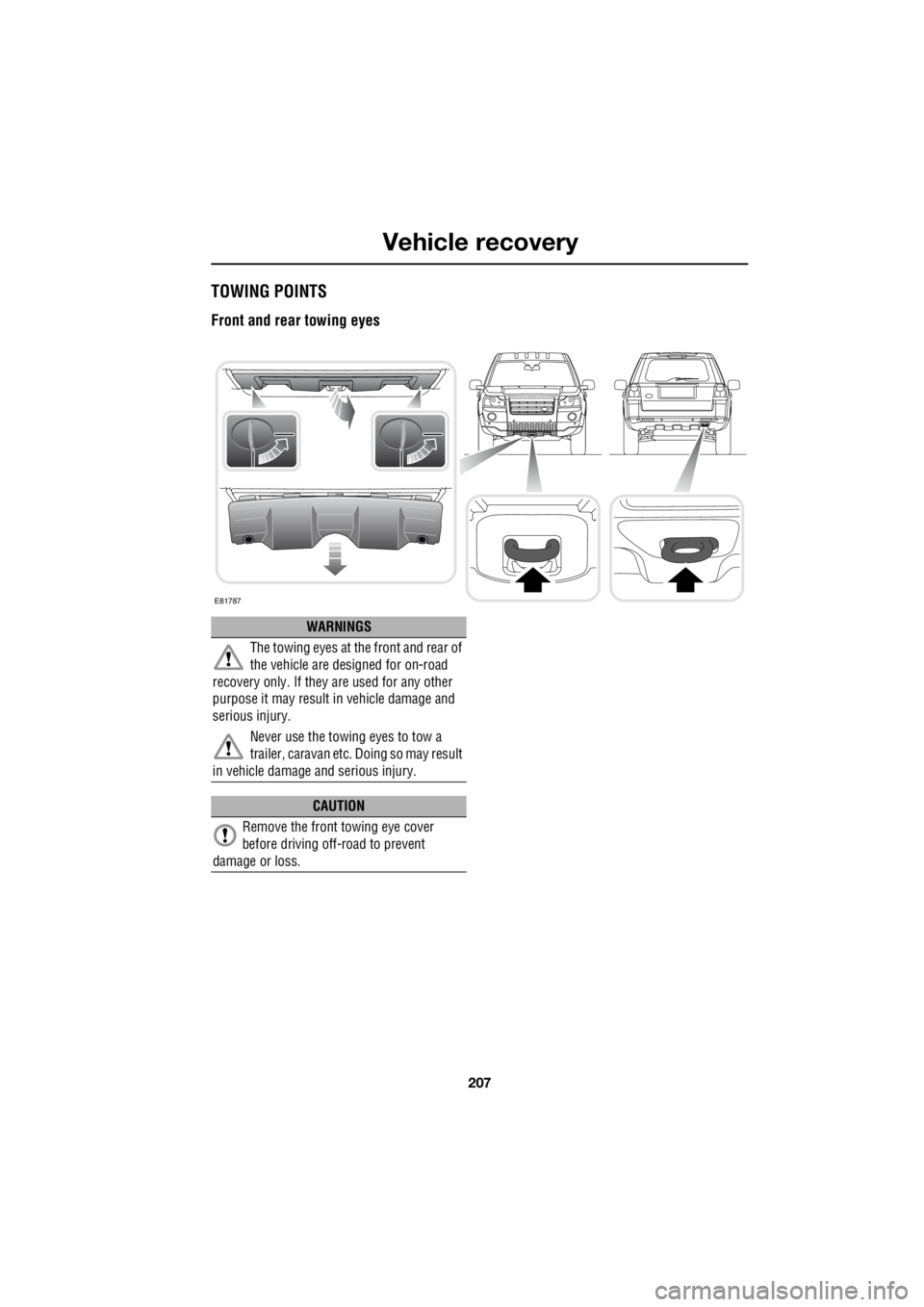
Vehicle recoveryTOWING POINTS
Front and rear towing eyes
E81787
WARNINGS
The towing eyes at the front and rear of
the vehicle are designed for on-road
recovery only. If they are used for any other
purpose it may result in vehicle damage and
serious injury.
Never use the towing eyes to tow a
trailer, caravan etc. Doing so may result
in vehicle damage and serious injury.
CAUTION
Remove the front towing eye cover
before driving off-road to prevent
damage or loss.
Page 2928 of 3229
Vehicle recovery
208
L
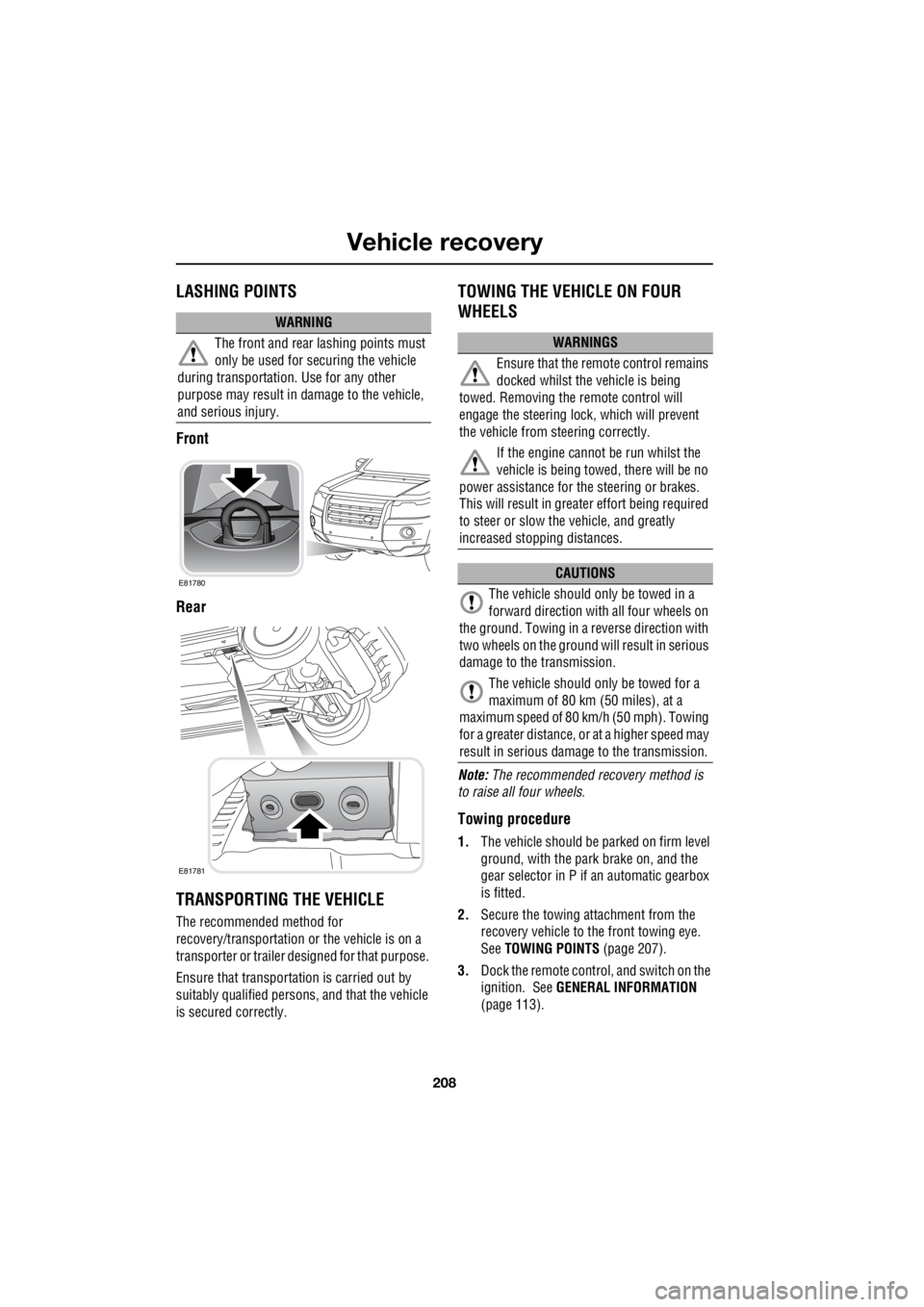
LASHING POINTS
Front
Rear
TRANSPORTING THE VEHICLE
The recommended method for
recovery/transportation or the vehicle is on a
transporter or trailer de signed for that purpose.
Ensure that transporta tion is carried out by
suitably qualified persons , and that the vehicle
is secured correctly.
TOWING THE VEHICLE ON FOUR
WHEELS
Note: The recommended recovery method is
to raise all four wheels.
Towing procedure
1. The vehicle should be parked on firm level
ground, with the park brake on, and the
gear selector in P if an automatic gearbox
is fitted.
2. Secure the towing attachment from the
recovery vehicle to the front towing eye.
See TOWING POINTS (page 207).
3. Dock the remote control, and switch on the
ignition. See GENERAL INFORMATION
(page 113).
WARNING
The front and rear lashing points must
only be used for securing the vehicle
during transportation. Use for any other
purpose may result in da mage to the vehicle,
and serious injury.
E81780
E81781
WARNINGS
Ensure that the remote control remains
docked whilst the vehicle is being
towed. Removing the remote control will
engage the steering lo ck, which will prevent
the vehicle from steering correctly.
If the engine cannot be run whilst the
vehicle is being towed, there will be no
power assistance for the steering or brakes.
This will result in grea ter effort being required
to steer or slow the vehicle, and greatly
increased stopping distances.
CAUTIONS
The vehicle should only be towed in a
forward direction with all four wheels on
the ground. Towing in a reverse direction with
two wheels on the ground will result in serious
damage to the transmission.
The vehicle should only be towed for a
maximum of 80 km (50 miles), at a
maximum speed of 80 k m/h (50 mph). Towing
for a greater distance, or at a higher speed may
result in serious dama ge to the transmission.