tow LINCOLN MKZ 2013 Owners Manual
[x] Cancel search | Manufacturer: LINCOLN, Model Year: 2013, Model line: MKZ, Model: LINCOLN MKZ 2013Pages: 474, PDF Size: 3.79 MB
Page 5 of 474
Security
Passive Anti-Theft System................72
Anti-Theft Alarm
...................................73
Steering Wheel
Adjusting the Steering Wheel...........75
Audio Control
.........................................76
Voice Control
...........................................77
Cruise Control
.........................................77
Information Display Control..............77
Heated Steering Wheel......................78
Wipers and Washers
Windshield Wipers
...............................79
Autowipers..............................................79
Windshield Washers
...........................80
Lighting
Lighting Control
.....................................82
Autolamps...............................................82
Instrument Lighting Dimmer............83
Headlamp Exit Delay...........................83
Daytime Running Lamps...................83
Automatic High Beam Control
........84
Direction Indicators
..............................85
Interior Lamps
........................................85
Windows and Mirrors
Power Windows
....................................87
Global Opening and Closing............88
Exterior Mirrors......................................88
Interior Mirror
.........................................90
Sun Visors
...............................................90
Sun Shades
..............................................91 Moonroof..................................................91
Instrument Cluster
Gauges......................................................94
Warning Lamps and Indicators.......95
Audible Warnings and
Indicators.............................................99
Information Displays
General Information
..........................100
Information Messages
......................105
Audio System
General Information
...........................122
Audio unit - Vehicles With: Premium AM/FM/CD
........................................123
Media Hub
..............................................125
Climate Control
Automatic Climate Control.............126
Hints on Controlling the Interior Climate................................................127
Heated Windows and Mirrors.........128
Cabin Air Filter
......................................129
Remote Start
........................................129
Seats
Sitting in the Correct Position
..........131
Head Restraints
....................................131
Power Seats
..........................................133
Memory Function................................135
Rear Seats..............................................137
Heated Seats
.........................................137
Ventilated Seats
..................................139
Rear Seat Armrest
..............................140
2
Table of Contents
Page 6 of 474
Universal Garage Door
Opener
Universal Garage Door Opener......142
Auxiliary Power Points
Auxiliary Power Points.......................147
Storage Compartments
Center Console....................................149
Overhead Console..............................149
Starting and Stopping the Engine
General Information
..........................150
Keyless Starting...................................150
Starting a Gasoline Engine..............152
Engine Block Heater
...........................153
Fuel and Refueling
Safety Precautions
.............................155
Fuel Quality
...........................................156
Running Out of Fuel...........................156
Refueling................................................158
Fuel Consumption
..............................160
Emission Control System..................161
Transmission
Automatic Transmission
..................165
Hill Start Assist
.....................................170
All-Wheel Drive
Using All-Wheel Drive.........................171
Brakes
General Information............................177 Hints on Driving With Anti-Lock
Brakes..................................................178
Electric Parking Brake
........................178
Traction Control
Principle of Operation
........................181
Using Traction Control.......................181
Stability Control
Principle of Operation.......................182
Using Stability Control......................183
Parking Aids
Parking Aid
............................................184
Active Park Assist...............................186
Rear View Camera...............................191
Cruise Control
Principle of Operation.......................195
Using Cruise Control..........................195
Using Adaptive Cruise Control
.......196
Driving Aids
Driver Alert............................................203
Lane Keeping System......................208
Blind Spot Monitor..............................212
Steering...................................................217
Load Carrying
Load Limit..............................................219
Towing
Towing a Trailer
....................................227
Recommended Towing Weights...............................................227
3
Table of Contents
Page 7 of 474
Essential Towing Checks.................229
Transporting the Vehicle...................231
Towing the Vehicle on Four
Wheels................................................232
Driving Hints
Breaking-In............................................235
Economical Driving
............................235
Driving Through Water.....................236
Floor Mats.............................................236
Roadside Emergencies
Roadside Assistance
........................238
Hazard Warning Flashers................239
Fuel Cut-Off Switch..........................239
Jump-Starting the Vehicle.............240
Customer Assistance
Getting the Services You Need......243
In California (U.S. Only)...................244
The Better Business Bureau (BBB) Auto Line Program (U.S.
Only)...................................................245
Utilizing the Mediation/Arbitration Program (Canada Only)..............247
Getting Assistance Outside the U.S. and Canada
......................................247
Ordering Additional Owner's Literature...........................................248
Reporting Safety Defects (U.S. Only)...................................................249
Reporting Safety Defects (Canada Only)...................................................250
Fuses
Changing a Fuse
..................................251
Fuse Specification Chart
.................252 Maintenance
General Information
..........................263
Opening and Closing the Hood.....264
Under Hood Overview - 2.0L EcoBoost™......................................265
Under Hood Overview - 3.7L..........266
Engine Oil Dipstick - 2.0L EcoBoost™.......................................267
Engine Oil Dipstick - 3.7L.................267
Engine Oil Check - 2.0L EcoBoost™/3.7L
............................267
Engine Coolant Check - 2.0L EcoBoost™/3.7L............................268
Automatic Transmission Fluid Check...................................................272
Brake Fluid Check
...............................276
Power Steering Fluid Check............276
Fuel Filter...............................................276
Washer Fluid Check
............................277
Changing the 12V Battery.................277
Checking the Wiper Blades
............279
Changing the Wiper Blades............279
Changing the Engine Air Filter - 2.0L EcoBoost™/3.7L............................280
Adjusting the Headlamps
................281
Removing a Headlamp
....................282
Changing a Bulb
.................................282
Bulb Specification Chart.................283
Vehicle Care
General Information
..........................284
Cleaning Products.............................284
Cleaning the Exterior........................284
Repairing Minor Paint Damage......285
Waxing...................................................285
Cleaning the Engine
..........................286
4
Table of Contents
Page 10 of 474
ABOUT THIS MANUAL
Thank you for choosing Lincoln. We
recommend that you take some time
to get to know your vehicle by reading
this manual. The more that you know
about it, the greater the safety and
pleasure you will get from driving it.
WARNING
Always drive with due care and
attention when using and
operating the controls and features
on your vehicle. Note:
This manual describes product
features and options available
throughout the range, sometimes even
before they are generally available. It
may describe options not fitted to your
vehicle.
Note: Some of the illustrations in this
manual may be used for different
models, so may appear different to
your vehicle. However, the essential
information in the illustrations is
always correct.
Note: Always use and operate your
vehicle in line with all applicable laws
and regulations.
Note: Pass on this manual when
selling your vehicle. It is an integral part
of the vehicle.
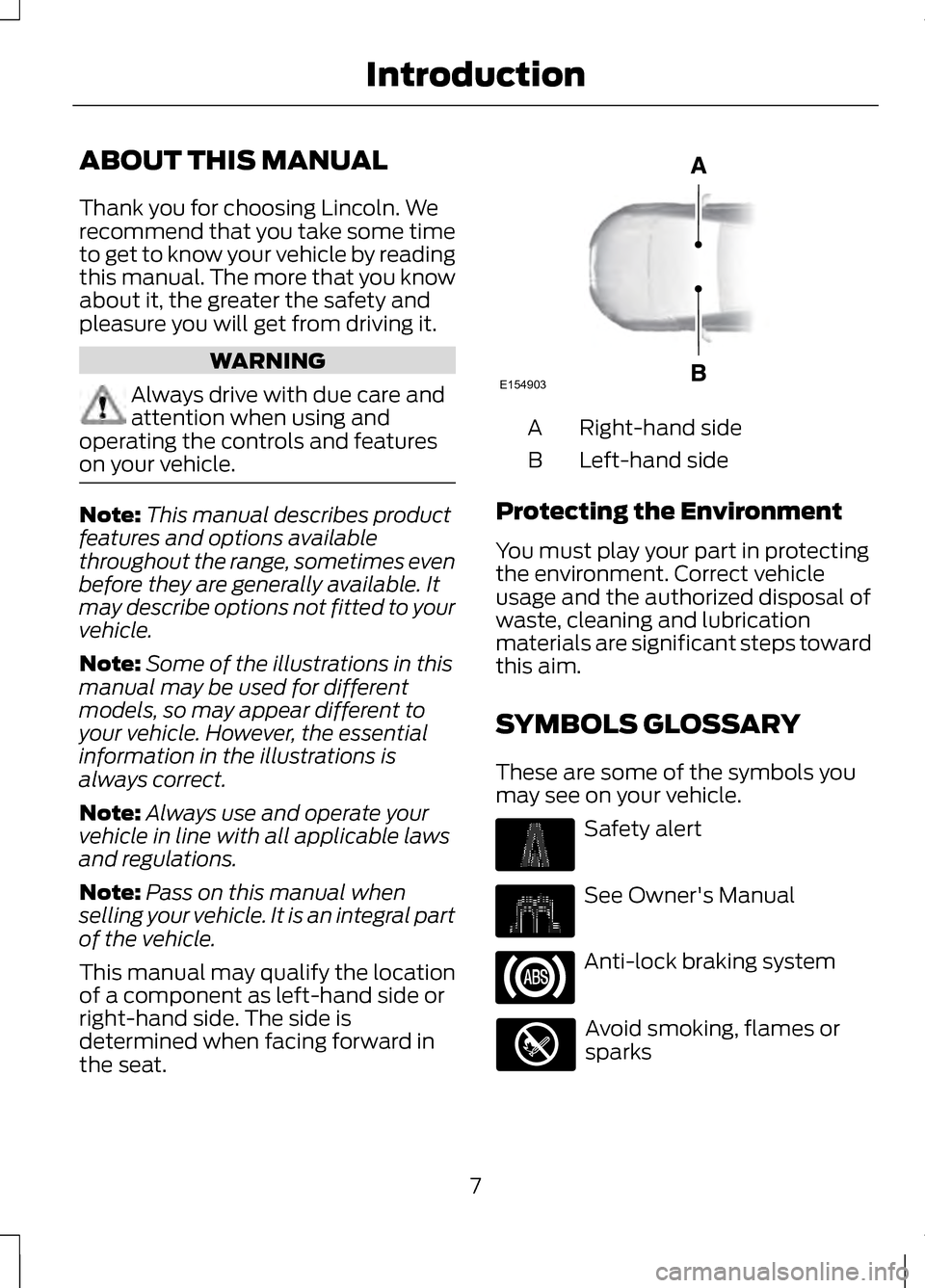
This manual may qualify the location
of a component as left-hand side or
right-hand side. The side is
determined when facing forward in
the seat. Right-hand side
A
Left-hand side
B
Protecting the Environment
You must play your part in protecting
the environment. Correct vehicle
usage and the authorized disposal of
waste, cleaning and lubrication
materials are significant steps toward
this aim.
SYMBOLS GLOSSARY
These are some of the symbols you
may see on your vehicle. Safety alert
See Owner's Manual
Anti-lock braking system
Avoid smoking, flames or
sparks
7
IntroductionE154903
Page 20 of 474
•
You are required by law to properly
use safety seats for infants and
toddlers in the United States and
Canada.
• Many states and provinces require
that small children use approved
booster seats until they reach age
eight, a height of 4 feet 9 inches
(1.45 meters) tall, or 80 pounds
(36 kilograms). Check your local
and state or provincial laws for
specific requirements about the
safety of children in your vehicle.
• When possible, always properly
restrain children twelve years of
age and under in a rear seating
position of your vehicle. Accident
statistics suggest that children are
safer when properly restrained in
the rear seating positions than in
a front seating position. See Front
Passenger Sensing System
(page 45).
CHILD SEAT POSITIONING WARNINGS
Airbags can kill or injure a child
in a child seat. NEVER place a
rear-facing child seat in front of an
active airbag. If you must use a
forward-facing child seat in the front
seat, move your vehicle seat all the
way back. When possible, all children
age 12 and under should be properly
restrained in a rear seating position. If
all children cannot be seated and
restrained properly in a rear seating
position, properly restrain the largest
child in the front seat. WARNINGS
Always carefully follow the
instructions and warnings
provided by the manufacturer of any
child restraint to determine if the
restraint device is appropriate for your
child's size, height, weight, or age.
Follow the child restraint
manufacturer's instructions and
warnings provided for installation and
use in conjunction with the
instructions and warnings provided by
your vehicle manufacturer. A safety
seat that is improperly installed or
utilized, is inappropriate for your
child's height, age, or weight or does
not properly fit the child may increase
the risk of serious injury or death. Never let a passenger hold a
child on his or her lap while your
vehicle is moving. The passenger
cannot protect the child from injury in
a collision, which may result in serious
injury or death. Never use pillows, books, or
towels to boost a child. They can
slide around and increase the
likelihood of injury or death in a
collision. Always restrain an unoccupied
child seat or booster seat. These
objects may become projectiles in a
collision or sudden stop, which may
increase the risk of serious injury.
17
Child Safety
Page 27 of 474
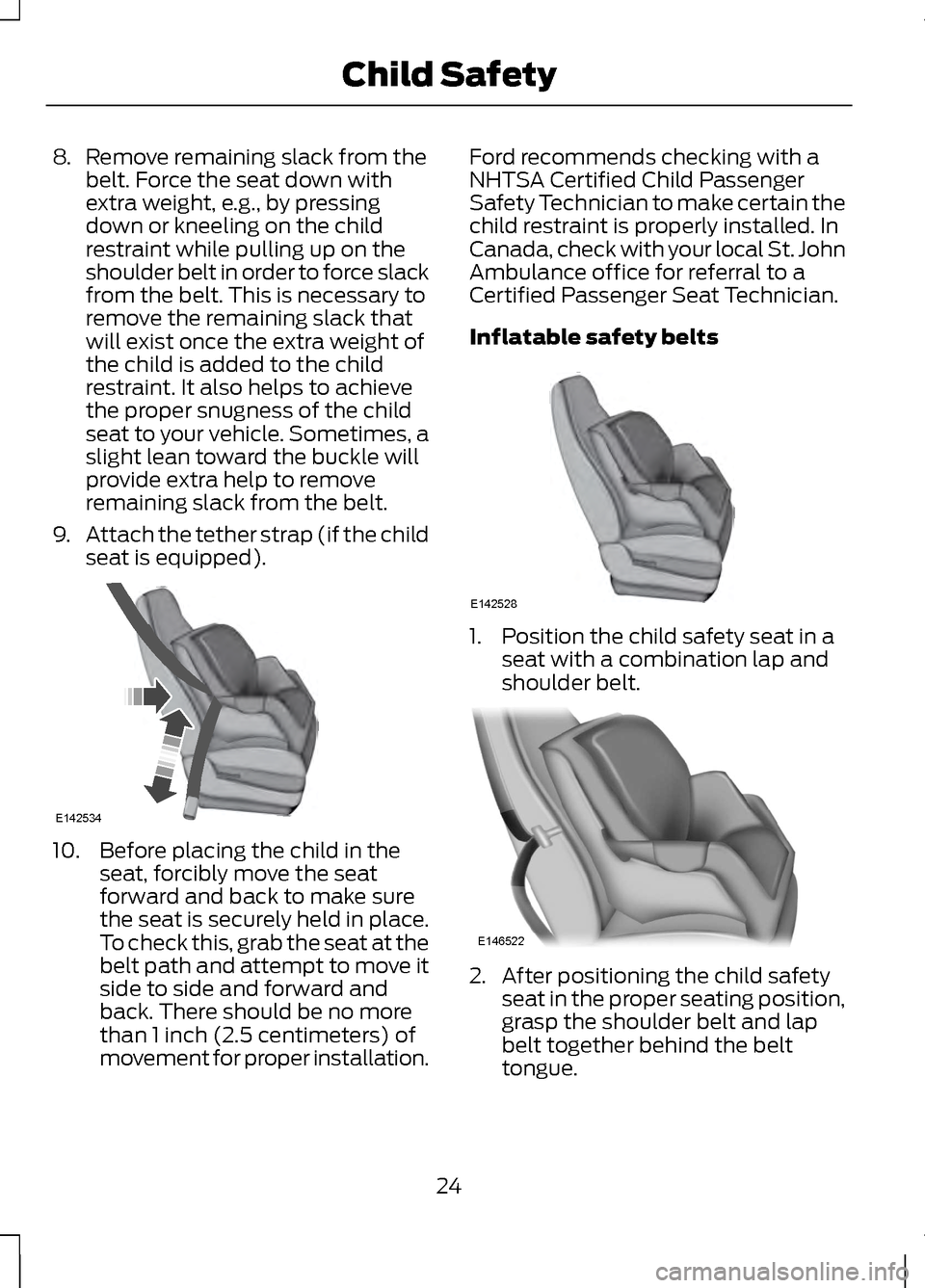
8.
Remove remaining slack from the
belt. Force the seat down with
extra weight, e.g., by pressing
down or kneeling on the child
restraint while pulling up on the
shoulder belt in order to force slack
from the belt. This is necessary to
remove the remaining slack that
will exist once the extra weight of
the child is added to the child
restraint. It also helps to achieve
the proper snugness of the child
seat to your vehicle. Sometimes, a
slight lean toward the buckle will
provide extra help to remove
remaining slack from the belt.
9. Attach the tether strap (if the child
seat is equipped). 10. Before placing the child in the
seat, forcibly move the seat
forward and back to make sure
the seat is securely held in place.
To check this, grab the seat at the
belt path and attempt to move it
side to side and forward and
back. There should be no more
than 1 inch (2.5 centimeters) of
movement for proper installation. Ford recommends checking with a
NHTSA Certified Child Passenger
Safety Technician to make certain the
child restraint is properly installed. In
Canada, check with your local St. John
Ambulance office for referral to a
Certified Passenger Seat Technician.
Inflatable safety belts
1. Position the child safety seat in a
seat with a combination lap and
shoulder belt. 2. After positioning the child safety
seat in the proper seating position,
grasp the shoulder belt and lap
belt together behind the belt
tongue.
24
Child SafetyE142534 E142528 E146522
Page 29 of 474
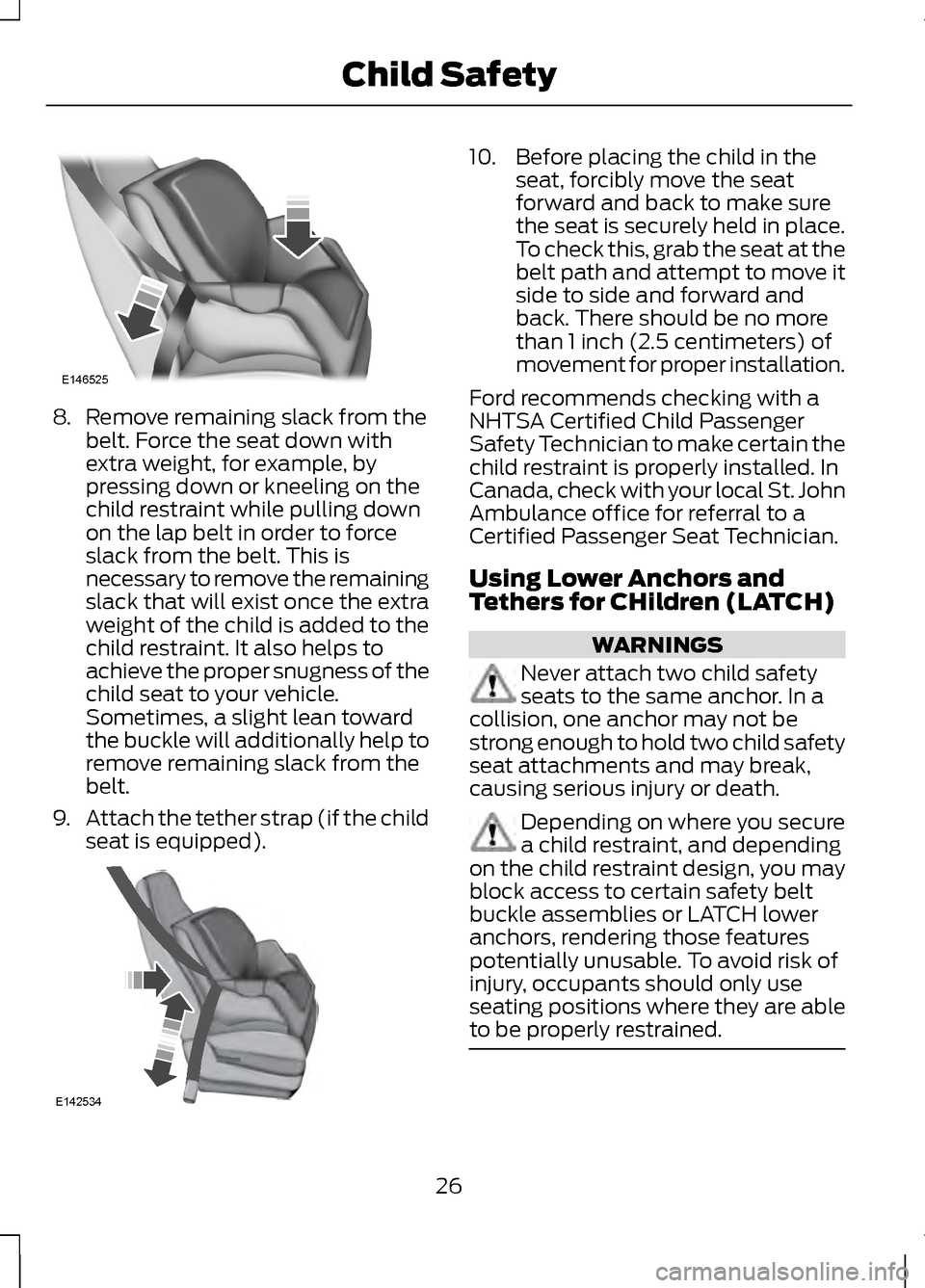
8.
Remove remaining slack from the
belt. Force the seat down with
extra weight, for example, by
pressing down or kneeling on the
child restraint while pulling down
on the lap belt in order to force
slack from the belt. This is
necessary to remove the remaining
slack that will exist once the extra
weight of the child is added to the
child restraint. It also helps to
achieve the proper snugness of the
child seat to your vehicle.
Sometimes, a slight lean toward
the buckle will additionally help to
remove remaining slack from the
belt.
9. Attach the tether strap (if the child
seat is equipped). 10. Before placing the child in the
seat, forcibly move the seat
forward and back to make sure
the seat is securely held in place.
To check this, grab the seat at the
belt path and attempt to move it
side to side and forward and
back. There should be no more
than 1 inch (2.5 centimeters) of
movement for proper installation.
Ford recommends checking with a
NHTSA Certified Child Passenger
Safety Technician to make certain the
child restraint is properly installed. In
Canada, check with your local St. John
Ambulance office for referral to a
Certified Passenger Seat Technician.
Using Lower Anchors and
Tethers for CHildren (LATCH) WARNINGS
Never attach two child safety
seats to the same anchor. In a
collision, one anchor may not be
strong enough to hold two child safety
seat attachments and may break,
causing serious injury or death. Depending on where you secure
a child restraint, and depending
on the child restraint design, you may
block access to certain safety belt
buckle assemblies or LATCH lower
anchors, rendering those features
potentially unusable. To avoid risk of
injury, occupants should only use
seating positions where they are able
to be properly restrained. 26
Child SafetyE146525 E142534
Page 54 of 474
CRASH SENSORS AND
AIRBAG INDICATOR
WARNING
Modifying or adding equipment
to the front end of the vehicle
(including frame, bumper, front end
body structure and tow hooks) may
affect the performance of the airbag
system, increasing the risk of injury.
Do not modify the front end of the
vehicle. The vehicle has a collection of crash
and occupant sensors which provide
information to the Restraints Control
Module which deploys (activates) the
front safety belt pretensioners, driver
airbag, passenger airbag, knee
airbag(s), seat mounted side airbags,
and the side curtain airbags. Based on
the type of collision (frontal impact
or side impact), the restraints control
module will deploy the appropriate
safety devices.
The restraints control module also
monitors the readiness of the above
safety devices plus the crash and
occupant sensors. The readiness of
the safety system is indicated by a
warning indicator light in the
instrument cluster or by a backup tone
if the warning light is not working.
Routine maintenance of the airbag is
not required.
A difficulty with the system is
indicated by one or more of the
following: · The readiness light will not
illuminate immediately after
the ignition is turned on.
• The readiness light will either flash
or stay lit.
• A series of five beeps will be heard.
The tone pattern will repeat
periodically until the problem, the
light or both are repaired.
If any of these things happen, even
intermittently, have the supplemental
restraint system serviced at an
authorized dealer immediately. Unless
serviced, the system may not function
properly in the event of a collision.
The safety belt pretensioners and the
front airbag supplemental restraint
system are designed to activate when
the vehicle sustains longitudinal
deceleration sufficient to cause the
restraints control module to deploy a
safety device.
The fact that the safety belt
pretensioners or front airbags did not
activate for both front seat occupants
in a collision does not mean that
something is wrong with the system.
Rather, it means the restraints control
module determined the accident
conditions (crash severity, belt usage,
etc.) were not appropriate to activate
these safety devices.
51
Supplementary Restraints System
Page 56 of 474
GENERAL INFORMATION
ON RADIO FREQUENCIES
This device complies with Part 15 of
the FCC Rules and with Industry
Canada license-exempt RSS
standard(s). Operation is subject to
the following two conditions: (1) This
device may not cause harmful
interference, and (2) This device must
accept any interference received,
including interference that may cause
undesired operation.
Note:
Changes or modifications not
expressively approved by the party
responsible for compliance could void
the user's authority to operate the
equipment. The term IC before the
radio certification number only signifies
that Industry Canada technical
specifications were met.
The typical operating range for your
transmitter is approximately 33 feet
(10 meters). Vehicles with the remote
start feature will have a greater range.
One of the following could cause a
decrease in operating range:
• weather conditions
• nearby radio towers
• structures around the vehicle
• other vehicles parked next to your
vehicle The radio frequency used by your
remote control can also be used by
other short distance radio
transmissions, for example amateur
radios, medical equipment, wireless
headphones, remote controls and
alarm systems. If the frequencies are
jammed, you will not be able to use
your remote control. You can lock and
unlock the doors with the key.
Note:
Make sure to lock your vehicle
before leaving it unattended.
Note: If you are in range, the remote
control will operate if you press any
button unintentionally.
Intelligent Access
The system uses a radio frequency
signal to communicate with your
vehicle and authorize your vehicle to
unlock when one of the following
conditions are met:
• You touch the inside of the front
exterior door handle.
• You press the luggage
compartment button.
• You press a button on the
transmitter.
If excessive radio frequency
interference is present in the area or
if the transmitter battery is low, you
may need to mechanically unlock your
door. You can use the mechanical key
blade in your intelligent access key to
open the driver door in this situation.
See
Remote Control (page 54).
53
Keys and Remote Controls
Page 75 of 474
PASSIVE ANTI-THEFT
SYSTEM
Note:
The system is not compatible
with non-Ford aftermarket remote start
systems. Use of these systems may
result in vehicle starting problems and
a loss of security protection.
Note: Metallic objects, electronic
devices or a second coded key on the
same key chain may cause vehicle
starting problems if they are too close
to the key when starting the engine.
Prevent these objects from touching
the coded key while starting the engine.
Switch the ignition off, move all objects
on the key chain away from the coded
key and restart the engine if a problem
occurs.
Note: Do not leave a duplicate coded
key in the vehicle. Always take your
keys and lock all doors when leaving
the vehicle.
SecuriLock®
The system is an engine
immobilization system. It is designed
to help prevent the engine from being
started unless a coded key
programmed to your vehicle is used.
Using the wrong key may prevent the
engine from starting. A message may
appear in the information display.
If you are unable to start the engine
with a correctly coded key, a
malfunction has happened and a
message may appear in the
information display. Automatic Arming
The vehicle is armed immediately
after switching the ignition off.
Automatic Disarming
Switching the ignition on with a coded
key disarms the vehicle.
Replacement Keys
Note:
Your vehicle comes equipped
with two intelligent access keys.
The intelligent access key functions
as a programmed key that operates
the driver door lock and activates the
intelligent access with push button
start system, as well as a remote
control.
If your programmed transmitters are
lost or stolen and you do not have an
extra coded key, you will need to have
your vehicle towed to an authorized
dealer. The key codes need to be
erased from your vehicle and new
coded keys will need to be
programmed.
Store an extra programmed key away
from the vehicle in a safe place to help
prevent any inconveniences. See your
authorized dealer to purchase
additional spare or replacement keys.
Programming a Spare Intelligent
Access Key
Note: You can program a maximum
for four intelligent access keys to your
vehicle.
72
Security