tow LINCOLN MKZ 2014 Workshop Manual
[x] Cancel search | Manufacturer: LINCOLN, Model Year: 2014, Model line: MKZ, Model: LINCOLN MKZ 2014Pages: 468, PDF Size: 4.49 MB
Page 246 of 468
ROADSIDE ASSISTANCE
Vehicles Sold In The U.S.:
Getting Roadside Assistance
To fully assist you should you have a
vehicle concern Ford Motor Company
offers a complimentary roadside
assistance program. This program is
separate from the New Vehicle
Limited Warranty. The service is
available:
• 24-hours, seven days a week.
• for the coverage period listed onthe Roadside Assistance Card
included in your Owner's Manual
portfolio.
Roadside assistance will cover:
• a flat tire change with a good spare (except vehicles that have been
supplied with a tire inflation kit).
• battery jump start.
• lock-out assistance (key replacement cost is the customer's
responsibility).
• fuel delivery — Independent Service Contractors, if not
prohibited by state, local or
municipal law shall deliver up to
2.0 gallons (7.5L) of gasoline or
5.0 gallons (18.9L) of diesel fuel
to a disabled vehicle. Fuel delivery
service is limited to two no-charge
occurrences within a 12-month
period. • winch out — available within 100
feet (30.5 meters) of a paved or
county maintained road, no
recoveries.
• towing — Ford and Lincoln eligible vehicles towed to an authorized
dealer within 35 miles (56 km) of
the disablement location or to the
nearest authorized dealer. If a
member requests to be towed to
an authorized dealer more than 35
miles (56 km) from the
disablement location, the member
shall be responsible for any
mileage costs in excess of 35 miles
(56 km).
Trailers shall be covered up to $200
if the disabled eligible vehicle requires
service at the nearest authorized
dealer. If the trailer is disabled, but the
towing vehicle is operational, the
trailer does not qualify for any
roadside services.
Vehicles Sold In The U.S. :
Using Roadside Assistance
Complete the roadside assistance
identification card and place it in your
wallet for quick reference. This card
is found in the owner's information
portfolio in the glove compartment.
U.S. Lincoln vehicle customers who
require Roadside Assistance, call
1-800-521-4140.
243
Roadside Emergencies
Page 247 of 468
If you need to arrange roadside
assistance for yourself, Ford Motor
Company will reimburse a reasonable
amount for towing to the nearest
dealership within 35 miles (56 km).
To obtain reimbursement information,
U.S. Lincoln vehicle customers call
1-800-521-4140. Customers will be
asked to submit their original receipts.
Vehicles Sold In Canada :
Getting Roadside Assistance
Canadian customers who require
roadside assistance, call
1-800-665-2006.
Vehicles Sold In Canada : Using
Roadside Assistance
Complete the roadside assistance
identification card and place it in your
wallet for quick reference. In Canada,
the card is found in the Warranty
Guide in the glove box.
Canadian Roadside coverage and
benefits may differ from the U.S.
coverage. Please refer to your
Warranty Guide or visit our website at
www.ford.ca for information on
Canadian services and benefits.
Canadian customers who need to
obtain roadside information, call
1-800-665-2006 or visit our website
at www.ford.ca.
HAZARD WARNING
FLASHERS
Note:If used when the vehicle is not
running, the battery will lose charge.
There may be insufficient power to
restart your vehicle.
The hazard warning button
is located on the instrument
panel. Use it when your
vehicle is creating a safety hazard for
other motorists.
• Press the button to turn on the hazard warning function, and the
front and rear direction indicators
will flash.
• Press the button again to turn them off.
FUEL SHUTOFF
WARNING
Failure to inspect and, if
necessary, repair fuel leaks after
a collision may increase the risk of fire
and serious injury. Ford Motor
Company recommends that the fuel
system be inspected by an authorized
dealer after any collision.
In the event of a moderate to severe
collision, this vehicle is equipped with
a fuel pump shut-off feature that
stops the flow of fuel to the engine.
Not every impact will cause a shut-off.
Should your vehicle shut off after a
collision, you may restart your vehicle
by doing the following:
244
Roadside Emergencies
Page 260 of 468
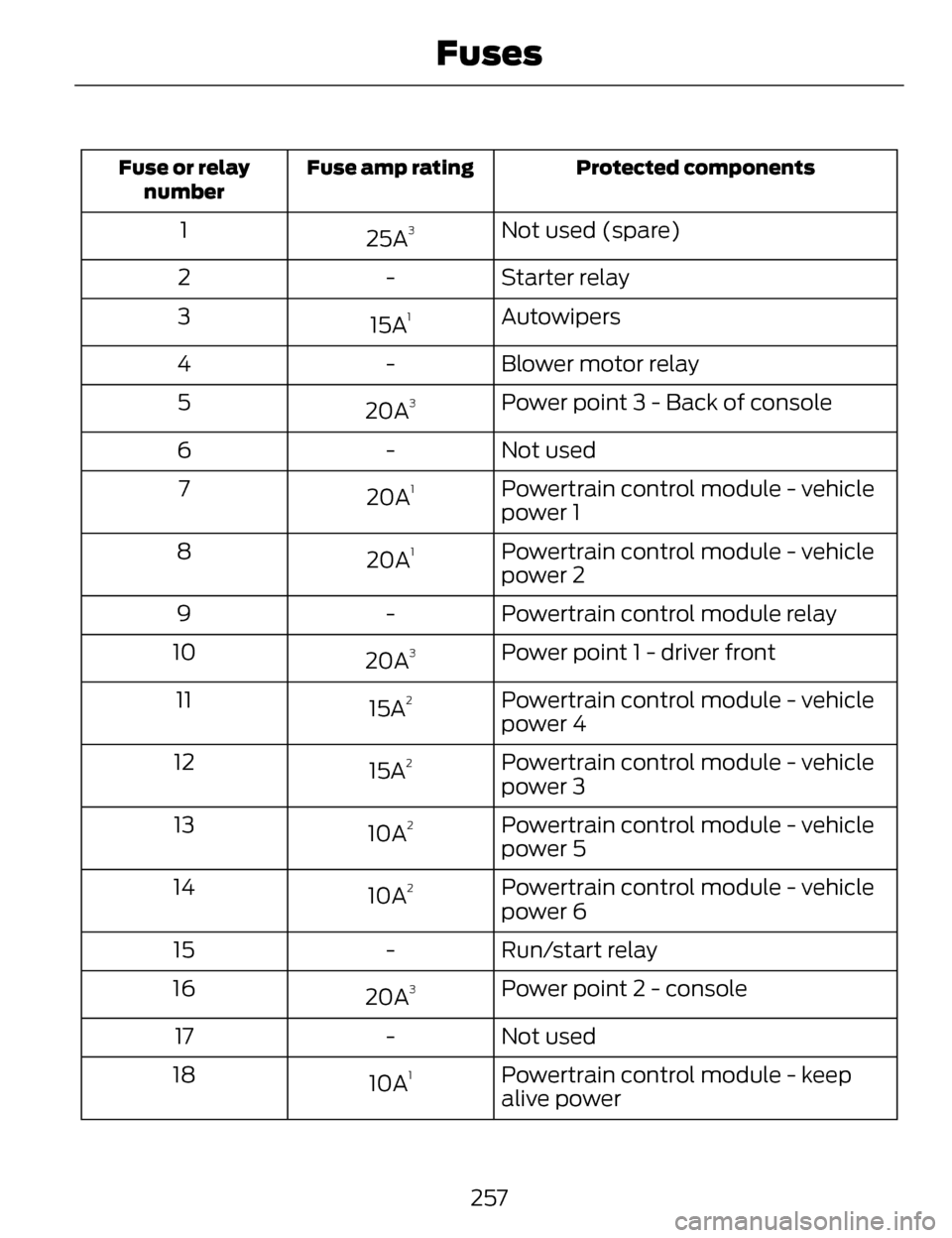
Protected components
Fuse amp rating
Fuse or relay
number
Not used (spare)
25A31
Starter relay
-
2
Autowipers
15A
13
Blower motor relay
-
4
Power point 3 - Back of console
20A
35
Not used
-
6
Powertrain control module - vehicle
power 1
20A
17
Powertrain control module - vehicle
power 2
20A
18
Powertrain control module relay
-
9
Power point 1 - driver front
20A
310
Powertrain control module - vehicle
power 4
15A
211
Powertrain control module - vehicle
power 3
15A
212
Powertrain control module - vehicle
power 5
10A
213
Powertrain control module - vehicle
power 6
10A
214
Run/start relay
-
15
Power point 2 - console
20A
316
Not used
-
17
Powertrain control module - keep
alive power
10A
118
257
Fuses
Page 263 of 468
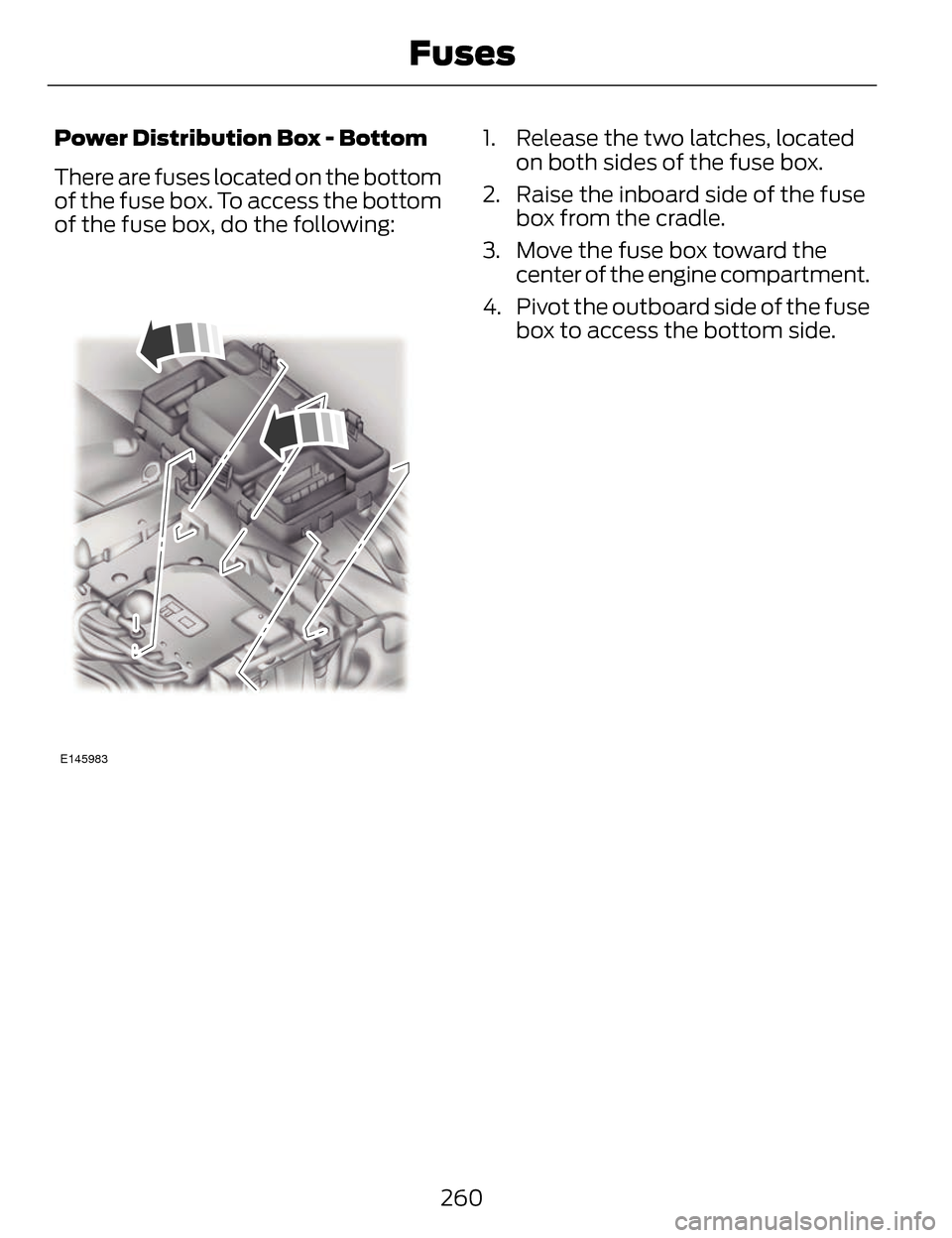
Power Distribution Box - Bottom
There are fuses located on the bottom
of the fuse box. To access the bottom
of the fuse box, do the following:
E145983
1. Release the two latches, locatedon both sides of the fuse box.
2. Raise the inboard side of the fuse box from the cradle.
3. Move the fuse box toward the center of the engine compartment.
4. Pivot the outboard side of the fuse box to access the bottom side.
260
Fuses
Page 271 of 468
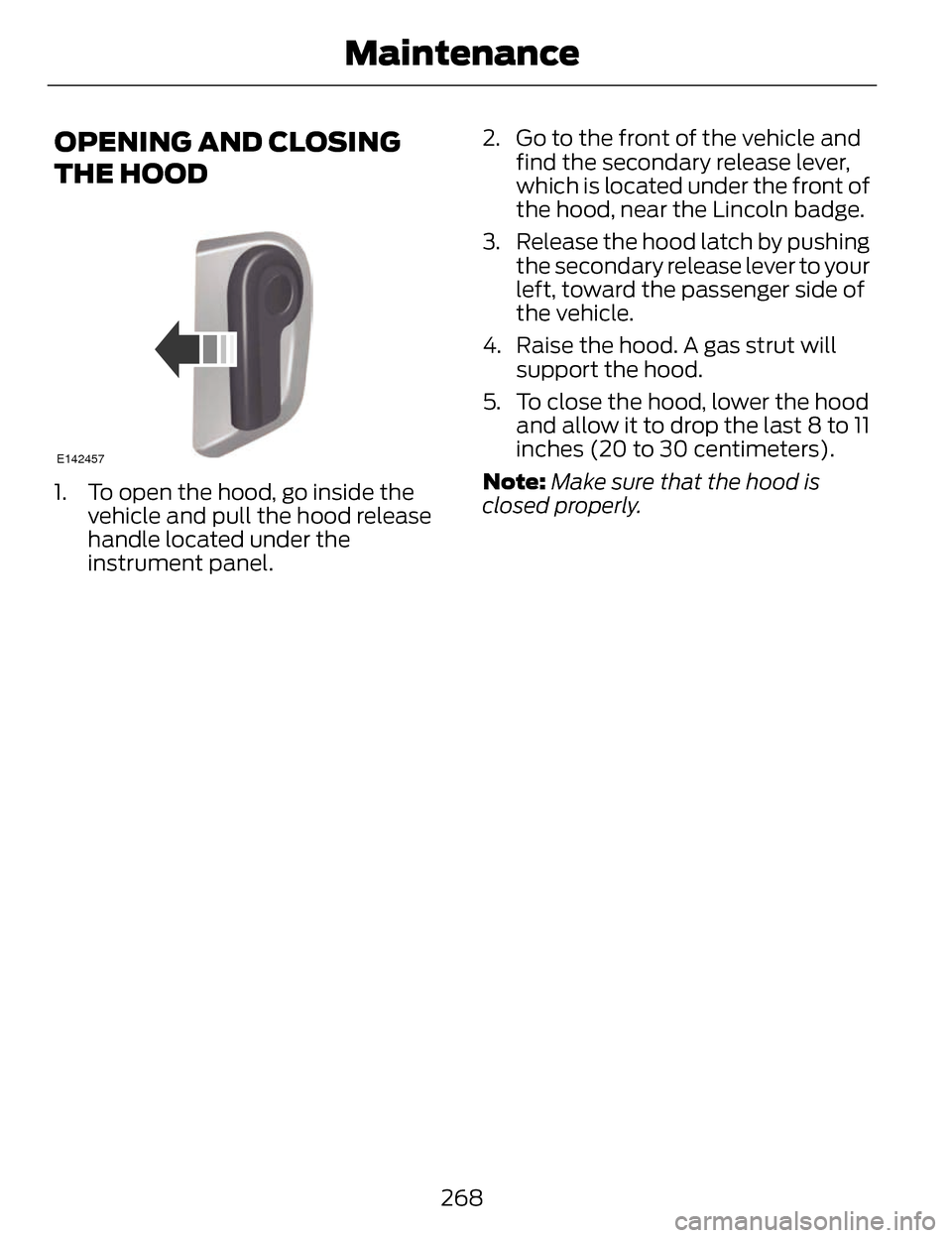
OPENING AND CLOSING
THE HOOD
E142457
1. To open the hood, go inside thevehicle and pull the hood release
handle located under the
instrument panel. 2. Go to the front of the vehicle and
find the secondary release lever,
which is located under the front of
the hood, near the Lincoln badge.
3. Release the hood latch by pushing the secondary release lever to your
left, toward the passenger side of
the vehicle.
4. Raise the hood. A gas strut will support the hood.
5. To close the hood, lower the hood and allow it to drop the last 8 to 11
inches (20 to 30 centimeters).
Note: Make sure that the hood is
closed properly.
268
Maintenance
Page 291 of 468
GENERAL INFORMATION
Your Ford or Lincoln authorized dealer
has many quality products available
to clean your vehicle and protect its
finishes.
CLEANING PRODUCTS
For best results, use the following
products or products of equivalent
quality:
Motorcraft Bug and Tar Remover
(ZC-42)
Motorcraft Custom Bright Metal
Cleaner (ZC-15)
Motorcraft Detail Wash (ZC-3-A)
Motorcraft Dusting Cloth (ZC-24)
Motorcraft Engine Shampoo and
Degreaser (U.S. only) (ZC-20)
Motorcraft Engine Shampoo (Canada
only) (CXC-66-A)
Motorcraft Multi-Purpose Cleaner
(Canada only) (CXC-101)
Motorcraft Premium Glass Cleaner
(Canada only) (CXC-100)
Motorcraft Premium Quality
Windshield Washer Fluid (Canada
only) [CXC-37-(A, B, D or F)]
Motorcraft Premium Windshield Wash
Concentrates (U.S. only) (ZC-32-A1
or ZC-32-B1)
Motorcraft Professional Strength
Carpet & Upholstery Cleaner (ZC-54)
Motorcraft Spot and Stain Remover
(U.S. only) (ZC-14)Motorcraft Ultra-Clear Spray Glass
Cleaner (ZC-23)
Motorcraft Vinyl Cleaner (Canada
only) (CXC-93)
Motorcraft Wheel and Tire Cleaner
(ZC-37-A)
CLEANING THE EXTERIOR
Wash your vehicle regularly with cool
or lukewarm water and a neutral pH
shampoo, such as Motorcraft® Detail
Wash.
• Never use strong household
detergents or soap, such as dish
washing or laundry liquid. These
products can discolor and spot
painted surfaces.
• Never wash a vehicle that is “hot to the touch” or during exposure
to strong, direct sunlight.
• Dry your vehicle with a chamois or soft terry cloth towel in order to
eliminate water spotting.
• Immediately remove items such as gasoline, diesel fuel, bird
droppings and insect deposits
because they can cause damage
to your vehicle’s paintwork and
trim over time. Use Motorcraft Bug
and Tar Remover.
• Remove any exterior accessories, such as antennas, before entering
a car wash.
Note: Suntan lotions and insect
repellents can damage any painted
surface; if these substances come in
contact with your vehicle, wash off as
soon as possible.
288
Vehicle Care
Page 301 of 468
General Information
WARNING
Failure to follow these guidelines
could result in an increased risk
of loss of vehicle control, injury or
death.
Note: Do not use the kit if a tire has
become severely damaged by driving
the vehicle with a tire that has
insufficient air pressure. Only punctured
areas located within the tire tread can
be sealed with the kit.
Do not attempt to repair punctures
larger than 1.4 inch (6.4 millimeters)
or damage to the tire's sidewall. The
tire may not completely seal.
Loss of air pressure may adversely
affect tire performance. For this
reason:
Note: Do not drive the vehicle above
50 mph (80 km/h).
Note: Do not drive further than 120
miles (200 kilometers). Drive only to
the closest Ford Motor Company
authorized dealer or tire repair shop to
have your tire inspected.
• Drive carefully and avoid abrupt steering maneuvers.
• Periodically monitor tire inflation pressure in the affected tire; if the
tire is losing pressure, have the
vehicle towed.
• Read the information in the Tips for Use of the Kit section to make
sure safe operation of the kit and
your vehicle.
Tips for Use of the Kit
Read the following list of tips to
ensure safe operation of the kit:
• Before operating the kit, make sureyour vehicle is safely off the road
and away from moving traffic. Turn
on the hazard lights.
• Always set the parking brake to ensure the vehicle doesn't move
unexpectedly.
• Do not remove any foreign objects, such as nails or screws, from the
tire.
• When using the kit, leave the engine running (only if the vehicle
is outdoors or in a well-ventilated
area) so the compressor doesn't
drain the vehicle's battery.
• Do not allow the compressor to operate continuously for more
than 15 minutes; this will help
prevent the compressor from
overheating.
• Never leave the kit unattended when it is operating.
• Sealant compound contains latex. Make sure that you use the
non-latex gloves provided to avoid
an allergic reaction.
• Keep the kit away from children.
• Only use the kit when the ambient temperature is between -22°F
(–30°C) and 158°F (70°C).
298
Wheels and Tires
Page 304 of 468
9. When the recommended tirepressure is reached, turn off the kit
by pressing the on button;
disconnect the kit from the tire
valve and the power point.
Re-install the valve cap on the tire
valve, place the tube cap on the
metal connector, and return the kit
to the stowage area
10. Immediately and cautiously, drive the vehicle 4 miles (6 kilometers)
to distribute the sealant evenly
inside the tire. Do not exceed 50
mph (80 km/h).
11. After 4 miles (6 kilometers), stop and check the tire pressure. See
Second stage: Checking tire
pressure.
Note: If you experience any unusual
vibration, ride disturbance or noise
while driving, reduce your speed until
you can safely pull off to the side of the
road to call for roadside assistance.
Note: Do not proceed to the second
stage of this operation.
Second Stage: Checking Tire
Pressure
WARNINGS
If you are proceeding from the
First stage: Re–inflating the tire
with sealing compound and air section
and have injected sealant in the tire
and the pressure is below 20 psi (1.4
bar), stop and call roadside
assistance. If tire pressure is above 20
psi (1.4 bar), continue to the next step.
The power plug may get hot
after use and should be handled
carefully while unplugging.
Check the air pressure of your tires as
follows:
1. Remove the valve cap from the tire valve.
2. Unhook the black hose from the side of the compressor and fasten
firmly on the valve stem by turning
clockwise.
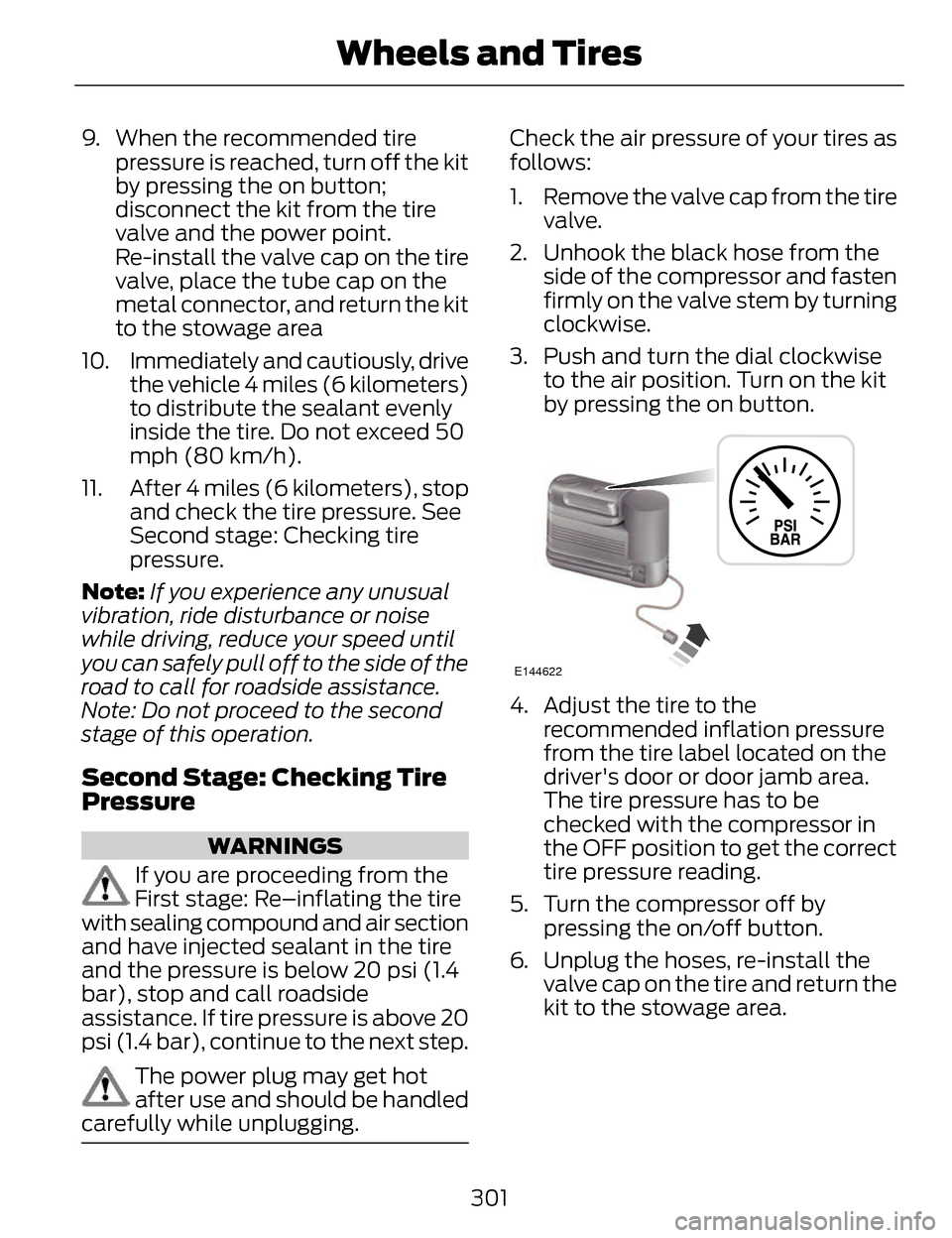
3. Push and turn the dial clockwise to the air position. Turn on the kit
by pressing the on button.
E144622
4. Adjust the tire to therecommended inflation pressure
from the tire label located on the
driver's door or door jamb area.
The tire pressure has to be
checked with the compressor in
the OFF position to get the correct
tire pressure reading.
5. Turn the compressor off by pressing the on/off button.
6. Unplug the hoses, re-install the valve cap on the tire and return the
kit to the stowage area.
301
Wheels and Tires
Page 324 of 468
Driving habits have a great deal to
do with your tire mileage and
safety.
• Observe posted speed limits
• Avoid fast starts, stops andturns
• Avoid potholes and objects on the road
• Do not run over curbs or hit the tire against a curb when
parking
Highway Hazards
No matter how carefully you drive
there is always the possibility that
you may eventually have a flat tire
on the highway. Drive slowly to the
closest safe area out of traffic.
This may further damage the flat
tire, but your safety is more
important.
If you feel a sudden vibration or
ride disturbance while driving, or
you suspect your tire or vehicle
has been damaged, immediately
reduce your speed. Drive with
caution until you can safely pull
off the road. Stop and inspect the
tires for damage. If a tire is
under-inflated or damaged,
deflate it, remove the wheel and
replace it with your spare tire and
wheel (if provided). If you cannot
detect a cause, have the vehicle
towed to the nearest repair facility
or tire dealer to have the vehicle
inspected. Tire and Wheel Alignment
A bad jolt from hitting a curb or
pothole can cause the front end
of your vehicle to become
misaligned or cause damage to
your tires. If your vehicle seems to
pull to one side when you’re
driving, the wheels may be out of
alignment. Have an authorized
dealer check the wheel alignment
periodically.
Wheel misalignment in the front
or the rear can cause uneven and
rapid treadwear of your tires and
should be corrected by an
authorized dealer. Front-wheel
drive vehicles and those with an
independent rear suspension (if
equipped) may require alignment
of all four wheels.
The tires should also be balanced
periodically. An unbalanced tire
and wheel assembly may result in
irregular tire wear.
Tire Rotation
Note:
If your tires show uneven
wear ask an authorized dealer to
check for and correct any wheel
misalignment, tire imbalance or
mechanical problem involved
before tire rotation.
321
Wheels and Tires
Page 327 of 468
Dissimilar Spare Wheel and
Tire Assembly Information
WARNING
Failure to follow these guidelines
could result in an increased risk
of loss of vehicle control, injury or
death.
If you have a dissimilar spare wheel
and tire, then it is intended for
temporary use only. This means that
if you need to use it, you should
replace it as soon as possible with a
road wheel and tire assembly that is
the same size and type as the road
tires and wheels that were originally
provided by Ford. If the dissimilar
spare tire or wheel is damaged, it
should be replaced rather than
repaired.
A dissimilar spare wheel and tire
assembly is defined as a spare wheel
and tire assembly that is different in
brand, size or appearance from the
road tires and wheels and can be one
of three types:
1. T-type mini-spare: This spare tire
begins with the letter T for tire size
and may have Temporary Use Only
molded in the sidewall.
2. Full-size dissimilar spare with
label on wheel: This spare tire has a
label on the wheel that states: THIS
WHEEL AND TIRE ASSEMBLY FOR
TEMPORARY USE ONLY.
When driving with one of the
dissimilar spare tires listed above, do
not: • Exceed 50 mph (80 km/h)
• Load the vehicle beyond maximum
vehicle load rating listed on the
Safety Compliance Label.
• Tow a trailer.
• Use snow chains on the end of the vehicle with the dissimilar spare
tire.
• Use more than one dissimilar spare tire at a time.
• Use commercial car washing equipment.
• Try to repair the dissimilar spare tire.
Use of one of the dissimilar spare tires
listed above at any one wheel location
can lead to impairment of the
following:
• Handling, stability and braking performance.
• Comfort and noise.
• Ground clearance and parking at curbs.
• Winter weather driving capability.
• Wet weather driving capability.
• All-wheel driving capability (if applicable).
3. Full-size dissimilar spare
without label on wheel
When driving with the full-size
dissimilar spare wheel and tire
assembly, do not:
• Exceed 70 mph (113 km/h).
• Use more than one dissimilar spare wheel and tire assembly at a time.
324
Wheels and Tires