fuel pump MAZDA 6 2002 Suplement Owner's Manual
[x] Cancel search | Manufacturer: MAZDA, Model Year: 2002, Model line: 6, Model: MAZDA 6 2002Pages: 909, PDF Size: 17.16 MB
Page 110 of 909
F1–22
OUTLINE, ENGINE TUNE-UP
SUPPLEMENTAL SERVICE INFORMATIONA6E390218881206•The following changes and/or additions have been made since publication of the Mazda6 Workshop Manual
(1621-10-98E).
Idle speed
•Adjustment procedure has been modified.
Fuel tank
•Removal/installation procedure has been modified.
Fuel pump unit
•Removal/installation procedure has been modified.
Quick release connector (fuel tank side, transfer hose part)
•Removal/installation procedure has been added.
Exhaust system
•Removal/installation procedure has been modified.
PCM
•Inspection procedure has been modified.
On-board diagnostic
•Inspection procedure has been modified.
Troubleshooting
•Inspection procedure has been modified.
End Of Sie
IDLE SPEED INSPECTION (4WD)A6E390802000201
Note
•Ignition timing is not adjustable.
•Ignition timing verification requires WDS or equivalent.
1. Turn off the electrical loads.
2. Warm up the engine as follows.
(1) Start the engine.
(2) Maintain the engine speed at approx. 3,000 rpm until the cooling fans start to operate.
(3) Release the accelerator pedal.
(4) Wait until the cooling fans stop.
3. Verify that the idle speed (WDS: RPM PID) is within the specification using WDS or equivalent.
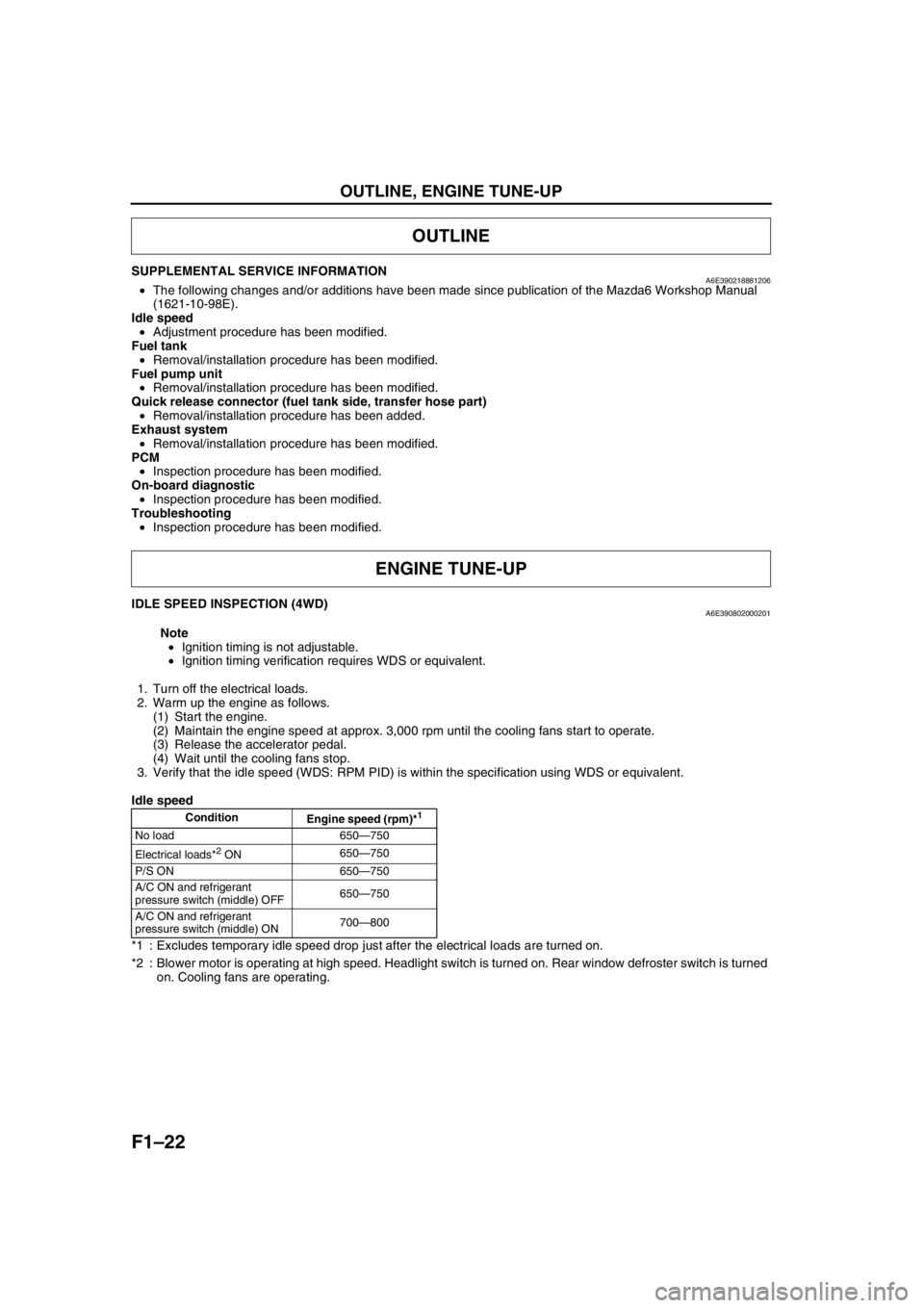
Idle speed
*1 : Excludes temporary idle speed drop just after the electrical loads are turned on.
*2 : Blower motor is operating at high speed. Headlight switch is turned on. Rear window defroster switch is turned
on. Cooling fans are operating.
End Of Sie
OUTLINE
ENGINE TUNE-UP
Condition
Engine speed (rpm)*1
No load 650—750
Electrical loads*
2 ON650—750
P/S ON 650—750
A/C ON and refrigerant
pressure switch (middle) OFF650—750
A/C ON and refrigerant
pressure switch (middle) ON700—800
Page 111 of 909

FUEL SYSTEM
F1–23
F1
FUEL TANK REMOVAL/INSTALLATIONA6E391242110201
Warning
•Repairing a fuel tank that has not been properly steam cleaned can be dangerous. Explosion or
fire may cause death or serious injury. Always properly steam clean a fuel tank before repairing it.
•Fuel line spills and leakage are dangerous. Fuel can ignite and cause serious injuries or death and
damage. Fuel can also irritate skin and eyes. To prevent this, do not damage the sealing surface of
the fuel pump unit when removing or installing.
Caution
•Disconnecting/connecting the quick release connector without cleaning it may possibly cause
damage to the fuel pipe and quick release connector. Always clean the quick release connector
joint area before disconnecting/connecting using a cloth or soft brush, and make sure that it is
free of foreign material.
1. Level the vehicle.
2. Complete the “BEFORE REPAIR PROCEDURE”.
3. Disconnect the negative battery cable.
4. Remove the fuel pump unit. (See F1–26 FUEL PUMP UNIT REMOVAL/INSTALLATION.)
5. Remove the fuel gauge sender sub-unit. (See T–27 Fuel Gauge Sender Sub-Unit.)
6. Siphon the fuel from the service hole.
7. Remove the presilencer. (See F1–30 EXHAUST SYSTEM REMOVAL/INSTALLATION.)
8. Remove the TWC. (See F1–30 EXHAUST SYSTEM REMOVAL/INSTALLATION.)
9. Remove the propeller shaft. (See L–5 PROPELLER SHAFT REMOVAL/INSTALLATION.)
FUEL SYSTEM
Page 114 of 909
F1–26
FUEL SYSTEM
FUEL PUMP UNIT REMOVAL/INSTALLATIONA6E391213350202
Warning
•Fuel line spills and leakage are dangerous. Fuel can ignite and cause serious injuries or death and
damage. Fuel can also irritate skin and eyes. To prevent this, do not damage the sealing surface of
the fuel pump unit when removing or installing.
Caution
•Disconnecting/connecting the quick release connector without cleaning it may possibly cause
damage to the fuel pipe and quick release connector. Always clean the quick release connector
joint area before disconnecting/connecting using a cloth or soft brush, and make sure that it is
free of foreign material.
Note
•Since the fuel pump unit is integrated with the fuel filter, it needs to be replaced every 75,000 km.
1. Complete the “BEFORE REPAIR PROCEDURE”.
2. Disconnect the negative battery cable.
3. Complete the following in order to the work area.
(1) Loosen the bolt of the fuel tank strap.
(2) Lower the fuel tank to a position where the SST can be attached from the service hole cover.
4. Remove the rear seat cushion.
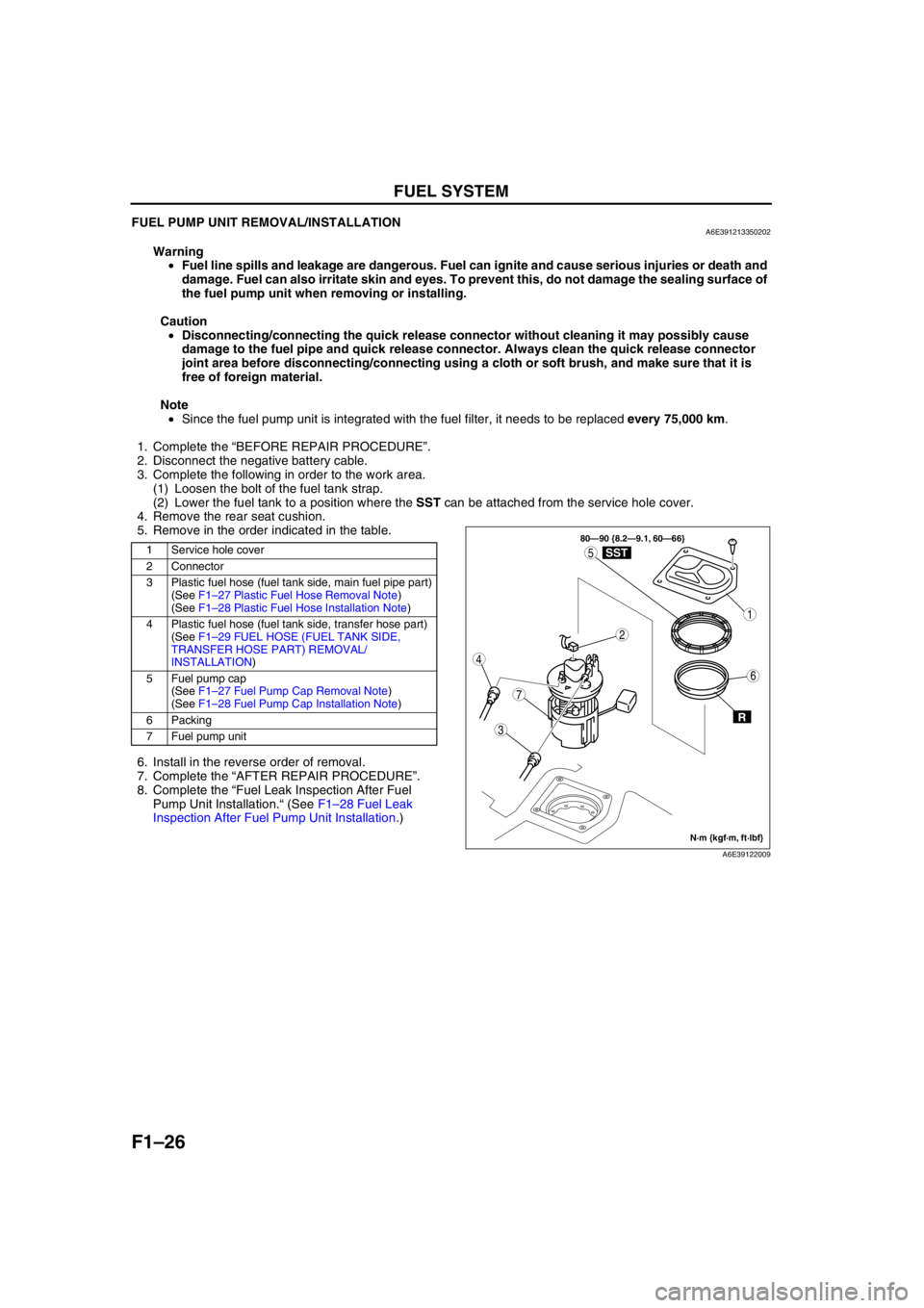
5. Remove in the order indicated in the table.
.
6. Install in the reverse order of removal.
7. Complete the “AFTER REPAIR PROCEDURE”.
8. Complete the “Fuel Leak Inspection After Fuel
Pump Unit Installation.“ (See F1–28 Fuel Leak
Inspection After Fuel Pump Unit Installation.)
1 Service hole cover
2 Connector
3 Plastic fuel hose (fuel tank side, main fuel pipe part)
(See F1–27 Plastic Fuel Hose Removal Note)
(See F1–28 Plastic Fuel Hose Installation Note)
4 Plastic fuel hose (fuel tank side, transfer hose part)
(See F1–29 FUEL HOSE (FUEL TANK SIDE,
TRANSFER HOSE PART) REMOVAL/
INSTALLATION)
5Fuel pump cap
(See F1–27 Fuel Pump Cap Removal Note)
(See F1–28 Fuel Pump Cap Installation Note)
6 Packing
7 Fuel pump unit
3
7
1
4
5
2
6
80—90 {8.2—9.1, 60—66}
R
SST
N·m {kgf·m, ft·lbf}
A6E39122009
Page 115 of 909

FUEL SYSTEM
F1–27
F1
Plastic Fuel Hose Removal Note
Caution
•The quick release connector may be damaged if the tab is bent excessively. Do not expand the tab
over the stopper.
1. Disconnect the quick release connector.
(1) Push the tab on the locking coupler 90
degrees until it stops.
(2) Pull the fuel hose straight back.
Note
•The stopper may be removed from the quick
connector. Take care not to lose it.
Reinstall it to the quick release connector
before reconnecting the fuel line.
•The locking coupler has two internal locking
tabs which retain the fuel pipe. Be sure that
the tab on the locking coupler is rotated until
it stops to release two internal locking tabs.
2. Cover the disconnected quick release connector
and fuel pipe with vinyl sheets or the like to
prevent them from being scratched or
contaminated with foreign material.
Fuel Pump Cap Removal Note
1. Using the SST, remove the fuel pump cap.
FUEL PIPE
STOPPER TAB
A6E3912W001
LOCKING TAB
A6E3912W002
A6E39122015
49 T042 001A
A6E39122012
Page 116 of 909
F1–28
FUEL SYSTEM
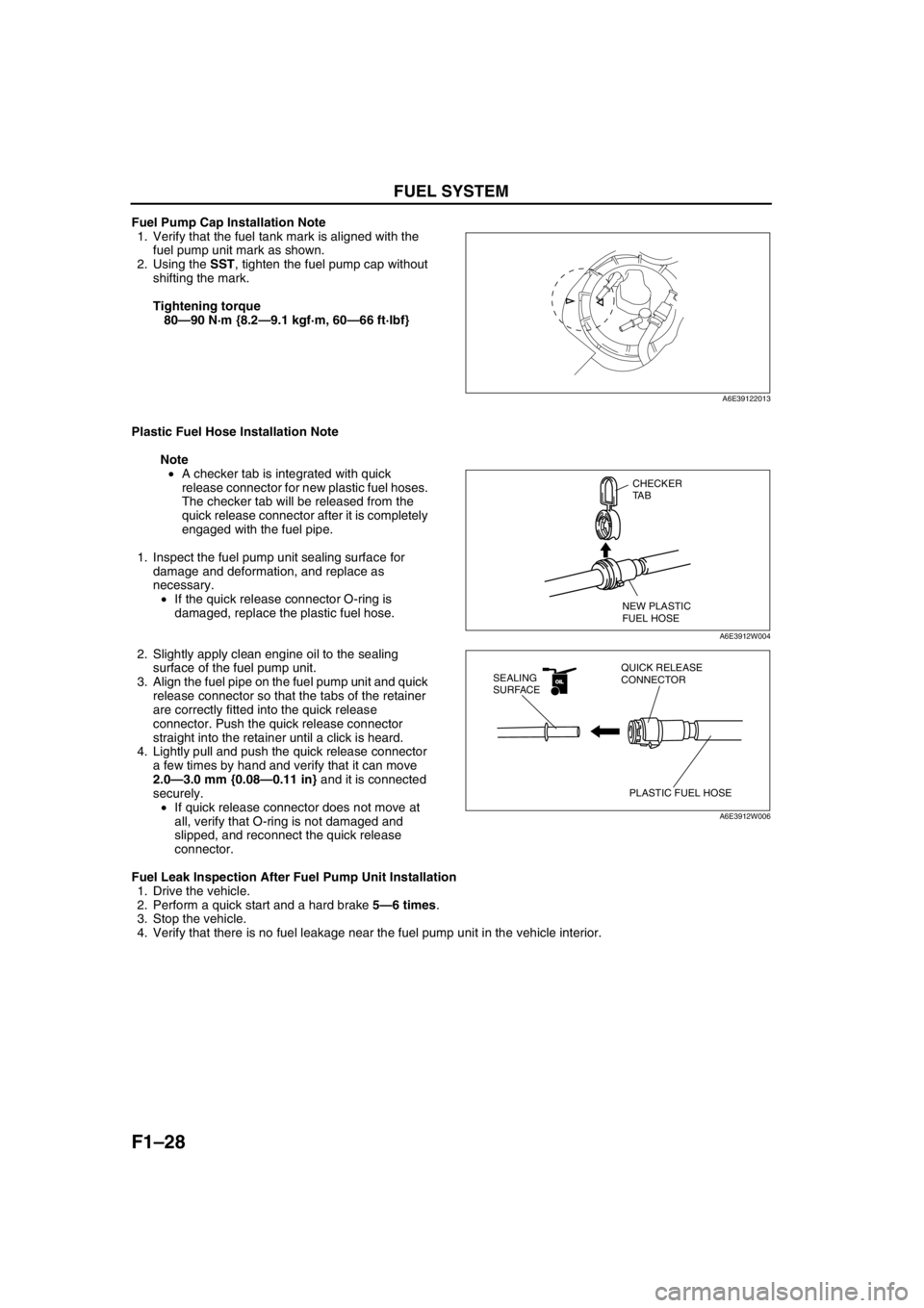
Fuel Pump Cap Installation Note
1. Verify that the fuel tank mark is aligned with the
fuel pump unit mark as shown.
2. Using the SST, tighten the fuel pump cap without
shifting the mark.
Tightening torque
80—90 N·m {8.2—9.1 kgf·m, 60—66 ft·lbf}
Plastic Fuel Hose Installation Note
Note
•A checker tab is integrated with quick
release connector for new plastic fuel hoses.
The checker tab will be released from the
quick release connector after it is completely
engaged with the fuel pipe.
1. Inspect the fuel pump unit sealing surface for
damage and deformation, and replace as
necessary.
•If the quick release connector O-ring is
damaged, replace the plastic fuel hose.
2. Slightly apply clean engine oil to the sealing
surface of the fuel pump unit.
3. Align the fuel pipe on the fuel pump unit and quick
release connector so that the tabs of the retainer
are correctly fitted into the quick release
connector. Push the quick release connector
straight into the retainer until a click is heard.
4. Lightly pull and push the quick release connector
a few times by hand and verify that it can move
2.0—3.0 mm {0.08—0.11 in} and it is connected
securely.
•If quick release connector does not move at
all, verify that O-ring is not damaged and
slipped, and reconnect the quick release
connector.
Fuel Leak Inspection After Fuel Pump Unit Installation
1. Drive the vehicle.
2. Perform a quick start and a hard brake 5—6 times.
3. Stop the vehicle.
4. Verify that there is no fuel leakage near the fuel pump unit in the vehicle interior.
End Of Sie
A6E39122013
CHECKER
TA B
NEW PLASTIC
FUEL HOSE
A6E3912W004
OILOIL
PLASTIC FUEL HOSE QUICK RELEASE
CONNECTOR SEALING
SURFACE
A6E3912W006
Page 117 of 909
FUEL SYSTEM
F1–29
F1
FUEL HOSE (FUEL TANK SIDE, TRANSFER HOSE PART) REMOVAL/INSTALLATIONA6E391242692202
Warning
•Repairing a fuel tank that has not been properly steam cleaned can be dangerous. Explosion or
fire may cause death or serious injury. Always properly steam clean a fuel tank before repairing it.
•Fuel line spills and leakage are dangerous. Fuel can ignite and cause serious injuries or death and
damage. Fuel can also irritate skin and eyes. To prevent this, do not damage the sealing surface of
the fuel pump unit when removing or installing.
Caution
•Disconnecting/connecting the quick release connector without cleaning it may possibly cause
damage to the fuel pipe and quick release connector. Always clean the quick release connector
joint area before disconnecting/connecting using a cloth or soft brush, and make sure that it is
free of foreign material.
Removal
1. Complete the “BEFORE REPAIR PROCEDURE”.
2. Disconnect the negative battery cable.
Note
•Squeezing the tab while lightly pushing the fuel hose on the fuel pipe side will make removal easier.
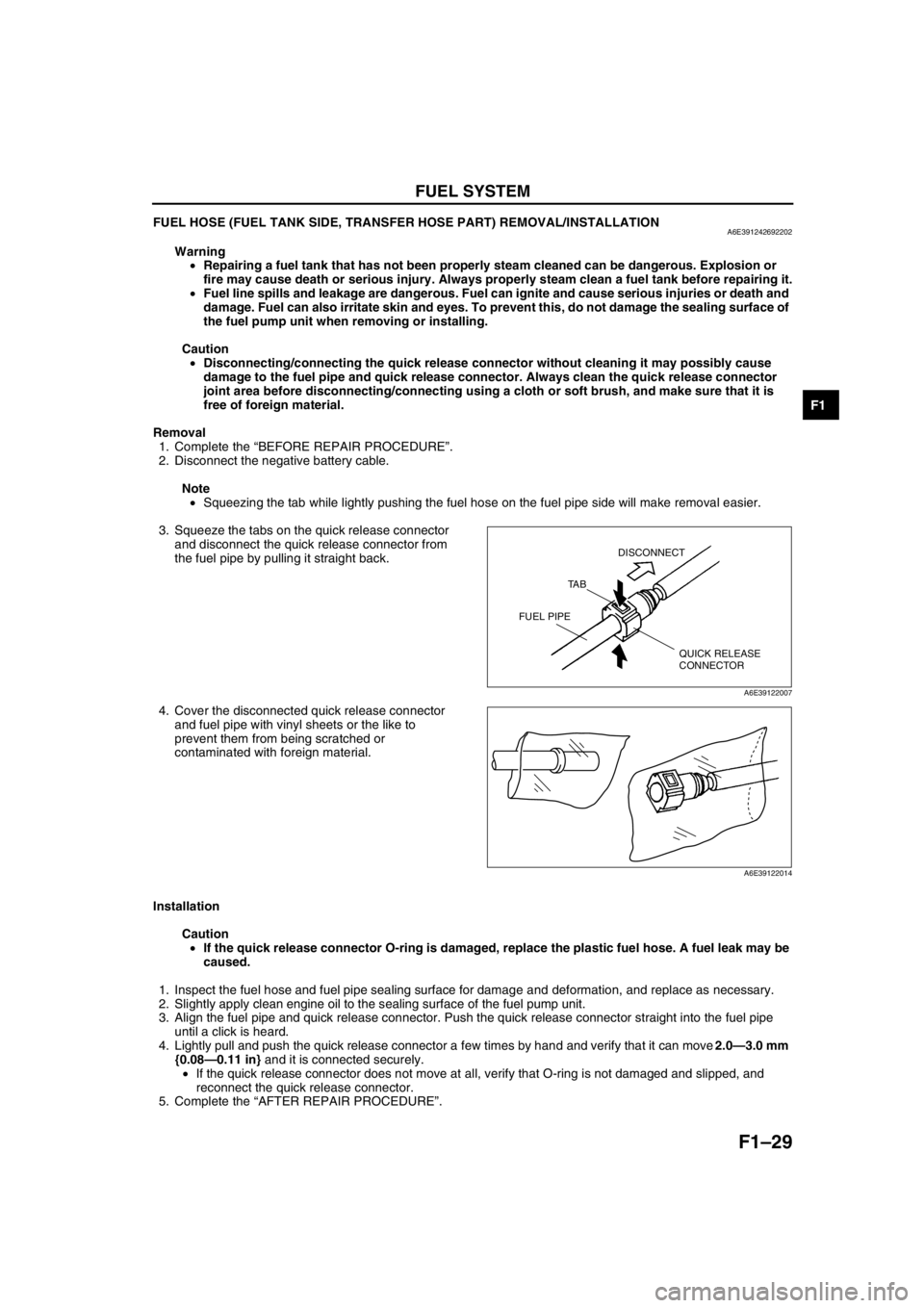
3. Squeeze the tabs on the quick release connector
and disconnect the quick release connector from
the fuel pipe by pulling it straight back.
4. Cover the disconnected quick release connector
and fuel pipe with vinyl sheets or the like to
prevent them from being scratched or
contaminated with foreign material.
Installation
Caution
•If the quick release connector O-ring is damaged, replace the plastic fuel hose. A fuel leak may be
caused.
1. Inspect the fuel hose and fuel pipe sealing surface for damage and deformation, and replace as necessary.
2. Slightly apply clean engine oil to the sealing surface of the fuel pump unit.
3. Align the fuel pipe and quick release connector. Push the quick release connector straight into the fuel pipe
until a click is heard.
4. Lightly pull and push the quick release connector a few times by hand and verify that it can move 2.0—3.0 mm
{0.08—0.11 in} and it is connected securely.
•If the quick release connector does not move at all, verify that O-ring is not damaged and slipped, and
reconnect the quick release connector.
5. Complete the “AFTER REPAIR PROCEDURE”.
End Of Sie
QUICK RELEASE
CONNECTOR TA BDISCONNECT
FUEL PIPE
A6E39122007
A6E39122014
Page 122 of 909
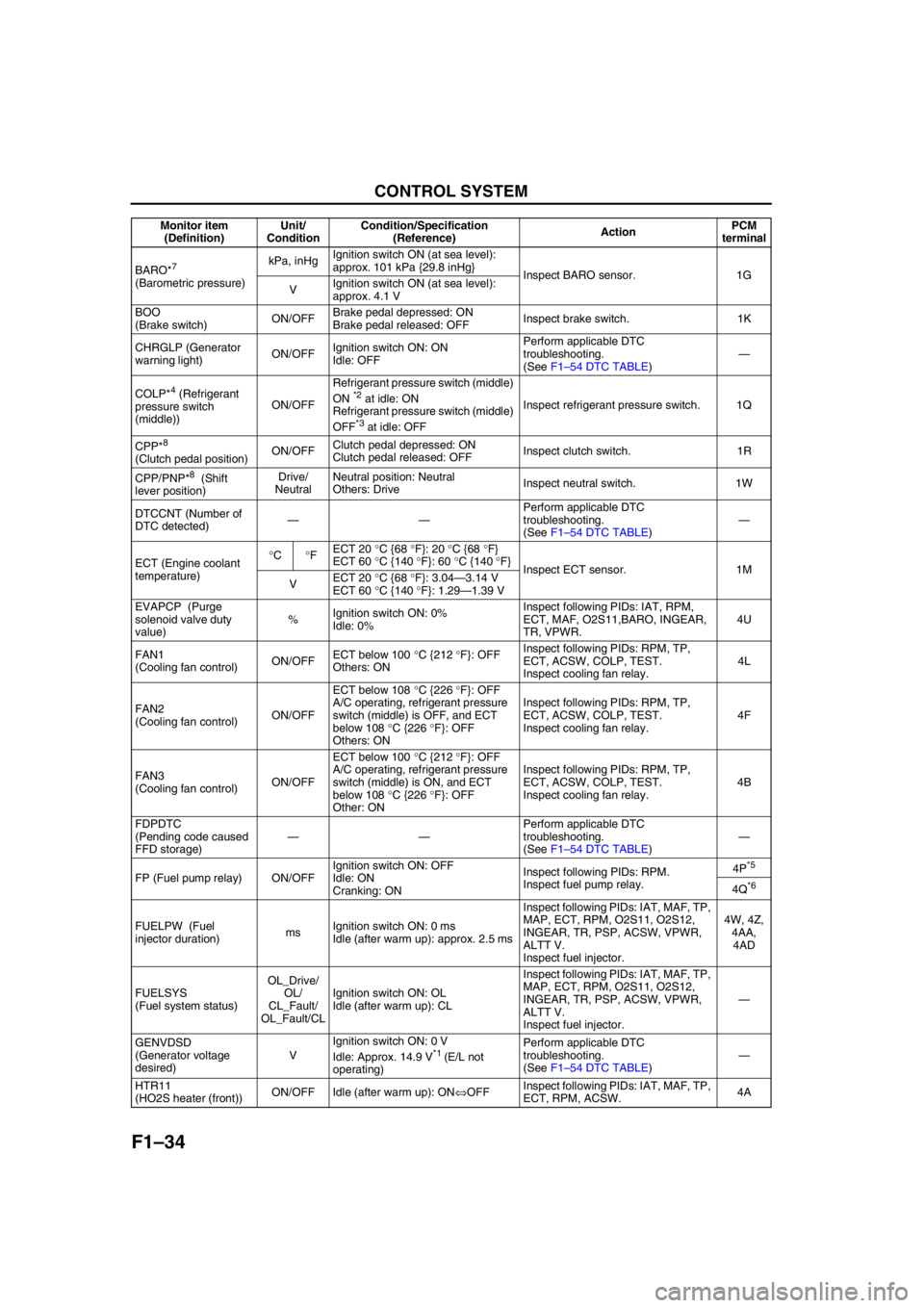
F1–34
CONTROL SYSTEM
BARO*7
(Barometric pressure)kPa, inHgIgnition switch ON (at sea level):
approx. 101 kPa {29.8 inHg}
Inspect BARO sensor. 1G
VIgnition switch ON (at sea level):
approx. 4.1 V
BOO
(Brake switch)ON/OFFBrake pedal depressed: ON
Brake pedal released: OFFInspect brake switch. 1K
CHRGLP (Generator
warning light)ON/OFFIgnition switch ON: ON
Idle: OFFPerform applicable DTC
troubleshooting.
(See F1–54 DTC TABLE)—
COLP*
4 (Refrigerant
pressure switch
(middle))ON/OFFRefrigerant pressure switch (middle)
ON *2 at idle: ON
Refrigerant pressure switch (middle)
OFF
*3 at idle: OFFInspect refrigerant pressure switch. 1Q
CPP*
8
(Clutch pedal position)ON/OFFClutch pedal depressed: ON
Clutch pedal released: OFFInspect clutch switch. 1R
CPP/PNP*
8 (Shift
lever position)Drive/
NeutralNeutral position: Neutral
Others: DriveInspect neutral switch. 1W
DTCCNT (Number of
DTC detected)——Perform applicable DTC
troubleshooting.
(See F1–54 DTC TABLE)—
ECT (Engine coolant
temperature)°C°FECT 20 °C {68 °F}: 20 °C {68 °F}
ECT 60 °C {140 °F}: 60 °C {140 °F}
Inspect ECT sensor. 1M
VECT 20 °C {68 °F}: 3.04—3.14 V
ECT 60 °C {140 °F}: 1.29—1.39 V
EVAPCP (Purge
solenoid valve duty
value)%Ignition switch ON: 0%
Idle: 0%Inspect following PIDs: IAT, RPM,
ECT, MAF, O2S11,BARO, INGEAR,
TR, VPWR.4U
FAN1
(Cooling fan control)ON/OFFECT below 100 °C {212 °F}: OFF
Others: ONInspect following PIDs: RPM, TP,
ECT, ACSW, COLP, TEST.
Inspect cooling fan relay.4L
FAN2
(Cooling fan control)ON/OFFECT below 108 °C {226 °F}: OFF
A/C operating, refrigerant pressure
switch (middle) is OFF, and ECT
below 108 °C {226 °F}: OFF
Others: ONInspect following PIDs: RPM, TP,
ECT, ACSW, COLP, TEST.
Inspect cooling fan relay.4F
FAN3
(Cooling fan control)ON/OFFECT below 100 °C {212 °F}: OFF
A/C operating, refrigerant pressure
switch (middle) is ON, and ECT
below 108 °C {226 °F}: OFF
Other: ONInspect following PIDs: RPM, TP,
ECT, ACSW, COLP, TEST.
Inspect cooling fan relay.4B
FDPDTC
(Pending code caused
FFD storage)——Perform applicable DTC
troubleshooting.
(See F1–54 DTC TABLE)—
FP (Fuel pump relay) ON/OFFIgnition switch ON: OFF
Idle: ON
Cranking: ONInspect following PIDs: RPM.
Inspect fuel pump relay.4P
*5
4Q*6
FUELPW (Fuel
injector duration)msIgnition switch ON: 0 ms
Idle (after warm up): approx. 2.5 msInspect following PIDs: IAT, MAF, TP,
MAP, ECT, RPM, O2S11, O2S12,
INGEAR, TR, PSP, ACSW, VPWR,
ALTT V.
Inspect fuel injector.4W, 4Z,
4AA,
4AD
FUELSYS
(Fuel system status)OL_Drive/
OL/
CL_Fault/
OL_Fault/CLIgnition switch ON: OL
Idle (after warm up): CLInspect following PIDs: IAT, MAF, TP,
MAP, ECT, RPM, O2S11, O2S12,
INGEAR, TR, PSP, ACSW, VPWR,
ALTT V.
Inspect fuel injector.—
GENVDSD
(Generator voltage
desired)VIgnition switch ON: 0 V
Idle: Approx. 14.9 V
*1 (E/L not
operating)Perform applicable DTC
troubleshooting.
(See F1–54 DTC TABLE)—
HTR11
(HO2S heater (front))ON/OFF Idle (after warm up): ON⇔OFFInspect following PIDs: IAT, MAF, TP,
ECT, RPM, ACSW.4A Monitor item
(Definition)Unit/
ConditionCondition/Specification
(Reference)ActionPCM
terminal
Page 130 of 909
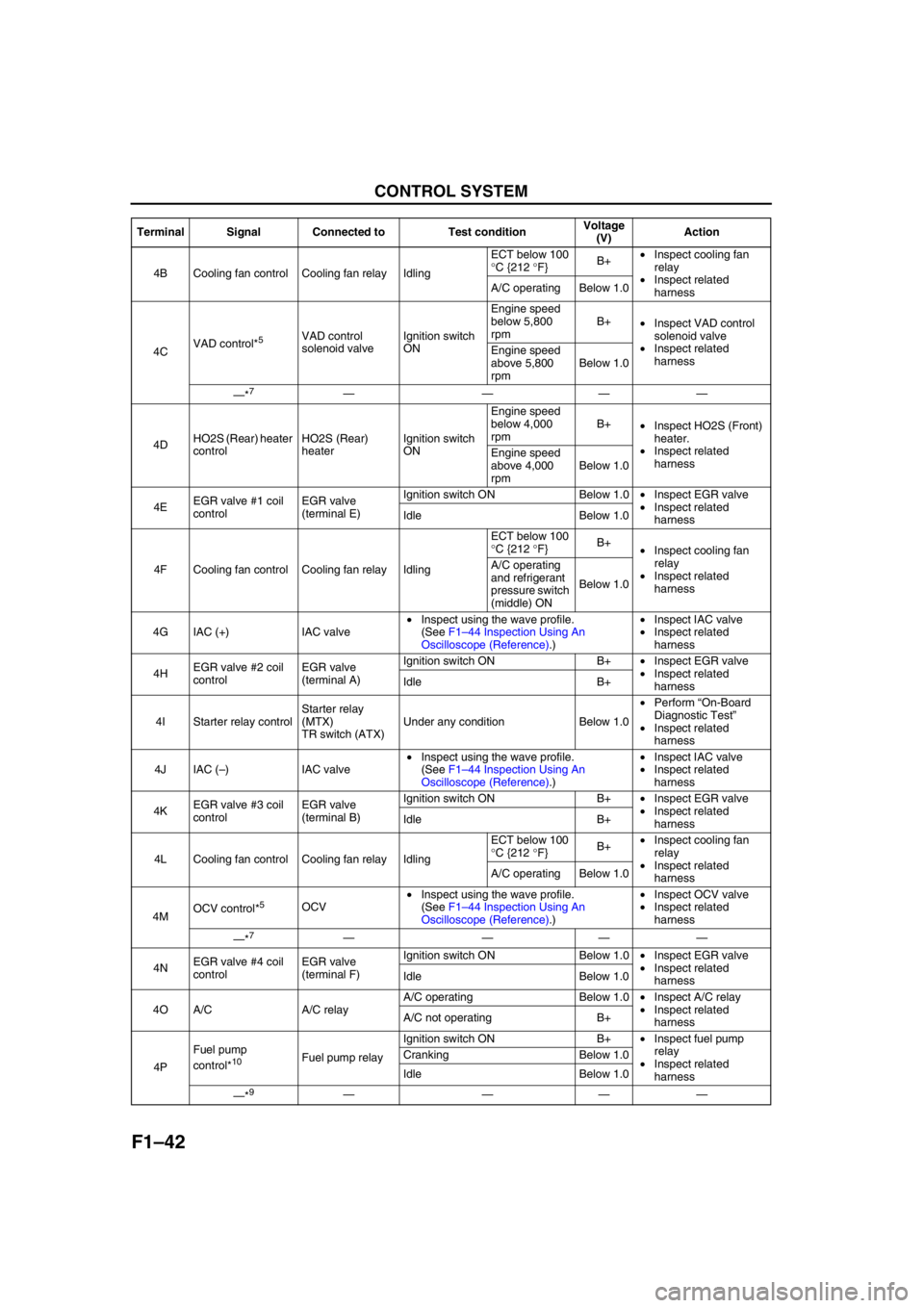
F1–42
CONTROL SYSTEM
4B Cooling fan control Cooling fan relay IdlingECT below 100
°C {212 °F}B+•Inspect cooling fan
relay
•Inspect related
harness A/C operating Below 1.0
4CVAD control*
5VAD control
solenoid valveIgnition switch
ONEngine speed
below 5,800
rpmB+
•Inspect VAD control
solenoid valve
•Inspect related
harness Engine speed
above 5,800
rpmBelow 1.0
—*
7————
4DHO2S (Rear) heater
controlHO2S (Rear)
heaterIgnition switch
ONEngine speed
below 4,000
rpmB+
•Inspect HO2S (Front)
heater.
•Inspect related
harness Engine speed
above 4,000
rpmBelow 1.0
4EEGR valve #1 coil
controlEGR valve
(terminal E)Ignition switch ON Below 1.0•Inspect EGR valve
•Inspect related
harness Idle Below 1.0
4F Cooling fan control Cooling fan relay IdlingECT below 100
°C {212 °F}B+
•Inspect cooling fan
relay
•Inspect related
harness A/C operating
and refrigerant
pressure switch
(middle) ONBelow 1.0
4G IAC (+) IAC valve•Inspect using the wave profile.
(See F1–44 Inspection Using An
Oscilloscope (Reference).)•Inspect IAC valve
•Inspect related
harness
4HEGR valve #2 coil
controlEGR valve
(terminal A)Ignition switch ON B+•Inspect EGR valve
•Inspect related
harness Idle B+
4I Starter relay controlStarter relay
(MTX)
TR switch (ATX)Under any condition Below 1.0•Perform “On-Board
Diagnostic Test”
•Inspect related
harness
4J IAC (–)IAC valve•Inspect using the wave profile.
(See F1–44 Inspection Using An
Oscilloscope (Reference).)•Inspect IAC valve
•Inspect related
harness
4KEGR valve #3 coil
controlEGR valve
(terminal B)Ignition switch ON B+•Inspect EGR valve
•Inspect related
harness Idle B+
4L Cooling fan control Cooling fan relay IdlingECT below 100
°C {212 °F}B+•Inspect cooling fan
relay
•Inspect related
harness A/C operating Below 1.0
4MOCV control*
5OCV•Inspect using the wave profile.
(See F1–44 Inspection Using An
Oscilloscope (Reference).)•Inspect OCV valve
•Inspect related
harness
—*
7————
4NEGR valve #4 coil
controlEGR valve
(terminal F)Ignition switch ON Below 1.0•Inspect EGR valve
•Inspect related
harness Idle Below 1.0
4O A/C A/C relayA/C operating Below 1.0•Inspect A/C relay
•Inspect related
harness A/C not operating B+
4PFuel pump
control*
10Fuel pump relayIgnition switch ON B+•Inspect fuel pump
relay
•Inspect related
harness Cranking Below 1.0
Idle Below 1.0
—*
9———— Terminal Signal Connected to Test conditionVoltage
(V)Action
Page 131 of 909

CONTROL SYSTEM
F1–43
F1
*1: Calculated value; differs from terminal voltage
*2: MTX models
*3: ATX models
*4: LF engine models
*5: L3 engine models
4QFuel pump control*
9Fuel pump relayIgnition switch ON B+•Inspect fuel pump
relay
•Inspect related
harness Cranking Below 1.0
Idle Below 1.0
—*
10————
4RVIC control*
5VIC control
solenoid valveEngine speed: above 4,500 rpm B+•Inspect VIC solenoid
valve
•Inspect related
harness Engine speed: below 4,500 rpm Below 1.0
—*
7————
4S—— — ——
4TVariable tumble
controlVariable tumble
control solenoid
valveECT above 63 °C { 145 °F} while
idling.B+•Inspect variable
tumble control
solenoid valve
•Inspect related
harness ECT below 63 °C {145 °F} and
engine speed below 3,750 rpmBelow 1.0
4U Purge controlPurge solenoid
valve•Inspect using the wave profile.
(See F1–44 Inspection Using An
Oscilloscope (Reference).)•Inspect purge
solenoid valve
•Inspect related
harness
4VB+*
3Main relayIgnition switch OFF Below 1.0•Inspect battery
•Inspect related
harness Ignition switch ON B+
—— — ——
4W Fuel injection (#2) Fuel injector No.2•Inspect using the wave profile.
(See F1–44 Inspection Using An
Oscilloscope (Reference).)•Inspect fuel injector
No.2
•Inspect related
harness
4X GND GND Under any condition Below 1.0•Inspect related
harness
4YShift solenoid C
control*
11Shift solenoid C•Inspect using the wave profile.
(See F1–44 Inspection Using An
Oscilloscope (Reference).)•Inspect shift solenoid
C
•Inspect related
harness
—*
14————
4Z Fuel injection (#1) Fuel injector No.1•Inspect using the wave profile.
(See F1–44 Inspection Using An
Oscilloscope (Reference).)•Inspect fuel injector
No.1
•Inspect related
harness
4AA Fuel injection (#4) Fuel injector No.4•Inspect using the wave profile.
(See F1–44 Inspection Using An
Oscilloscope (Reference).)•Inspect fuel injector
No.4
•Inspect related
harness
4ABShift solenoid A
control*
11Shift solenoid A•Inspect using the wave profile.
(See F1–44 Inspection Using An
Oscilloscope (Reference).)•Inspect shift solenoid
A
•Inspect related
harness
—*
14————
4ACShift solenoid B
control*
11Shift solenoid B•Inspect using the wave profile.
(See F1–44 Inspection Using An
Oscilloscope (Reference).)•Inspect shift solenoid
B
•Inspect related
harness
—*
14————
4AD Fuel injection (#3) Fuel injector No.3•Inspect using the wave profile.
(See F1–44 Inspection Using An
Oscilloscope (Reference).)•Inspect fuel injector
No.3
•Inspect related
harness Terminal Signal Connected to Test conditionVoltage
(V)Action
Page 147 of 909
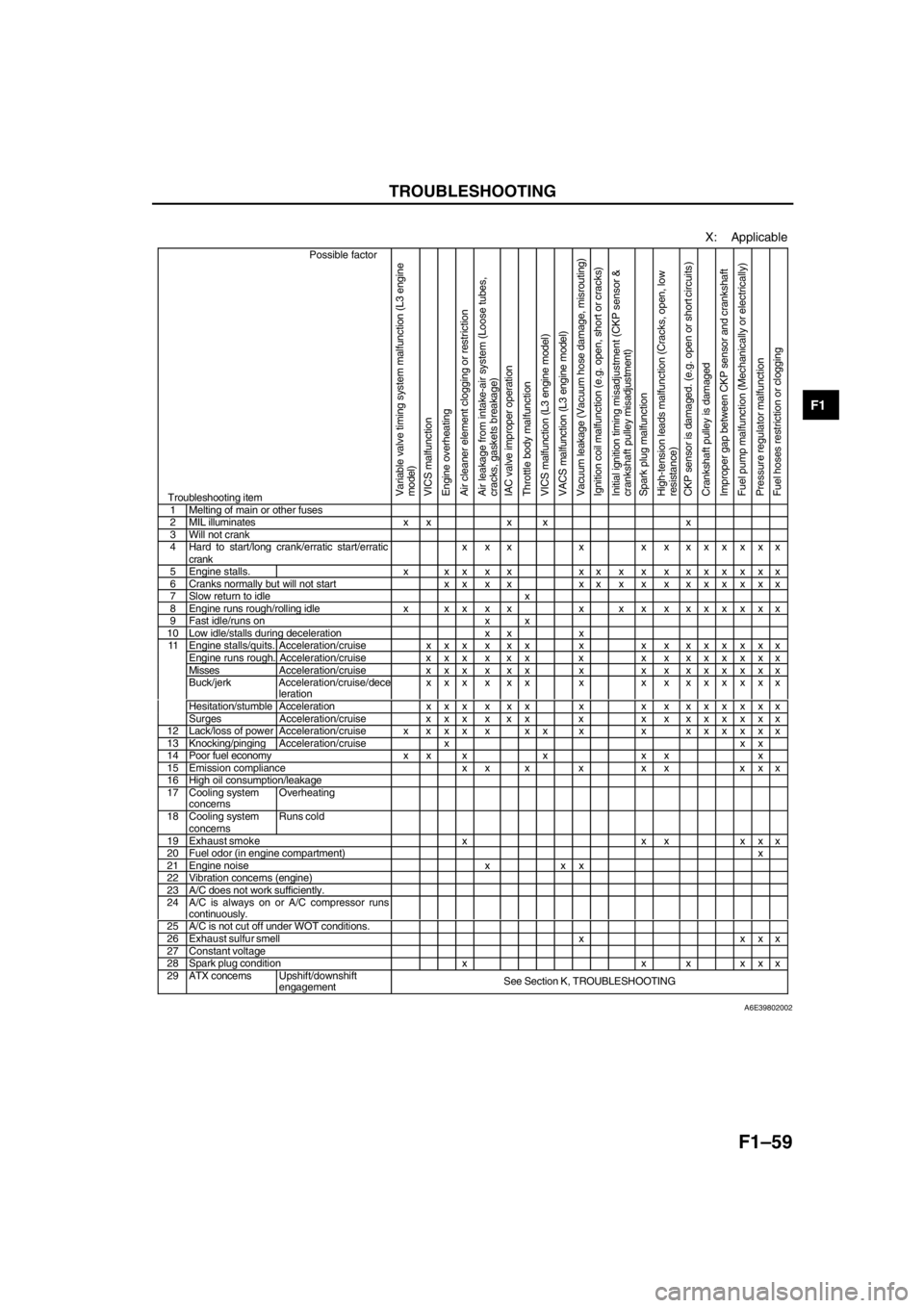
TROUBLESHOOTING
F1–59
F1
X: Applicable
Possible factor
Troubleshooting itemVariable valve timing system malfunction (L3 engine
model)
VICS malfunction
Engine overheating
Air cleaner element clogging or restriction
Air leakage from intake-air system (Loose tubes,
cracks, gaskets breakage)
IAC valve improper operation
Throttle body malfunction
VICS malfunction (L3 engine model)
VACS malfunction (L3 engine model)
Vacuum leakage (Vacuum hose damage, misrouting)
Ignition coil malfunction (e.g. open, short or cracks)
Initial ignition timing misadjustment (CKP sensor &
crankshaft pulley misadjustment)
Spark plug malfunction
High-tension leads malfunction (Cracks, open, low
resistance)
CKP sensor is damaged. (e.g. open or short circuits )
Crankshaft pulley is damaged
Improper gap between CKP sensor and crankshaft
Fuel pump malfunction (Mechanically or electrically)
Pressure regulator malfunction
Fuel hoses restriction or clogging
1 Melting of main or other fuses2 MIL illuminates x x x x x3 Will not crank4 Hard to start/long crank/erratic start/erratic
crankx x x x x x xxxxxx
5 Engine stalls. x x x x x xxxxxxxxxxx6 Cranks normally but will not start x x x x xxxxxxxxxxx7 Slow return to idle x8 Engine runs rough/rolling idle x x x x x x x x xxxxxxx9 Fast idle/runs on x x10 Low idle/stalls during deceleration x x xEngine stalls/quits. Acceleration/cruise x x x x x x x x xxxxxxxEngine runs rough. Acceleration/cruise x x x x x x x x xxxxxxxMissesAcceleration/cruise x x x x x x x x xxxxxxxBuck/jerk Acceleration/cruise/dece
lerationxxx x xx x x x xxxxxx
Hesitation/stumble Acceleration x x x x x x x x xxxxxxx
11
Surges Acceleration/cruise x x x x x x x x xxxxxxx
12 Lack/loss of powerAcceleration/cruise x x x x x x x x xxxxxxx13 Knocking/pingingAcceleration/cruise x x x14 Poor fuel economy x x x x x x x15 Emission compliance x x x x x x x x x16 High oil consumption/leakage17 Cooling system
concernsOverheating
18 Cooling system
concernsRuns cold
19 Exhaust smoke x x x x x x20 Fuel odor (in engine compartment)x21 Engine noise x x x22 Vibration concerns (engine)23 A/C does not work sufficiently.24 A/C is always on or A/C compressor runs
continuously.
25 A/C is not cut off under WOT conditions.26 Exhaust sulfur smell x x x x27 Constant voltage28 Spark plug condition x x x x x x29 ATX concernsUpshift/downshift
engagementSee Section K, TROUBLESHOOTING
A6E39802002