fuel pump MAZDA 6 2002 Suplement Repair Manual
[x] Cancel search | Manufacturer: MAZDA, Model Year: 2002, Model line: 6, Model: MAZDA 6 2002Pages: 909, PDF Size: 17.16 MB
Page 276 of 909

F2–124
ON-BOARD DIAGNOSTIC
DTC P0191A6E407001082221
Diagnostic procedure
End Of Sie
DTC P0191 Fuel pressure sensor circuit performance problem
DETECTION
CONDITION•PCM monitors fuel pressure in common rail from fuel pressure sensor while engine is running. PCM
calculates difference between actual fuel pressure and target fuel pressure. If pressure difference exceeds
preprogrammed criteria, PCM determines fuel pressure sensor circuit performance problem.
POSSIBLE
CAUSE•Fuel pressure sensor malfunction
•Suction control valve malfunction
•Clogged fuel line
•PCM malfunction
STEP INSPECTION ACTION
1VERIFY RELATED REPAIR INFORMATION
AVAILABILITY
•Check for related Service Information
availability.
•Is any related repair information available?Yes Perform repair or diagnosis according to available Service
Information.
•If vehicle is not repaired, go to next step.
No Go to next step.
2FOLLOW OTHER DETECTED DTC FIRST
•Turn engine switch to OFF.
•Start engine.
•Have P0091, P0092, P0192, P0193 been
detected?Yes Go to applicable DTC inspection.
(See F2–87 DTC TABLE)
No Go to next step.
3INSPECT FUEL PRESSURE SENSOR
•Inspect fuel pressure sensor.
(See F2–79 FUEL PRESSURE SENSOR
INSPECTION)
•Is there any malfunction?Yes Replace common rail, go to Step 6.
(See F2–53 SUPPLY PUMP REMOVAL/INSTALLATION)
No Go to next step.
4INSPECT SUCTION CONTROL VALVE
•Inspect suction control valve.
(See F2–54 SUCTION CONTROL VALVE
INSPECTION)
•Is there any malfunction?Yes Repair supply pump, go to Step 6.
(See F2–54 SUPPLY PUMP INSPECTION)
No Go to next step.
5INSPECT FUEL LINE
•Turn engine switch to OFF.
•Inspect for clogs in following fuel lines for each
cylinder:
—Common rail and fuel injector.
—Common rail and fuel tank.
• Is there any malfunction?Yes Repair or replace suspected fuel line, go to next step.
No Go to next step.
6VERIFY TROUBLESHOOTING OF DTC P0016
COMPLETED
•Make sure to reconnect all disconnected
connectors.
•Clear DTC from PCM memory using WDS or
equivalent.
•Start engine.
•Is same DTC present?Yes Replace PCM, go to next step.
(See F2–64 PCM REMOVAL/INSTALLATION)
No Go to next step.
7VERIFY AFTER REPAIR PROCEDURE
•Perform “After Repair Procedure”.
(See F2–86 AFTER REPAIR PROCEDURE)
•Is there any DTC present?Yes Go to applicable DTC inspection.
(See F2–87 DTC TABLE)
No Troubleshooting completed.
Page 278 of 909

F2–126
ON-BOARD DIAGNOSTIC
End Of Sie
5INSPECT FUEL PRESSURE SENSOR SIGNAL
CIRCUIT FOR SHORT TO GND
•Turn engine switch to OFF.
•Inspect continuity between fuel pressure
sensor terminal B and body GND.
•Is there continuity?Yes Repair or replace harness for short to GND, go to Step 9.
No Go to next step.
6INSPECT FUEL PRESSURE SENSOR CIRCUIT
FOR SHORT WITH EACH OTHER
•Turn engine switch to OFF.
•Inspect continuity between fuel pressure
sensor terminals B and A.
•Is there continuity?Yes Repair or replace harness for short with each other, go to
Step 9.
No Go to next step.
7INSPECT FUEL TEMPERATURE SENSOR
•Inspect fuel temperature sensor.
(See F2–79 FUEL PRESSURE SENSOR
INSPECTION)
•Is there any malfunction?Yes Repair supply pump, go to Step 9.
(See F2–54 SUPPLY PUMP INSPECTION)
No Go to next step.
8INSPECT POOR CONNECTION OF PCM
CONNECTOR
•Turn engine switch to OFF.
•Inspect for poor connection (damaged, pulled-
out terminals, corrosion, etc.).
•Is there any malfunction?Yes Repair or replace suspected terminal, go to next step.
No Go to next step.
9VERIFY TROUBLESHOOTING OF DTC P0192
COMPLETED
•Make sure to reconnect all disconnected
connectors.
•Clear DTC from PCM memory using WDS or
equivalent.
•Start engine.
•Is same DTC present?Yes Replace PCM, go to next step.
(See F2–64 PCM REMOVAL/INSTALLATION)
No Go to next step.
10VERIFY AFTER REPAIR PROCEDURE
•Perform “After Repair Procedure”.
(See F2–86 AFTER REPAIR PROCEDURE)
•Is there any DTC present?Yes Go to applicable DTC inspection.
(See F2–87 DTC TABLE)
No Troubleshooting completed. STEP INSPECTION ACTION
Page 279 of 909

ON-BOARD DIAGNOSTIC
F2–127
F2
DTC P0193A6E407001082223
Diagnostic procedure
DTC P0193 Fuel pressure sensor circuit high input
DETECTION
CONDITION•PCM monitors input voltage from fuel pressure sensor while engine is running. If input voltage from fuel
pressure sensor is above 4.8 V, PCM determines fuel pressure sensor circuit high input.
POSSIBLE
CAUSE•Fuel pressure sensor malfunction
•Connector or terminal malfunction
•Fuel pressure sensor power and signal circuits short each other
•Open circuit in wiring between fuel pressure sensor terminal B and PCM terminal 61
•Open circuit in wiring between fuel pressure sensor terminal A and PCM terminal 91
•PCM malfunction
STEP INSPECTION ACTION
1VERIFY RELATED REPAIR INFORMATION
AVAILABILITY
•Check for related Service Information
availability.
•Is any related repair information available?Yes Perform repair or diagnosis according to available Service
Information.
•If vehicle is not repaired, go to next step.
No Go to next step.
2INSPECT POOR CONNECTION OF FUEL
PRESSURE SENSOR CONNECTOR
•Turn engine switch to OFF.
•Inspect for poor connection (damaged, pulled-
out terminals, corrosion, etc.).
•Is there any malfunction?Yes Repair or replace suspected terminal, go to Step 7.
No Go to next step.
3INSPECT FUEL PRESSURE SENSOR CIRCUIT
FOR SHORT WITH EACH OTHER
•Turn engine switch to OFF.
•Inspect continuity between fuel pressure
sensor terminals C and B
•Is there continuity?Yes Repair or replace harness for short with each other, go to
Step 7.
No Go to next step.
4INSPECT FUEL TEMPERATURE SENSOR
•Inspect fuel temperature sensor.
(See F2–77 FUEL TEMPERATURE SENSOR
INSPECTION)
•Is there any malfunction?Yes Repair supply pump, go to Step 7.
(See F2–54 SUPPLY PUMP INSPECTION)
No Go to next step.
53
6
2
5
4
3
6
2
25
FUEL PRESSURE SENSOR
C
B
A90
61
91PCM
CBA
919061 FUEL PRESSURE SENSOR
HARNESS SIDE CONNECTORPCM
HARNESS SIDE CONNECTOR
Page 321 of 909

TROUBLESHOOTING
F2–169
F2
×: Applicable
Troubleshooting item
1 Melting of main or other fuses
2 MIL illuminates×× × ×
3 Will not crank
4 Hard start/long crank/erratic start/erratic crank×× ×××××××
5 Engine stalls After start/at idle×× ×××××××
6 Cranks normally but will not start×× ×××××××
7 Slow return to idle××××××××
8 Engine runs rough/rolling idle×××××××××
9 Fast idle/runs on×
10 Low idle/stalls during deceleration××××××××××
11Engine stalls/quits Acceleration/cruise× × ×××××××
Engine runs rough Acceleration/cruise× ××××××××××
Misses Acceleration/cruise× ××××××××××
Buck/jerk Acceleration/cruise/ deceleration× ××××××××××
Hesitation/stumble Acceleration× ××××××××××
Surges Acceleration/cruise× ×× ×××××××
12 Lack/loss of power Acceleration/cruise××× ×××××××××
13 Knocking/pinging××××× ××× × ×
14 Poor fuel economy××× ×××××× ×
15 Emissions compliance×××××××××××××
16 High oil consumption/leakage×
17 Cooling system concerns Overheating×
18 Cooling system concerns Runs cold
19 Excessive black smoke××× × ××× ×××
20 Fuel odor (in engine compartment)××
21 Engine noise× ××× ×
22 Vibration concerns (engine)
23 A/C does not work sufficiently
24 A/C always on or A/C compressor runs continuously
25 A/C does not cut off under wide open throttle conditions
26 Constant voltage
Turbocharger malfunctionCarge air cooler malfunctionVBC system malfunctionGlow system malfunctionIncorrect fuel injection timingIncorrect idle speedCKP sensor is damaged (e.g.: open or short circuits)CKP sensor pulse wheel is damagedImproper gap between CKP sensor and pulse wheelSupply pump malfunctionSuction control valve malfunctionFuel pressure limiter malfunctionFuel line restriction or clogging
Page 325 of 909
![MAZDA 6 2002 Suplement Repair Manual TROUBLESHOOTING
F2–173
F2
NO.1 MELTING OF MAIN OR OTHER FUSESA6E408018881203
End Of Sie
1 Melting of main or other fuses
[TROUBLESHOOTING HINTS]
Inspect condition of fuse.
Damaged fuse Related wiri](/img/28/57057/w960_57057-324.png "MAZDA 6 2002 Suplement Repair Manual TROUBLESHOOTING
F2–173
F2
NO.1 MELTING OF MAIN OR OTHER FUSESA6E408018881203
End Of Sie
1 Melting of main or other fuses
[TROUBLESHOOTING HINTS]
Inspect condition of fuse.
Damaged fuse Related wiri")
TROUBLESHOOTING
F2–173
F2
NO.1 MELTING OF MAIN OR OTHER FUSESA6E408018881203
End Of Sie
1 Melting of main or other fuses
[TROUBLESHOOTING HINTS]
Inspect condition of fuse.
Damaged fuse Related wiring harness
MAINMAIN fuse
•BTN fuse
•FAN fuse
•AD FAN fuse
•IG KEY 2 fuse
IG KEY 1IG KEY 1 fuse
•Engine switch
—ENGINE fuse
FUEL PUMPFUEL PUMP fuse
•Fuel warmer
•PCM control relay
BTNBTN fuse
•ROOM fuse
IG KEY 2IG KEY 2 fuse
•Engine switch
ROOMROOM fuse
•DLC-2
ENGINEENGINE fuse
•PCM
INJINJ fuse
•PCM
•IDM
•MAF/IAT sensor
•VSC solenoid valve
•VBC solenoid valve
•EGR control solenoid valve
•EGR solenoid valve (vacuum)
•EGR solenoid valve (vent)
•Intake shutter solenoid valve (half)
•Intake shutter solenoid valve (full)
GLOWGLOW fuse
•Glow plug relay
—Glow plug
—GLOW SIG
ENG+BENG+B fuse
•PCM
FANFAN fuse
•Cooling fan relay No.2
AD FANAD FAN fuse
•Cooling fan relay No.1
Shorted harness
Repair shorted harness and replace fuseFuseDeterioration
Replace fuse
Page 328 of 909

F2–176
TROUBLESHOOTING
NO.4 HARD START/LONG CRANK/ERRATIC START/ERRATIC CRANKA6E408018881206
Diagnostic Procedure
4 HARD START/LONG CRANK/ERRATIC START/ERRATIC CRANK
DESCRIPTION•Starter cranks engine at normal speed but engine requires excessive cranking time before starting.
•Battery is in normal condition.
POSSIBLE
CAUSE•Poor fuel quality
•Intake-air system restriction or clogging
•Starting system malfunction
•Inadequate fuel pressure
•Fuel pressure limiter malfunction (built-in common rail)
•Suction control valve malfunction (built-in supply pump)
•Engine overheating
•Glow system malfunction
•Fuel filter clogging or restriction
•Fuel line clogging or restriction
•Fuel leakage
•Exhaust system and/or catalyst converter restriction or clogging
•Incorrect fuel injection timing
•Erratic signal from CKP sensor
•Erratic signal from CMP sensor
•ECT sensor or related circuit malfunction
•Accelerator position sensor or related circuit malfunction
•Accelerator position sensor misadjustment
•MAF/IAT sensor or related circuit malfunction
•Fuel pressure sensor or related circuit malfunction
•Supply pump malfunction
•Fuel injector malfunction
•Low engine compression
•IDM or related circuit malfunction
•EGR system malfunction
Warning
The following troubleshooting flow chart contains the fuel system diagnosis and repair
procedures. Read the following warnings before performing the fuel system services:
•Fuel vapor is hazardous. It can easily ignite, causing serious injury and damage. Always keep
sparks and flames away from fuel.
•Fuel line spills and leakage are dangerous. Fuel can ignite and cause serious injury or death
and damage. Fuel can also irritate skin and eyes. To prevent this, always complete “BEFORE
REPAIR PROCEDURE” and “AFTER REPAIR PROCEDURE” described in this manual.
STEP INSPECTION RESULTS ACTION
1 Inspect for following:
•Fuel quality (e.g.: include water
contamination, winter/summer blend)
•Fuel line/fuel filter clogging
•Intake-air system restriction
Are all items okay?Yes Go to next step.
No Service as necessary.
Repeat Step 1.
2 Is engine overheating? Yes Go to symptom troubleshooting “NO.17 COOLING
SYSTEM CONCERNS-OVERHEATING”.
No Go to next step.
3 Connect WDS or equivalent to DLC-2.
Turn engine switch to ON.
Retrieve any DTC.
Is DTC displayed?YesDTC is displayed:
Go to appropriate DTC test.
Communication error message is displayed:
Inspect following:
•Open circuit between PCM control relay and PCM
terminal 53 or 79
•Open circuit PCM control relay and PCM terminal
69
•PCM control relay stuck open
•Open or poor GND circuit (PCM terminal 65, 85,
103 or 104)
•Poor connection vehicle body GND
NoNo DTC is displayed:
Go to next step.
Page 329 of 909

TROUBLESHOOTING
F2–177
F2
4 Does engine start normally after warm-up? Yes Inspect glow system operation.
(See T–19 RELAY INSPECTION)
Replace any malfunctioning part as necessary.
If glow system is okay, go to next step.
No Go to next step.
5 Is there any restriction in exhaust system or
catalyst converter?Yes Repair or replace as necessary.
No Go to next step.
6 Inspect for fuel leakage from fuel pipe.
Is any fuel leakage found on fuel pipe?Yes Repair or replace as necessary.
No Go to next step.
7 Inspect adjustment of accelerator position
sensor and idle switch.
(See F2–72 ACCELERATOR POSITION
SENSOR INSPECTION)
(See F2–70 IDLE SWITCH INSPECTION)
Are accelerator position sensor and idle switch
adjusted correctly?Yes Go to next step.
No Adjust accelerator position sensor and idle switch
correctly.
(See F2–73 ACCELERATOR POSITION SENSOR
ADJUSTMENT)
(See F2–71 IDLE SWITCH ADJUSTMENT)
8 Visually inspect CKP sensor and teeth of pulse
wheel.
Are CKP sensor and teeth of pulse wheel okay?Yes Go to next step.
No Replace malfunctioning parts.
9 Measure gap between CKP sensor and teeth of
pulse wheel.
Specification
1.5—2.5 mm {0.059—0.098 in}
Is gap within specification?Yes Go to next step.
No Adjust CKP sensor position.
10 Visually inspect CMP sensor and teeth of pulse
wheel.
Are CMP sensor and teeth of pulse wheel okay?Yes Inspect following PIDs:
(See F2–65 PCM INSPECTION)
•ECT
•IAT
•MAF
•RPM
If PID value is not as specified, repair or replace
malfunctioning parts.
If PID value is okay, go to next step.
No Replace malfunctioning parts.
11 Inspect fuel pressure sensor.
(See F2–79 FUEL PRESSURE SENSOR
INSPECTION)
Is fuel pressure okay?Yes Go to next step.
No Replace common rail.
12 Inspect suction control valve.
(See F2–54 SUCTION CONTROL VALVE
INSPECTION)
Is suction control valve okay?Yes Go to next step.
No Repair supply pump.
(See F2–54 SUPPLY PUMP INSPECTION)
13 Is engine compression correct?
(See B2–8 COMPRESSION INSPECTION)Yes Go to next step.
No Inspect for following:
•Damaged valve seat
•Worn valve stem and valve guide
•Worn or stuck piston ring
•Worn piston, piston ring or cylinder
Service as necessary.
14 Inspect fuel injector.
(See F2–56 FUEL INJECTOR INSPECTION)
Is fuel injector okay?Yes Go to next step.
No Repair or replace as necessary.
15 Inspect EGR system operation.
Is EGR system operation normal?Yes Go to next step.
No Repair or replace malfunctioning part according to
EGR system operation results.
16 Inspect IDM.
(See F2–84 INJECTOR DRIVER MODULE
(IDM) INSPECTION)
Is IDM okay?Yes Go to next step.
No Repair or replace as necessary.
17 Inspect starting system.
Is starting system normal?Yes Inspect for loose connectors or poor terminal contact.
If okay, remove and inspect supply pump and common
rail.
No Repair or replace components as required. STEP INSPECTION RESULTS ACTION
Page 330 of 909

F2–178
TROUBLESHOOTING
End Of Sie
NO.5 ENGINE STALLS-AFTER START/AT IDLEA6E408018881207
Diagnostic Procedure
18 Verify test results.
•If okay, return to diagnostic index to service any additional symptoms.
•If malfunction remains, replace PCM. (See F2–64 PCM REMOVAL/INSTALLATION) STEP INSPECTION RESULTS ACTION
5 ENGINE STALLS-AFTER START/AT IDLE
DESCRIPTION•Engine stops unexpectedly.
POSSIBLE
CAUSE•Poor fuel quality
•Intake-air system restriction or clogging
•Engine overheating
•A/C system improper operation
•Immobilizer system (PATS) and/or circuit malfunction (if equipped)
•PCM control relay malfunction
•Glow system malfunction
•Inadequate fuel pressure
•Fuel pressure sensor related circuit malfunction
•Suction control valve malfunction (built-in supply pump)
•Fuel pressure limiter malfunction (built-in common rail)
•Fuel leakage
•Fuel line clogging or restriction
•Fuel filter clogging or restriction
•Incorrect fuel injection timing
•Erratic signal from CKP sensor
•Erratic signal from CMP sensor
•Supply pump malfunction
•Fuel injector malfunction
•Low engine compression
•Improper valve timing
•Exhaust system and/or catalyst converter restriction or clogging
•EGR system malfunction
•ECT sensor or related circuit malfunction
•Accelerator positions sensor or related circuit malfunction
•Accelerator positions sensor misadjustment
•MAF/IAT sensor or related circuit malfunction
•V-reference voltage supply circuit malfunction
•IDM or related circuit malfunction
Warning
The following troubleshooting flow chart contains the fuel system diagnosis and repair
procedures. Read the following warnings before performing the fuel system services:
•Fuel vapor is hazardous. It can easily ignite, causing serious injury and damage. Always keep
sparks and flames away from fuel.
•Fuel line spills and leakage are dangerous. Fuel can ignite and cause serious injury or death
and damage. Fuel can also irritate skin and eyes. To prevent this, always complete “BEFORE
REPAIR PROCEDURE” and “AFTER REPAIR PROCEDURE” described in this manual.
STEP INSPECTION RESULTS ACTION
1Note
•The following test should be perform for
vehicles with immobilizer system. Go to
Step 10 for vehicles without immobilizer
system.
Connect WDS or equivalent to DLC-2.
Do following conditions appear?
•Engine is not completely started.
•DTC B1681 is displayed.YesBoth conditions appear:
Go to Step 4.
NoEither or other condition appears:
Go to next step.
2 Is coil connector securely connected to coil? Yes Go to next step.
No Connect coil connector securely.
Return to Step 1.
3 Does security light illuminate? Yes Go to next step.
No Inspect instrument cluster and wiring harness.
Page 332 of 909
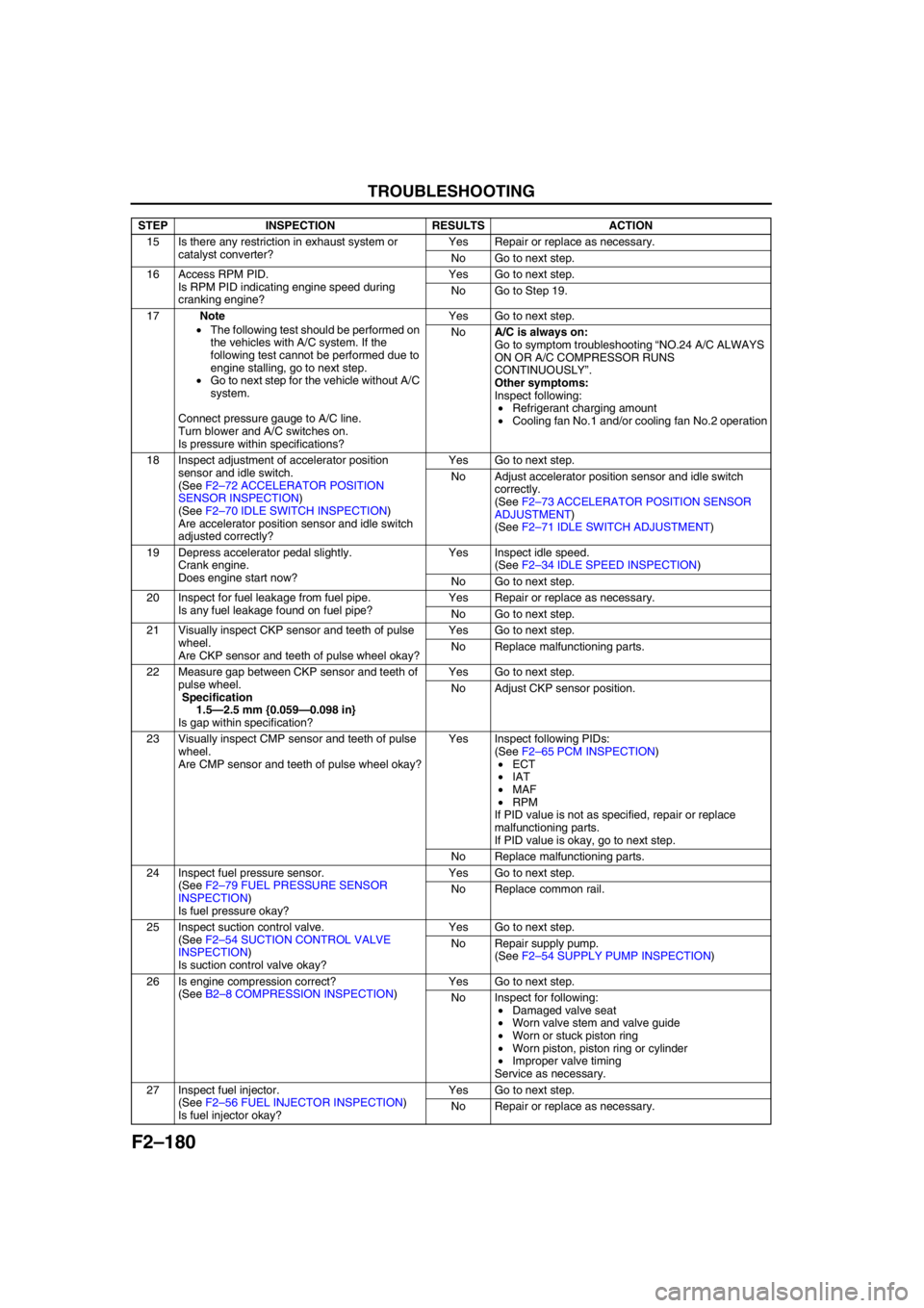
F2–180
TROUBLESHOOTING
15 Is there any restriction in exhaust system or
catalyst converter?Yes Repair or replace as necessary.
No Go to next step.
16 Access RPM PID.
Is RPM PID indicating engine speed during
cranking engine?Yes Go to next step.
No Go to Step 19.
17Note
•The following test should be performed on
the vehicles with A/C system. If the
following test cannot be performed due to
engine stalling, go to next step.
•Go to next step for the vehicle without A/C
system.
Connect pressure gauge to A/C line.
Turn blower and A/C switches on.
Is pressure within specifications?Yes Go to next step.
NoA/C is always on:
Go to symptom troubleshooting “NO.24 A/C ALWAYS
ON OR A/C COMPRESSOR RUNS
CONTINUOUSLY”.
Other symptoms:
Inspect following:
•Refrigerant charging amount
•Cooling fan No.1 and/or cooling fan No.2 operation
18 Inspect adjustment of accelerator position
sensor and idle switch.
(See F2–72 ACCELERATOR POSITION
SENSOR INSPECTION)
(See F2–70 IDLE SWITCH INSPECTION)
Are accelerator position sensor and idle switch
adjusted correctly?Yes Go to next step.
No Adjust accelerator position sensor and idle switch
correctly.
(See F2–73 ACCELERATOR POSITION SENSOR
ADJUSTMENT)
(See F2–71 IDLE SWITCH ADJUSTMENT)
19 Depress accelerator pedal slightly.
Crank engine.
Does engine start now?Yes Inspect idle speed.
(See F2–34 IDLE SPEED INSPECTION)
No Go to next step.
20 Inspect for fuel leakage from fuel pipe.
Is any fuel leakage found on fuel pipe?Yes Repair or replace as necessary.
No Go to next step.
21 Visually inspect CKP sensor and teeth of pulse
wheel.
Are CKP sensor and teeth of pulse wheel okay?Yes Go to next step.
No Replace malfunctioning parts.
22 Measure gap between CKP sensor and teeth of
pulse wheel.
Specification
1.5—2.5 mm {0.059—0.098 in}
Is gap within specification?Yes Go to next step.
No Adjust CKP sensor position.
23 Visually inspect CMP sensor and teeth of pulse
wheel.
Are CMP sensor and teeth of pulse wheel okay?Yes Inspect following PIDs:
(See F2–65 PCM INSPECTION)
•ECT
•IAT
•MAF
•RPM
If PID value is not as specified, repair or replace
malfunctioning parts.
If PID value is okay, go to next step.
No Replace malfunctioning parts.
24 Inspect fuel pressure sensor.
(See F2–79 FUEL PRESSURE SENSOR
INSPECTION)
Is fuel pressure okay?Yes Go to next step.
No Replace common rail.
25 Inspect suction control valve.
(See F2–54 SUCTION CONTROL VALVE
INSPECTION)
Is suction control valve okay?Yes Go to next step.
No Repair supply pump.
(See F2–54 SUPPLY PUMP INSPECTION)
26 Is engine compression correct?
(See B2–8 COMPRESSION INSPECTION)Yes Go to next step.
No Inspect for following:
•Damaged valve seat
•Worn valve stem and valve guide
•Worn or stuck piston ring
•Worn piston, piston ring or cylinder
•Improper valve timing
Service as necessary.
27 Inspect fuel injector.
(See F2–56 FUEL INJECTOR INSPECTION)
Is fuel injector okay?Yes Go to next step.
No Repair or replace as necessary. STEP INSPECTION RESULTS ACTION
Page 333 of 909
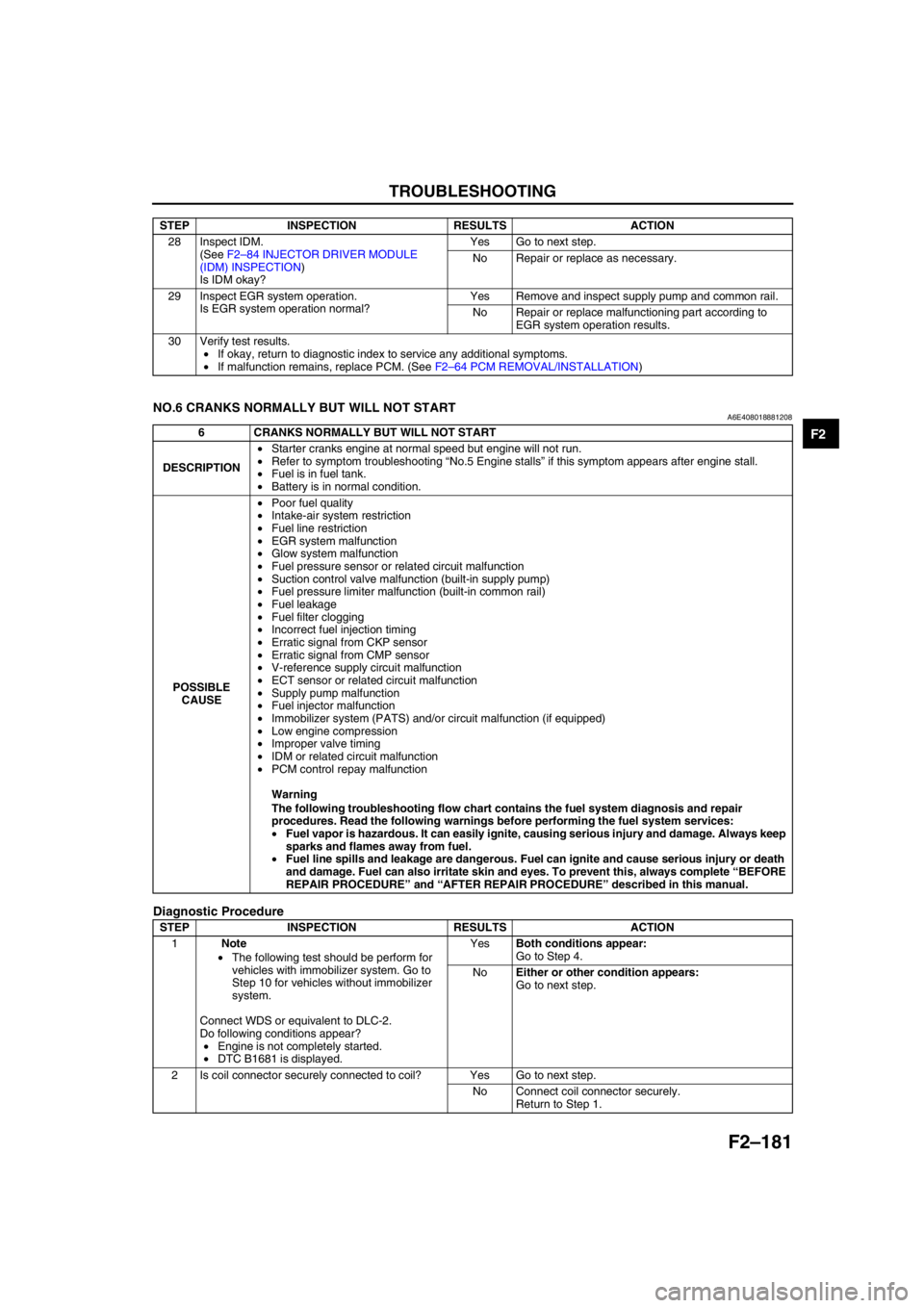
TROUBLESHOOTING
F2–181
F2
End Of Sie
NO.6 CRANKS NORMALLY BUT WILL NOT STARTA6E408018881208
Diagnostic Procedure
28 Inspect IDM.
(See F2–84 INJECTOR DRIVER MODULE
(IDM) INSPECTION)
Is IDM okay?Yes Go to next step.
No Repair or replace as necessary.
29 Inspect EGR system operation.
Is EGR system operation normal?Yes Remove and inspect supply pump and common rail.
No Repair or replace malfunctioning part according to
EGR system operation results.
30 Verify test results.
•If okay, return to diagnostic index to service any additional symptoms.
•If malfunction remains, replace PCM. (See F2–64 PCM REMOVAL/INSTALLATION) STEP INSPECTION RESULTS ACTION
6 CRANKS NORMALLY BUT WILL NOT START
DESCRIPTION•Starter cranks engine at normal speed but engine will not run.
•Refer to symptom troubleshooting “No.5 Engine stalls” if this symptom appears after engine stall.
•Fuel is in fuel tank.
•Battery is in normal condition.
POSSIBLE
CAUSE•Poor fuel quality
•Intake-air system restriction
•Fuel line restriction
•EGR system malfunction
•Glow system malfunction
•Fuel pressure sensor or related circuit malfunction
•Suction control valve malfunction (built-in supply pump)
•Fuel pressure limiter malfunction (built-in common rail)
•Fuel leakage
•Fuel filter clogging
•Incorrect fuel injection timing
•Erratic signal from CKP sensor
•Erratic signal from CMP sensor
•V-reference supply circuit malfunction
•ECT sensor or related circuit malfunction
•Supply pump malfunction
•Fuel injector malfunction
•Immobilizer system (PATS) and/or circuit malfunction (if equipped)
•Low engine compression
•Improper valve timing
•IDM or related circuit malfunction
•PCM control repay malfunction
Warning
The following troubleshooting flow chart contains the fuel system diagnosis and repair
procedures. Read the following warnings before performing the fuel system services:
•Fuel vapor is hazardous. It can easily ignite, causing serious injury and damage. Always keep
sparks and flames away from fuel.
•Fuel line spills and leakage are dangerous. Fuel can ignite and cause serious injury or death
and damage. Fuel can also irritate skin and eyes. To prevent this, always complete “BEFORE
REPAIR PROCEDURE” and “AFTER REPAIR PROCEDURE” described in this manual.
STEP INSPECTION RESULTS ACTION
1Note
•The following test should be perform for
vehicles with immobilizer system. Go to
Step 10 for vehicles without immobilizer
system.
Connect WDS or equivalent to DLC-2.
Do following conditions appear?
•Engine is not completely started.
•DTC B1681 is displayed.YesBoth conditions appear:
Go to Step 4.
NoEither or other condition appears:
Go to next step.
2 Is coil connector securely connected to coil? Yes Go to next step.
No Connect coil connector securely.
Return to Step 1.