fuel MAZDA 6 2002 Suplement Repair Manual
[x] Cancel search | Manufacturer: MAZDA, Model Year: 2002, Model line: 6, Model: MAZDA 6 2002Pages: 909, PDF Size: 17.16 MB
Page 124 of 909

F1–36
CONTROL SYSTEM
*1: Calculated value; differs from terminal voltage
*2: Refrigerant pressure switch (middle) turns on when the refrigerant pressure is 1.69—1.84 MPa {17.3—18.7
kgf/cm2, 247—265 psi}
*3: Refrigerant pressure switch (middle) turns off when the refrigerant pressure is 1.26—1.49 MPa {12.9—15.1
kgf/cm2, 184—214 psi}
*4: L3 and L8, LF (Intensely hot area) engine models
*5: Immobilizer system equipped model
*6: Immobilizer system not equipped
*7: L3 engine model only
*8: MTX model only
•Following PIDs are for the ATX models. If inspects for following PIDs, see K2–180 PID/DATA MONITOR
INSPECTION.
PIDs for the ATX models
—GEAR, LINEDES, LPS, OP_SW_B, SSA/SS1, SSB/SS2, SSC/SS3, TCS, TFT, TFTV, THOP, TR,
TR_SENS, TSS
RO2FT1 (Rear oxygen
sensor fuel trim)—Idle (after warm up): approx. –
0.03—0.03Perform applicable DTC
troubleshooting.—
RPM (Engine speed) rpm
LF Unleaded fuel (RON 90 or
above) model
No load: 600—700 rpm
E/L operating: 650—750 rpm
P/S operating: 650—750 rpm
A/C ON: 700—800 rpm
L3 4WD ATX model
No load: 650—750 rpm
E/L operating: 650—750 rpm
P/S operating: 650—750 rpm
A/C ON: 650—750 rpm*
2, 700—
800 rpm*3
Inspect CKP sensor. 2D, 2G
SEGRP (EGR valve
(stepping motor)
position)StepIgnition switch ON: 0 step
Idle: 0 step
Cranking: 0—60 stepsInspect following PIDs: MAF, TP,
ECT, RPM, VSS.
Inspect EGR valve.4E, 4H,
4K, 4N
SHRTFT1 (Short term
fuel trim)%Idle (after warm up): approx.–30—
25%Perform applicable DTC
troubleshooting.
(See F1–54 DTC TABLE)—
SPARKADV (Ignition
timing)°Ignition switch ON: BTDC 0°
Idle: BTDC approx. 10°Inspect following PIDs: MAF, TP,
ECT, RPM, INGEAR, TR, PSP,
ACSW, VPWR.
Inspect ignition timing.2J, 2M
TEST (Test mode) ON/OFF———
TP (TP)%CTP: 13—23%
WOT: 86—96%
Inspect TP sensor. 2A
VCTP: 0.65—1.15 V
WOT: 4.3—4.8 V
TPCT
(TP sensor voltage at
CTP )V0.65—1.15 V Inspect TP sensor. 2A
VPWR (Battery positive
voltage)V Ignition switch ON: B+Inspect main relay.
Inspect battery.2Y, 2Z
VSS (Vehicle speed) kph, mphVehicle speed 20 kph {12 mph}:
20 kph {12 mph}
Vehicle speed 40 kph {25 mph}:
20 kph {12 mph}Perform applicable DTC
troubleshooting.
(See F1–54 DTC TABLE)—
VT DUTY1*
7% Idle: 0%Inspect following PIDs: TP, ECT,
RPM.
Inspect OCV.2I, 2L Monitor item
(Definition)Unit/
ConditionCondition/Specification
(Reference)ActionPCM
terminal
Page 130 of 909
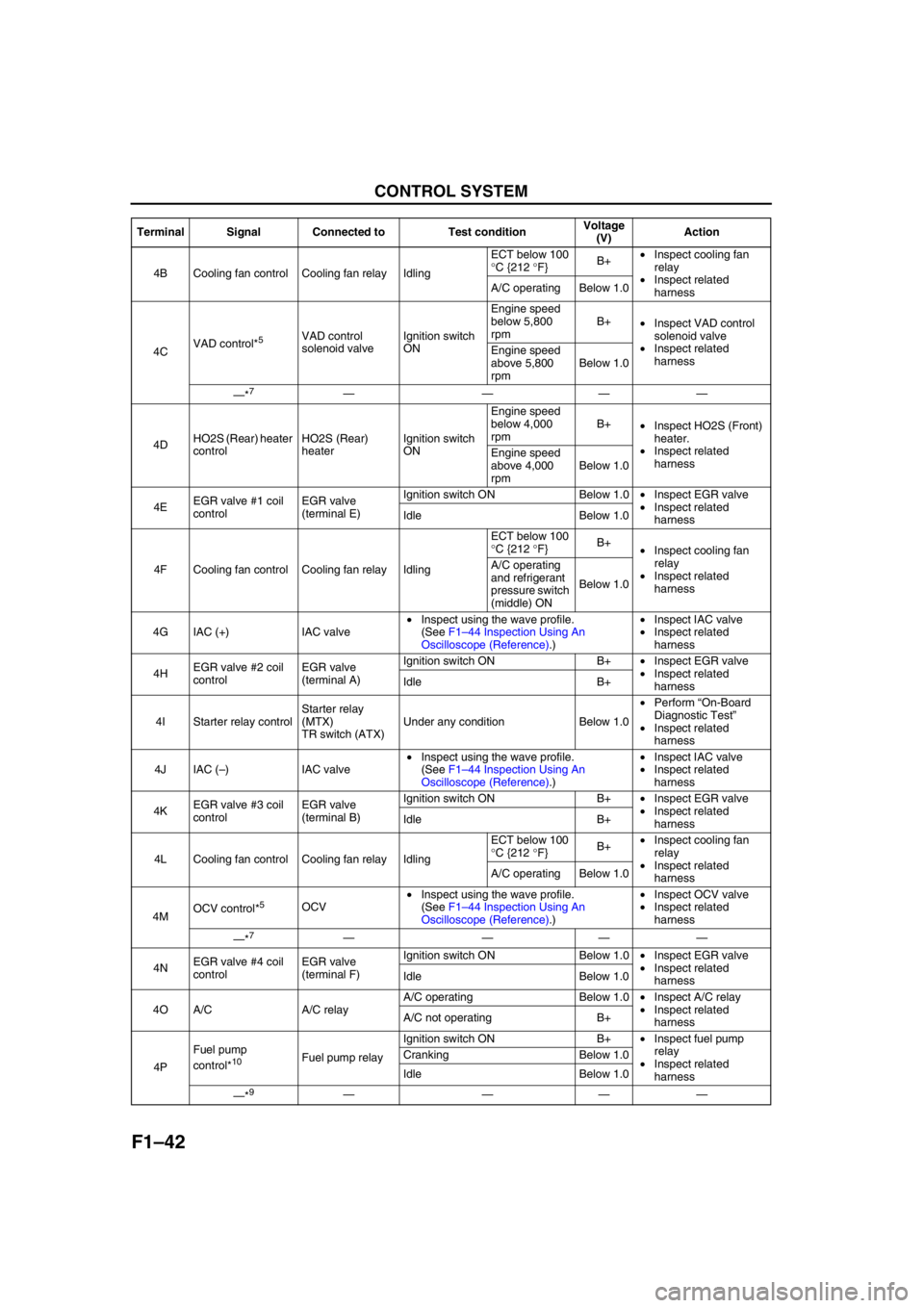
F1–42
CONTROL SYSTEM
4B Cooling fan control Cooling fan relay IdlingECT below 100
°C {212 °F}B+•Inspect cooling fan
relay
•Inspect related
harness A/C operating Below 1.0
4CVAD control*
5VAD control
solenoid valveIgnition switch
ONEngine speed
below 5,800
rpmB+
•Inspect VAD control
solenoid valve
•Inspect related
harness Engine speed
above 5,800
rpmBelow 1.0
—*
7————
4DHO2S (Rear) heater
controlHO2S (Rear)
heaterIgnition switch
ONEngine speed
below 4,000
rpmB+
•Inspect HO2S (Front)
heater.
•Inspect related
harness Engine speed
above 4,000
rpmBelow 1.0
4EEGR valve #1 coil
controlEGR valve
(terminal E)Ignition switch ON Below 1.0•Inspect EGR valve
•Inspect related
harness Idle Below 1.0
4F Cooling fan control Cooling fan relay IdlingECT below 100
°C {212 °F}B+
•Inspect cooling fan
relay
•Inspect related
harness A/C operating
and refrigerant
pressure switch
(middle) ONBelow 1.0
4G IAC (+) IAC valve•Inspect using the wave profile.
(See F1–44 Inspection Using An
Oscilloscope (Reference).)•Inspect IAC valve
•Inspect related
harness
4HEGR valve #2 coil
controlEGR valve
(terminal A)Ignition switch ON B+•Inspect EGR valve
•Inspect related
harness Idle B+
4I Starter relay controlStarter relay
(MTX)
TR switch (ATX)Under any condition Below 1.0•Perform “On-Board
Diagnostic Test”
•Inspect related
harness
4J IAC (–)IAC valve•Inspect using the wave profile.
(See F1–44 Inspection Using An
Oscilloscope (Reference).)•Inspect IAC valve
•Inspect related
harness
4KEGR valve #3 coil
controlEGR valve
(terminal B)Ignition switch ON B+•Inspect EGR valve
•Inspect related
harness Idle B+
4L Cooling fan control Cooling fan relay IdlingECT below 100
°C {212 °F}B+•Inspect cooling fan
relay
•Inspect related
harness A/C operating Below 1.0
4MOCV control*
5OCV•Inspect using the wave profile.
(See F1–44 Inspection Using An
Oscilloscope (Reference).)•Inspect OCV valve
•Inspect related
harness
—*
7————
4NEGR valve #4 coil
controlEGR valve
(terminal F)Ignition switch ON Below 1.0•Inspect EGR valve
•Inspect related
harness Idle Below 1.0
4O A/C A/C relayA/C operating Below 1.0•Inspect A/C relay
•Inspect related
harness A/C not operating B+
4PFuel pump
control*
10Fuel pump relayIgnition switch ON B+•Inspect fuel pump
relay
•Inspect related
harness Cranking Below 1.0
Idle Below 1.0
—*
9———— Terminal Signal Connected to Test conditionVoltage
(V)Action
Page 131 of 909

CONTROL SYSTEM
F1–43
F1
*1: Calculated value; differs from terminal voltage
*2: MTX models
*3: ATX models
*4: LF engine models
*5: L3 engine models
4QFuel pump control*
9Fuel pump relayIgnition switch ON B+•Inspect fuel pump
relay
•Inspect related
harness Cranking Below 1.0
Idle Below 1.0
—*
10————
4RVIC control*
5VIC control
solenoid valveEngine speed: above 4,500 rpm B+•Inspect VIC solenoid
valve
•Inspect related
harness Engine speed: below 4,500 rpm Below 1.0
—*
7————
4S—— — ——
4TVariable tumble
controlVariable tumble
control solenoid
valveECT above 63 °C { 145 °F} while
idling.B+•Inspect variable
tumble control
solenoid valve
•Inspect related
harness ECT below 63 °C {145 °F} and
engine speed below 3,750 rpmBelow 1.0
4U Purge controlPurge solenoid
valve•Inspect using the wave profile.
(See F1–44 Inspection Using An
Oscilloscope (Reference).)•Inspect purge
solenoid valve
•Inspect related
harness
4VB+*
3Main relayIgnition switch OFF Below 1.0•Inspect battery
•Inspect related
harness Ignition switch ON B+
—— — ——
4W Fuel injection (#2) Fuel injector No.2•Inspect using the wave profile.
(See F1–44 Inspection Using An
Oscilloscope (Reference).)•Inspect fuel injector
No.2
•Inspect related
harness
4X GND GND Under any condition Below 1.0•Inspect related
harness
4YShift solenoid C
control*
11Shift solenoid C•Inspect using the wave profile.
(See F1–44 Inspection Using An
Oscilloscope (Reference).)•Inspect shift solenoid
C
•Inspect related
harness
—*
14————
4Z Fuel injection (#1) Fuel injector No.1•Inspect using the wave profile.
(See F1–44 Inspection Using An
Oscilloscope (Reference).)•Inspect fuel injector
No.1
•Inspect related
harness
4AA Fuel injection (#4) Fuel injector No.4•Inspect using the wave profile.
(See F1–44 Inspection Using An
Oscilloscope (Reference).)•Inspect fuel injector
No.4
•Inspect related
harness
4ABShift solenoid A
control*
11Shift solenoid A•Inspect using the wave profile.
(See F1–44 Inspection Using An
Oscilloscope (Reference).)•Inspect shift solenoid
A
•Inspect related
harness
—*
14————
4ACShift solenoid B
control*
11Shift solenoid B•Inspect using the wave profile.
(See F1–44 Inspection Using An
Oscilloscope (Reference).)•Inspect shift solenoid
B
•Inspect related
harness
—*
14————
4AD Fuel injection (#3) Fuel injector No.3•Inspect using the wave profile.
(See F1–44 Inspection Using An
Oscilloscope (Reference).)•Inspect fuel injector
No.3
•Inspect related
harness Terminal Signal Connected to Test conditionVoltage
(V)Action
Page 132 of 909

F1–44
CONTROL SYSTEM
*6: Unleaded fuel (RON 90 or above) models
*7: Exclude L3 engine models
*8: MTX, without ABS models
*9: Immobilizer system equipped
*10: Immobilizer system not equipped
*11: 2WD ATX models
*12: 4WD ATX models
*13: Exclude MTX models without ABS
*14: Exclude 2WD ATX models
Inspection Using An Oscilloscope (Reference)
IGT1, IGT2 control signals
PCM terminals
•IGT1(No.1 and No.4): 1A(+)—1D(–)
•IGT2(No.2 and No.3): 1B(+)—1C(–)
Oscilloscope setting
•4 V/DIV (Y), 0.01 ms/DIV (X), DC range
Vehicle condition
•Idle after warm up (engine speed approx. 650
rpm [MTX] or 700 rpm [ATX], no load, P/S off, A/C
off)
Generator output voltage signal
PCM terminals
•1AA(+)—2AC(–)
Oscilloscope setting
•2 V/DIV (Y), 2 ms/DIV (X), DC range
Vehicle condition
•Idle after warm up (engine speed approx. 650
rpm [MTX] or 700 rpm [ATX], no load, P/S off, A/C
off)
HO2S (front) signal
PCM terminals
•1AB(+)—2H(–)
Oscilloscope setting
•0.1 V/DIV (Y), 400 ms/DIV (X), DC range
Vehicle condition
•Idle after warm up (engine speed approx. 650
rpm [MTX], 700 rpm [ATX], no load, P/S off, A/C
off)
0 V
A6A3940W003
0 V
A6A3940W004
0 V
A6A3940W005
Page 137 of 909

CONTROL SYSTEM
F1–49
F1
Fuel injection control
PCM terminals
•Fuel Injection No.1: 4Z(+)—1C(–)
•Fuel Injection No.1: 4W(+)—1C(–)
•Fuel Injection No.1: 4AD(+)—1C(–)
•Fuel Injection No.1: 4AA(+)—1C(–)
Oscilloscope setting
•4 V/DIV (Y), 10 ms/DIV (X), DC range
Vehicle condition
•Idle after warm up (engine speed approx. 650
rpm [MTX] or 700 rpm [ATX], no load, P/S off, A/C
off)
Shift solenoid C control
PCM terminals
•4Y(+)—1C(–)
Oscilloscope setting
•5 V/DIV (Y), 5 ms/DIV (X), DC range
Vehicle condition
•Idle after warm up (engine speed approx. 650
rpm [MTX] or 700 rpm [ATX], no load, P/S off, A/C
off)
Shift solenoid A control
PCM terminals
•4AB(+)—1C(–)
Oscilloscope setting
•5 V/DIV (Y), 5 ms/DIV (X), DC range
Vehicle condition
•Idle after warm up (engine speed approx. 650
rpm [MTX] or 700 rpm [ATX], no load, P/S off, A/C
off)
Shift solenoid B control
PCM terminals
•4AC(+)—1C(–)
Oscilloscope setting
•5 V/DIV (Y), 5 ms/DIV (X), DC range
Vehicle condition
•Idle after warm up (engine speed approx. 650
rpm [MTX] or 700 rpm [ATX], no load, P/S off, A/C
off)
End Of Sie
0 V
A6A3940W024
0 V
A6A3940W025
0 V
A6A3940W026
0 V
A6A3940W027
Page 138 of 909

F1–50
ON-BOARD DIAGNOSTIC
OUTLINEA6E397018881201•The construction and operation of the on-board diagnostic system is essentially carried over from that of the
current Mazda6 (GG), except for the following. (See Mazda6 Training Manual 3359-1*-02C.)
4WD ATX model
—DTCs, PID monitoring items, and simulation items have been deleted to match the vehicle characteristics.
Unleaded fuel (RON 90 or above) model
—DTCs and PID monitoring items which relevant to BARO sensor have been deleted to match the vehicle
characteristics.
End Of Sie
CONTROL DEVICE AND MONITORING SYSTEM RELATIONSHIP CHARTA6E397018881202Monitoring System
×: Applicable
End Of Sie
DIAGNOSTIC TEST MODE (4WD)A6E397018881203Sending Emission-related Malfunction code (DTC) (Mode 03)
•The DTCs are shown in the table.
DTC table
×: Applicable
—: Not applicable
ON-BOARD DIAGNOSTIC
ComponentMonitor item
Catalyst Misfire Fuel system Oxygen sensor Oxygen sensor
heater
Input
CKP sensor×××××
CMP sensor×××××
VSS×××
MAF sensor×××××
ECT sensor×××××
IAT sensor××××
TP sensor××××
Rear HO2S×××
Front HO2S××××
Output
DLC-2×××××
MIL×××××
Purge solenoid valve××
Fuel injectors×
DTC No. Condition MIL DC Monitor itemMemory
function
P0010 CMP actuator circuit malfunction ON 1 CCM×
P0011 CMP timing over-advanced ON 1 CCM×
P0012 CMP timing over-retarded ON 1 CCM×
P0031 Front HO2S heater circuit low input ON 2O
2 sensor heater
×
P0032 Front HO2S heater circuit high input ON 2O
2 sensor heater
×
P0037 Rear HO2S heater circuit low input ON 2O
2 sensor heater
×
P0038 Rear HO2S heater circuit high input ON 2O
2 sensor heater
×
P0101 MAF sensor inconsistent with TP sensor ON 2 CCM×
P0102 MAF circuit low input ON 1 CCM×
P0103 MAF circuit high input ON 1 CCM×
P0107 MAP sensor circuit low input ON 1 CCM×
P0108 MAP sensor circuit high input ON 1 CCM×
P0111 IAT circuit performance problem ON 2 CCM×
Page 139 of 909

ON-BOARD DIAGNOSTIC
F1–51
F1
P0112 IAT circuit low input ON 1 CCM×
P0113 IAT circuit high input ON 1 CCM×
P0117 ECT circuit low input ON 1 CCM×
P0118 ECT circuit high input ON 1 CCM×
P0121 TP stuck closed ON 2 CCM×
P0122 TP circuit low input ON 1 CCM×
P0123 TP circuit high input ON 1 CCM×
P0125 Excessive time to enter closed loop fuel control ON 2 CCM×
P0131 Front HO2S no inversion (stuck low) ON 2 CCM×
P0132 Front HO2S no inversion (stuck high) ON 2 CCM×
P0133 Front HO2S circuit malfunction ON 2O
2 sensor
×
P0134 Front HO2S circuit no activity detected ON 2 CCM×
P0138 Rear HO2S circuit high input ON 2 CCM×
P0140 Rear HO2S circuit no activity detected ON 2 CCM×
P0171 Fuel trim system too lean ON 2 Fuel×
P0172 Fuel trim system too rich ON 2 Fuel×
P0300 Random misfire detected Flash / ON 1 or 2 Misfire×
P0301 Cylinder No.1 misfire detected Flash / ON 1 or 2 Misfire×
P0302 Cylinder No.2 misfire detected Flash / ON 1 or 2 Misfire×
P0303 Cylinder No.3 misfire detected Flash / ON 1 or 2 Misfire×
P0304 Cylinder No.4 misfire detected Flash / ON 1 or 2 Misfire×
P0327 Knock sensor circuit low input ON 1 CCM×
P0328 Knock sensor circuit high input ON 1 CCM×
P0335 CKP sensor circuit malfunction ON 1 CCM×
P0340 CMP sensor circuit malfunction ON 1 CCM×
P0403 EGR valve motor coils open or short ON 2 CCM×
P0420 Catalyst system efficiency below threshold ON 2 Catalyst×
P0443Evaporative emission control system purge control
valve circuit malfunctionON 2 CCM×
P0480 Fan relay control circuit malfunction OFF 2 Other×
P0500 Vehicle speed sensor (VSS) circuit malfunction ON 2 CCM×
P0505 Idle control system malfunction OFF—Other—
P0506 Idle control system RPM lower than expected ON 2 CCM×
P0507 Idle control system RPM higher than expected ON 2 CCM×
P0511 Idle control system circuit malfunction ON 1 CCM×
P0550 PSP switch circuit malfunction ON 2 CCM×
P0602 PCM programming error ON 1 CCM×
P0610 Control module vehicle options error ON 1 CCM×
P0661 VIS control circuit low input OFF 2 Other×
P0662 VIS control circuit high input OFF 2 Other×
P0703 Brake switch input malfunction ON 2 CCM×
P0704 Clutch switch input malfunction ON 2 CCM×
P0850 Neutral switch input malfunction ON 2 CCM×
P1410 Variable air duct valve circuit malfunction OFF 2 Other×
P1562 PCM +BB voltage low ON 1 CCM×
P2006 Variable tumble control shutter valve stuck closed ON 2 CCM×
P2009 Variable tumble control solenoid circuit low input ON 2 CCM×
P2010 Variable tumble control solenoid circuit high input ON 2 CCM×
P2228 BARO sensor circuit low input ON 1 CCM×
P2229 BARO sensor circuit high input ON 1 CCM×
P2502 Generator output voltage signal no electricity OFF 1 Other—
P2503 Battery overcharge OFF 1 Other—
P2504 Generator terminal B circuit open OFF 1 Other—
U0073 CAN bus off OFF 1 Other— DTC No. Condition MIL DC Monitor itemMemory
function
Page 142 of 909
F1–54
ON-BOARD DIAGNOSTIC
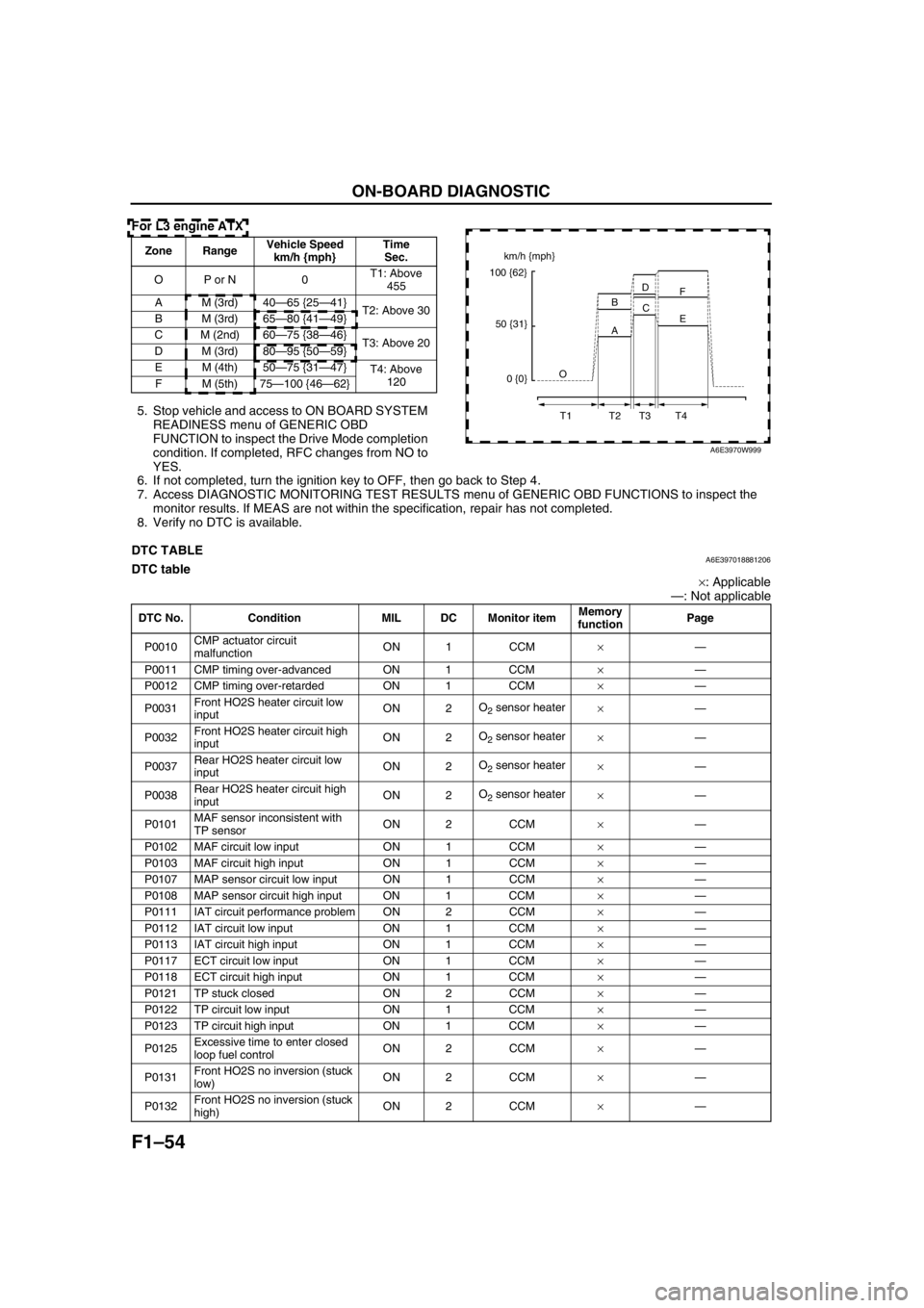
For L3 engine ATX
5. Stop vehicle and access to ON BOARD SYSTEM
READINESS menu of GENERIC OBD
FUNCTION to inspect the Drive Mode completion
condition. If completed, RFC changes from NO to
YES.
6. If not completed, turn the ignition key to OFF, then go back to Step 4.
7. Access DIAGNOSTIC MONITORING TEST RESULTS menu of GENERIC OBD FUNCTIONS to inspect the
monitor results. If MEAS are not within the specification, repair has not completed.
8. Verify no DTC is available.
End Of Sie
DTC TABLEA6E397018881206DTC table
×: Applicable
—: Not applicable
Zone RangeVehicle Speed
km/h {mph}Time
Sec.
OP or N 0T1: Above
455
A M (3rd) 40—65 {25—41}
T2: Above 30
B M (3rd) 65—80 {41—49}
C M (2nd) 60—75 {38—46}
T3: Above 20
D M (3rd) 80—95 {50—59}
EM (4th)50—75 {31—47}
T4: Above
120
FM (5th)75—100 {46—62}km/h {mph}
100 {62}
50 {31}
0 {0}O
T1 T2 T3 T4A BD
C
E F
A6E3970W999
DTC No. Condition MIL DC Monitor itemMemory
functionPage
P0010CMP actuator circuit
malfunctionON 1 CCM×—
P0011 CMP timing over-advanced ON 1 CCM×—
P0012 CMP timing over-retarded ON 1 CCM×—
P0031Front HO2S heater circuit low
inputON 2O
2 sensor heater
×—
P0032Front HO2S heater circuit high
inputON 2O
2 sensor heater
×—
P0037Rear HO2S heater circuit low
inputON 2O
2 sensor heater
×—
P0038Rear HO2S heater circuit high
inputON 2O
2 sensor heater
×—
P0101MAF sensor inconsistent with
TP sensorON 2 CCM×—
P0102 MAF circuit low input ON 1 CCM×—
P0103 MAF circuit high input ON 1 CCM×—
P0107 MAP sensor circuit low input ON 1 CCM×—
P0108 MAP sensor circuit high input ON 1 CCM×—
P0111 IAT circuit performance problem ON 2 CCM×—
P0112 IAT circuit low input ON 1 CCM×—
P0113 IAT circuit high input ON 1 CCM×—
P0117 ECT circuit low input ON 1 CCM×—
P0118 ECT circuit high input ON 1 CCM×—
P0121 TP stuck closed ON 2 CCM×—
P0122 TP circuit low input ON 1 CCM×—
P0123 TP circuit high input ON 1 CCM×—
P0125Excessive time to enter closed
loop fuel controlON 2 CCM×—
P0131Front HO2S no inversion (stuck
low)ON 2 CCM×—
P0132Front HO2S no inversion (stuck
high)ON 2 CCM×—
Page 143 of 909

ON-BOARD DIAGNOSTIC
F1–55
F1
P0133 Front HO2S circuit malfunction ON 2O2 sensor
×—
P0134Front HO2S circuit no activity
detectedON 2 CCM×—
P0138 Rear HO2S circuit high input ON 2 CCM×—
P0140Rear HO2S circuit no activity
detectedON 2 CCM×—
P0171 Fuel trim system too lean ON 2 Fuel×—
P0172 Fuel trim system too rich ON 2 Fuel×—
P0300 Random misfire detected Flash / ON 1 or 2 Misfire×—
P0301 Cylinder No.1 misfire detected Flash / ON 1 or 2 Misfire×—
P0302 Cylinder No.2 misfire detected Flash / ON 1 or 2 Misfire×—
P0303 Cylinder No.3 misfire detected Flash / ON 1 or 2 Misfire×—
P0304 Cylinder No.4 misfire detected Flash / ON 1 or 2 Misfire×—
P0327 Knock sensor circuit low input ON 1 CCM×—
P0328 Knock sensor circuit high input ON 1 CCM×—
P0335 CKP sensor circuit malfunction ON 1 CCM×—
P0340 CMP sensor circuit malfunction ON 1 CCM×—
P0403EGR valve motor coils open or
shortON 2 CCM×—
P0420Catalyst system efficiency
below thresholdON 2 Catalyst×—
P0443Evaporative emission control
system purge control valve
circuit malfunctionON 2 CCM×—
P0480Fan relay control circuit
malfunctionOFF 2 Other×—
P0500Vehicle speed sensor (VSS)
circuit malfunction (MTX)ON 2 CCM×—
P0505 Idle control system malfunction OFF—Other——
P0506Idle control system RPM lower
than expectedON 2 CCM×—
P0507Idle control system RPM higher
than expectedON 2 CCM×—
P0511Idle control system circuit
malfunctionON 1 CCM×—
P0550 PSP switch circuit malfunction ON 2 CCM×—
P0602 PCM programming error ON 1 CCM×—
P0610Control module vehicle options
errorON 1 CCM×—
P0661 VIS control circuit low input OFF 2 Other×—
P0662 VIS control circuit high input OFF 2 Other×—
P0703 Brake switch input malfunction ON 2 CCM×—
P0704 Clutch switch input malfunction ON 2 CCM×—
P0850 Neutral switch input malfunction ON 2 CCM×—
P1410Variable air duct valve circuit
malfunctionOFF 2 Other×—
P1562 PCM +BB voltage low ON 1 CCM×—
P2006Variable tumble control system
shutter valve stuck closedON 2 CCM×—
P2009Variable tumble control solenoid
valve circuit low inputON 2 CCM×—
P2010Variable tumble control solenoid
valve circuit high inputON 2 CCM×—
P2228 BARO sensor circuit low input ON 1 CCM×—
P2229 BARO sensor circuit high input ON 1 CCM×—
P2502Generator output voltage signal
no electricityOFF 1 Other——
P2503 Battery overcharge OFF 1 Other—— DTC No. Condition MIL DC Monitor itemMemory
functionPage
Page 145 of 909

TROUBLESHOOTING
F1–57
F1
ENGINE SYMPTOM TROUBLESHOOTINGA6E398018881201•Confirm trouble symptom using the following diagnostic index, then go to appropriate troubleshooting chart.
Diagnostic Index
End Of Sie
TROUBLESHOOTING
No. TROUBLESHOOTING ITEM DESCRIPTION
1 Melting of main or other fuses—
2 MIL illuminates MIL is illuminated incorrectly.
3 Will not crank Starter does not work.
4Hard to start/long crank/erratic start/erratic
crankStarter cranks engine at normal speed but engine requires excessive
cranking time before starting.
5 Engine stalls. After start/at idle Engine stops unexpectedly at idle and/or after start.
6 Cranks normally but will not start Starter cranks engine at normal speed but engine will not run.
7 Slow return to idle Engine takes more time than normal to return to idle speed.
8 Engine runs rough/rolling idleEngine speed fluctuates between specified idle speed and lower
speed and engine shakes excessively.
9 Fast idle/runs onEngine speed continues at fast idle after warm-up.
Engine runs after ignition switch is turned to off.
10 Low idle/stalls during decelerationEngine stops unexpectedly at beginning of deceleration or recovery
from deceleration.
11Engine stalls/quits. Acceleration/cruiseEngine stops unexpectedly at beginning of acceleration or during
acceleration.
Engine stops unexpectedly while cruising.
Engine runs rough. Acceleration/cruise Engine speed fluctuates during acceleration or cruising.
Misses Acceleration/cruise Engine misses during acceleration or cruising.
Buck/jerkAcceleration/cruise/
decelerationVehicle bucks/jerks during acceleration, cruising, or deceleration.
Hesitation/stumble Acceleration Momentary pause at beginning of acceleration or during acceleration
Surges Acceleration/cruise Momentary minor irregularity in engine output
12 Lack/loss of power Acceleration/cruisePerformance is poor under load.
(e.g., power down when climbing hills)
13 Knocking/pinging Acceleration/cruiseSound is produced when air/fuel mixture is ignited by something other
than spark plug. (e.g., hot spot in combustion chamber)
14 Poor fuel economy Fuel economy is unsatisfactory.
15 Emission compliance Fails emissions test.
16 High oil consumption/leakage Oil consumption is excessive.
17Cooling system
concernsOverheating Engine runs at higher than normal temperature/overheats.
18Cooling system
concernsRuns cold Engine does not reach normal operating temperature.
19 Exhaust smoke Blue, black, or white smoke from exhaust system
20 Fuel odor (in engine compartment) Gasoline fuel smell or visible leakage
21 Engine noise Engine noise from under hood
22 Vibration concerns (engine) Vibration from under hood or driveline
23 A/C does not work sufficiently.A/C compressor magnetic clutch does not engage when A/C is turned
on.
24A/C is always on or A/C compressor runs
continuously.A/C compressor magnetic clutch does not disengage.
25 A/C is not cut off under WOT conditions. A/C compressor magnetic clutch does not disengage under WOT.
26 Exhaust sulphur smell Rotten egg smell (sulphur) from exhaust
27 Constant voltage Incorrect constant voltage
28 Spark plug condition Incorrect spark plug condition
29 ATX concernsUpshift/downshift/
engagementATX concerns not related to engine performance