fuel MAZDA 626 1987 Workshop Manual
[x] Cancel search | Manufacturer: MAZDA, Model Year: 1987, Model line: 626, Model: MAZDA 626 1987Pages: 1865, PDF Size: 94.35 MB
Page 468 of 1865

4B OUTLINE
SPECIFICATIONS
Item Specification
Idle speed rpm MTX: 800 +5„° (Neutral), ATX: 900 +5S
(P
range)
Throttle body
Type Horizontal draft (1 -barrel)
Throat diameter mm (in) 50 (2.0)
Air flow meter
E2-VS More than
20
E2-VC 100-300
Resistor
Q
E2-VB 200—400 Resistor
Q
E2-THA -20°C
(
—4°F) 13,600-18,400 20°C
(
68°F) 2,210-2,690 60°C (140°F)
493- 667
Air cleaner
Element type Oil permeated
Fuel pump
Type Impeller
(in
tank)
Output pressure kPa (kg/cm2,
psi)
441-588 (4.5-6.0, 64—85)
Feeding capacity cc (cu in)/10 sec. 220 (13.4) minmum
Fuel filter
Type Low pressure side Nylon element Type High pressure side Paper element
Pressure regulator
Type Diaphragm
Regulating pressure kPa (kg/cm2,
psi)
235-275 (2.4—2.8, 34—40)
Injector
TvDe
Hiqh-ohmic
Type
of
drive Voltage
Resistance
fi
12-16
Injection amount cc (cu
in) 15
seconds 38—53 (2.3-3.2)
Fuel tank
Capacity liters (US gal, Imp gal) 60 (15.9, 13.2)
Fuel
Soecification Unleaded reaular
76G04B-506
4B—6
Page 469 of 1865

TROUBLESHOOTING GUIDE 4B
TROUBLESHOOTING GUIDE
This troubleshooting guide shows the malfunction numbers and the symptoms of various failures.
Perform troubleshooting as described below.
Possible cause
Symptom
Input sensors and switches
o>
C
0
Jh c 01
4B-14
a> 4)
E
o
4B-1S
o in c « m o E k_ 0) c.
0 <0 £
4B-16
o CO c a> 0) o E
a>
.x
co
4B-17
o 10 c a) co
4B-18
o in c a> (0
o> o> a>
a) £ a VI o E
4B-19
0 <0 c a> 0) c a> 01
S? o
4B-20
E a> in (0
o 10 A •o 0) 0> u.
4B-21
Output solenoid valves
o «
3 O) 0)
0) 0) 01
0> > 10 >
•o o c V o tt)
4B-22
0)
OI
0> > CO >
TJ
O c 0> o CO
4B-23
oc O u
o> > 75 >
•o o c a> o 05
4B-23
0 a. 3 1
2
0) > (0 >
"D O
o 0> in in a a >. £
4B-23
ffl a 3 • a>
2
a> > 10 >
"O o c a> o
CO Q. >. JO
4B-24
Fault Indicated by SST
Code No. 01 08 09 10 12 14 15 17 25 26 28 34 35
Hard start or won't start
(Cranks OK)
Engine stalls
Rough
idle
While warming up
After warming up
While warming up
After warming up
High idle speed after
warming up
TROUBLESHOOTING PROCEDURE
Note
Step 1 under symptom is to quickly determine what system or unit may be at fault by use of the SST. (Self-Diagnosis Checker 49 H018 9A1)
1st:
Check input sensors and output solenoid valves with the
SST.
(Refer
to
page 4B—10.)
2nd:
Check other switches with the
SST.
(Refer
to
page 4B—26.)
3rd:
Check the following items:
11
Poor acceleration, hesita-
tion or lack of power
Runs rough on deceleration
Afterburn in exhaust system
Poor fuel consumption
Engine stalls or rough after hot starting
Electrical system
1) Battery condition
2) Fuses
Fuel system
1) Fuel level 2) Fuel leakage
3) Fuel filter 4) Idle speed
Engine
1) Compression 2) Overheating
Ignition system
1) Ignition spark 2) Ignition timing
Intake air system
1)
Air
cleaner element 2) Vacuum
or air
leakage 3) Vacuum hose routing
4) Accelerator cable
Others
1) Clutch slippage 2) Brake dragging
Fails emission test 4th:
Check Fuel and Emission Control Systems. (Refer
to
page 4B—8.)
76G04B-003
4B—7
Page 470 of 1865

4B TROUBLESHOOTING GUIDE
The Troubleshooting Guide lists the systems most likely
to
cause
a
given symptom. After finding
sys-
tems
to
check, refer
to
the
pages shown
for
detailed guides
for
each system.
Possible
cause
Fuel
and
Emission Control Systems
Possible
cause
Intake
Air
System
(Poor
connection
of
components,
throttle
body)
Fuel
System
(Fuel
injection,
Fuel
pressure)
Pressure
Regulator
Control
System
Idle-up
System
(Air
valve,
solenoid
valve
malfunction)
EGR
System
(EGR
control
valve
stuck
and
open)
EEC
system
(Vacuum
switch
valve,
No.1
purge
control
valve
malfunction)
PCV
System
(System
clogged)
Deceleration
System
(Dashpot,
fuel
cut
operation
malfunction)
Air
injection
system
(Reed
valve
malfunction)
Exhaust
system
(System
clogged)
Page 4B—30 4B—42 4B—53 4B—35 4B—71 4B—74 4B—80 4B—64 4B—68 4B—81
Symptom
2
2 1
Symptom
3
4 3 1 2
Symptom
3
5 4 2 3 1
Symptom
4
6 5 1 4 2 3
Symptom
4
7 6 2 4 5 1 3
Symptom
5
3 1 2
Symptom
6
3 4 1 2 5
Symptom
7
3 2 1
Symptom
8
3 4 1 2
Symptom
9
2 3 1 4
Symptom
10
2 1
Symptom
11
7 8 5 2 6 3 4 1
76G04B-004
The numbers
of
the list show the priorities
of
inspections from the most possible to that with
the
lowest
possibility.
These were determined
on the
following basis:
• Ease
of
inspection
•
Most possible system
•
Most possible point
in
system
4B—8
Page 491 of 1865

IDLE ADJUSTMENT 4B
76G04B-034
76G04B-035
Idle mixture
Automatic
Control
Function
Engine Control Unit
IDLE
ADJUSTMENT
IDLE SPEED
Preparation
1) Check the condition of the engine (plugs, leaks in
hoses, etc.).
2) Make sure all accessories are OFF.
3) Warm up the engine and run it for three minutes
at 2,500—3,000 rpm in neutral.
4) Check the initial ignition timing and adjust if
necessary.
Inspection and Adjustment
Caution
Disconnect the air bypass solenoid connec-
tor when checking and adjusting the idle
speed.
1. Check that the idle speed is within specification.
Specification:
MTX—800 +58 rpm
ATX—900 +58 rpm (P range)
2. If the idle speed is not within specification, remove
the blind cap from the throttle body and adjust it
by turning the air adjust screw.
IDLE MIXTURE
Because an automatic compensation function
for air/fuel mixture is built into the engine con-
trol unit, it is not necessary to check and adjust
the idle mixture.
86U04A-049
4B-29
Page 492 of 1865

4B INTAKE AIR SYSTEM
INTAKE AIR SYSTEM
76G04B-036
This system controls the air required by the engine for operation. The system consists of the air duct,
air cleaner, air flow meter, throttle body, dynamic chamber, and intake manifold.
COMPONENT DESCRIPTIONS
Component Function Remarks
Air cleaner
Filters
air
into throttle body
Air flow meter
Detects amount
of
intake air;
sends signal
to
engine control unit Intake
air
thermo sensor and fuel pump
switch are integrated
Throttle body
Controls intake
air
quantity Integrated throttle sensor and idle switch
76G04B-037
4B—30
Page 493 of 1865

INTAKE AIR SYSTEM 4B
REMOVAL
Caution
Before removing the following parts, release the fuel pressure from fuel system to reduce
the possibility of injury or fire. (Refer to page 4B—45.)
Remove in the sequence shown in the figure.
1. Air flow meter connector
and secondary air hose
2. Air cleaner
3. Air duct
4. Resonance chamber
5. Air flow meter
6. Air hose
7. Vacuum hoses, air hoses,
and water hoses
8. Accelerator cable
9. Throttle sensor connector
10. Throttle body
11. EGR modulator valve
12. Air hose
13. Air bypass solenoid valve
76G04B-038
14. Intake manifold bracket
15. Dynamic chamber bracket
16. Fuel return pipe
17. Dynamic chamber
18. Injector connector
19. Delivery pipe assembly
20. Air valve
21. Intake manifold and gaskets
4B—31
Page 504 of 1865
4B FUEL SYSTEM
FUEL SYSTEM
76G04B-057
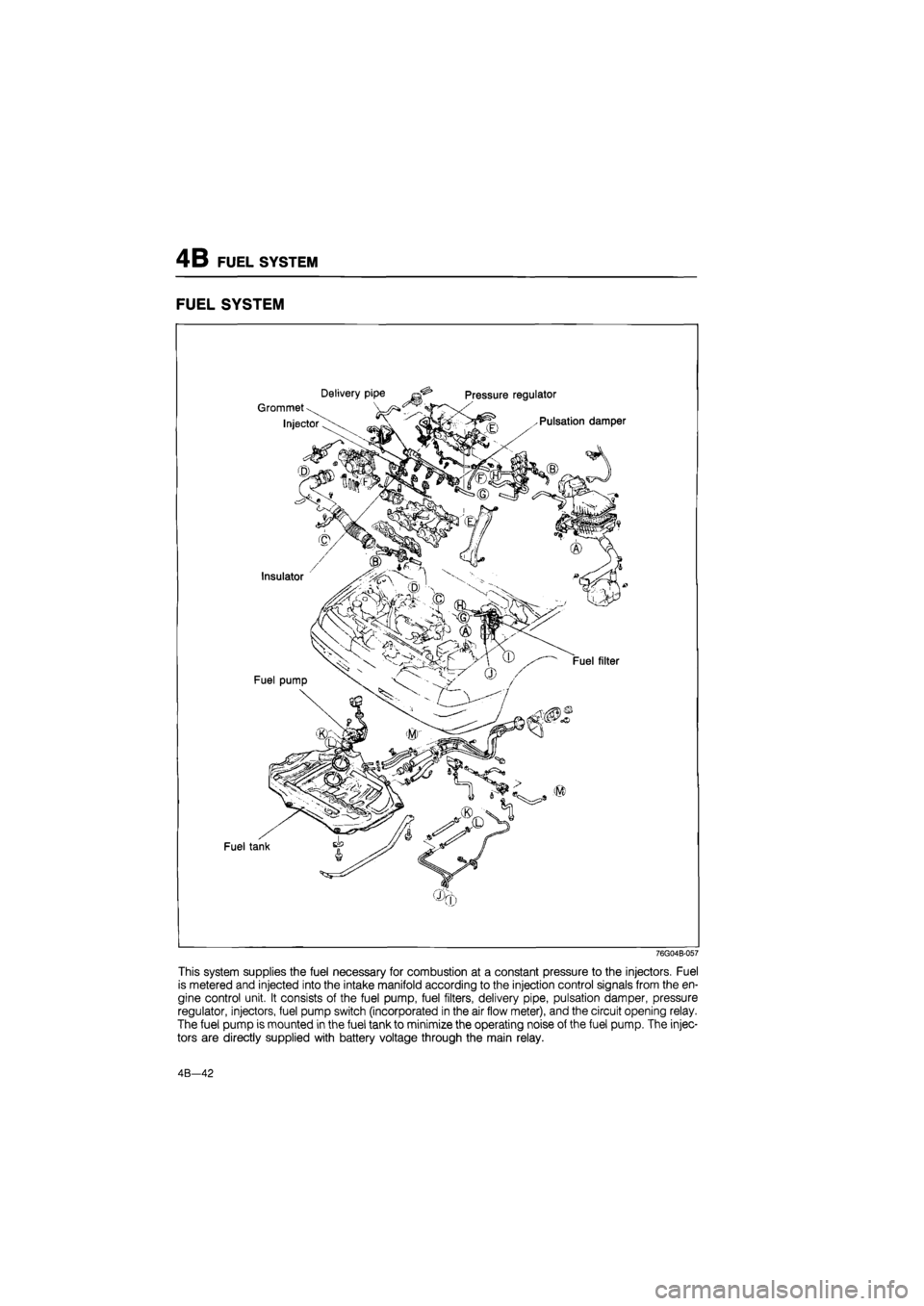
This system supplies the fuel necessary for combustion at a constant pressure to the injectors. Fuel
is metered and injected into the intake manifold according to the injection control signals from the en-
gine control unit. It consists of the fuel pump, fuel filters, delivery pipe, pulsation damper, pressure
regulator, injectors, fuel pump switch (incorporated in the air flow meter), and the circuit opening relay.
The fuel pump is mounted in the fuel tank to minimize the operating noise of the fuel pump. The injec-
tors are directly supplied with battery voltage through the main relay.
4B—42
Page 505 of 1865
FUEL SYSTEM 4B
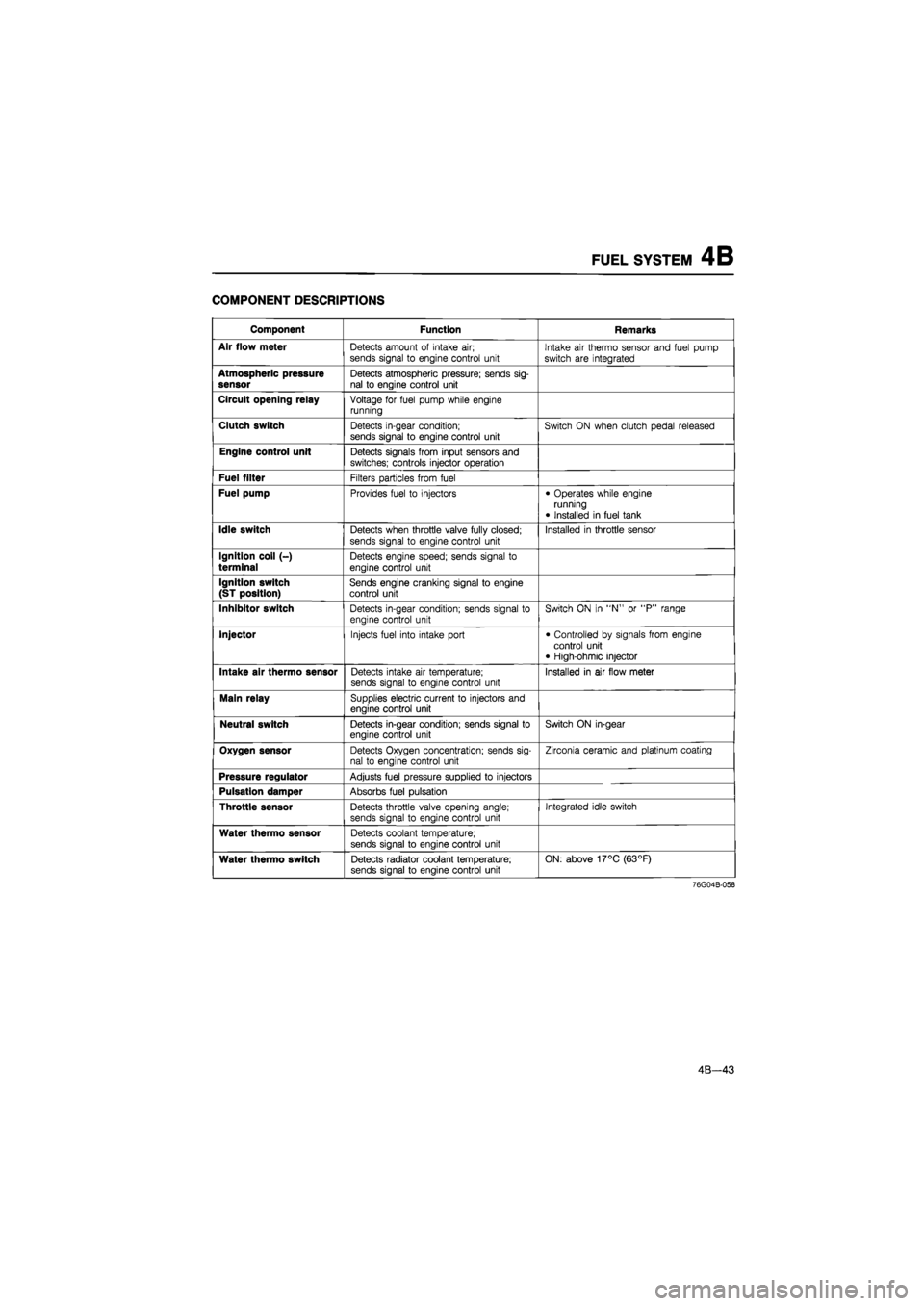
COMPONENT DESCRIPTIONS
Component Function Remarks
Air flow meter
Detects amount
of
intake
air;
sends signal
to
engine control unit Intake
air
thermo sensor and fuel pump
switch
are
integrated
Atmospheric pressure sensor
Detects atmospheric pressure; sends sig-nal
to
engine control unit
Circuit opening relay
Voltage
for
fuel pump while engine running
Clutch switch
Detects in-gear condition; sends signal
to
engine control unit Switch
ON
when clutch pedal released
Engine control unit
Detects signals from input sensors and switches; controls injector operation
Fuel filter
Filters particles from fuel
Fuel pump
Provides fuel
to
injectors • Operates while engine running
• Installed
in
fuel tank
Idle switch
Detects when throttle valve fully closed;
sends signal
to
engine control unit
Installed
in
throttle sensor
Ignition coil (-) terminal
Detects engine speed; sends signal
to
engine control unit
Ignition switch (ST position)
Sends engine cranking signal
to
engine control unit
Inhibitor switch
Detects in-gear condition; sends signal
to
engine control unit
Switch
ON in "N" or "P"
range
Injector
Injects fuel into intake port • Controlled
by
signals from engine control unit • High-ohmic injector
Intake air thermo sensor
Detects intake
air
temperature;
sends signal
to
engine control unit Installed
in air
flow meter
Main relay
Supplies electric current
to
injectors and engine control unit
Neutral switch
Detects in-gear condition; sends signal
to
engine control unit
Switch
ON
in-gear
Oxygen sensor
Detects Oxygen concentration; sends sig-nal
to
engine control unit
Zirconia ceramic and platinum coating
Pressure regulator
Adjusts fuel pressure supplied
to
injectors
Pulsation damper
Absorbs fuel pulsation
Throttle sensor
Detects throttle valve opening angle; sends signal
to
engine control unit
Integrated idle switch
Water thermo sensor
Detects coolant temperature;
sends signal
to
engine control unit
Water thermo switch
Detects radiator coolant temperature; sends signal
to
engine control unit ON: above 17°C (63°F)
76G04B-058
4B—43
Page 506 of 1865
4B FUEL SYSTEM
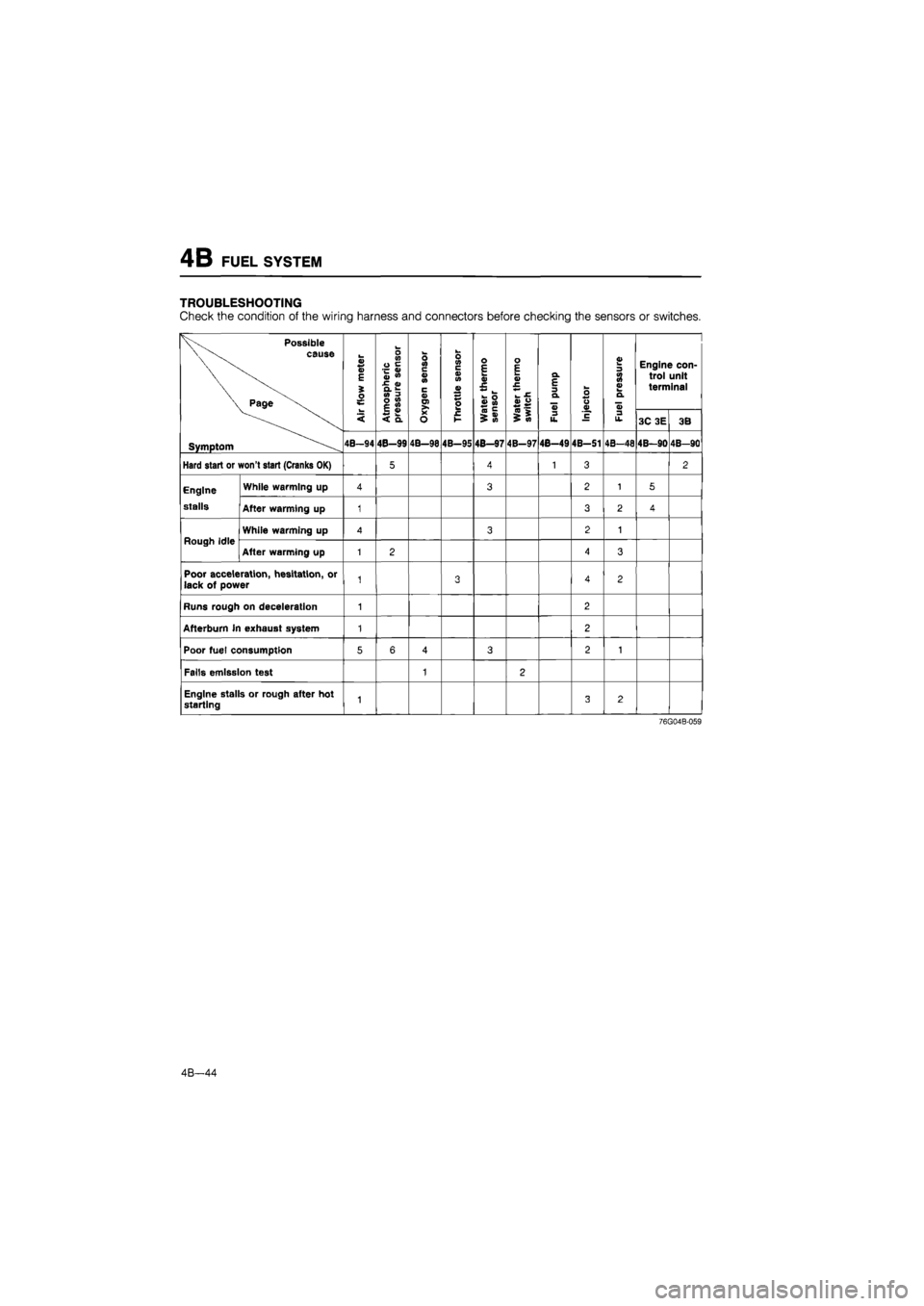
TROUBLESHOOTING
Check
the
condition
of
the wiring harness and connectors before checking
the
sensors
or
switches.
Possible
cause
Page
V
S E
i
o
o V)
0
e
~
0)
Ju
»
•E
<»
CL
01
3
0
<0
1
£
Oxygen
sensor
s c V
in
V
P
o E k_
•E **
l_
h
O
v
w
Water
thermo
switch
Q.
E
3 Q.
u
Injector
£ 3 3 o d
aj
Engine
con-
trol unit terminal
< £
8
<
Q. Oxygen
sensor
£ t->
0)
>
M Water
thermo
switch
3
u.
Injector
3
u. 3C
3E
3B
Symptom 4B-94 4B-99 4B—98 4B-95 48—97 4B-97 4B-49 4B-S1 4B-48 4B-90 4B-90
Hard start
or
won't start (Cranks
OK)
5 4 1 3 2
Engine While warming
up
4 3 2 1 5
stalls After warming
up
1 3 2 4
Rough Idle While warming
up
4 3 2 1
Rough Idle After warming
up
1 2 4 3
Poor acceleration, hesitation,
or
lack
of
power
1 3 4 2
Runs rough
on
deceleration
1 2
Afterburn
in
exhaust system
1 2
Poor fuel consumption
5 6 4 3 2 1
Falls emission test
1 2
Engine stalls
or
rough after
hot
starting
1 3 2
76G04B-059
4B—44
Page 507 of 1865
FUEL SYSTEM 4B
86U04A-068
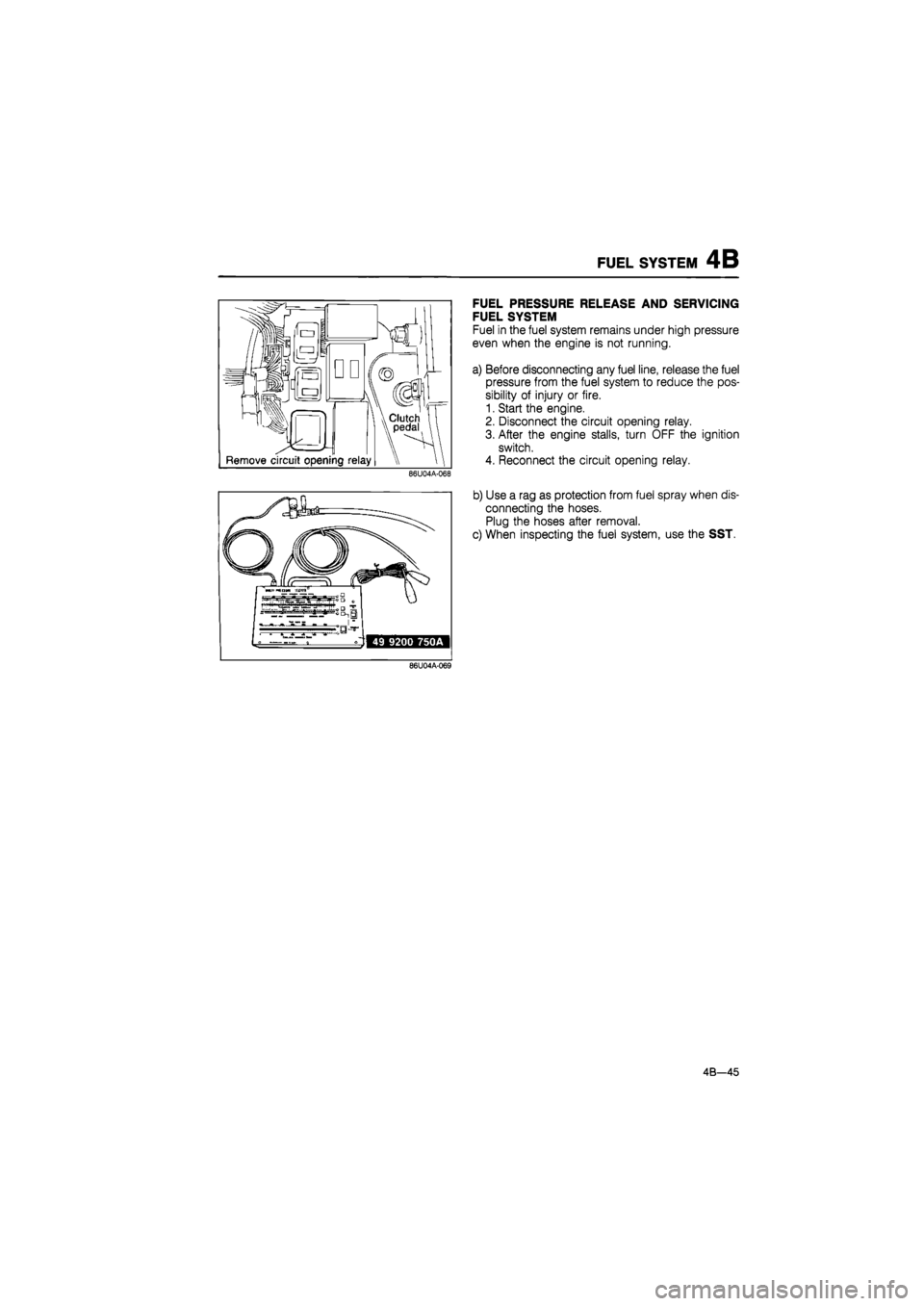
FUEL PRESSURE RELEASE AND SERVICING
FUEL SYSTEM
Fuel in the fuel system remains under high pressure
even when the engine is not running.
a) Before disconnecting any fuel line, release the fuel
pressure from the fuel system to reduce the pos-
sibility of injury or fire.
1. Start the engine.
2. Disconnect the circuit opening relay.
3. After the engine stalls, turn OFF the ignition
switch.
4. Reconnect the circuit opening relay.
b) Use a rag as protection from fuel spray when dis-
connecting the hoses.
Plug the hoses after removal.
c) When inspecting the fuel system, use the SST.
86U04A-069
4B—45