steering wheel MAZDA 626 1987 User Guide
[x] Cancel search | Manufacturer: MAZDA, Model Year: 1987, Model line: 626, Model: MAZDA 626 1987Pages: 1865, PDF Size: 94.35 MB
Page 569 of 1865

4C OUTLINE
SPECIFICATIONS
Item Engine type Unleaded Fuel Leaded Fuel
Idle speed rpm 750 ± 50
Throttle body
Type Horizontal draft (2-barrel)
Throat diameter mm (in) No. 1 46 (1.8) Throat diameter mm (in) No. 2 40 (1.6)
Fuel pump
Type Impeller (in tank)
Output pressure kPa (kg/cm2, psi) Main pump: 441-588 (4.5—6.0, 64—85) Transfer pump: 20—25 (0.20—0.25, 2.8—3.6)
Feeding capacity cc (cu in)/10 sec. Main pump: More than 220 (13.4) Transfer pump: More than 190 (11.6)
Fuel filter
Type Low pressure side Nylon element Type High pressure side Paper element
Pressure regulator
Type Diaphragm
Regulating pressure kPa (kg/cm2, psi) 235-275 (2.4 -2.8, 34-40)
Injector
Type High-ohmic
Type of drive Voltage
Resistance G 12--16
Injection amount cc (cu in)/15 sec. 66-91 (4.03-5.55)
Idle speed control valve
Solenoid resistance a 6.3--9.9
Fuel tank
Capacity liters (US gal, Imp gal) 60 (15.9, 13.2), 57 (15.0, 12.5): 4-wheel steering vehicle
Air cleaner
Element type Dry
Fuel
Specification Unleaded (95 RON or more) Leaded or unleaded fuel
(95 RON or more)
76G04C-008
4C-8
Page 606 of 1865

ISC SYSTEM 4C
COMPONENT DESCRIPTION
Component Function Remark
A/C switch Detects air conditioner operation; sends
signal to engine control unit Switch ON when air conditioner
operating
Air valve When cold, supplies bypass air into dy-namic chamber • Engine speed increased to shorten warm-up period • Thermo wax type
• Installed in BAC valve
Clutch switch Detects in-gear condition; sends signal to engine control unit Switch ON when clutch pedal released
E/L control unit Detects that E/L is being applied; sends
signal to engine control unit
Engine control unit Detects signals from input sensors and switches; controls solenoid valve (Idle speed control)
Idle switch Detects when throttle valve fully closed;
sends signal to engine control unit
Installed on throttle body
Ne signal pick-up Detects crank angle at 180° intervals; sends signal to engine control unit Installed in distributor
Neutral switch Detects in-gear condition; sends signal to engine control unit
Switch ON when in gear
P/S pressure switch Detects P/S operation; sends signal to engine control unit Switch ON when steering wheel turned right or left
Solenoid valve (Idle speed control) Controls bypass air amount • Controlled by duty signal from engine control unit • Installed in BAC valve
• Operates idle-up
Test connector For initial idle speed adjustment • Gerrn, 1-pin
• Idle speed feedback control cancelled when connector grounded
Water thermo sensor Detects coolant temperature; sends
signal to engine control unit
76G04C-078
4C—45
Page 610 of 1865

FUEL SYSTEM 4C
FUEL SYSTEM
76G04C-087
This system supplies the necessary fuel for combustion at a constant pressure to the injectors. Fuel
is metered and injected into the intake manifold according to the injection control signals from the en-
gine control unit. It consists of the fuel pump, fuel filters, delivery pipe, pulsation damper, pressure
regulator, injectors, fuel pump control unit, and the control relay.
The fuel pump is mounted in the fuel tank to minimize the operating noise of the fuel pump. The injec-
tors directly supplied with battery voltage through the control relay. The connector of the injectors is
white to distinguish the injectors for FE DOHC from those of other engines.
Due to the installation of the steering angle transfer shaft for the 4-wheel steering (4WS) the fuel tank
of 4WS vehicles is designed with separate right and left sections. A transfer pump is used to pump
fuel from the left side to the right side.
4C—49
Page 620 of 1865

FUEL SYSTEM 4C
5. Connect the SST to the battery and injector.
6. Check the injection volume with a graduated con-
tainer.
Injection volume:
Approx. 66—91 cc (4.03—5.55 cu in) /15 sec.
Caution
When using the SST, make sure of the SST
number and use correct one.
7. If not correct, replace the injector.
76G04C-107
Rear seat Cushion Release Button -
76G04C-108
TRANSFER PUMP CONTROL SYSTEM (4 WHEEL
STEERING)
1. Remove the rear seat. (Refer to 14 section.)
2. Remove the fuel filler cap.
3. Turn the ignition switch ON.
Note
a) The tank should be more than 1/3 full.
b) Due to the delay timer, transfer pump oper-
ation begins approx. 10 sec. after the igni-
tion switch is turned ON.
4. Listen for the operational sound of the transfer
pump.
5. Install the fuel filler cap.
6. If no sound was heard, check the voltage at the
transfer pump connector.
Terminal (wire) Voltage
A, C (WG) Approx. 12V
I, J (B) OV
86U04B-075
I C A
lb d
cp a • • •
J
76G04C-211
7. If the voltages are correct, replace the transfer
pump.
8. If not correct, disconnect the transfer pump con-
nector.
9. Check the voltage at the terminals below.
Terminal (wire) Voltage
A, C (WG) Approx. 12V
I, J (B) OV
10. If the voltages are correct, replace the transfer
pump.
4C—59
Page 626 of 1865

FUEL SYSTEM 4C
FUEL TANK
Removal
Caution
a) Before performing the following procedure, release the fuel pressure from the fuel sys-
tem to reduce the possibility of injury or fire. (Refer to page 4C—52.)
b)When removing the fuel tank, keep sparks, cigarettes, and open flames away from the
fuel tank.
Remove in the sequence shown in the figure.
76G04C-125
Note
Drain the fuel from the fuel tank before removing the tank.
1. Remove fuel filler cap.
2. Fuel pump connectors
3. Fuel hoses
4. Steering angle transfer shaft (4-wheel
steering)
(Refer to section 10)
5. Cross member (4-wheel steering)
6. Evaporative hoses
7. Fuel filler hose
8. Breather hose
9. Parking cable bracket
10. Fuel tank strap
11. Fuel tank
4C-65
Page 628 of 1865

FUEL SYSTEM 4C
Installation note
Hoses
1. Push the ends of the main fuel hose, fuel return
hose, and evaporation hoses onto the fuel tank fit-
tings at least 25 mm (1.0 in).
2. Push the fuel filler hose onto the fuel tank pipe and
filler pipe at least 35 mm (1.4 in).
Steering angle transfer shaft
(4-wheel steering)
Refer to section 10
4C—67
Page 658 of 1865
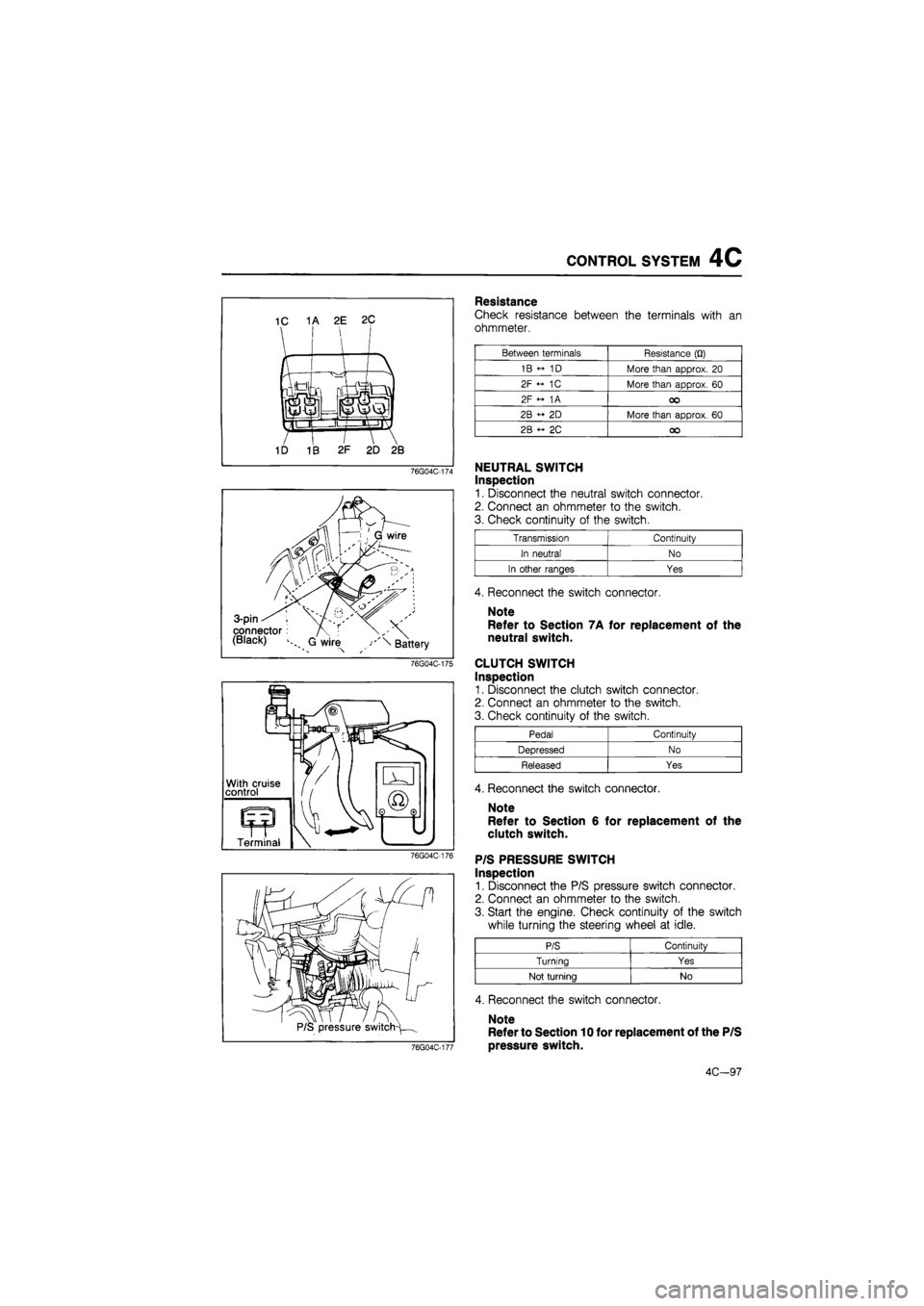
CONTROL SYSTEM 4C
Resistance
Check resistance between the terminals with an
ohmmeter.
Between terminals Resistance (Q)
1B « 1D More than approx. 20
2F <- 1C More than approx. 60
2F « 1A oo
2B « 2D More than approx. 60
2B ~ 2C oo
NEUTRAL SWITCH
Inspection
1. Disconnect the neutral switch connector.
2. Connect an ohmmeter to the switch.
3. Check continuity of the switch.
Transmission Continuity
In neutral No
In other ranges Yes
4. Reconnect the switch connector.
Note
Refer to Section 7A for replacement of the
neutral switch.
CLUTCH SWITCH
Inspection
1. Disconnect the clutch switch connector.
2. Connect an ohmmeter to the switch.
3. Check continuity of the switch.
Pedal Continuity
Depressed No
Released Yes
4. Reconnect the switch connector.
Note
Refer to Section 6 for replacement of the
clutch switch.
P/S PRESSURE SWITCH
Inspection
1. Disconnect the P/S pressure switch connector.
2. Connect an ohmmeter to the switch.
3. Start the engine. Check continuity of the switch
while turning the steering wheel at idle.
P/S Continuity
Turning Yes
Not turning No
4. Reconnect the switch connector.
Note
Refer to Section 10 for replacement of the P/S
pressure switch.
4C-97
Page 819 of 1865

REMOVAL 7A
RF-N and RF-CX
1. Battery
2. Air cleaner assembly
3. Vacuum hose
4. Intercooler pipe and hose
(RF-CX)
5. Electric fan
6. Speedometer cable
7. Ground(s)
8. Clutch release cylinder
9. Pressure and return hoses
(power steering)
10. Starter
11. Wheel
12. Splash shield
13. Stabilizer
14. Joint shaft
15. Extension bar
16. Control rod
76G07A-011
17. Exhaust pipe bracket
18. Water pipe
19. Gusset plate (rear)
20. Gusset plate (front)
21. Under cover
22. Engine mount No.4
23. Engine mount No.2
24. Crossmember
7 A—13
Page 1256 of 1865

TROUBLESHOOTING GUIDE 9
TROUBLESHOOTING GUIDE
Problem Possible Cause Remedy Page
Faulty operation of
driveshaft
Broken ball joint
Broken tri-pod joint
Worn or seized joint
Replace
Replace
Replace
9—31
9—35
9—31, 35
Abnormal noise from driveshaft Insufficient grease in joint or spline Excessive backlash on spline Worn joint
Add or replace
Replace
Replace
9—33, 36 9—31, 35 9-31, 35
Steering wheel pulls. (Steering wheel pulls toward either right or left side)
Bent steering linkage
Fatigued coil spring
Lower arm bushing worn or damaged Bent knuckle Bent lower arm or loose mounting Incorrect toe-in adjustment Improper tire air pressure Unevenly worn tires (left and right tires) Brake dragging
Refer to Section 10 Refer to Section 13 Refer to Section 13 Replace Refer to Section 13 Refer to Section 13 Refer to Section 12 Refer to Section 12 Refer to Section 11
9-11
Unstable handling Bent steering linkage
Joint in steering system worn or damaged
Incorrect steering pinion preload adjustment Fatigued coil spring
Faulty shock absorber(s) Lower arm bushing worn or damaged Incorrect toe-in adjustment (front or rear) Improper tire air pressure Wheel(s) bent or unbalanced
Refer to Section 10 Refer to Section 10 Refer to Section 10 Refer to Section 13 Refer to Section 13 Refer to Section 13 Refer to Section 13 Refer to Section 12 Refer to Section 12
—
Excessive steering wheel play Faulty front wheel bearing Incorrect steering pinion preload adjustment Rack and pinion worn Joint in steering system worn or damaged Lower arm bushing worn or damaged
Adjust Refer to Section 10 Refer to Section 10 Refer to Section 10 Refer to Section 13
9-11
Tires excessively worn or worn un-evenly
Incorrect toe-in adjustment Improper tire air pressure Unbalanced wheel(s)
Refer to Section 13 Refer to Section 12 Refer to Section 12 —
Abnormal noise
from axle
Faulty wheel bearing Replace 9-11,18,23
86U09X-006
9—7
Page 1289 of 1865

10
STEERING SYSTEM
OUTLINE 10— 2
STRUCTURAL VIEW 10— 2 SPECIFICATIONS 10— 6
TROUBLESHOOTING GUIDE 10— 7
MANUAL STEERING 10— 7
POWER STEERING 10— 8
4WS 10— 9
ON-VEHICLE MAINTENANCE 10— 10
STEERING WHEEL PLAY 10— 10
LOOSENESS OR PLAY OF THE
STEERING WHEEL 10— 10
STEERING WHEEL EFFORT 10— 10
POWER STEERING FLUID LEVEL 1 fl-11
LOOSE OR DAMAGED
OIL PUMP BELT IC— 12
REAR STEERING GEAR OIL 10— 12 LEAKAGE OF POWER STEERING
FLUID 10— 13
INSPECTION AND ADJUSTMENT. 10— 15
BLEEDING OF POWER STEERING
SYSTEM 10— 15
POWER STEERING PRESSURE ... 10— 16
TIE-ROD END BOOTS 10— 18
REMOVAL AND INSTALLATION .. 10— 18
STEERING WHEEL AND COLUMN 10— 21
STRUCTURAL VIEW 10— 21
REMOVAL 10— 22
DISASSEMBLY AND ASSEMBLY.. 10— 24
INSPECTION 10— 25
INSTALLATION 1 fl-27
STEERING GEAR AND LINKAGE .. IC— 28
STRUCTURAL VIEW 10— 28
REMOVAL 10— 29
INSTALLATION 10— 30
4-WHEEL STEERING GEAR AND
LINKAGE 10— 31
STRUCTURAL VIEW 10— 31 4WS PERFORMANCE INSPECTION 10— 32
ADJUSTMENT OF STEERING
ANGLE TRASFER SHAFT 10— 35
REMOVAL AND INSTALLATION .. 10— 37
INSPECTION 10— 44
MANUAL STEERING 10— 48
DISASSEMBLY 10— 48
INSPECTION 10— 51
ASSEMBLY 10— 52
ENGINE SPEED SENSING POWER
STEERING 10— 58
DISASSEMBLY 10— 58
INSPECTION 10— 62
ASSEMBLY 10— 64
ELECTRONICALLY-CONTROLLED
POWER STEERING 10— 75
DISASSEMBLY 10— 75
INSPECTION 10— 78
ASSEMBLY 10— 79
OIL PUMP 10— 83
REMOVAL AND INSTALLATION .. 10— 83
ELECTRICAL COMPONENTS OF
ELECTRONICALLY-CONTROLLED
POWER STEERING 10— 87
CIRCUIT DIAGRAM 10— 87
TROUBLESHOOTING GUIDE 10— 87
TROUBLESHOOTING 10— 87
ELECTRICAL COMPONENTS OF
4 WHEEL STEERING 10— 94
CIRCUIT DIAGRAM 10— 94
TROUBLESHOOTING GUIDE 10— 95
TROUBLESHOOTING 10— 95
4WS WARNING LIGHT 10—102
SPEED SENSOR (IN METER) 10—103
SPEED SENSOR (AT TRANSAXLE) 10—103
REAR-TO-FRONT STEERING
RATIO SENSOR 10—103
OIL LEVEL SWITCH
(IN P/S RESERVOIR) 10—103
RELAY AND TIMER 10—104 76G10X-001