brake fluid MAZDA 626 1987 Owner's Manual
[x] Cancel search | Manufacturer: MAZDA, Model Year: 1987, Model line: 626, Model: MAZDA 626 1987Pages: 1865, PDF Size: 94.35 MB
Page 925 of 1865
TROUBLESHOOTING (G4A-HL) 7B
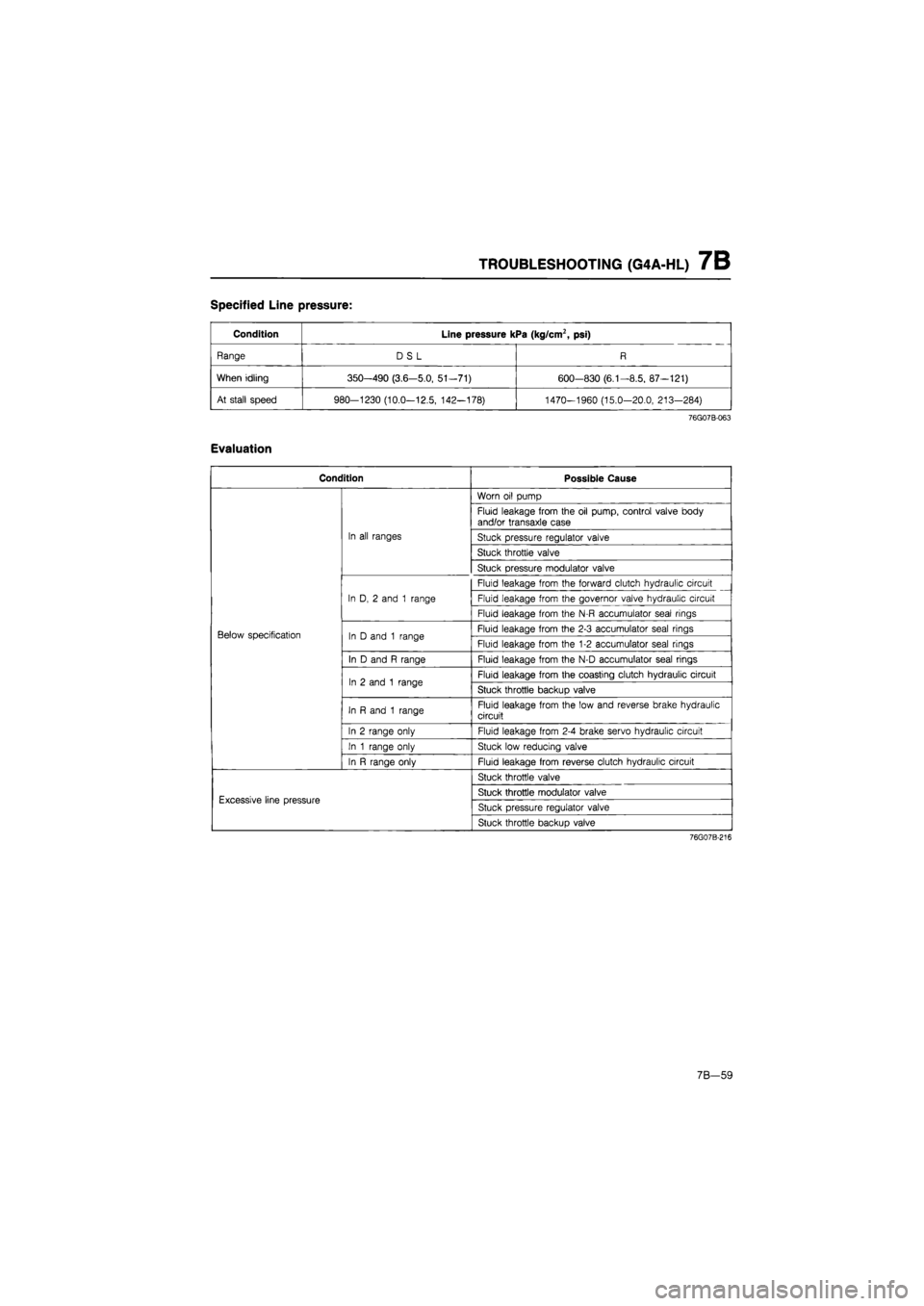
Specified Line pressure:
Condition Line pressure kPa (kg/cm2, psi)
Range DSL R
When idling 350-490 (3.6-5.0, 51-71) 600-830 (6.1-8.5, 87-121)
At stall speed 980-1230 (10.0—12.5, 142—178) 1470-1960 (15.0-20.0, 213-284)
76G07B-063
Evaluation
Condition Possible Cause
Below specification
In all ranges
Worn oil pump
Below specification
In all ranges
Fluid leakage from the oil pump, control valve body
and/or transaxle case
Below specification
In all ranges Stuck pressure regulator valve
Below specification
In all ranges
Stuck throttle valve
Below specification
In all ranges
Stuck pressure modulator valve
Below specification
In D, 2 and 1 range
Fluid leakage from the forward clutch hydraulic circuit
Below specification
In D, 2 and 1 range Fluid leakage from the governor valve hydraulic circuit
Below specification
In D, 2 and 1 range
Fluid leakage from the N-R accumulator seal rings
Below specification In D and 1 range Fluid leakage from the 2-3 accumulator seal rings Below specification In D and 1 range Fluid leakage from the 1-2 accumulator seal rings Below specification
In D and R range Fluid leakage from the N-D accumulator seal rings
Below specification
In 2 and 1 range Fluid leakage from the coasting clutch hydraulic circuit
Below specification
In 2 and 1 range Stuck throttle backup valve
Below specification
In R and 1 range Fluid leakage from the low and reverse brake hydraulic
circuit
Below specification
In 2 range only Fluid leakage from 2-4 brake servo hydraulic circuit
Below specification
In 1 range only Stuck low reducing valve
Below specification
In R range only Fluid leakage from reverse clutch hydraulic circuit
Excessive line pressure
Stuck throttle valve
Excessive line pressure Stuck throttle modulator valve Excessive line pressure Stuck pressure regulator valve Excessive line pressure
Stuck throttle backup valve
76G07B-216
7B—59
Page 932 of 1865

7B ELECTRICAL SYSTEM COMPONENTS
76G07B-073
7B-66
3. Remove the screw and move the inhibitor switch
so that the small hole is aligned with the screw hole.
4. Set the alignment by inserting a 2.0 mm (0.079
in) diameter pin through the holes.
5. Loosely tighten the switch mounting bolts, remove
the pin, and reinstall the screw.
6. Tighten the switch mounting bolts to specification.
Tightening torque:
8—11 N-m (80—110 cm-kg, 69—95 in-lb)
7. Recheck the continuity of the individual terminals.
WATER TEMPERATURE SWITCH
Inspection
1. Remove the water temperature switch.
2. Place the switch in water with a thermometer and
heat up the water gradually.
3. Check the continuity of the terminals. If necessary
replace the switch.
Connection guide
Water temperature Continuity
Below 65°C (149°F) Yes
Above 72°C (162°F) \ No
FLUID TEMPERATURE SWITCH (G4A-EL)
Inspection
1. Remove the fluid temperature switch.
2. Place the switch in oil with a thermometer as shown
and heat it up gradually.
3. Check the continuity of the terminals. If necessary
replace the switch.
Connection guide
Fluid temperature Continuity
Above 150°C (302°F) Yes
Below 143°C (289°F) No
BRAKE LIGHT SWITCH (G4A-EL)
Inspection of Terminal Voltage
1. Turn the ignition switch ON.
2. Check the voltage between terminal (WG) and
ground while depressing the brake pedal.
Terminal voltage I Brake pedal
Approx. 12V Depressed
Below 1,5V Released
3. If not correct, check continuity of the switch.
Page 936 of 1865

7B ELECTRICAL SYSTEM COMPONENTS
Terminal Connected to Voltage Condition
1J — — —
1K — — —
1L (Input) Idle switch Below 1.5V At idle 1L (Input) Idle switch Approx. 12V Other speeds
1M — — —
1N (Input) Brake light switch Approx. 12V Brake pedal depressed 1N (Input) Brake light switch Below 1.5V Brake pedal released
10 (Input) Throttle sensor
Approx. 5V Ignition switch ON 10 (Input) Throttle sensor Below 1,5V Ignition switch OFF
1P (Input)
Throttle sensor
Approx. 0.5—4.3V Throttle valve fully closed to fully open
1Q (Input) Vehicle speed sensor
Approx. 4.5V During driving
1Q (Input) Vehicle speed sensor Approx. 4.5V or below 1.5V Vehicle stopped
1R (Ground) Throttle sensor Below 1,5V —
1S (Input) Pulse generator Approx. 12V Engine running 1S (Input) Pulse generator Below 1,5V Engine stopped
1S (Ground) Pluse generator Below 1.5V —
2A (Battery power) Battery Approx. 12V Ignition switch ON 2A (Battery power) Battery Below 1,5V Ignition switch OFF
2B (Ground) Body ground Below 1,5V —
2C (Memory power) Battery Approx. 12V —
2D (Ground) Body ground Below 1,5V —
2E (Output) 1-2 shift solenoid valve Approx. 12V
Refer to page 7B—26 of solenoid valve
operation table
2E (Output) 1-2 shift solenoid valve Below 1.5V Refer to page 7B—26 of solenoid valve
operation table
2F (Output) 2-3 shift solenoid valve Approx. 12V
Refer to page 7B—26 of solenoid valve
operation table
2F (Output) 2-3 shift solenoid valve Below 1,5V
Refer to page 7B—26 of solenoid valve
operation table
2G — — —
2H (Output) 3-4 shift solenoid valve Approx. 12V Refer to page 7B—26 of solenoid valve operation table 2H (Output) 3-4 shift solenoid valve Below 1.5V
Refer to page 7B—26 of solenoid valve operation table
21 — — —
2J (Output) Lock-up solenoid valve Approx. 12V Lock-up 2J (Output) Lock-up solenoid valve Below 1,5V Other
2K (Output) Hold indicator Below 1,5V Hold mode 2K (Output) Hold indicator Approx. 12V Other modes
2L (Output) Mode indicator Approx. 12V Hold mode 2L (Output) Mode indicator Below 1,5V Power or economy mode
2M (Output) EC-AT Tester
(malfunction code)
Approx. 12V Normal
2M (Output) EC-AT Tester
(malfunction code) Below 1,5V If malfunction present 2M (Output) EC-AT Tester
(malfunction code) Code signal Self-diagnosis check connector grounded
2N — — —
20 (Input) Fluid temperature switch Below 1,5V Above 150°C (302°F) 20 (Input) Fluid temperature switch Approx. 10—12V Below 143°C (289°F)
2P (Input) EC-AT check connect Approx. 12V —
76G07B-084
7B-70
Page 937 of 1865
ON-VEHICLE MAINTENANCE 7B
ON-VEHICLE MAINTENANCE
AUTOMATIC TRANSAXLE FLUID (ATF)
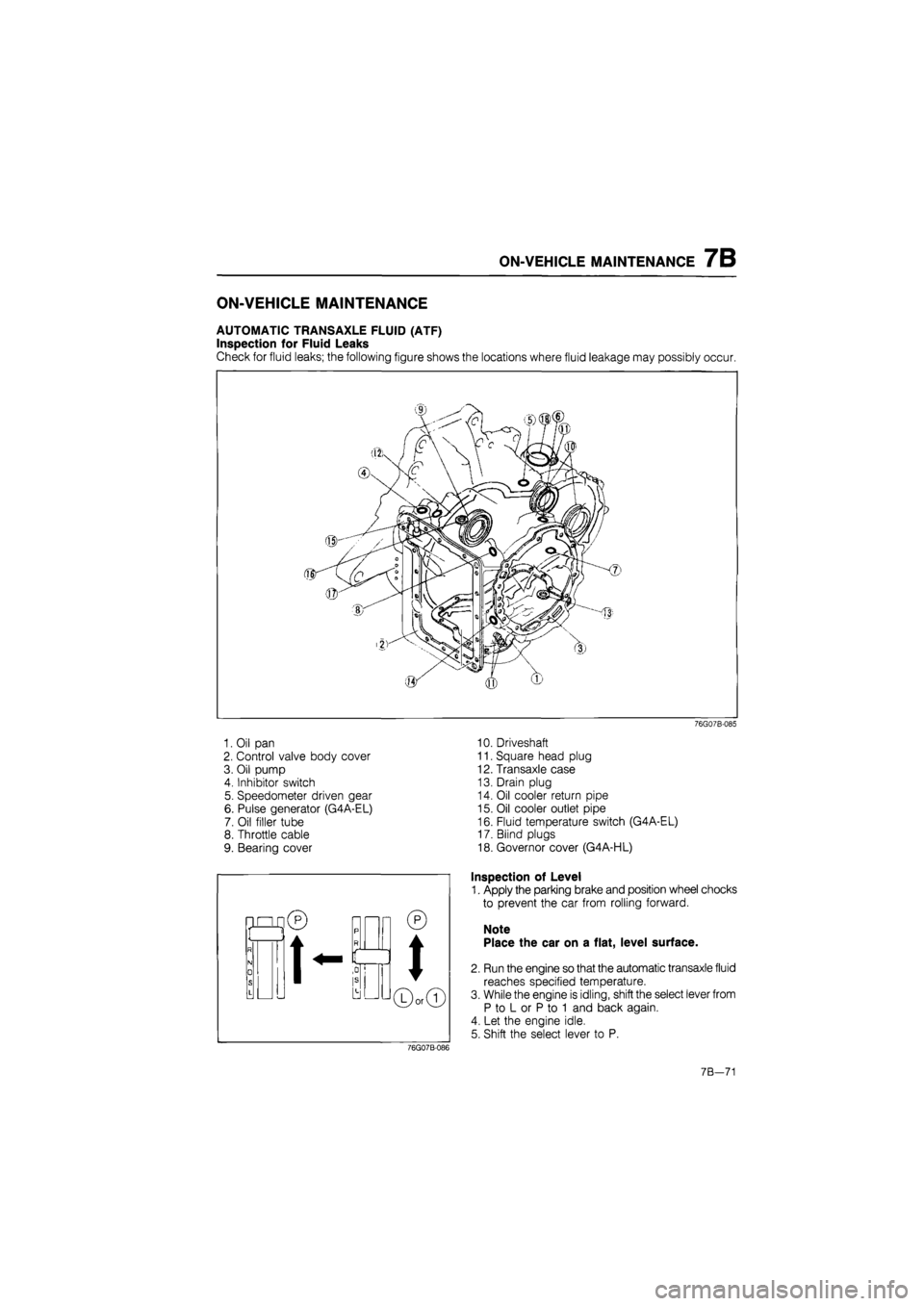
Inspection for Fluid Leaks
Check for fluid leaks; the following figure shows the locations where fluid leakage may possibly occur.
1. Oil pan
2. Control valve body cover
3. Oil pump
4. Inhibitor switch
5. Speedometer driven gear
6. Pulse generator (G4A-EL)
7. Oil filler tube
8. Throttle cable
9. Bearing cover
76G07B-085
10. Driveshaft
11. Square head plug
12. Transaxle case
13. Drain plug
14. Oil cooler return pipe
15. Oil cooler outlet pipe
16. Fluid temperature switch (G4A-EL)
17. Blind plugs
18. Governor cover (G4A-HL)
Inspection of Level
1. Apply the parking brake and position wheel chocks
to prevent the car from rolling forward.
Note
Place the car on a flat, level surface.
2. Run the engine so that the automatic transaxle fluid
reaches specified temperature.
3. While the engine is idling, shift the select lever from
P to L or P to 1 and back again.
4. Let the engine idle.
5. Shift the select lever to P.
76G07B-086
7B—71
Page 946 of 1865
7B ON-VEHICLE MAINTENANCE
86U07B-091
76G07B-101
76G07B-102
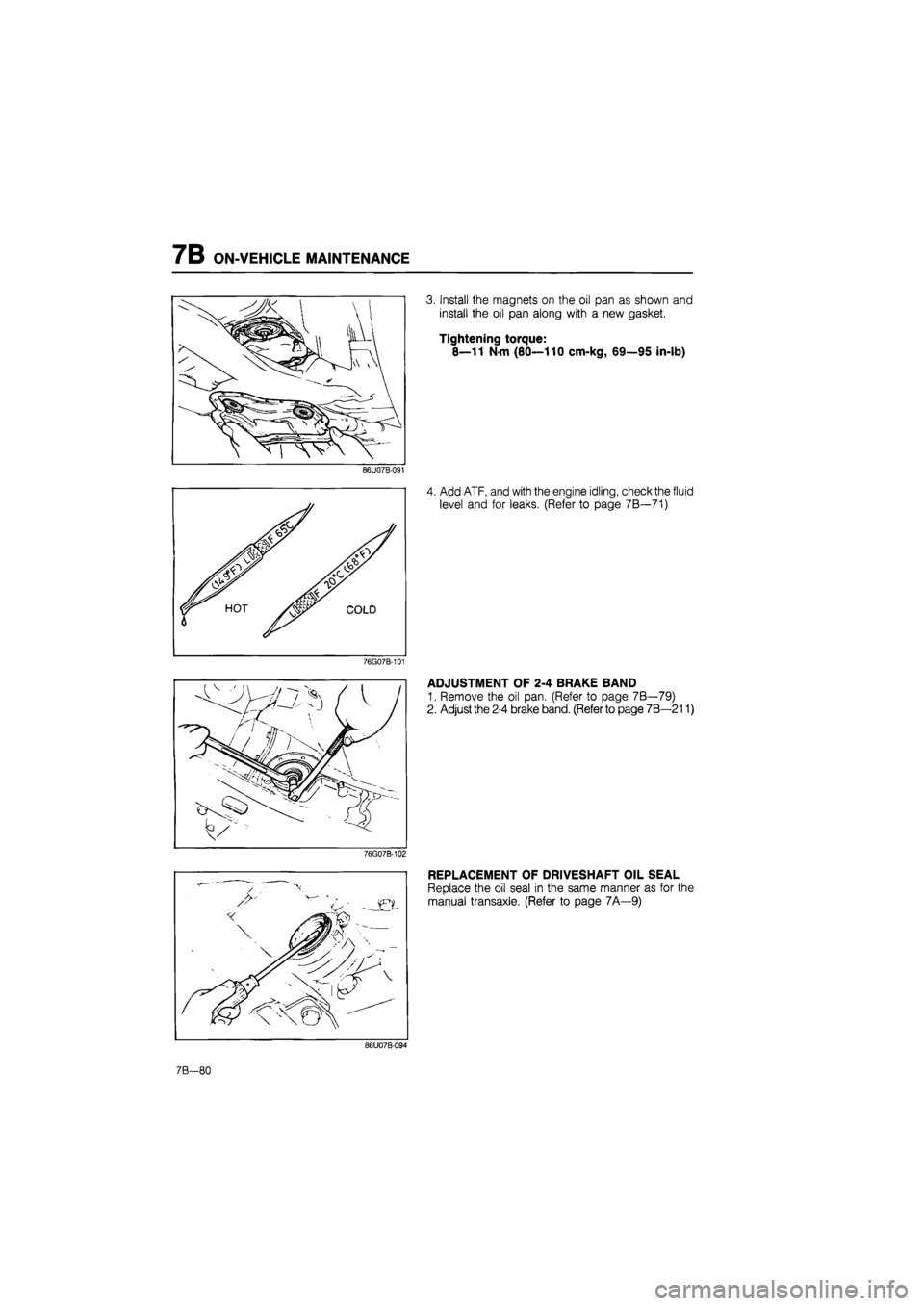
3. Install the magnets on the oil pan as shown and
install the oil pan along with a new gasket.
Tightening torque:
8—11 Nm (80—110 cm-kg, 69—95 in-lb)
4. Add ATF, and with the engine idling, check the fluid
level and for leaks. (Refer to page 7B—71)
ADJUSTMENT OF 2-4 BRAKE BAND
1. Remove the oil pan. (Refer to page 7B—79)
2. Adjust the 2-4 brake band. (Refer to page 7B—211)
REPLACEMENT OF DRIVESHAFT OIL SEAL
Replace the oil seal in the same manner as for the
manual transaxle. (Refer to page 7A—9)
86U07B-094
7B-80
Page 967 of 1865

DISASSEMBLY 7B
86U07B-156
86U07B-157
86U07B-158
(4) Remove the low and reverse brake piston by
applying compressed air through the fluid
passage.
4. Remove the manual shaft and manual plate.
(1) Remove the plug, washer, spring, and detent
ball.
(2) Remove the bracket.
(3) Loosen the nut and pull the manual shaft out.
(4) Remove the nut, washer, spacer, and manual
plate.
86U07B-159
7B—101
Page 1002 of 1865

7B INSPECTION AND REPAIR
CONTROL VALVE BODY (G4A-EL)
Precaution
(1) Pay close attention when handling the control valve because it consists of the most precise and
delicate parts of the transaxle.
(2) Neatly arrange the removed parts in order to avoid mixing up similar parts.
(3) Disassemble the control valve assembly and thoroughly clean it when the clutch and/or brake bands
are burned, and/or when the automatic transaxle fluid is degenerated.
Components I
Front and premain control body
6—8 N-m (66—80 cm-kg, 57—69 in-lb)
1.1-2 Solenoid valve
2. 2-3 Solenoid valve
3. Bolts
4. Front control body
5. Front/premain front gasket
6. Premain separator
7. Front/premain rear gasket
8. Premain control body
9. Premain/main front gasket
10. Main separator
76G07B-141
7B—136
Page 1021 of 1865

INSPECTION AND REPAIR 7B
CONTROL VALVE BODY (G4A-HL)
Precaution
(1) Pay close attention when handling the control valve because it consists df the most precise and
delicate parts of the transaxle.
(2) Neatly arrange the removed parts in order to avoid mixing up similar parts.
(3) Disassemble the control valve assembly and thoroughly clean it when the clutch and/or brake bands
are burned, and/or when the automatic transaxle fluid is degenerated.
Components I
Front and premain control body
6—8 Nm ® (66—80 cm-kg, 57—69 In-lb)
1. Lock-up solenoid valve
2. Front control body
3. Front/premain front gasket
4. Premain separator
5. Front/premain rear gasket
6. Premain control body
7. Premain/main front gasket
8. Main separator
76G07B-163
7B—155
Page 1053 of 1865

ASSEMBLY 7B
ASSEMBLY
PRECAUTION
(1) The automatic transaxle consists of high-precision-finished parts, necessitating careful inspection
before assembly because even a small nick could cause fluid leakage or affect performance.
(2) Clean out oil holes and oil passages with compressed air, and check that there are no obstructions.
(3) Before assembly, apply ATF to each O-ring, seal ring, rotating part, and friction part.
(4) If the brake band or drive plates are replaced with new ones, first soak them in ATF for at least
2 hours before installing.
(5) Each seal gasket and O-ring must be replaced with a new one.
(6) Be sure to install all thrust bearings and races in the correct direction and position.
ASSEMBLY—STEP 1
Torque Specifications
83U07B-365
11—14 N-m (110—140 cm-kg, 95—122 in-lb) 6-9 N-m (60—90 cm-kg, 52—78 in-lb)
8—11 N-m (80—110 cm-kg, 69—95 In-lb)
19—26 N m (1.9—2.6 m-kg, 14—19 ft-lb)
83U07B-366
7B—187
Page 1067 of 1865

ASSEMBLY 7B
86U07B-390
76G07B-182
86U07B-392
O-rings
Sealant
Output shell
(5) Install the SST in the case.
(6) Compress the spring and retainer assembly.
(7) Install the snap ring with snap ring pliers.
(8) Remove the SST.
6. Check the low and reverse brake piston operation.
(1) Pour in ATF so that the low and reverse brake
piston is fully submerged.
(2) Check that no bubbles come from between the
piston and seals when applying compressed
air through the fluid passage. (Refer to page
7B—204)
Caution
The compressed air must be under 392 kPa
(4.0 kg/cm2, 57 psi) and not applied for over
3 seconds.
7. Install the output shell to the output gear, and in-
stall the bearing race onto the output shell.
Bearing race outer diameter.
72.0 mm (2.83 in)
8. Apply a thin coat of silicon sealant to the contact
surfaces of the converter housing and transaxle
case.
9. Install the O-rings.
10. Install the transaxle case to the converter housing.
Tightening torque:
37—52
N
m (3.8—5.3 m-kg, 27—38 ft-lb)
86U07B-393
7B—201