brake fluid MAZDA 626 1987 Repair Manual
[x] Cancel search | Manufacturer: MAZDA, Model Year: 1987, Model line: 626, Model: MAZDA 626 1987Pages: 1865, PDF Size: 94.35 MB
Page 1402 of 1865

1 1 BRAKE HYDRAULIC LINE
Procedure
1. Jack up the vehicle and support it with safety
stands.
2. Fill the reservoir with brake fluid. Be sure that it is
at least half full at all times during the air bleeding
process.
Caution
a) Be careful not to spill brake fluid onto a
painted surface.
b)Use only the specified brake fluid. Do not
mix it with any other type.
3. Remove the bleeder cap; then connect one end
of a transparent vinyl tube to the bleeder screw and
place the other end in a receptacle.
4. Have an assistant depress the brake pedal a few
times, and then hold it in the depressed position.
5. Loosen the bleeder screw, drain out the fluid, and
retighten the bleeder.
Note
a) The two people should stay in voice con-
tact with each other.
b) Be sure the pedal remains depressed until
the bleeder is tightened.
86U11X-014
6. Repeat steps 4 and 5 until no more air is dis-
charged.
7. Tighten the bleeder screw, and check that there
is no fluid leakage.
Bleeder screw tightening torque:
6—9 N-m (60—90 cm-kg, 52—78 in-lb)
Caution
Be sure to clean away any spilled fluid with
rags.
8. Add brake fluid to the reservoir up to the speci-
fied level.
11—10
Page 1406 of 1865

1 1 MASTER CYLINDER
MASTER CYLINDER
REMOVAL
Remove in the sequence shown in the figure, referring to removal note for specially marked parts.
Caution
Brake fluid will damage painted surfaces. If it does get on a painted surface, wipe it off
immediately.
1. Fluid level sensor connector
2. Brake pipe
76G11X-011
3. Master cylinder
4. Clutch pipe holder (LHD MTX ABS)
Removal Note
Brake pipe (Flare nut type)
1. Place rags under the master cylinder to prevent
brake fluid from dripping on painted surfaces.
2. Disconnect the brake pipe from the master cylin-
der with the SST.
76G11X-012
11—14
Page 1407 of 1865

MASTER CYLINDER 1 1
DISASSEMBLY AND ASSEMBLY (EXCEPT RHD DOHC TURBO)
1. Pour out the brake fluid.
2. Disassemble in the sequence shown in the figure, referring to disassembly note for specially marked
parts.
3. Assemble in the reverse order of disassembly, referring to assembly note for specially marked parts.
Caution a) Do not to allow any foreign material into the master cylinder during repairs. b)Do not scratch the inside of the cylinder or the outer surface of the piston.
Note
The primary piston assembly is not repairable. Replace it as an assembly.
76G11X-013
1. Fluid level sensor 5. Secondary piston assembly
2. Stopper screw and O-ring 6. Reservoir assembly
3. Snap ring 7. Bushing
4. Primary piston assembly
11—15
Page 1408 of 1865

1 1 MASTER CYLINDER
86U11X-029
Disassembly Note
Stopper screw
Remove the stopper screw with a Phillips screwdriver.
Note
Prepare a suitable container for the brake fluid
to drain into.
Snap ring
Push the primary piston with a Phillips screwdriver
and remove or install the snap ring with snap-ring
pliers.
Secondary Piston Assembly
Remove the secondary piston assembly by gradual-
ly blowing compressed air into the cylinder.
Caution
Use a rag to catch the secondary piston as-
sembly when applying compressed air.
Assembly Note
Application of brake fluid
Before assembly, apply brake fluid to the following
parts:
1. Cylinder inner surface
2. Piston
3. Piston cups
4. Bushings
rQ^W 1 ..-V ti V^LUl I
IMCHI tWW&EZBlQ
at itt^
86U11X030
11—16
Page 1410 of 1865

1 1 MASTER CYLINDER
DISASSEMBLY AND ASSEMBLY (RHD DOHC TURBO)
1. Pour out the brake fluid.
2. Disassemble in the sequence shown in the figure, referring to disassembly note for specially marked
parts.
3. Assemble in the reverse order of disassembly, referring to assembly note for specially marked parts.
Caution a) Do not to allow any foreign material into the master cylinder during repairs. b)Do not scratch the inside of the cylinder or the outer surface of the piston.
Note
The primary piston assembly is not repairable. Replace it as an assembly.
76G11X-014
1. Stopper screw and O-ring
2. Snap ring
3. Spacer
4. Piston guide assembly
5. Primary piston assembly
6. Stopper
7. O-ring
8. Piston guide cup
9. Piston guide
10. Secondary piston assembly
11. Stopper
12. Piston cup
13. Washer
14. Secondary piston
15. Spring
16. O-ring
17. Screw
18. Bushing
19. Reservoir assembly
20. Fluid level sensor
21. Master cylinder body
11—18
Page 1411 of 1865
MASTER CYLINDER 1 1
76G11X-015
76G11X-016
76G11X-017
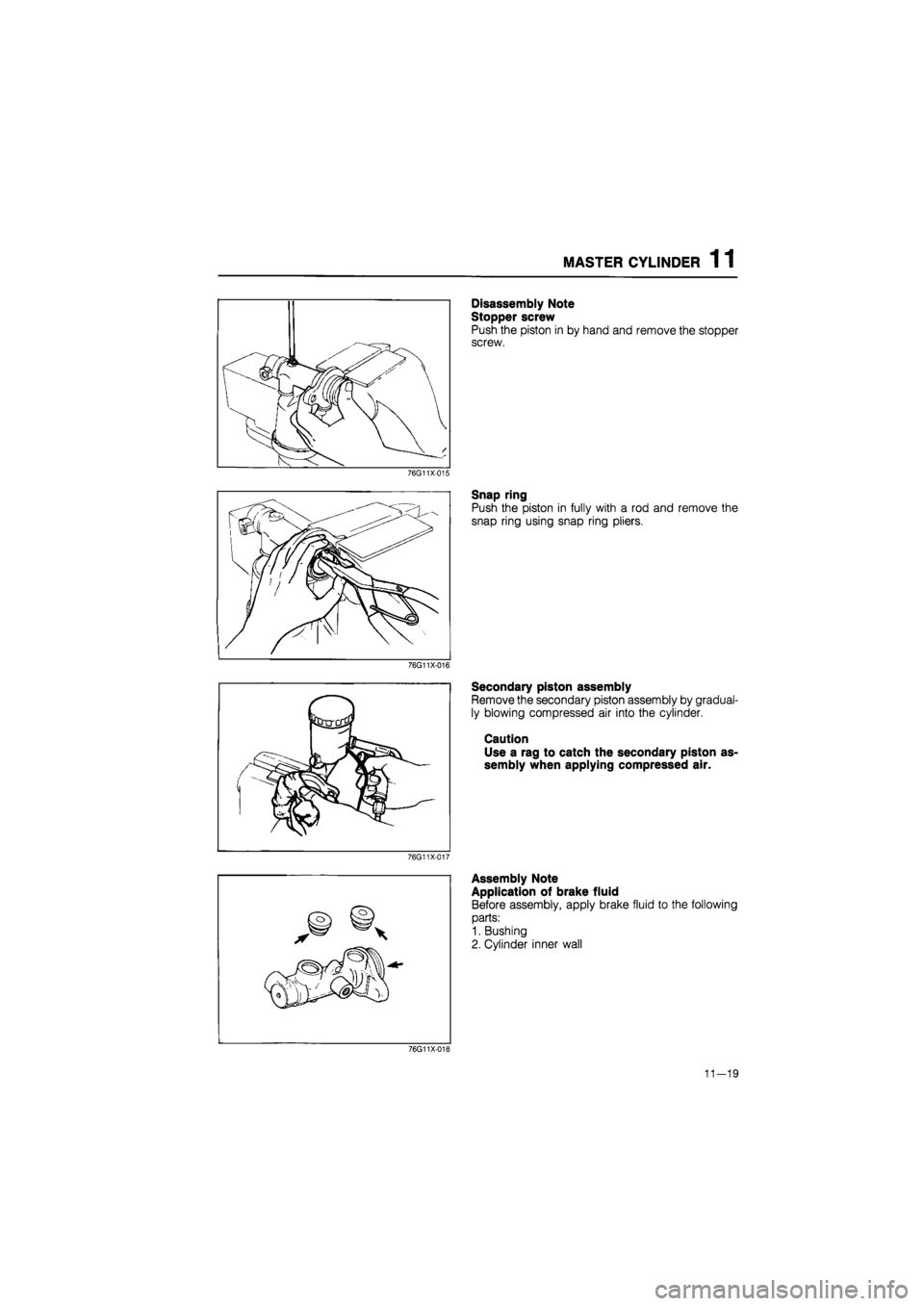
Disassembly Note
Stopper screw
Push the piston in by hand and remove the stopper
screw.
Snap ring
Push the piston in fully with a rod and remove the
snap ring using snap ring pliers.
Secondary piston assembly
Remove the secondary piston assembly by gradual-
ly blowing compressed air into the cylinder.
Caution
Use a rag to catch the secondary piston as-
sembly when applying compressed air.
Assembly Note
Application of brake fluid
Before assembly, apply brake fluid to the following
parts:
1. Bushing
2. Cylinder inner wall
76G11X-018
11—19
Page 1412 of 1865
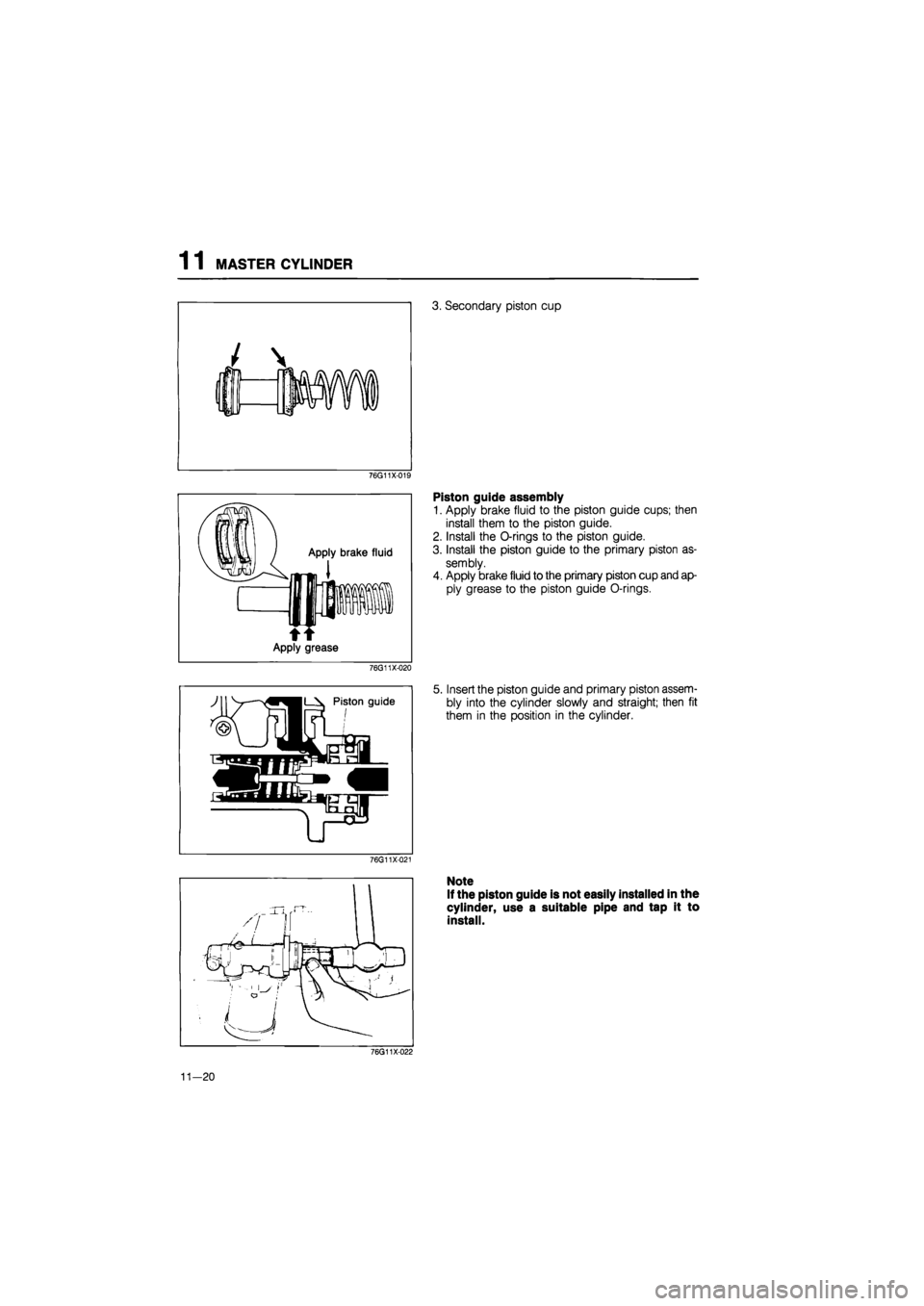
1 1 MASTER CYLINDER
3. Secondary piston cup
76G11X-019
Apply brake fluid
t Apply grease
76G11X-020
Piston guide assembly
1. Apply brake fluid to the piston guide cups; then
install them to the piston guide.
2. Install the O-rings to the piston guide.
3. Install the piston guide to the primary piston as-
sembly.
4. Apply brake fluid to the primary piston cup and ap-
ply grease to the piston guide O-rings.
5. Insert the piston guide and primary piston assem-
bly into the cylinder slowly and straight; then fit
them in the position in the cylinder.
76G11X-021
Note
If the piston guide is not easily installed in the
cylinder, use a suitable pipe and tap it to
install.
76G11X-022
11—20
Page 1420 of 1865

1 1 POWER BRAKE UNIT
a) Checking for vacuum loss
Unloaded condition
1. Start the engine.
2. Stop the engine when the vacuum gauge reading
reaches 500 mmHg (19.7 inHg).
3. Observe the vacuum gauge for 15 seconds.
If
the
gauge shows 475—500 mmHg (18.7—19.7
inHg), the unit is operating.
76G11X-065
Loaded condition
1. Start the engine.
2. Depress the brake pedal with a force of 196 N (20
kg, 44 lb).
3. With the brake pedal depressed, stop the engine
when the vacuum gauge reading reaches 500
mmHg (19.7 inHg).
4. Observe the vacuum gauge for 15 seconds.
If
the
gauge shows 475—500 mmHg (18.7—19.7
inHg), the unit is operating.
76G11X066
b) Checking for hydraulic pressure
1. If with the engine stopped (when vacuum is 0
mmHg) the relation between pedal force and fluid
pressure is within specification, the unit is operating.
Pedal force Fluid pressure
196 N (20 kg, 44 lb) | 1,177 kPa (12 kg/cm2, 171 psi) mia
76G11X-067
2. Start the engine. Depress the brake pedal when
the vacuum reaches 500 mmHg (19.7 inHg).
If the relation between pedal force and fluid pres-
sure is within specification, the unit is operating.
Pedal force Fluid pressure
196 N (20 kg, 44 lb) 7,063 kPa (72 kg/cm2, 1,024 psi) min.
76G11X068
11-28
Page 1421 of 1865
POWER BRAKE UNIT 1 1
76G11X-034
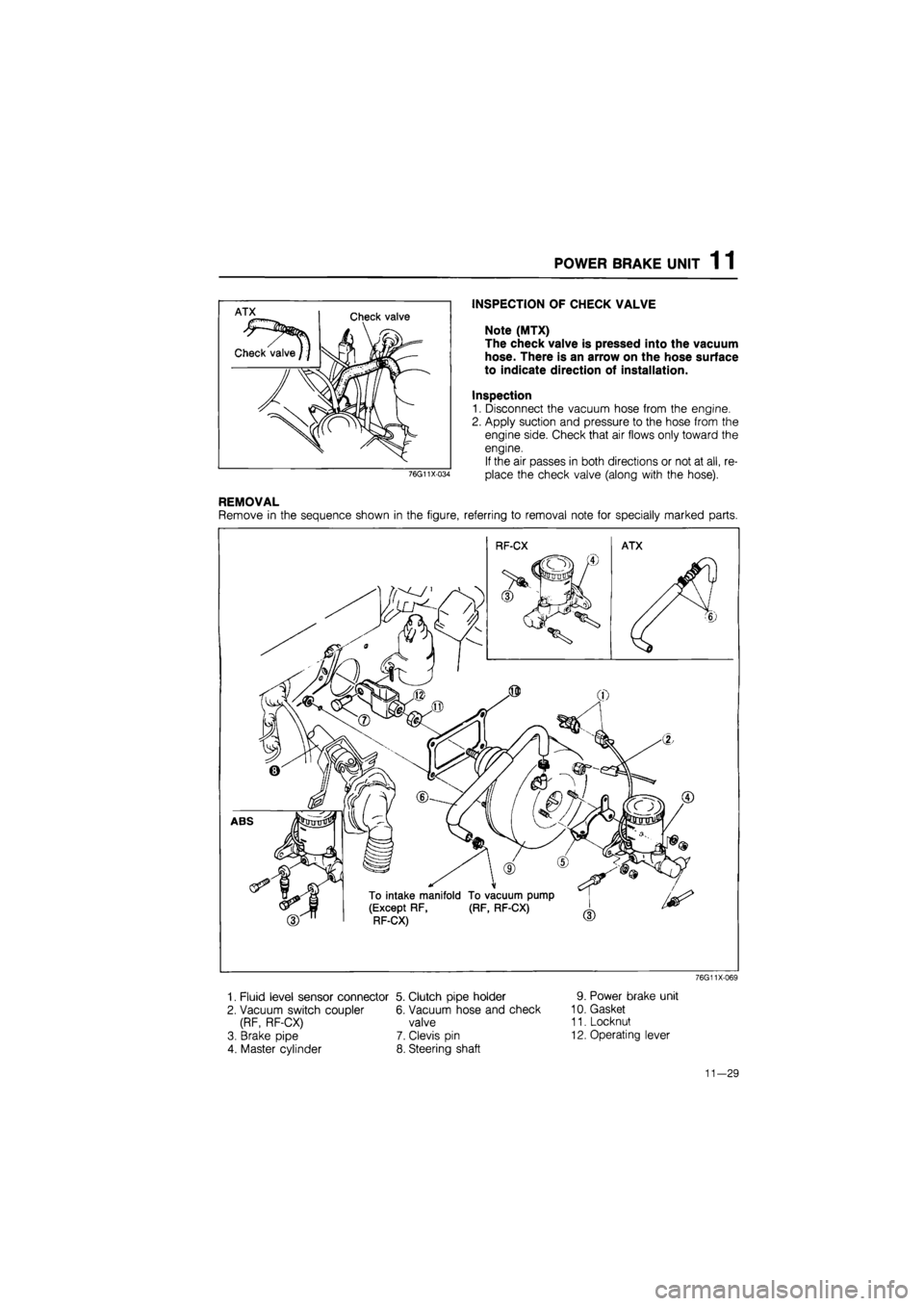
INSPECTION OF CHECK VALVE
Note (MTX)
The check valve is pressed into the vacuum
hose. There is an arrow on the hose surface
to indicate direction of installation.
Inspection
1. Disconnect the vacuum hose from the engine.
2. Apply suction and pressure to the hose from the
engine side. Check that air flows only toward the
engine.
If the air passes in both directions or not at all, re-
place the check valve (along with the hose).
REMOVAL
Remove in the sequence shown in the figure, referring to removal note for specially marked parts.
1. Fluid level sensor connector
2. Vacuum switch coupler
(RF, RF-CX)
3. Brake pipe
4. Master cylinder
5. Clutch pipe holder
6. Vacuum hose and check
valve
7. Clevis pin
8. Steering shaft
76G11X-069
9. Power brake unit
10. Gasket
11. Locknut
12. Operating lever
11-29
Page 1424 of 1865

1 1 POWER BRAKE UNIT
Diaphragm
Install the diaphragm to the power piston and plate.
Caution
Check that the diaphragm is well seated in the
groove.
86U11X-052
Rear shell assembly
Assemble the rear shell assembly; carefully guiding
the tube end of the power piston through the dust
seal of the rear shell.
86U11X-053
Front shell and rear shells
Press down the rear shell assembly, and rotate it
clockwise until the matching marks are aligned.
Caution
Fit suitable nuts to two studs of the rear shell
and tighten them to mount the wrench.
76G11X-072
INSPECTION
1. Inspect all rubber parts. Wipe free of fluid and care-
fully inspect all rubber parts for cuts, nicks, and
other damage.
2. Check the power piston for cracks,distortion, chip-
ping, and damaged seats.
3. Inspect the reaction disc rubber for deterioration.
4. Check that the seats of the valve rod and plunger
are smooth and free of nicks and dents.
5. Inspect the front and rear shells for scratches,
scores, pits, dents, and other damage.
6. Check the diaphragm for cuts and other damage.
11—32