brake light MAZDA 626 1987 Owner's Manual
[x] Cancel search | Manufacturer: MAZDA, Model Year: 1987, Model line: 626, Model: MAZDA 626 1987Pages: 1865, PDF Size: 94.35 MB
Page 933 of 1865

ELECTRICAL SYSTEM COMPONENTS 7B
Inspection of Continuity
1. Disconnect the brake light switch connector.
2. Check for continuity between the terminals while
depressing the brake pedal.
79G07C-114
76G07B-076
KICK-DOWN SWITCH (G4A-HL)
Inspection of Terminal Voltage
1. Turn the ignition switch ON.
2. Check the voltage at terminal (V) with a voltmeter.
Depressing stroke Terminal voltage
7/8-8/8 (Full) Approx. 12V
0-7/8 Below 1,5V
3. If not correct, check the wiring harness, switch, or
adjust the switch position.
Inspection of Continuty
1. Disconnect the kick-down switch connector.
2. Check for continuity of the switch with an
ohmmeter.
Switch Continuity
Pushed Yes
Released No
3. If not correct, replace the kick-down switch.
76G07B-077
Adjustment
1. Loosen the kick-down switch locknuts.
2. Depress the accelerator pedal fully.
3. Turn the switch until the threaded case touches the
stopper.
4. Turn the switch counterclockwise by one half revo-
lution.
5. Secure the switch with the locknut.
76G07B-078
7B—67
Page 936 of 1865

7B ELECTRICAL SYSTEM COMPONENTS
Terminal Connected to Voltage Condition
1J — — —
1K — — —
1L (Input) Idle switch Below 1.5V At idle 1L (Input) Idle switch Approx. 12V Other speeds
1M — — —
1N (Input) Brake light switch Approx. 12V Brake pedal depressed 1N (Input) Brake light switch Below 1.5V Brake pedal released
10 (Input) Throttle sensor
Approx. 5V Ignition switch ON 10 (Input) Throttle sensor Below 1,5V Ignition switch OFF
1P (Input)
Throttle sensor
Approx. 0.5—4.3V Throttle valve fully closed to fully open
1Q (Input) Vehicle speed sensor
Approx. 4.5V During driving
1Q (Input) Vehicle speed sensor Approx. 4.5V or below 1.5V Vehicle stopped
1R (Ground) Throttle sensor Below 1,5V —
1S (Input) Pulse generator Approx. 12V Engine running 1S (Input) Pulse generator Below 1,5V Engine stopped
1S (Ground) Pluse generator Below 1.5V —
2A (Battery power) Battery Approx. 12V Ignition switch ON 2A (Battery power) Battery Below 1,5V Ignition switch OFF
2B (Ground) Body ground Below 1,5V —
2C (Memory power) Battery Approx. 12V —
2D (Ground) Body ground Below 1,5V —
2E (Output) 1-2 shift solenoid valve Approx. 12V
Refer to page 7B—26 of solenoid valve
operation table
2E (Output) 1-2 shift solenoid valve Below 1.5V Refer to page 7B—26 of solenoid valve
operation table
2F (Output) 2-3 shift solenoid valve Approx. 12V
Refer to page 7B—26 of solenoid valve
operation table
2F (Output) 2-3 shift solenoid valve Below 1,5V
Refer to page 7B—26 of solenoid valve
operation table
2G — — —
2H (Output) 3-4 shift solenoid valve Approx. 12V Refer to page 7B—26 of solenoid valve operation table 2H (Output) 3-4 shift solenoid valve Below 1.5V
Refer to page 7B—26 of solenoid valve operation table
21 — — —
2J (Output) Lock-up solenoid valve Approx. 12V Lock-up 2J (Output) Lock-up solenoid valve Below 1,5V Other
2K (Output) Hold indicator Below 1,5V Hold mode 2K (Output) Hold indicator Approx. 12V Other modes
2L (Output) Mode indicator Approx. 12V Hold mode 2L (Output) Mode indicator Below 1,5V Power or economy mode
2M (Output) EC-AT Tester
(malfunction code)
Approx. 12V Normal
2M (Output) EC-AT Tester
(malfunction code) Below 1,5V If malfunction present 2M (Output) EC-AT Tester
(malfunction code) Code signal Self-diagnosis check connector grounded
2N — — —
20 (Input) Fluid temperature switch Below 1,5V Above 150°C (302°F) 20 (Input) Fluid temperature switch Approx. 10—12V Below 143°C (289°F)
2P (Input) EC-AT check connect Approx. 12V —
76G07B-084
7B-70
Page 966 of 1865

7B DISASSEMBLY
1. Remove the bolts; then remove the transaxle case
by tapping lightly with a plastic hammer.
86U07B-153
3. Remove the low and reverse brake piston
(1) Install the SST.
(2) Compress the spring and retainer assembly.
86U07B-154
(3) Remove the snap ring with snap ring pliers;
then remove the spring and retainer assembly.
86U07B-155
7B—100
Page 1296 of 1865
1 0 TROUBLESHOOTING GUIDE
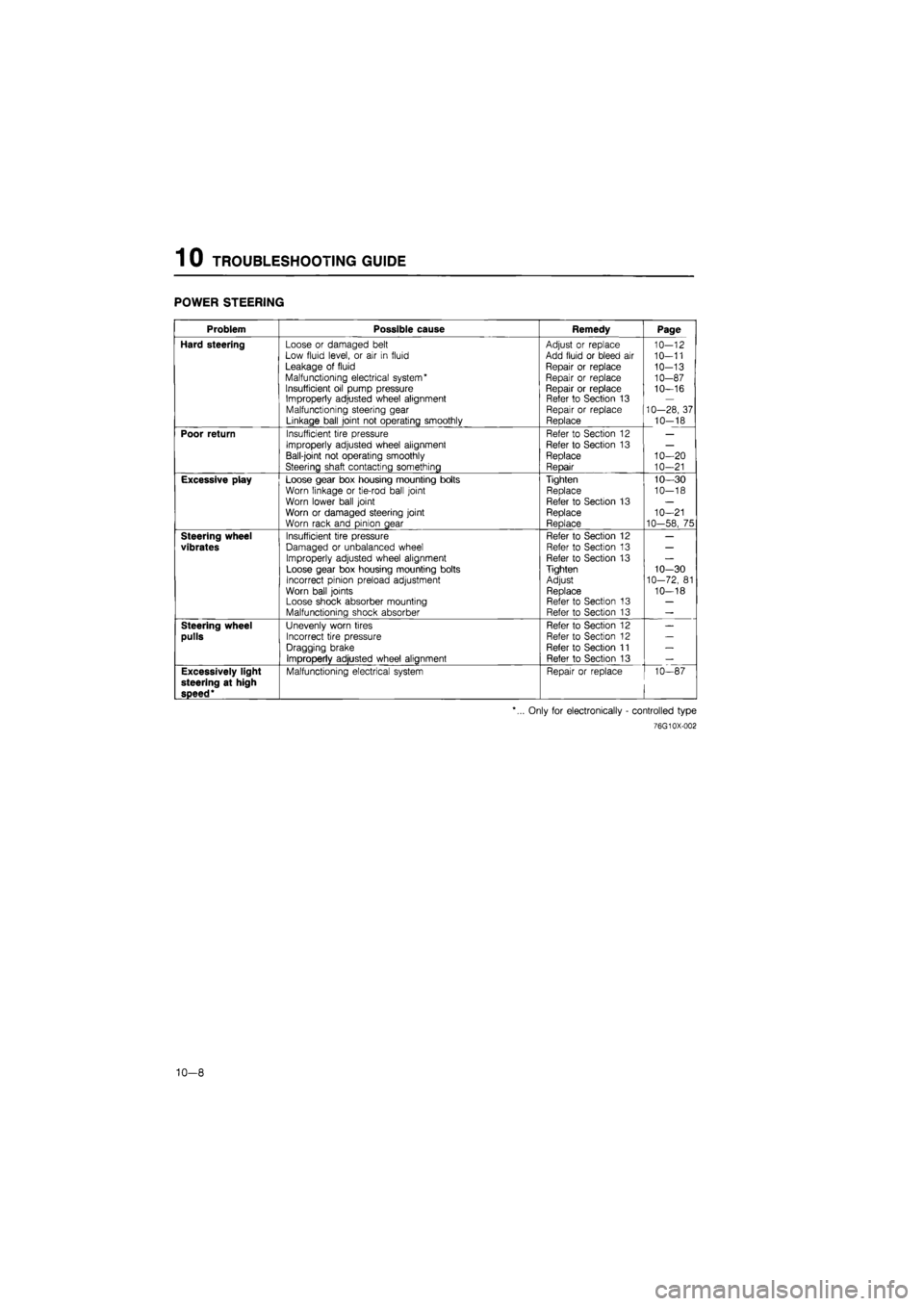
POWER STEERING
Problem Possible cause Remedy Page
Hard steering
Loose
or
damaged belt Low fluid level,
or air in
fluid Leakage
of
fluid
Malfunctioning electrical system* Insufficient oil pump pressure Improperly adjusted wheel alignment Malfunctioning steering gear Linkage ball joint not operating smoothly
Adjust
or
replace Add fluid
or
bleed
air
Repair
or
replace Repair
or
replace Repair
or
replace Refer
to
Section
13
Repair
or
replace Replace
10—12 10-11 10-13 10-87 10-16
10—28,
37
10-18
Poor return
Insufficient tire pressure
Improperly adjusted wheel alignment
Ball-joint not operating smoothly
Steering shaft contacting something
Refer
to
Section
12
Refer
to
Section
13
Replace
Repair
10-20 10-21
Excessive play
Loose gear box housing mounting bolts Worn linkage
or
tie-rod ball joint Worn lower ball joint Worn
or
damaged steering joint Worn rack and pinion gear
Tighten Replace
Refer
to
Section
13
Replace
Replace
10—30
10—18
10—21
10-58,
75
Steering wheel
vibrates
Insufficient tire pressure Damaged
or
unbalanced wheel Improperly adjusted wheel alignment Loose gear box housing mounting bolts Incorrect pinion preload adjustment Worn ball joints
Loose shock absorber mounting Malfunctioning shock absorber
Refer
to
Section
12
Refer
to
Section
13
Refer
to
Section
13
Tighten Adjust
Replace Refer
to
Section
13
Refer
to
Section
13
10-30 10-72,
81
10—18
Steering wheel
pulls
Unevenly worn tires
Incorrect tire pressure
Dragging brake
Improperly adjusted wheel alignment
Refer
to
Section
12
Refer
to
Section
12
Refer
to
Section
11
Refer
to
Section
13 —
Excessively light
steering at high
speed*
Malfunctioning electrical system Repair
or
replace 10-87
*... Only
for
electronically
-
controlled type
76G10X-002
10—8
Page 1393 of 1865

11
BRAKING SYSTEM
OUTLINE 11—2
STRUCTURAL VIEW 11—2
SPECIFICATIONS 11— 4
TROUBLESHOOTING GUIDE 11— 5
ON-VEHICLE MAINTENANCE 11—6
BRAKE FLUID LEVEL IN MASTER
CYLINDER RESERVOIR 11— 6
BRAKE HYDRAULIC LINE 11—6
STRUCTURAL VIEW 11—6
ON-VEHICLE INSPECTION OF
BRAKE LINES 11— 8
REMOVAL AND INSTALLATION OF
BRAKE LINES 11— 9
REPLACEMENT OF BRAKE
FLUID 11— 9
AIR BLEEDING 11— 9
BRAKE PEDAL 11—11
ON-VEHICLE INSPECTION 11—11
REMOVAL 11—12
INSPECTION 11—13
INSTALLATION 11—13
MASTER CYLINDER 11—14
REMOVAL 11—15
DISASSEMBLY AND ASSEMBLY
(EXCEPT RHD DOHC TURBO).... 11—14
INSPECTION 11—17
DISASSEMBLY AND ASSEMBLY
(RHD DOHC TURBO) 11—18
INSPECTION 11—21
INSTALLATION 11—22
POWER BRAKE UNIT 11—27
FUNCTION CHECK 11—27
INSPECTION OF CHECK VALVE... 11—29
REMOVAL 11—29
DISASSEMBLY AND ASSEMBLY... 11—30
INSPECTION 11—32
INSTALLATION 11—33
VACUUM PUMP 11—35
ON-VEHICLE INSPECTION 11—35
REMOVAL AND INSTALLATION.... 11—35
DISASSEMBLY AND ASSEMBLY... 11—36
INSPECTION 11—37
DUAL PROPORTIONING VALVE 11—38
FUNCTION CHECK 11—38
REMOVAL AND INSTALLATION.... 11—39
FRONT DISC BRAKE 11—40
SIMPLE INSPECTION OF DISC
PAD WEAR 11—40
REPLACEMENT OF DISC PAD 11—40
REMOVAL 11—42
DISASSEMBLY AND ASSEMBLY... 11—43
INSPECTION 11—44
INSTALLATION 11—45
REAR DISC BRAKE 11—46
SIMPLE INSPECTION OF DISC
PAD WEAR 11—46
REPLACEMENT OF DISC PAD 11—46
REMOVAL 11—49
DISASSEMBLY AND ASSEMBLY... 11—50
INSPECTION 11—54
INSTALLATION 11—55
REAR DRUM BRAKE 11—56
REMOVAL 11—56
DISASSEMBLY AND ASSEMBLY
OF WHEEL CYLINDER 11—59
INSPECTION 11—60
INSTALLATION 11—61
PARKING BRAKE 11—65
ON-VEHICLE MAINTENANCE 11—65
REMOVAL AND INSTALLATION
OF PARKING BRAKE LEVER 11—66
REMOVAL OF PARKING BRAKE
CABLE 11—68
INSTALLATION OF PARKING
BRAKE CABLE 11—69
ANTI-LOCK BRAKE SYSTEM
(ABS) 11—71
STRUCTURAL VIEW 11—71
WIRING DIAGRAM 11—72
TROUBLESHOOTING 11—73
DIAGNOSIS INDICATION MODE ... 11—86
MEMORY CANCEL 11—86
ABS WARNING LIGHT 11—87
RELAY BOX 11—87
WHEEL SPEED SENSOR 11—87
SENSOR ROTOR 11—90
HYDRAULIC UNIT FLUID 11—94
HYDRAULIC UNIT 11—94
CONTROL UNIT CIRCUIT 11—99
76G11X-001
Page 1403 of 1865

BRAKE PEDAL 1 1
Pedal height
"tt^
Pedal-to-floor clearance
76G11X-008
BRAKE PEDAL
ON-VEHICLE INSPECTION
Pedal Height
Inspection
Check that the distance from the center of the upper
surface of the pedal pad to the firewall is as specified.
LHD and RHD
Pedal height: 222 mm (8.74 +0-200 in)
Adjustment
1. Disconnect the stop light switch connector.
2. Loosen locknut B and turn switch A until it does
not contact the pedal.
3. Loosen locknut D and turn rod C to adjust the
height.
4. Adjust the pedal free play and tighten locknut D.
5. Turn the stop light switch until it contacts the ped-
al; then turn an additional 1/2 turn. Tighten lock-
nut B.
Locknut B tightening torque:
14—18 N m (1.4—1.8 m-kg, 10—13 ft-lb)
Locknut D tightening torque:
24—34 Nm (2.4—3.5 m-kg, 17—25 ft-lb)
Pedal Play
Inspection
1. Depress the pedal a few times to eliminate the
vacuum in the system.
2. Gently depress the pedal again by hand, and
check the free play. (Until the valve plunger con-
tacts the stopper plate = until the power piston be-
gins to move.)
Pedal play: 4—7 mm (0.16—0.28 in)
76G11X-099
Adjustment
Loosen the locknut D of the operating rod C; then
turn the rod to adjust the free play.
Locknut D tightening torque:
24—34 Nm (2.4—3.5 m-kg, 17—25 ft-lb)
86U11X-018
11—11
Page 1418 of 1865
1 1 MASTER CYLINDER
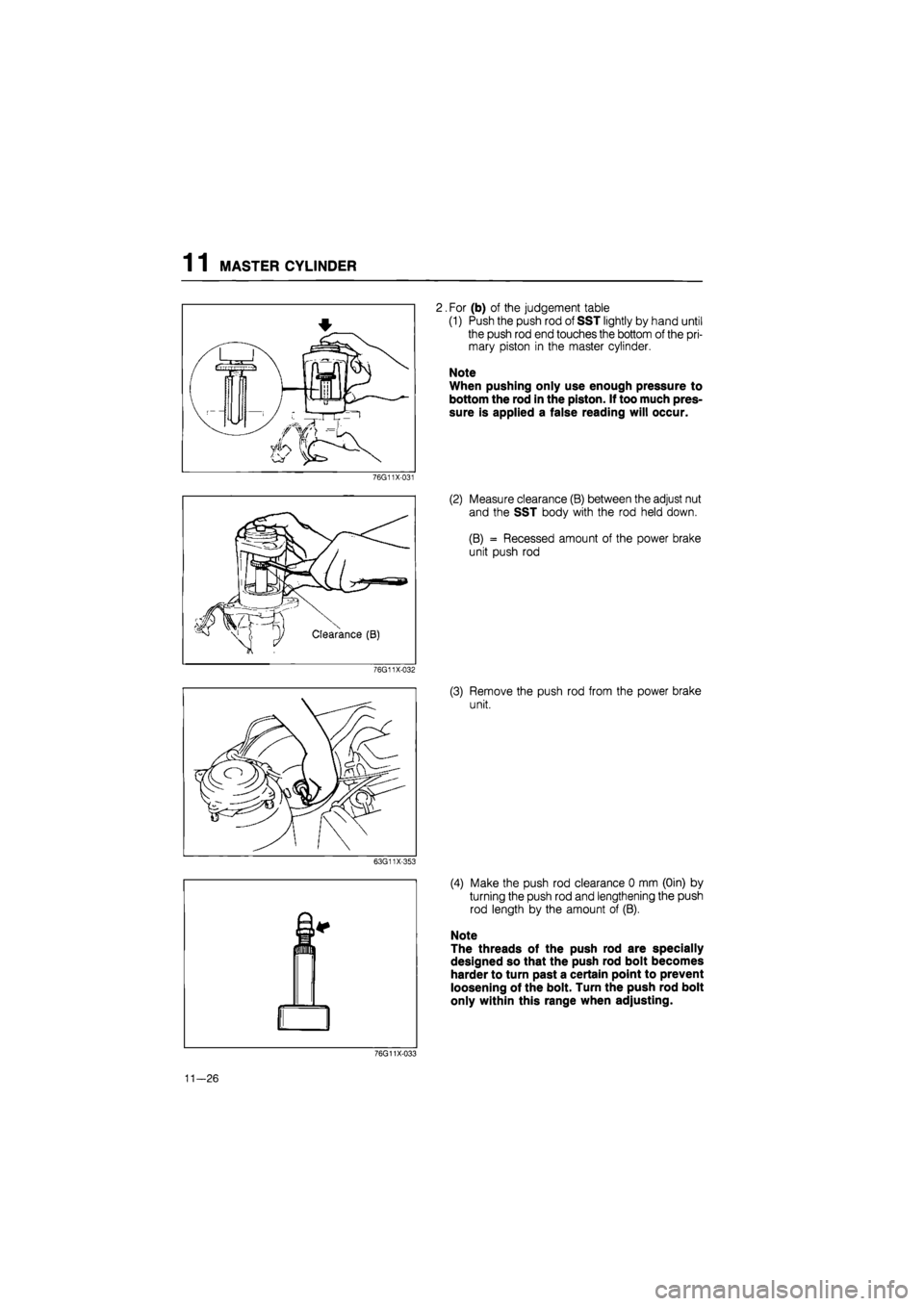
2. For (b) of the judgement table
(1) Push the push rod of SST lightly by hand until
the push rod end touches the bottom of the pri-
mary piston in the master cylinder.
Note
When pushing only use enough pressure to
bottom the rod in the piston. If too much pres-
sure is applied a false reading will occur.
76G11X-031
(2) Measure clearance (B) between the adjust nut
and the SST body with the rod held down.
(B) = Recessed amount of the power brake
unit push rod
76G11X-032
(3) Remove the push rod from the power brake
unit.
63G11X-353
(4) Make the push rod clearance 0 mm (Oin) by
turning the push rod and lengthening the push
rod length by the amount of (B).
Note
The threads of the push rod are specially
designed so that the push rod bolt becomes
harder to turn past a certain point to prevent
loosening of the bolt. Turn the push rod bolt
only within this range when adjusting.
76G11X-033
11—26
Page 1419 of 1865

POWER BRAKE UNIT 1 1
86U11X-038
0
o
X
\ V^ Third
Second
^ First
86U11X-039
O X
fiSy
V
86U11X-040
Pedal-depression Pre!tur!9au9e
force gauge
^Intake manifold
86U11X-041
POWER BRAKE UNIT
FUNCTION CHECK
Simple Method
First step
1. With the engine stopped, depress the pedal a few
times.
2. With the pedal depressed, start the engine
3. If immediately after the engine starts the pedal
moves down slightly, the unit is operating.
Second step
1. Start the engine.
2. Stop the engine after it has run for
1
or 2 minutes.
3. Depress the pedal with the usual force.
4.
If
the first pedal stroke is long and becomes short-
er with subsequent strokes, the unit is operating.
5. If a problem is found, inspect for damage of the
check valve or vacuum hose, and examine the in-
stallation condition. Repair if necessary, and inspect
it once again.
Third step
1. Start the engine.
2. Depress the pedal with the usual force.
3. Stop the engine with the pedal still depressed.
4. Hold the pedal down for about 30 seconds.
5. If the pedal height does not change, the unit is
operating.
6. If there is a problem, check for damage to the
check valve or vacuum hose, and check the con-
nection. Repair if necessary, and check once
again.
If the nature of the problem is still not clear after fol-
lowing the 3 steps above, follow the more detailed
check described in "Method using tester".
Method Using Tester
Connect a pressure gauge, vacuum gauge, and ped-
al depression force gauge as shown in the figure. Af-
ter bleeding the air from the pressure gauge, conduct
the test as described in the 3 steps below.
Note
Use commercially available gauges and ped-
al depression force gauge.
11—27
Page 1465 of 1865

ANTI-LOCK BRAKE SYSTEM (ABS) 1 1
TROUBLESHOOTING
Precaution
Conditions that are not malfunctions
1. It may happen that vibration is felt in the steering wheel, body, and/or brake pedal when the ABS
is functioning; such vibration is simply an indication that the system is functioning.
2. Sound of the pump motor operating, accumulator pressure being released, or the relay operating
may be heard from the engine compartment when the engine is started as the system is being auto-
matically checked.
3. The ABS pump motor may be automatically activated even though the ABS is not operating.
4. The ABS warning light may illuminate under any of the following conditions:
• When the vehicle is traveling on snow or ice with the parking brake activated or a brake dragging
at one wheel.
• When different-sized tires are used.
• When tires of different gripping performance are used.
• When (while the vehicle is jacked up or stuck) only the front wheels are spun for 20 seconds or more.
• When there is insufficient battery voltage.
Note
Under the above conditions, the warning light will not illuminate a second time when the
ignition is switched OFF then back ON, and there will be no memory entry to the control
unit of a problem.
Troubleshooting notes
The ABS is composed of electrical components, mechanical components (hydraulic unit), and the com-
ponents of the standard brake system.
Fundamentally, malfunction of the ABS electrical or mechanical components is judged by the self-
diagnosis function within the ABS control unit. And malfunctions are indicated by the warning light
in the instrument panel.
The location
of
a malfunction is indicated by the technician switching the system to the diagnosis-indication
mode.
The self-diagnosis and indication functions must be used when malfunctions of the ABS are being
diagnosed.
76G11X-091
11—73
Page 1466 of 1865

1 1 ANTI-LOCK BRAKE SYSTEM (ABS)
Troubleshooting Main Flow Chart
Check that the ABS warning light operates.
• Turn ignition switch OFF
to
ON, and check that ABS warning light illuminates constantly.
Flashing (Past failure)
OK
Check the ABS for failure.
• Start engine, and observe flashing
of
warning light.
Does not
illuminate
constantly
Warning light Possible cause
Does
not il-
luminate
at all
Refer
to
page 11—86.
ON
Alternator
L
ter-minal output Wiring harness (ALT-control unit) Control unit
OFF
1 sec
Alternator
L
ter-minal output Wiring harness (ALT-control unit) Control unit
ON
Relay box wiring harness (warning light-control unit) Control unit
OFF
1 sec
Relay box wiring harness (warning light-control unit) Control unit
No illumination
(Not diagnosed)
Illuminates constantly
(Present failure)
ABS is usually operating cor-rectly.
Consult table below when ABS failure
is
still suspected.
System Possible cause
ABS Brake light switch
Both rear wheel speed sensors
Control unit Proportioning
valve
in hy-
draulic unit
Other than Refer
to
ABS troubleshoot-ing guide
on
page 11—5.
Repair failures with flow
chart. (Refer to page
11—76.)
76G11X-054
11-74