towing MERCEDES-BENZ C-CLASS COUPE 2015 Service Manual
[x] Cancel search | Manufacturer: MERCEDES-BENZ, Model Year: 2015, Model line: C-CLASS COUPE, Model: MERCEDES-BENZ C-CLASS COUPE 2015Pages: 385, PDF Size: 13.12 MB
Page 352 of 385
Removin
gthe towin geye X
Loosen the towing ey eand unscrew it.
X Attach cover :to the bumpe rand press until
it engages.
X Pu tthe towing ey ebacki nto the vehicl etool
kit. Towin
gthe vehicle awa ywitht he rear
axl eraised
Whe ntowing your vehicl ewitht he rea raxle
raised ,itisimportant that yo uobserve the
safety instructions (Y page 347).
! Vehicles with automatic transmissio
nmust
not be towe dwitht he rea raxler aised .The
car/traile rcombination may otherwise
swerve or eve noverturn.
! The ignition mus
tbes witched off if yo uare
towing the vehicl ewitht he rea raxler aised.
Intervention by ESP ®
could otherwise dam-
ag et he brake system.
X Switch on the hazard warning lamps
(Y page 120).
X Move the front wheel stothe straight-ahead
position.
X If necessary, turn the key in the ignition lock
to position 0and remove the key from the
ignition lock.
X Whe nleaving the vehicle, take the key with
you. Towin
gthe vehicle with both axles on
the ground
Vehicles with automati ctransmission: the
automatic transmissio nautomaticall yshifts to
position Pwhen yo uopent he driver' sorfront-
passenger doo rorwheny ou remove the key
from the ignition lock. In order to ensure that the automatic transmissio nstay sinp osition N
when towing away the vehicle, yo umustd othe
following:
X Make sure that the vehicl eisstationary.
X Turn the key to position 2in the ignition lock. X
Depress the brake pedal and keep it
depressed.
X Shif tthe automatic transmissio ntoposition
N.
Vehicles with manual transmission: X Turn the key to position 2in the ignition lock.
X Depress the brake pedal and keep it
depressed.
X Depress the clutch pedal fully and shift to
neutral.
Vehicles with manual or automati ctrans-
mission:
X Leave the key in position 2in the ignition lock.
X Releas ethe brake pedal.
X Releas ethe electri cparking brake.
X Switch on the hazard warning lamps
(Y page 120).
In order to signal achange of direction when
towing the vehicl ewitht he hazard warning
lamps switched on, us ethe combination switch
as usual. In this case, only the turn signal sfor
the desire ddirection flash. Whe nyou reset the
combination switch, the hazard warning lamps
star tflashing again. Transporting the vehicle
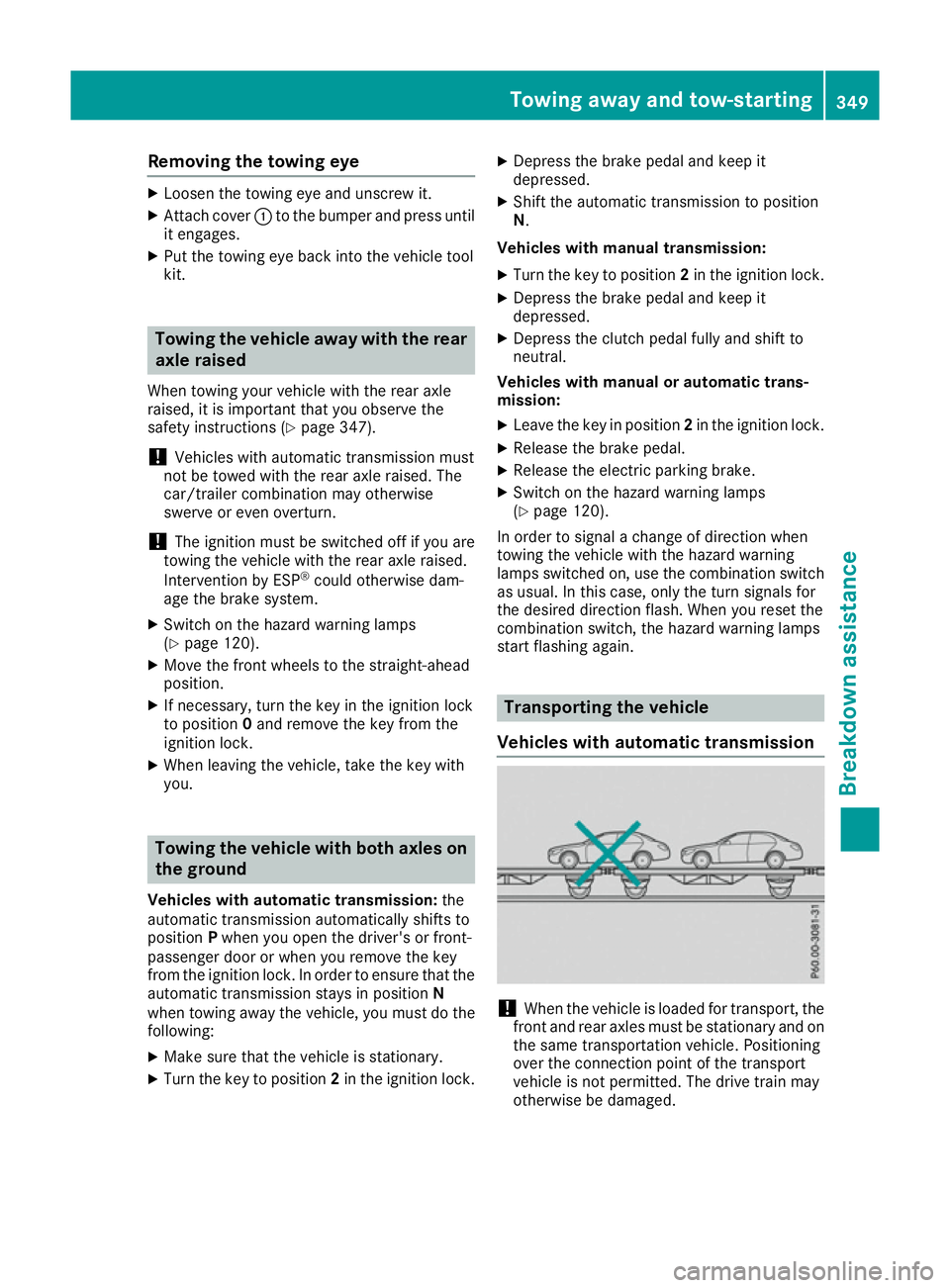
Vehicles with automati ctransmission !
Whe
nthe vehicl eisloaded for transport, the
front and rea raxles mus tbes tationary and on
the same transportation vehicle. Positioning
ove rthe connection point of the transport
vehicl eisnot permitted. The drive trai nmay
otherwise be damaged. Towin
gawayand tow-starting
349Breakdown assistance Z
Page 360 of 385
G
WARNING
If you fit unsuitabl eaccessories onto tyre
valves, the tyre valve smay be overloadeda nd
malfunction, which can caus etyre pressure
loss. Due to their design, retrofitted tyre pres-
sure monitors keep the tyre valve open. This
can alsor esult in tyre pressure loss. There is a
risk of accident.
Only screw standard valve caps or valve caps
specifically provided by Mercedes-Benz for
yourv ehicleonto the tyre valve. G
WARNING
If the tyre pressure drops repeatedly ,the
wheel, valve or tyre may be damaged. Tyre
pressure that is too low may result in atyre
blow-out. There is arisk of accident.
R Check the tyre for foreig nobjects.
R Check whethe rthe whee lislosing air or the
valve is leaking.
If you are unable to rectify the damage, con-
tact aqualified specialist workshop. H
Environmental note
Check the tyre pressure regularly, at least
every 14 days.
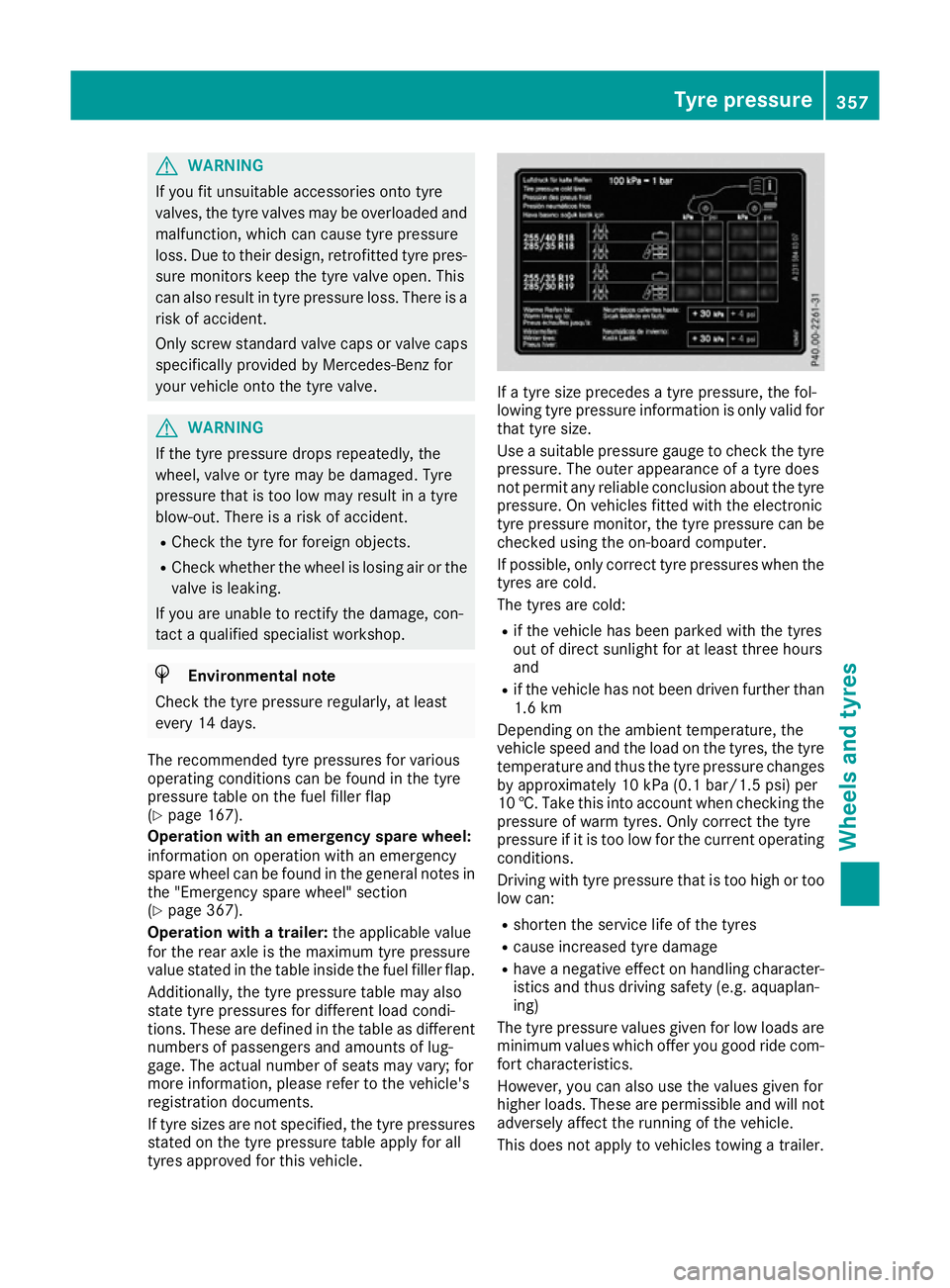
The recommende dtyre pressures for various
operating conditions can be found in the tyre
pressure table on the fuel filler flap
(Y page1 67).
Operation with an emergency spare wheel:
information on operation with an emergency
spar ewhee lcan be found in the genera lnotes in
the "Emergency spar ewheel" section
(Y page3 67).
Operation with atrailer: the applicable value
for the rear axle is the maximu mtyre pressure
valu estated in the table insid ethe fuel filler flap.
Additionally, the tyre pressure table may also
state tyre pressures for different loadc ondi-
tions. These are defined in the table as different numbers of passengers and amounts of lug-
gage .The actua lnumber of seats may vary ;for
more information, please refer to the vehicle's
registration documents.
If tyre sizes are not specified ,the tyre pressures
stated on the tyre pressure table apply for all
tyres approved for this vehicle. If
at yre size precedes atyre pressure, the fol-
lowing tyre pressure information is only vali dfor
that tyre size.
Use asuitable pressure gauge to check the tyre
pressure. The outer appearance of atyre does
not permi tany reliablec onclusion about the tyre
pressure. On vehicles fitted with the electronic
tyre pressure monitor, the tyre pressure can be checked using the on-board computer.
If possible,o nly correct tyre pressures when the
tyres are cold.
The tyres are cold:
R if the vehicl ehas been parked with the tyres
out of direct sunlight for at least three hours
and
R if the vehicl ehas not been drive nfurther than
1.6 km
Depending on the ambient temperature, the
vehicl espee dand the loadont he tyres, the tyre
temperature and thus the tyre pressure changes
by approximatel y10k Pa (0.1 bar/1.5 psi) per
10 †. Take this into account when checking the
pressure of warm tyres. Only correct the tyre
pressure if it is too low for the current operating conditions.
Driving with tyre pressure that is too high or too
low can:
R shorten the service life of the tyres
R caus eincreased tyre damage
R have anegative effect on handling character-
istics and thus driving safety (e.g. aquaplan-
ing)
The tyre pressure values given for low loads are minimu mvalues which offer you good ride com-
fort characteristics.
However, you can alsou se the values given for
higher loads. These are permissible and willn ot
adversely affect the running of the vehicle.
This does not apply to vehicles towing atrailer. Tyre pressure
357Wheels and tyres Z
Page 361 of 385
This improves the ride comfor
tofyour vehicle;
however, fuel consumption may increase
slightly. Tyrep
ressure loss warning system
General notes While the vehicle is in motion
,the tyre pressure
loss warning system monitors the set tyre pres-
sure using the rotational speed of the wheels.
This enables the system to detect significant
pressure loss in atyre. If the speed of rotation of
aw heel changes as aresult of aloss of pressure,
ac orresponding warning message will appear in
the multifunction display.
You can recognise the tyre pressure loss warn-
ing by the Run Flat Indicator active
Run Flat Indicator active
Restart with OK Restart with OK message which appears in
the Service
Service menu of the multifunction display.
Information on the message display can be
found in the "Restarting the tyre pressure loss
warning system" section (Y page 358).
Important safety notes The tyre pressure warning system does not warn
you of an incorrectly set tyre pressure. Observe the notes on the recommended tyre pressure
(Y page 356).
The tyre pressure loss warning does not replace the need to regularly check the tyre pressures.
An even loss of pressure on several tyres at the
same time cannot be detected by the tyre pres-
sure loss warning system.
The tyre pressure monitor is not able to warn
you of asudden loss of pressure, e.g. if the tyre
is penetrated by aforeign object .Inthe event of
as udden loss of pressure, bring the vehicle to a
halt by braking carefully. Avoid abrupt steering
manoeuvres.
The function of the tyre pressure loss warning
system is limited or delayed if:
R snow chains are fitted to your vehicle's tyres.
R road conditions are wintry.
R you are driving on sand or gravel.
R you adopt avery sporty driving style (corner-
ing at high speeds or driving with high rates of
acceleration).
R you are towing avery heavy or large trailer. R
you are driving with aheavy load (in the vehi-
cle or on the roof).
R
Restarting the tyrep ressureloss warn-
ing system Restart the tyre pressure loss warning system if
you have:
R changed the tyre pressure
R changed the wheels or tyres
R fitted new wheels or tyres
X Before restarting, make sure that the tyre
pressures are set properly on all four tyres for
the respective operating conditions. The rec-
ommended tyre pressures can be found in the
tyre pressure table on the fuel filler flap.
The tyre pressure loss warning system can
only give reliable warnings if you have set the correc ttyre pressure. If an incorrect tyre
pressure is set, these incorrect values will be
monitored.
X Observe the notes in the section on tyre pres-
sures (Y page 356).
X Make sure that the key is in position 2in the
ignition lock (Y page 145).
X Press òon the steerin gwheel to call up
the menu list.
X Press 9or: on the steerin gwheel to
select the Service Servicemenu.
X Confirm by pressing aon the steering
wheel.
X Select Tyre pressure
Tyre pressure with9 or:.
X Press ato confirm.
The Run
Run Flat
Flat Indicator
Indicator active
activeRestart
Restart
with OK
with OK message is shown in the multifunc-
tion display.
If you wish to confirm the restart: X Press the abutton.
The Tyre pressure now OK?
Tyre pressure now OK? message is
shown in the multifunction display.
X Select Yes
Yeswith 9 or:.
X Press ato confirm.
The Run Flat Indicator restarted
Run Flat Indicator restarted mes-
sage is shown in the multifunction display.
After ateach-in period, the tyre pressure loss
warning system will monitor the set tyre pres- sures of all four tyres. 358
Tyrep
ressureWheels and tyres
Page 381 of 385
Mercedes-AMG vehicles
Vehicle height, Mercedes
AMG
C63 1400 mm
Vehicle height, Mercedes
AMG
C63S 1402 mm
Wheelbase
2840 mm
Maximum roof load
75 kg
Maximum bootl
oad 100 kg
All other models
Vehicle length
4686 mm
Vehicle width including
exterio
rmirrors 2016 mm
Vehicle width excluding
exterio
rmirrors 1810 mm
Vehicle height
1405 mm
Wheelbase
2840 mm
Maximum roof load
75 kg
Maximum bootl
oad 100 kg
Trailer tow hitch
Mountin
gdimensions
! If you have
atrailer tow hitch retrofitted,
changes to the engine cooling system may be necessary ,depending on the vehicl etype.
If you have atrailer tow hitch retrofitted,
observe the anchorage points on the chassis.
The retrofitting of atrailer tow hitch is only per-
missible if atowing weight is specified in your
vehicl edocuments. If this is not the case, then
the vehicl eisnot approved for the towing of a
trailer.
For more information, please contact aqualified
specialist workshop.
Towing atrailer is not possible with all models.
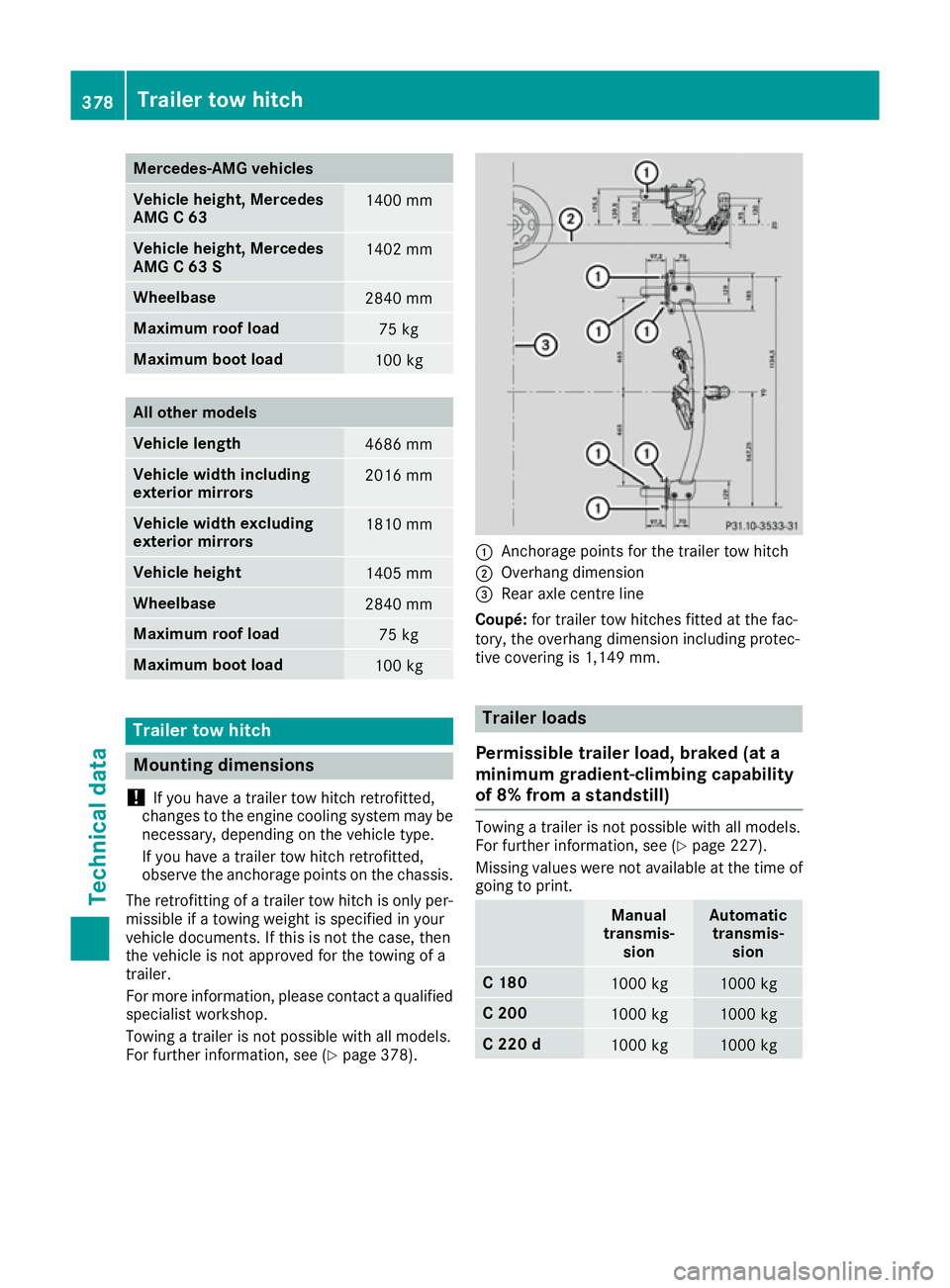
For further information, see (Y page378). :
Anchorage points for the trailer tow hitch
; Overhang dimension
= Reara xle centre line
Coupé: for trailer tow hitches fitted at the fac-
tory, the overhang dimension including protec-
tive covering is 1,149 mm. Trailer loads
Permissible trailer load, braked (at a
minimum gradient-climbing capability
of 8% from astandstill) Towing
atrailer is not possible with all models.
For further information, see (Y page227).
Missing values were not available at the time of
going to print. Manual
transmis- sion Automatic
transmis- sion C1
80 1000 kg 1000 kg
C2
00 1000 kg 1000 kg
C2
20 d 1000 kg 1000 kg378
Trailer tow hitchTechnical data
Page 382 of 385
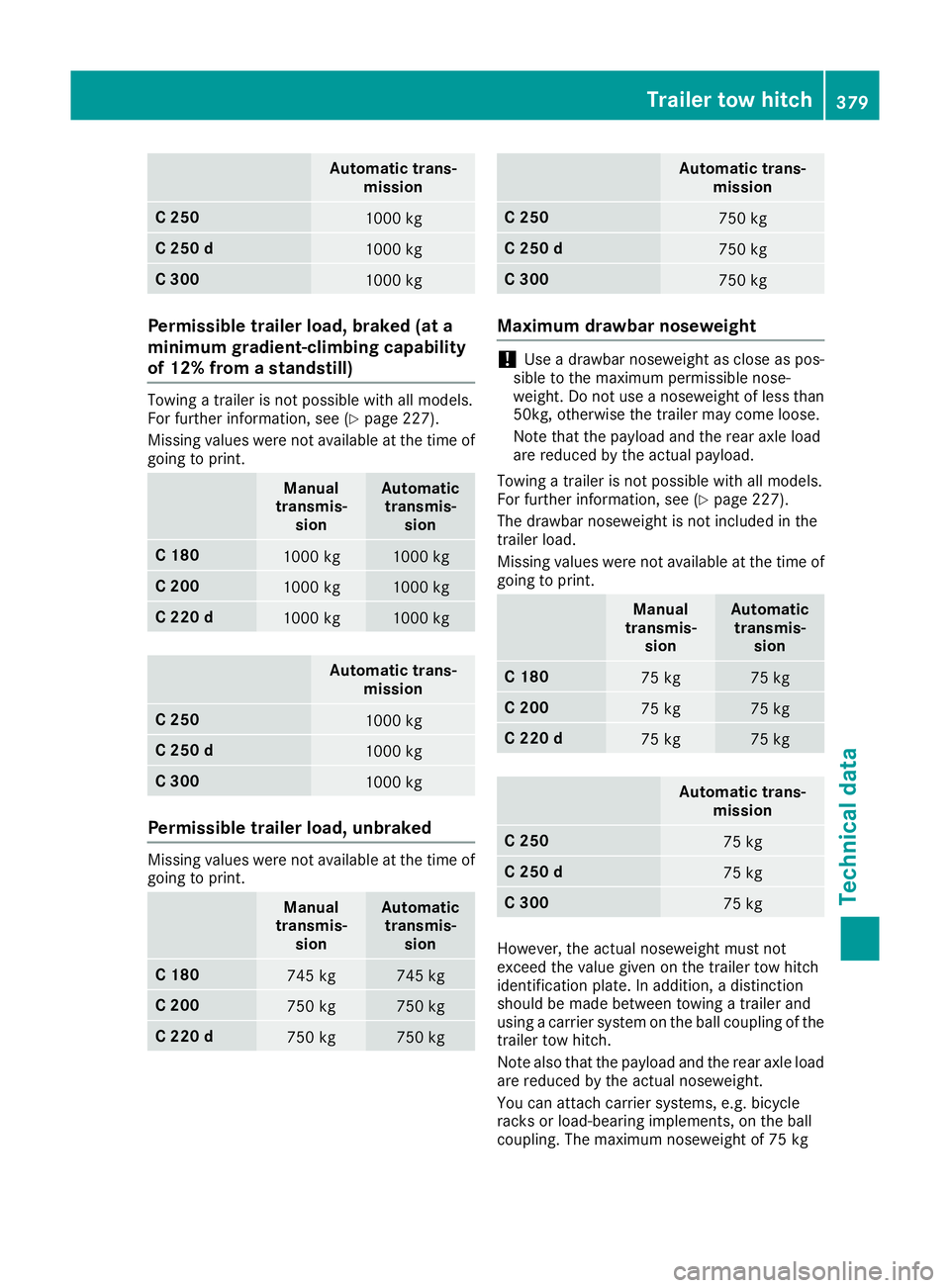
Automatic trans-
mission C2
50 1000 kg
C2
50 d 1000 kg
C3
00 1000 kg
Permissibl
etrailer load ,brake d(at a
minimum gradient-climbing capability
of 12% from astandstill) Towin
gatrailer is no tpossible wit hall models.
For further information, see (Y page 227).
Missing values were no tavailable at th etimeof
goin gtop rint. Manual
transmis- sion Automatic
transmis- sion C1
80 1000 kg 1000 kg
C2
00 1000 kg 1000 kg
C2
20 d 1000 kg 1000 kg
Automatic trans-
mission C2
50 1000 kg
C2
50 d 1000 kg
C3
00 1000 kg
Permissibl
etrailer load ,unbraked Missing values were no
tavailable at th etimeof
goin gtop rint. Manual
transmis- sion Automatic
transmis- sion C1
80 74
5kg 74
5kg C2
00 75
0kg 75
0kg C2
20 d 75
0kg 75
0kg Automatic trans-
mission C2
50 75
0kg C2
50 d 75
0kg C3
00 75
0kg Maximum drawba
rnoseweight !
Use
adrawbar noseweight as close as pos-
sible to th emaximum permissible nose-
weight. Do no tuse an oseweight of less than
50kg ,otherwise th etrailer may come loose.
Not ethatthe payload and th erear axle load
are reduced by th eactual payload.
Towin gatrailer is no tpossible wit hall models.
For further information, see (Y page 227).
The drawbar noseweight is no tincluded in the
trailer load.
Missing values were no tavailable at th etimeof
goin gtop rint. Manual
transmis- sion Automatic
transmis- sion C1
80 75 kg 75 kg
C2
00 75 kg 75 kg
C2
20 d 75 kg 75 kg
Automatic trans-
mission C2
50 75 kg
C2
50 d 75 kg
C3
00 75 kg
However, th
eactual noseweight must not
excee dthe value give nonthetrailer to whitch
identification plate. In addition ,adistinction
should be made between towing atrailer and
usin gac arrier system on th eball couplin gofthe
trailer to whitch.
Not ealso that th epayload and th erear axle load
are reduced by th eactual noseweight.
You can attach carrier systems ,e.g.b icycle
racks or load-bearing implements ,ontheball
coupling. The maximum noseweight of 75 kg Trailer tow hitch
379Technical data Z